After listing, Circle surged 7x. Is its fundamental analysis solid?

Original Title: "Circle In-Depth Analysis: Opportunities and Challenges of the Stablecoin Giant"
Original Authors: dddd, Biteye
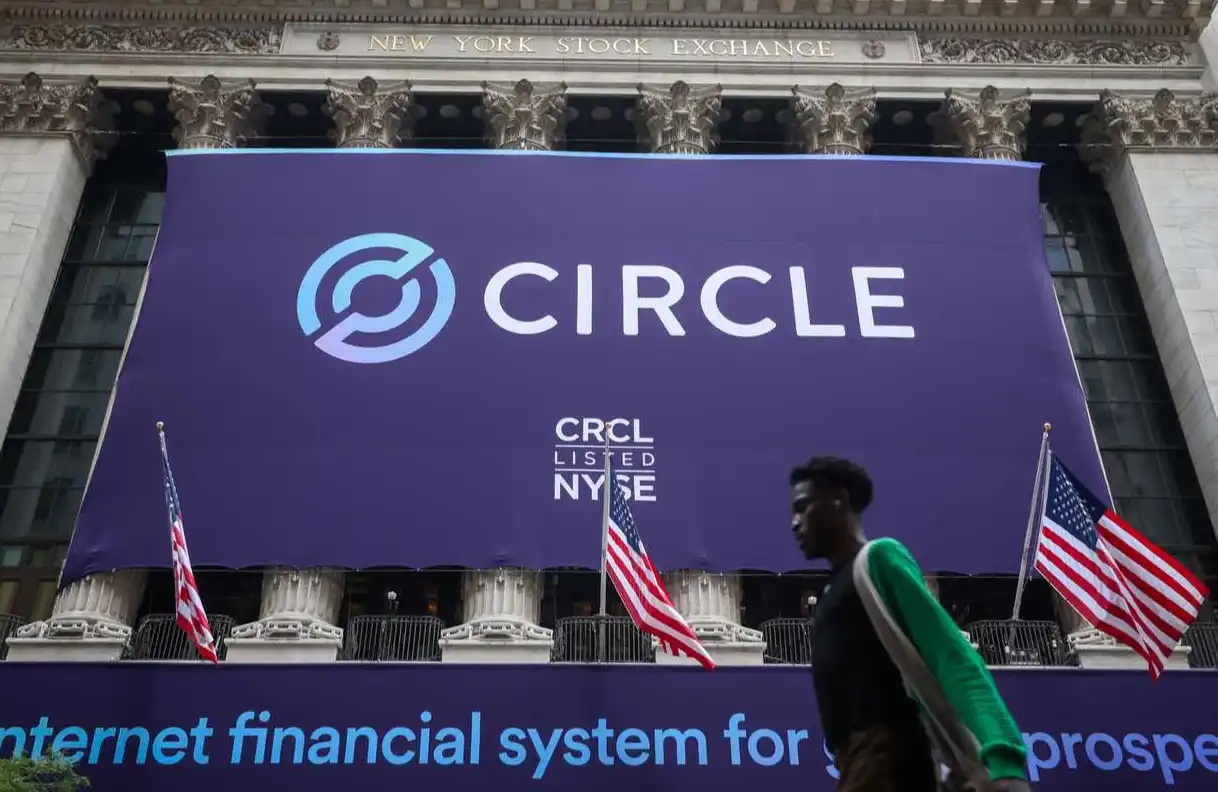
In the global digital currency market, stablecoins play an increasingly important role as a bridge between traditional finance and the cryptocurrency world. As the second-largest stablecoin by market share, USDC (USD Coin) and its issuer Circle have recently attracted market attention. Since Circle's IPO listing in early June at a price of 31 USD, the stock price has surged to nearly 200 USD (peaking at 298.99 USD). This remarkable stock price performance not only reflects the growth trajectory of the stablecoin industry but also reveals the opportunities and challenges facing this emerging financial tool. This article will conduct an in-depth analysis of USDC's issuance mechanism, revenue model, competitive advantages, as well as Circle's financial situation and investment value.
01 USDC Issuance Mechanism and Revenue Model
Funds Protection System
USDC has implemented a strict funds protection mechanism. For every 1 USDC purchased, investors are required to deposit 1 USD as a reserve. To ensure the safety of investor funds, USDC adopts a system of separating ownership from control. Legally, Circle, as the issuer, holds the ownership of the USDC reserve and manages these assets in a "trust form." USDC holders, by holding the token, have actual control over the reserve, and Circle can only operate the reserve based on user instructions. In terms of custody, the USDC reserve is held in custody by the Bank of New York Mellon, stored in a segregated account, ensuring the security and independence of the funds. Investment management is handled by the globally renowned asset management company BlackRock, primarily investing in its managed money market funds, with U.S. Treasury bonds as the main investment target, generating revenue through interest differentials.
Risks and Limitations of the Revenue Model
Although USDC's revenue model is relatively stable, it also has significant risks and limitations. Firstly, the reserve income is entirely determined by BlackRock's money market fund (mainly invested in short-term Treasury bonds), and Circle lacks active control over this part of the revenue. In terms of actual performance, according to Circle's 2024 financial report, the interest income of the USDC reserve was 1.661 billion USD, with a total USDC issuance of 60 billion USD, resulting in an actual annualized yield of 2.77%, while the U.S. six-month Treasury bond yield during the same period was 4.2%. This data shows that the yield of BlackRock-managed money market fund is significantly lower than the yield level of direct investment in Treasury bonds. The main reasons may include the management fees of the money market fund, liquidity management requirements (the need to hold cash reserves), and portfolio risk diversification requirements.
Secondly, reserve revenue is highly sensitive to government bond rate fluctuations, with profit increasing as rates rise and decreasing as rates fall. This passivity makes Circle's profitability highly dependent on the macroeconomic environment and monetary policy changes. The current Federal Reserve rate hike cycle has provided Circle with a relatively favorable earnings environment, but once it enters a rate-cutting cycle, the company's profitability will face significant pressure.
More importantly, Circle cannot enjoy all the revenue brought by USDC. Due to a historical partnership, Circle needs to share USDC's investment income with Coinbase. Specifically, all USDC revenue within the Coinbase platform belongs to Coinbase, while external USDC revenue is split 50-50 between both parties. This arrangement means that Circle effectively only receives 38.5% of the total USDC investment income, while Coinbase owns 61.5% of the revenue (based on 2024 financial data calculations).
Market Competition and Channel Expansion
To reduce dependence on Coinbase, Circle actively explores new distribution channels. The company partnered with Binance, paying $60.25 million plus monthly trading rewards to secure Binance's support. This strategy has been remarkably successful, as Binance has become the world's largest USDC trading market, accounting for 49% of the total trading volume, successfully reducing Coinbase's market share.
However, this competitive relationship has also brought new challenges. Coinbase has designated USDC as the core settlement token on the Base chain, collaborated with Stripe to support USDC on the Base chain, and offered up to 12% yield for users holding USDC in the Coinbase Advance version of the derivatives market to maintain its market position and distribution income.
02 USDC vs. USDT Competitive Analysis
Market Share Comparison
In the stablecoin market, USDT still holds the dominant position. As of May 31, 2025, USDT's market cap reached $153 billion, accounting for 61.2% market share, while USDC's market cap was $61 billion, representing 24.4% market share. USDT's issuance growth rate continues to outpace USDC, demonstrating its strong position in the market.
USDC's Competitive Advantage
Despite lagging behind USDT in market share, USDC has significant advantages in various aspects.
Transparency and Auditability Advantage: USDC adopts a "100% transparent anchor" model, with reserve assets consisting of cash (23%) and short-term U.S. Treasury bonds (77%), audited monthly by institutions such as Grant Thornton and publicly reported. By the fourth quarter of 2024, the reserve size reached $43 billion. This transparency has led institutions such as BlackRock and Goldman Sachs to choose USDC as a cross-border settlement tool, with institutional holdings reaching 38% in 2024.
In contrast, USDT has faced investigation issues regarding reserve transparency and was embroiled in controversies from 2017 to 2019, ultimately settling for $41 million. Although USDT improved its reserve structure after 2024, its "self-attestation" model still lacks transparency.
Regulatory Compliance: USDC holds the New York BitLicense, EU MiCA license, and Japan FSA certification, becoming the first globally circulated stablecoin approved in Japan. By participating in the U.S. GENIUS Act legislation, USDC is poised to become an industry benchmark under the regulatory framework, successfully attracting banks such as JPMorgan Chase and Citigroup to join its payment network in 2024.
USDT, on the other hand, adopts a "gray area" strategy, with its headquarters in Hong Kong and registration in the British Virgin Islands, operating in a regulatory gray area. The EU MiCA legislation excludes USDT from the compliance list, leading to a significant drop in its EU market share from 12% in early 2024 to 5%.
Investor Trust: During the 2023 Silicon Valley Bank incident, although USDC briefly dropped to $0.87, after Circle publicly demonstrated its reserves the next day, the price rebounded to $0.99 within 48 hours, showcasing the market's confidence in its compliance model. BlackRock only accepts USDC as collateral in its on-chain fund products, reflecting institutional trust in USDC.
Traditional Finance Penetration: USDC partnered with SWIFT to develop the "Digital Dollar Payment Gateway," connecting with 150 international banks in 2024, aiming to become the "blockchain version of SWIFT" for enterprise cross-border settlements.
Impact of Regulatory Policies
The introduction of the "2025 U.S. Stablecoin Innovation and Establishment Act" (GENIUS Act) could reshape the stablecoin market landscape. This act, as the first U.S. federal regulatory framework for stablecoins, may position USDC as the only globally compliant stablecoin, attracting more institutions to include it in asset management products.
For USDT, if the bill requires the issuer of a stablecoin to be a Federal chartered bank, USDT may be prohibited from operating in the U.S. due to its offshore registration, leading to an expected loss of 20% of market share.
03 Circle Company Financial Analysis
Profitability Analysis
Circle's financial situation exhibits some contradictory characteristics. In terms of profitability, the company's gross profit margin is 24.00%, significantly lower than the industry median of 50.18% (hereinafter, all "industry" refers to the banking industry and fintech companies such as PayPal, Visa, Stripe, etc.). The main reason is that revenue comes from the BlackRock-managed money market fund, with returns tied to the U.S. Treasury rate, lacking pricing power, and incurring channel fees.
However, Circle's EBITDA margin is 11.43%, slightly higher than the industry median of 10.43%, indicating good operational efficiency. More notably, the company's net profit margin reaches 9.09%, far exceeding the industry median of 3.57%, reflecting the enterprise's high effectiveness in cost management.
Low Asset Utilization
Circle performs poorly in asset utilization. The company's asset turnover is only 0.05 times, much lower than the industry median of 0.59 times, meaning that every $1 of assets can only generate $0.05 of revenue. The return on assets (ROA) is 0.28%, also well below the industry median of 2.05%.
The fundamental reason for this situation is that Circle invests a large amount of funds in Treasury bonds. Although the returns are stable, the yield is low, leading to inefficient asset utilization. However, as long as Circle can deploy more funds, the total profit amount is still considerable.
Cash Flow Situation
Circle demonstrates excellent cash flow management, with operating cash flow reaching $324 million, far above the industry median of $113.92 million. This is mainly due to regulatory requirements in the stablecoin business, where the company needs to maintain high cash reserves.
Growth Prospects and Concerns
Circle shows strong revenue growth, with a growth rate of 15.57%, 2.6 times the industry median of 5.95%. However, the company has experienced significant deterioration in profit growth. EBITDA growth is -31.75%, EBIT growth is -32.57%, and EPS growth is -61.90%, forming a "revenue growth without profit growth" trend. This situation is mainly due to a significant increase in costs during the expansion process. Distribution and transaction costs increased by 71.3% QoQ, marketing expenses reached $3.9 million, and employee compensation increased by 23.7% YoY.
04 Valuation Analysis and Investment Perspective
Current Valuation Level
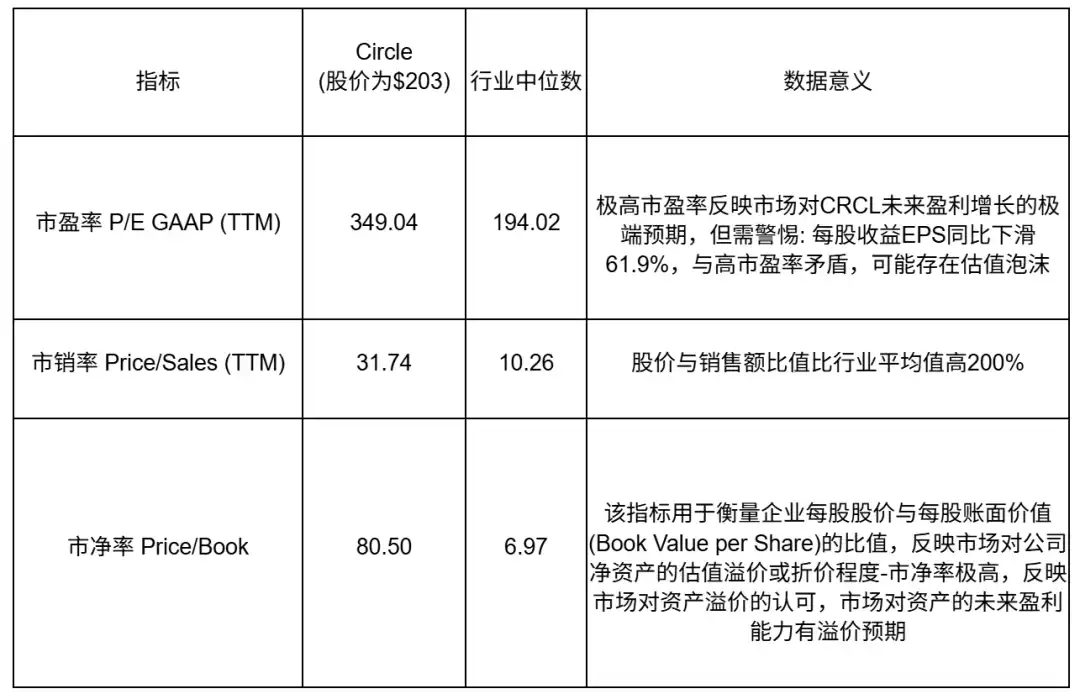
Circle's P/E ratio, P/S ratio, P/C ratio, and P/B ratio are all higher than the industry median, reflecting investors' very high expectations for the company's future performance. To support these high expectations, Circle needs to achieve strong growth in profitability, revenue, and free cash flow to digest the current high valuation. It is worth noting that Circle's future growth drivers may mainly come from product diversification, especially the rapid expansion of the EURC Euro stablecoin in the European market, and the breakthrough of the RWA tokenized product USYC in the digitalization of real-world assets.
Equity Structure Analysis
Circle's equity structure is not healthy. Institutional investors hold only 10% of the shares, compared to Coinbase where institutional investors hold 30%. The ownership percentage of senior executives is 7.4%, which is relatively low. Retail and other investors hold 37% of the shares, more than both institutions and executives. The IPO pricing range given by JPMorgan Chase, Citigroup, and Goldman Sachs is $27-28, reflecting institutions' lack of confidence in Circle.
Investment Logic Analysis
Bullish Logic:
· Stablecoins address inherent pain points of the traditional fiat-based transaction system, and the market is in an expansion phase
· USDC has a significant compliance advantage in the stablecoin market
· Gradually reducing reliance on Coinbase for distribution, potential for larger share of investment returns in the future
· GENIUS Act may force major competitor USDT out of the U.S. market
Bearish Logic:
· Valuation is disconnected from fundamentals, continued decline in earnings is significantly at odds with high valuation
· Low asset return rates, difficult to support long-term value growth
· Over 60% of USDC investment returns are attributable to Coinbase, Circle cannot fully benefit (2024 financials data)
· Institutional investors' ownership percentage is too low, equity structure is unhealthy
05 Conclusion and Outlook
Circle exhibits the characteristics of "high market expectations, rapid growth, and high valuation." On the one hand, the company's stock price has risen by over 540% since its IPO, reflecting the market's recognition of its strengths in regulatory compliance, market share expansion, and other aspects. USDC, as the most transparent stablecoin, enjoys a good reputation among institutional investors, providing the company with a solid competitive foundation. On the other hand, the company faces challenges such as limited profitability, low asset utilization, and digesting a high valuation.
In the short term, the significant increase in Circle's stock price has fully reflected the market's optimistic expectations, and investors need to pay attention to the alignment between valuation and fundamentals. Looking ahead, whether Circle can achieve a breakthrough through product diversification will be crucial. The expansion of the EURC Euro stablecoin in the European market, the innovative application of RWA tokenization product USYC, and the gradual reduction of reliance on Coinbase revenue sharing all have the potential to bring new growth drivers to the company.
With the advancement of regulatory policies such as the "GENIUS Act" and the continued development of the stablecoin market, USDC's compliance-first advantage may translate into a larger market share and profitability. When evaluating Circle, investors need to balance its innovation potential with its current valuation level and focus on whether the company can prove that the high expectations from the market are reasonable through a diversified strategy and operational efficiency improvement.
Welcome to join the official BlockBeats community:
Telegram Subscription Group: https://t.me/theblockbeats
Telegram Discussion Group: https://t.me/BlockBeats_App
Official Twitter Account: https://twitter.com/BlockBeatsAsia
 Related Articles