



Trading platforms, crypto VCs, and market makers: Who is really affected by Singapore's DTSP Act?
On May 30th, the Monetary Authority of Singapore (MAS) officially released its final response document regarding the licensing framework for Digital Token Service Providers (DTSP). Initially, this policy did not garner widespread attention. However, a few days later, an article on a public account began to gain traction, causing the entire industry to recognize its significance. The document explicitly mandates that all projects operating in Singapore without a license must cease operations by June 30th. This has left many crypto practitioners in Singapore feeling anxious.
What impact will this new regulation have on the crypto world? Are we about to witness another "Wandering Earth"-style mass exodus? On the evening of June 12th, BlockBeats invited a panel of experts, including Christopher Liu, Chief Compliance Officer of Matrixport; Chen Wu, CEO of EX.IO; Ye Su, Founding Partner of ArkStream Capital; and Valentina, BD Director of Herring Global, to engage in an in-depth dialogue exploring the topic, "The End of the Web3 Paradise? What Impact Will Singapore’s DTSP Legislation Have?" Together, they dissected the regulatory logic behind the policy and its far-reaching implications for the industry’s development.
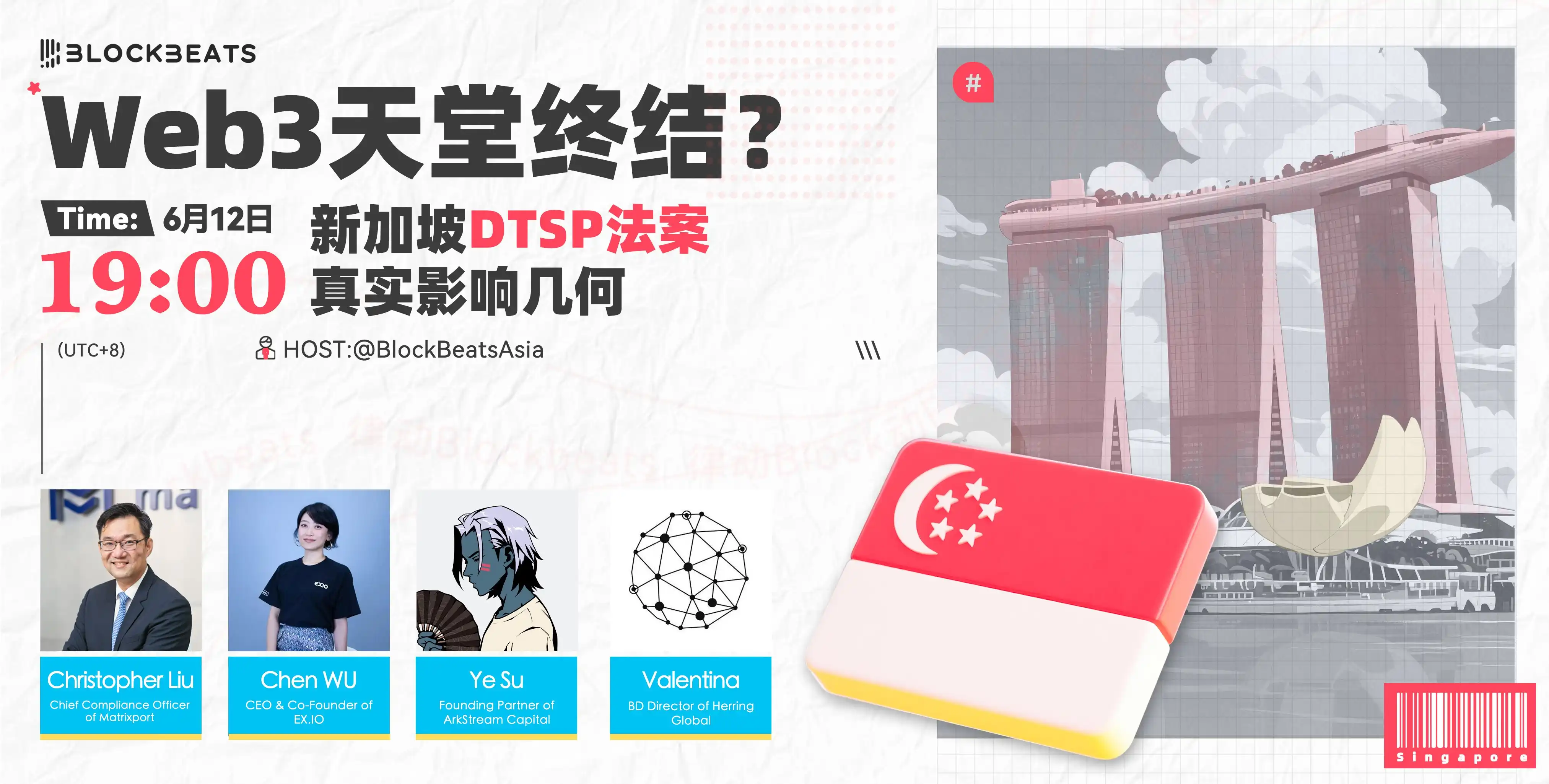
BlockBeats: Tonight, we have invited several seasoned guests from top-tier compliance VCs, trading platforms, and other institutions to discuss the intent behind Singapore's new policy, as well as its short- and long-term impacts on the country’s Web3 industry. Let’s begin by having our guests introduce themselves briefly.
Ye Su: Thank you for the invitation. I’m Ye Su, a partner at ArkStream Capital. We are a Crypto fund established in 2020, primarily focused on early-stage investments and liquidity strategies. Over the past five years, we have invested in more than 100 projects, including recently launched initiatives like Space and Time, Kernel, and Particle Network. We also maintain close collaborations with the institutions represented by several of the guests here today.
Although I am not currently based in Singapore, half of our LPs (Limited Partners) hail from there, many of whom are licensed institutions. At present, approximately 20% of the allocations from our sixth fund are targeted at Singapore. I personally lived in Singapore for over a year during 2022, though I decided not to remain long-term due to the regulatory environment and overall living atmosphere. I’m glad to join today’s discussion and delve deeper into these topics with everyone. Thank you.
Chen Wu: Hello everyone, I am Chen Wu, the founder and CEO of EX.IO, a Hong Kong-based compliant trading platform. We are currently one of the licensed trading platforms in Hong Kong and the only key enterprise introduced by the Hong Kong government. We bring a traditional financial background and are committed to compliance-driven growth.
Although we currently do not have an official business presence in Singapore, we conducted extensive research on compliance paths across various global regions before deciding to apply for a Hong Kong license. Naturally, Singapore was one of the key regions of focus. Our ultimate decision to choose Hong Kong was based on a comprehensive assessment of its history, economic environment, and policy framework. I’ll be sharing more details about our decision-making process in the future.
Taking this opportunity, I’d like to introduce our upcoming initiative with multiple organizations, including the City University of Hong Kong and the event organizer BlockBeats. Together, we will host a four-city tour in Mainland China, focusing on talent cultivation, project incubation, and ecosystem development. This is part of our corporate social responsibility efforts, and we also hope to encourage more universities and young professionals to engage in the Web3 industry. Thank you, everyone.
Christopher Liu: Hello, everyone. My name is Chris, and I’m the Chief Compliance Officer at Matrixport Group. Matrixport is a crypto asset platform offering a range of services, including OTC and custody solutions, which many of you might already be familiar with. I am based in Singapore and have previously worked in banking, the payments industry, and regulatory agencies. I’ve been involved in the crypto industry for three and a half years now. Please note that my comments today reflect my personal views and not the stance of the company. Thank you for having me, and I look forward to engaging with all of you.
Valentina: Hello, everyone. I’m Valentina from Herring Global. Our entire team originated in Singapore, including our traders and founders, so we have built our operations on a compliance-first approach from the very beginning. After the DTSP Act was introduced, our firm was actually included on the official "license exemption list." As a liquidity provider, our services span both centralized and decentralized scenarios, offering liquidity solutions for project teams and venture capital firms. We also work with the institution of Professor Ye Su. Personally, I have worked on a DeFi project before joining Herring Global, and I’m delighted to discuss Singapore’s latest compliance developments with all the esteemed guests here today.
BlockBeats: The new DTSP regulations in Singapore seem to have caused quite a stir in public opinion. How do you and the people around you perceive this development? Is it really as serious as it appears?
Christopher Liu: Sure. Actually, this Financial Services and Markets Act (FSA) isn’t entirely new—it has been in the works since 2020. While its enforcement timeline has only recently been clarified, the industry in Singapore has long been aware of this regulatory framework’s imminent implementation. The primary driver behind it is the FATF (Financial Action Task Force) guidelines issued back in 2019. FATF specifically required its member countries to establish regulatory frameworks that cover both locally licensed entities and businesses conducting cross-border operations from the local jurisdiction. Consequently, Singapore released a related consultation paper in 2020, initially naming it the "Omnibus Act," which later formally evolved into the Financial Services and Markets Act (FSA) in 2022.
So, the implementation of this policy isn’t exactly a sudden move. The industry wasn’t particularly surprised by it either. MAS (Monetary Authority of Singapore) had engaged in communications and consultations with industry organizations before and after the issuance of the policy. Regarding the question of "is it really that serious?", if you only look at the Chinese-speaking community or parts of the media coverage, the rhetoric does seem a bit extreme, almost as if Singapore were completely cutting off foreign operations. However, following the publication of the document on May 30, MAS promptly clarified: institutions that are already licensed can still conduct external business and recruit users.
The real impact is on those enterprises that lack licenses but are engaged in international operations. MAS also mentioned that they have identified some affected platforms and are assisting them in transitioning, such as by guiding them to apply for licenses. Overall, MAS has not shown a heavy-handed, one-size-fits-all approach.
Valentina: Currently, our institution is in an "exempted from licensing" status. From the very beginning, we opted for a compliance-driven approach and have maintained ongoing communication with the regulators. At this stage, MAS has granted us temporary exemptions during their evaluation process, but this doesn’t mean we can operate without a license indefinitely. There are three potential outcomes to this exempted status:
1. Obtaining an official license, which may not necessarily be a DTSP license but could be another type of license.
2. The organization decides to exit the business and no longer applies for a license.
3. MAS identifies issues during their annual review and requires the business to cease operations.
At the early stages of the new policy's release, there were indeed some panic reactions within the industry, particularly among trading platforms and custodial service providers. However, for institutions that have already committed to a compliance-centered path and maintained steady communication with MAS, the actual impact has been minimal. Singapore’s regulatory focus isn’t about stifling innovation but ensuring that technological exploration happens within a compliance framework. MAS continues to support emerging technologies like DeFi, stablecoins, and AI, but the premise is to establish anti-money laundering mechanisms and enforce KYC/KYB standards. Thus, the "severity" of the policy essentially depends on whether a company genuinely incorporates compliance as part of its growth strategy.
Chen Wu: Let me preface by saying that we are a licensed trading platform in Hong Kong, rather than a local virtual asset trading platform in Singapore. Honestly speaking, when we noticed the Chinese-speaking community expressing panic over Singapore’s policies, we did have a bit of a "schadenfreude" moment internally. We also saw some KOLs (Key Opinion Leaders) suggesting that Singapore might no longer be the ideal place for Web3 startups, with some even talking about relocating back to Hong Kong, Dubai, or other regions.
There has also been a lot of comparison between Hong Kong’s VATP (Virtual Asset Trading Platform) license and Singapore’s DTSP framework. Some argue that VATP is more lenient and better suited for retail investors. However, we’ve interacted offline with many project teams that are deeply rooted in Singapore and found that very few are actually planning to leave. Most still wish to continue developing in the region. At the end of the day, this is because, while the DTSP has been introduced, its detailed regulatory guidelines, thresholds, and applicable scope remain ambiguous to this day. Questions such as who can apply, who qualifies for exemptions, and what business activities are restricted still lack clear standards.
We’ve seen discussions within the community around topics like whether DeFi projects will face restrictions, whether they can continue operating in Singapore, or whether they can bypass regulations, with interpretations varying significantly. This has further solidified my confidence in choosing Hong Kong. While Hong Kong's compliance path is stringent, its policies are at least clear and its thresholds well-defined. The VATP license guidelines we applied for span nearly 300 pages, offering detailed, actionable insights. This highlights the differences we've observed: take Dubai for example, where the regulatory framework is continuously updated. While concise, it undergoes iterative optimization each year, enhancing clarity and transparency.
In contrast, Singapore provides policy notifications three years in advance yet only unveils its specific guidelines a month before the deadline, leaving significant uncertainty. This ambiguity not only affects whether existing projects choose to stay but also impacts whether new projects will dare to enter and whether capital is willing to invest. Therefore, I believe the true impact of DTSP may not be about "driving anyone away" but rather about "who it can still attract." This is a question that has yet to be thoroughly discussed within the community. I’m also eager to hear Ye Su’s perspective from the VC angle later on this topic.
Christopher Liu: I’d like to add something. Many people, especially some online KOLs, jump to conclusions as soon as the DTSP framework is introduced, assuming that it's the primary regulatory logic for Singapore's entire industry. However, this isn’t the case.
The primary regulation currently applicable to the crypto industry in Singapore is actually the Payment Services Act (PSA). Over the past two years of communication with MAS (Monetary Authority of Singapore), the regulators have repeatedly emphasized that if you intend to provide services like trading platforms, custody, or OTC in Singapore, the license you need to apply for is under PSA, specifically the MPI (Major Payment Institution) category. The introduction of the DTSP is to address the grey areas not covered by the PSA, such as companies registered in Singapore but primarily serving overseas users without holding a PSA license.
The fundamental reason behind launching DTSP lies with FATF (Financial Action Task Force) and its anti-money laundering (AML) regulatory requirements. The expansion of this framework aims to include those teams previously not under PSA's scope but operating cross-border businesses. If you are genuinely a Web3 practitioner planning to establish a long-term presence in Singapore, offering services like OTC, custody, or trading platforms, the license you need to apply for remains the PSA’s MPI license, not DTSP.
MAS also made it explicitly clear in its DTSP release that there would be no "dual regulation," meaning they won’t require a single institution to hold multiple licenses simultaneously. If you are already holding a PSA license or are in the process of applying for one, the DTSP's impact on you is minimal.
律动 BlockBeats: Ye Su, you previously referred to this policy as a "regulatory performance act" on Twitter. Could you elaborate on your perspective?
Ye Su: When I posted that tweet, it was in response to some very intense reactions to the policy, with terms like "great purge" being thrown around. My introduction of the concept "regulatory performance studies" wasn’t meant to be derogatory, but rather to encourage people to look at this matter from another angle: this is part of a strategic regulatory rhythm by the government.
Let me draw a comparison. It's like a project hosting a "yield-farming event," which also follows its own roadmap. The first phase focuses on attracting mass participation; the second phase involves requiring participants to complete KYC and AML procedures; the third phase aims to retain high-quality users and promote the ecosystem's growth. I believe Singapore’s regulatory evolution for Web3 follows a similar pattern.
Since 2017, Singapore has been welcoming all Web3 companies to set up operations, which was the "open phase." By 2021, it entered the “filtering phase,” emphasizing compliance. Now, with the implementation of the DTSP regulation, it has progressed into the “consolidation phase”—a stage where only truly compliant and capable institutions are welcomed for long-term development.
The scope of this new legislation is remarkably broad. It covers activities such as token issuance, custody, trading, payments, brokerage, staking, and even includes working-from-home operations as part of business activities. The only exemptions are for pure tech consulting and non-transactional advertising and promotions. I also reviewed Singapore’s past regulatory trajectories in two similar cases: First, the 2019 payment industry overhaul, where it was announced 90% of payment agencies would be cleared out. In practice, a three-year transition period was provided, and ultimately around 40% were approved. Second, the 2023 family office tax exemption policy, which raised the exemption threshold from 5 million SGD to 20 million SGD but didn’t enforce the change abruptly, instead introducing a grace period.
At its core, the goal of these policies is consistent: retain compliant and legitimate businesses while filtering out illicit arbitragers. While the surface approach appears to be "strict regulation," it’s actually a "selective welcome." That’s why I termed it a "regulatory performance"—it’s Singapore making a proactive statement in the global compliance narrative. From this perspective, it’s a strategic expression that aligns with their ambition to position themselves as the "Global Center for Compliance and Innovation."
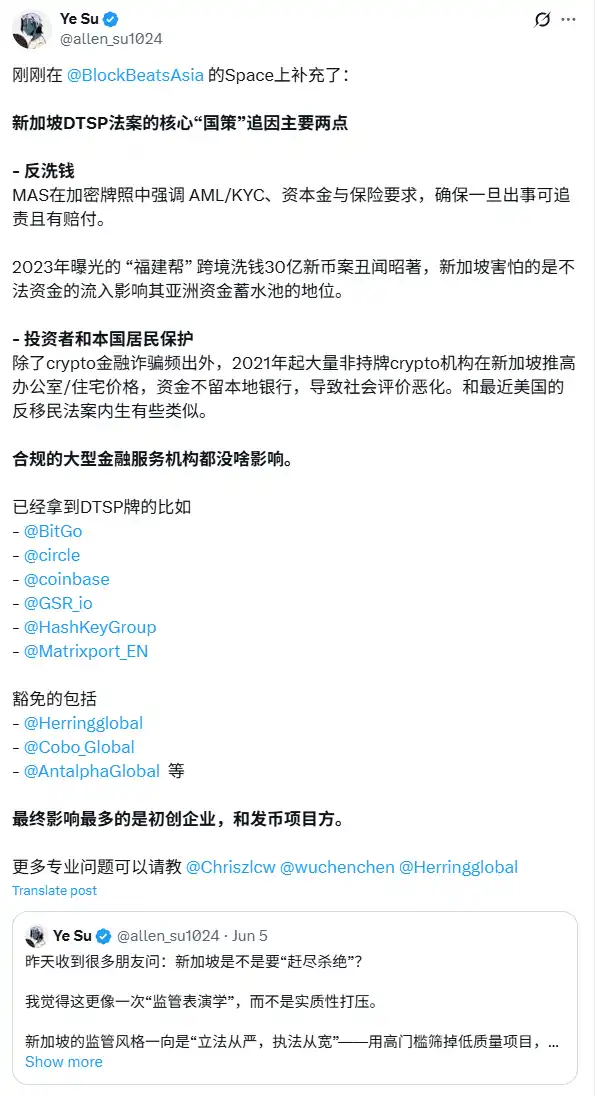
Ye Su’s Tweet
律动 BlockBeats: Why is Singapore issuing this directive? How do you foresee the medium-to-long term impact of this new regulation on the development of the Web3 industry in the country?
Christopher Liu: In terms of regulatory clarity, Singapore has been one of the earliest countries in the Asia-Pacific region to establish a licensing framework for the crypto industry. Since the introduction of the PSA licenses in 2020, the country has developed a relatively mature regulatory logic.
The introduction of the DTSP serves as an extension of the existing system, making the entire framework more complete. The MAS has also explicitly stated that institutions already holding a PSA license or those on a compliance pathway can continue to serve both local and overseas clients. For institutions with existing compliance arrangements, this acts as further "confirmation."
Moreover, in recent years, MAS has expanded the regulatory definition of "digital currencies" and, starting last year, began allowing formal applications for custody business licenses. These details indicate that MAS is not cracking down on the industry but is instead gradually refining its regulatory boundaries, particularly in balancing "preventing retail investors from speculative trading" with "supporting industry development." In the medium to long term, Singapore will continue to position itself as a Web3 compliance hub, aiming to encourage compliant platforms to use Singapore as a base to extend their reach across the Asia-Pacific market.
Valentina: Overall, Singapore has always sought to strike a balance between "encouraging innovation" and "ensuring financial stability." The introduction of the DTSP regulations addresses some regulatory gaps that the PSA framework was unable to cover, especially after the recent surge in industry collapse incidents, which exposed blind spots in oversight.
From a medium- to long-term perspective, this policy could lead to several impacts: First, it raises the entry threshold for the industry. For early-stage projects with limited resources, compliance costs could become a significant barrier to entry. Singapore will increasingly be more suitable for project teams committed to long-term development and with a focus on compliance. Second, it accelerates industry consolidation. Teams unwilling or unable to pursue a compliance pathway will be forced to exit, leading Singapore's digital asset ecosystem to evolve toward being "high-quality, transparent, and regulated." Third, it makes it easier to attract traditional financial capital. For large institutions, regulatory clarity is paramount. The introduction of DTSP essentially opens the door for such players. For instance, family offices, banking-affiliated trading entities, and other traditional players with stringent compliance requirements can formally participate in the Web3 ecosystem under Singapore's clear policies.
In summary, I see the implementation of DTSP not as a "crackdown" but a "restructuring." It will help Singapore establish a long-term ecosystem that genuinely integrates traditional capital with crypto innovation.
Chen Wu: I fully agree with the insights shared by the previous two speakers. At the end of the day, the government's intention behind this policy is to optimize and elevate the country's overall economic structure. The core focus of the DTSP framework is essentially anti-money laundering (AML). The essence of all compliance regulations boils down to two priorities: first, AML; and second, investor protection.
At present, the majority of global compliance frameworks start with AML (Anti-Money Laundering). Why? Because it represents the baseline for the international financial system. From this perspective, understanding why Singapore made this decision requires us to think from the level of its national strategy.
Many people mention that Singapore is one of Asia's financial hubs, alongside Hong Kong. However, if you look at the data, Singapore is not as "dependent on finance" as we might think. The financial sector accounts for about 13% of its GDP, whereas Hong Kong's peak contribution reaches as high as 23-24%. As a sovereign nation, Singapore’s foundation lies in its irreplaceable geographical location—serving as a critical trade hub connecting the East and the West.
Singapore's economic development began with entrepôt trade and gradually expanded to high-value-added manufacturing and supply chain services. This was complemented by elite governance, education, technology, and real estate policies, which together built a robust national framework. Therefore, from a macroeconomic perspective, Singapore does not require an influx of "unrestricted capital" and instead places greater emphasis on stable, high-quality, and controllable capital.
Returning to the financial sector itself, Singapore's banking industry is highly competitive: total assets, profitability, bad loan ratios, and payment clearing capabilities all outperform Hong Kong. However, its capital markets are relatively weaker, with IPO activity consistently low and daily trading volumes amounting to just $8-10 billion, far below Hong Kong’s levels. On the other hand, Singapore leads Asia in wealth management.
The rise of its asset management industry is closely tied to the influx of high-net-worth individuals and family offices. These groups are drawn to Singapore’s financial security and safe-haven appeal. However, this situation—where "capital flows in, but projects do not land locally"—also creates risks, such as the lack of tax contributions, rising property prices, and increased social costs. Particularly following the exposure of the 2023 "Fujian Money Laundering Scandal," the external perception of the crypto industry has been called into question to some extent.
Thus, this regulatory upgrade is not only a response to international pressure but also a systemic move at the national policy level to "clean up financial gray areas and enhance capital quality."
Ye Su: Although our fund is not registered in Singapore, a significant portion of our LPs are based in the region, as much of Asia’s LP community is concentrated there. Many of our LPs come from licensed institutions or large enterprises. Overall, Singapore's policy logic can be boiled down to two core aspects: AML and investor protection.
From a micro perspective, we’ve also observed some very tangible societal issues. Crypto companies rent luxury office spaces, do not pay taxes locally, and drive up local housing prices and car permit (COE) costs. Meanwhile, local residents often lack participation or fail to benefit from the industry's growth. This kind of "resource crowding-out" phenomenon is, in fact, prompting the government to respond to public sentiment through regulation. Coupled with the money laundering case in 2023, the entire regulatory framework is entering a "refined governance phase." This is not merely a tightening of regulation but rather the government recalibrating the structure of incoming capital while solidifying social trust.
Additionally, from the perspective of institutional distribution, the licensing and exemption list issued by MAS this time covers major platforms like Circle, Coinbase, and HashKey, as well as platforms focused on OTC, custody, or derivatives. The groups most affected, however, are project teams and startups. This is because the startup ecosystem in Singapore is not as vibrant as in Hong Kong, making these projects the most impacted by policy adjustments.
Rhythm BlockBeats: What are the thresholds and key considerations for applying for a DTSP license at this stage?
Valentina: Actually, there’s a very critical line in the MAS media release issued on June 6: they will set high licensing thresholds and "will not issue licenses lightly." The message is very clear: it is extremely challenging to apply for a DTSP license.
So my recommendation is to first familiarize yourself with the two basic types of licenses: the PSA (Payment Services Act) and the CMS (Capital Markets Services). These two licenses currently form the most fundamental regulatory framework recognized by MAS. If you plan to apply for a license, the first thing to do is to ensure that your organization has robust KYC/AML strategies and fund segregation mechanisms in place. This isn't just about having these processes on paper; they need to be fully implemented in daily operations, technical systems, and data management. Singapore places a strong emphasis on technical compliance and operational transparency. Without long-term, systematic planning, it’s extremely difficult to navigate the application process. Therefore, I strongly recommend that project teams thoroughly study the scope and compliance pathways of PSA and CMS before considering a DTSP license.
Christopher Liu: Allow me to add to that. First, let me clarify: we at Matrixport are one of the 33 licensed entities in Singapore, and we are also in the process of applying for another type of license, so we have direct, hands-on experience. I agree with Tina's analysis. Singapore's regulatory approach is very straightforward: DTSP is meant to complement areas that PSA does not cover, but the primary regulatory framework remains PSA. MAS has also clearly stated that they avoid redundant regulation, meaning the same business activities don't require multiple license applications.
From my previous experience applying for licenses in multiple jurisdictions, one of Singapore’s advantages is regulatory centralization: areas like OTC, custody, stablecoins, and trading platforms are all overseen by a single regulatory body, MAS. This leads to greater efficiency in communication and consistency across processes. However, regulatory requirements are continuously evolving. In the early stages, the focus might have been primarily on AML and Technology Risk Management (TRM), but now considerations have expanded to include user protection, conflict of interest management, and more. Particularly after the series of industry blow-ups in 2022, regulators have significantly broadened their areas of concern.
Overall, Singapore remains a very rational regulatory environment. Although the media sometimes portrays it more dramatically, DTSP is not a "ban," but more of a "completion." Nearly every region around the globe is strengthening licensing mechanisms, which will become an irreversible long-term trend.
BlockBeats: Thank you very much, Mr. Liu, for your insights. One last question: Will DTSP impact this year’s TOKEN2049 event?
Christopher Liu: I don’t think so. TOKEN2049 is a commercial event and does not fall under the scope of license regulation. Even during the F1 ban on advertisements, TOKEN2049 was still able to carry out various promotions within its venue. This shows that Singapore still welcomes industry exchanges and technology showcases, but places higher demands on financing and operational compliance. So, everyone can participate without concern.
BlockBeats: Thank you again to all the guests for their wonderful input. From today’s discussion, it is evident that regulatory boundaries are becoming increasingly clear—compliance is no longer an "option," but a "passport" to enter the market. The future of Web3 will no longer stand in opposition to regulation; instead, it will co-create a new order alongside policies.
Space Link: https://x.com/i/spaces/1ypJdZOleOoKW
Welcome to join the official BlockBeats community:
Telegram Subscription Group: https://t.me/theblockbeats
Telegram Discussion Group: https://t.me/BlockBeats_App
Official Twitter Account: https://twitter.com/BlockBeatsAsia







