Kernel-level proof mechanism for machine learning models
Original Title: Kernel-Wise Proving for Machine Learning Models
Written by: Zhiyong Fang
How do you eat an elephant? One bite at a time.
In recent years, machine learning models have been advancing at a staggering pace. As the capabilities of these models improve, their complexity grows correspondingly—state-of-the-art models today can easily possess hundreds of millions, or even billions, of parameters. To address challenges of this magnitude, various zero-knowledge proof systems have emerged, with the relentless goal of dynamically balancing proving time, verification time, and proof size.
Table 1: Exponential growth in model parameter scale
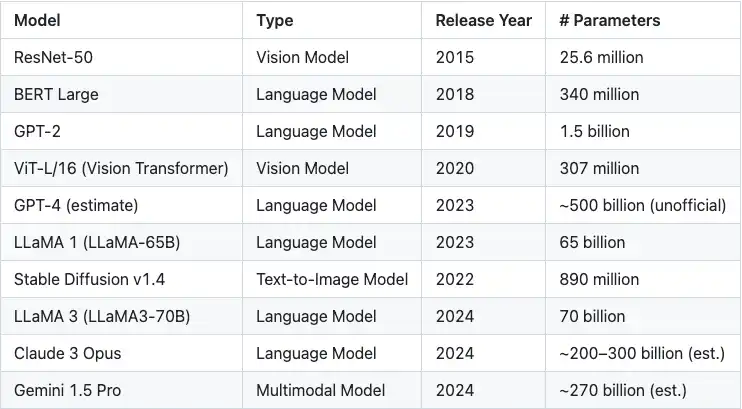
Although much of the current work in the zero-knowledge proof domain is focused on optimizing the proof systems themselves, one critical dimension is often overlooked—how can large-scale models be efficiently decomposed into smaller, more manageable submodules for proving? You might wonder: why is this so important?
Let us explain this in detail:
Modern machine learning models often have parameter counts measured in billions. Even without any cryptographic processing, such models already consume an immense amount of memory resources. And in the context of zero-knowledge proofs (ZKP), this challenge is further magnified.
Every floating-point parameter must be converted into an element within an arithmetic field. This conversion process alone increases memory consumption by approximately 5 to 10 times. Furthermore, to accurately emulate floating-point operations within the arithmetic field, additional operational overhead is introduced, typically around 5x as well.
In aggregate, the overall memory requirement of the model can balloon to 25 to 50 times its original scale. For example, a model with 1 billion 32-bit floating-point parameters might require 100 to 200 GB of memory just to store the converted parameters. Adding in the intermediate computation values and the overhead of the proof system itself, the total memory consumption easily surpasses the terabyte range.
Current mainstream proof systems, such as Groth16 and Plonk, in their non-optimized implementations, typically assume that all relevant data can be loaded into memory simultaneously. While this assumption is technically feasible, it becomes highly impractical given real-world hardware limitations, significantly restricting the available computing resources for proving.
```htmlPolyhedra's Solution: zkCuda
What is zkCuda?
As described in the zkCUDA Technical Documentation:
Polyhedra introduces zkCUDA, a zero-knowledge computing environment tailored for high-performance circuit development, designed specifically to enhance proof generation efficiency. Without compromising circuit expressiveness, zkCUDA fully leverages the parallel capabilities of underlying provers and hardware to enable fast ZK proof generation.
zkCUDA's syntax and semantics are highly similar to CUDA, making it particularly friendly for developers with existing CUDA expertise. It is implemented in Rust at its core, ensuring both safety and performance.
With zkCUDA, developers can:
Quickly construct high-performance ZK circuits;
Efficiently schedule and utilize distributed hardware resources, such as GPUs or MPI-supported cluster environments, enabling large-scale parallel computation.
Why Choose zkCUDA?
zkCuda is a high-performance zero-knowledge computing framework inspired by GPU computing, capable of breaking down massive machine learning models into smaller, more manageable computational units (kernels). Through a CUDA-like frontend language, it achieves efficient control. This design brings the following key advantages:
1. Precisely Matched Proof System Selection
zkCUDA supports fine-grained analysis of each computational kernel, matching it with the most suitable zero-knowledge proof system. For example:
For highly parallel computational tasks, protocols such as GKR, which excel in handling structured parallelism, could be chosen;
For smaller-scale or irregularly structured tasks, more compact systems like Groth16 are better suited for reducing overhead.
By customizing backend selection, zkCUDA maximizes the performance advantages of various ZK protocols.
``````html2. Smarter Resource Scheduling and Parallel Optimization
Different proving kernels exhibit significant variances in their resource demands for CPU, memory, and I/O. zkCUDA can accurately evaluate the resource consumption of each task and implement intelligent scheduling to maximize overall throughput capacity.
More importantly, zkCUDA supports task distribution across heterogeneous computing platforms—including CPU, GPU, and FPGA—thereby achieving optimal utilization of hardware resources and significantly enhancing system-level performance.
Natural Alignment Between zkCUDA and the GKR Protocol
While zkCUDA is designed as a general-purpose computation framework compatible with various zero-knowledge proof (ZKP) systems, it exhibits a natural architectural alignment with the GKR (Goldwasser-Kalai-Rothblum) protocol.
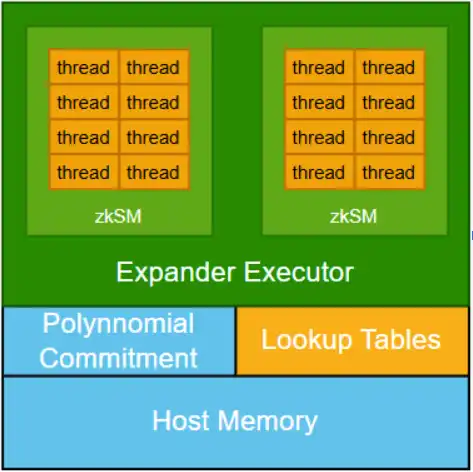
In its architectural design, zkCUDA introduces a polynomial commitment mechanism to link individual computational kernels, ensuring that all sub-computations run based on consistent shared data. This mechanism is critical for maintaining system completeness but also incurs significant computational overhead.
In contrast, the GKR protocol provides a more efficient alternative. Unlike traditional ZKP systems that require each kernel to fully prove its internal constraints, GKR allows the verification of computational correctness to recursively trace back from kernel outputs to inputs. This mechanism enables the propagation of cross-kernel correctness without fully unfolding the verification within each module. Its core concept is akin to backpropagation in machine learning, where correctness claims are propagated and traced through a computational graph.
Although combining such "proof gradients" across multiple paths introduces certain complexities, this mechanism forms the foundation for the deep synergy between zkCUDA and GKR. By aligning with structural features inherent in machine learning training processes, zkCUDA is poised to achieve tighter system integration and more efficient zero-knowledge proof generation in large-scale model scenarios.
Preliminary Results and Future Directions
We have completed the initial development of the zkCUDA framework and successfully tested it in multiple scenarios, including cryptographic hash functions such as Keccak and SHA-256 as well as small-scale machine learning models.
Looking ahead, we aim to further incorporate a series of mature engineering techniques from modern machine learning training, such as memory-efficient scheduling and graph-level optimization. We believe that integrating these strategies into the zero-knowledge proof generation process will dramatically expand system performance boundaries and adaptability.
```This is just a starting point; zkCuda will continuously move towards becoming a highly efficient, scalable, and adaptable general-purpose proof framework.
Welcome to join the official BlockBeats community:
Telegram Subscription Group: https://t.me/theblockbeats
Telegram Discussion Group: https://t.me/BlockBeats_App
Official Twitter Account: https://twitter.com/BlockBeatsAsia
 Related Articles