2025 Q2 DeFAI Development Report: DeFAI Technology Reconstruction, What is the Next Value Hotspot?
Original Title: State of DeFAI Q2/2025
Original Author: OxJeff
Translated By: johyyn, BlockBeats
The following is the translated content (the original content has been rearranged for better readability):
In January 2025, the DeFAI revolution erupted with the introduction of the "Abstraction Layer": This enabled users to interact through ChatGPT-like conversational interfaces, executing on-chain and DeFi operations by simply inputting commands. It was widely believed to herald the next generation of decentralized finance.
For reference, check out the previous article: "DeFAI Summer is Coming: How AI is Reshaping the Future of DeFi?"
As projects like @griffaindotcom, @HeyAnonai, @bankrbot, and @orbitcryptoai emerged with their unique characteristics, the limitations of Abstraction Layer technology also became apparent. Some products were found to lack sufficient DeFi protocol integration, while others exhibited inadequate reasoning capabilities, forcing users to meticulously craft prompts to drive AI execution effectively.
A deeper and more pervasive issue was "decision paralysis": Faced with a blank, ChatGPT-style chatbox, users often didn’t know how to phrase commands—they sought high yields or trading alpha but didn’t know where to start. This cognitive gap led many users to revert to traditional tools with clearer UI/UX design.
Low adoption rates of this interaction model, compounded by the early nature of the DeFAI ecosystem, valuation bubbles, and macroeconomic uncertainties, ultimately triggered a market price collapse.
Nevertheless, DeFAI did not meet its demise. Between Q1 and Q2, the industry underwent critical directional shifts, emphasizing several core trends (though not limited to):
1. Transition from the Abstraction Layer ➔ Discovery Layer
2. Enhancing existing workflows with DeFAI (rather than replacing them)
3. DeFAI autonomous agents: Achieving full workflow abstraction (using agents as interaction interfaces)
4. Integrating AI into DeFi protocols (or outlining explicit AI roadmaps).
Some projects have already achieved initial product-market fit (PMF), while others remain in development. Analysis begins with the first trend.
```htmlCore Trend: Strategic Shift from the Abstraction Layer to the Discovery Layer
Currently, users interacting with the DeFAI abstraction layer primarily consist of two categories:
A. Investors seeking Alpha opportunities in trading, and
B. Holders aiming to activate idle capital through yield farming.
The traditional abstraction layer, due to its overly broad scope, high operational complexity (and existing technological flaws), has failed to provide effective solutions beyond what existing tools/protocols already offer for these user categories. Against this backdrop, some DeFAI protocols have shifted from merely expanding execution layer integration capabilities to building core discovery layer functionalities—their strategic focus revolves around:
1. Aggregating and presenting high-quality trading signals and yield farming strategies
2. Positioning as a centralized portal for Alpha discovery
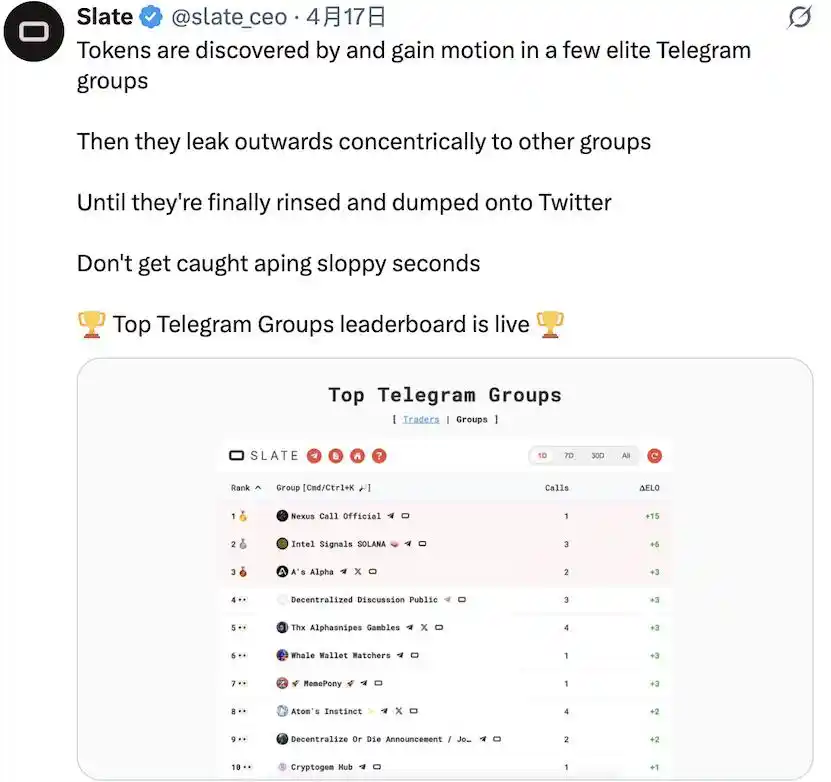
A representative example: the abstraction layer protocol @slate_ceo, once renowned for its advanced trade execution features, has now pivoted into a structured discovery layer platform.
Its core mechanisms include:
1. Tracking signal flows from top Telegram trading groups
2. Dynamically ranking and credit-scoring signal sources based on performance and historical records
3. Extracting Alpha before trading strategies diffuse to Platform X
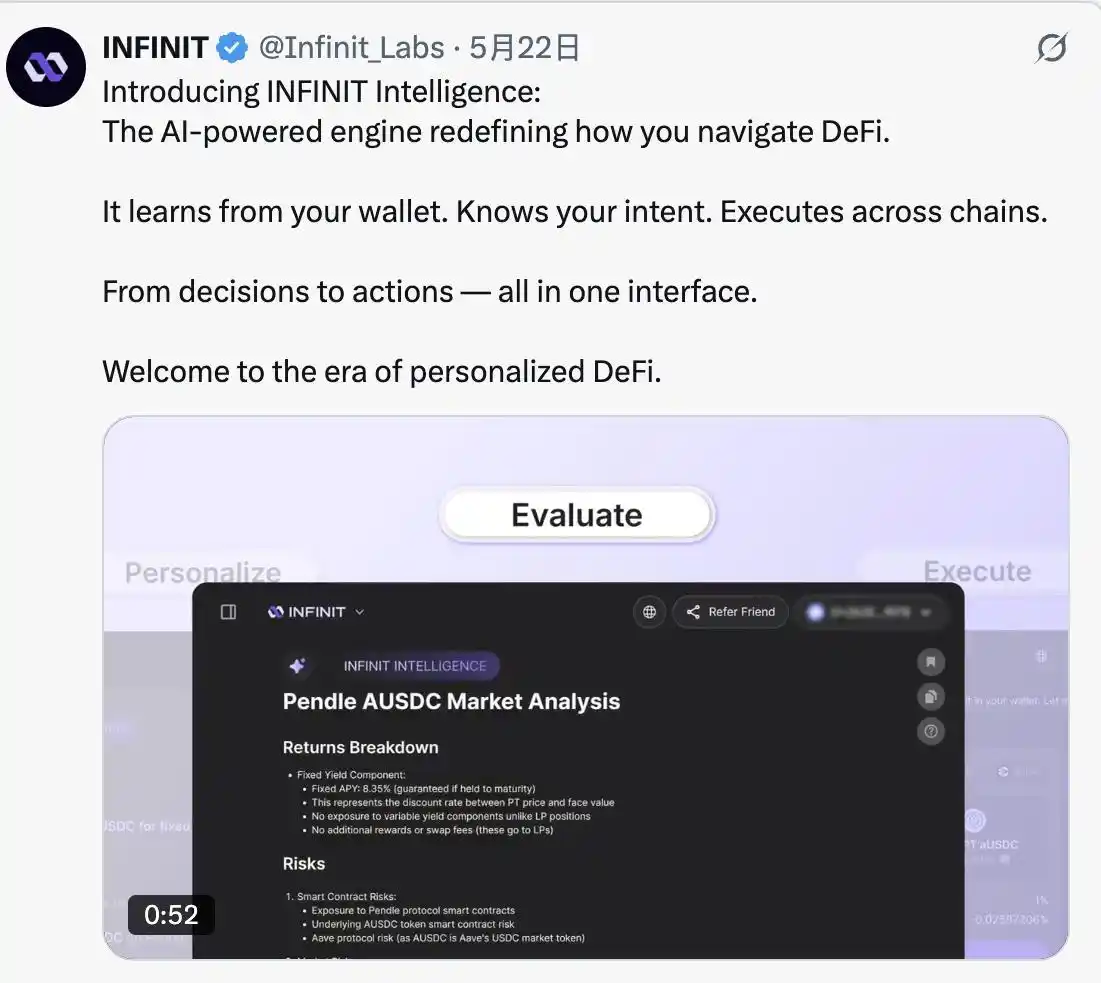
@Infinit_Labs positions itself as a comprehensive terminal capable of learning wallet behaviors by analyzing on-chain historical data to provide personalized yield farming strategies and DeFi investment opportunities. It supports users in executing strategy decisions directly within the same interface, completing the "insight-to-execution" loop. Leading protocols have achieved initial product-market fit (PMF), their user bases are continually expanding, and neither has yet issued native tokens.
Strategic Shift in DeFAI
Historical Challenges:
1. Most early DeFAI abstraction layers focused on building standalone terminals, aiming to serve as the primary gateway for user trading and DeFi interactions, but encountered resistance from sticky workflows:
2. Users heavily rely on native toolchains (e.g., Technical Analysis on TradingView, collaboration with crypto analysts on Platform X (CT), and execution on Axiom).
```3. The cost of forced migration far exceeds expectations
Paradigm Innovation: Transitioning to an "Embedded Enhancement" strategy — injecting DeFAI capabilities into users' existing workflows. A prime example is @HeyAnonai's launch of HUD (Heads-Up Display), a transparent information overlay:
1. Using dynamic data overlay technology to inject real-time risk/reward signals directly into users' original interface
2. Ensuring workflow continuity through Zero Context-Switching
By dynamically overlaying real-time risk/reward signals directly onto users' existing interfaces, it achieves Non-intrusive Data Delivery while retaining workflow continuity and enhancing decision-making capabilities. This evolution fundamentally represents an upgrade in positioning from a replacement to an Enhancement Layer, marking a new phase of co-evolution between the DeFAI abstraction layer and user ecosystems.
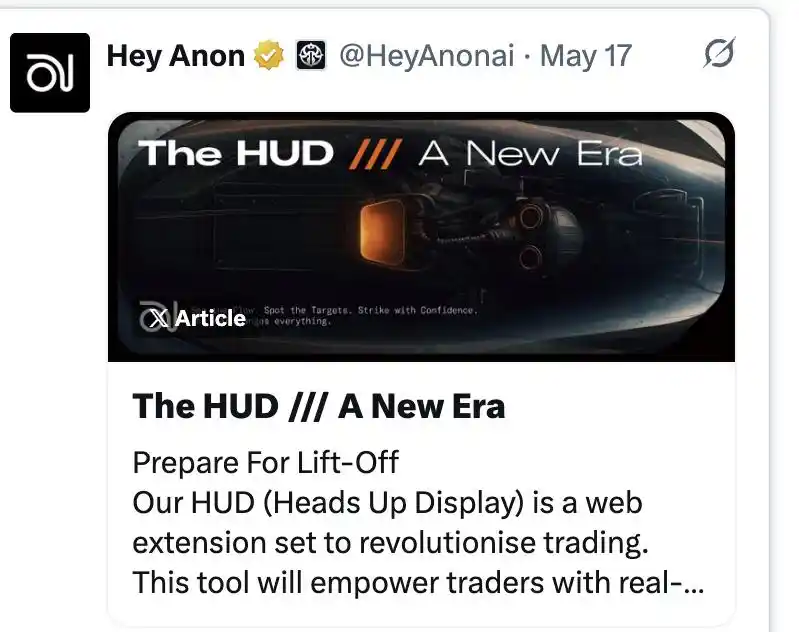
HUD has launched a trading pilot program with direct integrations into platforms like Axiom, Pumpfun, GMGN, MEXC, Kraken, and TradingView. Users can directly conduct dollar-cost averaging (DCA) buys/sells, utilize technical analysis (TA) tools, and gain real-time insights into tokens directly on charts.
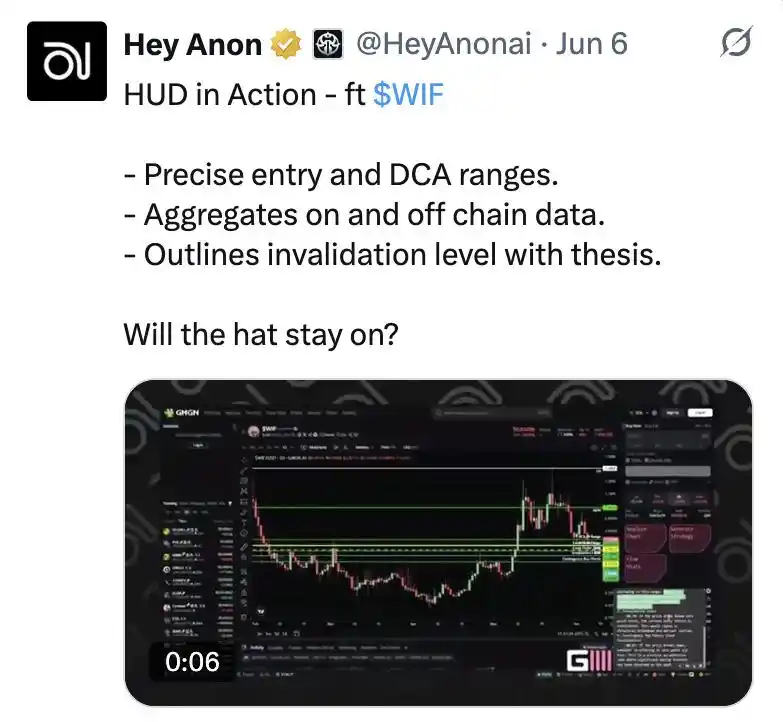
By integrating the HUD interface as an overlay, smart analytics and tools are seamlessly embedded into users' existing interfaces. This is a highly creative approach that delivers core capabilities precisely to users' hands.
DeFAI Autonomous Agents: Achieving Full Workflow Abstraction
Unlike ChatGPT-style conversational interfaces, some teams are opting to build fully automated DeFi Autonomous Agents that operate in the background to handle and optimize DeFi tasks on behalf of users. For users, it only takes a few clicks, with the rest handled by the intelligent agent.
These autonomous agents are often designed around risk control, privacy protection, and verifiability from the outset, laying a strong foundation for building high-performance DeFi strategies.
A notable example is @gizatechxyz:
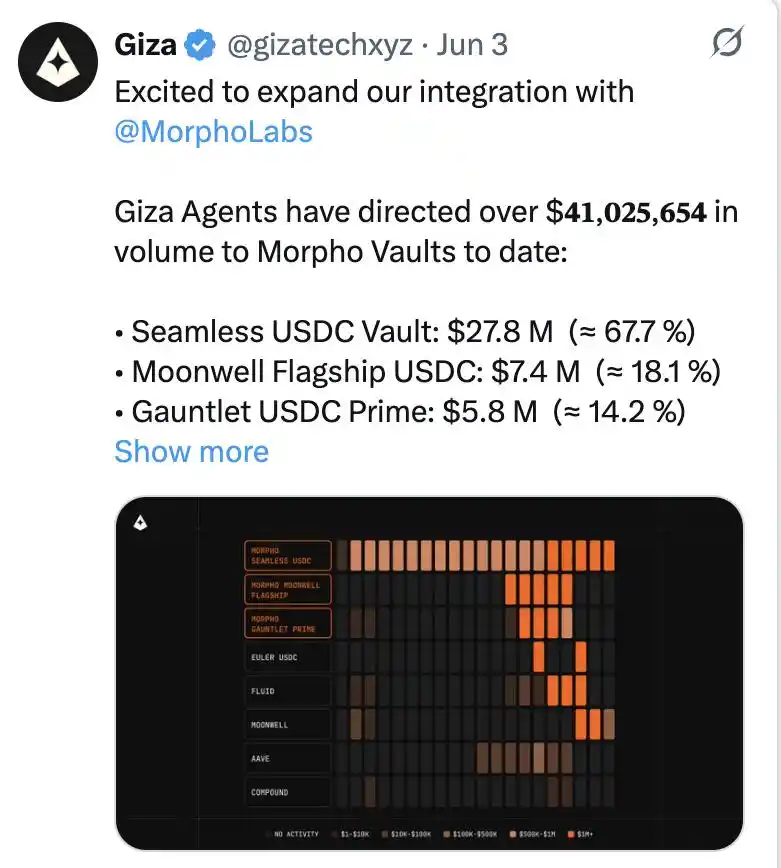
Giza's agent provides customizable and verifiable yield optimization services for users, built on multi-platform integration and a "risk-first" architecture;
1. Integrated @eigenlayer's AVS (Active Validation Service);
2. Utilizes advanced machine learning models to perform dynamic risk assessments by combining real-time market data;
3. Features an independently open-sourced zkML (zero-knowledge machine learning) framework, which will support more verifiable AI use cases in the future;
4. Implements smart accounts and session keys mechanisms to ensure non-custodial security—agents cannot directly control user funds, while users can set precise boundaries and time limits for operations;
5. Leverages MCP (multi-chain semantic abstraction layer) for smart orchestration of on-chain operations.
Currently, the Giza agent has generated over $70 million in trading volume across platforms such as Morpho, Aave, Fluid, and Compound. Notably, the flagship ARMA stablecoin farming agent has shown over 80% performance improvement compared to static strategies.
The recently released GIZA token has consistently outperformed the market during multiple bullish catalysts between June and July:
1. Re7 agents: Stablecoin and ETH yield optimization agents targeted at institutions are set to launch soon;
2. ARMA will integrate more complex dynamic machine learning systems to extend its capabilities;
3. Giza's zkML framework will also expand beyond financial use cases.
In addition to stablecoin and yield strategies, trading agents are another direction worth attention.
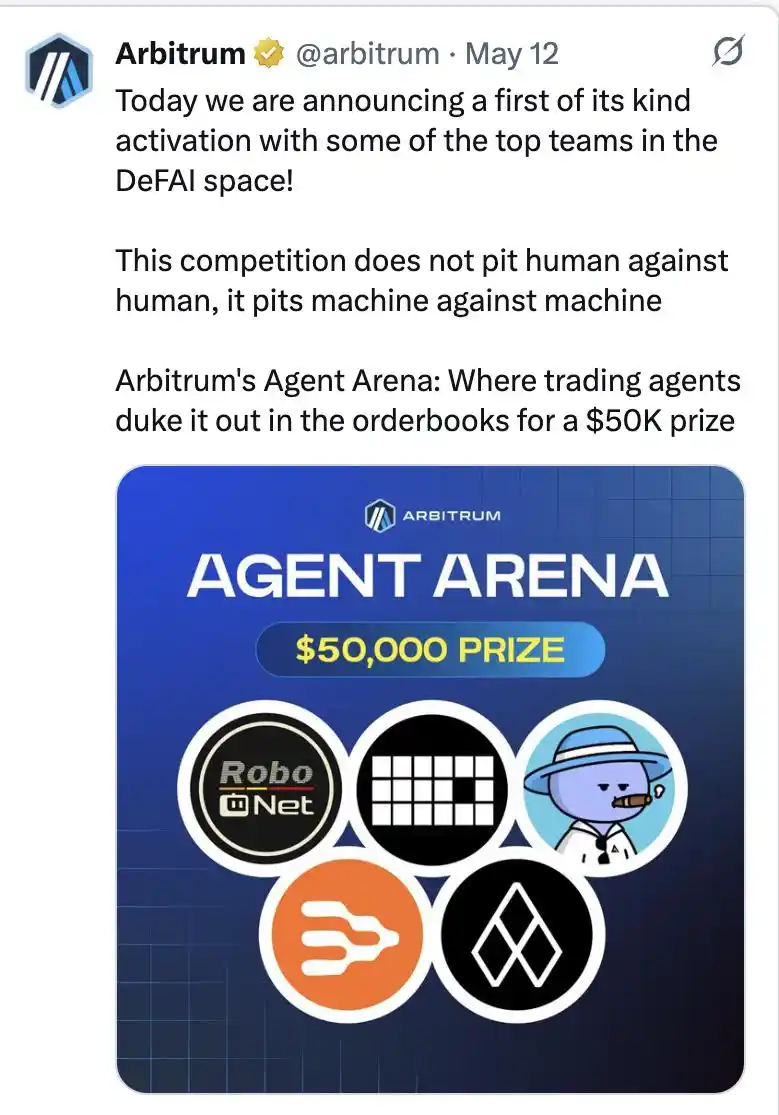
Trading agents are built on the promise of "trading for you and outperforming the market." Currently, only a handful of teams are actively developing in this space, with one of the best observation arenas being @arbitrum:
Arbitrum is hosting a 30-day agent showdown where top trading agent teams are competing on the same stage, with the winner set to receive a $50,000 prize;
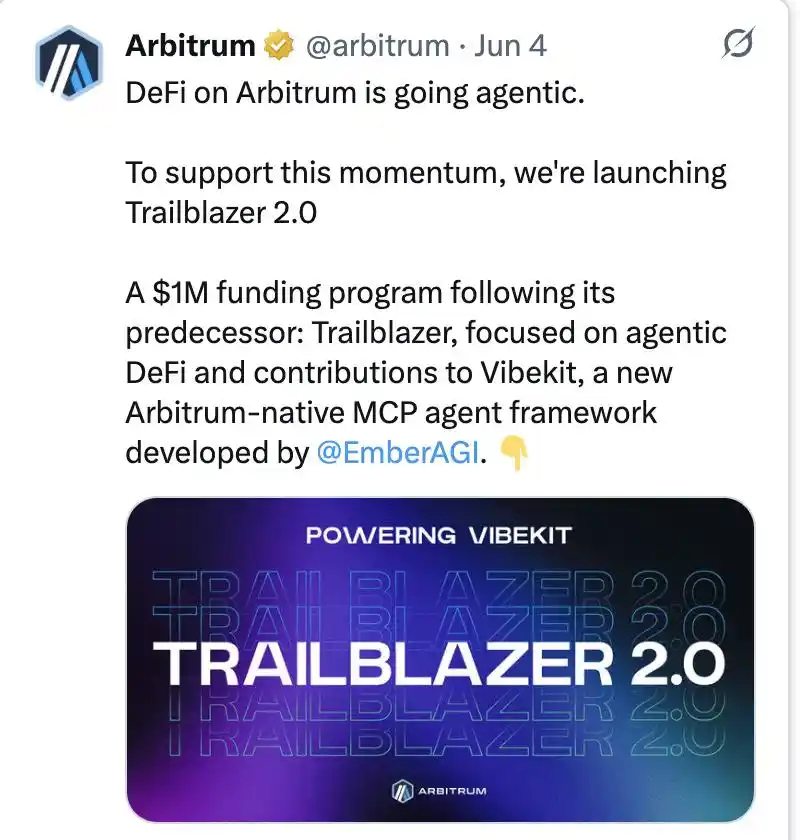
At the same time, Arbitrum has just launched Trailblazer 2.0, offering $1 million in funding to support teams contributing to Vibekit (developed by @EmberAGI and native to Arbitrum's MCP).
Although trading agents are still in their early stages and no clear long-term outperformers have emerged yet, much attention is being directed towards the beta version of @Almanak__. This system emphasizes scalability and privacy-first principles, enabling rapid deployment of quantitative trading agents.
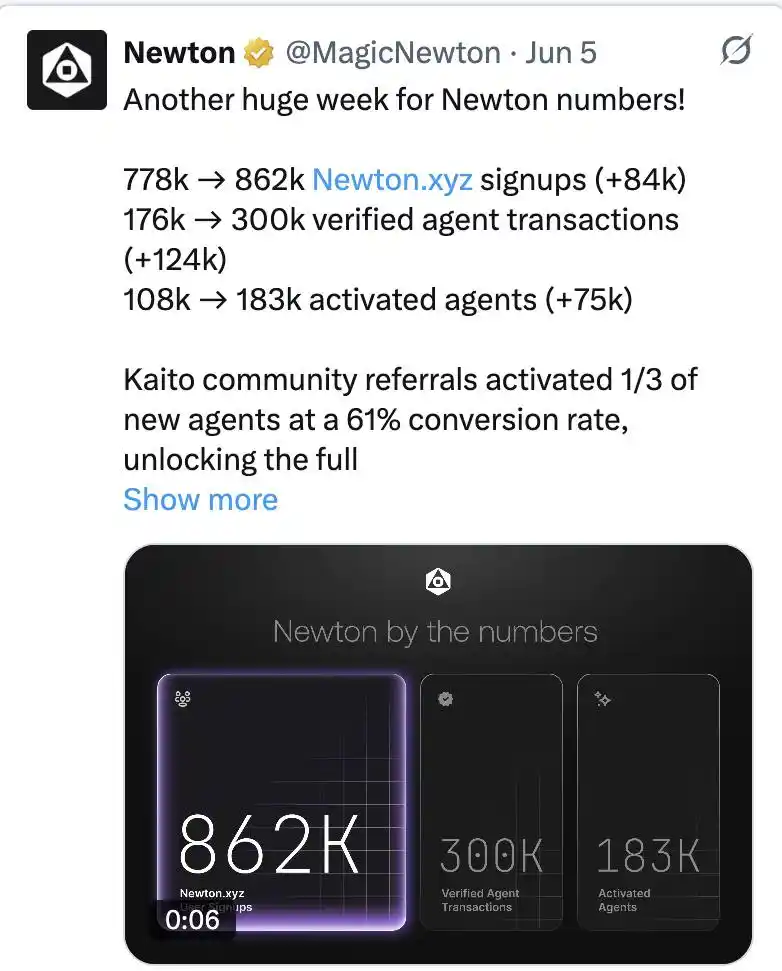
Another noteworthy team is @magicnewton, which utilizes Zero-Knowledge Proofs (ZKPs) and Trusted Execution Environments (TEEs) to build verifiable agents.
Their unique approach focuses on automated trading scenarios, starting from Dollar-Cost Averaging (DCA) agents, while constructing an "Automated Agent Marketplace" that allows third-party developers to create agents. Users' trading intents are matched with executors via a matchmaking Orderbook to form a complete closed-loop system.
Though still in its infancy, its integration with @KaitoAI has already shown initial signs of growth momentum.
Trends in Integrating AI with DeFi Protocols
An increasing number of DeFi protocols are incorporating AI into their product roadmaps, with applications ranging from basic customer support and product education (leveraging Large Language Models, LLMs) to embedding sophisticated Machine Learning (ML) models into core product functionalities.
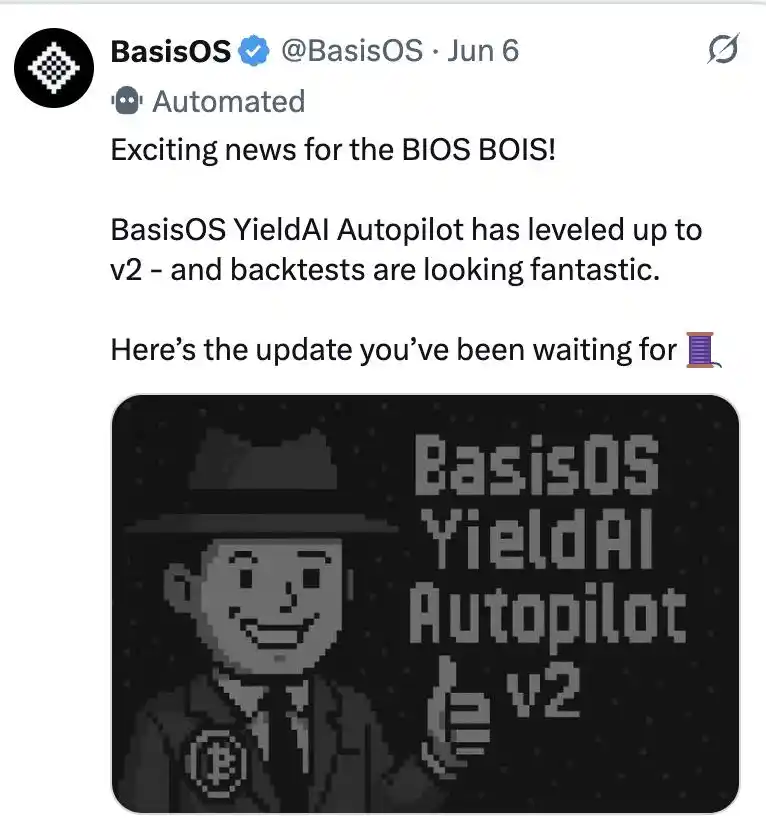
@BasisOS launched its token on @virtuals_io, backed by robust DeFi products (DN Vaults) and a forward-looking AI integration roadmap. The project continues to draw market attention, with strong token performance and growing TVL. Its latest release, YieldAI Autopilot v2, combines machine learning with inference mechanisms to deliver smarter, more efficient execution of DeFi yield strategies.
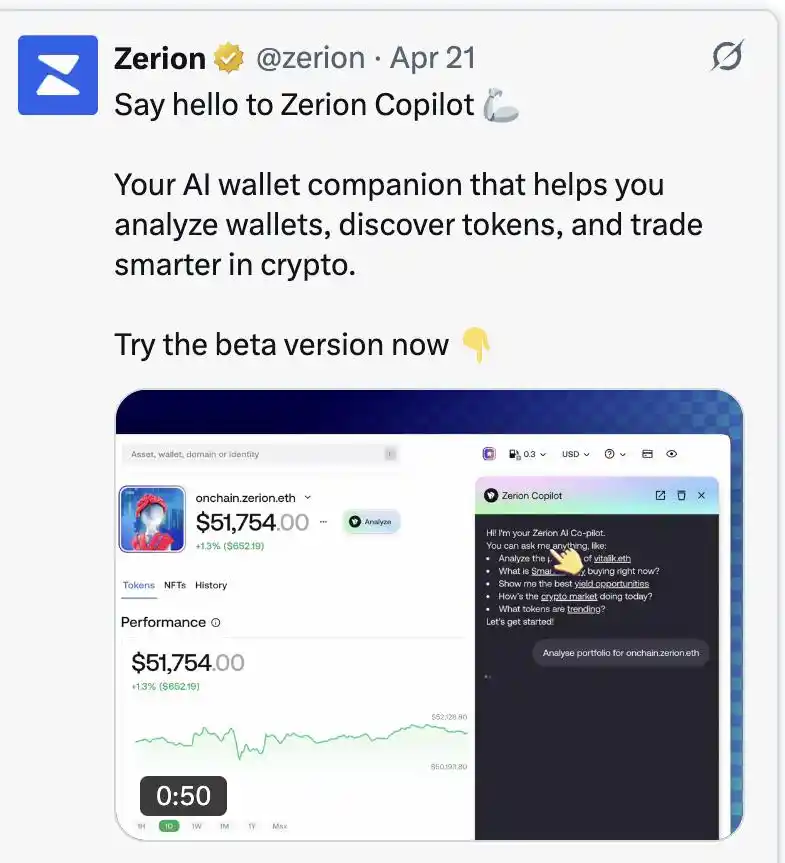
@loomlayai developed an AI co-pilot feature for @zerion, enabling users to directly analyze wallets, tokens, and uncover trends on the Zerion platform, enhancing the asset management experience.
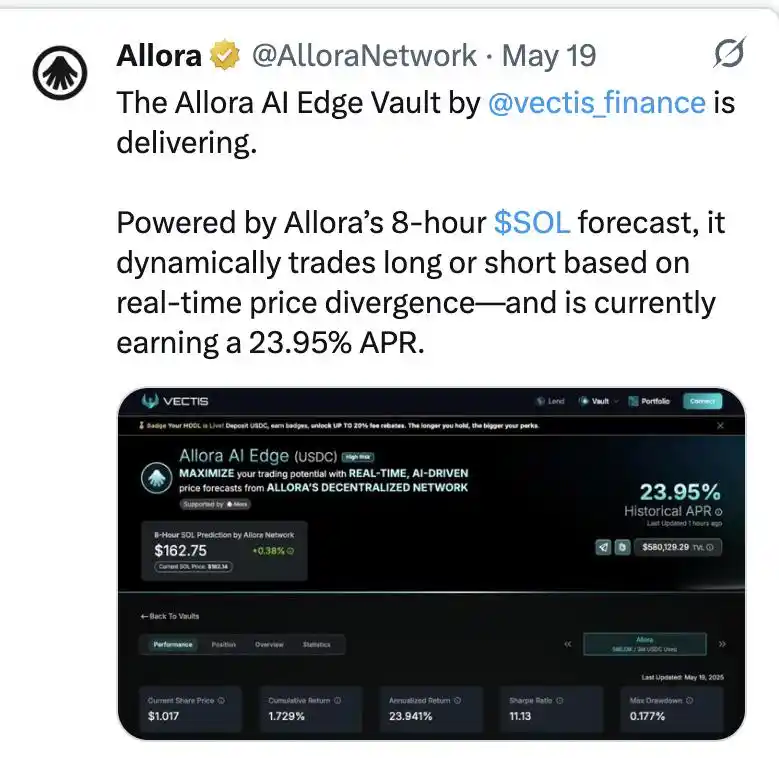
@vectis_finance integrated @AlloraNetwork's SOL price prediction model to develop a stablecoin strategy, maintaining a consistent annual yield of 15%-20%.
@modenetwork launches Mode Trade, integrating Synth Bittensor SN50's predictive inference capability directly into its Mode perpetual swap trading dApp.

Additionally, next week, we will witness the top-ranked options protocol @IthacaProtocol debut its new product, Stratos, on the Virtuals platform—a "smart swarm" composed of multiple options trading agents.
These AI agents will be driven by the liquidity-backed capital of the protocol (approximately $20,000 to $30,000) and will participate in various option trading strategies.
The AI system will process and categorize market data, identifying different "market regimes" such as bullish, bearish, high-volatility, and stable conditions, dynamically adjusting strategies accordingly.
Each agent in Stratos possesses a unique "personality," simulating experience-based decision-making processes: they evaluate algorithm-recommended trade commands but may override or modify strategies based on learned market experience, showcasing adaptive "subjective judgment."
Industry Evolution Direction
Convergence Trend: Traditional Alpha-capturing tools will deeply integrate with AI-enhanced user experiences.
Core Implementation Pathways:
1. Delivering frictionless insights via AI Co-pilots and Agentic Workflows.
2. Deepening the application of decentralized AI verification frameworks within autonomous agent systems:
1. Verifiability
2. Confidentiality
3. Privacy-Preserving Architecture
4. On-chain Execution integrations
Ultimate Vision: To enable anyone to seamlessly capture on-chain value across DeFi, RWAs (Real-World Assets), and more through AI interfaces.
Investment Mapping Logic
1. Focal Points for Value Capture:
1. The DeFAI project, with its underlying DeAI (Decentralized AI) capabilities, is set to replicate GIZA's value growth trajectory.
2. Core Standard: Building a new AI agent foundation layer that is "trustless and verifiable."
2. Motivations for Protocol Development:
1. Current valuation is heavily suppressed by Macro Overhang.
2. Market preferences are shifting from VC-backed infrastructure to Fair Launch projects.
Summary: Q2 will mark a stage of intensive breakout in differentiated innovation
Price fluctuations do not hinder progress. This quarter, we are seeing:
1. Many small, fair-launch teams sustaining rapid experimentation through lean operations + trading revenue, seeking product-market fit (PMF), and surviving resiliently;
2. Medium to large teams making their debut post-TGE (Token Generation Event). While initial prices face pressure, valuations will eventually align with fundamentals. This is particularly true during BTC-dominated attention cycles, where only a small number of altcoins garner interest amidst a choppy market.
Personal Statement: Thank you for reading! This is a condensed version. For my in-depth insights into the DeFAI space, please refer to the full version on my Substack column. Additionally, my "The After Hour" series will continue to provide updates on top DeAI potential projects and emerging protocol research reports (the latest target assessment will be released this weekend).
Disclaimer: This document is solely for informational sharing and opinion exchange purposes. The content herein under no circumstances constitutes investment advice or recommendations. Recipients must conduct independent due diligence based on their own financial situation, investment objectives, and risk tolerance (none of which are considered in this article). It is hereby stated that this document does not pertain to any offer or solicitation to buy or sell the assets mentioned, nor does it constitute a basis for any binding agreement.
Welcome to join the official BlockBeats community:
Telegram Subscription Group: https://t.me/theblockbeats
Telegram Discussion Group: https://t.me/BlockBeats_App
Official Twitter Account: https://twitter.com/BlockBeatsAsia

 Related Articles