error
Source: okx

The current cryptocurrency narrative is divided into two extremes: on one side, the BTC dominance continues; on the other, the MEME trend is surging. On high-performance public chains like Solana, Avalanche, and BSC, thousands of MEME coins continue to emerge, attracting more and more on-chain players to the battlefield. Everyone wants to go from being a Pion to a General, hoping to catch the next "golden dog."
How many Pions in the MEME battlefield have actually made money? Let's start with the conclusion: approximately only 10% to 20%. The rest mostly fall into the liquidity trap. Over 80% of MEME coins have a lifespan of less than 24 hours—what you think is getting in on the "first wave" is actually just carrying the sedan chair for earlier Pions. After researching the P Generals who managed to ride the golden dog trend, it was discovered that they share several key features: partnering with KOLs to drive traffic; initiating self-projects with a clear rhythm, conducting the first round of pumping to attract attention, the second round to wash out weak hands, and the third round to pump and dump; highly automated processes, including blockchain monitoring, robot deployment, and seamless coordination; collaborative efforts with clear goals and precise division of labor, truly resembling professional traders.
So, the question arises: Is there a better way to participate? Yes, if you can't beat them, join them. Tracking the addresses of these P Generals is one of the best ways to enter the game. Their on-chain address behavior serves as the best MEME compass.MEME Handbook Issue 01 will first discuss how to track reputable addresses and build your own address intelligence system. In the following issues, more advanced gameplay will be explored, such as identifying and trailing smart money, blockchain scanning and dormant techniques, understanding the bid/ask spread, cross-verifying uncertain information, and managing expectations and fund allocation. Stay tuned for more insights and let's learn together to avoid pitfalls and level up.
Multi-Chain Address Tracking—Convenient on both PC & Mobile
OKX Wallet's "Tracking" feature is one of the core tools for building and tracking an on-chain address library. One of its greatest advantages is that the experience is nearly identical on mobile and web platforms, delivering a smooth and seamless experience that is always online. This is crucial for MEME players because the market never waits. For demonstration purposes, the following steps will be conducted using the OKX Wallet web platform: log in to the OKX Wallet website → connect your wallet → go to the "Market" page → open the "Tracking Panel."
After opening the "Tracking Panel," you will find that it is not just a simple wallet tool but an all-in-one on-chain intelligence station and trading system. The Smart Money section covers not only the most active addresses but also real-time tracking of addresses on multiple chains such as ETH, BSC, Avalanche, and Solana. All data is derived from on-chain interactions, with delays controlled at the millisecond level, ensuring you can capture the movements of smart money—whether they are accumulating, scanning the market, or offloading—so you can get crucial information before the market kicks off.
errorThe "Tracking Panel" supports users to follow up to 600 addresses, providing a visual design. For most real users, this upper limit is already enough, the key is: how you manage, how you annotate and group, how you set up tags! It is recommended that novice users group from a few basic dimensions, as follows:
1. On-chain, Off-chain
2. Long-term holding, Prefer swing trading
3. Chinese Community KOL, Western Community KOL
4. DEV address, Whale/Whale Address, Insider Trading Address
5. High Win Rate Address, High Yield Address
6. Front-Running Address, "Sandwich" Address, and so on
Currently, OKX Wallet's address grouping supports multiple selections, for example, an address is both on-chain and a KOL, in short, good grouping habits can help you better observe and track, quickly identify their behavior patterns, and read real signals from a massive amount of data. For example, recently Player A caught a wallet address on the Solana blockchain through the "Tracking Panel" leaderboard, which used a limit order to open a position in Theranos. This kind of low-key accumulation often means that there may be a whale quietly sweeping goods. Therefore, Player A followed the whale's layout, bought in, and benefited from a surge, achieving their own "Aha Moment."
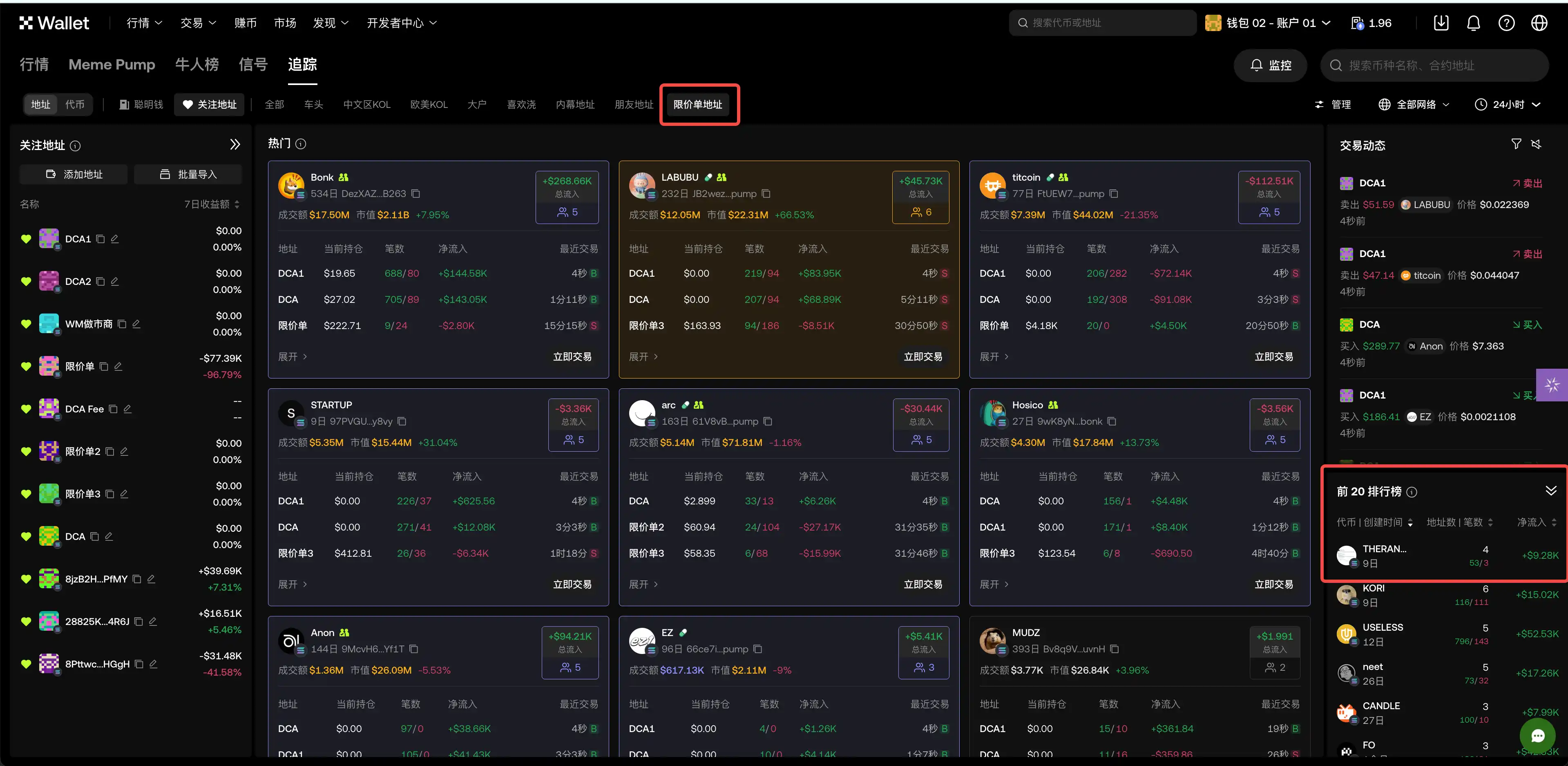
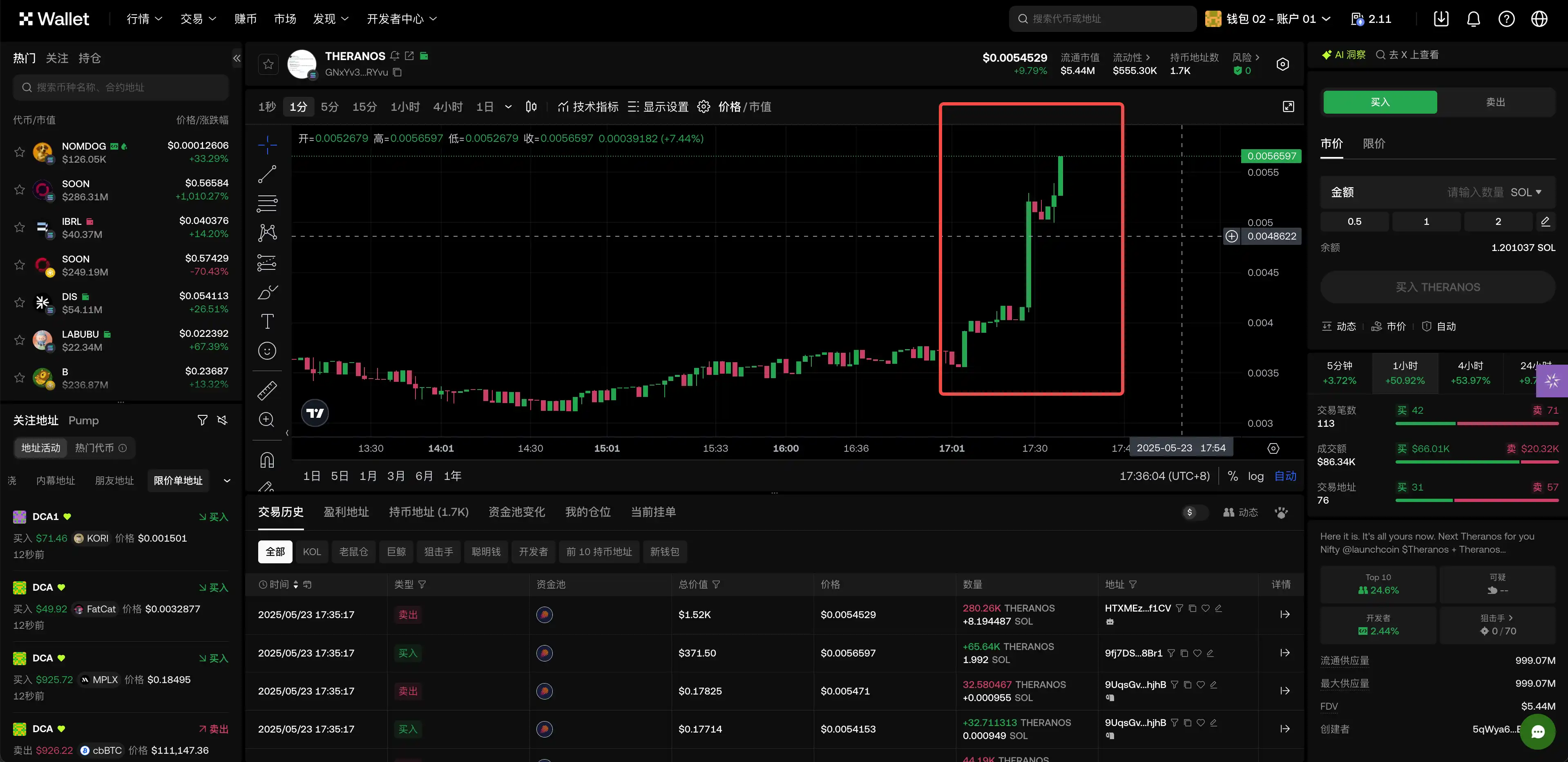
Address Library "Realization" Diagram
Furthermore, OKX Wallet is currently one of the very few wallet tools that first launched on mobile to support address tracking and real-time alerts. After setting up the alerts, as long as you have push notifications enabled in the app, you will receive prompts for a specific address's position opening, adding, or aggressive buying — this means you can leave your computer without missing out on opportunities while going out for a meal.
Is It an Opportunity or a Bear Trap? Practical Experience Sharing
A good address library is your on-chain transaction battlefield map and early warning radar. Here is a scenario where veteran Meme player B used the OKX Wallet "Tracking" feature as a "highlight." Senior player B used the OKX Wallet's "bulk import feature" through "tracking" to collect Jupiter's DCA (Dollar-Cost Averaging) addresses and create a group. By using the net fund inflow leaderboard, they could determine which tokens the on-chain funds were flowing into, thus seizing a good opportunity. To briefly explain, behind the Jupiter DCA addresses, there might be a professional team with high security requirements and a large fund size because they will consistently DCA into a specific token to profit from its long-term growth.
errorerrorWelcome to join the official BlockBeats community:
Telegram Subscription Group: https://t.me/theblockbeats
Telegram Discussion Group: https://t.me/BlockBeats_App
Official Twitter Account: https://twitter.com/BlockBeatsAsia

 Related Articles