Explore AI Layer1: Seeking the Promised Land for On-Chain DeAI

Original Title: "Biteye & PANews Jointly Release AI Layer 1 Research Report: Exploring the Fertile Ground for On-Chain DeAI"
Original Authors: @anci_hu49074 (Biteye), @Jesse_meta (Biteye), @lviswang (Biteye), @0xjacobzhao (Biteye), @bz1022911 (PANews)
Overview
Background
In recent years, top tech companies such as OpenAI, Anthropic, Google, Meta, etc., have been advancing the rapid development of Large Language Models (LLMs). LLMs have demonstrated unprecedented capabilities across various industries, greatly expanding the human imagination space, and even showing the potential to replace human labor in some scenarios. However, the core of these technologies is firmly held by a few centralized tech giants. With ample capital and control over high-cost computing resources, these companies have established formidable barriers that make it difficult for the vast majority of developers and innovative teams to compete.
Source: BONDAI Trend Analysis Report
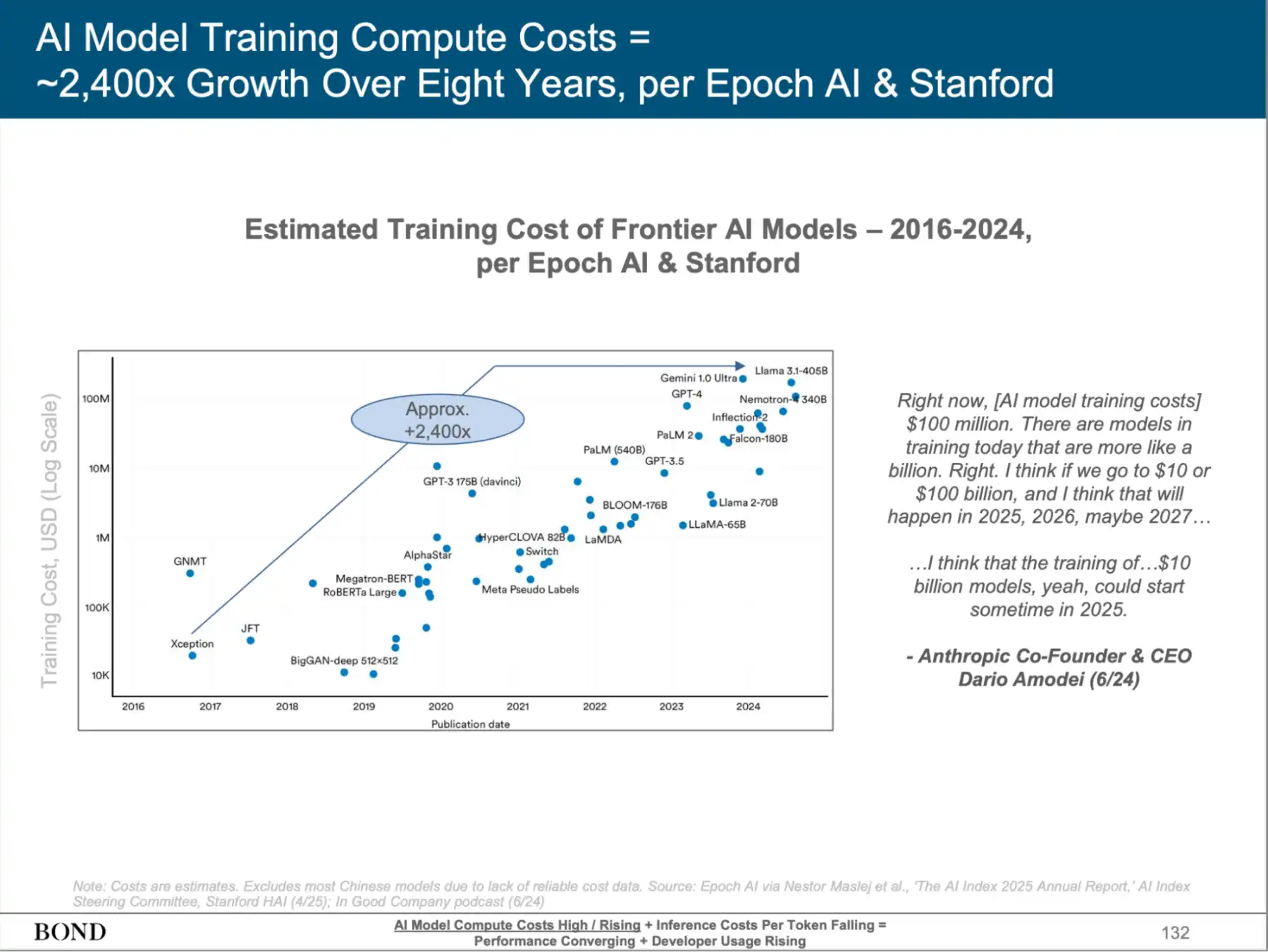
At the same time, in the early stages of AI's rapid evolution, public opinion often focused on the breakthroughs and conveniences brought by the technology, while relatively insufficient attention was paid to core issues such as privacy protection, transparency, security, etc. In the long run, these issues will profoundly affect the healthy development of the AI industry and its social acceptance. If not properly addressed, the debate over whether AI will "do good" or "do harm" will become increasingly prominent. Moreover, under the profit-driven nature of centralized giants, there is often a lack of sufficient motivation to proactively address these challenges.
Blockchain technology, with its decentralized, transparent, and censorship-resistant characteristics, has provided new possibilities for the sustainable development of the AI industry. Currently, numerous "Web3 AI" applications have emerged on mainstream blockchains such as Solana and Base. However, a deeper analysis reveals that these projects still face many issues: on the one hand, their level of decentralization is limited, key processes and infrastructure still rely on centralized cloud services, they exhibit a strong meme attribute, making it difficult to support a truly open ecosystem; on the other hand, compared to AI products in the Web2 world, on-chain AI still lags in model capabilities, data utilization, and application scenarios, indicating a need to enhance innovation depth and breadth.
To truly realize the vision of decentralized AI, enabling blockchain to securely, efficiently, and democratically support large-scale AI applications, and to compete with centralized solutions in performance, we need to design a Layer1 blockchain tailored specifically for AI. This will provide a solid foundation for open innovation in AI, democratic governance, and data security, driving the prosperous development of the decentralized AI ecosystem.
Core Features of AI Layer 1
AI Layer 1, as a blockchain designed specifically for AI applications, has its underlying architecture and performance design closely aligned with the needs of AI tasks, aiming to efficiently support the sustainable development and prosperity of the on-chain AI ecosystem. Specifically, AI Layer 1 should possess the following core capabilities:
Efficient Incentives and Decentralized Consensus Mechanism
At the core of AI Layer 1 is the construction of an open network for shared resources such as computing power and storage. Unlike traditional blockchain nodes that mainly focus on ledger keeping, AI Layer 1 nodes are required to undertake more complex tasks. They must not only provide computing power and complete AI model training and inference but also contribute diverse resources such as storage, data, and bandwidth. This aims to break the monopoly of centralized giants in AI infrastructure. This places higher demands on the underlying consensus and incentive mechanisms: AI Layer 1 must be able to accurately assess, incentivize, and validate nodes' actual contributions to AI inference, training, and other tasks, ensuring network security and efficient resource allocation. Only in this way can network stability and prosperity be ensured while effectively reducing the overall computing costs.
Outstanding High Performance and Heterogeneous Task Support Capability
AI tasks, especially LLM training and inference, place extremely high demands on computing performance and parallel processing capabilities. Furthermore, the on-chain AI ecosystem often needs to support diverse and heterogeneous task types, including different model structures, data processing, inference, storage, and other scenarios. AI Layer 1 must be deeply optimized at the underlying architecture for requirements such as high throughput, low latency, and elastic parallelism. It must also inherently support heterogeneous computing resources to ensure that various AI tasks can run efficiently, achieving a smooth transition from "single-task type" to a "complex and diverse ecosystem."
Verifiability and Trustworthy Output Assurance
AI Layer 1 must not only prevent security risks such as model malignancy and data tampering but also ensure the verifiability and alignment of AI output results from the underlying mechanism. By integrating cutting-edge technologies such as Trusted Execution Environments (TEE), Zero-Knowledge Proofs (ZK), and Multi-Party Computation (MPC), the platform can enable independent verification of every model inference, training, and data processing step, ensuring the fairness and transparency of the AI system. Moreover, this verifiability can help users understand the logic and basis of AI outputs, achieving "as intended," enhancing user trust and satisfaction with AI products.
Data Privacy Protection
AI applications often involve user sensitive data, especially in the fields of finance, healthcare, social, etc., where data privacy protection is crucial. The AI Layer 1 should ensure verifiability and utilize encryption-based data processing techniques, privacy computing protocols, data permission management, etc., to ensure the security of data throughout the entire process of inference, training, and storage, effectively preventing data leakage and misuse, eliminating user concerns about data security.
Powerful Ecosystem Support and Development Capability
As a native AI Layer 1 infrastructure, the platform should not only have technological leadership but also provide comprehensive development tools, integrated SDKs, operation support, and incentive mechanisms for developers, node operators, AI service providers, and other ecosystem participants. By continuously optimizing platform usability and developer experience, promoting a diverse range of AI-native applications, facilitating the decentralized AI ecosystem's continuous prosperity.
Building on this background and expectation, this article will detail six AI Layer 1 representative projects, including Sentient, Sahara AI, Ritual, Gensyn, Bittensor, and 0G, systematically review the latest developments in the field, analyze the current status of the projects, and discuss future trends.
Sentient: Building a Trustworthy Open-Source Decentralized AI Model
Project Overview
Sentient is an open-source protocol platform that is building an AI Layer 1 blockchain (initially Layer 2, later migrating to Layer 1). By combining AI Pipeline and blockchain technology, it is constructing a decentralized artificial intelligence economy. Its core goal is to solve the issues of model ownership, call tracking, and value distribution in a centralized LLM market through the "OML" framework (Open, Monetizable, Loyal), enabling on-chain ownership structure, call transparency, and value sharing for AI models. Sentient's vision is to enable anyone to build, collaborate, own, and monetize AI products, thereby driving a fair, open AI Agent network ecosystem.
The Sentient Foundation team brings together top global academic experts, blockchain entrepreneurs, and engineers, dedicated to building a community-driven, open-source, and verifiable AGI platform. Key members include Princeton University Professor Pramod Viswanath and Indian Institute of Science Professor Himanshu Tyagi, responsible for AI security and privacy protection, led by Polygon co-founder Sandeep Nailwal overseeing blockchain strategy and ecosystem development. Team members have backgrounds across well-known companies such as Meta, Coinbase, Polygon, leading universities like Princeton University, Indian Institute of Technology, covering AI/ML, NLP, computer vision, among other fields, working together to drive the project forward.
As the second entrepreneurial project of Polygon co-founder Sandeep Nailwal, Sentient came with its own halo at the outset, boasting abundant resources, connections, and market recognition that provided a strong endorsement for the project's development. In mid-2024, Sentient completed an $85 million seed round of financing, led by Founders Fund, Pantera, and Framework Ventures, with other investment institutions including Delphi, Hashkey, and Spartan, among dozens of other well-known VCs.
Design Architecture and Application Layer
1. Infrastructure Layer
Core Architecture
Sentient's core architecture consists of an AI Pipeline and a blockchain system:
The AI Pipeline is the foundation for developing and training "loyal AI" artifacts, comprising two core processes:
· Data Curation: A community-driven data selection process used for model alignment.
· Loyalty Training: Ensuring the model undergoes training consistent with community intent.
The blockchain system provides transparency and decentralized control to the protocol, ensuring ownership of AI artifacts, usage tracking, revenue distribution, and equitable governance. The specific architecture is divided into four layers:
· Storage Layer: Stores model weights and fingerprint registration information;
· Distribution Layer: Authorization contracts control model invocation entry points;
· Access Layer: Validates user authorization through proof of permission;
· Incentive Layer: Revenue routing contracts allocate payments for each invocation to trainers, deployers, and validators.
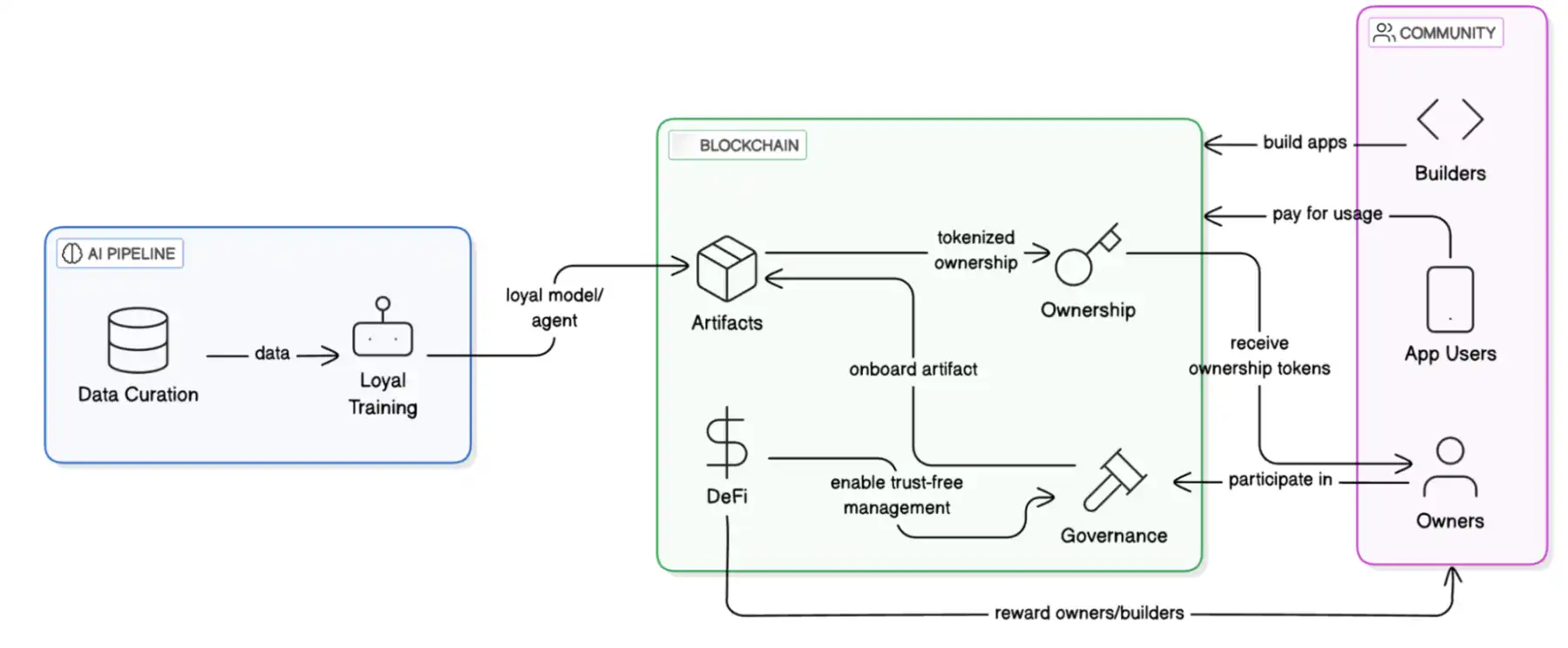
Sentient System Workflow Diagram
OML Model Framework
The OML framework (Open, Monetizable, Loyal) is the core concept proposed by Sentient, aiming to provide explicit ownership protection and economic incentive mechanisms for open-source AI models. By combining on-chain technology and AI-native cryptography, it has the following characteristics:
· Openness: The model must be open source, with transparent code and data structure to facilitate community reproduction, audit, and improvement.
· Monetization: Every model invocation triggers a revenue stream, with on-chain contracts distributing the revenue to trainers, deployers, and validators.
· Loyalty: The model belongs to the contributor community, with upgrade direction and governance determined by a DAO, and its use and modification controlled by cryptographic mechanisms.
AI-native Cryptography
AI-native Cryptography utilizes the continuity of AI models, low-dimensional manifold structure, and model differentiability to develop a "verifiable but non-removable" lightweight security mechanism. Its core technologies include:
· Fingerprint Embedding: Inserting a set of hidden query-response key pairs during training to form a unique signature for the model;
· Ownership Verification Protocol: Third-party verifiers (Provers) validate if the fingerprint is retained in a query-response format;
· Permissioned Invocation Mechanism: Prior to invocation, obtaining a "permission credential" issued by the model owner, upon which the system authorizes the model to decode the input and provide an accurate response.
This approach enables "behavior-based authorization invocation + ownership verification" without significant re-encryption costs.
Model Ownership and Secure Execution Framework
Sentient currently employs the Melange hybrid security approach: combining fingerprint ownership, TEE execution, and on-chain contract revenue sharing. The fingerprint method is based on OML 1.0, emphasizing the "Optimistic Security" concept, where default compliance is assumed, and violations can be detected and penalized.
The fingerprint mechanism is a key implementation of OML, generating unique signatures during the training phase through the embedding of specific "question-answer" pairs. Through these signatures, model owners can verify ownership, preventing unauthorized replication and commercialization. This mechanism not only protects the rights of model developers but also provides a traceable on-chain record of model usage behavior.
Furthermore, Sentient has introduced the Enclave TEE computing framework, utilizing trusted execution environments (such as AWS Nitro Enclaves) to ensure that models only respond to authorized requests, preventing unauthorized access and use. While TEE relies on hardware and has certain security risks, its high performance and real-time advantages make it a core technology for current model deployment.
In the future, Sentient plans to introduce Zero Knowledge Proof (ZK) and Fully Homomorphic Encryption (FHE) technologies to further enhance privacy protection and verifiability, providing a more mature solution for the decentralized deployment of AI models.
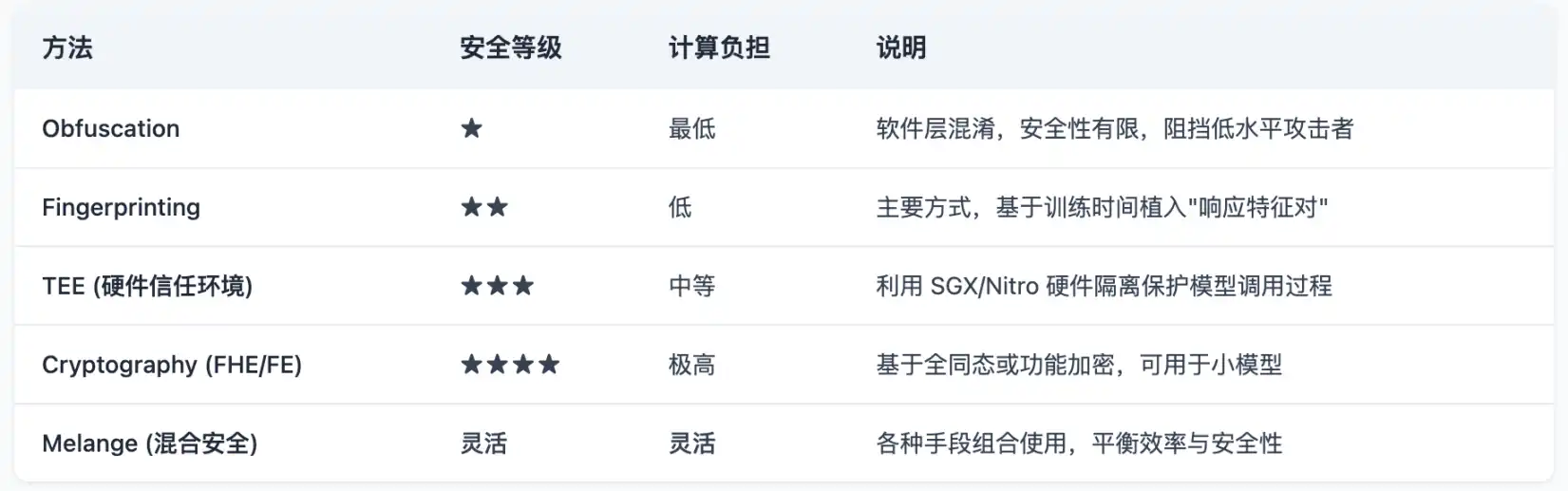
OML proposes an evaluation and comparison of five verifiability methods
2. Application Layer
Currently, Sentient's products mainly include the decentralized chat platform Sentient Chat, the open-source Dobby series of models, and the AI Agent framework.
Dobby Series Models
SentientAGI has released multiple "Dobby" series models, mainly based on the Llama model, focusing on the values of freedom, decentralization, and cryptocurrency support. Among them, the leashed version is more restrained and rational in style, suitable for scenarios requiring stable outputs; the unhinged version leans towards freedom and boldness, with a more diverse conversational style. The Dobby models have been integrated into multiple Web3 native projects, such as Firework AI and Olas. Users can also directly invoke these models for interaction in Sentient Chat. Dobby 70B is the most decentralized model to date, with over 600,000 owners (those who hold the Dobby fingerprint NFT are also co-owners of the model).
Sentient also plans to launch Open Deep Search, which is an attempt to go beyond ChatGPT and Perplexity Pro with a search agent system. This system combines Sensient's search features (such as query reformulation and document processing) with an inference agent to enhance search quality through open-source LLMs (such as Llama 3.1 and DeepSeek). Its performance on the Frames Benchmark has surpassed other open-source models and even approached some closed-source models, demonstrating its strong potential.
Sentient Chat: Decentralized Chat with On-Chain AI Agent Integration
Sentient Chat is a decentralized chat platform that combines open-source large language models (such as the Dobby series) with advanced inference agent frameworks, supporting multi-agent integration and complex task execution. The embedded inference agent in the platform can perform tasks such as search, computation, and code execution, providing users with an efficient interactive experience. Additionally, Sentient Chat supports direct integration of on-chain intelligent agents, currently including the Astrology Agent Astro247, the Crypto Analysis Agent QuillCheck, the Wallet Analysis Agent Pond Base Wallet Summary, and the Meditation Guidance Agent ChiefRaiin. Users can interact with different intelligent agents based on their needs. Sentient Chat will be used as a distribution and coordination platform for agents. User inquiries can be routed to any integrated model or agent to provide the best response results.
AI Agent Framework
Sentient provides two AI Agent frameworks:
· Sentient Agent Framework: A lightweight open-source framework focused on automating web tasks through natural language instructions (e.g., search, video playback). The framework supports building intelligent agents with perception, planning, execution, and feedback loops, suitable for lightweight development of off-chain web tasks.
· Sentient Social Agent: An AI system designed for social platforms (e.g., Twitter, Discord, and Telegram), supporting automated interactions and content generation. Through multi-agent collaboration, this framework can understand social contexts and provide users with a more intelligent social experience. It can also integrate with the Sentient Agent Framework to further expand its applications.
Ecosystem and Participation
The Sentient Builder Program currently offers a $1 million grant program to encourage developers to utilize its development kit to build AI agents that can access the Sentient Agent API and operate within the Sentient Chat ecosystem. The ecosystem partners listed on the Sentient website cover various projects in the Crypto AI space, as follows
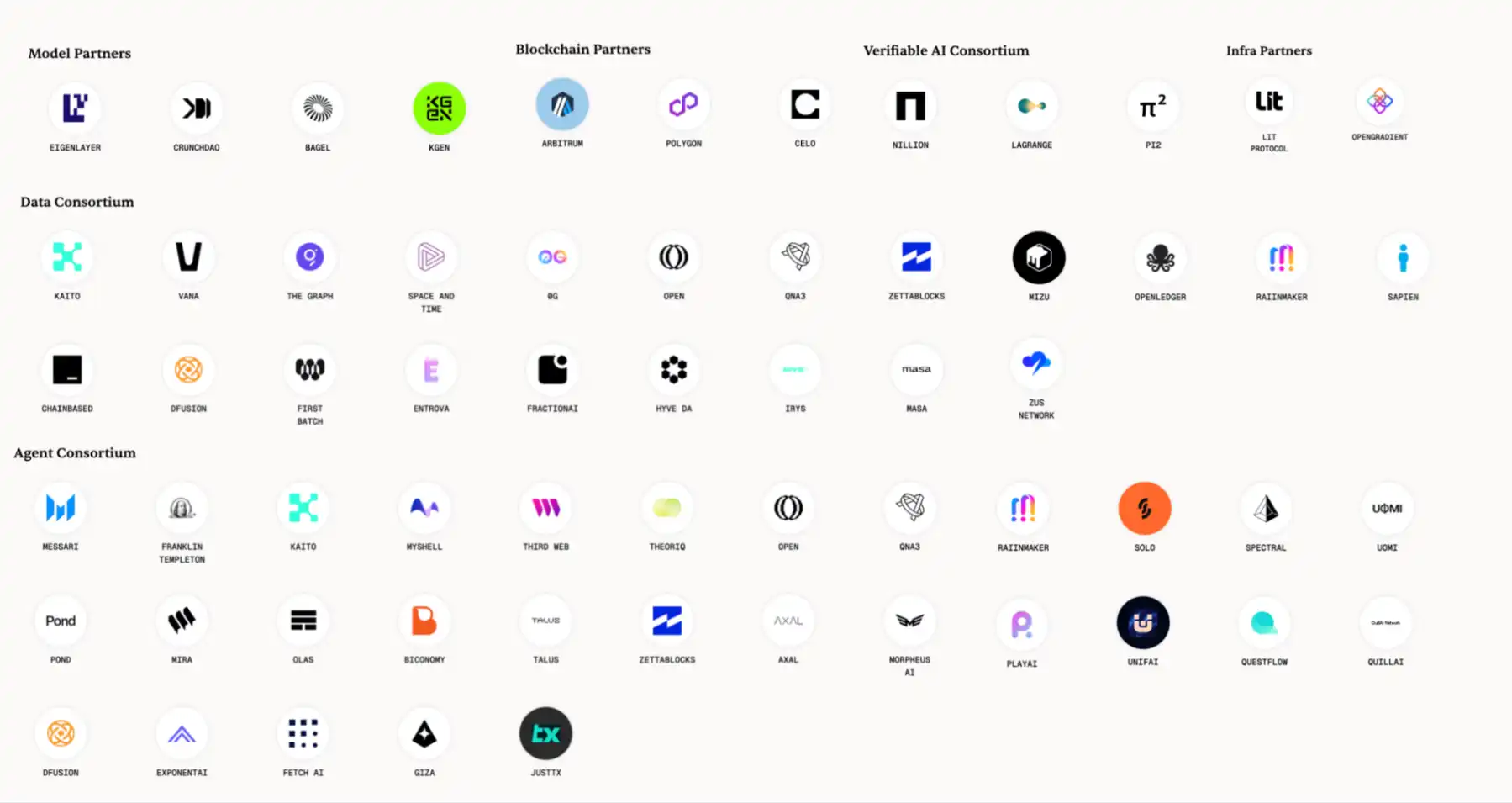
Sentient Ecosystem Chart
Furthermore, Sentient Chat is currently in a testing phase and requires an invitation code to access the whitelist. Regular users can join the waitlist. According to official information, there are already over 50,000 users and 1,000,000 query records. The Sentient Chat waitlist has 2,000,000 users waiting to join.
Challenges and Prospects
Sentient starts from the model end, aiming to address core issues faced by Large Language Models (LLMs) such as misalignment and lack of trust. Through the OML framework and blockchain technology, Sentient provides models with a clear ownership structure, usage tracking, and behavioral constraints, significantly advancing the development of decentralized open-source models.
Backed by Polygon co-founder Sandeep Nailwal's resources and endorsed by top VCs and industry partners, Sentient is a leader in resource integration and market attention. However, against the backdrop of the current market gradually losing interest in overvalued projects, whether Sentient can deliver truly impactful decentralized AI products will be a key test of its ability to become the standard for decentralized AI ownership. These efforts are not only crucial to Sentient's own success but also have far-reaching implications for rebuilding trust in the industry and decentralized development.
Sahara AI: Building a Decentralized AI World for Everyone
Project Overview
Sahara AI is a decentralized infrastructure born for the AI × Web3 new paradigm, dedicated to building an open, fair, and collaborative AI economy. The project achieves on-chain management and transactions of datasets, models, and intelligent agents through decentralized ledger technology, ensuring data and model sovereignty and traceability. At the same time, Sahara AI introduces a transparent, fair incentive mechanism that allows all contributors, including data providers, annotators, and model developers, to receive tamper-proof income rewards throughout the collaboration process. The platform also protects contributors' ownership and attribution of AI assets through an unlicensed "copyright" system, encouraging open sharing and innovation.
Sahara AI provides a one-stop solution covering the entire AI lifecycle, from data collection and annotation to model training, AI agent creation, and AI asset trading, meeting the AI development needs as a comprehensive ecosystem platform. Its product quality and technical capabilities have been highly recognized by global top enterprises and institutions such as Microsoft, Amazon, MIT, Motherson Group, and Snap, demonstrating strong industry influence and wide applicability.
Sahara is not just a research project but a deep-tech platform jointly driven by front-line tech entrepreneurs and investors with a focus on implementation. Its core architecture could become a key anchor for the implementation of AI × Web3 applications. Sahara AI has received a total of $43 million investment support from top institutions such as Pantera Capital, Binance Labs, and Sequoia China; co-founded by University of Southern California tenured professor and 2023 Samsung Research Fellow Sean Ren and former Binance Labs Investment Director Tyler Zhou, with core team members from Stanford University, UC Berkeley, Microsoft, Google, Binance, and other top institutions, integrating deep academic and industry expertise.
Design Architecture
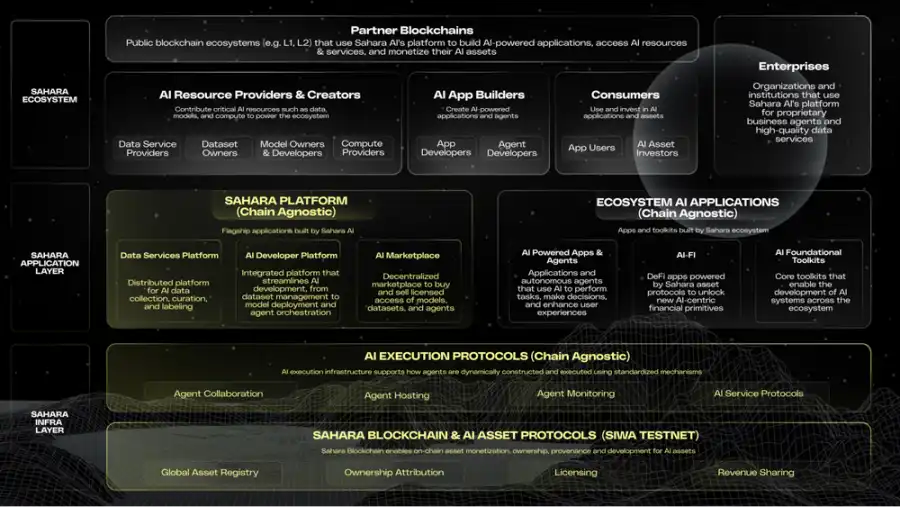
Sahara AI Architecture Diagram
1. Base Layer
The base layer of Sahara AI is divided into: 1. On-chain layer for AI asset registration and monetization, 2. Off-chain layer for running Agents and AI services. It consists of a collaborative on-chain and off-chain system responsible for AI asset registration, proof of ownership, execution, and revenue distribution, supporting trusted collaboration throughout the entire AI lifecycle.
Sahara Blockchain and SIWA Testnet (On-chain Infrastructure)
The SIWA testnet is the first public version of the Sahara blockchain. The Sahara Blockchain Protocol (SBP) is the core of the Sahara blockchain, which is a smart contract system designed specifically for AI, achieving on-chain ownership, traceability records, and revenue distribution of AI assets. Core modules include asset registration system, ownership protocol, contribution tracking, permission management, revenue distribution, execution proof, etc., building an "on-chain operating system" for AI.
AI Execution Protocol (Off-chain Infrastructure)
To support the trustworthiness of model execution and invocation, Sahara has also built an off-chain AI execution protocol system, combined with Trusted Execution Environments (TEE), supporting Agent creation, deployment, operation, and collaborative development. Each task execution automatically generates verifiable records, which are uploaded on-chain to ensure full traceability and verifiability throughout the process. The on-chain system is responsible for registration, authorization, and ownership records, while the off-chain AI execution protocol supports real-time operation and service interaction of AI Agents. As Sahara is cross-chain compatible, applications built on Sahara AI infrastructure can be deployed on any chain, even off-chain.
2. Application Layer
Sahara AI Data Service Platform (DSP)
The Data Service Platform (DSP) is a foundational module of Sahara's application layer, where anyone can receive data tasks via Sahara ID, participate in data annotation, denoising, and auditing, and receive on-chain point rewards (Sahara Points) as a contribution credential. This mechanism ensures data traceability and ownership, while driving a "contribution-reward-model optimization" loop. The platform is currently in its fourth season of activities, serving as the primary way for ordinary users to contribute.
Building on this foundation, to encourage users to submit high-quality data and services, through the introduction of a dual-incentive mechanism, not only can you receive rewards provided by Sahara, but you can also receive additional rewards from ecosystem partners, achieving a win-win situation through a single contribution. Taking data contributors as an example, once their data is repeatedly called by models or used to generate new applications, they can continue to receive benefits, truly participating in the AI value chain. This mechanism not only extends the lifecycle of data assets but also injects strong momentum into collaboration and co-construction. For example, on the BNB Chain, MyShell utilizes DSP crowdsourcing to generate custom datasets, enhance model performance, and users receive MyShell token incentives, forming a mutually beneficial closed loop.
AI enterprises can crowdsource custom datasets based on the data service platform by publishing specific data tasks, swiftly receiving responses from data annotators located globally. AI enterprises no longer solely rely on traditional centralized data providers but can massively acquire high-quality annotated data.
Sahara AI Developer Platform
The Sahara AI Developer Platform is an all-in-one AI building and operating platform for developers and enterprises, providing full-process support from data acquisition, model training to deployment execution, and asset monetization. Users can directly access high-quality data resources in the Sahara DSP for model training and fine-tuning; completed models can be composed, registered, and listed on the AI market within the platform, achieving ownership confirmation and flexible authorization through the Sahara blockchain.
The Studio also integrates decentralized computing capabilities, supporting model training and Agent deployment operation, ensuring the security and verifiability of the computation process. Developers can also store key data and models, perform encrypted hosting and permission control to prevent unauthorized access. Through the Sahara AI Developer Platform, developers can easily build, deploy, and commercialize AI applications at a lower threshold without having to self-build infrastructure, and seamlessly integrate into the on-chain AI economic system through protocolized mechanisms.
AI Marketplace
The Sahara AI Marketplace is a decentralized asset marketplace for models, datasets, and AI Agents. It not only supports asset registration, trading, and authorization but also establishes a transparent and traceable revenue distribution mechanism. Developers can register their own built models or collected datasets as on-chain assets, set flexible usage authorizations and revenue-sharing ratios, and the system will automatically execute revenue settlement based on call frequency. Data contributors can also continuously receive revenue sharing as their data is repeatedly called, achieving "continuous monetization."
This marketplace is deeply integrated with the Sahara blockchain protocol, where all asset transactions, calls, and revenue sharing records will be verifiable on-chain, ensuring clear asset ownership and traceable revenue. Through this marketplace, AI developers no longer rely on traditional API platforms or centralized model hosting services, but instead have an autonomous, programmable path to commercialization.
3. Ecosystem Layer
The ecosystem layer of Sahara AI connects data providers, AI developers, consumers, enterprise users, and cross-chain partners. Whether contributing data, developing applications, using products, or driving internal AI adoption within enterprises, participants can play a role and find revenue models. Data annotators, model development teams, and computing power providers can register their resources as on-chain assets, authorize and share rewards through Sahara AI's protocol mechanism, ensuring that every use of the resource automatically receives a return. Developers can integrate data, train models, deploy agents through a one-stop platform, and directly commercialize their results in the AI Marketplace.
Ordinary users without technical backgrounds can participate in data tasks, use AI apps, collect or invest in on-chain assets, becoming part of the AI economy. For enterprises, Sahara offers end-to-end support from data crowdsourcing and model development to private deployment and revenue realization. In addition, Sahara supports cross-chain deployment, allowing any public chain ecosystem to use the protocols and tools provided by Sahara AI to build AI applications, access decentralized AI assets, and achieve compatibility and extension in a multi-chain world. This makes Sahara AI not just a single platform but also a fundamental collaborative standard for on-chain AI ecosystems.
Ecosystem Progress
Since the project's inception, Sahara AI has not only provided a set of AI tools or computing power platform but also has restructured the on-chain production and distribution order of AI, creating a decentralized collaboration network where everyone can participate, have ownership, contribute, and share. It is for this reason that Sahara has chosen blockchain as the underlying architecture to build a verifiable, traceable, and allocatable economic system for AI.
Around this core goal, the Sahara ecosystem has made significant progress. Despite still being in the private testing phase, the platform has accumulated over 3.2 million on-chain accounts, with daily active accounts consistently above 1.4 million, demonstrating user engagement and network vitality. Among them, over 200,000 users have participated in data annotation, training, and validation tasks through the Sahara data service platform, receiving on-chain incentive rewards. At the same time, millions of users are still waiting to join the whitelist, confirming the market's strong demand for decentralized AI platforms and consensus.
In terms of corporate partnerships, Sahara has collaborated with global leading institutions such as Microsoft, Amazon, and the Massachusetts Institute of Technology (MIT) to provide them with customized data collection and annotation services. Enterprises can submit specific tasks through the platform, which are efficiently executed by Sahara's global network of data annotators, enabling scalable crowdsourcing. The advantages lie in execution efficiency, flexibility, and support for diverse needs.
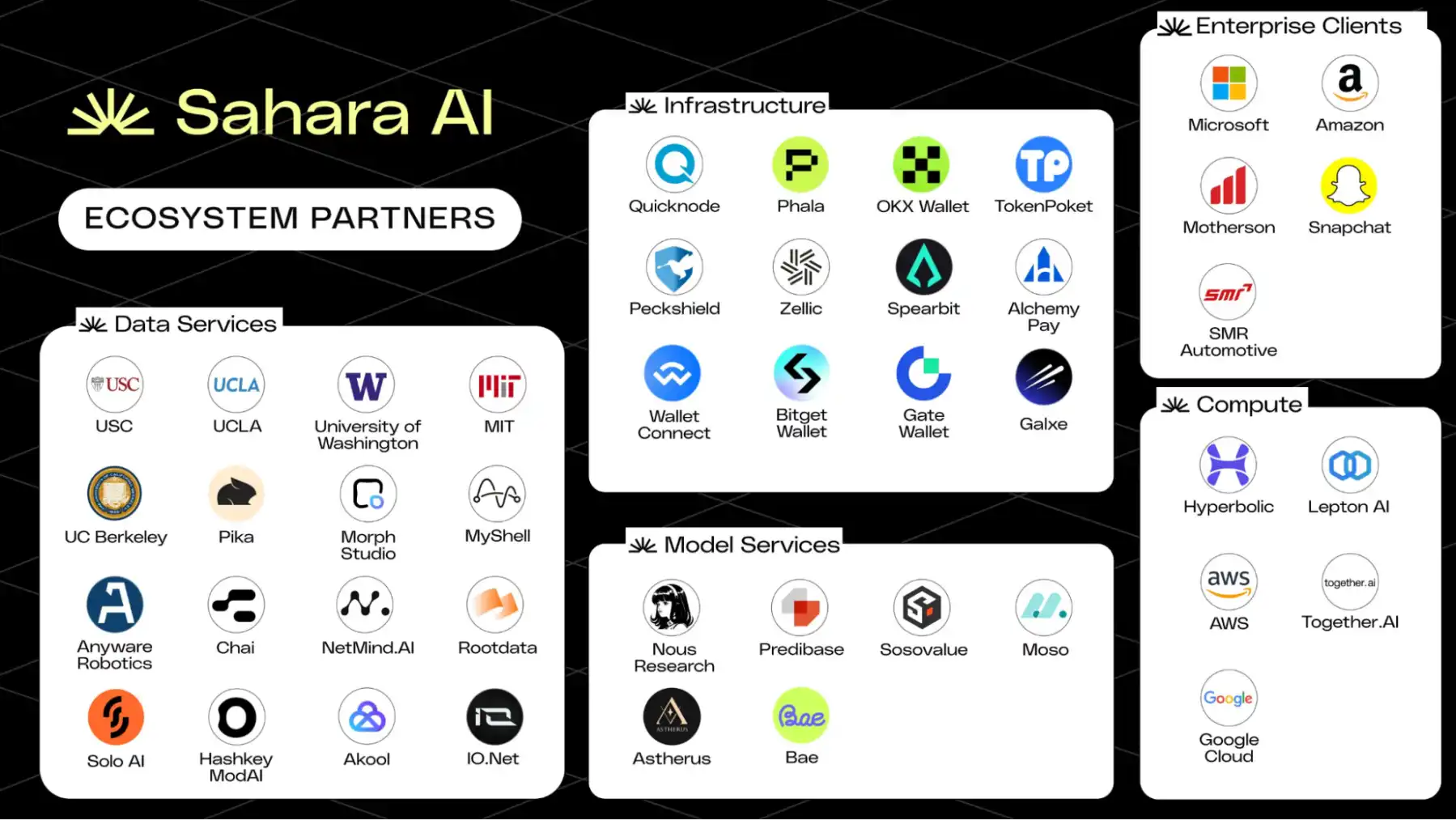
Sahara AI Ecosystem Map
Participation Method
SIWA will be launched in four phases. The current first phase establishes on-chain data ownership, where contributors can register and tokenize their datasets. The first phase is currently open to the public and does not require whitelisting. Contributors must ensure they upload data that is beneficial for AI, as plagiarism or inappropriate content may be dealt with. The second phase will enable on-chain monetization of datasets and models. The third phase will launch the testnet and open-source the protocol. The fourth phase will introduce AI data stream registration, traceability, and contribution proof mechanisms.
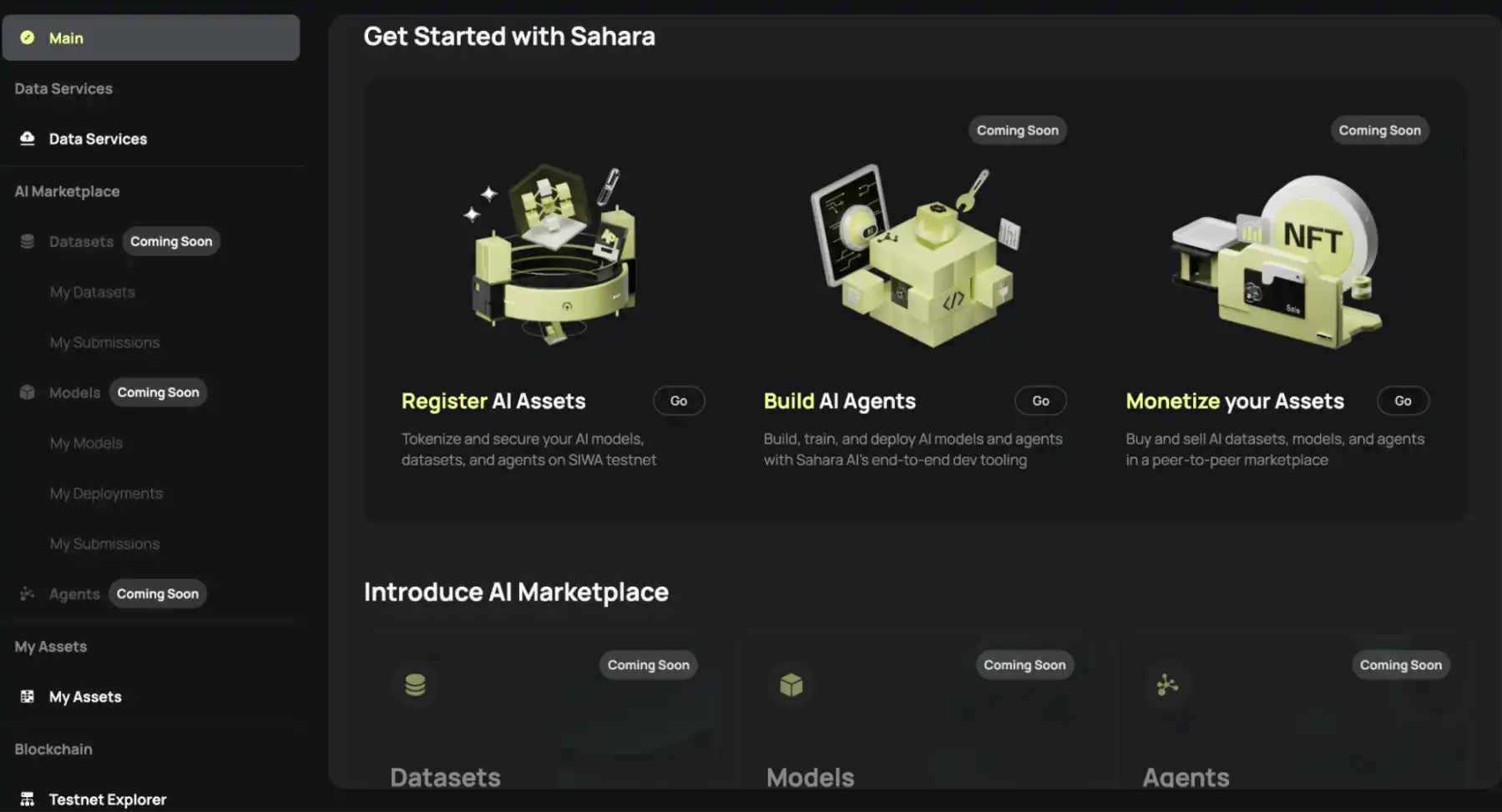
SIWA Testnet
In addition to the SIWA testnet, ordinary users can participate in Sahara Legends at this stage to learn about Sahara AI's functions through gamified tasks. After completing tasks, they receive Guardian Fragments, which can ultimately be combined into an NFT to record their contribution to the network.
Alternatively, users can annotate data on the data service platform, contribute valuable data, and act as reviewers. Sahara plans to collaborate with ecosystem partners to release tasks, allowing participants to receive incentives from both Sahara and the ecosystem partners. The first dual-reward task will be held in conjunction with Myshell, where users completing the task will receive rewards in Sahara tokens and Myshell tokens. According to the roadmap, Sahara is expected to launch its mainnet in Q3 2025, which may also coincide with a Token Generation Event (TGE).
Challenges and Prospects
Sahara AI aims to democratize AI, making it not limited to developers or large AI companies. For ordinary users, participation and earning profits do not require programming knowledge. Sahara AI is building a decentralized AI world where everyone can participate. For technical developers, Sahara AI bridges the gap between Web2 and Web3 development paths, providing decentralized yet flexible and powerful development tools and high-quality datasets.
For AI infrastructure providers, Sahara AI provides a decentralized monetization pathway for models, data, computing power, and services. Sahara AI not only focuses on public chain infrastructure but also plans to develop core applications, leveraging blockchain technology to promote the AI copyright system's advancement. At this stage, Sahara AI has already partnered with multiple top AI institutions, achieving preliminary success. The future success will depend on performance after the mainnet launch, ecosystem product development and adoption rates, and whether the economic model can continue to drive users to contribute to the dataset post-TGE.
Ritual: Innovative Design Breakthrough Core AI Challenges such as Heterogeneous Tasks
Project Overview
Ritual aims to address the centralization, closed nature, and trust issues existing in the current AI industry, providing transparent validation mechanisms, fair computation resource allocation, and flexible model adaptation capabilities for AI; allowing any protocol, application, or smart contract to integrate verifiable AI models in a few lines of code; and through its open architecture and modular design, driving widespread on-chain AI applications, creating an open, secure, and sustainable AI ecosystem.
Ritual completed a $25 million Series A financing round in November 2023, led by Archetype, with participation from multiple institutions and well-known angel investors, demonstrating market recognition and the team's strong social capabilities. Co-founders Niraj Pant and Akilesh Potti are former Polychain Capital partners who previously led investments in industry giants like Offchain Labs, EigenLayer, showing deep insights and judgment. The team has rich experience in cryptography, distributed systems, AI, and the advisory lineup includes founders from projects like NEAR and EigenLayer, showcasing their strong background and potential.
Design Architecture
From Infernet to Ritual Chain
Ritual Chain is the second-generation product that naturally transitions from the Infernet node network, representing Ritual's comprehensive upgrade on the decentralized AI computing network. Infernet was the first-phase product launched by Ritual and went live in 2023. It is a decentralized oracle network designed for heterogeneous computing tasks, aiming to address the limitations of centralized APIs, allowing developers to more freely and stably invoke transparent and open decentralized AI services.
Infernet adopts a flexible and simple lightweight framework that, due to its ease of use and efficiency, quickly attracted over 8,000 independent nodes upon its release. These nodes have diverse hardware capabilities, including GPU and FPGA, providing powerful computational resources for tasks such as AI inference and zero-knowledge proof generation. However, to maintain system simplicity, Infernet has forsaken some key features, such as consensus-coordinating nodes or integrated robust task routing mechanisms. These limitations make it difficult for Infernet to meet the needs of a broader range of Web2 and Web3 developers, prompting Ritual to introduce the more comprehensive and powerful Ritual Chain.
Ritual Chain is the next-generation Layer 1 blockchain designed for AI applications, aiming to address Infernet's limitations and provide developers with a more robust and efficient development environment. Through Resonance technology, Ritual Chain offers a concise and reliable pricing and task routing mechanism for the Infernet network, significantly optimizing resource allocation efficiency. Additionally, Ritual Chain is based on the EVM++ framework, which is a backward-compatible extension of the Ethereum Virtual Machine (EVM), equipped with more powerful features, including precompiled modules, native scheduling, Account Abstraction (AA), and a range of advanced Ethereum Improvement Proposals (EIPs). These features together build a powerful, flexible, and efficient development environment, offering developers new possibilities.
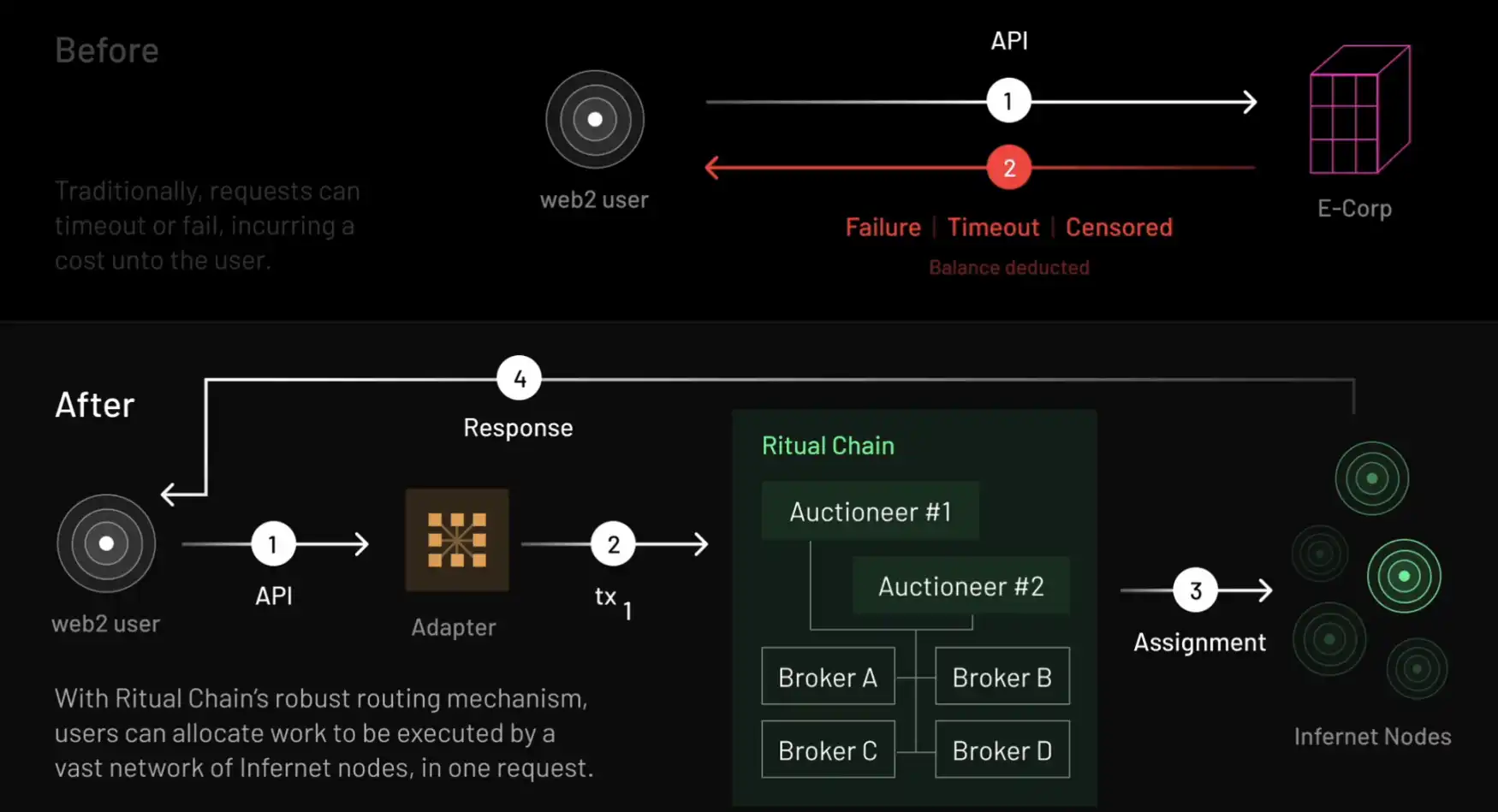
Ritual Chain Workflow Diagram
Precompiled Sidecars
Compared to traditional precompilation, Ritual Chain's design enhances the system's scalability and flexibility, allowing developers to create custom functional modules in a containerized manner without modifying the underlying protocol. This architecture not only significantly reduces development costs but also provides decentralized applications with more robust computational capabilities.
Specifically, Ritual Chain decouples complex computations from the execution client through a modular architecture and implements them in the form of independent Sidecars. These precompiled modules can efficiently handle complex computing tasks, including AI inference, zero-knowledge proof generation, and Trusted Execution Environment (TEE) operations, among others.
Native Scheduling
Native Scheduling addresses the need for task scheduling and conditional execution. Traditional blockchains usually rely on centralized third-party services (such as keepers) to trigger task execution, but this model carries centralization risks and high costs. Ritual Chain completely eliminates reliance on centralized services through a built-in scheduler. Developers can directly set the entry points and callback frequencies of smart contracts on-chain. Block producers maintain a mapping of pending calls and prioritize these tasks when generating new blocks. Combined with Resonance's dynamic resource allocation mechanism, Ritual Chain can efficiently and reliably handle computationally intensive tasks, providing stable support for decentralized AI applications.
Technological Innovation
Ritual's core technological innovations ensure its leading position in performance, security, and scalability, offering robust support for on-chain AI applications.
1. Resonance: Optimized Resource Allocation
Resonance is a two-sided market mechanism optimizing blockchain resource allocation to address the complexity of heterogeneous transactions. As blockchain transactions evolve from simple transfers to diverse forms like smart contracts and AI inference, existing fee mechanisms (such as EIP-1559) struggle to efficiently match user needs with node resources. Resonance introduces two key roles, the Broker and Auctioneer, to achieve the best match between user transactions and node capabilities:
The Broker analyzes user transaction fee willingness and node resource cost functions to optimize the transaction-to-node match and enhance computational resource utilization. The Auctioneer organizes fee distribution through a bilateral auction mechanism to ensure fairness and transparency. Nodes choose transaction types based on their hardware capabilities, while users can submit transaction requests based on priority criteria (such as speed or cost).
This mechanism significantly enhances network resource efficiency and user experience. Moreover, it reinforces system transparency and openness through a decentralized auction process.
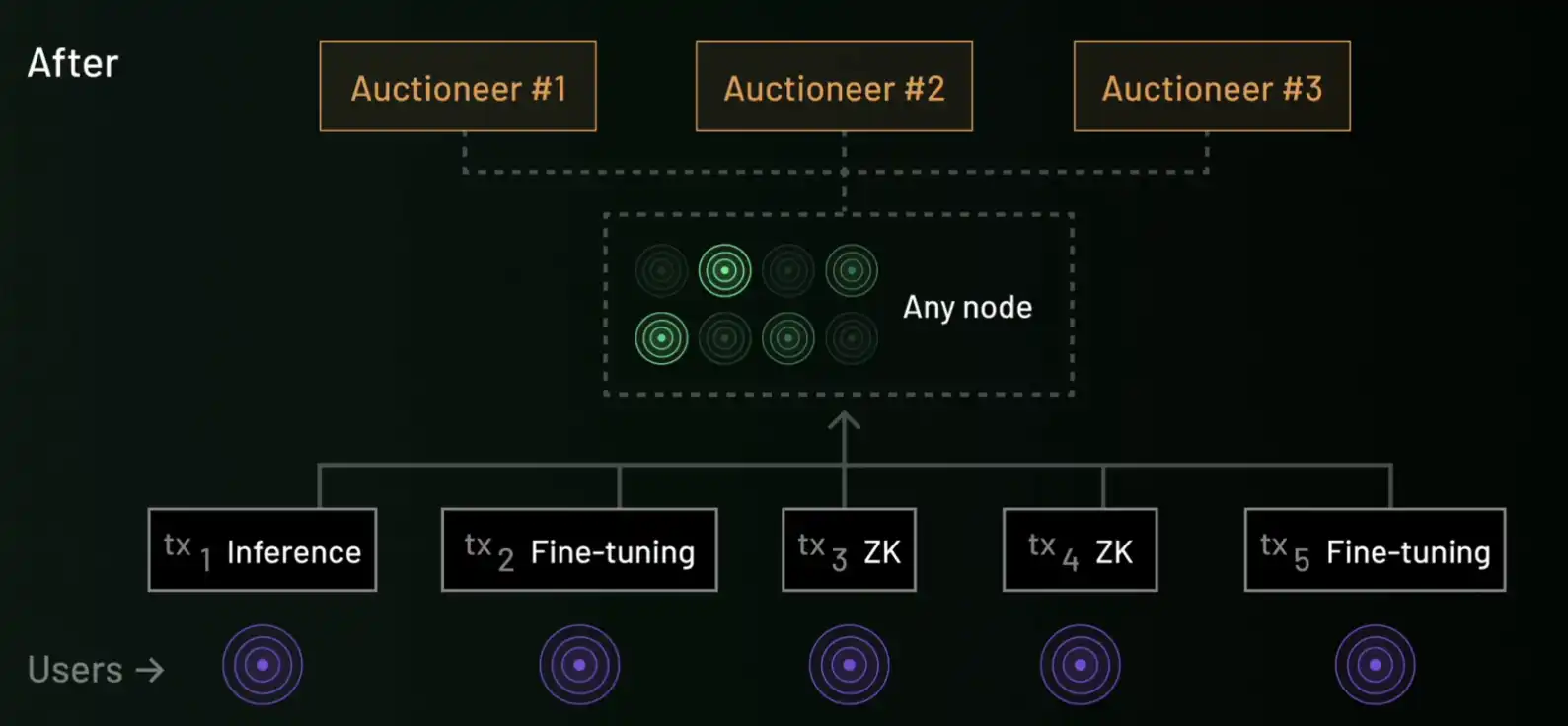
Under the Resonance mechanism: The Auctioneer assigns appropriate tasks to nodes based on Broker analysis.
2. Symphony: Enhancing Validation Efficiency
Symphony focuses on enhancing validation efficiency, addressing the inefficiency of the traditional blockchain "execute-often, validate-many" mode when handling and validating complex computation tasks. Symphony is based on the "Execute Once, Validate Many Times" (EOVMT) model, which separates computation from the validation process, significantly reducing the performance overhead of redundant computation. A designated node executes the computation once, broadcasts the result over the network, and validation nodes use non-interactive proofs (succinct proofs) to confirm the correctness of the result without redoing the computation.
Symphony supports distributed validation by decomposing complex tasks into multiple sub-tasks processed in parallel by different validation nodes, further enhancing validation efficiency while ensuring privacy and security. Symphony is highly compatible with trusted execution environments (TEEs) and zero-knowledge proof (ZKP) systems, providing flexible support for fast transaction confirmation and privacy-sensitive computation tasks. This architecture not only significantly reduces the performance cost of redundant computation but also ensures the decentralization and security of the validation process.
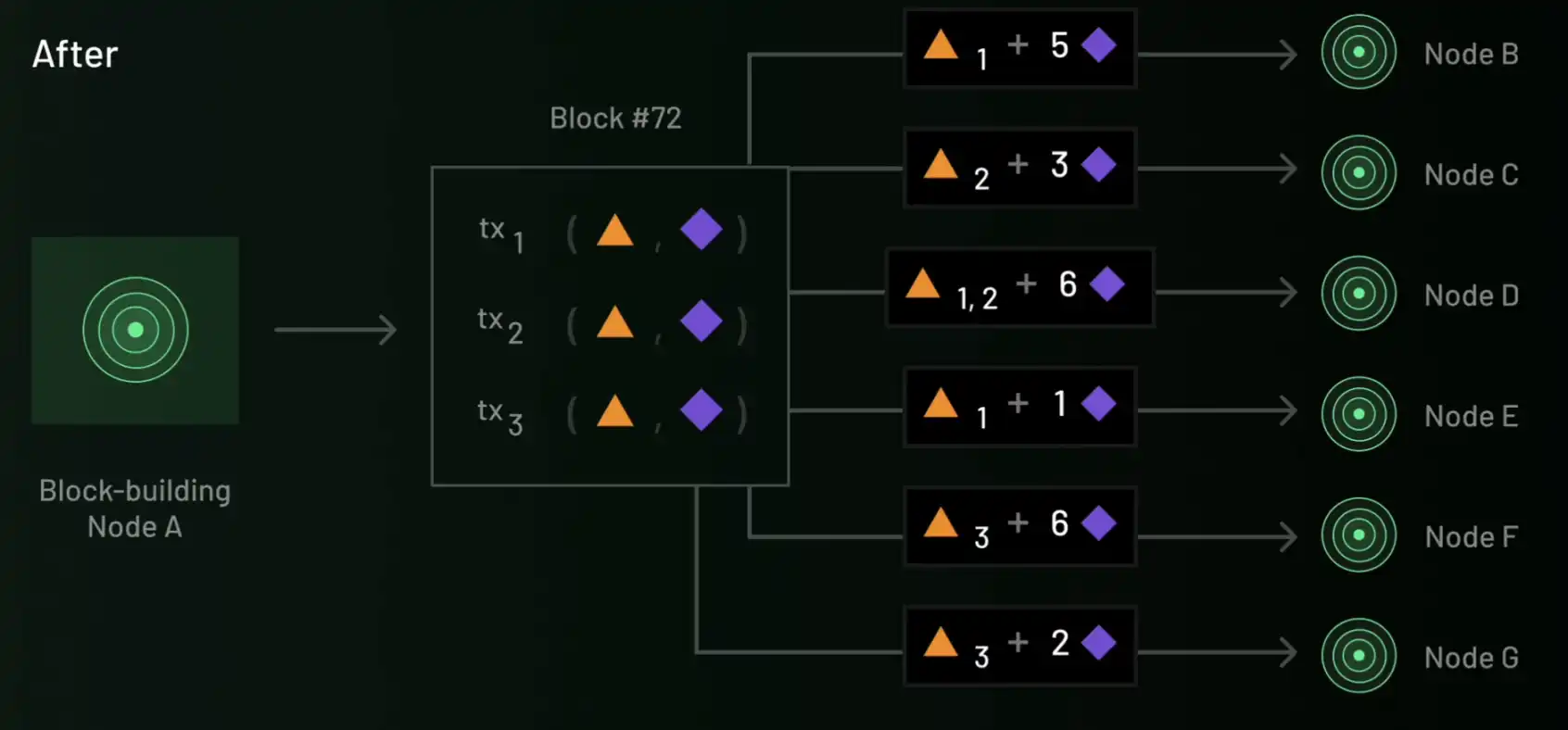
Symphony decomposes complex tasks into multiple sub-tasks processed in parallel by different validation nodes
3. vTune: Traceable Model Validation
vTune is a tool provided by Ritual for model validation and source tracing, with almost no impact on model performance and strong anti-tampering capabilities. It is especially suitable for protecting the intellectual property of open-source models and promoting fair distribution. vTune combines watermarking and zero-knowledge proof to achieve model source tracing and computation integrity assurance through embedded covert marks:
· Watermarking: Embedding marks through weight space, data, or function space watermarking allows for the verification of model ownership even when the model is made public. Function space watermarking, in particular, can verify ownership through model output without accessing model weights, leading to stronger privacy protection and robustness.
· Zero-Knowledge Proof: Introducing covert data during model fine-tuning to verify if the model has been tampered with while protecting the rights of the model creator.
This tool not only provides trusted source verification for decentralized AI model markets but also significantly enhances model security and ecosystem transparency.
Ecosystem Development
Ritual is currently in the private testnet phase, with limited opportunities for ordinary users to participate; developers can apply for and participate in the official Altar and Realm incentive programs, join Ritual's AI ecosystem development, and receive full-stack technical support and funding from the official team.
The official team has currently announced a batch of native applications from the Altar program:
· Relic: An AI-based automated market maker (AMM) that dynamically adjusts liquidity pool parameters through Ritual's infrastructure to optimize fees and underlying pool;
· Anima: Focuses on on-chain transaction automation tools based on LLM, providing users with a seamless and intuitive Web3 interaction experience;
· Tithe: An AI-driven lending protocol that supports a wider range of asset types through dynamic optimization of lending pools and credit scoring.
In addition, Ritual has deep collaborations with several established projects to drive the development of the decentralized AI ecosystem. For example, partnering with Arweave provides decentralized permanent storage support for models, data, and zero-knowledge proofs; through integrations with StarkWare and Arbitrum, Ritual introduces native on-chain AI capabilities to these ecosystems; furthermore, the re-staking mechanism provided by EigenLayer adds active validation services to Ritual's proof-of-stake market, further enhancing the network's decentralization and security.
Challenges and Outlook
Ritual's design addresses key aspects such as allocation, incentives, and validation, solving the core challenges faced by decentralized AI, while achieving model verifiability through tools like vTune, resolving the contradiction between model openness and incentives, and providing technical support for building a decentralized model market.
Currently, Ritual is in its early stages, focusing mainly on the model's inference phase, and the product matrix is expanding from infrastructure to model markets, L2 as a Service (L2aaS), and Agent frameworks. As blockchain is still in the private testing phase, the advanced technical design proposed by Ritual is yet to be widely implemented, requiring ongoing attention. With continuous improvement in technology and the gradual enrichment of the ecosystem, it is hoped that Ritual will become a key part of decentralized AI infrastructure.
Gensyn: Solving the Core Challenge of Decentralized Model Training
Project Overview
In the era of rapid artificial intelligence advancement and increasingly scarce computing resources, Gensyn is attempting to reshape the underlying paradigm of AI model training.
In the traditional AI model training process, computing power is almost monopolized by a few cloud computing giants, resulting in high training costs and low transparency, hindering the innovative progress of small and independent researchers. Gensyn's vision is to break this "centralized monopoly" structure by advocating for pushing the training task "down" to numerous devices worldwide with basic computing capabilities—whether it's a MacBook, a gaming-grade GPU, edge devices, or idle servers—all can join the network, participate in task execution, and receive rewards.
Founded in 2020, Gensyn focuses on building decentralized AI computing infrastructure. As early as 2022, the team first proposed to redefine the way AI models are trained at both the technical and institutional levels: no longer relying on closed cloud platforms or giant server clusters, but sinking the training task into heterogeneous computing nodes worldwide, constructing a trustless intelligent computing network.
In 2023, Gensyn further expanded its vision: to build a globally connected, open-source autonomous, and permissionless AI network—where any device with basic computing capabilities can become part of this network. Its underlying protocol is designed based on a blockchain architecture, not only possessing the composability of incentive and validation mechanisms.
Since its inception, Gensyn has raised a total of $50.6 million in support, with investors including a16z, CoinFund, Canonical, Protocol Labs, Distributed Global, and a total of 17 institutions. The Series A funding led by a16z in June 2023 has attracted widespread attention, signaling the decentralized AI field's entry into the mainstream Web3 venture capital landscape.
The core team members also have significant backgrounds: Co-founder Ben Fielding studied theoretical computer science at the University of Oxford, bringing deep technical research experience; while the other co-founder Harry Grieve has been involved in the design of decentralized protocols and economic modeling, providing strong support for Gensyn's architecture design and incentive mechanisms.
Design Architecture
The current development of decentralized artificial intelligence systems faces three core technical bottlenecks: Execution, Verification, and Communication. These bottlenecks not only limit the unleashing of large-scale model training capabilities but also constrain the fair integration and efficient utilization of global computing resources. Building on systematic research, the Gensyn team has proposed three representative innovative mechanisms—RL Swarm, Verde, and SkipPipe—to address the above issues and drive decentralized AI infrastructure from concept to implementation.
1. Execution Challenge: How to enable fragmented devices to collaboratively and efficiently train large models?
Currently, the performance improvement of large language models mainly relies on the "scale-up" strategy: larger parameter sizes, broader datasets, and longer training periods. However, this significantly increases the computational cost—training super-large models often needs to be split across thousands of GPU nodes, which require high-frequency data communication and gradient synchronization. In a decentralized setting, where nodes are geographically dispersed, hardware is heterogeneous, and state fluctuation is high, traditional centralized scheduling strategies are ineffective.
To address this challenge, Gensyn proposes RL Swarm, a peer-to-peer reinforcement learning post-training system. The core idea is to transform the training process into a distributed cooperative game. This mechanism consists of three stages: "Share—Critique—Decision." First, nodes independently perform problem reasoning and openly share results. Next, nodes evaluate peer answers based on logical consistency and strategic rationality, providing feedback. Finally, nodes adjust their outputs based on collective opinions to generate more robust answers. This mechanism effectively integrates individual computation and group collaboration, particularly suitable for tasks requiring high accuracy and verifiability, such as mathematics and logical reasoning. Experiments show that RL Swarm not only improves efficiency but also significantly reduces barriers to participation, demonstrating good scalability and fault tolerance.
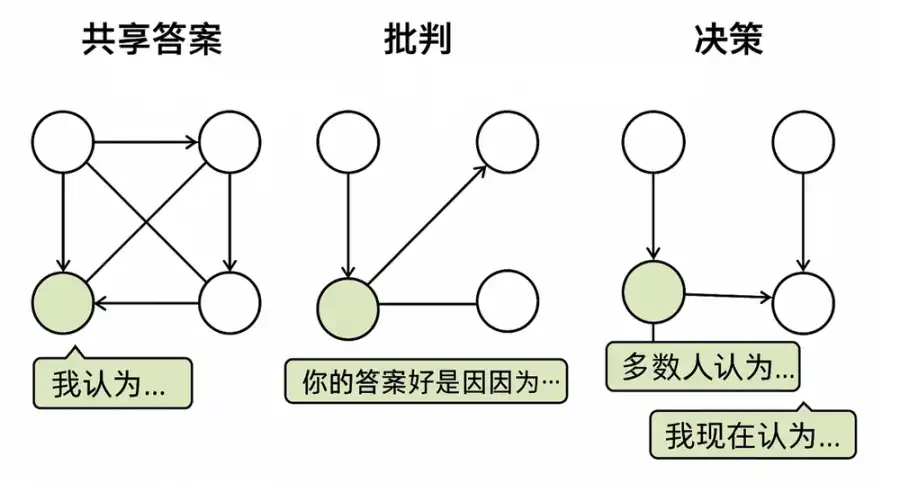
RL Swarm's "Share—Critique—Decision" three-stage reinforcement learning training system
2. Verification Challenge: How to verify the correctness of computation results from untrusted providers?
In a decentralized training network, "anyone can provide computing power" is both an advantage and a risk. The question is: How to validate these computations as authentic and valid without the need for trust?
Traditional methods such as recomputation or whitelist audits have significant limitations— the former is very costly and lacks scalability, and the latter excludes "long-tail" nodes, undermining network openness. To address this, Gensyn has designed Verde, a lightweight arbitration protocol specifically tailored for neural network training validation scenarios.
The key idea behind Verde is "Minimal Trusted Computing": when a validator suspects that a supplier's training result is incorrect, the arbitration contract only needs to recalculate the first disputed operation node in the computation graph, without replaying the entire training process. This significantly reduces the validation burden while ensuring the correctness of the result when at least one party is honest. To address the floating-point non-determinism issue across different hardware, Verde has also developed the Reproducible Operators library, which enforces a consistent execution order for common mathematical operations such as matrix multiplication, achieving bitwise consistent output across devices. This technology greatly enhances the security and engineering feasibility of distributed training, representing a significant breakthrough in the current trustless verification system.
The entire mechanism is built on the basis of the trainer logging crucial intermediate states (i.e., checkpoints), with multiple validators randomly assigned to reproduce these training steps to assess output consistency. Once a validator's recomputation results differ from the trainer's, the system does not rudely rerun the entire model; instead, through a network arbitration mechanism, it precisely identifies the first differing operation between the two in the computation graph and only replays that operation for comparison, thus achieving dispute resolution at extremely low cost. In this way, Verde, without trusting the training node, not only ensures the integrity of the training process but also balances efficiency and scalability, tailored as a verification framework for the distributed AI training environment.
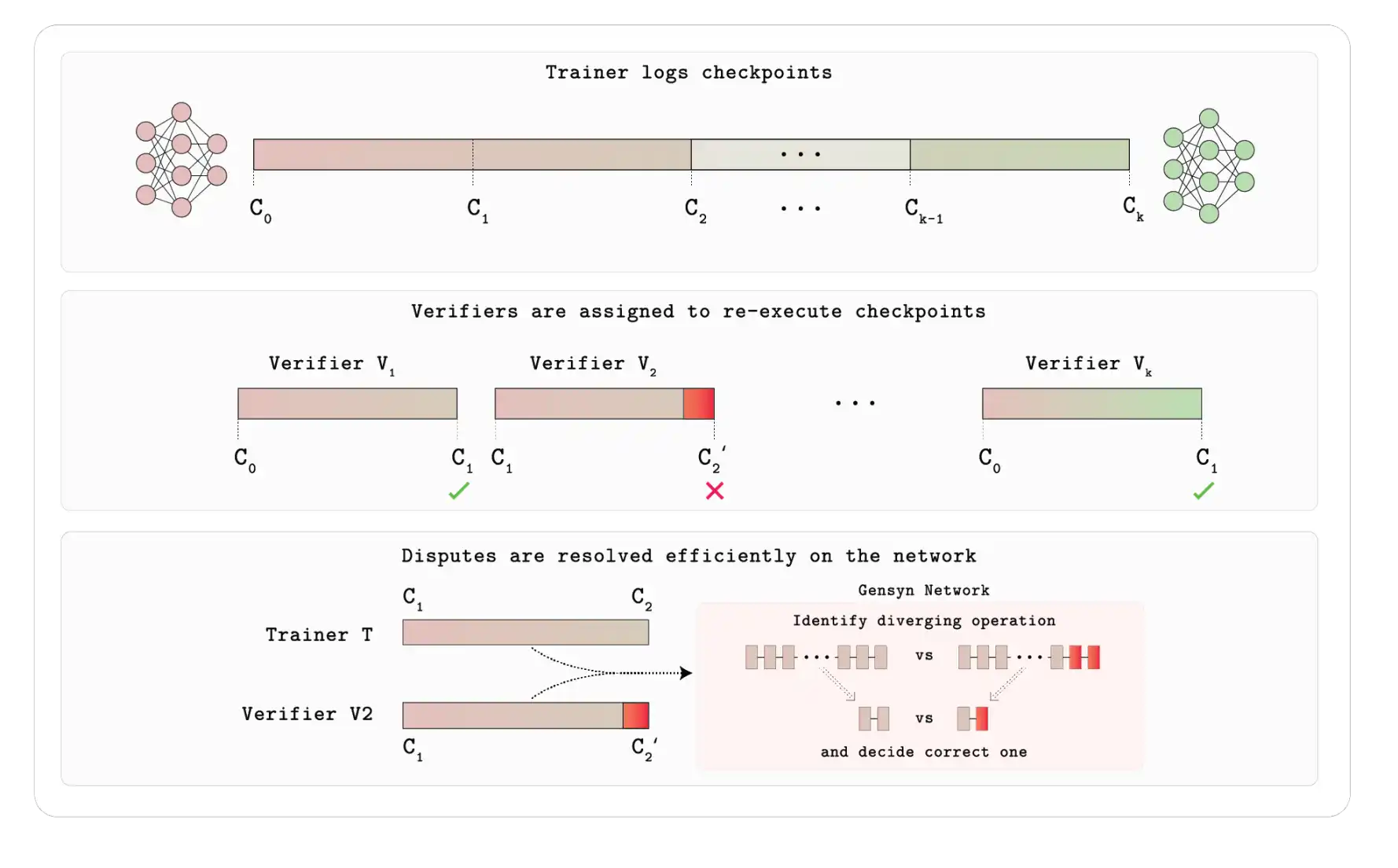
Vader's Workflow
III. Communication Challenge: How to Reduce Network Bottlenecks Caused by High-Frequency Node Synchronization?
In traditional distributed training, the model is either fully replicated or layer-wise split (pipeline parallelism), both of which require high-frequency node synchronization. In particular, in pipeline parallelism, a mini-batch must sequentially pass through each model layer, causing the entire training process to be blocked whenever a node is delayed.
Gensyn addresses this issue with SkipPipe: a high-fault-tolerant pipeline training system that supports speculative execution and dynamic path scheduling. SkipPipe introduces the "skip ratio" mechanism, allowing some mini-batch data to skip part of the model layers when a specific node is overloaded, while dynamically selecting the current optimal computation path using scheduling algorithms. Experiments show that in geographically dispersed, highly variant hardware, bandwidth-constrained network environments, SkipPipe can reduce training time by up to 55% and can still maintain only a 7% loss even at a high 50% node failure rate, demonstrating strong resilience and adaptability.
Participation Method
The Gensyn public testnet went live on March 31, 2025, and is currently in its early-stage Phase 0 as outlined in its technical roadmap, with a focus on the deployment and validation of the RL Swarm. The RL Swarm is Gensyn's first use case, designed around collaborative training of reinforcement learning models. Each participating node binds its behavior to an on-chain identity, and the contribution process is fully documented, providing a validation basis for subsequent incentive distribution and a trusted computing model.
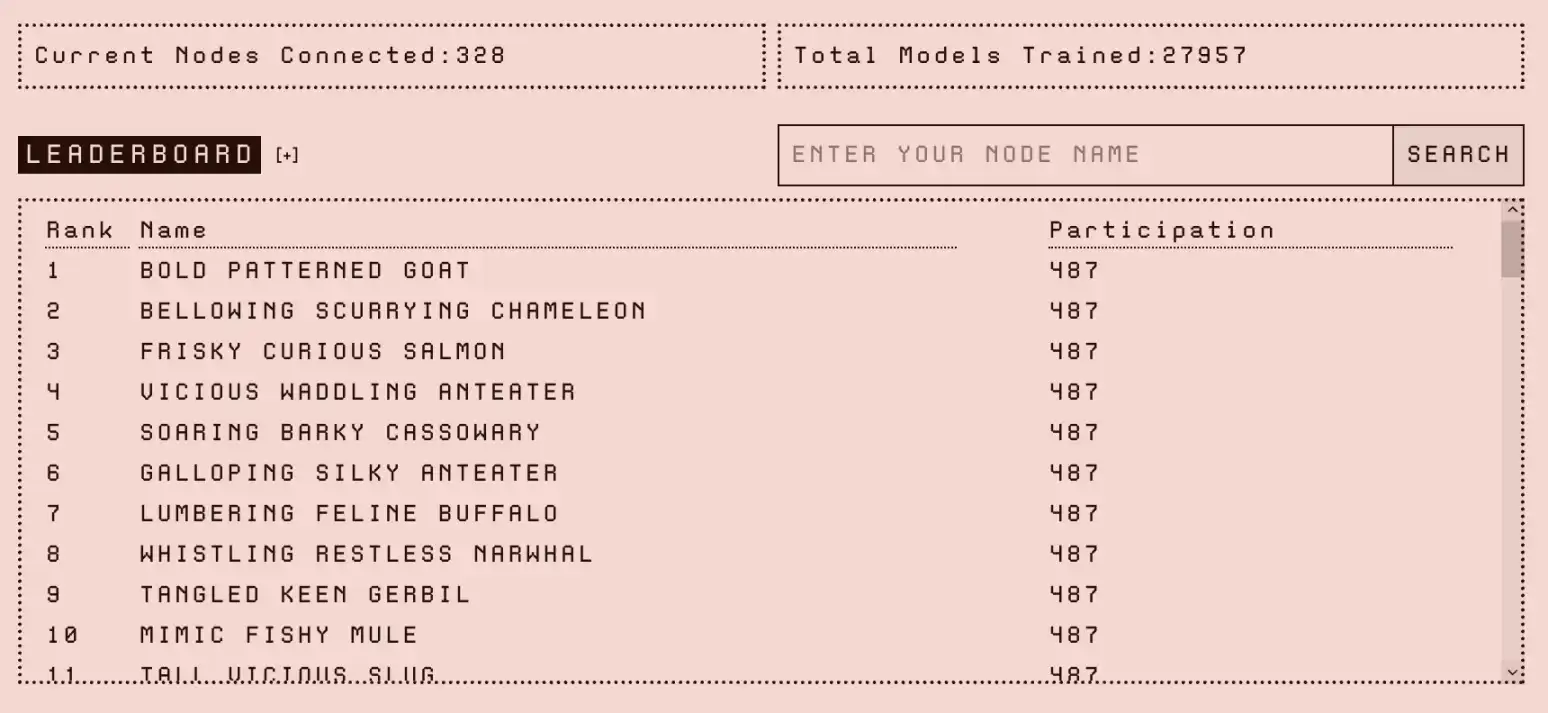
Gensyn Node Ranking
The hardware requirements for the early testing phase are relatively user-friendly: Mac users can run it on M-series chips, while Windows users are recommended to have high-performance GPUs like 3090 or 4090 with 16GB or more of memory to deploy a local Swarm node. After the system is running, users can complete the verification process via web login with an email address (Gmail recommended) and choose whether to bind a HuggingFace Access Token to activate more comprehensive model capabilities.
Challenges and Prospects
The greatest uncertainty facing the Gensyn project at present is that its testnet has not yet covered the full promised tech stack. Key modules such as Verde and SkipPipe are still in a pending integration state, leading to external skepticism about its architectural feasibility. The official explanation is that the testnet will progress in stages, with each stage unlocking new protocol capabilities to first validate the stability and scalability of the infrastructure. The initial stage starts with RL Swarm and will gradually expand to core scenarios such as pre-training, inference, and ultimately transition to mainnet deployment supporting real economic transactions.
Although the testnet started with a relatively conservative pace, it is noteworthy that just one month later, Gensyn introduced a new Swarm test task supporting larger-scale models and more complex mathematical tasks. This move to some extent addressed external concerns about its development pace and also demonstrated the team's efficiency in advancing local modules.
However, challenges have arisen: the new tasks set a very high hardware threshold, with recommended configurations including top-tier GPUs like A100 and H100 (80GB VRAM), making it almost unattainable for small to medium nodes. This creates a certain tension with Gensyn's emphasis on "open access" and "decentralized training." If the trend of centralized computing power is not effectively guided, it may affect network fairness and the sustainability of decentralized governance.
Next, if Verde and SkipPipe can integrate successfully, it will help enhance the protocol's integrity and collaborative efficiency. However, whether Gensyn can truly find a balance between performance and decentralization remains to be seen through longer and wider-ranging testing on the testnet. Currently, it has shown early signs of potential while also exposing challenges, embodying the most authentic state of an early-stage infrastructure project.
Bittensor: Innovation and Development of Decentralized AI Network
Project Overview
Bittensor is a groundbreaking project that combines blockchain and artificial intelligence, founded by Jacob Steeves and Ala Shaabana in 2019, aiming to build a "machine intelligence marketplace." Both founders have deep backgrounds in artificial intelligence and distributed systems. Yuma Rao, a named author of the project's whitepaper, is considered the core technical advisor, injecting a professional perspective in cryptography and consensus algorithms into the project.
The project aims to integrate global computing resources through a blockchain protocol, constructing a self-optimizing distributed neural network ecosystem. This vision transforms digital assets such as computing, data, storage, and models into an intelligent value flow, creating a new economic paradigm to ensure the fair distribution of AI development dividends. Setting itself apart from centralized platforms like OpenAI, Bittensor has established three core value pillars:
· Data Silo Breaker: Utilizing the TAO token incentive system to promote knowledge sharing and model contributions
· Market-Driven Quality Assessment: Introducing game theory mechanisms to filter high-quality AI models, achieving survival of the fittest
· Network Effect Amplifier: Participant growth is exponentially correlated with network value, forming a virtuous cycle
In terms of investment layout, Polychain Capital has been incubating Bittensor since 2019, currently holding around $200 million worth of TAO tokens; Dao5 holds approximately $50 million worth of TAO and is also an early supporter of the Bittensor ecosystem. In 2024, Pantera Capital and Collab Currency further increased their stakes through strategic investments. In August of the same year, Grayscale Group included TAO in its decentralized AI fund, marking institutional investors' high recognition of the project's value and long-term optimism.
Design Architecture and Operation Mechanism
Network Architecture
Bittensor has built a sophisticated network architecture consisting of four collaborative layers:
· Blockchain Layer: Built on the Substrate framework, serving as the network's trust base, responsible for recording state changes and token issuance. The system generates a new block every 12 seconds and issues TAO tokens according to the rules to ensure network consensus and incentive distribution.
· Neuron Layer: Serving as the network's computing nodes, neurons run various AI models to provide intelligent services. Each node explicitly declares its service type and interface specification through a carefully designed configuration file, achieving modularity and plug-and-play functionality.
· Synapse Layer: The communication bridge of the network, dynamically optimizing inter-node connection weights to form a neural network-like structure, ensuring efficient information transmission. Synapses also have a built-in economic model where interactions and service calls between neurons require payment in TAO tokens, forming a closed loop of value circulation.
· Metagraph Layer: Serving as the global knowledge graph of the system, continuously monitoring and evaluating the contribution value of each node to provide intelligent guidance for the entire network. The metagraph precisely calculates synapse weights to influence resource allocation, reward mechanisms, and node influence within the network.
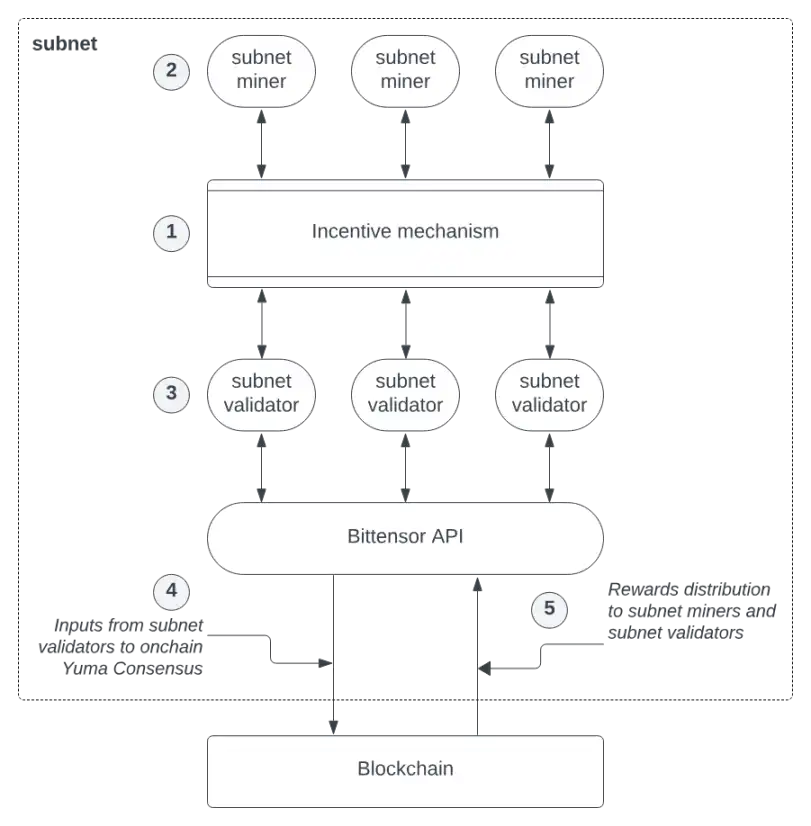
Bittensor's Network Framework
Yuma Consensus Mechanism
The network adopts a unique Yuma consensus algorithm, completing a round of reward distribution every 72 minutes. The validation process combines subjective assessment and objective measurement:
· Human Scoring: Validators subjectively assess the quality of miner outputs
· Fisher Information Matrix: Objectively quantify nodes' overall contribution to the network
This "subjective + objective" hybrid mechanism effectively balances professional judgment with algorithmic fairness.
Subnet Architecture and dTAO Upgrade
Each subnet focuses on a specific AI service area, such as text generation, image recognition, etc., operates independently but stays connected to the main blockchain subtensor, forming a highly flexible modular extension architecture. In February 2025, Bittensor completed a landmark dTAO (Dynamic TAO) upgrade, which transforms each subnet into an independent economic unit, intelligently regulating resource allocation through market demand signals. The core innovation is the Subnet Token (Alpha token) mechanism:
· Mechanism: Participants stake TAO to receive Alpha tokens issued by each subnet, representing market recognition and support for specific subnet services
· Allocation Logic: The market price of Alpha tokens serves as a key indicator of subnet demand intensity. Initially, all subnet Alpha token prices are the same, with only 1 TAO and 1 Alpha token in each liquidity pool. With increased trading activity and liquidity injection, Alpha token prices adjust dynamically, and TAO allocation is intelligently distributed based on the proportion of subnet token prices, favoring subnets with higher market demand. This achieves truly demand-driven resource optimization
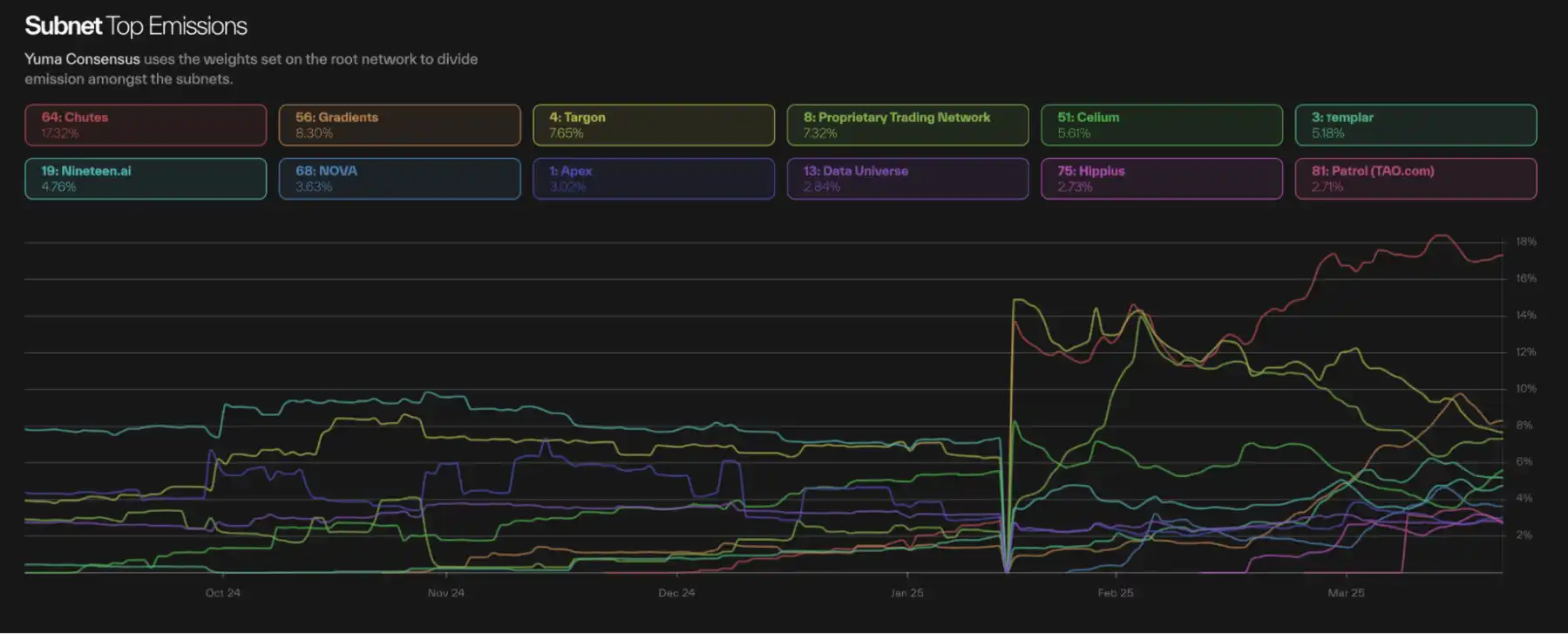
Bittensor Subnet Token Emission Distribution
The dTAO upgrade has significantly enhanced ecosystem vitality and resource utilization efficiency. The total market value of subnet tokens has reached $5 billion, demonstrating strong growth momentum.
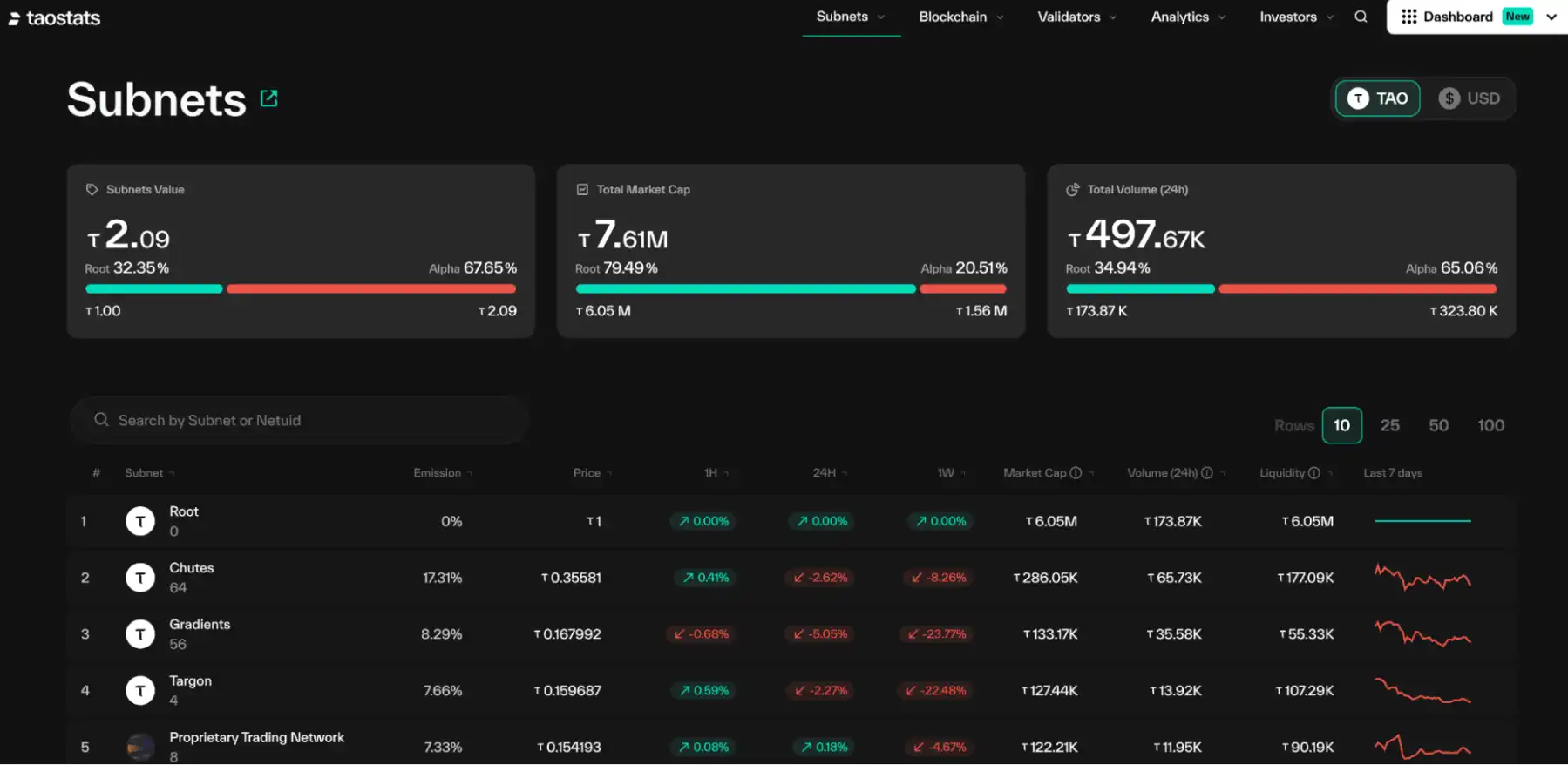
Bittensor Subnet Alpha Token Value
Ecosystem Progress and Use Cases
Mainnet Development History
The Bittensor network has gone through three key development stages:
· January 2021: Mainnet officially launched, laying the foundation infrastructure
· October 2023: "Revolution" upgrade introduced subnet architecture, achieving functional modularity
· February 2025: Completed the dTAO upgrade, establishing a market-driven resource allocation mechanism
The Subnet Ecosystem is experiencing explosive growth: as of June 2025, there are already 119 specialized subnets, with the number expected to potentially exceed 200 within the year.
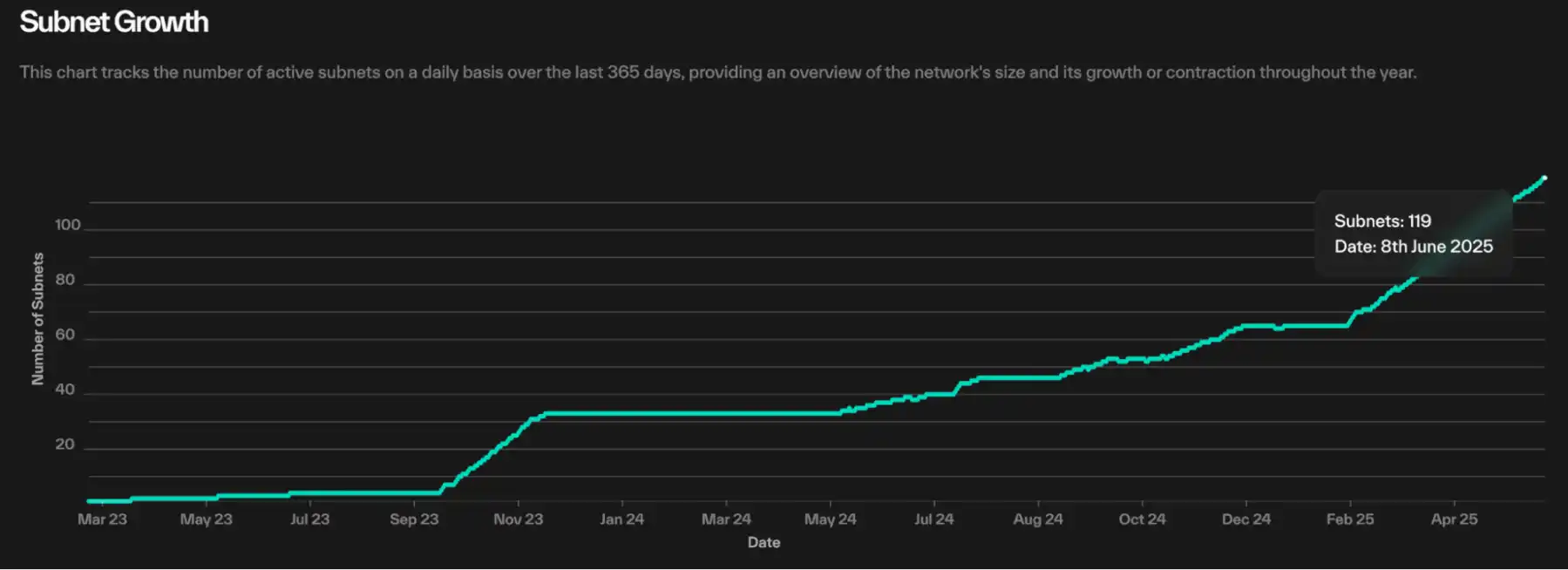
Bittensor Subnet Count
The ecosystem features a diverse range of project types, covering AI agents (such as Tatsu), prediction markets (such as Bettensor), DeFi protocols (such as TaoFi), among other cutting-edge areas, forming an innovative ecosystem where AI and finance are deeply integrated.
Representative Subnet Ecosystem Projects
· TAOCAT: TAOCAT is a native AI agent within the Bittensor ecosystem, built directly on the subnet, offering users a data-driven decision-making tool. Leveraging the large language model of Subnet 19, real-time data from Subnet 42, and the Agent Arena of Subnet 59, it provides market insights and decision support. It has received investment from DWF Labs, included in its $20 million AI agent fund, and launched on binance alpha.
· OpenKaito: A subnet launched on Bittensor by the Kaito team, aimed at building a decentralized crypto industry search engine. It has currently indexed 500 million web resources, showcasing the powerful capability of decentralized AI in handling massive data. Its key advantage over traditional search engines is the reduction of commercial bias, providing a more transparent, neutral data processing service, ushering in a new paradigm for information retrieval in the Web3 era.
· Tensorplex Dojo: Subnet 52 developed by Tensorplex Labs, focused on crowdsourcing high-quality human-generated datasets through a decentralized platform, encouraging users to earn TAO tokens through data labeling. In March 2025, YZi Labs (formerly Binance Labs) announced an investment in Tensorplex Labs, supporting the development of Dojo and Backprop Finance.
· CreatorBid: Running on Subnet 6, CreatorBid is a creative platform that combines AI and blockchain, integrated with Olas and other GPU networks (such as io.net), supporting content creators and AI model development.
Technology and Industry Collaboration
Bittensor has made breakthrough progress in cross-disciplinary collaborations:
· Established a deep model integration channel with Hugging Face, enabling on-chain seamless deployment of 50 leading AI models
· Collaborated with high-performance AI chip manufacturer Cerebras in 2024 to jointly release the BTLM-3B model, surpassing 160,000 cumulative downloads
· In March 2025, entered into a strategic partnership with DeFi giant Aave to explore the application of rsTAO as premium lending collateral
Participation Methods
Bittensor has designed diversified ecosystem participation paths to form a complete value creation and distribution system:
· Mining: Deploy mining nodes to produce high-quality digital goods (such as AI model services), and earn TAO rewards based on contribution quality
· Validation: Run validator nodes to assess mining output, maintain network quality standards, and receive corresponding TAO incentives
· Staking: Hold and stake TAO to support high-quality validator nodes, earn passive income based on validator performance
· Development: Build innovative applications, utility tools, or new subnets using the Bittensor SDK and CLI tools, actively participate in ecosystem development
· Service Usage: Utilize AI services provided by the network through a user-friendly client application interface, such as text generation or image recognition
· Trading: Engage in market trading of subnet asset-backed tokens, capturing potential value growth opportunities
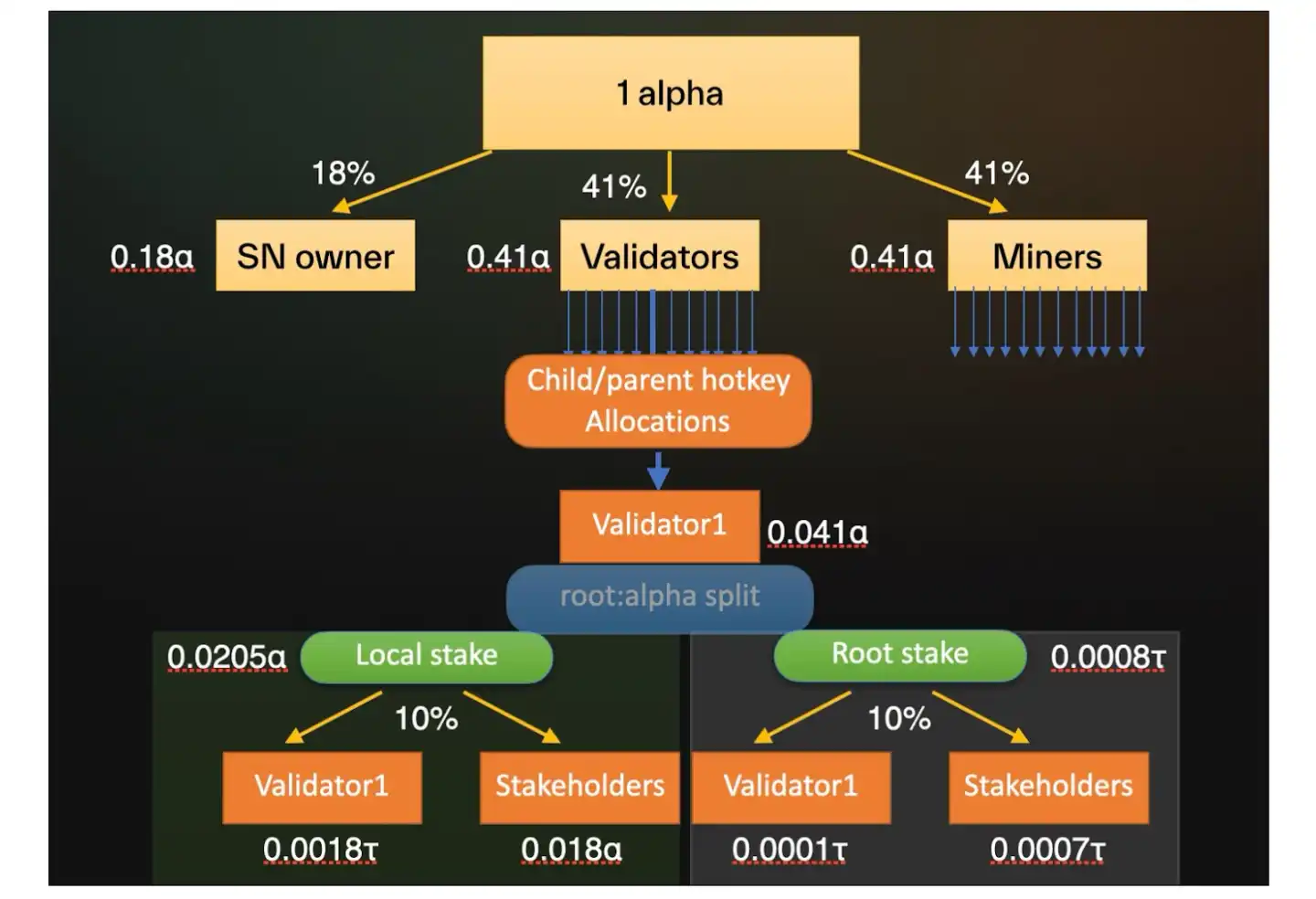
Distribution of subnet alpha tokens to participants
Challenges and Outlook
Despite demonstrating remarkable potential, Bittensor, as a frontier technology exploration, still faces multidimensional challenges. At the technical level, the security threats faced by a distributed AI network (such as model theft and adversarial attacks) are more complex than those of centralized systems, requiring continuous optimization of privacy computing and security protection solutions; in terms of the economic model, early inflationary pressures exist, with high volatility in subnet token markets, necessitating vigilance against potential speculative bubbles; in the regulatory environment, while the SEC has classified TAO as a utility token, regulatory framework differences worldwide may still restrict ecosystem expansion; concurrently, facing fierce competition from well-endowed centralized AI platforms, decentralized solutions need to prove their long-term competitive advantage in user experience and cost-effectiveness.
As the 2025 Halving Cycle approaches, Bittensor's development will focus on four strategic directions: further deepening the specialization of subnetworks to enhance the service quality and performance of vertical domain applications; accelerating deep integration with the DeFi ecosystem by leveraging newly introduced EVM compatibility to expand the boundary of smart contract applications; smoothly transitioning the network governance weight from TAO to Alpha token within the next 100 days through the dTAO mechanism to drive the decentralization of governance processes; and actively expanding interoperability with other mainstream blockchains to broaden the ecosystem boundary and application scenarios. These synergistic strategic initiatives will collectively propel Bittensor steadily towards the grand vision of the "Machine Intelligence Market Economy."
0G: Storage-Based Modular AI Ecosystem
Project Overview
0G is a Layer 1 public chain designed specifically for AI applications, aiming to provide efficient and reliable decentralized infrastructure for data-intensive and high-computational scenarios. Through a modular architecture, 0G has independently optimized core functions such as consensus, storage, computation, and data availability, supporting dynamic scalability to efficiently handle large-scale AI inference and training tasks.
The founding team consists of Michael Heinrich (CEO, previously founded Garten with over $100 million in funding), Ming Wu (CTO, Microsoft researcher, Co-Founder of Conflux), Fan Long (Co-Founder of Conflux), and Thomas Yao (CBO, Web3 investor), comprising 8 computer science Ph.D. members with backgrounds from companies like Microsoft and Apple, possessing deep expertise in blockchain and AI technologies.
In terms of funding, 0G Labs completed a $35 million Pre-seed round and a $40 million Seed round, totaling $75 million, with investors including Hack VC, Delphi Ventures, and Animoca Brands, among others. Additionally, the 0G Foundation secured a $250 million token purchase commitment, a $30.6 million public node sale, and an $88.88 million ecosystem fund.
Design Architecture
1. 0G Chain
The goal of the 0G Chain is to build the fastest modular AI public chain. Its modular architecture supports independent optimization of key components such as consensus, execution, and storage, and integrates data availability networks, distributed storage networks, and AI computing networks. This design provides outstanding performance and flexibility for the system to address complex AI application scenarios. The following are the three core features of the 0G Chain:
Modular Scalability for AI
0G adopts a horizontally scalable architecture that can efficiently handle large-scale data workflows. Its modular design separates the Data Availability (DA) layer from the data storage layer, providing higher performance and efficiency for AI tasks such as large-scale training or inference.
0G Consensus
0G's consensus mechanism consists of multiple independent consensus networks that can dynamically scale as needed. With exponential data growth, system throughput can also increase in sync, supporting scaling from 1 to hundreds or even thousands of networks. This distributed architecture not only improves performance but also ensures system flexibility and reliability.
Shared Staking
Validators are required to stake funds on the Ethereum mainnet to provide security for all participating 0G consensus networks. In the event of a slashable incident on any 0G network, validators' staked funds on the Ethereum mainnet will be slashed. This mechanism extends the security of the Ethereum mainnet to all 0G consensus networks, ensuring the overall security and robustness of the system.
0G Chain is EVM compatible, ensuring that Ethereum, Layer 2 Rollup, or other chain developers can easily integrate 0G services (such as data availability and storage) without migration. Additionally, 0G is exploring support for Solana VM, Near VM, and Bitcoin compatibility to expand AI applications to a broader user base.
2. 0G Storage
0G Storage is a highly optimized distributed storage system designed for decentralized applications and data-intensive scenarios. At its core is a unique consensus mechanism called Proof of Random Access (PoRA), incentivizing miners to store and manage data, achieving a balance of security, performance, and fairness.
Its architecture can be divided into three layers:
· Log Layer: Enables the permanent storage of unstructured data, suitable for purposes such as archiving or data logging.
· Key-Value Layer: Manages mutable structured data and supports access control, suitable for dynamic application scenarios.
· Transaction Layer: Supports multi-user concurrent writes, improving collaboration and data processing efficiency.
Proof of Random Access (PoRA) is a key mechanism of 0G Storage used to verify if a miner has correctly stored a specified data block. Miners periodically receive challenges and must provide valid cryptographic hashes as proof, similar to proof of work. To ensure fair competition, 0G limits the data range for each mining operation to 8 TB, preventing resource monopolization by large-scale operators and allowing small-scale miners to participate in competition within a fair environment.
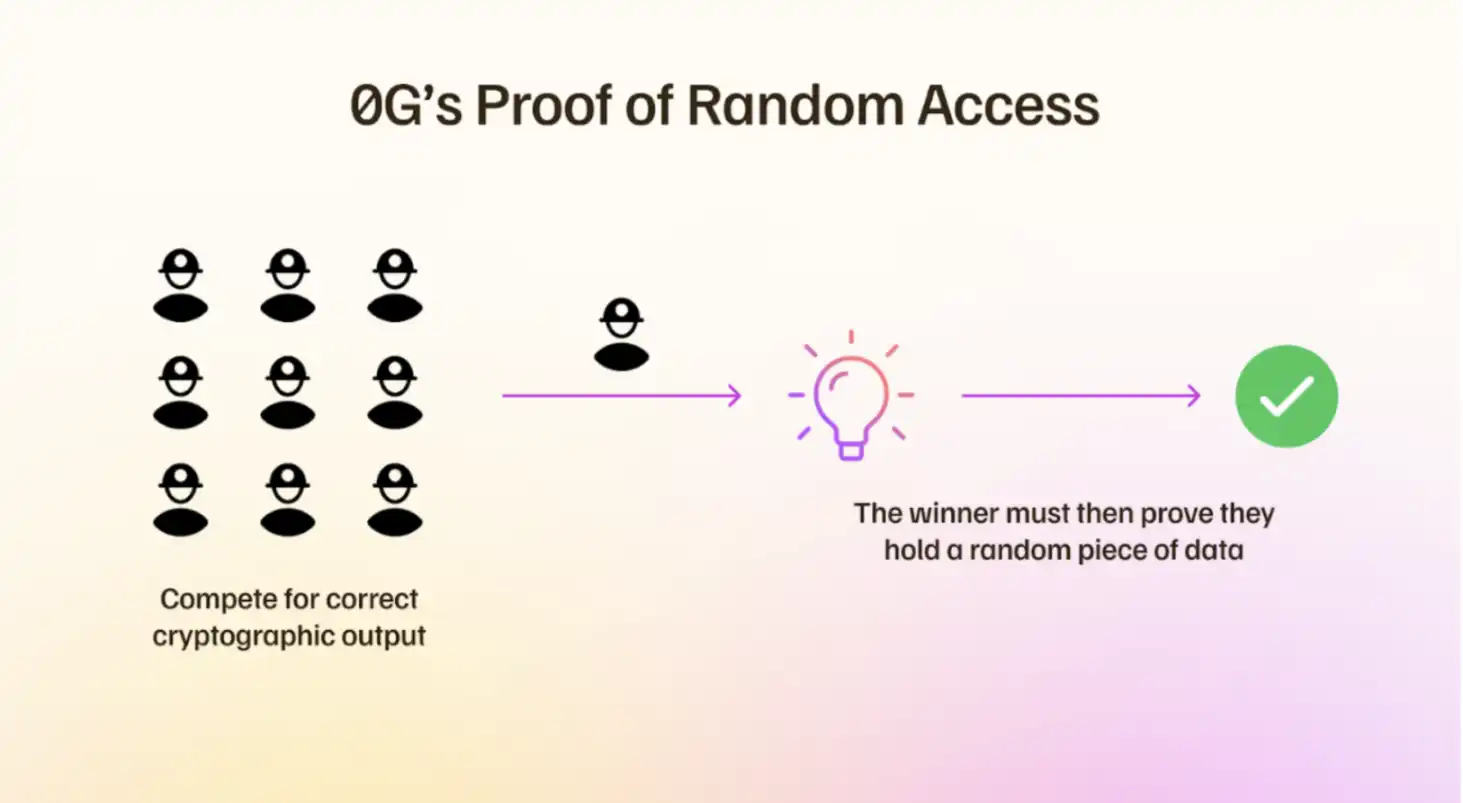
Proof of Random Access Conceptual Diagram
Through erasure coding technology, 0G Storage divides data into multiple redundant shards and distributes them to different storage nodes. This design ensures that even if some nodes go offline or fail, the data can still be fully recovered, significantly enhancing data availability and security, and enabling the system to perform well when handling large-scale data. In addition, data storage is finely managed at the sector and block levels, optimizing data access efficiency and enhancing miners' competitiveness in the storage network.
The submitted data is organized in sequential order, known as the data flow, which can be understood as a list of log entries or a sequence of fixed-size data sectors. In 0G, each piece of data can be quickly located by a common offset, enabling efficient data retrieval and challenge queries. By default, 0G provides a general data flow called the main flow for processing the majority of application scenarios. The system also supports specialized flows, which accept specific categories of log entries, providing independent contiguous address spaces optimized for different application requirements.
Through this design, 0G Storage can adapt flexibly to diverse usage scenarios while maintaining high-performance and management capabilities, providing robust storage support for AI x Web3 applications that need to handle large-scale data flows.
3. 0G Data Availability (0G DA)
Data Availability (DA) is one of the core components of 0G, aimed at providing accessible, verifiable, and retrievable data. This functionality is key to decentralized AI infrastructure, such as validating the results of training or inference tasks to meet user needs and ensure the reliability of the system's incentive mechanisms. 0G DA achieves outstanding scalability and security through a carefully designed architecture and validation mechanism.
The design goal of 0G DA is to provide extremely high scalability while ensuring security. Its workflow is mainly divided into two parts:
· Data Storage Lane: Data is divided into multiple small fragments ("data blocks") using erasure coding and distributed to storage nodes in the 0G Storage network. This mechanism effectively supports large-scale data transmission while ensuring data redundancy and recoverability.
· Data Publishing Lane: Data availability is verified by DA nodes through aggregate signatures and the results are submitted to the consensus network. Through this design, data publishing only needs to deal with a small amount of key data streams, avoiding the bottleneck issues in traditional broadcasting and significantly improving efficiency.
To ensure data security and efficiency, 0G DA uses a randomness-based validation approach combined with an aggregate signature mechanism, forming a complete validation process:
· Random Selection of Quorum: Through a Verifiable Random Function (VRF), the consensus system randomly selects a group of DA nodes from the validator set to form a quorum. This random selection method theoretically ensures that the honesty distribution of the quorum is consistent with the entire validator set, preventing collusion between the data availability client and the quorum.
· Aggregate Signature Verification: The quorum samples and validates the stored data blocks and generates an aggregate signature, submitting the availability proof to 0G's consensus network. This aggregate signature approach greatly enhances verification efficiency, performing several orders of magnitude faster than traditional Ethereum.
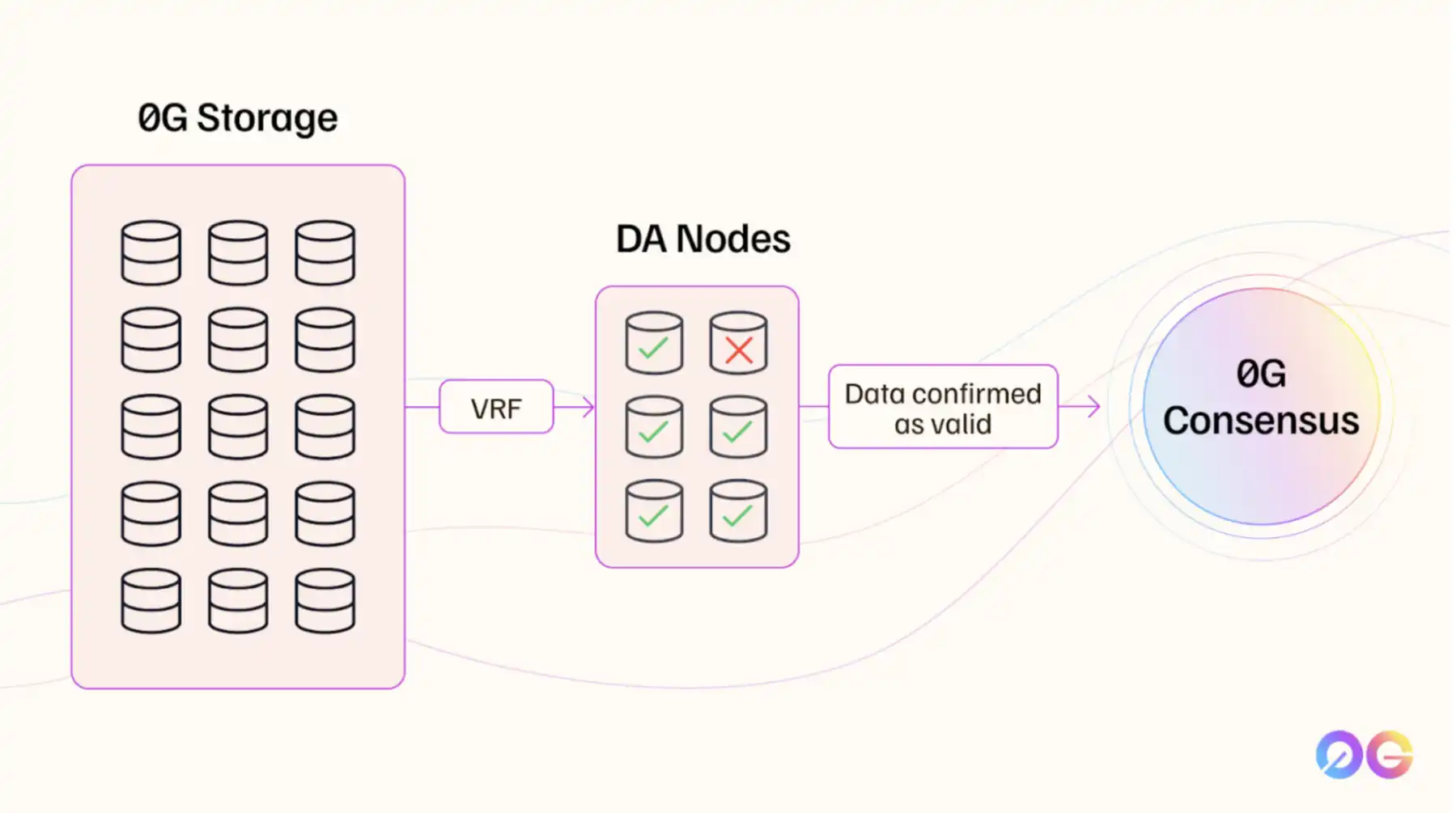
0G Validation Process
Through the above mechanism, 0G DA provides an efficient, highly scalable, and secure data availability solution, offering a solid foundation for decentralized AI applications.
4. 0G Compute
The 0G computing network is a decentralized framework designed to provide robust AI computing power to the community. Through smart contracts, compute providers can register the types of AI services they offer (e.g., model inference) and set prices for their services. When users send AI inference requests, service providers decide whether to respond based on the sufficiency of the user's balance, enabling efficient compute allocation.
To further optimize transaction costs and network efficiency, service providers can batch process multiple user requests. This approach significantly reduces on-chain settlements, mitigating the resource consumption of frequent transactions. Additionally, the 0G computing network employs Zero-Knowledge Proofs (ZK-Proofs) technology, which utilizes off-chain computation and on-chain verification to compress transaction data, reducing on-chain settlement costs. Combined with 0G's storage module, its scalable off-chain data management mechanism significantly reduces the on-chain cost of tracking storage requests for data keys while improving storage and retrieval efficiency.
Currently, 0G's decentralized AI network mainly provides AI inference services and has demonstrated advantages in efficiency and cost optimization. In the future, 0G plans to further expand its capabilities to achieve comprehensive decentralization, from inference to training and more AI tasks, providing users with a more comprehensive solution.
Ecosystem Development
0G's testnet has now upgraded from Newton v2 to Galileo v3, with over 8,000 validators according to official data. There are 1,591 active miners on the storage network, which has processed over 430,000 uploaded files, providing a total of 450.72 GB of storage space.
0G's impact in the decentralized AI field continues to expand with the increasing depth of cooperation with enterprises. According to official data, there have been over 450 integrations covering various domains such as AI compute, data, models, frameworks, infra, and DePin.
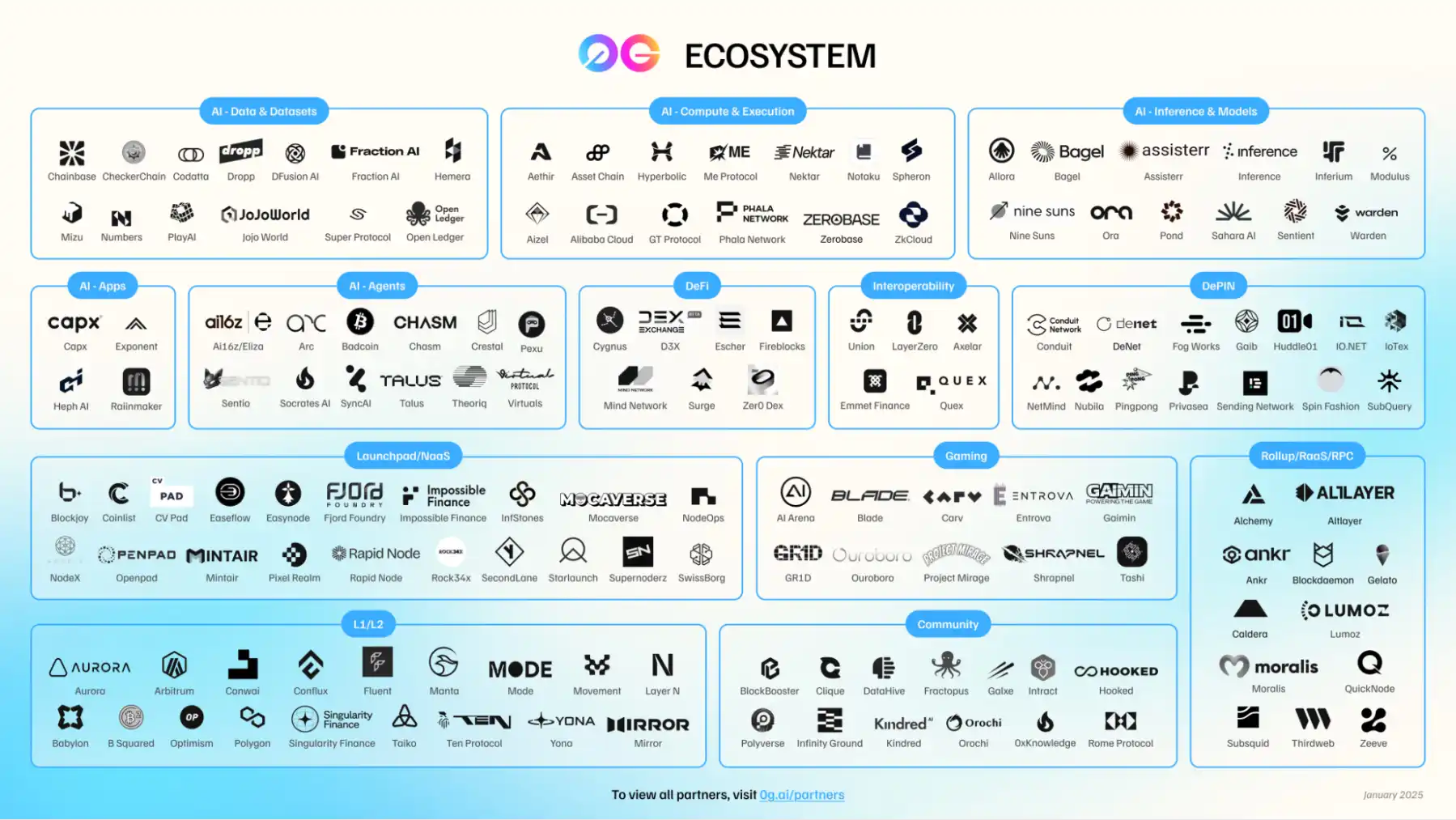
0G Ecosystem Chart
Furthermore, the 0G Foundation has launched an $88.8 million ecosystem fund to support the development of AI-related projects, which has led to the emergence of the following native applications:
· zer0: An AI-driven DeFi liquidity solution that provides on-chain liquidity optimization services
· H1uman: Decentralized AI Agent factory, creating a scalable AI integration workflow
· Leea Labs: Infrastructure for multiple AI Agents, supporting secure multi-Agent system deployment
· Newmoney.AI: Intelligent DeFi Agent Wallet, automating investment and trading management
· Unagi: AI-driven on-chain entertainment platform, merging anime and gaming into a Web3 experience
· Rivalz: Verifiable AI Oracle, providing trusted AI data access for smart contracts
· Avinasi Labs: AI project focused on longevity research
Participation
Regular users can currently participate in the 0G ecosystem through the following channels:
· Engage with 0G Testnet Interaction: 0G has launched Testnet V3 (Galileo V3), where users can access the official testnet page (0G Testnet Guide) to claim test tokens and interact with DApps on the 0G chain.
· Join the Kaito Initiative: 0G has joined the Kaito platform's content creation initiative, allowing users to participate by creating and sharing high-quality content related to 0G (such as technical analysis, ecosystem developments, or AI application use cases) to earn rewards.
Challenges and Outlook
0G has demonstrated strong technical capabilities in the storage sector, providing a comprehensive modular solution for decentralized storage with excellent scalability and cost-effectiveness (storage costs as low as $10-11 per TB). Additionally, 0G has addressed data verifiability through the Data Availability layer (DA), laying a solid foundation for future large-scale AI inference and training tasks. This design provides robust support for decentralized AI at the data storage layer and creates an optimized storage and retrieval experience for developers.
In terms of performance, 0G expects the mainnet TPS to increase to the range of 3,000 to 10,000, representing a tenfold growth in performance compared to previous achievements, ensuring the network can meet the high-intensity computing demands associated with AI inference and high-frequency trading tasks. However, in the computing power market and model aspects, 0G still requires substantial development. Currently, 0G's computing power business is limited to AI inference services, and more customized design and technological innovation are needed to support model training tasks. As a core component of AI development, models and computing power are not only critical for driving product upgrades and large-scale applications but also essential for 0G to achieve its goal of becoming the largest AI Layer 1 ecosystem.
Summary
Current Status: Diverse Entries, Facing Challenges
Reflecting on the six AI Layer1 projects above, each has chosen a different entry point, focusing on core elements such as AI assets, computing power, models, storage, etc., exploring the path of decentralized AI infrastructure and ecosystem development:
· Sentient: Focuses on the development of decentralized models, launching the Dobby series, emphasizing the model's trustworthiness, alignment, and loyalty. The underlying chain development is still ongoing, aiming to achieve deep integration between models and the chain.
· Sahara AI: With AI asset ownership protection at its core, the initial stage focuses on data ownership and circulation, striving to provide a trustworthy data foundation for the AI ecosystem.
· Ritual: Centers on efficient deployment solutions for decentralized computing power in inference, strengthening the functionality of the blockchain itself, enhancing system flexibility and scalability, and promoting the development of AI-native applications.
· Gensyn: Committed to addressing the challenge of decentralized model training, lowering the cost of large-scale distributed training through technical innovation, and providing a viable path for AI computing power sharing and democratization.
· Bittensor: A more mature subnet platform that, through token incentives and decentralized governance, has pioneered the development of a rich developer and application ecosystem, serving as an early model for decentralized AI.
· 0G: Taking decentralized storage as its entry point, focusing on the data storage and management challenges in the AI ecosystem, gradually expanding to more comprehensive AI infrastructure and application services.
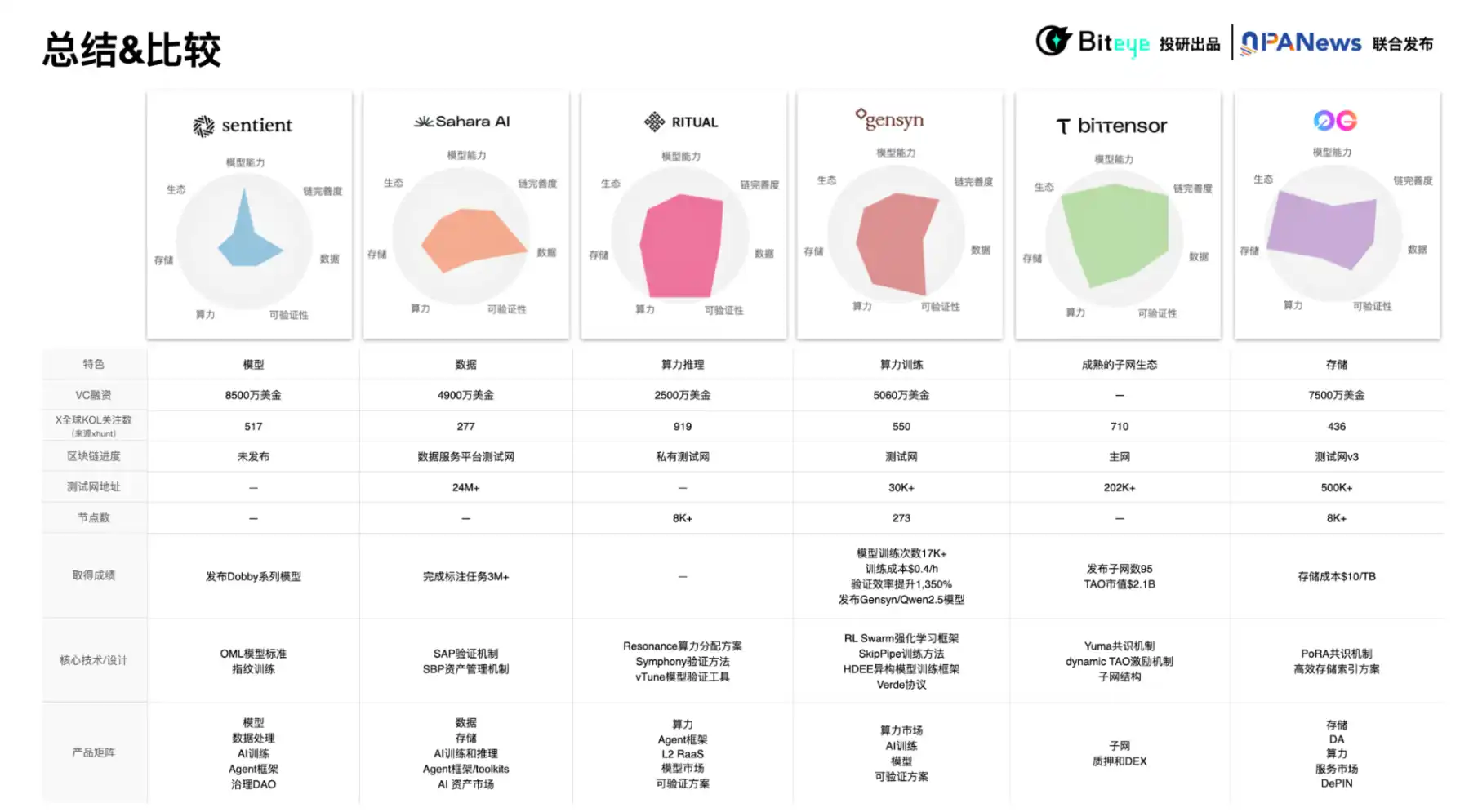
Project Comparison and Summary
Overall, these projects not only have differences in technical roadmaps but also complement each other in ecosystem strategies, collectively driving the diverse development of on-chain decentralized AI ecosystems. However, it is undeniable that the entire track is still in the early exploration stage. Although many forward-looking visions and blueprints have been put forward, actual development progress and ecosystem construction still require time to mature, and many key infrastructure and innovative applications are yet to be implemented.
How to attract and incentivize more computing power, storage, and other basic nodes to join the network is a core issue that needs to be addressed urgently. Just as the Bitcoin network went through more than a decade of development before gradually gaining mainstream market recognition, a decentralized AI network also needs to continuously expand the scale of its nodes to meet the massive demand for computing power in AI tasks. Only when the resources such as computing power and storage in the network reach a certain level of abundance can costs be effectively reduced, promote the democratization of computing power, and ultimately realize the grand vision of decentralized AI.
In addition, there is still a lack of innovation in on-chain AI applications. Currently, many products are still based on a Web2 model and undergo simple migration, lacking innovative designs deeply integrated with the native mechanisms of blockchain, failing to fully demonstrate the unique advantages of decentralized AI. These real challenges remind us that the continued development of the industry not only requires technological breakthroughs but also depends on the enhancement of user experience and the continuous improvement of the entire ecosystem.
Continuous Development: Emerging High-quality AI Layer1 and DeAI Projects
In addition to the projects we have discussed in depth, in the context of the era's major trends, there are many new AI Layer1 and DeAI projects worthy of our attention. (Due to space limitations, here we will provide a brief introduction first, and you can follow our continuous research on more AI tracks)
Kite AI
Based on its core consensus mechanism "Proof of Attributed Intelligence" (PoAI), Kite AI has built an EVM-compatible Layer 1 blockchain, dedicated to creating a fair AI ecosystem. It aims to ensure that data providers, model developers, and AI Agent creators can transparently record and receive fair rewards for their contributions to AI value creation, thus breaking the AI resource monopoly held by a few tech giants. Currently, Kite AI's development focus is on the consumer-facing application layer and ensures the development, rights confirmation, and monetization of AI assets through subnet architecture and a transaction marketplace.
Story
Centered around open Intellectual Property (IP), Story is an AI Layer 1 built to provide creators and developers with a set of end-to-end tools to help them register, track, authorize, manage, and monetize various content IPs on-chain, whether they are videos, audios, texts, or AI works. Story allows users to mint original content as NFTs, incorporates flexible licensing and revenue-sharing mechanisms, allowing users to engage in derivative works and business collaborations while ensuring transparent ownership and revenue distribution.
Vana
Vana is a new generation data-centric AI Layer 1 built for "user data monetization and AI training." It breaks free from the data monopoly of large corporations, allowing individuals to truly own, manage, and share their data. Users can participate in a "Data DAO" (a decentralized autonomous organization for user governance, sharing, and benefiting from AI training data) to aggregate social, health, consumption data for AI training while retaining data ownership, and receive dividends. Additionally, Vana prioritizes privacy and security in its design, employing privacy-preserving computation and encryption verification technologies to safeguard user data.
Nillion
Nillion is a "blind computation network" focusing on data privacy and secure computation, providing developers and enterprises with a set of privacy-enhancing technologies (such as Multi-Party Computation MPC, Homomorphic Encryption, Zero-Knowledge Proofs, etc.) that enable data storage, sharing, and complex computation without decrypting the original data. This allows various scenarios such as AI, Decentralized Finance (DeFi), healthcare, personalized applications, etc., to handle high-value and sensitive information more securely without worrying about the risk of data leakage. Currently, the Nillion ecosystem supports various innovative applications including AI privacy computation, personalized intelligent agents, private knowledge bases, attracting partners such as Virtuals, NEAR, Aptos, Arbitrum, and more.
Mira Network
Mira Network is an innovative network designed for "decentralized validation" of AI outputs, aiming to build a trustworthy validation layer for autonomous AI. Mira's core innovation involves running multiple different language models simultaneously in the background using integrated assessment technology, breaking down the AI-generated results into specific assertions for independent validation by distributed model nodes. Only when the vast majority of models reach consensus and agree on the content as "fact" is it outputted to users. Through this multi-model consensus mechanism, Mira significantly reduces the single-model 25% hallucination rate to just 3%, equivalent to a reduction of over 90% in error rate. Mira abandons reliance on centralized large institutions or a single large model, adopting distributed nodes and economic incentive mechanisms, becoming a verifiable foundational infrastructure layer for numerous Web2 and Web3 AI applications, truly achieving the transition from AI co-piloting to AI systems with autonomous decision-making capabilities that are trustworthy.
Prime Intellect
Prime Intellect is a platform focusing on decentralized AI training and computation infrastructure, aiming to integrate global computing resources to drive collaborative training of open-source AI models. Its core architecture includes a peer-to-peer compute rental marketplace and an open training protocol, allowing anyone to contribute idle hardware to the network for large-scale model training and inference, thereby addressing the issues of traditional AI being highly centralized, resource-intensive, and wasteful. Additionally, Prime Intellect has developed open-source distributed training frameworks (such as OpenDiLoco) supporting efficient cross-border training of multi-billion-parameter large models and delving into algorithm innovation and specialized tracks, such as the METAGENE-1 model based on metagenomics and the INTELLECT-MATH project focused on mathematical reasoning. In 2025, Prime Intellect also launched the SYNTHETIC-1 initiative, leveraging crowdsourcing and reinforcement learning to create the world's largest open-source dataset for inference and mathematical code validation.
Future Outlook: Decentralized AI for Openness and Win-Win Collaboration
Despite facing many challenges, on-chain decentralized AI still has vast development prospects and transformative potential. As the underlying technology gradually matures and various projects continue to deliver on their promises, the unique advantages of decentralized AI are expected to become increasingly prominent. AI Layer1 projects are expected to realize the following vision:
· Democratized sharing of computing power, data, and models, breaking the monopoly of technological giants. This will enable global individuals, enterprises, and organizations to participate in AI innovation seamlessly.
· Ownership, circulation, and trustworthy governance of AI assets, promoting the free flow and transaction of core assets such as data and models on-chain. This will safeguard the benefits of the owners and establish a healthy open ecosystem.
· More trustworthy, traceable, and alignable AI outputs, providing a solid foundation for the secure and controllable development of AI. This will effectively reduce the risk of "AI malice."
· The inclusive implementation of AI in various industries such as finance, healthcare, education, and content creation, unlocking the significant value of AI and benefiting society in a decentralized manner.
As more and more AI Layer1 projects make progress, we look forward to the early realization of the decentralized AI goals. We also hope that more developers, innovators, and participants will join hands to collectively build a more open, diverse, and sustainable AI ecosystem.
Welcome to join the official BlockBeats community:
Telegram Subscription Group: https://t.me/theblockbeats
Telegram Discussion Group: https://t.me/BlockBeats_App
Official Twitter Account: https://twitter.com/BlockBeatsAsia