



Industry Research: Bitcoin Solidifies Its Position as the Number One Legacy Asset, with Nearly 60% of Users Choosing Wallets
Source: OKX
Industry Research: Bitcoin Secures Its Position as the Top Inheritance Asset, Nearly 60% of Users Choose Wallets
In the narrative of traditional wealth inheritance, cash, real estate, and precious metals have long held the core. However, as Bitcoin's market value soared to become the world's fifth-largest asset—surpassing Amazon and Google, and closely approaching Apple and Nvidia—a new intergenerational inheritance logic is emerging: over 33% of respondents prefer to use cryptocurrency for inheritance, surpassing traditional assets such as cash, real estate, and gold.
On the occasion of "International Children's Day," OKX, in collaboration with PANews, BlockBeats, Jinse Finance, Planet Daily, and Chaincatcher, five industry media outlets jointly launched the "Wealth and Courage Across Time: Bitcoin Inheritance Research Survey," covering over 5,000 cryptocurrency users in the industry. The survey group is positioned as users with a certain level of understanding of cryptocurrency.
Asset Preference: Cryptocurrency Becomes the Top Choice Asset Inheritance Tool for Industry Professionals, Far Surpassing Gold and Real Estate
In traditional thinking, real estate and gold are the "cornerstones" of intergenerational wealth transfer. However, for the group that already has a certain understanding of cryptocurrency, cryptocurrency has risen to become the core asset class for intergenerational inheritance, surpassing cash and bank deposits, real estate, and gold to become the top choice for surveyed users.
Among the survey group, 33.39% of respondents placed cryptocurrency in the first place in the inheritance asset category, while 30.92% of respondents preferred cash and bank deposits. Only 19.24% and 14.47% of users preferred real estate or gold, respectively. This survey of the blockchain industry group clearly demonstrates that when considering future wealth inheritance, cryptocurrency acceptance has shown strong momentum.
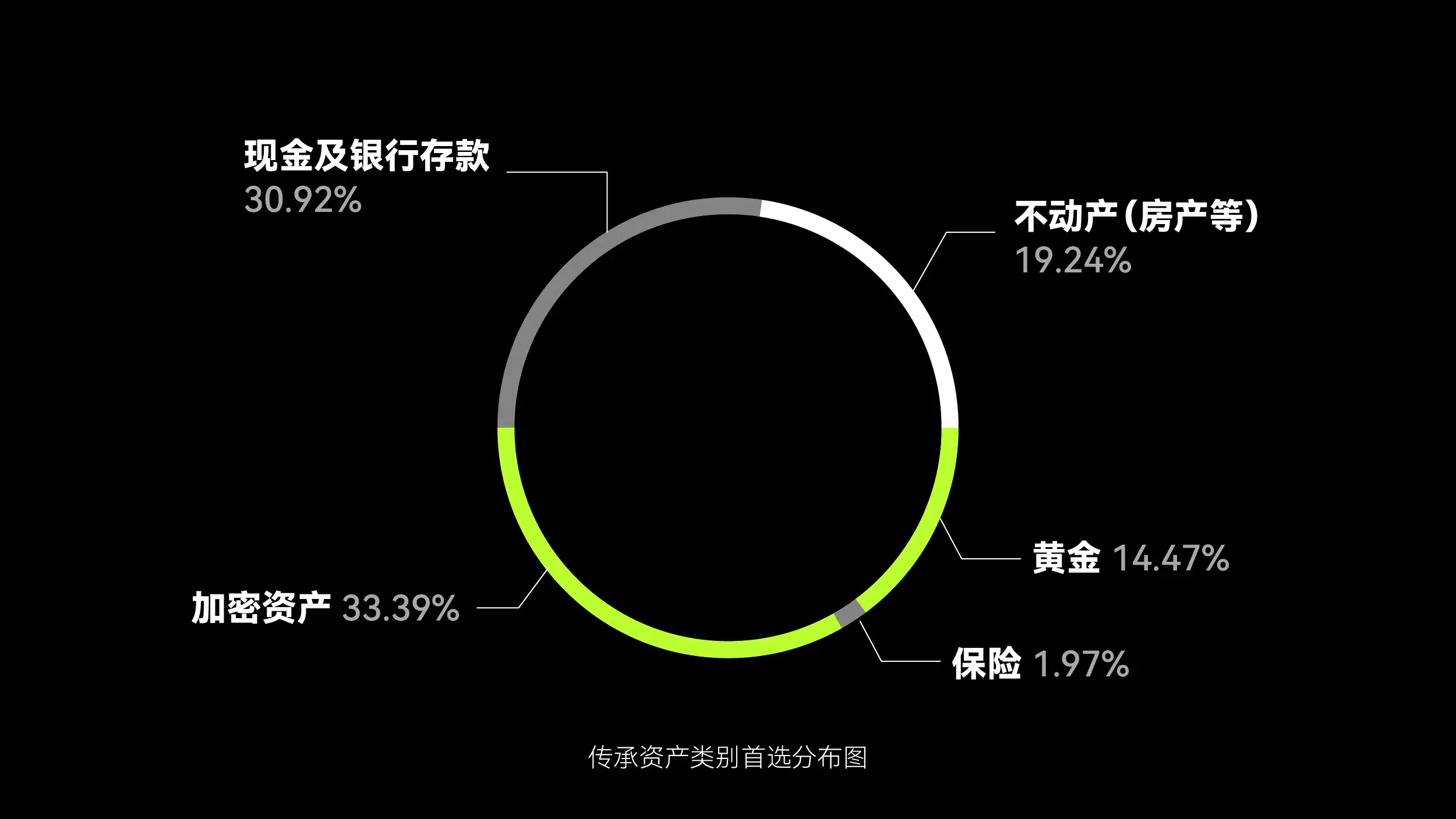
The cryptocurrency community's long-term belief in digital assets has surpassed reliance on traditional hard assets. Compared to the physical attributes and geographical restrictions of real estate, or the physical storage and relatively moderate appreciation potential of gold, cryptocurrency is better suited to adapt to future economic forms and meet the needs of long-term wealth growth.
In the survey, respondents generally have the most recognition for the appreciation potential, global circulation, and scarcity features of cryptocurrency. The distribution of these features shows that 73.34% choose appreciation potential, 66.56% choose global circulation, and 47.85% choose scarcity attributes. This feature distribution indicates that for surveyed cryptocurrency users, Bitcoin and other similar assets, compared to traditional assets, possess both the ability to grow in value over time and the borderless liquidity in space. This also reflects the general expectation of this group that the current prices of Bitcoin and other cryptocurrencies have not yet reached their peak and still have room for appreciation in the future.
Comparing to historical prices, Bitcoin has become a mature alternative asset, with its volatility showing a clear downward trend over time. During Bitcoin's early stages, the 180-day realized volatility often surpassed 80%-100%. During events such as the pandemic and the FTX black swan event, its volatility also increased significantly. However, since 2021, Bitcoin's 180-day realized volatility has gradually decreased, stabilizing around 50%-60%. This has brought its volatility in line with many popular tech stocks, lower than MicroStrategy (MSTR) and Tesla (TSLA). This trend of maturation has provided a more stable foundation for viewing it as a long-term inheritance asset.
Accumulation Strategy: Nearly Half of Families Plan to Allocate 30% to Inheritance Shares, Preferring Direct Purchase or Dollar-Cost Averaging
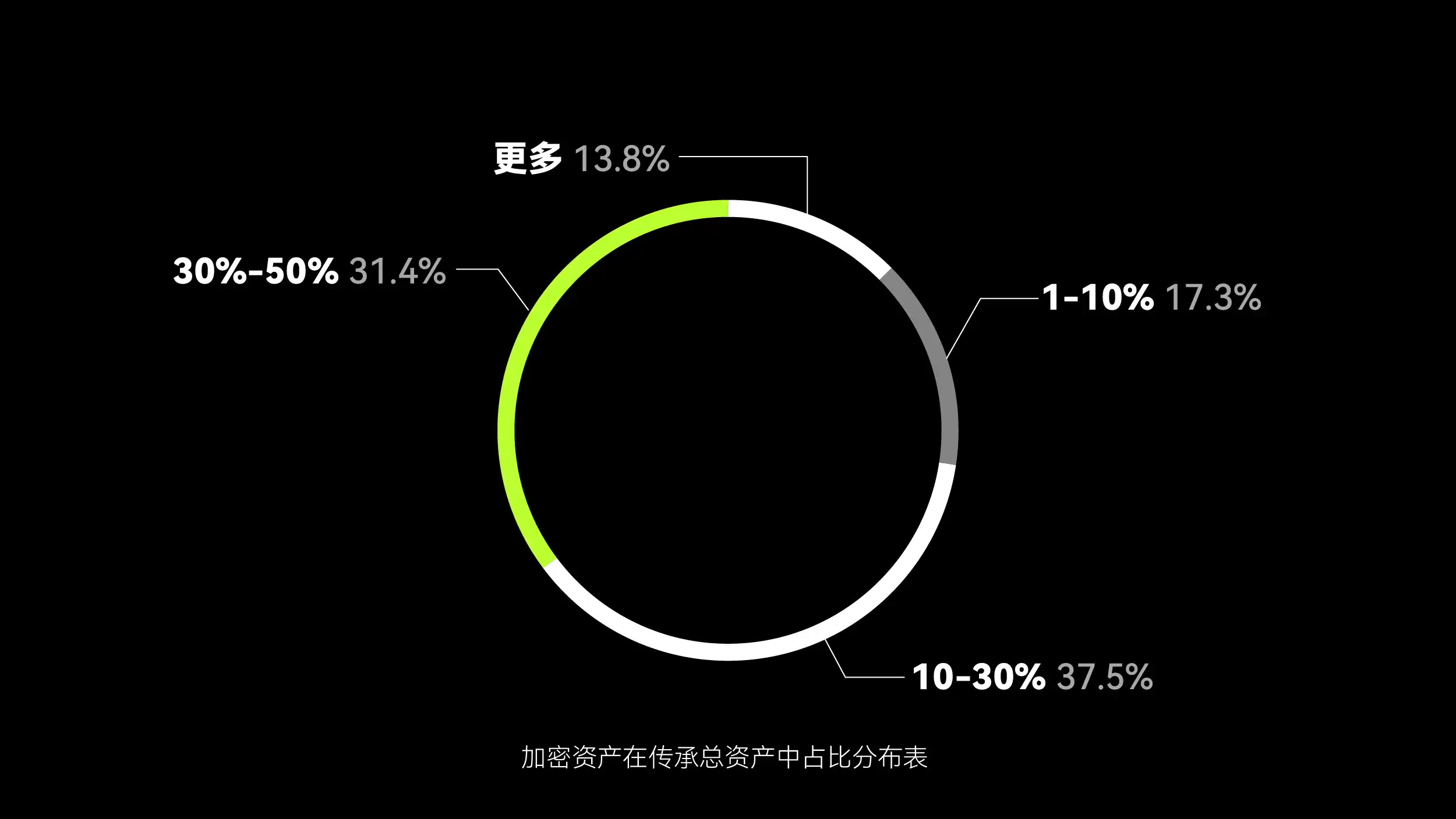
At the same time, a survey on allocation intentions further corroborated this structural shift: 45% of respondents plan for their children to inherit assets, with the share of crypto assets not less than 30%. Among them, 31% of families plan for a 30%-50% allocation, and 14% of families plan for a high allocation of over 50%. This marks the transformation of crypto assets from fringe allocation to a mainstream inheritance tool, reflecting a high degree of consensus among users on the long-term value of digital assets.
In a survey on how users acquire Bitcoin, user behavior also shows a distinct stratification of risk preferences. 40.79% of users chose to directly purchase Bitcoin to quickly build their position at specific times; 31.58% chose a dollar-cost averaging strategy to gradually accumulate Bitcoin, smoothing out volatility risk. This transforms the inheritance of Bitcoin into an executable long-term wealth accumulation plan, demonstrating a belief in the long-term value of digital assets.
After further analysis of data related to allocation ratios, we found that: the higher the proportion of Bitcoin allocation by users, the stronger their sense of security anxiety, leading them to prefer wallet storage and dollar-cost averaging strategies, indicating that security concerns and asset size exhibit a clear positive correlation. In contrast, users opting for professional custody platforms (such as exchanges) rely more on the platform's robust systemic risk management capabilities, requiring the platform to have the ability to withstand external attack risks.
Essentially, this is a game of choice regarding "risk attribution." The differentiation of custody models clearly indicates that the inheritance of crypto assets is entering a new stage of increased institutionalization, tooling, and professionalism.
Inheritance Pathway: 56% of Users Choose Self-Custody, but Over 70% of Respondents Worry About Key Loss
The survey results indicate that the majority of respondents chose wallets and exchanges as their inheritance methods. Among them, 56.58% chose self-custody (wallet) method, reflecting these respondents' fundamental need for asset control, directly assuming private key management and internalizing security risks. The exchange selection rate was 26.97%, actively transferring security responsibility to professional institutions, with their trust based on the latter's established and verified risk control system.
Transferring Cryptocurrency Safely to the Next Generation has become a top priority for the group of individuals with inheritance intentions.
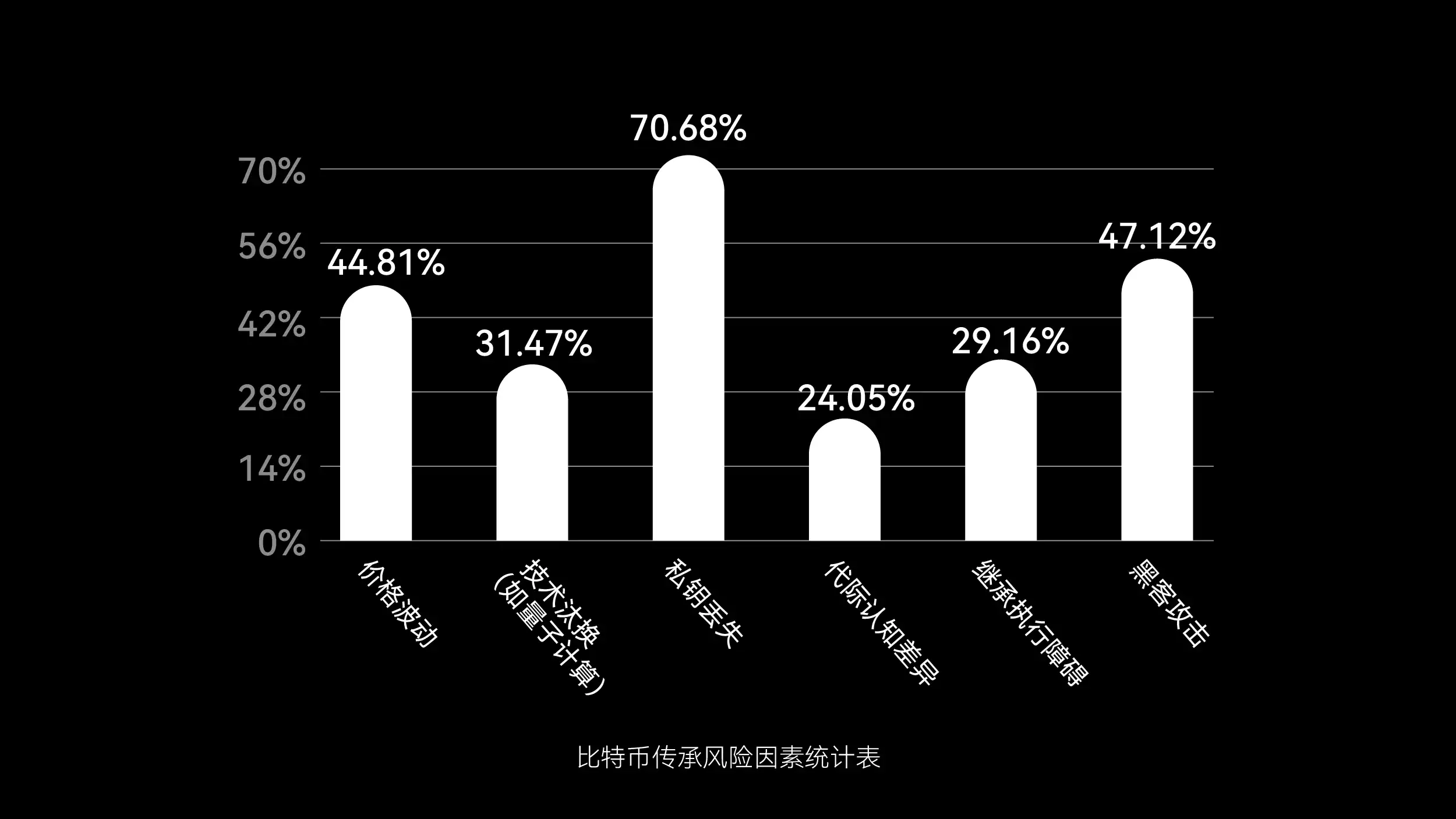
Furthermore, users have shifted from a speculative trading mindset to a long-term asset custody mindset. Among the surveyed group, 70.68% of cryptocurrency users are concerned about private key loss, 47.12% fear hacker attacks, and price volatility ranks third in inheritance planning risk factors (44.81%). With the maturation of Bitcoin and the stabilization of volatility, price volatility has dropped to third place in inheritance risk. This indicates that, among the group with inheritance intentions, price volatility is no longer the primary concern, and security is becoming a core focus.
Cognitive Transmission: Diversified Bitcoin Education Methods, Technical Principle Explanation Becomes Essential
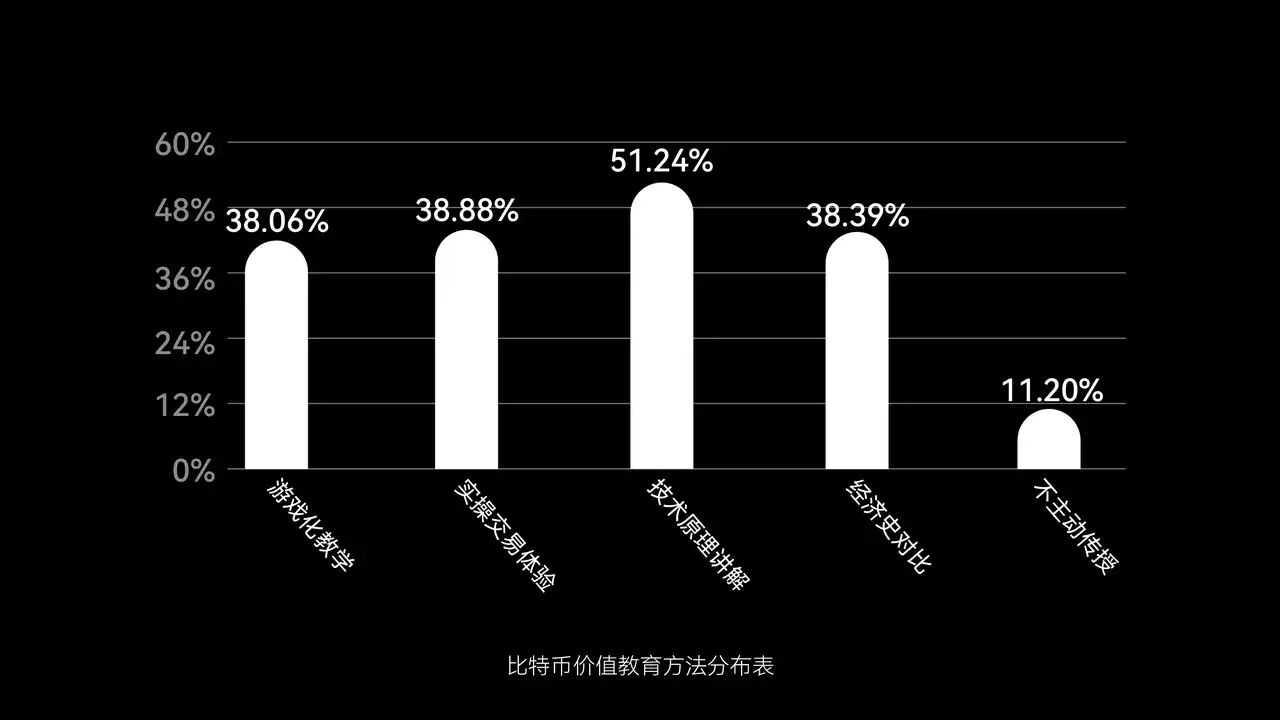
Cryptocurrency inheritance is more than just the asset itself; it is also a continuation of cognition and belief. Users who choose gamified learning, practical trading experiences, and economic history comparative methods are highly close in proportion; moreover, over 50% of users hope the next generation will understand blockchain technology. Only 11.20% of users choose not to actively impart knowledge, confirming that cognitive transmission is a prerequisite for asset inheritance.
Singapore has included blockchain in its secondary school curriculum, and Ivy League schools in the United States offer cryptocurrency literacy courses, indicating that technological awareness is becoming a survival skill for the "digital native" generation. This foreshadows the evolution of the inheritance scenario from "wealth transfer" to "ability transfer." The inheritance of cryptocurrency is not only about asset ownership but also about how to empower the next generation with the ability to understand, use, and assess the future financial system.
Additionally, it is worth noting that in asset inheritance planning, respondents without children allocated a significantly higher percentage to cryptocurrency assets in their inheritance plans. This trend may reflect the preference of the younger generation to consider Bitcoin and other cryptocurrencies as mainstream inheritance assets compared to traditional real estate, gold, and other assets, demonstrating their high recognition of the long-term value of digital assets.
Conclusion:
As the financial landscape transitions from ledgers to blockchain, family asset structures are also shifting from physical ownership to digital sovereignty. What the next generation inherits is no longer just property deeds and bank accounts but control over digital assets. This is no longer an edge practice confined to the geek community but is becoming a new mainstream paradigm for family wealth transfer. The market's increasing recognition of its long-term appreciation, global circulation, and scarcity, coupled with higher demands for secure custody and education outreach, continue to reinforce this shift.
OKX is committed to safeguarding the on-chain assets of every family. We have not only witnessed the growth of cryptocurrency assets but have also contributed to passing on every ounce of trust from one generation to the next—keeping digital wealth truly alive, transcending time and generations, and passing on the torch.
Disclaimer:
This article is for reference only. It represents the author's views and not those of OKX. This article is not intended to provide (i) investment advice or investment recommendations; (ii) an offer or solicitation to buy, sell, or hold digital assets; or (iii) financial, accounting, legal, or tax advice. We do not guarantee the accuracy, completeness, or usefulness of such information. Holding digital assets (including stablecoins and NFTs) involves high risk and can be highly volatile. You should carefully consider whether trading or holding digital assets is suitable for you based on your financial situation. For your specific circumstances, please consult your legal, tax, or investment professional. Please take responsibility for understanding and complying with relevant local laws and regulations.
This article is contributed content and does not represent the views of BlockBeats.
Welcome to join the official BlockBeats community:
Telegram Subscription Group: https://t.me/theblockbeats
Telegram Discussion Group: https://t.me/BlockBeats_App
Official Twitter Account: https://twitter.com/BlockBeatsAsia

 Related Articles








