From Deterministic Optimism to Deterministic Pessimism, the real opportunity lies behind disillusionment


Original Title: The Crypto Arc
Original Author: Matti
Original Translation: zhouzhou, BlockBeats
Editor's Note: This article outlines the evolution path of the crypto industry from early idealism to realism, pointing out that we are now at a crucial turning point post-disillusionment. Despite most projects tending towards imitation and conservatism, true opportunities still lie at the edge of "deterministic pessimism."
The following is the original content (slightly reorganized for better readability):
Here comes another Peter Thiel-inspired mashup article. As a self-proclaimed "Thielogian," I often think about the future through the lens of his classic work "Zero to One." Thiel's analytical framework is versatile and can be used to dissect various ideas, trends, and movements. However, sometimes it is more like Wittgenstein's ruler—it relies heavily on the observer's standpoint for its reliability and does not always provide a clear and consistent view.
As a crypto investor, I often better understand potential opportunities by analyzing narratives. At this industry inflection point—where we are at a crucial moment of narrowing the arbitrage space in the emerging technology market—I am also contemplating how to discover and inspire higher-quality ideas and products.
Through Thiel's perspective, I see the timeline of the crypto world as an evolution: from Bitcoin's early days of "deterministic optimism" to the "nondeterministic optimism" of the grand Web3 vision—where finance was ultimately seen as a killer app; then to the "nondeterministic pessimism" of the meme coin casino era; and now, in the current era of increasing regulatory clarity, we seem to be strategically embracing a "deterministic pessimism."
This is a journey that starts from cypherpunk idealism, goes through the frenzy of startups, slides into a decadent quagmire, and finally moves towards standardization.
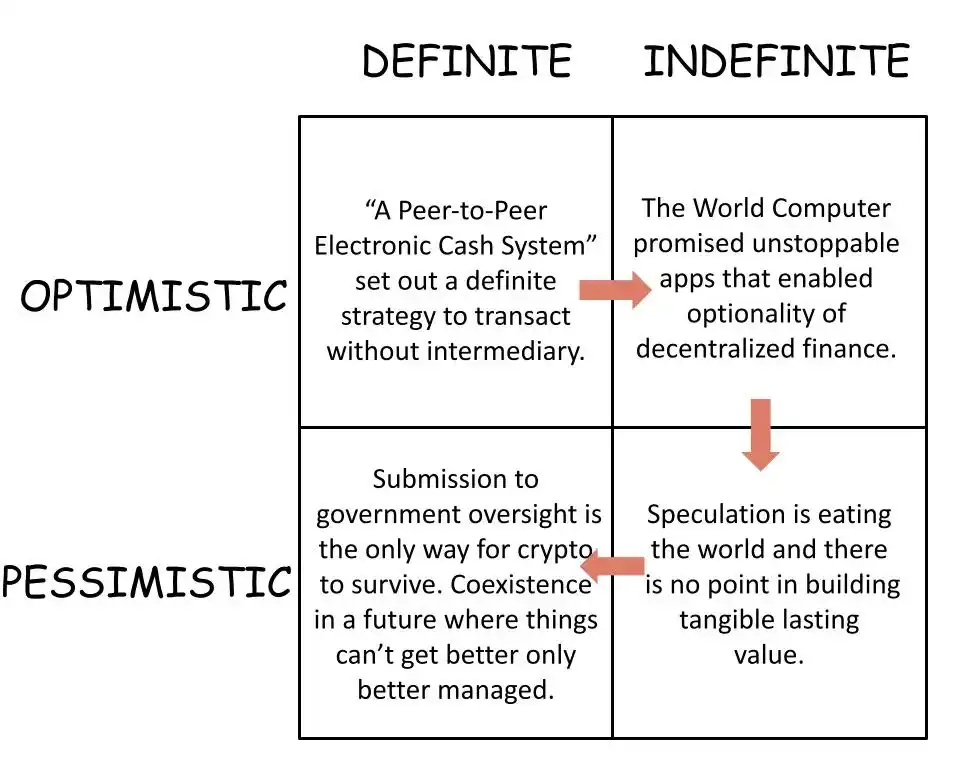
Is this trajectory commonly present in various trends? A revolutionary idea, after being partially validated, is often mythologized as a panacea; when it fails to meet those lofty expectations, it is cursed, eventually gradually blending into the status quo. The revolution is never truly completed, but we are still trapped in the closed loop of Gartner's hype cycle, repeatedly playing out a (satisfactory to some) cycle.
In the crypto space, this grand hype cycle is often overshadowed by price volatility. Each crypto cycle—Bitcoin, the ICO craze promising to build a "world computer," DeFi, meme coins, and now the current blend of regulation and integration with traditional finance—all seem to be fractals of a larger pattern. Currently, we are in a "disillusionment trough." According to Carlota Perez's technology surge framework, this is a key turning point.
Web3 once promised to "on-chain" Web2's profit model, decentralize, and tokenize. But Web2 or Web3 is not a place, nor a clearly identifiable "thing." As I said a few years ago, it is more like a "user preference"; and today, this preference still belongs to a niche. If you always need to rely on the old world's language to explain new things, then you are not actually creating something truly new.
The crypto industry is no longer a frontier market, but opportunities still exist at the edge of this established field. In this maturing stage, where does the greatest victory come from? Intuitively, it is from those players in a growth phase or with a latecomer advantage.
It is also worth mentioning that those centralized exchanges that once held high the flag of "deterministic optimism" and drove crypto adoption have now turned into pessimists, more focused on defending their existing market share rather than driving on-chain adoption.
In the past, exchanges and Layer 1 blockchains brought the most generous returns to investors. Ironically, the most fiercely competitive place, where optimism has receded and pragmatism has taken over, has produced the biggest winners.
Does this mean that we have no more "secrets" to uncover? I don't think so. Today's "secret" is precisely yesterday's lesson. Have we truly built many innovative and valuable companies or networks?
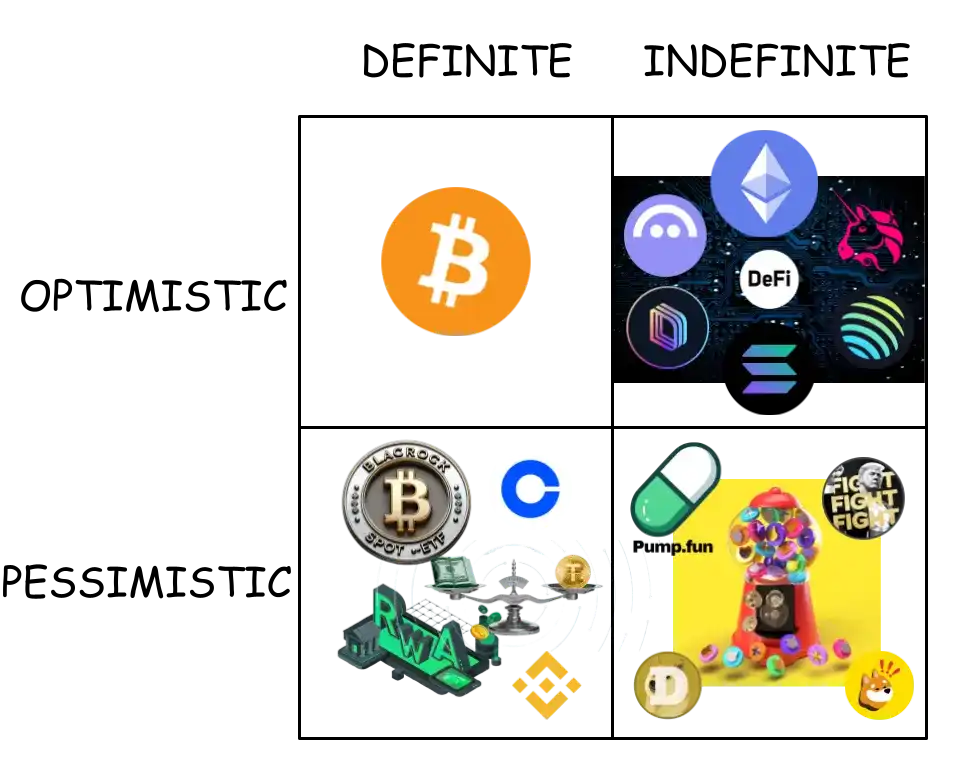
The low-hanging fruit has already been picked—the majority of today's projects are either imitating predecessors or slightly repackaging, pretending to be original. Many "solutions" are chasing non-existent problems, while others are simply trying to port traditional finance to the blockchain.
Crypto was originally a force inherently imbued with revisionism but has failed to achieve a true revolution. Today, it is trapped by a core (perhaps a false dilemma) question: "Are you trying to do the right thing or trying to make money?" In other words, are you willing to "sell out" yourself at the price the old system is willing to pay? The revolutionaries who are tired of crying in the meme coin casino are increasingly accepting this deal.
Building vague products that developers think users "should want" (no, people don't really want to own their own data) and the apparent success of centralized service providers have together propelled the industry into its current stalemate. Today, in the crypto world, true "deterministic optimists" are nearly impossible to find. But it is precisely in this "almost impossible" that the opportunity for cutting-edge investment lies.
Welcome to join the official BlockBeats community:
Telegram Subscription Group: https://t.me/theblockbeats
Telegram Discussion Group: https://t.me/BlockBeats_App
Official Twitter Account: https://twitter.com/BlockBeatsAsia

 Related Articles