SEND Surges Over 500% in 24 Hours, Can Meme New Lottery Site Super.exchange Save the Bear Market?

The market has long been plagued by insider trading. This is perhaps the sigh that every degen who has been rugged by a presale or airdrop will make. Just when they finally survived the aping-in stage and avoided a rug pull, a waterfall sell-off washes the market, causing FUD among investors.
At this moment, "No LP, No Insider Trading." "We will save the bear market!" — A project named Super.exchange, like a Superhero swooping in to rescue the market, quickly caught the community's attention. What magic does this Solana ecosystem's new asset issuance platform possess?
An Upgraded Version of Pump.fun
Why are meme insider trading, sniper attacks, and rug pulls so common? According to Super.exchange, a significant part of the problem lies in the fact that "Bonding Curves have been played out," which is one of the core reasons why tokens cannot achieve price discovery, leading to extreme price volatility.
To address early whale control issues, Super.exchange upgraded the traditional bonding curve to an Infinite Bonding Curve AKA Super Curve, making price increases more gradual. The principle of the Super Curve is not complicated; it can be seen as a Bonding Curve composed of seven different curves. These seven curves are like the gears of a manual transmission car — to accelerate, the car must shift gears. Similarly, to make the token price "accelerate," its underlying liquidity must also "shift gears." The seven "gears" of the Super Curve maintain market depth stability while promoting rapid and sustained price growth.
So, what problem does the Super Curve solve? The traditional bonding curve grows too slowly in the early stages, allowing some buyers to accumulate a large proportion of the token supply. Later on, as the curve grows too fast, it can lead to a liquidity gap. Without the support of market makers, trading becomes challenging. However, by using the Super Curve, all price ranges have permanently locked liquidity, eliminating rug pull risks and ensuring sustainable price growth.
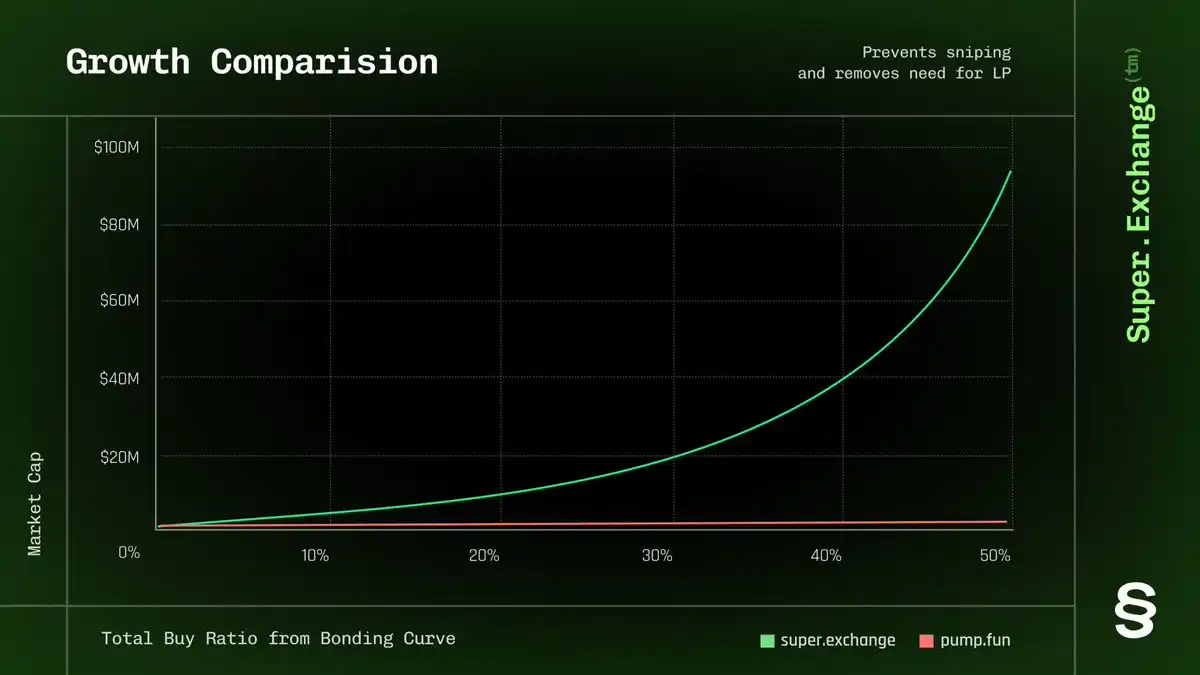
Comparison of token growth using Super Curve and traditional Bonding Curve. Image source: @_superexchange official account
More specifically, by controlling 80% of the token supply through a traditional Bonding Curve on Pump.fun, it only takes less than $20,000, and the price has only increased by 15 times. But on Super, to buy 80% of the tokens, the price will increase by 40,269 times. Consequently, it is difficult to accumulate a large amount of chips at a low price early in the token.
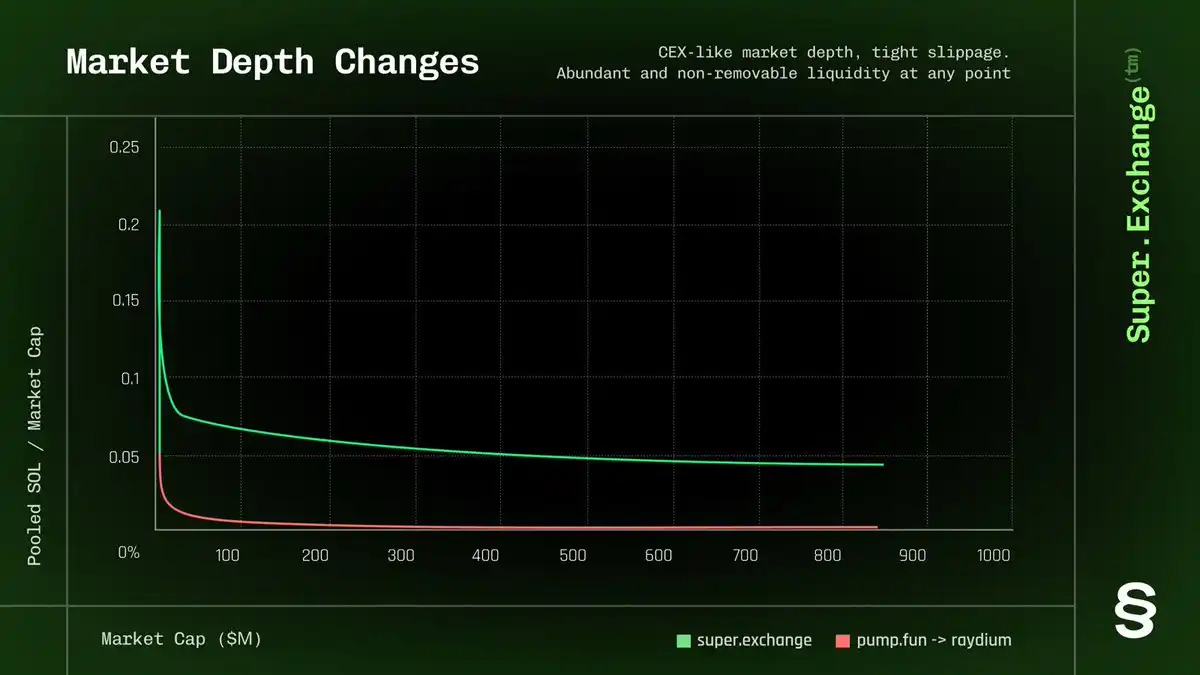
Super Curve vs. market depth characteristics of the traditional model, image from the official account of @_superexchange
On Pump.fun, as the market value increases, the depth of the pool rapidly decreases. Super.exchange, by eliminating reliance on liquidity providers, preventing pool draining, ensuring sustainable liquidity, has created a secure and growth-friendly trading environment.
Not only the innovation of the Super Curve, but Super.exchange also adeptly addressed another headache for everyone from pawns to grandmasters during the meme rush—the uniqueness of the ticker.
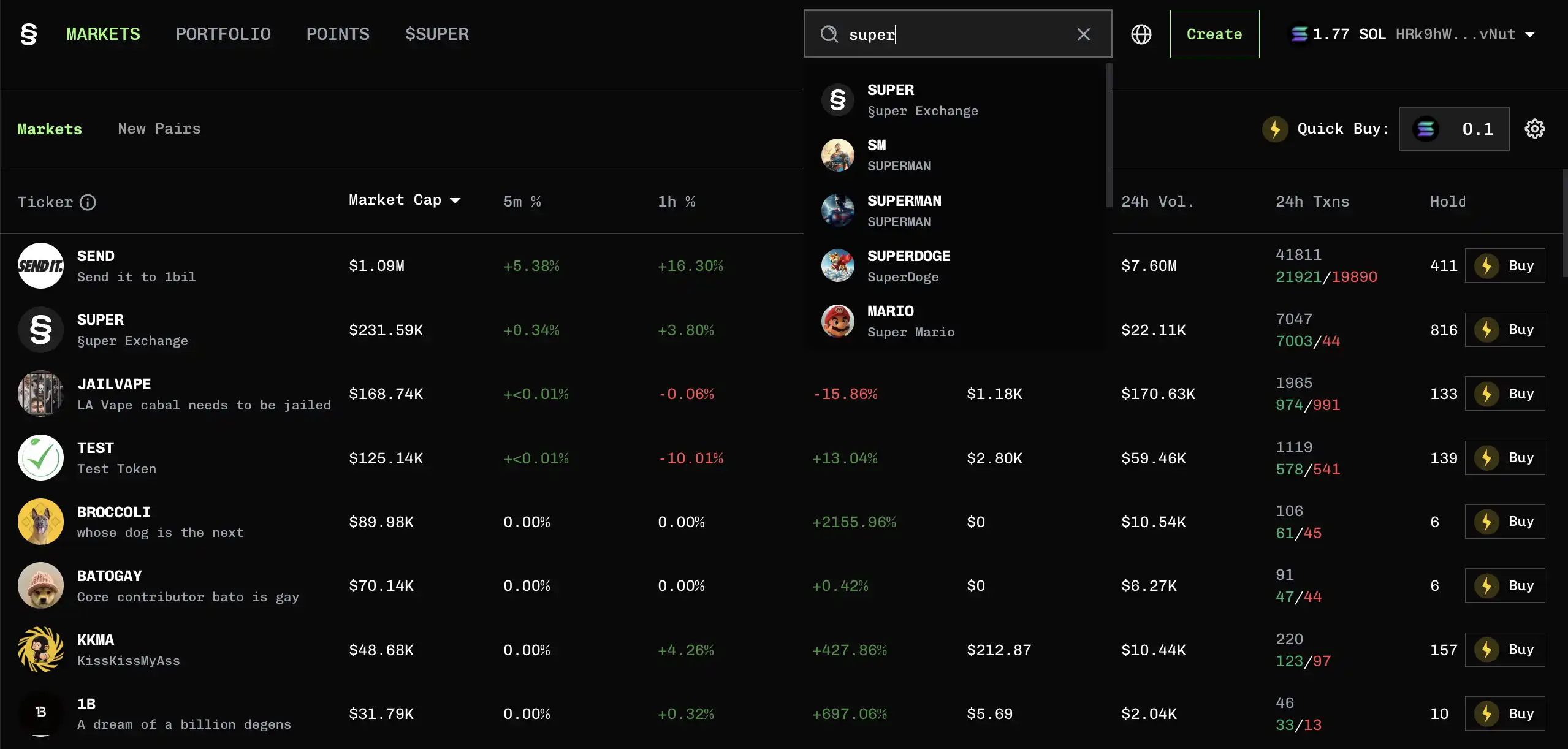
Do you remember the Broccoli War on the BNB Chain half a month ago? A large number of homogenized tokens were simultaneously issued, appearing on the new coin leaderboard flaunting the same image and name, triggering an intense PvP showdown. However, trying to search for $SUPER on Super.exchange, the results are crystal clear. No more need to painstakingly verify each one, as each ticker is the unique identity of the token, all in uppercase letters, putting an end to the lowercase-uppercase dispute.
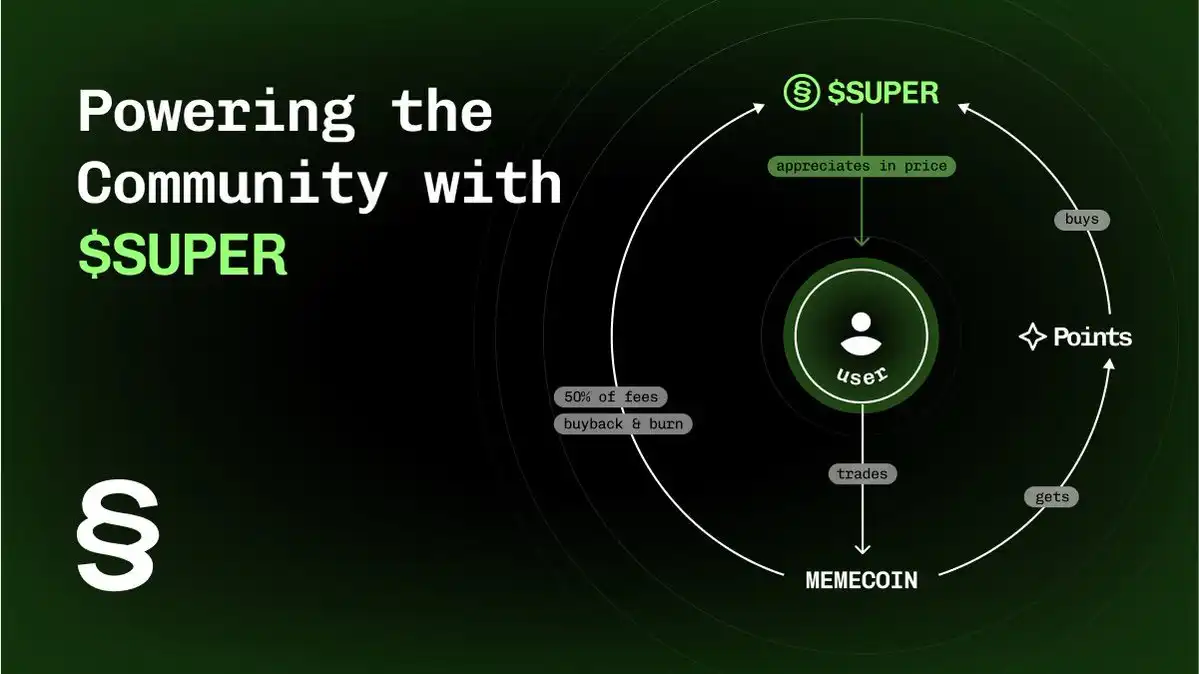
Finally, Super.exchange has also created its own platform token $SUPER. $SUPER is 100% community-owned, with a deflationary mechanism and a transparent buyback and burn policy. $SUPER has a total supply of 10 billion, launched fairly with no reserves, no front-running, and no VC quota. Of this, 50% of the platform fee income is used to buy back $SUPER and burn it, executed by a smart contract in 5-minute intervals, with the entire process transparently on-chain. As the platform grows, the buyback scale expands, driving long-term price growth and setting up a community growth flywheel.
How to Play Super.exchange
How to Get Started with Super.exchange? When users enter the homepage link to their wallet, they can mainly interact with the following three functions.
How to Create a Coin
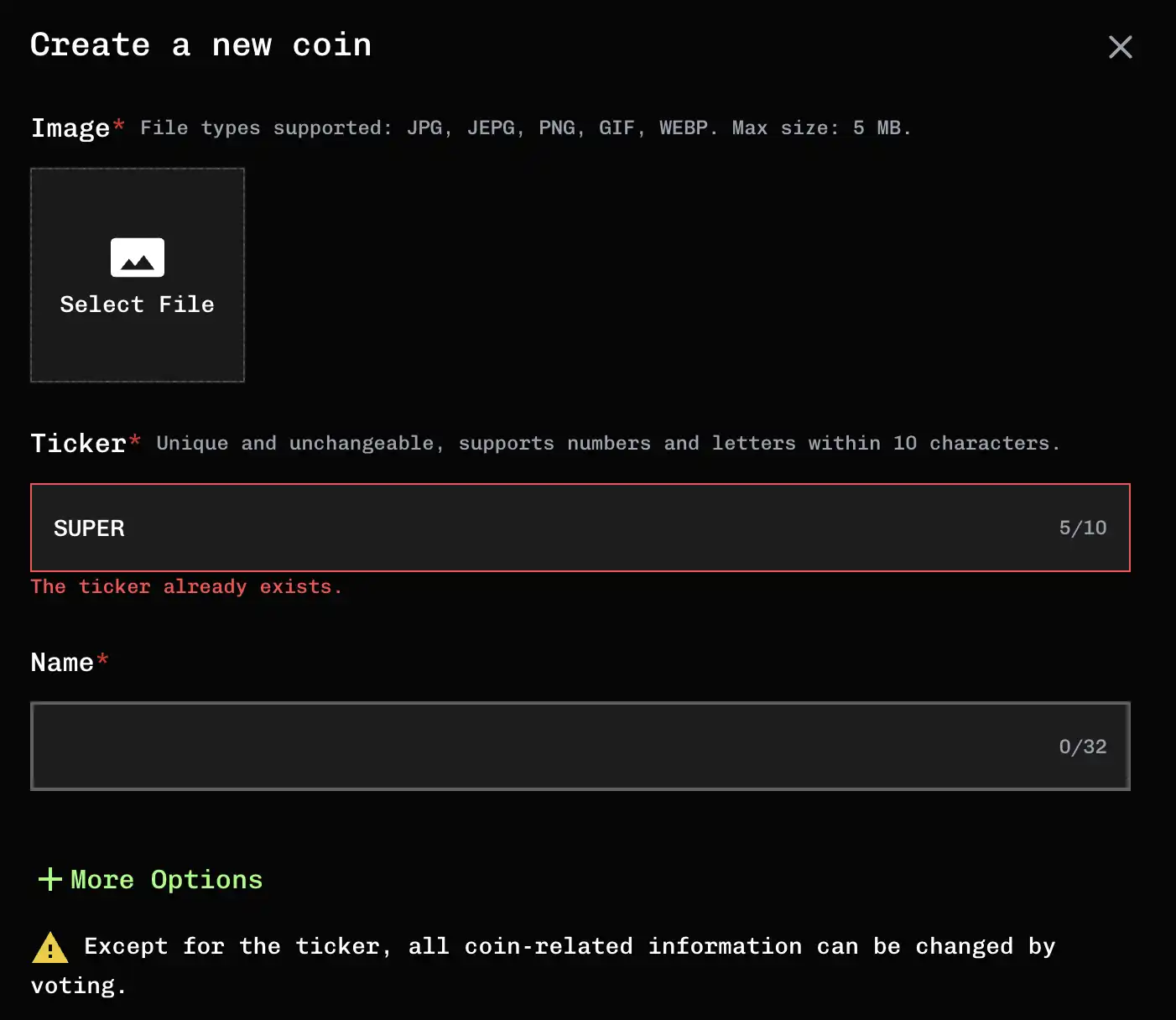
In the top right corner of the homepage, you can see the 'create' option. Clicking on it, you can enter the token icon, ticker, and name to complete the creation. If the chosen ticker is already in use, you cannot issue a token with the same name. It supports a combination of up to 10 alphanumeric characters. Besides the ticker, which cannot be changed after creation, other options can be modified after a community vote. Based on practical results, creating a coin takes approximately a 2.5% fee, slightly more expensive than Pump.fun.
How to Buy Coins
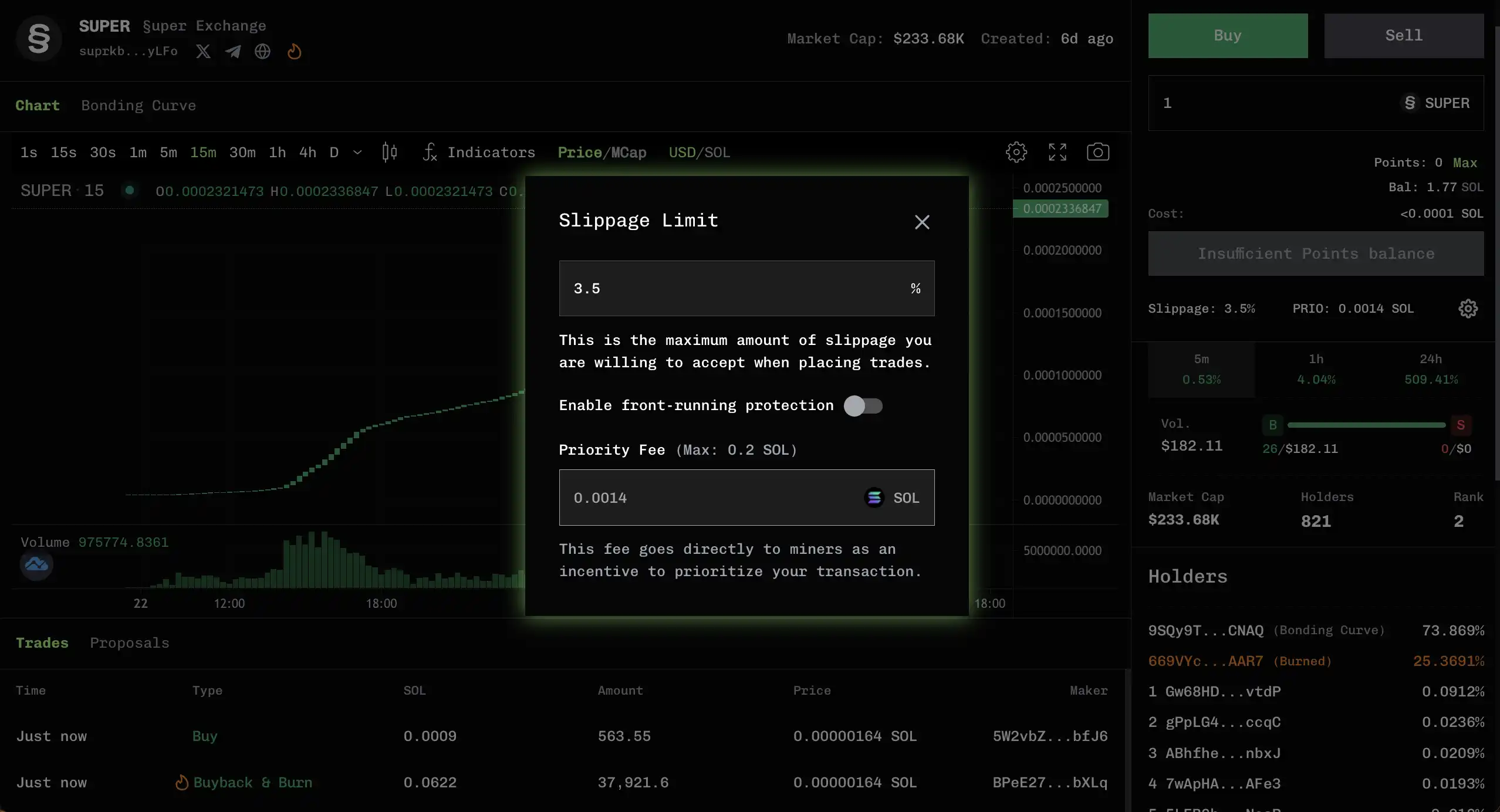
Super.exchange also distinguishes between internal and external markets. By clicking on 'MARKETS' on the homepage, you can see the token board, where 'Markets' represent the external market and 'New Pairs' correspond to the internal market. The market value of each token is calculated using the Super Curve. Clicking on the token icon to enter the purchase page allows you to set the amount and slippage tolerance. After purchase, you can view the acquired assets in 'PORTFOLIO.'
How to Earn $SUPER
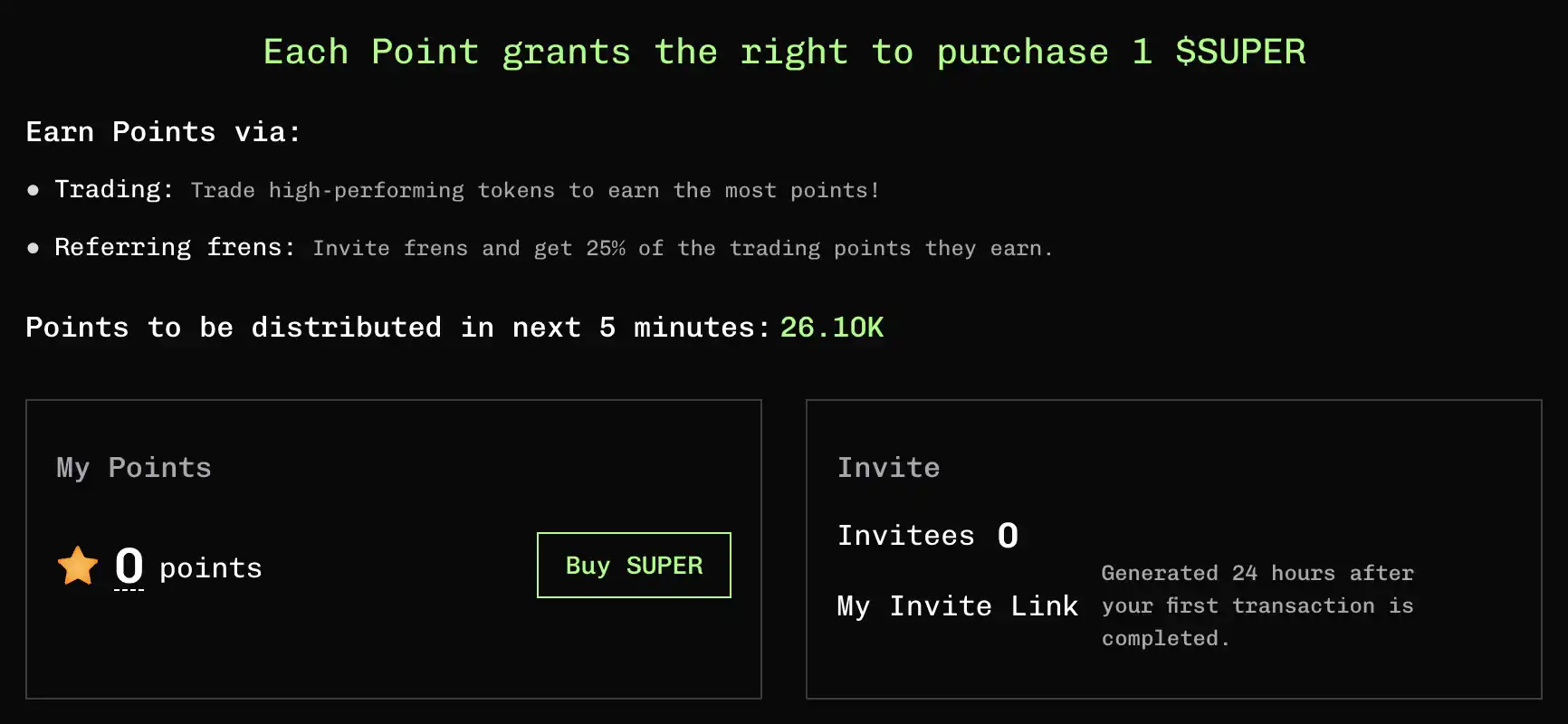
Currently, the official website only provides two ways to earn $SUPER: trading and referrals. The higher the performance of a token in trading, the more points you earn. Inviting friends allows you to receive 25% of their trading points. 1 point equals the right to purchase 1 SUPER, meaning that only actively trading platform users have the right to buy $SUPER. This approach aims to allow early users who genuinely use the platform for trading to enjoy dividends, rather than having whales lock up millions in liquidity in new DeFi protocols.
Will Super.exchange Become a Meme Superhero?
As of now, Super.exchange has indeed to some extent addressed the pain points of the current meme market: insider trading, chip accumulation at low prices, indistinguishable tickers, and rug pulls after pumps. These issues have made the market filled with uncertainty and a crisis of trust once memes have completely turned into a casino. At this point, it seems that Super.exchange, through its unique design and mechanism, has provided a solution to these chaos, at least on the surface, making the trading environment appear more transparent and fair.
However, looking back at the entire meme coin cycle, the essence of its rise is more of a community-driven cultural phenomenon, rather than something that can be fully covered by just the technology or tokenomics. While Super.exchange has optimized the trading mechanism, it's hard to deny that the most attractive aspect of meme coins, a large part of it, comes from the lottery station tailored for it by Pump.fun and the myth of creating wealth by hundreds or thousands of times.
Related reading: "Neiro Resurrection: Exchanges are becoming the "referee" of the meme market | 100x Retrospective"
The current improvements may perhaps curb some speculative behavior, but it's also challenging to answer the following questions: How can a strong and lasting community consensus be quickly formed without the short-term stimulation of a pump? If the meme lottery odds are no longer appealing, will it still attract many people to sit and bring in new liquidity? Especially in the current bear market, will memes be cleared from the market as oversupply, or will they continue to span cycles with their emotional and ideological value? This may be the real key to the future development of meme coins.
And for Super.exchange, can it, after the market is pockmarked, filter out memes that truly have consensus and value through a more rational price discovery mechanism? With the dual drive of innovative mechanisms and community flywheels, can it become the Superhero that saves memes? Perhaps only time will provide the answer.
Welcome to join the official BlockBeats community:
Telegram Subscription Group: https://t.me/theblockbeats
Telegram Discussion Group: https://t.me/BlockBeats_App
Official Twitter Account: https://twitter.com/BlockBeatsAsia