AiFi Summit 2024 Devcon Highlights
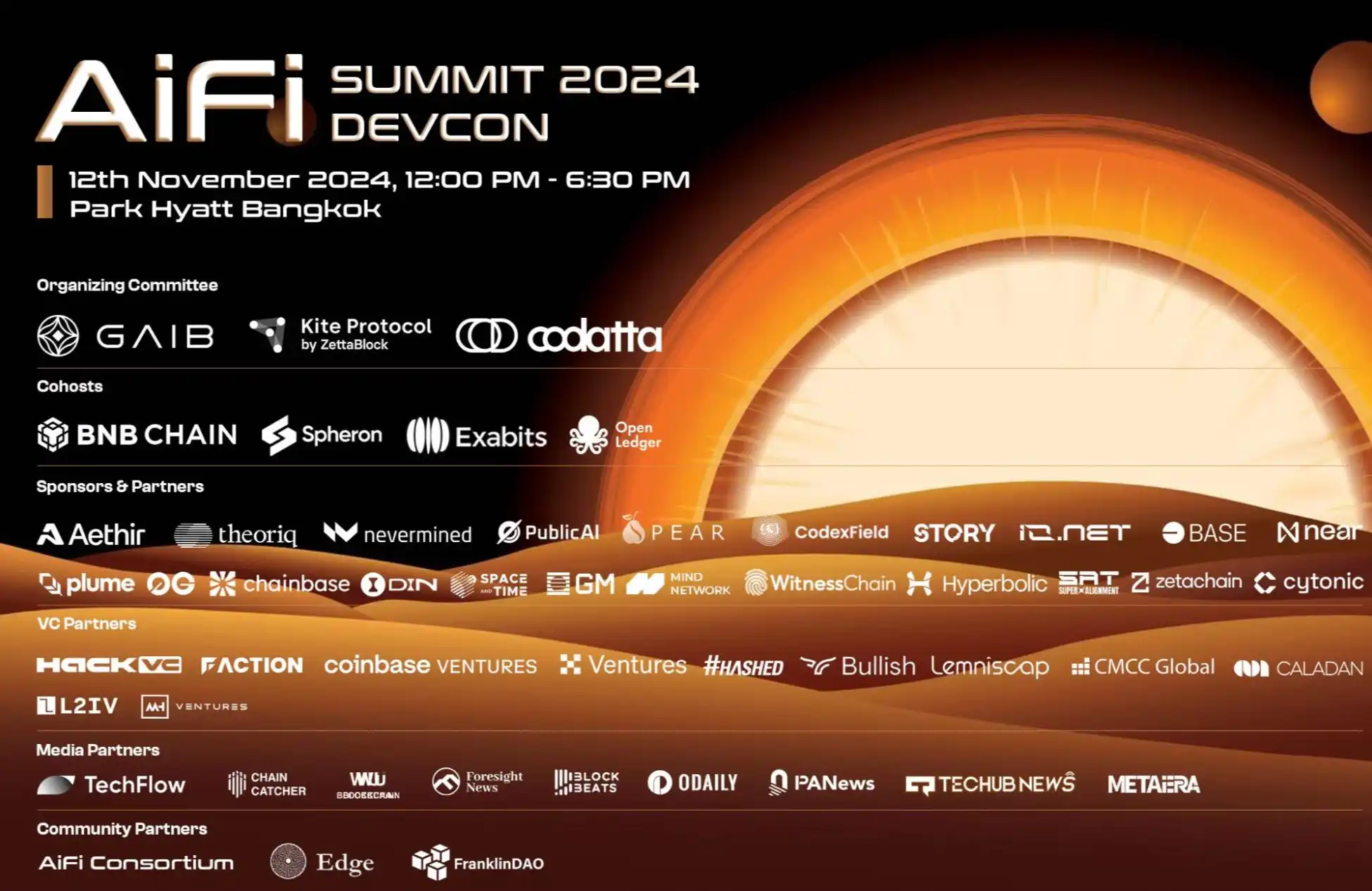
The AiFi Summit 2024 Devcon, jointly hosted by GAIB, Codatta, and Kite AI (formerly ZettaBlock), concluded successfully at the Park Hyatt Hotel in Bangkok on November 12. The event saw a registration of 1300 attendees, with over 500 in-person participants. A total of 27 projects and investment institutions, including Paypal, BNB Chain, Base, NEAR Protocol, Story Protocol, 0G, Aethir, io.net, Exabits, Plume, Space and Time, Hyperbolic, Faction, Hashed, and Coinbase Ventures, delivered insightful speeches.

Sarah, the Asia-Pacific Regional Head of BNB Chain, delivered the opening keynote. She mainly introduced the construction of the entire BNB Chain ecosystem, various developer support policies, and synchronized the audience with the current progress of BNB Chain in various AI applications.
In the following second keynote speech, GAIB's CEO Kony expressed his views on the potential opportunities in the current computing power market. He mentioned that AI is the most important era after the mobile internet, and computing power has captured a significant proportion of value in the AI boom. Compared to other financial assets, investing in GPU computing power assets can bring unparalleled returns that other targets cannot match. However, the current issue in the GPU market is the inefficient connection between the two participants: on one side are operators who have to bear significant financing costs when scaling GPU for external financing; on the other side are investors who find it challenging to invest directly in computing power assets and usually can only choose to invest in semiconductor stocks like Nvidia. GAIB aims to tokenize computing power assets and their income, and provide liquidity to investors, offering a more decentralized, transparent, and AI cash flow-based on-chain asset.
The first panel discussion at the AiFi Summit was themed "AiFi: Financialization of AI & Compute Assets," where core members from GAIB, Exabits, io.net, Aethir, WitnessChain, and Plume teams discussed the current opportunities, challenges, and industry regulations surrounding AiFi.

Exabits' CIO Jonathan mentioned: Currently, if users want to use a GPU, they can only turn to major cloud providers such as AWS or Azure, but these platforms tend to serve large enterprises more, which limits the development of startups. We need a more democratic and open GPU resource to support small and medium-sized enterprises. In the Web3 world, everyone can become a GPU investor to break AWS's computing power monopoly, which presents a huge industry opportunity.
Asa, the Asia-Pacific region lead at io.net, mentioned that outside the three major cloud providers, independent data centers still have 50% of GPUs underutilized. These data centers lack opportunities to reach users. However, GPUs need to ensure continuous operation and face maintenance issues. Building an incentive mechanism to ensure the interests of investors and other participants is a significant challenge in the AiFi space.
Kartik, the ecosystem lead at Aethir, mentioned that the entire system involves computing power demanders, computing power operators, investors, etc. Convincing them to participate in a market that relies on on-chain mechanisms and ensuring the needs of all parties are met poses many challenges. Regulatory risks exist in some countries and regions, where incentivizing data center services through tokens may cause trouble, so it is necessary to establish compliance boundaries in customer agreements.
Ranvir, co-founder and CEO of WitnessChain, proposed that computing power as a new asset requires a new pricing mechanism. There is no unified formula to calculate the commodity price of computing power, as different platforms and GPUs have cost and performance differences. Additionally, GPUs of different performances contributing to the same task will have different impacts, creating opportunities for designing new financial mechanisms.
Teddy, CBO of Plume, also mentioned the need for cautious regulatory considerations when new assets emerge. There is already a certain compliance framework for AI-related assets that enables asset trading to be legitimate and viable, which is also what Plume does to help ecosystem projects.
In the following keynote speech, Yi, CEO of Codatta, explained how decentralized data trading drives AI towards AGI and Codatta's position and mission in this process. He mentioned that only domain-specific data can enhance the base model's reasoning and planning capabilities in a specific field, and only by collecting a large amount of data from various domains can AGI be achieved. Each piece of data we provide as data contributors can actually be applied to multiple scenarios, each of which will have different companies to commercialize it. This means that the vertical domain data we provide will generate income over time, which is why we consider data as an asset. Therefore, we need to make data asset transactions easier and ensure relatively fair pricing in the market.
The second panel discussion focused on the Open Data Economy, with core members from projects such as Spheron, Theoriq, Space and Time, Hyperbolic, Base, and Nevermined discussing the current state of the AI data ecosystem, infrastructure support, and the needs of future ecosystems.

Theoriq's Co-founder and CEO Ron mentioned that we are currently seeing many applications beyond simple chatbots and governance bots on DAOs. These applications involve the collaboration of multiple agents. In addition to the crypto space, these applications are increasingly appearing in marketing, analytics, and other scenarios. While many people believe that the main use of data is to train models, we are witnessing data playing an increasingly significant role in the decision-making process. Different agents obtaining different data and working together can create the most value.
Space and Time's Co-founder and CTO Scott stated that Space and Time is currently using smart contracts to build a rule engine for agent systems. This allows agents to use your funds in a trustless environment, achieving the ideal on-chain form of agents. Space and Time's product enables users to query an agent's past behavior and establish strict enforcement policies for agents.
Nevermined's CEO Don believes that two conditions are necessary to succeed in the data marketplace: monopolization of data transactions and restrictions on data assets to prevent data contributors from uploading meaningless assets. A feasible approach is to build analytical tools around data assets for specific scenarios, maximizing data value and profits.
As one of the hosts, Kite AI's CEO Chi announced a brand upgrade in her keynote speech, unveiling the new artificial intelligence platform Kite AI during the summit. She discussed the challenges of the current centralized AI development and how KiteAI is expanding the boundaries of AI through its solution. Due to the lack of data distribution channels and data ownership verification mechanisms, a significant amount of personal and even enterprise data is difficult to utilize for large-scale training of models. In the past year, the proportion of open-source licensed datasets on the internet has dropped from 95% to 75%. Companies that perform model training find it challenging to access the best quality data to provide to their models and struggle to achieve breakthroughs in model performance. The industry needs decentralized AI solutions to access more valuable data.
In the third roundtable discussion, team members from GM Network, Mind Network, 0G Labs, NEAR Protocol, and Chainbase discussed how Web3 companies can participate in AI competition, data privacy, application implementation, and other topics.

Max, a founding team member of GM Network, mentioned that users have been generating a large amount of data, but this data has not been well utilized, causing it to lose its value. We need to combine the collected data with AI to make smart devices even smarter.
Leon, the Asia-Pacific lead from Mind Network, pointed out that while there is no perfect data privacy protection measure in reality, combining different methods may explore feasible solutions. To protect user privacy, Mind Network is currently encrypting data at three different levels: encrypting data in distributed storage, using fully homomorphic encryption during GPU computing processes, and encrypting at the application level.
Chris, an AI researcher at 0G Labs, mentioned that in traditional AI models, even with open-source models, it is difficult to know what data was used in training and how they would perform in new scenarios, making model results hard to trust. 0G has a robust data storage infrastructure where data can be loaded directly from the cloud into the training process, enabling the construction of more secure and trustworthy models through personal verified data in the future.
Chris, the COO of Chainbase, mentioned that there are currently two narratives in the market: crypto for AI and AI for Crypto. Utilizing crypto to address the issue of large companies controlling data, computing power, and models has been discussed extensively. Recently, many AI for Crypto use cases have emerged, such as truth terminals and AI payments, with more and more projects starting to collaborate to support the AI ecosystem. Users are very concerned about whether data can be monetized, and the platform's key task is to solve how to distribute profits between data contributors and consumers effectively. Developers are not a vision-driven group; the most important thing is to help them save time and earn money.
In the subsequent keynote speeches, Bu Fan, the Head of IPFi at Story Protocol, and Prakarsh, the ecosystem lead at Spheron, shared their views on the tokenization of decentralized AI assets and how their organizations are adapting to this trend.
Bu Fan mentioned that there are already many real-world scenarios combining AI and Crypto in the market. The first type is user-facing chatbots, where creators create AI characters and issue commercial licenses on-chain. The second type is AI meme coins, where creators can legitimately connect on-chain to the original IP asset and release tokens externally. The third type is providing model training data (such as images), allowing continuous revenue through on-chain royalty collection. However, these are just some very early applications, and the patterns have not yet formed. Creators can continue to explore AI+Crypto integration scenarios. The Story Protocol focuses on standardizing IP activities through tokens and disseminating IP in various forms. He believes that most AI is also a form of IP, and if IP can be securitized, then AI can also be securitized. For example, the images used to train an AI model can be IP, the AI model itself can be IP, and when the AI model generates new content, on-chain IP distribution transactions can be conducted to achieve securitization.
Prakarsh mentioned that in the AI era, computing power will become the underlying anchoring asset for most agents and AI applications. Distributed computing power will have many applications. They currently see some potential use cases, including inter-hospital knowledge sharing under the premise of data privacy protection and AI dialogue systems supported by local computing power and models, ultimately forming personalized AI systems.
The fourth panel discussion focused on how to connect the Crypto and AI worlds. Investors discussed the challenges faced by centralized AI systems and where Crypto+AI can break through.

Hiroki, Head of Research at Lemniscap, proposed that there are two challenges in building a decentralized AI network. One is that the scalability of a distributed computing network is difficult to compare with centralized competitors, and the other is that controlling the data quality contributed by individuals is challenging.
Will, an investment partner at Faction, said that currently, you can have AI plan your entire vacation, but the plan cannot be implemented because AI currently cannot make payments for you. Will believes that AI Agents need to have a cryptocurrency wallet, with the wallet acting as a bank account, and the payment technology stack will have a significant opportunity as all fund transactions must flow through these Agents.
Ryan, an investment partner from Coinbase Ventures, believes that most models currently can only access public data and cannot access sensitive private data such as financial and medical data. Crypto can drive models to access private data pools, improving AI performance in specific domains. Agent systems currently cannot perform very complex tasks; they actually do not know how to understand and act on smart contract contents. We need large models that can access smart contracts, understand them, and provide human-readable interpretations.
Hashed's investor Dan pointed out that the current incentive system for distributed AI is not very sound. In the entire AI value chain, only a few people have made significant positive contributions, but their contributions are not reflected in the incentives. The lack of a proper allocation mechanism has led to unfair distribution. Additionally, the models owned by the community must be secure and controllable, returning ownership of the parameters to the community for research, rather than providing a black box like centralized companies. If the model involves scenarios such as emotional support, it should be even more governed in an open environment.
Bullish Capital's director Sylvia mentioned that the design of the incentive model must fully consider what the underlying needs are. For example, if edge devices are required, it is necessary to consider how to find them among numerous distributed computing devices. Therefore, without solving the issue of model architecture optimization, there is no way to design a truly effective incentive model.
The above are all the highlights of the AiFi Summit 2024 Devcon. Despite facing challenges in regulation, incentive mechanisms, and various other aspects, the AiFi track is also full of opportunities. With the market at new highs and the AI track being highly active in all aspects, the industry as a whole is showing a positive trend, with talents continuously entering and more and more innovations emerging.
For more content, please follow:
GAIB: https://x.com/gaib_ai
Codatta: https://x.com/codatta_io
KITE AI: https://x.com/GoKiteAI
Welcome to join the official BlockBeats community:
Telegram Subscription Group: https://t.me/theblockbeats
Telegram Discussion Group: https://t.me/BlockBeats_App
Official Twitter Account: https://twitter.com/BlockBeatsAsia

 Related Articles