Bitwise: Why Traditional Investors Need to Pay Attention to Stablecoins?

Original Title: Could Stablecoins Put an End to Money Market Accounts?
Original Authors: Juan Leon, Ari Bookman, Bitwise
Original Translation: Luffy, Foresight News
The Bitwise research team releases a "Crypto Market Review" every quarter, analyzing the most important fundamentals and trends affecting the crypto market from a data-driven perspective. The third-quarter market review was particularly exciting.
On the one hand, cryptocurrency prices remained stagnant, with the market mostly trading sideways over the past six months.
However, as Bitwise Chief Investment Officer Matt Hougan puts it, "The surface calm hides enormous progress underneath."
We want to highlight just one aspect of these developments: stablecoins emerging as the dominant application of blockchain technology.
Why Investors Should Care About Stablecoins
Stablecoins are no longer niche; we have been talking about them for many years. Major traditional players like PayPal are rolling out their own stablecoins. High-ranking members of the U.S. House and Senate are discussing stablecoins. Last week, payment processing giant Stripe announced that it plans to acquire the stablecoin issuance platform Bridge for $1 billion, marking its largest-ever acquisition in the cryptocurrency space.
So, what makes stablecoins so valuable? And why should investors care about them?
Unlike other crypto assets, stablecoins are designed to maintain a stable value relative to an asset (usually the dollar). If you see a stablecoin's price fluctuate, something is definitely wrong. This makes them less attractive as investment targets and more as a medium of exchange. Importantly, this role positions stablecoins as a bridge between traditional finance and the crypto economy.
Furthermore, they are fast, efficient, and programmable. You can send $10,000 to anyone in the world within seconds, without worrying about bank hours or long settlement times. As digital assets, stablecoins can be programmed to execute smart contracts enabling automatic payments, custody services, and various decentralized finance (DeFi) applications.
This is why stablecoin usage has skyrocketed to record levels. In the first half of this year, over $5.1 trillion in global transactions were conducted through stablecoins, almost on par with Visa's $6.5 trillion.
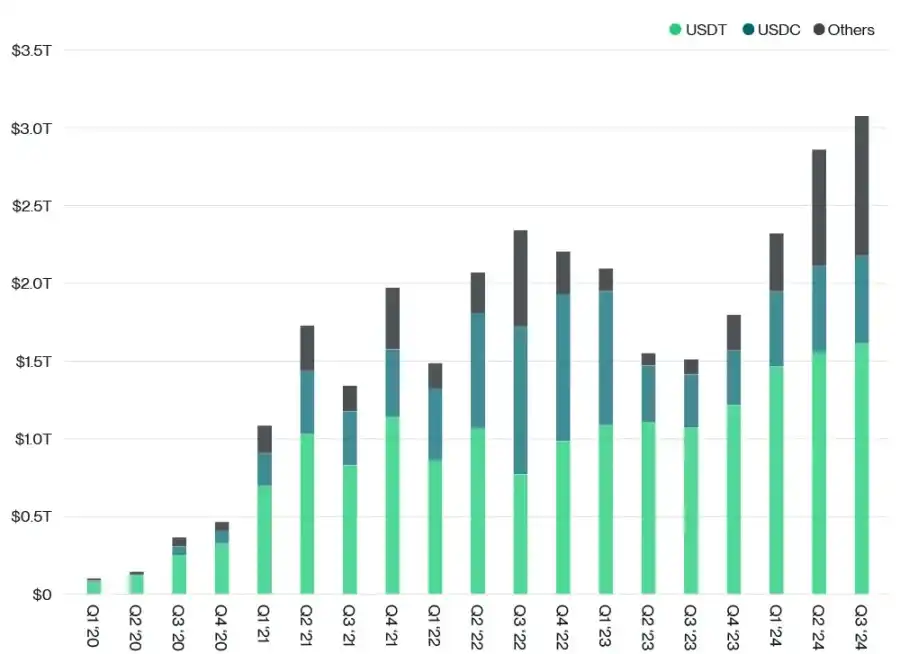
Stablecoin Trading, Source: Bitwise Asset Management, Coin Metrics. Data covers from Q1 2020 to Q3 2024. Note: "Others" include BUSD, DAI, FDUSD, GUSD, HUSD, LUSD, PYUSD, TUSD, USDK, and USDP.
How Did Stablecoins Take Off?
Why did the traditional payment giant PayPal launch a stablecoin? The answer is that this business model is just too good.
The issuer takes in US dollars (or other fiat currency) and mints an equivalent amount of stablecoins. They then use these fiat currencies to purchase US treasuries and other income-generating assets. Finally, they pocket the interest income.
How well has this model worked? The largest stablecoin issuer, Tether, made more profit last year than BlackRock.
These issuers are becoming major players. As shown in the chart below, the total US Treasury holdings of the top five stablecoins exceed those of some G20 countries like South Korea and Germany. Therefore, stablecoin growth has provided a new source of demand for US debt and helped provide liquidity to the US Treasury market, benefiting the broader financial system.
Investors are eager to get involved. Tether's biggest competitor, Circle, is willing to help investors and quietly filed for an IPO this year. Additionally, publicly traded companies like Visa have plans to integrate stablecoins into their operations.
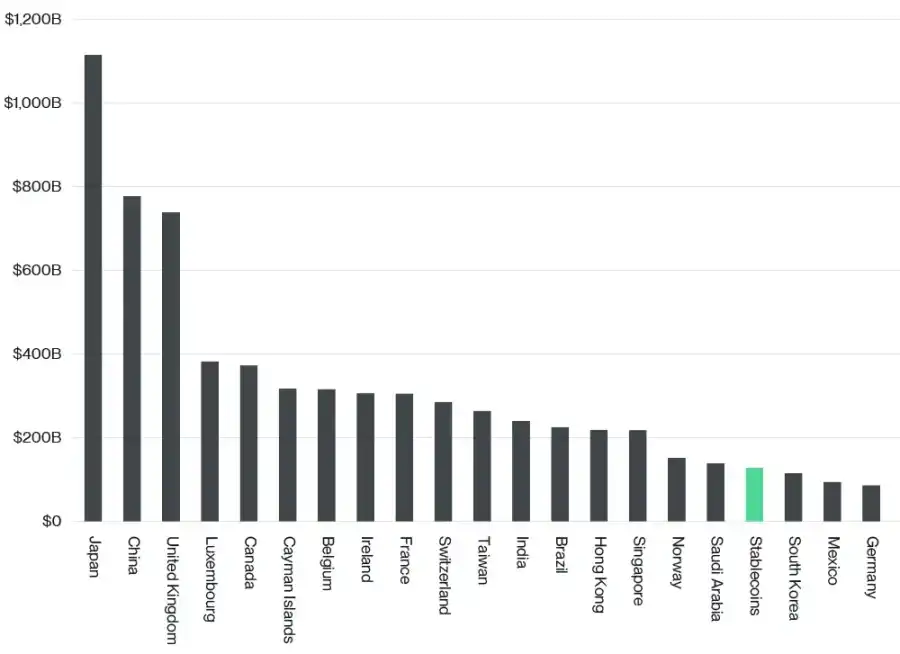
Stablecoin Holdings of US Treasuries vs. Major Foreign Holders, Data from the US Treasury and company reports. Data as of June 30, 2024.
What Opportunities Should Investors Seize?
So how should investors seize this opportunity?
Remember: Stablecoins do not appreciate; they will face the same inflationary pressures (and currency exchange risks) as the assets they are pegged to.
So, what opportunities should investors look for? What risks should they be aware of?
1) Publicly Traded Companies
Some multinational corporations are integrating stablecoins into their business for a competitive edge. These companies are reflected in cryptocurrency stock indexes such as the Bitwise Crypto Innovators 30 Index. Due to stablecoins providing lower transaction costs and faster settlement times than traditional payment intermediaries, we expect companies like Visa and PayPal to not be the last to embrace stablecoins, with more banks and payment processors expected to enter the space.
2) Potential Alternative for Money Market Accounts
For most stablecoin holders today, the stablecoins they hold are akin to cash in a checking account: they don't earn interest. But what if issuers could pass on some of the interest earned from their Treasury reserve holdings to holders?
If this avenue were pursued, stablecoins would become an attractive alternative to money market funds (a $6.3 trillion industry). For advisors with cash-heavy clients, stablecoins could become a useful tool in a portfolio. Given that stablecoin regulation is a hot topic in Congress, this is worth watching.
3) Value Accrual to the Underlying Blockchain
Most stablecoin activity occurs on Ethereum. The growth of stablecoins directly contributes to network growth and indirectly impacts the price of ETH. Of course, the reverse is true as well: if stablecoins were to falter, it could put pressure on network activity.
Final Thoughts
How big could stablecoins get? Consider this:
The total amount of U.S. transaction deposits is around $18 trillion. Currently, stablecoins represent only 1% of that market size. If we were to see approval of interest-bearing stablecoins at scale or a clearer regulatory framework emerge, how might the relative market share shift?
For investors, the signal is clear: now is the time to pay attention to stablecoins.
Welcome to join the official BlockBeats community:
Telegram Subscription Group: https://t.me/theblockbeats
Telegram Discussion Group: https://t.me/BlockBeats_App
Official Twitter Account: https://twitter.com/BlockBeatsAsia