Four Pillar detailed research report: From concept to implementation, Taiko redefines Ethereum L2 solution
Original title: "Four Pillar detailed research report: From concept to implementation, Taiko redefines Ethereum L2 solution"
Original author: FourPillar
Original translation: TechFlow
Ethereum was launched in 2015 with the goal of fully realizing the potential of blockchain technology through smart contracts and decentralized applications (dapps). However, as the number of users and transaction volume of the Ethereum network grew rapidly, it encountered serious scalability issues.
Initially, the number of transactions on Ethereum was relatively small, so the processing capacity of the blockchain was not a problem. Users could process transactions quickly and at low cost, and the network operated stably. However, as Ethereum's popularity quickly increased, various dapps such as DeFi, games, and NFT markets emerged, and the number of transactions surged. As a result, the time to include transactions in blocks increased, and transaction fees rose significantly. This is particularly burdensome for users who make small transactions or require fast transaction processing.
To address the scalability issue, the Ethereum Foundation and the community have studied a variety of solutions. Among them, sharding is a prominent solution. Sharding is a scalability technology that divides the blockchain network into multiple smaller "shards", greatly increasing transaction throughput. Just like multiple computers can process tasks at the same time, sharding enables the Ethereum network to process more transactions quickly and efficiently. Ethereum plans to introduce this technology to greatly enhance the network's processing power.
Although this technology is highly anticipated, Ethereum has shifted from directly implementing sharding to a Layer 2 approach due to concerns about centralization and technical challenges that have caused development delays.
As Ethereum fully adopts L2 solutions, multiple Ethereum L2 projects have emerged. Taiko, which will be introduced in this article, is one of them. Its development direction is unique and different from many other Ethereum L2s. Because Taiko aims to comprehensively solve the problems faced by the existing Ethereum L2, before we delve into Taiko, let's first explore the development history of Ethereum L2 and the problems it has encountered.
1. The heyday of Ethereum L2 blockchain
1.1 The rise of Ethereum L2 blockchain: different approaches and philosophies
Ethereum Layer 2 refers to blockchain infrastructure that aims to increase transaction processing speed and reduce fees while maintaining the security of the Ethereum mainnet (Layer 1). The most well-known L2 types are Plasma, Optimistic Rollup, and zk Rollup. Ethereum L2 projects began to develop their own Ethereum L2 blockchains based on their own methods, philosophies, and beliefs, pursuing the common goal of solving Ethereum's scalability problem. As a result, users enjoyed lower fees and faster transaction speeds. However, is this a question of direction or speed? As the number of Ethereum L2 blockchains increased rapidly, Ethereum and its scalability issues began to take a back seat.
Fundamentally, Ethereum L2 was created to solve Ethereum's scalability problem, but many of these projects began to focus more on promoting their own mainnets and neglected to solve the core problem. Many Ethereum L2s chose to deliberately reduce the way they connect to Ethereum, providing only minimal value association through bridges, or even no support at all in some cases. This has led to the emergence of independent blockchains that are actually unrelated to Ethereum.
For example, Blast launched its mainnet on February 29, 2024, initially emphasizing its positioning and philosophy as Ethereum L2. However, at some point, it began to call itself a "full-stack chain" and gradually distanced itself from Ethereum. It is no coincidence that Blast's official account on X (formerly Twitter) changed from @Blast_L2 to @blast.
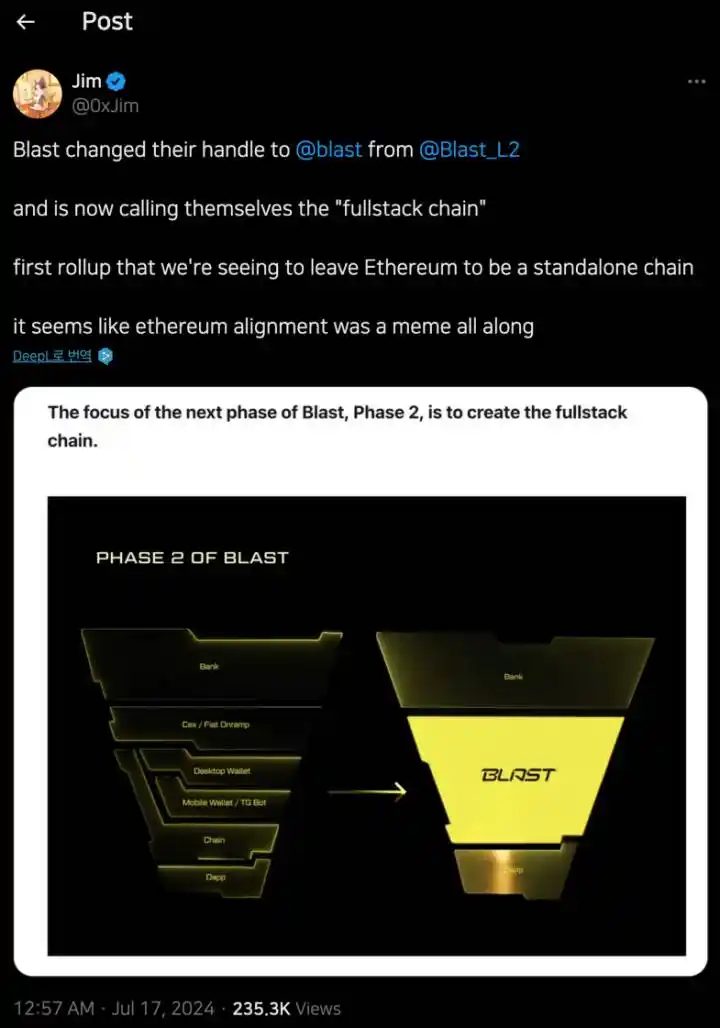
Source: Jim X
This shows that although many Ethereum L2s claim to attach importance to connectivity with Ethereum and are committed to expanding its scalability, it seems that no real Ethereum L2 can fulfill its promise to work with Ethereum. So what is the problem?
1.1.1 Declining connectivity with Ethereum
Many L2 solutions increasingly value their unique features and functions, resulting in a gradual weakening of connectivity with Ethereum. This intention to build an independent ecosystem stems from the pursuit of autonomy. However, this independence could hinder interoperability with the Ethereum mainnet, making it difficult for L2 and Ethereum to interact seamlessly. As a result, the L2 blockchain, which was originally created to solve Ethereum's scalability problems, ultimately weakens the overall integrity of the network. This deviates from the original intention of Ethereum's scalability solution and may cause chaos throughout the Ethereum ecosystem.
1.1.2 Centralization for Efficiency
Some L2 projects have adopted centralized means in the pursuit of efficiency. While such approaches may improve performance and reduce fees in the short term, they undermine the fundamental principle of decentralization of blockchain technology. This may undermine the trust and security of the technology in the long term. In addition, centralized structures create single points of failure and increase security vulnerabilities, which pose significant risks to users and developers.
1.1.3 Ignoring Developers’ Needs
As L2 projects build their ecosystems, they often cause confusion and burdens for developers. Since each L2 project adopts a different technical approach, developers are forced to learn and adapt to multiple platforms, which sets a high threshold for developing new dApps or porting existing dApps to L2 blockchains. In addition, due to the lack of standardized protocols between L2 blockchains, developers face the challenge of modifying their code to adapt to different infrastructures. This situation not only reduces developer efficiency, but also hinders innovation and growth within the Ethereum ecosystem.
L2 projects may argue that they have no choice but to make these decisions to expand their ecosystems and obtain funds. However, this trend ultimately weakens the security of the Ethereum mainnet and has a negative impact on the entire Ethereum ecosystem.
1.2 Back to the basics
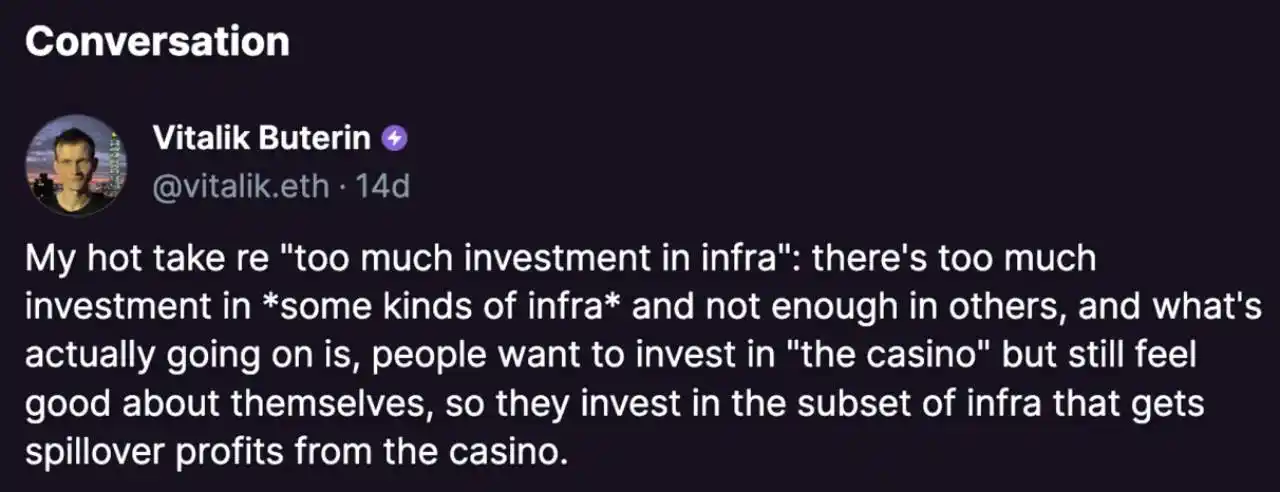
Source: Vitalik Buterin warpcast
In July 2024, Ethereum founder Vitalik Buterin published an article criticizing the current blockchain industry's over-investment in infrastructure. Vitalik pointed out that this over-investment stems from investors indirectly investing their funds in technology rather than directly investing in tokens to comfort their moral conscience. His observation seems to fit in with the disorderly emergence of L2 projects. As a result of the influx of funds into infrastructure, a number of projects have emerged that are solely focused on profits rather than Ethereum's scalability narrative, causing Ethereum and its scalability issues to gradually fade out of the L2 narrative.
Of course, investment in the L2 ecosystem is not a bad thing in itself. Capital is essential for the operation of a project. However, this capital should not be the top priority. What is most important is to focus on the problems that the L2 solution is trying to solve and how it intends to achieve these goals.
L2 projects must remember their original goals of solving Ethereum's scalability problem. It is important to maintain interoperability with Ethereum, adhere to the principles of decentralization, and provide an environment where developers can easily participate. If L2 solutions fail to achieve this balance, not only will the development of the Ethereum ecosystem be threatened, but the long-term trust and security of blockchain technology will also be threatened. When L2 projects return to their core principles and solve Ethereum's scalability problem by working closely with Ethereum, the real progress of blockchain technology will be achieved.
2. Taiko: The Real Ethereum L2
So, what factors are needed to become an Ethereum L2 that truly solves Ethereum's scalability problem? There are three key points here: 1) Is it fully integrated with Ethereum? 2) Is it fully decentralized? 3) Does it fully consider the needs of developers in the Ethereum environment? Let's examine Taiko's efforts to become a true Ethereum L2 based on these factors.
2.1 Ethereum Equivalent L2
The solution to Ethereum's scalability problem must naturally integrate closely with Ethereum. Here, integration refers not only to system-level integration, but also to value integration and even conceptual integration. Of course, "integration" does not mean being exactly the same or repetitive in many aspects. However, this is an important quality required to become a true Ethereum L2, because many blockchains do not follow these basic principles when running as Ethereum L2.
2.1.1 Type-1 EVM blockchain
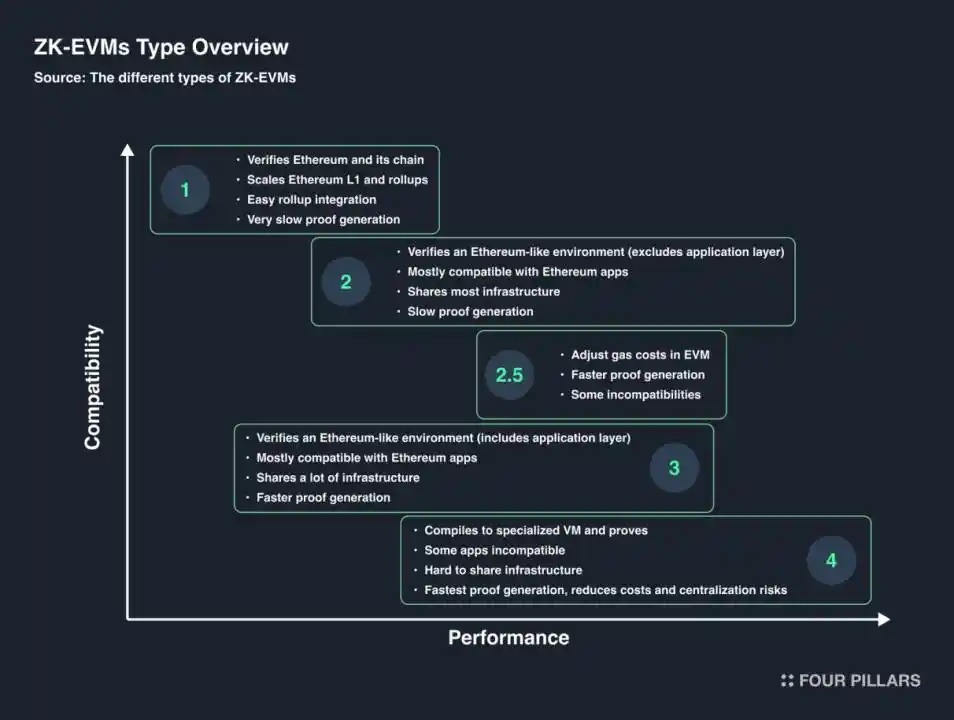
On August 4, 2022, Vitalik Buterin published The different types of ZK-EVMs, analyzing and classifying zkEVMs. According to his analysis, zkEVMs are divided into Type 1, 2, 2.5, 3, and 4, and higher numbers mean lower interoperability and compatibility with Ethereum, but higher efficiency in generating proofs and overall performance. In other words, the changes involved in zkEVM types with higher numbers include modifying the EVM core or introducing additional modules to optimize performance.
While Vitalik notes in the article that no zkEVM type has a clear technical advantage and that they may coexist, he concludes at the end of the article:
“Personally, I hope that over time, through improvements to ZK-EVMs and improvements to Ethereum itself to make it more suitable for ZK-SNARKs, everything can become Type 1.” - Vitalik Buterin (Founder of Ethereum)
Ultimately, in the choice between interoperability and performance, Vitalik chose interoperability over Ethereum scalability.
Although this article was written in 2022, it is still worth reflecting on in the context of the emergence of a large number of Ethereum L2 blockchains today. To truly operate as an Ethereum L2 blockchain, the ultimate goal should be to implement a Type-1 zkEVM.
While Vitalik’s article only categorizes zkEVMs, from a broader perspective, the structure of L2 itself can also be extended to the type of EVM or L2 depending on whether it is fully integrated with Ethereum. From this perspective, Taiko aims to achieve Ethereum’s scalability by using a Type-1 EVM equivalent to Ethereum.
Because Taiko aims to be an L2 blockchain equivalent to Ethereum, it is inevitable that it will be relatively lower in performance than other types of Ethereum L2 blockchains, such as Type 2 or Type 3. However, considering that the other L2 blockchains mentioned above are not fully committed to Ethereum’s scalability, this trade-off is reasonable. It is worth noting that this is not a big problem because the Taiko team has been aware of this and has explicitly set a goal to improve the performance deficiencies through internal protocol design.
2.1.2 Based Rollup
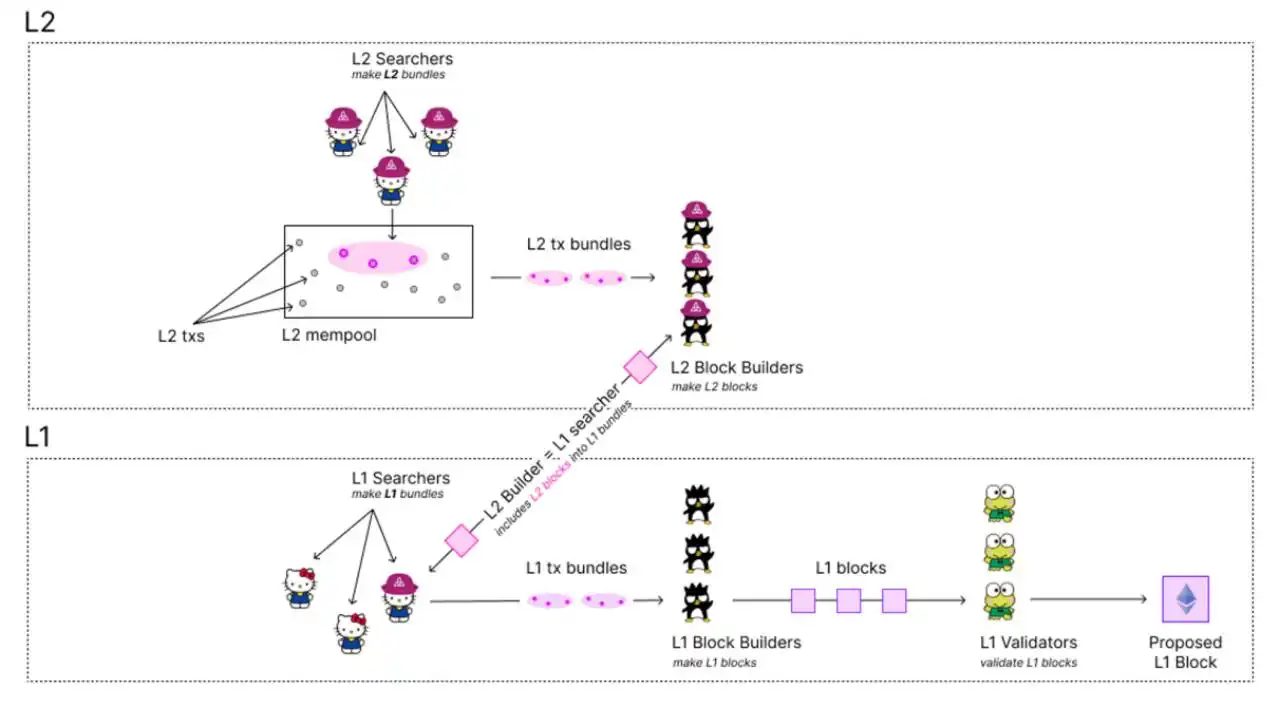
Source: MEV for "Based Rollup"
Taiko not only fully integrates Ethereum's system infrastructure, but also strives to keep up with Ethereum in terms of security. Taiko adopts a concept called Based Rollup, which operates without a centralized sorter. Instead, Ethereum's validators also act as Taiko's sorters, responsible for sorting transactions and blocks. Due to these characteristics, the fragmentation of the Ethereum ecosystem has the potential to be reintegrated into a whole.
Based on the characteristics of Based Rollup, Ethereum's block proposers become Taiko's sorters. This role comes with specific responsibilities, including maintaining their profits as a beneficiary of Taiko's MEV (maximum extractable value) and maintaining activity as a sorter. This additional incentive mechanism prompts them to operate more carefully.
2.2 The road to full decentralization
From a system perspective, decentralization is a complex and inconvenient concept. Frankly speaking, if everything is handled and managed by a single center, it will be more efficient and simpler to maintain. Therefore, many Ethereum L2s have chosen a centralized sorter model. However, this approach has flaws, for example, malicious sorters may censor transactions or cause single points of failure to increase. In this case, who will trust the system? The blockchain industry was born precisely because no one can be fully trusted. In order to eliminate these potential risks, it is crucial to achieve full decentralization.
Source: Based Contestable Rollup (BCR): A configurable, multi-proof rollup design
What conditions are needed to achieve full decentralization? Taiko thought about this problem and launched Based Contestable Rollup (BCR). The key to avoiding centralization is to ensure multi-party participation, prevent collusion, and encourage competition. Taiko's BCR is a rollups protocol with a competitive mechanism that plays a role in rollups proof and sorting, covering all the necessary elements.
“34,469 lines of code is hard to be error-free for a long time.” - Vitalik Buterin
The reason why Taiko chose the BCR structure is to achieve full decentralization. Vitalik Buterin pointed out that zk-SNARKs is not yet a completely reliable technology. In particular, the latest zk-SNARK systems are significantly more complicated, which greatly increases the possibility of errors. Since the technology is not yet mature, it is expected to become more complex and thus more prone to technical errors. When there are such vulnerabilities, centralized rollups can prevent the problem from getting worse because there is an entity responsible and able to solve any technical errors or specific risks. However, Taiko pursues a completely decentralized environment, which makes it difficult to clearly solve these problems. Therefore, Taiko avoids relying on a structure that blindly trusts zk-SNARKs. In other words, with the BCR structure, Taiko is prepared for the possibility of rollups proof errors and builds a system that can challenge incorrect rollups proofs.
To understand how Taiko's BCR works, a simple example may be more effective than a complex explanation.
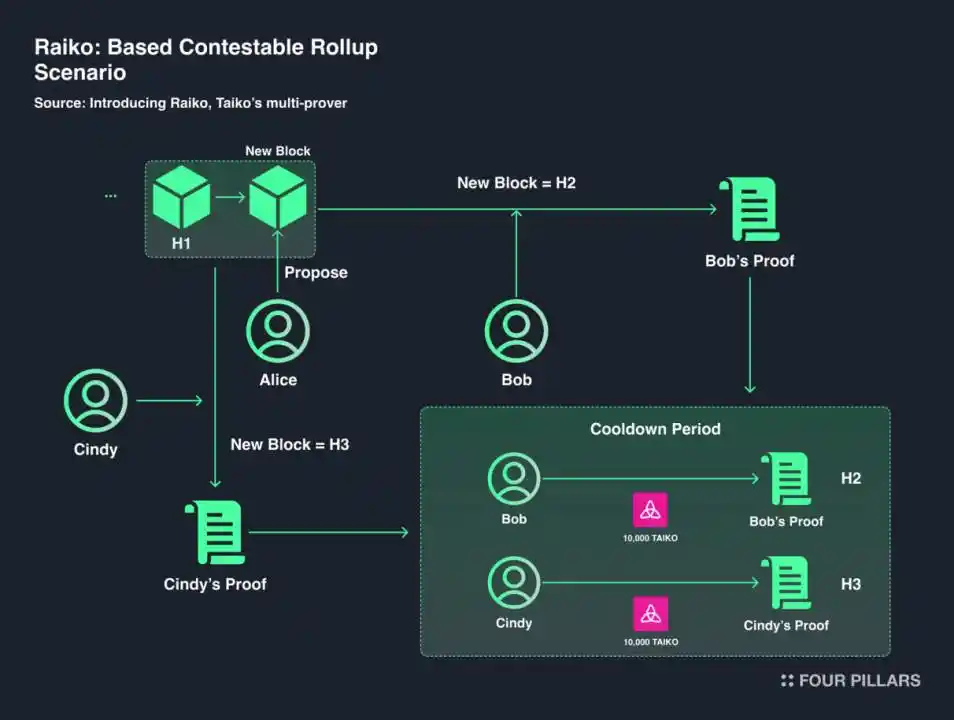
Alice proposed a new block.
Bob submitted a proof of state change from H1 → H2. H1 is the parent hash and H2 is the new block hash. Bob pledged 10,000 TAIKO as a deposit. His proof entered a cooling-off period.
The state information proposed by Bob and the attached proof are publicly disclosed.
Cindy believes that Bob's state change should be H1 → H3, not H1 → H2. Cindy stakes her 10,000 TAIKO as a competitive deposit during the cool-off period and challenges Bob's proof.
The dispute status between Bob and Cindy changes during the cool-off period, awaiting a higher-level proof. This higher-level proof allows Bob and all other attesters a chance to challenge it.
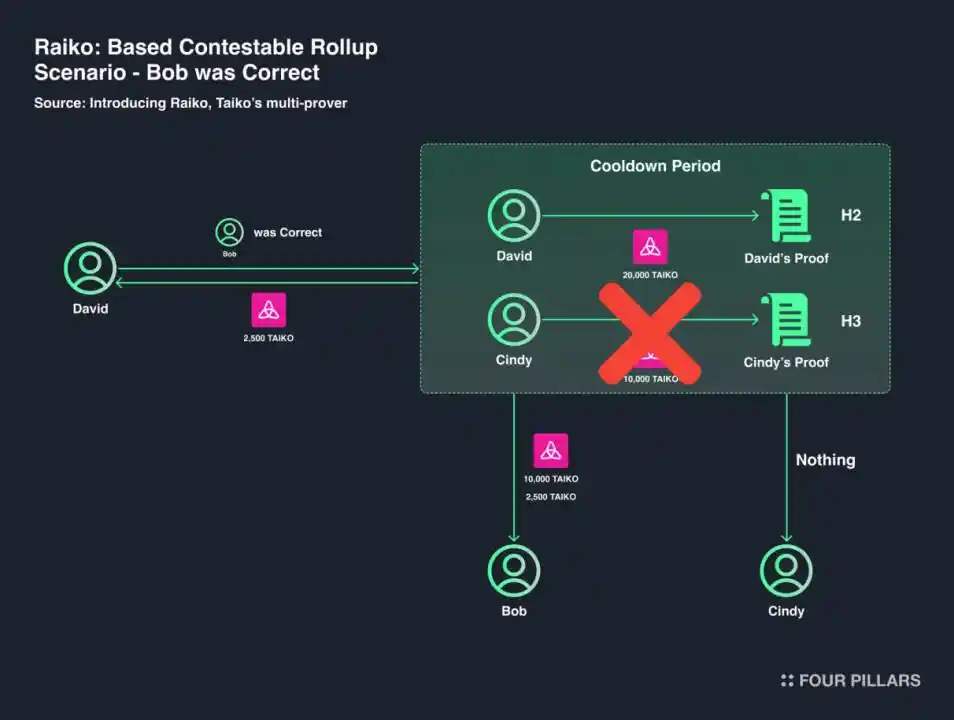
Scenario 1 - If Bob's proposal is correct:
David verifies Bob's proposal H1 → H2, proving that Bob is correct. David is rewarded with 2,500 TAIKO for completing a higher level of verification and becomes a validator for H1 → H2, staking 20,000 TAIKO as a deposit.
Cindy loses her entire deposit for proposing the wrong revision.
Bob gets his original 10,000 TAIKO deposit back and is rewarded with an additional 2,500 TAIKO for proposing the correct proposal.
The cool-off period for David's new proposal and verification begins.
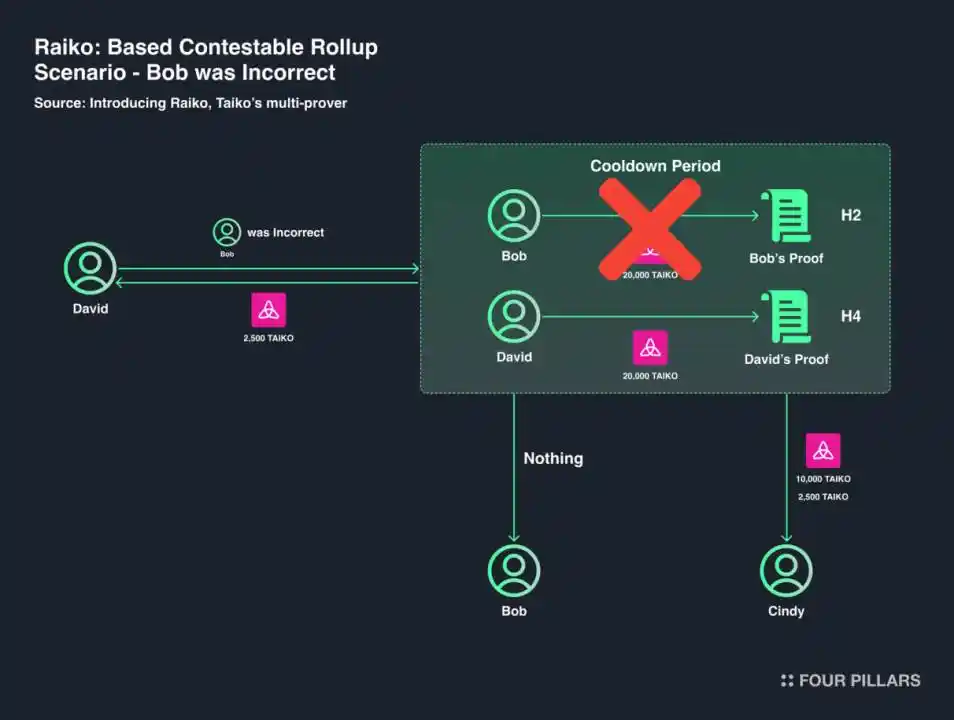
Scenario 2 - If Bob's proposal is incorrect and David proposes a new one:
David provides a three-step transition proof from H1 → H4, proving that Bob's transition was incorrect. David is rewarded with 2,500 TAIKO and stakes 20,000 TAIKO as a deposit to capitalize his state change and proof.
Cindy gets her original 10,000 TAIKO deposit back and receives an additional 2,500 TAIKO as a reward for successfully challenging Bob's incorrect state change.
Bob forfeits his entire deposit for proposing incorrect state change and proof.
The cool-off period for David's new proposal and verification begins.
This structure incentivizes rollup validators to remain responsible when challenging and prevents unnecessary attacks by using competitive deposits. It is worth noting that as the number of verification rounds increases, the deposit required for competition increases significantly, preventing unnecessary rounds of competition.
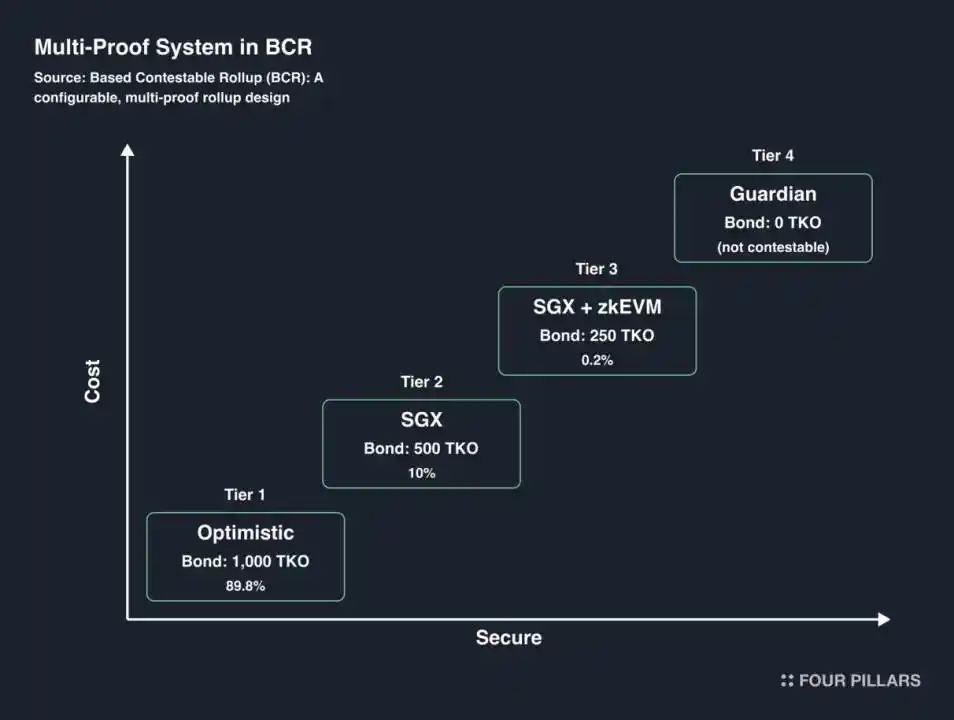
In addition, Taiko adopts multiple proof systems in BCR. This system allows different rollup verification systems (such as SGX, ZK, SGX+ZK, etc.) to be used according to different stages to ensure the flexibility and more stable operation of the system. Despite these advantages, this design also has a disadvantage: when the frequency of competition is low, the validator is not active enough. The validator mechanism needs to make a profit through a lot of competition, so in an environment with insufficient competition, they may choose not to participate. To address this problem, Taiko implemented dynamic adjustments to different rollup verification systems to solve this challenge.
In the early stages of the service, there may be a low frequency of competition. To address this, a group of validators called Guardian Provers will utilize a multi-signature scheme as a security guarantee until the system matures. As the system matures, their role will gradually decrease and eventually disappear to achieve full decentralization.
2.3 Built for EVM builders
The various features of Ethereum L2 and a more decentralized L2 are attractive and necessary. However, we often overlook a key question: Why does Ethereum L2 exist? Who are they designed for? The answer is simple: they exist for ecosystem participants who want to use these Ethereum L2s. Among them, developers who attract a large number of users and drive the development of the entire L2 ecosystem are particularly important. However, in this golden age of Ethereum L2 blockchains, a large number of infrastructures with their own rules have emerged. This situation is like operating the same service in countries with different laws and regulations, which requires a lot of unnecessary time and money to deal with the differences.
In order to help developers focus resources on service development effectively, we need to standardize the rules and narrow the gap between infrastructures. To this end, it is crucial to introduce infrastructures that have been historically verified or widely used by many developers. That's right, we need to introduce infrastructures used in the Ethereum environment. This will enable developers to use the methodologies and expertise they have accumulated on Ethereum, making it easy to integrate into the Ethereum L2 blockchain.
"Taiko can only make a difference in this world when it helps others change the world." - Taiko Labs
In this regard, Taiko has demonstrated a real commitment to developers. As Taiko's blog post states, Taiko will benefit ecosystem participants, especially developers, by allowing them to work freely. To deliver on this promise, Taiko continues to open source all development and adopts a framework called Based Booster Rollup (BBR) to help EVM developers transition faster and easier.
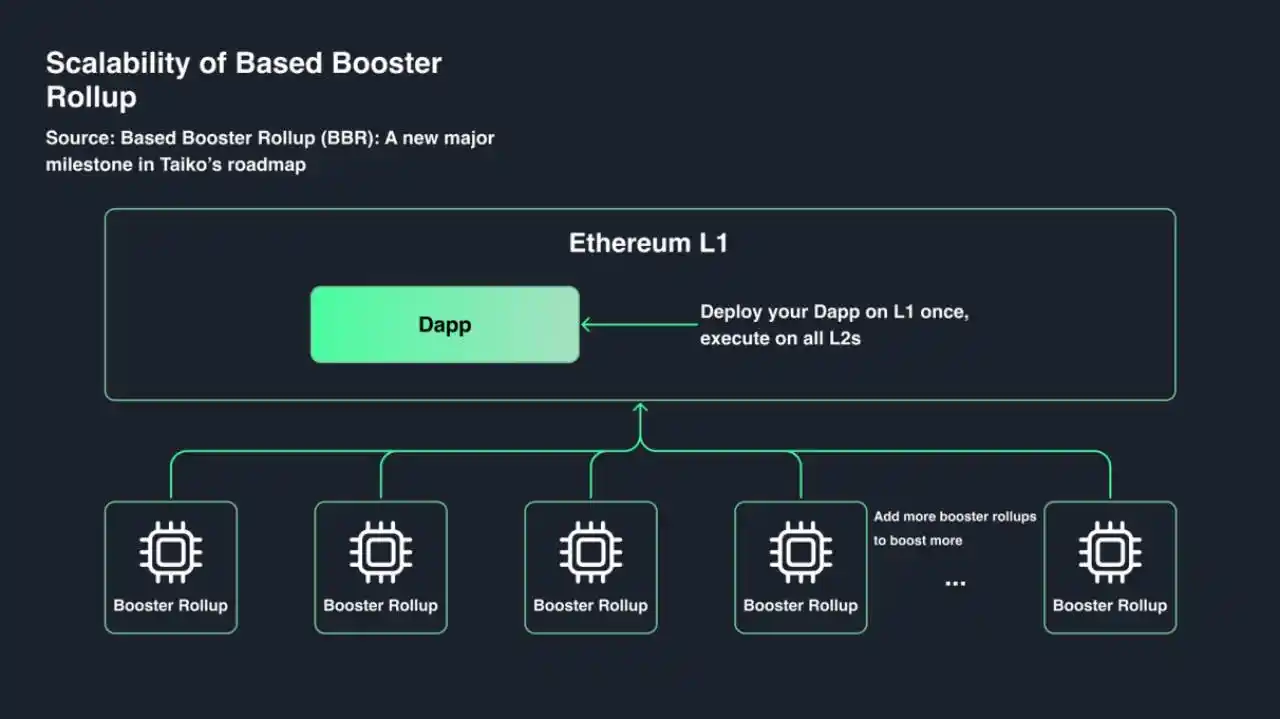
BBR is an extension of the advantages of Based Rollup from the developer's perspective, exploring how to apply the advantages of Based Rollup to the application layer of the core infrastructure of the blockchain. With Taiko's BBR, developers only need to deploy their dApp once on L1 Ethereum to achieve automatic dApp deployment on all L2s without additional work or resource investment.
3. Taiko's Aspiration: Ethereum Integrated Infrastructure and Community
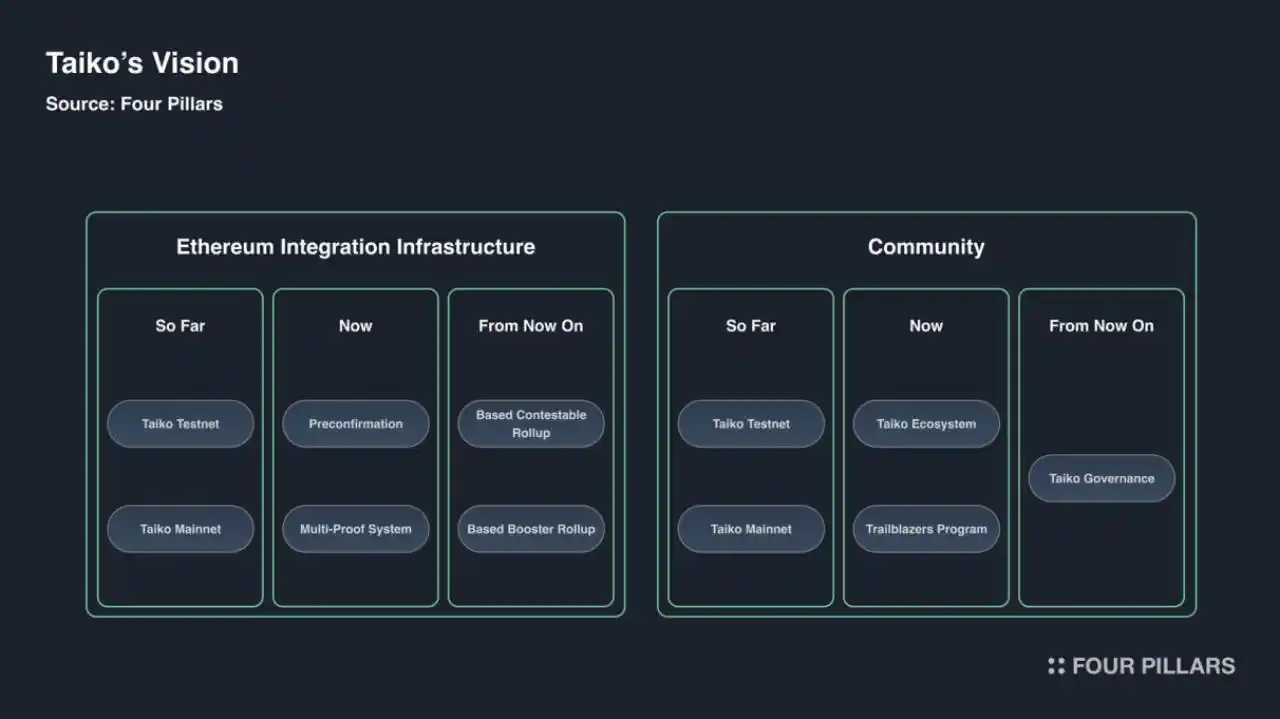
We have explored the direction Taiko is pursuing. Despite having three powerful concepts as a foundation, concepts alone cannot bring about major changes in the industry. These concepts must be implemented within a planned timeline so that others can benefit from them, form a virtuous circle, and become a disruptor in the industry. So, let's look at the process of how Taiko intends to become an industry disruptor from the perspective of the past, present, and future.
3.1 Ethereum Integrated Infrastructure
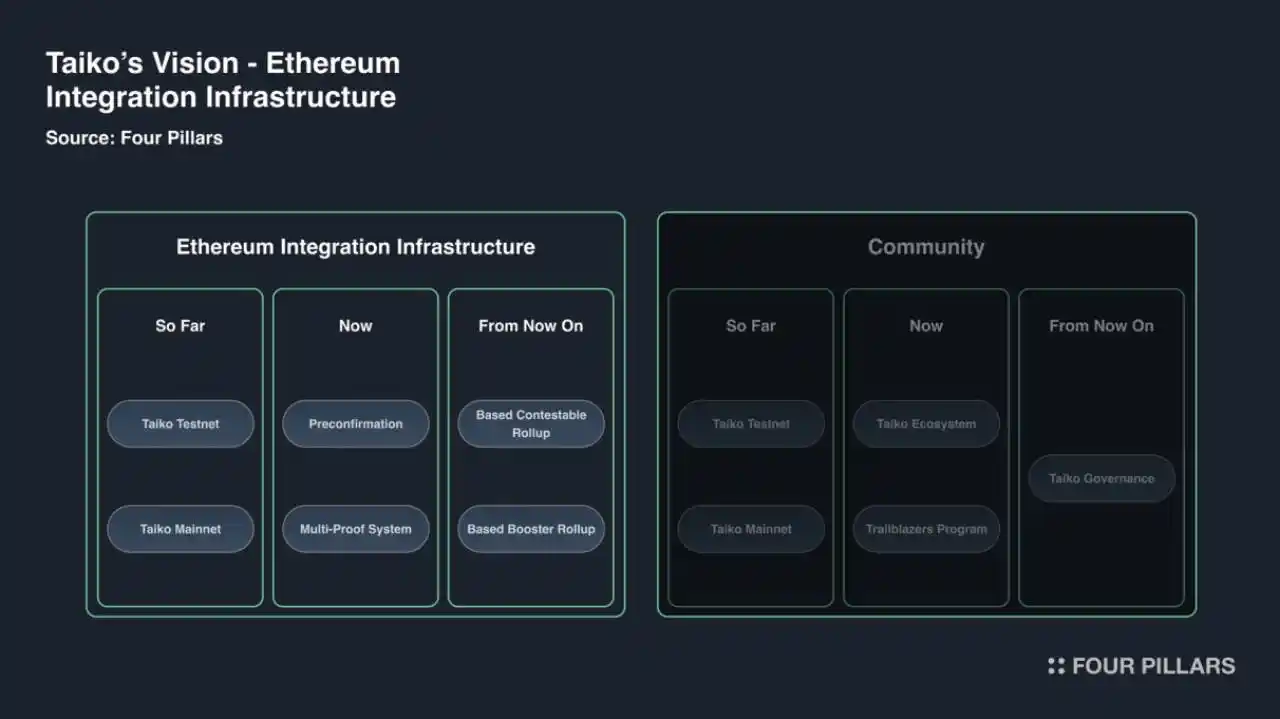
One of the key pillars is infrastructure. As the cornerstone of becoming a true Ethereum L2, Taiko is leveraging multiple technical advantages to build this infrastructure. Let's take a look at how Taiko's infrastructure history has developed.
3.1.1 So far - from Taiko testnet to mainnet
Taiko did not try to accomplish all goals at the same time. In order to achieve the major goal of launching the mainnet, it conducted as many as seven alpha testnets, gradually preparing for the realization of Taiko's vision. Let's first take a look at the content of these seven stages of alpha testnets.
Alpha Testnet-1 (Snæfellsjökull)
All developers can deploy smart contracts, and users are able to use all Ethereum and Solidity tools just like on Ethereum. This makes transaction testing accessible to everyone. This version allows anyone interested to run an L2 node and opens up participation as a block proposer. To this end, Taiko plans to run a few nodes and propose blocks, inviting everyone to join. The testnet includes a cross-chain bridge for transferring assets between the testnet and Ethereum, and a block explorer for inspecting transaction history.
Alpha Testnet-2 (Askja)
This is the first testnet that successfully verified that the network can run through a proof mechanism open to everyone. It established the foundation for the full decentralization of this version. In addition, monitoring and alerting functions of the blockchain network were implemented, and developers can directly deploy their decentralized applications (dApps) to this testnet without modifying the code used on Ethereum.
Alpha Testnet-3 (Grímsvötn)
This version established and implemented a token economic model based on a new fee and reward model. It also included testing the necessary proof cooling mechanism in the proof mechanism, as well as preliminary testing of the starting layer of Taiko L3.
Alpha Testnet-4 (Eldfell L3)
In this version, the initial layer of L3 was deployed for the first time, and the concept of rollup-on-rollup was introduced. Since Taiko L2 is fully integrated with Ethereum, Taiko actually treats L2 as L1 and tries to expand to L3. In addition, a new staking-based verification mechanism is introduced to prevent the centralization of validators and ensure that they receive reasonable rewards.
Alpha Testnet-5 (Jólnir)
This version introduces a new proposal and verification implementation based on Proposer-Builder Separation (PBS). PBS is a series of processes involving economic mechanisms between proposers and validators, designed to ensure the decentralized nature of block construction. Unlike previous testnets that did not introduce this aspect, this version of block construction adopts an open market model.
Alpha Testnet-6 (Katla)
In the sixth testnet Katla, the initial version of BCR (Blockchain Consensus Rule) was implemented. As Taiko aims to be the L2 equivalent of Ethereum, this version tests and prepares for the latest updates to Ethereum, such as EIP-4844, although these updates are not yet activated. In addition, the cross-chain bridge was updated and the blockchain explorer was enhanced to provide more comprehensive information.
Alpha Testnet-7 (Hekla)
The last testnet Hekla focused on activating EIP-4844, which had been prepared in the previous testnet. This successfully implemented and adopted the new rollup storage mechanism Blob on the Ethereum mainnet. In addition, this testnet version introduced several improvements, including adjustments to L2 block gas issuance, activation of snap sync, and modifications to EIP-1559 settings. Based on the features applied and tested in this version of the testnet, the mainnet is now ready without any problems.
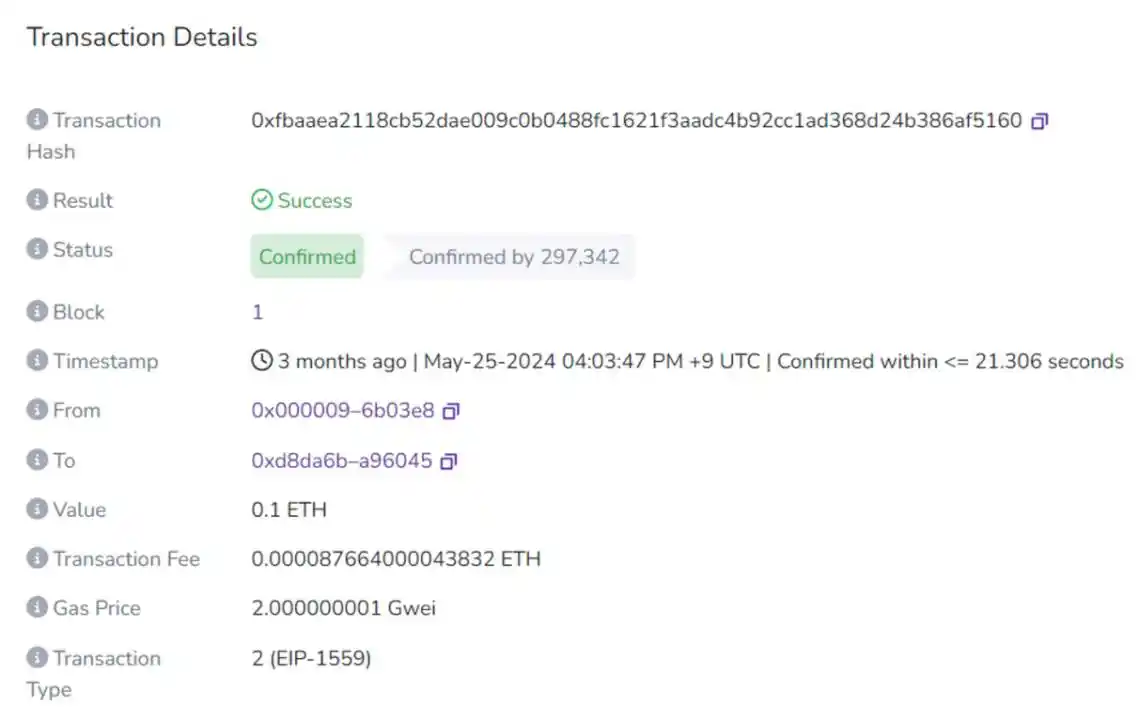
Source: Taiko Mainnet #1 Block
Taiko Mainnet
The blockchain network content verified and secured during the testnet is presented to the world through the mainnet launch. It is worth mentioning that Ethereum founder Vitalik Buterin immediately generated the next block after the genesis block, adding to its importance. Regular users can transfer ETH from Ethereum to the Taiko Mainnet via the cross-chain bridge and interact directly with decentralized applications (dApps) on the Taiko blockchain. Developers, in particular, can run nodes, propose and verify blocks, and actively participate in the Taiko blockchain, which has great potential. On the technical side, Taiko has introduced implementation modules such as BCR and Raiko, reflecting its determination to become a true Ethereum L2.
3.1.2 Now - Pre-confirmation and Multi-proof System
As Taiko successfully launched the mainnet through six test networks, it is also constantly consolidating its internal structure to become a more advanced Ethereum L2. Two of the most notable developments are the pre-confirmation and multi-proof systems, which we will explore in detail below.
Pre-confirmation
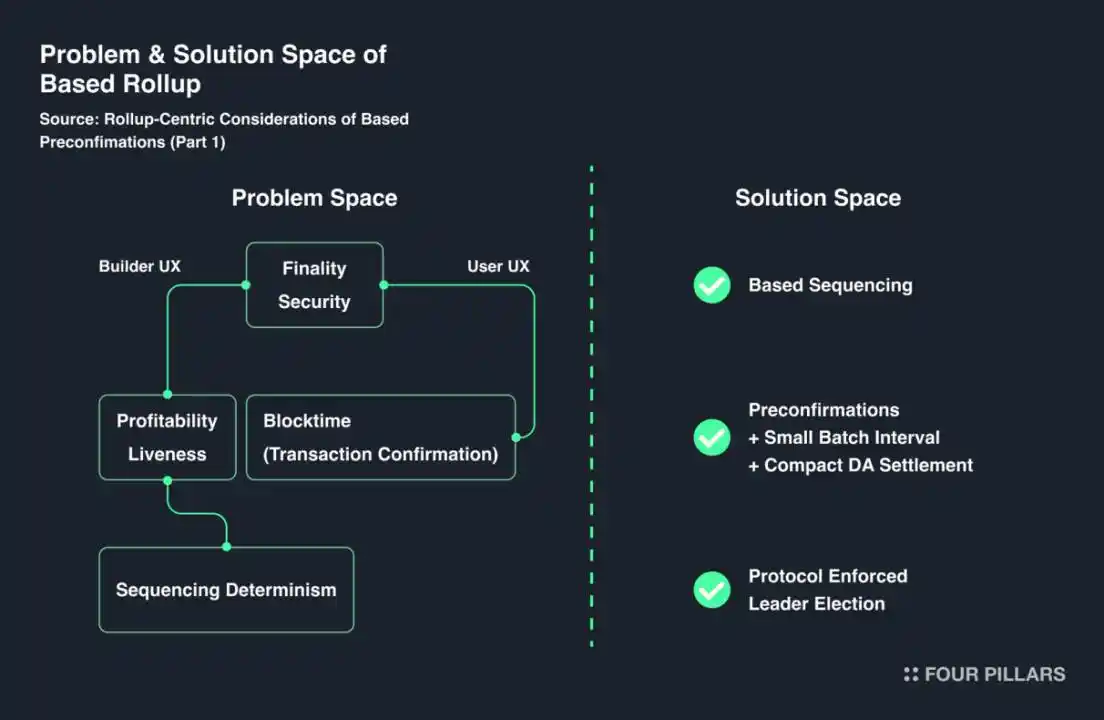
Even after the mainnet is launched, Taiko is still working to inherit the security and certainty of Ethereum. However, this development also brings the risk that block proposers may face survival difficulties due to lack of profitability. For example, in an ecosystem with scarce liquidity like Taiko, users usually give low tips to block proposers, making Taiko's 12-second block time insufficient for any block proposer to be profitable. Therefore, Taiko Labs is temporarily operating proposers without pursuing profits to prevent this from happening. If no measures are taken, the block time of Taiko mainnet will continue to increase.
In order to solve the profitability of L2 block construction, block time improvements, and data publishing efficiency, Taiko plans to introduce a concept called pre-confirmation. Pre-confirmation is the main focus of research and development in the second half of 2024 and will also play an important role outside the Taiko mainnet. Through pre-confirmation, L2 block construction can become more efficient and stable, allowing users to enjoy faster transaction confirmation speeds. In addition, pre-confirmation can simplify and enhance the rollup structure by integrating the roles of L2 and L1 proposers. This is associated with the sorting-based mechanism, which may encounter difficulties in actual operation when considering the profitability of builders, the startup survival mechanism, and the configuration of fast block times. However, if multiple pre-confirmation participants perform pre-confirmation, forks may occur on the Taiko mainnet. Therefore, despite some controversy, mechanisms such as leader selection are being discussed as a practical compromise.
Multi-Verification System
Another research and development topic of Taiko is the multi-verification system, which aims to integrate multiple clients and various verification systems. The multi-verification method reduces the risk caused by vulnerabilities in client implementation and verification systems, ensuring that even if one verification method is compromised, other methods can prevent the same vulnerability from being attacked.

Source:
First, Taiko plans to build an "open" multi-client system in which each client is able to independently verify blocks. This allows users to choose their preferred client for block verification, bringing the advantages of accessibility and scalability. In addition, it serves as a basic measure to prevent single points of failure, which contributes to the safe operation of the mainnet. However, since this requires Ethereum (as an L1 network) to support multi-client functionality, Taiko plans to use a "closed" system that uses multiple improved types of validators until this support is fully implemented.
In addition, Taiko runs a free market multi-verification system, where proposers look for validators, propose blocks, and verify them using the verification system of their choice. In addition, this multi-verification system emphasizes modularity and openness, allowing multiple clients and verification systems to collaborate in generating multiple verifications. To this end, Taiko has worked with companies such as Powdr Labs and Risc Zero to improve the interoperability between compilers and zk-SNARK systems and build a modular ZK stack.
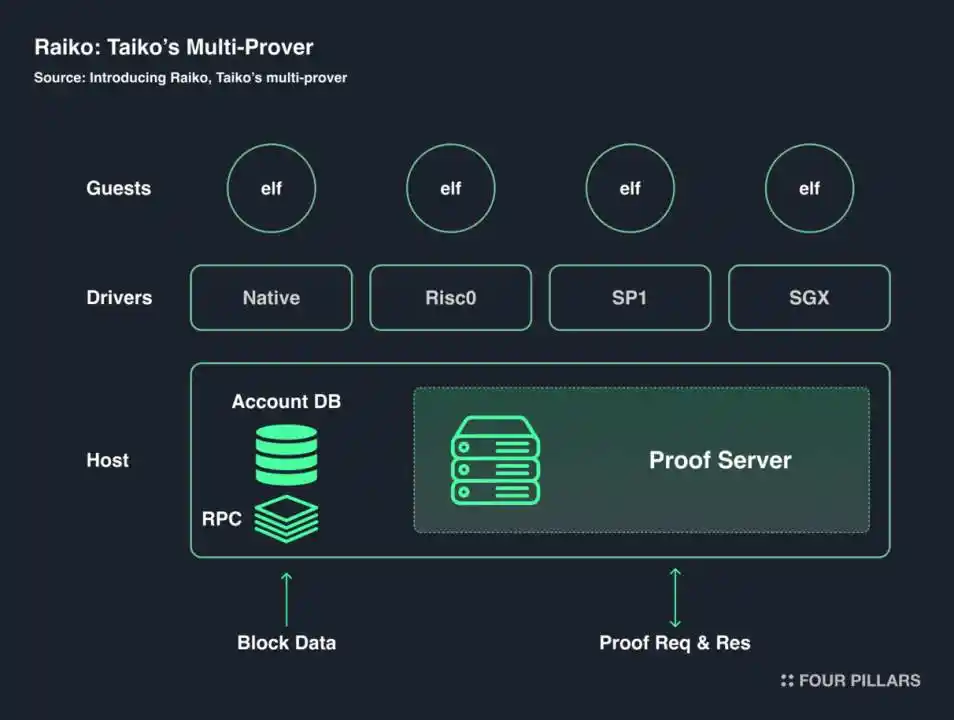
The implementation of these concepts is called "Raiko". Raiko supports multiple zkVMs and uses SGX to enhance security. The system increases the flexibility of block proofs through the ZK/TEE architecture and improves zkVM and TEE through standardized input methods. Taiko plans to continue integrating more zkVMs and expand Wasm zkVM. The system aims to provide a user-friendly and integrated environment for EVM-compatible block proofs.
3.1.3 Looking to the Future - Through BCR and BBR
Although Taiko has made significant progress, the goal of becoming a disruptor still seems far away. Ultimately, Taiko's path to achieving its ultimate vision relies heavily on two core elements, BCR and BBR, which have been initially implemented but still need further improvement.
While we have explained BCR and BBR above, let’s revisit them.
BCR allows users and developers to propose blocks, run nodes, and deploy smart contracts just like on Ethereum, and introduces a dispute resolution mechanism that can quickly handle errors in rollups. This ensures determinism and accuracy within the blockchain, making BCR the cornerstone of Taiko’s core technology.

Source: Based Booster Rollup (BBR): A new major milestone in Taiko』s roadmap
BBR builds on the advantages of Based Rollup to provide higher efficiency and comprehensive Ethereum interoperability. This allows users to use integrated dApps on all L2s without switching between them, while developers can deploy dApps once and have them automatically adapt on all L2s. In addition, BBR solves the fragmentation problem that exists in all rollups, while significantly reducing transaction costs and increasing throughput. Therefore, Taiko believes that BBR has the potential to fundamentally expand the Ethereum ecosystem, and once this technology is applied, all users and developers of the Ethereum network can look forward to a better experience.
Taiko's mainnet is designed to support developers, users, and builders, allowing them to operate flexibly and efficiently in the Ethereum environment, focusing on these two core pillars. However, since these pillars are not perfect yet, they need to continue to evolve and improve as important technical components to help realize Taiko's vision. As these two pillars become stronger and more complete, Taiko will be able to propose a new standard for L2, providing full Ethereum interoperability, full decentralization, and closer to users and builders.
3.2 Community

Another important pillar is the community. In order to ensure that the platform that Taiko builds through its infrastructure is truly valuable, community participation is crucial. To this end, Taiko is working on multiple areas, including token issuance, token economics development, ecosystem activation, and the establishment of a governance environment. Let’s take a look at some of Taiko’s efforts in these areas.
3.2.1 So far - TAIKO token issuance and distribution
After the Taiko mainnet went live, an airdrop of TAIKO, the native token of the Taiko network, was conducted. TAIKO is at the core of the Taiko economic mechanism and tokenomics, with a total supply of 1 billion tokens. TAIKO’s Token Generation Event (TGE) takes place on June 5, 2024. The specific distribution is as follows: 11.62% of the total supply is allocated to investors and 9.81695% is allocated to the Taiko Labs core team, as shown in the attached figure.
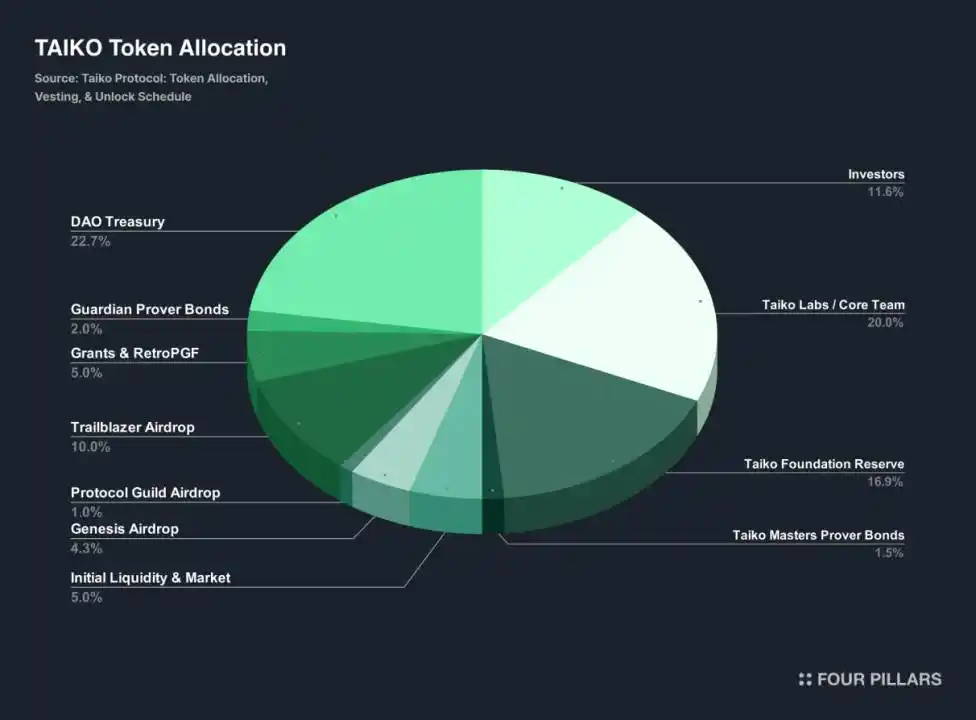
The distributed TAIKO tokens have an initial 12-month lockup period. After the lockup period, 25% of the locked tokens will be unlocked, and the remaining 75% will be gradually released over a three-year period. This vesting structure is designed to minimize market volatility, encourage long-term participation in the Taiko ecosystem, and ultimately contribute to the success of the Taiko project.
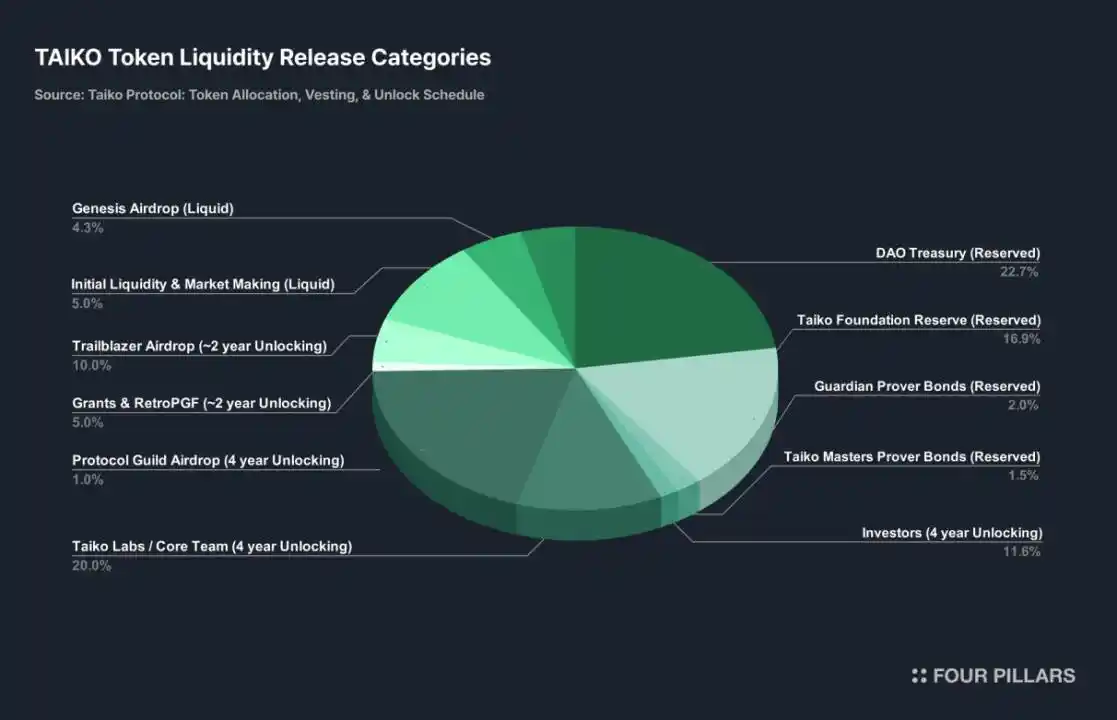
The token liquidity release plan is illustrated in the figure above, where green represents distributed tokens, yellow represents tokens that will be distributed within 2-4 years, orange represents tokens that will be gradually distributed over three years after one year of launch, and pink represents tokens allocated to protocol development, DAO governance and network, with a period of five years or longer.
3.2.2 Now - The Expanding Taiko Ecosystem

Source: Introducing Trailblazers: Explore Taiko and get rewarded
Taiko’s Trailblazers program is a loyalty program where users can earn experience points (XP) and claim rewards through various on-chain activities on the Taiko mainnet. 10% of the total TAIKO token supply has been allocated to the program, which allows users to gain more experience points and level up by participating in activities. Certain NFT holders will receive experience points bonuses, and the program offers a variety of activities and special events.
The program aims to encourage users to explore the Taiko ecosystem and actively participate in the community. Experience points can be gained by participating in activities such as cross-chain, increasing transaction volume, and proposing blocks on the Taiko mainnet. At the end of each season, rewards will be distributed based on the accumulated experience points.
In addition, the Trailblazers program introduces a faction system, where users can team up and compete within two factions (Based and Boosted). Users can collect badges associated with each faction, which bring bonuses such as additional experience points (XP). At the end of the season, the faction with the highest experience points will receive additional rewards. Developers can also participate in this program and receive rewards for the best performing applications.
The Trailblazers program aims to attract more users to join the Taiko ecosystem and let them gain experience and rewards through various activities.
With the active support of Taiko, the Taiko ecosystem is growing rapidly. More details on this will be introduced in Chapter 4.
3.2.3 From Now On - Full Decentralization with Taiko Governance
To achieve full decentralization, Taiko will allow the community to participate in decision-making through the DAO. Major decisions will be made through votes by TAIKO token holders to determine the direction of the network's operations. However, Taiko's governance is still in its early stages and is not yet fully active. Therefore, the first committee will be established by Taiko Labs, and the addition and removal of committee members will be decided by voting by the Taiko DAO.
3.3 A Challenging but Incremental Path
Taiko is making steady progress, albeit slowly, towards the philosophy and goals it wants to achieve. Taiko places a special emphasis on being a user- and developer-friendly blockchain, which is reflected in the growing Taiko ecosystem after the mainnet launch. In the next chapter, we will dive deeper into the development of the Taiko ecosystem.
4. Taiko's Ecosystem
The Taiko ecosystem is a dynamic and collaborative space that aims to create a highly "Ethereum" friendly environment for developers and users. Although it is in its early stages, its goal is to provide the tools and support that Ethereum has. Key milestones include the Alpha-1 testnet in December 2022 and the mainnet launch in May 2024, which includes the Genesis airdrop and lays the foundation for community-driven development and governance.
A key project of Taiko is its grant program, which provides financial and other support to projects on the platform. Taiko supports developers by providing the resources needed to realize their ideas. Through these grants, Taiko not only helps individual projects, but also strengthens the entire ecosystem, encouraging the development of products for the broader Ethereum community.
Next, let's explore the various components that make up the "Taiko Ecosystem".
4.1 Taiko Organizational Structure
Source: What is Taiko? | Docs
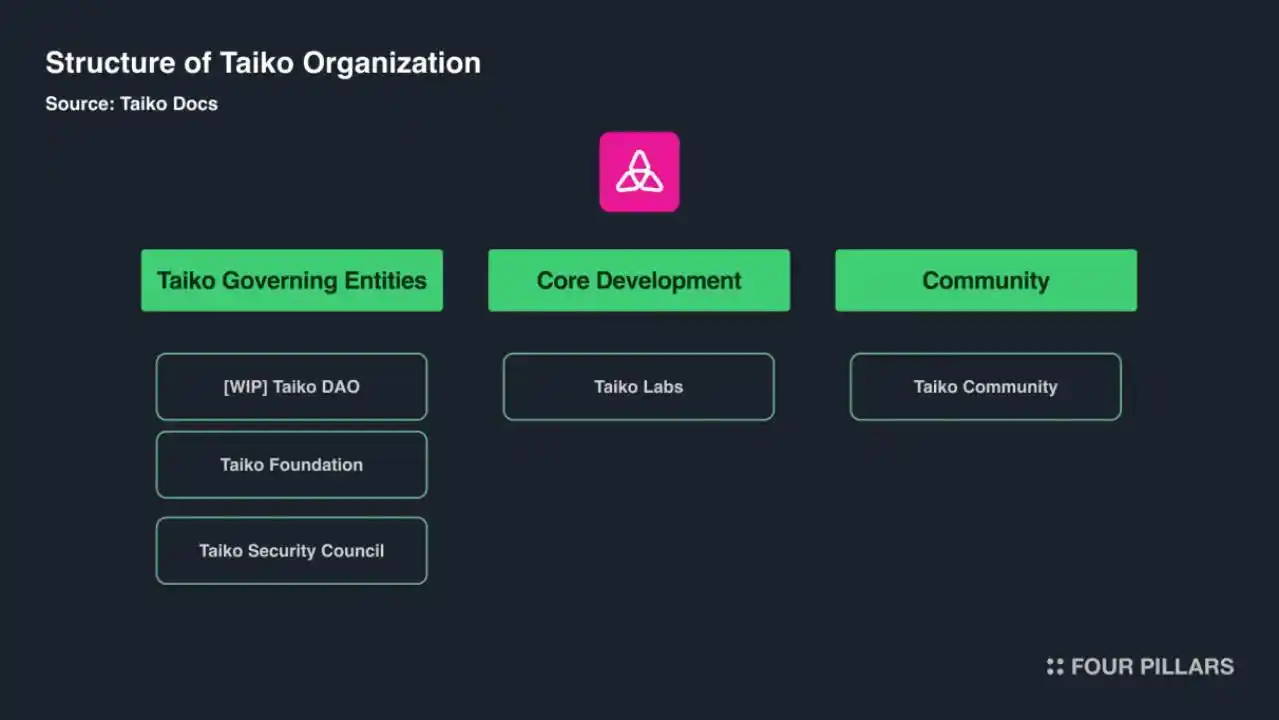
The organizational structure of Taiko L2 consists of several key parts, each of which plays a different role in managing the Taiko ecosystem.
4.1.1 Taiko Governing Entity
Taiko DAO
This DAO will be developed as the governance body for the Taiko protocol. TAIKO token holders will have voting rights and can participate in decision-making on smart contract upgrades and other network-related issues. Such a democratic structure ensures that the community collectively controls all smart contract aspects of the Taiko protocol. In addition, the Taiko Treasury is managed by the DAO, processing the revenue generated by the Taiko protocol and ensuring that financial resources are appropriately allocated to support the continued development and operational needs of the protocol.
Taiko Foundation
The Foundation is responsible for managing the Taiko protocol and its ecosystem. It supports the Taiko DAO and token holders by providing transparent funding for technical development, ecosystem growth, partnership agreements, and event organization.
Taiko Security Committee
The Security Committee, elected by the Taiko DAO, is responsible for responding to emergencies and taking necessary measures to ensure the security of the protocol. It is responsible for overseeing key upgrades and changes and managing Guardian Provers to ensure the integrity and security of the Taiko protocol.
4.1.2 Core Development
Taiko Labs
This is a group focused on research and development of the Taiko protocol. Taiko Labs is committed to driving technological advancements to improve the functionality and performance of the protocol.
4.1.3 Community
Taiko Community
Includes all Taiko-related social groups and accounts, such as Taiko Discord and Taiko Twitter. The community is the main platform for communication, interaction, and information dissemination among Taiko enthusiasts and stakeholders.
4.2 Taiko Team Members
Co-founder and CEO - Daniel Wang
He is an experienced blockchain entrepreneur and technologist, best known for founding the Loopring Foundation, one of the early zkRollups built for decentralized exchanges. Between 2017 and 2021, his leadership of Loopring made the protocol a key player in the DeFi space, improving the efficiency of transactions and payments. Prior to that, Wang held senior engineering positions at ZhongAn Insurance, JD.com, and Google, honing his skills in managing complex systems and large teams. At Taiko, Wang has successfully raised $37 million in funding and is leading the Ethereum equivalent of zkRollup, which aims to scale Ethereum while retaining its core principles of decentralization and security.
Terence Lam, Co-Founder and COO
He plays a key role in the company's strategy and operations. With three decades of experience working in the Web2 and Web3 industries, including experience in multinational Fortune 500 companies and numerous startups, Terence brings a wealth of experience to Taiko. He played a key role in obtaining $37 million in funding from renowned venture capital firms such as Lightspeed Faction and Hashed. Prior to joining Taiko, he was an associate professor at the University of Hong Kong and graduated from several prestigious universities including Harvard Business School.
Brcht Devos, Co-Founder and CTO
He brings extensive technical experience from his work at Loopring. At Taiko, Brecht played a key role in designing the technical architecture of Ethereum’s equivalent of zkRollup, including the innovative Contestable Rollup (BCR) and Accelerated Rollup (BBR) designs. The architecture is designed to simplify the Layer 2 value chain, reduce trust assumptions, and promote developer adoption. His leadership was critical to the successful execution of six testnets involving over 1.1 million unique wallets and an active developer community, preparing Taiko for a successful mainnet launch.
Ben Wan, Chief Community Officer
As Taiko’s Chief Community Officer, Ben Wan played a key role in growing the largest crypto community on Discord with over 1,000,000 members. His leadership has been instrumental to the success of the Taiko testnet and the rapid growth of the mainnet. Ben’s background in managing global IT projects for major multinational companies enables him to effectively guide and support Taiko’s diverse, global community.
4.3 Ecosystem Overview
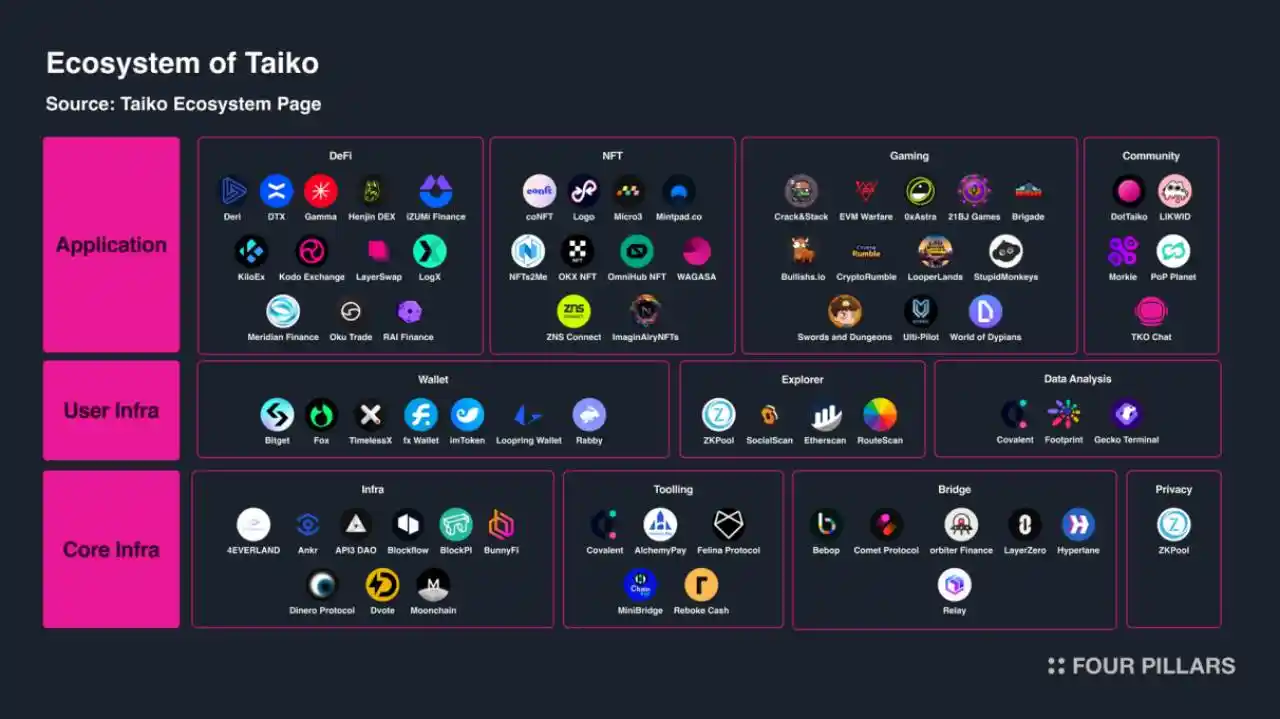
Taiko’s ecosystem is built in a community-driven model, emphasizing an open source development approach. In addition, Taiko supports a variety of applications and tools covering multiple areas, including DeFi, cross-chain bridges, and Web3 infrastructure. Since Taiko is fully EVM-compatible, dapps on Ethereum can be ported more easily and with reduced risk.
Let’s take a deeper look at this ecosystem, from infrastructure to user experience.
Source: Ecosystem - Taiko
4.3.1 Core Infrastructure
From the beginning, the ecosystem has prioritized developer-friendly tools. Key partnerships have been established with industry leaders to provide core services: ANKR for RPC, Covalent and Subgraphs for indexing, Pyth and Redstone for oracle solutions, and Tenderly for developer tools. This combination of services ensures that developers have access to high-reliability infrastructure from the earliest testnet stages. Here is an overview of the key projects involved:
ANKR
ANKR provides remote procedure call (RPC) services that are essential for developers to interact with blockchain networks. RPC services facilitate communication between dApps and blockchains, allowing developers to efficiently execute commands and retrieve data. ANKR's infrastructure is known for its reliability and speed, which is essential to maintaining seamless operations in the Taiko ecosystem.
Covalent and Subgraphs for Indexing
Covalent and Subgraphs provide indexing solutions that enable developers to easily query blockchain data. Covalent provides a unified API that integrates data from multiple blockchains, making it easier for developers to access and analyze blockchain information. Subgraphs is part of The Graph Protocol and enables efficient querying through a decentralized indexing service. Together, these tools provide developers with the infrastructure they need to build data-driven applications and efficiently access and utilize blockchain data.
Pyth and Redstone for Oracle Solutions
Oracles are core components in blockchain ecosystems as they deliver external data to smart contracts. Pyth and Redstone are two oracle solutions integrated into the Taiko ecosystem. Pyth focuses on providing high-fidelity financial market data, which is critical for DeFi applications that require real-time price information. Meanwhile, Redstone provides a flexible and decentralized oracle network that supports multiple data feeds.
Tenderly for Developer Tools
Tenderly provides a suite of developer tools that optimize the development and debugging process of smart contracts. It features real-time monitoring, alerts, and advanced debugging capabilities to help developers quickly discover and resolve issues. Tenderly's tools are particularly useful during the testing and deployment phases as they provide in-depth analysis of the performance and behavior of smart contracts.
4.3.2 Applications - DeFi
Since the mainnet launch at the end of May, the DeFi space has achieved significant growth, integrating mature and local blockchain projects. Users can use a variety of DEXs, including OKU (Uniswap V3) and local versions Ritsu and Henjin DEX. Other notable projects include:
iZUMi Finance (DEX)
iZUMi Finance is a multi-chain DeFi protocol that has expanded its services to the Taiko blockchain, committed to providing liquidity solutions. On Taiko, iZUMi Finance launched iZiSwap, providing trading pairs and introducing features such as limit orders in a decentralized manner. This expansion to Taiko is in line with iZUMi Finance's goal of supporting multiple networks and enhancing on-chain liquidity in various blockchain ecosystems.
KiloEx and DTX (Derivatives)
KiloEx and DTX are derivatives trading platforms in the Taiko ecosystem. Both protocols provide hedging, speculation, and risk management tools, offering a range of derivatives such as futures and swaps.
Deri (Options)
Deri is a decentralized options trading protocol in the Taiko ecosystem. It enables users to trade options, which are financial instruments that give the holder the right, but not the obligation, to buy or sell an asset at a predetermined price within a specific time. Deri offers a variety of options contracts, allowing traders to hedge against price volatility or speculate on future price movements.
XY Finance (Cross-chain Swaps)
XY Finance is a protocol in the Taiko ecosystem that focuses on enabling cross-chain swaps. It allows users to seamlessly exchange assets between different blockchain networks, improving interoperability and liquidity in the decentralized finance (DeFi) space.
4.3.2 Applications - Games
The gaming space offers a diverse range of experiences, from shooters and MMORPGs to strategy and gambling games. Games to watch include: Crack & Stack, Looperlands, 21BJ, Ultiverse, and EVM Warfare. This diversity reflects the ecosystem's commitment to providing engaging and innovative gaming experiences that cater to different player preferences and have the potential to attract a large number of users to the platform.
Crack & Stack
Crack & Stack is a game embedded in the Taiko blockchain ecosystem that combines puzzle and strategy elements. Players need to strategically place blocks in stacking challenges to achieve specific goals or overcome obstacles. The game uses blockchain technology to ensure fair competition and transparency, allowing players to earn rewards and compete with other players around the world.
Looperlands
Looperlands is an NFT gaming platform in the Taiko ecosystem, known as the "Pixel Universe", where players can play, create and explore. It provides a metaverse experience with various games and activities that allow users to interact with NFT assets. The platform focuses on creativity and community participation, allowing players to build their own worlds and experiences.
21BJ
21BJ is a game project based on the Taiko blockchain that brings the classic card game Blackjack to the digital world. It offers a decentralized version that allows players to play blackjack against other people or AI opponents. The combination of blockchain technology ensures transparency and fairness, as all game results can be verified on the Taiko network. Players can also earn rewards and participate in tournaments, making 21BJ a competitive and attractive option for card game enthusiasts.
Ultiverse
Ultiverse is a massively multiplayer online (MMO) game in the Taiko ecosystem that offers an interstellar experience. It uses NFT assets as avatars, allowing players to explore a vast universe and participate in various activities. Ultiverse focuses on social interaction and community building, giving players the opportunity to cooperate and compete in a dynamic digital environment.
EVM Warfare
EVM Warfare is a strategy game based on the Taiko blockchain that combines elements of war and resource management. Players engage in tactical battles and use various strategies to outsmart their opponents and achieve victory.
4.3.3 Applications - NFT
Native and mature NFT markets coexist in the ecosystem, providing diverse options for creators and collectors. Loopexchange is a native solution, while OKX NFT Marketplace brings its mature marketplace to the platform. Creator-centric tools such as NFTs2Me and Mintpad provide artists with the ability to mint and manage their digital assets. Notable series such as Taikonauts, Taikoons, and Trailblazers Faction Badges have emerged, each with unique utility.
NFTs2Me
NFTs2Me is a comprehensive NFT creation tool designed to help artists and creators by streamlining the process of launching an NFT project. It covers the entire NFT lifecycle, including creation, deployment, and contract management, providing users with an intuitive platform to manage their digital assets.
Mintpad
Mintpad is a user-friendly platform that simplifies the issuance and management of NFT collections. It takes care of everything from artwork generation to smart contract deployment and metadata generation, streamlining the process. Mintpad allows creators to design custom minting sites or embed minting functionality on existing sites, with flexibility and ease of use.
Taikoons
Taikoons are a notable NFT series in the Taiko ecosystem, known for providing significant advantages to holders, such as providing XP boosts for the Trailblazers Program. These NFTs enhance the user experience by providing additional rewards and incentives for users to participate in on-chain activities. Taikoons are highly sought after within the community, reflecting their value and importance in the loyalty and engagement program of the Taiko ecosystem.
4.4 Taiko Grants
Source: Grant Program – Taiko
The Taiko Grants program is designed to support community projects that promote the Taiko ecosystem. It supports the realization of these projects by providing financial incentives and developer resources.
Taiko Grants is divided into three tracks: Community, Partner, and Request for Proposal (RFP). The Community track supports builders and early-stage projects on Taiko, supporting projects as diverse as games, media, zero-knowledge proof (ZKP) applications, and artificial intelligence (AI). The Partner track supports mature projects with an active user base, including crypto service providers seeking to integrate with Taiko. The RFP track is aimed at experienced builders or teams working on high-impact projects requested by Taiko Labs, focusing on Taiko's protocol or ecosystem.
The grant program runs on a cycle basis with specific application opening dates, deadlines, and review periods. For example, in the second cycle, applications for the community track open on December 4, 2023, close on January 15, 2024, and review ends on February 15, 2024. During the review phase, the grant committee evaluates proposals, provides feedback, and selects winners to launch projects. The program encourages projects that align with Taiko's mission and supports open source or public product initiatives.
4.5 Recent Progress Post-Mainnet Launch
Since the launch of the Taiko mainnet, there has been significant progress in all aspects of the network. Over the past 90 days, Taiko has achieved significant growth in network activity, profitability, user engagement, and technological advancement. In this section, we will look at these metrics.
4.5.1 Transaction and User Growth
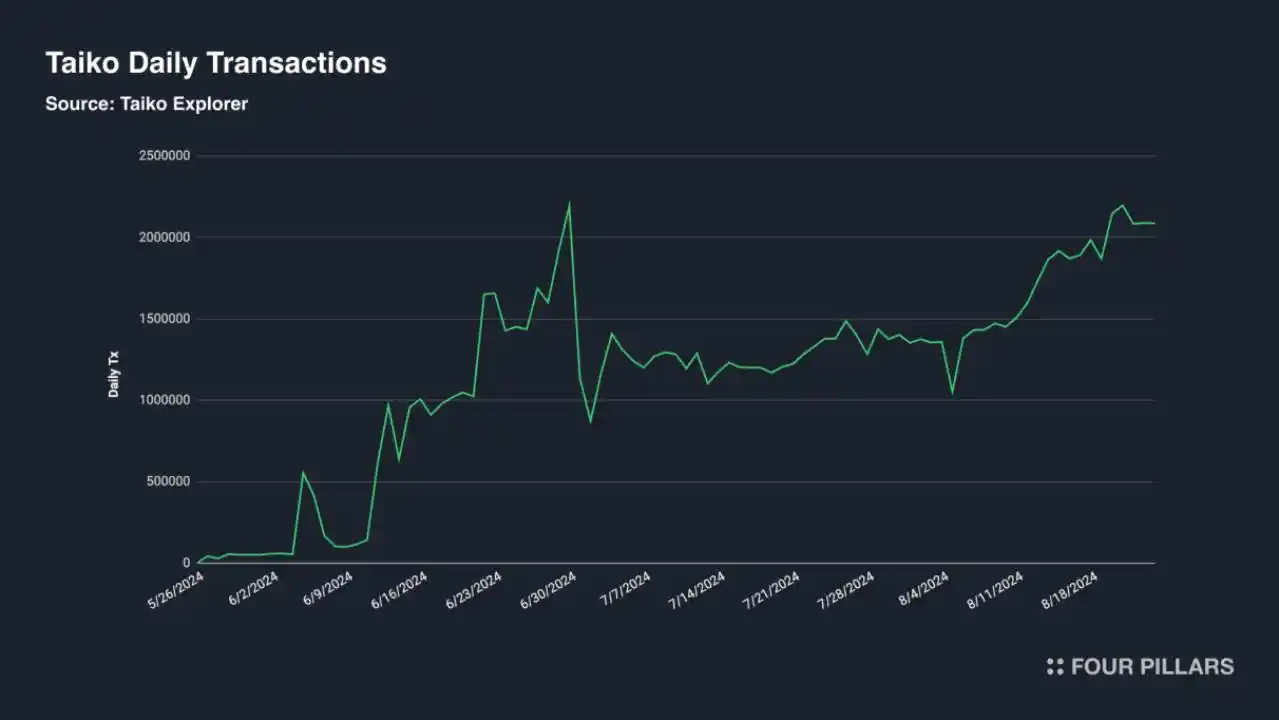
Taiko’s mainnet has seen growth in network activity, achieving over 100 million transactions. This surge in activity is further evidenced by the network processing up to 2,000,000 transactions per day, demonstrating its strong capacity and growing adoption. The expanding user base is evidenced by attracting over 1,000,000 unique wallet addresses, reflecting strong user interest and engagement in the Taiko ecosystem.
4.5.2 Profitability and Decentralization
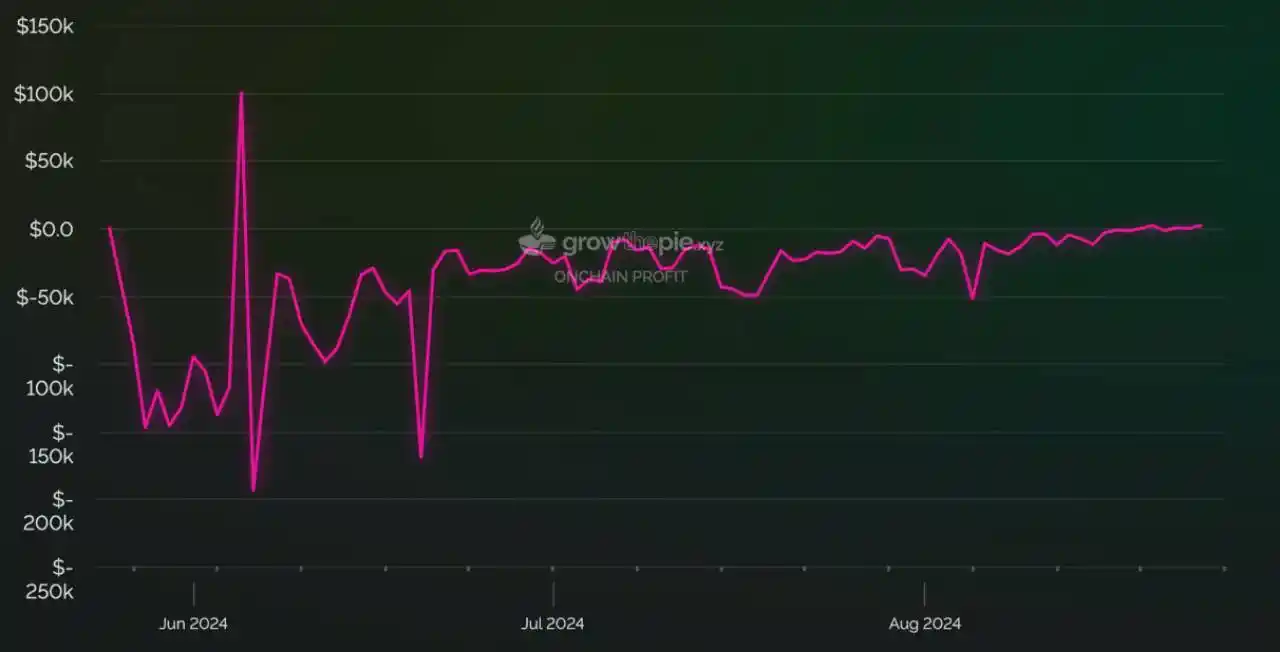
One of the notable achievements since the mainnet launch is that Taiko Labs’ proposers have become decentralized, permissionless, and profitable. This milestone overturns the current understanding of Ethereum and brings new possibilities for Ethereum scaling solutions. Although Taiko has suffered losses in the past, it is steadily moving towards profitability as more and more dapps are launched. The next few months will be a critical period to observe.
Source: Onchain Profit - growthepie
4.5.3 Lower operating costs
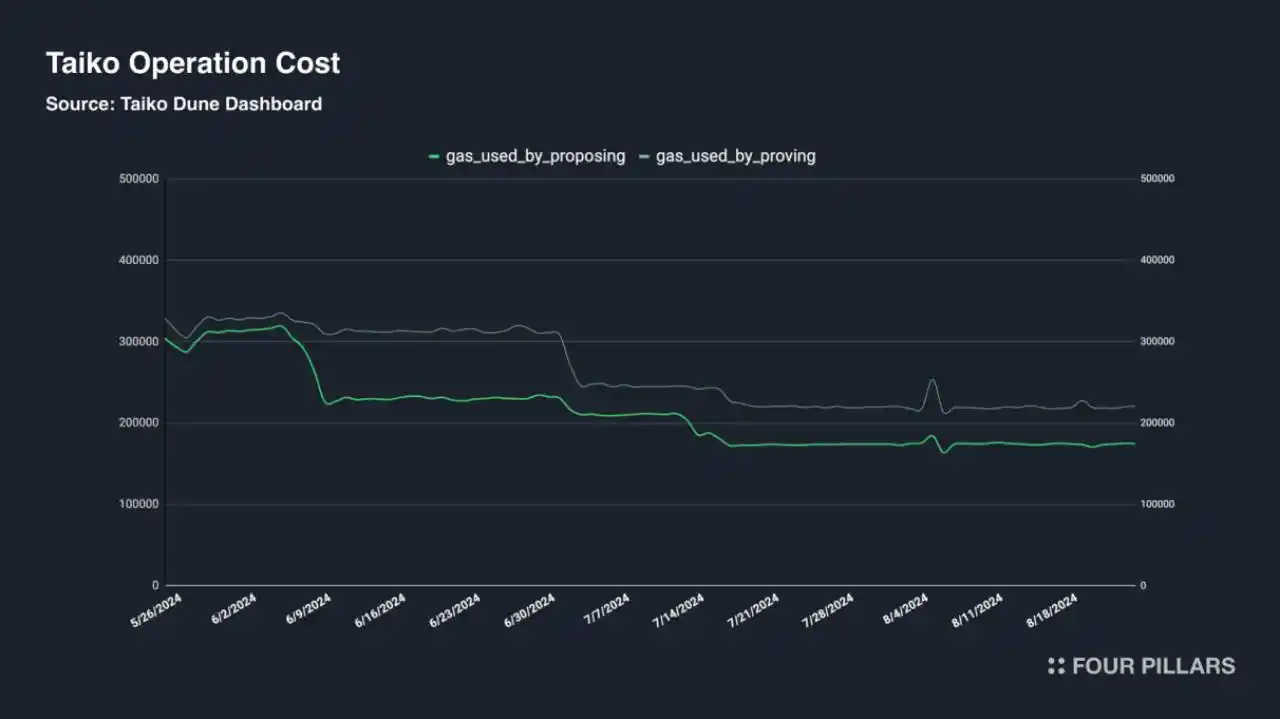
Taiko has made several technical advances to optimize network performance and reduce costs. In particular, gas fees for TaikoL1 contracts have been reduced by 30%, improving proposer profitability. In addition, liveness deposits and validity and dispute deposits for SGX proofs have been reduced by 50%, which reduces capital costs and enables more participants to participate in Taiko's permissionless transaction ordering.
5. Now is the time to pay attention to Taiko's progress

Source: Taiko Mirror
Nine years have passed since Ethereum first appeared on the world. During this period, Ethereum has experienced tremendous growth and has undergone many changes to address the challenges encountered in the expansion process. Among them, Layer 2 solutions have become Ethereum's key choice to solve the scalability problem, ushering in the current era of Ethereum L2 prominence. However, over time, some solutions have emerged that deviate from the original Ethereum L2 vision, making their relationship with Ethereum more competitive or antagonistic, thereby weakening Ethereum's security.
Now, the key is to focus on identifying "L2s that are truly aligned with the Ethereum vision" - projects that have the potential to become true partners of Ethereum rather than threats. This means that we need to carefully discern which entities are truly focused on solving the scalability challenges set by Ethereum and take appropriate steps to do so. Based on this, Taiko has attracted widespread attention. Taiko is striving to become an L2 comparable to Ethereum, a fully decentralized L2, and a developer-first L2. It is worth noting that Taiko has invested a lot of effort in achieving these goals and is supported by a strong technical foundation such as BCR and BBR.
Of course, many other Ethereum L2 projects are also working hard in their own ways, so it remains uncertain which project will ultimately dominate in this era of Ethereum L2 dominance. However, Taiko has attracted much attention because it is steadily translating its clear direction, which is to solve Ethereum's fundamental challenges, into practical results.
This article is from a contribution and does not represent the views of BlockBeats
Welcome to join the official BlockBeats community:
Telegram Subscription Group: https://t.me/theblockbeats
Telegram Discussion Group: https://t.me/BlockBeats_App
Official Twitter Account: https://twitter.com/BlockBeatsAsia