Silicon Valley Turns Right: Peter Thiel, A16Z, and the Political Ambitions of Cryptocurrency

Original Author: Jack, BlockBeats
The paradise of liberalism is taking a right turn.
It seems that overnight, the Silicon Valley's public opinion has started leaning towards the Trump camp. After Harris became the Democratic Party's presumptive presidential nominee, Silicon Valley has become increasingly divided. Openly supporting Trump was once a taboo in Silicon Valley, but now this blue fortress is wavering due to frustration with Biden and the Democratic government.
Over the past two years, Silicon Valley's tech giants have begun to engage in politics in a more high-profile manner. Just like "software is eating the world," these kingmakers are reshaping Washington's power dynamics through capital and influence.
The Contrarian, and His Uber-Trumpism
At the 2016 Vanity Fair New Establishment Summit, during an interview, Amazon CEO Bezos was asked about his views on Peter Thiel's support for Trump, to which he replied, "You have to remember, Peter Thiel is a contrarian, and contrarians are often wrong." He then went on to say that if it were him, he wouldn't have asked Peter Thiel to leave the Amazon board.
Even in the star-studded Silicon Valley, Peter Thiel stands out. His alliance with Zuckerberg is considered one of the most powerful partnerships in Silicon Valley history, and the influence of the "PayPal Mafia" permeates every corner of the tech industry. However, in the summer of 2016, Thiel found himself in a "to-be-or-not-to-be" dilemma. Due to his outspoken and high-profile support for Trump, he offended much of Silicon Valley. Over the next four years, his relationship with the Facebook board deteriorated, leading to his departure from the social network company in May 2022.
But this was not the end for Thiel. After leaving Facebook, he embarked on a pursuit of a more discreet and radical form of power, and as an emerging political force, he expanded his influence from Silicon Valley all the way to Washington. Through a series of efforts, he propelled his disciple J.D. Vance into the political spotlight, becoming the key figure behind the scenes of Silicon Valley's "right turn."
「The Contrarian」
In Silicon Valley, Peter Thiel has a more well-known alias — The Contrarian. He almost always holds a view that is opposite or at least different from everyone else's, then seizes the enormous opportunity in this non-consensus. In addition to co-founding PayPal, he was also the first outside investor in Facebook, the godfather of Bitcoin in Silicon Valley, and one of the early backers of companies like Tesla, SpaceX, and Airbnb, which were often not well understood or favored in the early days, but Peter Thiel always showed up in front of them.
Peter Thiel's secret to success is by no means simply "going against the grain." A philosophical thread that runs through his life is: today's people no longer have real views.
During his time at Stanford, Thiel was angry and frustrated by the various crazy behaviors on campus in pursuit of a diverse culture. He then co-authored a 250-page treatise with his friend David O. Sacks titled "The Diversity Myth: Multiculturalism and the Politics of Intolerance at Stanford." In the book, Thiel criticizes Stanford's false diversity culture for diverting students' attention from genuinely important issues and transmitting dangerous ideas to society through them. He accuses the campus culture of appearing diverse but, in fact, having everyone's thoughts being the same.

A young Peter Thiel, image from New York Magazine
Thiel sees this as the fundamental reason for the bubble in American society, so when people unquestionably believe in something, they should quickly steer clear of it. Based on this theory, Thiel sold PayPal on the eve of the Internet bubble bursting, successfully avoiding the 2008 subprime crisis. Now, he tells people that popular tech trends are all overvalued, and entrepreneurs are best off thinking contrarian, staying away from buzzwords like big data, cloud computing, etc., because "trendy" often means many people are already doing the same thing.
When it comes to venture capital, Thiel opposes the "move fast and break things + idea validation" lean startup mindset, instead advocating for foreseeing the future through long-term thinking. This way, you don't have to keep trial and erroring; the conclusion you come to after serious thought is the trend. He claims that 75% of the value of the technology companies invested in by Founder's Fund will come from cash flows generated 10 years later.
In 2016, Peter Thiel once again discovered a rare contrarian opportunity.
Over the years, Peter Thiel has acted as a bridge between Silicon Valley and the conservative right. At that time, the left-liberal was still the mainstream in Silicon Valley, and the majority of tech company employees were supporters and donors of the Democratic Party. Thiel found that many Silicon Valley professionals were severely offended by Trump's MAGA slogan; they felt that "Make America Great Again" denied Silicon Valley's contribution to American social development, and what appealed to Thiel was precisely this kind of pessimism.
Over the years, Thiel has always favored more pessimistic presidential candidates. He loathes or even disdains the traditional politicians' optimism, believing that they, like Reagan, depict America as a shining city, and "if you are too optimistic, it can only mean you are out of touch with reality." Thiel believes the era of great men accomplishing great things in government is long gone, and the current federal institutions are an "ossified center-left regime" restrained by rules that stifle innovation.
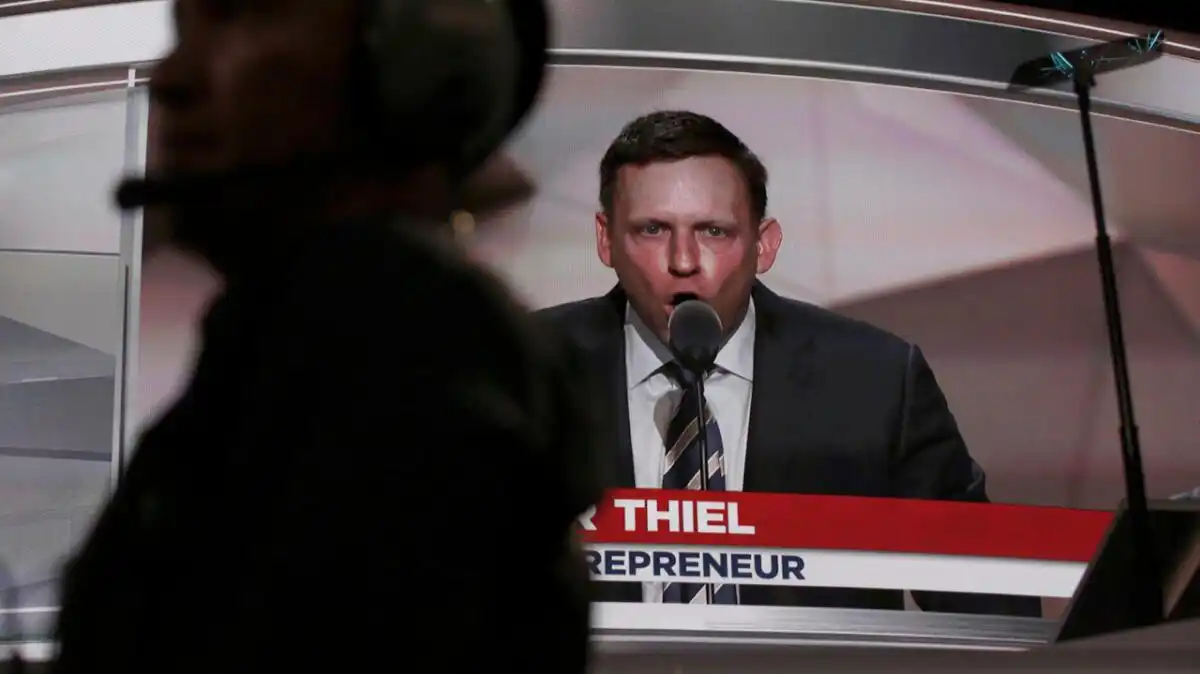
In contrast, Trump's America is a fragmented landscape. To Thiel, MAGA is the most pessimistic campaign slogan in a hundred years because it acknowledges that America is no longer a great country. For a presidential candidate, this is utterly shocking. At that time, Washington was desperate to avoid this political "outsider," while Peter Thiel chose to donate $1.25 million to him and spoke in support at the 2016 Republican National Convention.
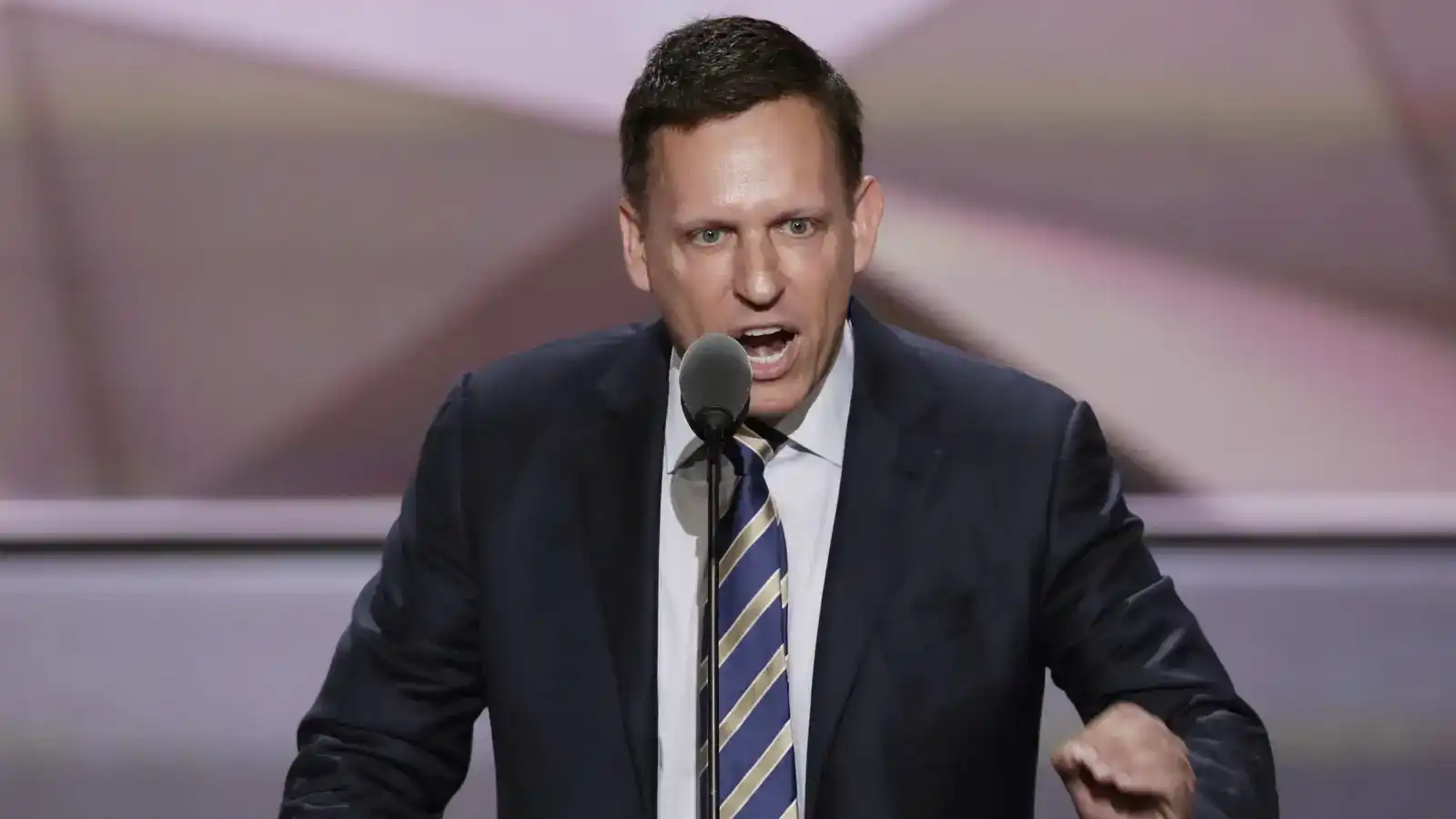
Peter Thiel's speech at the 2016 Republican National Convention, image source from Quartz
This action caused a conflict between Thiel and Facebook's Democratic board members and liberal employees at Washington Post, some executives thought Thiel's political behavior was somewhat overboard. After the conference, Thiel received an email from board member and Netflix CEO Reed Hastings, calling Thiel's decision a "disastrously wrong judgment."
However, Thiel saw his support for Trump as almost the "least contrarian" choice he had ever made, given that it received "the acceptance of half the country." Since then, Thiel has become increasingly distant from Silicon Valley. In 2018, he moved both his home and investment firm to Los Angeles. It turns out that this contrarian visionary's judgment on "Trumpism" was incredibly foresighted, and his bet on Trump has brought him significant political returns, although these returns were somewhat different from what he initially imagined.
Beyond Trumpism
In a media interview last November The Atlantic, Peter Thiel openly expressed his "buyer's remorse" for the former Trump administration and admitted that supporting Trump was a bad bet. Thiel told The Atlantic's reporter that he had envisioned a "national reckoning" by the Trump administration after the election, cutting regulations, dismantling the administrative state before rebuilding the nation, "but it was crazier and more dangerous than I imagined. They (the Trump administration) couldn't even get the most basic functions of government to work, which was worse than my low expectations."
Peter Thiel has a soft spot for "outsiders." In his perception, disruptors and agitators are almost always outsiders, which is also the main reason Thiel admired Trump. However, shortly after Trump took office, he realized that this administration was not as radical as he had anticipated.
During the transition period from 2016 to 2017, Peter Thiel had an office in the Trump Tower and submitted a cabinet nomination list to Trump containing over 50 senior government positions. The purpose of this list was to "disrupt the administrative state," with many being either extreme libertarians or thorough reactionaries, making the list even too radical for the Trump administration.
One example was the position of Chief Science Advisor, for which Thiel recommended William Happer, a prominent American climate skeptic who once likened demonization of fossil fuels to Hitler's treatment of Jews. In the end, apart from his disciple Michael Kratsios being appointed as Chief Technology Officer, Thiel's other candidates hardly found any roles in the Trump administration. Soon after, Steve Bannon, closely associated with Thiel and former White House Chief Strategist, was also ousted from the White House.
According to Puck's report, Thiel's relationship with Trump has been exaggerated by the media and Silicon Valley observers. The fact is, at that time, Thiel was not among Trump's innermost circle of business leaders. While Thiel had a good relationship with Trump's son-in-law Jared Kushner, he was far less connected to Trump himself compared to Trump's long-time allies like Tom Barrack or old money powerhouses like Robert Wood Johnson IV.
Therefore, during Trump's reelection campaign in 2020, Peter Thiel chose to stay on the sidelines.
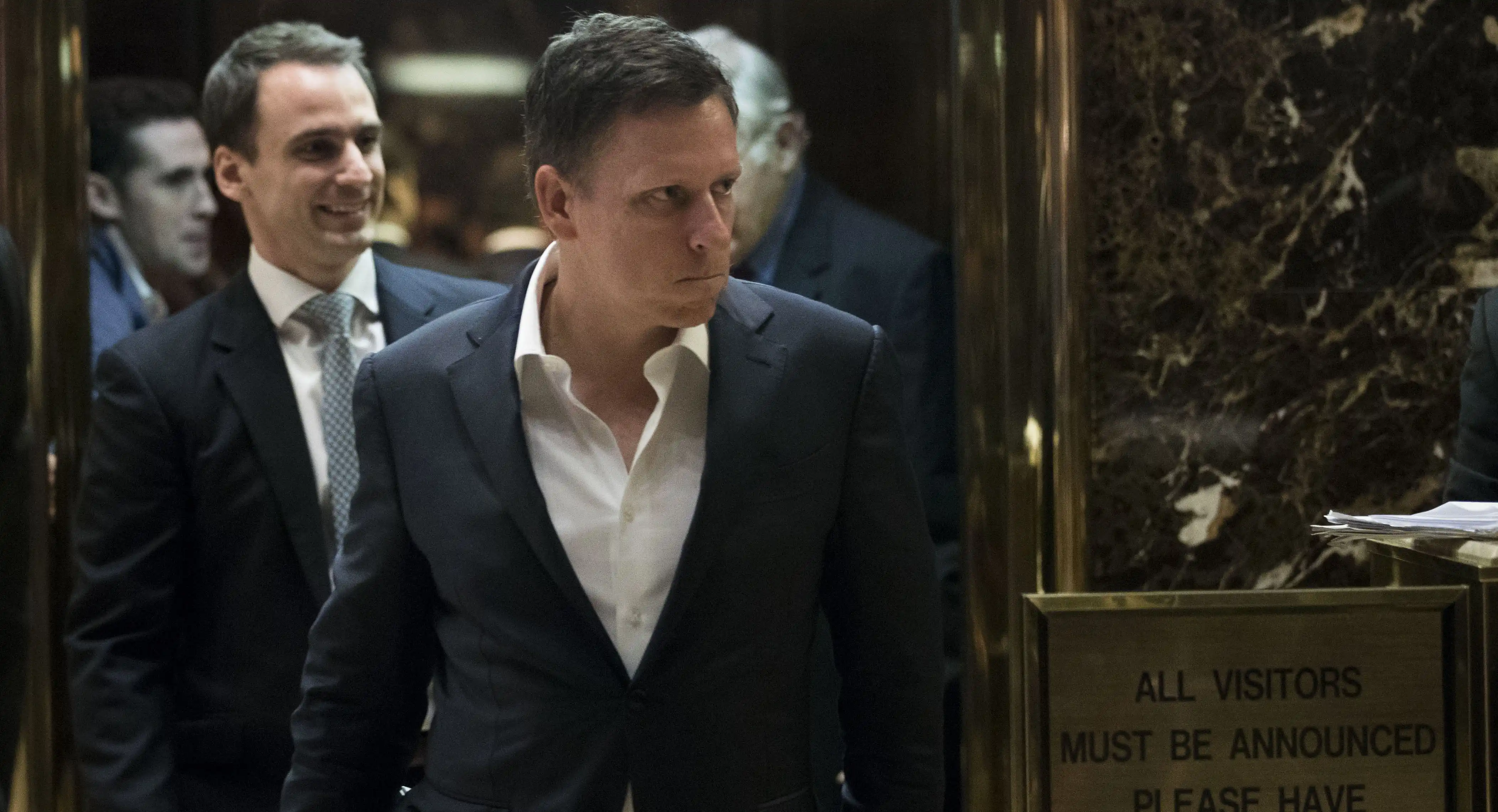
Peter Thiel leaving Trump Tower, image source: POLITICO
However, Thiel did not abandon the ideology symbolized by Trump, known as "Trumpism." This belief in anti-establishment principles and achieving societal reconstruction through radical disruption is what Thiel holds dear. He is willing to find a path forward and reliable successors for this ideology, with or without Trump's direct involvement.
The good news is that, in the years following Trump's arrival at the White House, Thiel's image has significantly improved within conservative circles. The passing of GOP mega-donor Sheldon Adelson in early 2021 and the arrest of Tom Barrack later that summer further created a vacuum for Thiel to expand his influence within the party.
According to The New York Times, throughout 2021 and 2022, Republican politicians clamored to visit Peter Thiel at his home or at least have a phone call with him. Republicans saw a clear path: Thiel could come to the rescue of struggling candidates, providing them with enough funding to combat Democratic attacks.
According to Puck's report, Senate Republican leader Mitch McConnell had repeatedly implored Peter Thiel to step in and assist J.D. Vance and Blake Masters in their disastrous performances in Ohio and Arizona during the 2022 midterm elections but was consistently met with Thiel's refusal. This left McConnell puzzled, as he couldn't understand why Thiel would pour nearly $20 million into the two during the primary only to abandon his investment during the final election.
Facing McConnell, Thiel had his reasons for taking a tough stance. In early 2022, he, alongside Rebekah Mercer (Mercer family heiress), formed a secretive conservative donor alliance named Rockbridge aimed at "disrupting and advancing the GOP agenda" and seeking to reshape the American right outside of the party machinery. As the godfather of venture capital, Peter Thiel naturally wants to win, but his goal isn't just another GOP seat — it's about disruption. He aims to further push the GOP to the right, purging the moderate establishmentarians. Bankrupt or redefine the industry: that's Thiel's investment philosophy.
After learning from the lessons of 2016, Peter Thiel's political strategy underwent a significant shift. He began treating candidates like startup founders, providing early and substantial support to promising candidates. Reportedly, Thiel donated over $20 million during the midterm elections, backing a total of 16 Republican candidates. As a Silicon Valley godfather, Thiel brought the Paypal Mafia rule to Washington, nurturing disciples, emphasizing loyalty. With expectations of the Republican Party gaining more congressional seats, Thiel began focusing on strategically placing loyalists within the party.
In the 2022 midterm elections, Peter Thiel's two loyal disciples were Masters and Vance. The former is an executive at Thiel's family office and co-authored Silicon Valley's "startup bible," "Zero to One," with Thiel. The latter is the author of the bestselling book "Hillbilly Elegy" and a former employee of Peter Thiel's Mithril Capital.
In early 2022, The Washington Post Magazine extensively covered Vance's journey from a prominent writer to an extreme right-wing politician in an article titled "J.D. Vance's Road to Radicalization." From his days at Yale listening to Peter Thiel's "life-changing" lecture, to working for Thiel's Mithril Capital in 2017, and later founding Narya Capital with Thiel's backing three years later, Thiel played an influential role in almost every step of Vance's development path.
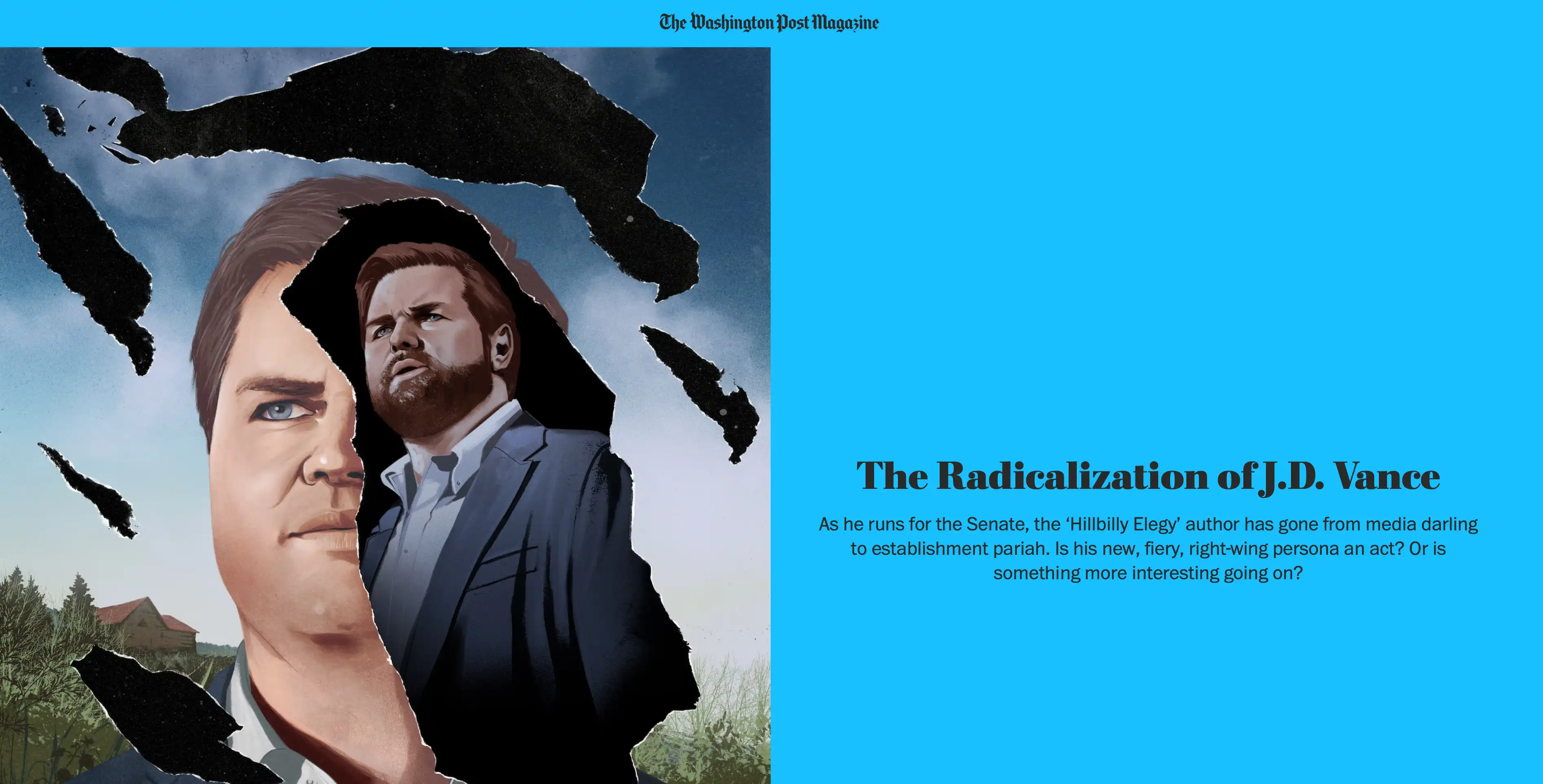
Washington Post Special on J.D. Vance
At the last moment of the election, Vance, with Till's help, secured Trump's support and won the Ohio race with the $1.5 million Till injected. By injecting "emergency political funding" for Vance and Masters, these inexperienced right-wing disciples, Till ensured they would be absolutely loyal to him, not McConnell; in a sense, they are an extension of Till's ideology. One example is Facebook, where in 2018 Till's Palantir, following the Cambridge Analytica incident, was officially investigated by Facebook. Vance's criticism of Facebook to some extent is also part of Till's external push to steer Zuckerberg toward the right-wing.
Unlike Musk's flashy image on Twitter, Peter Thiel is an operator behind the scenes. He was once a top-ten player in the U.S. chess rankings and now excels at using his influence to deploy political pawns to achieve his goals. Many underestimate Thiel's will and tactics; as a descendant of Germans, his thinking carries a distinct German-Prussian hue, cold, iron-fisted, and even extreme. Thiel's influence does not merely come from money; his ten-year ruthless vendetta against Gawker News is a solemn warning he conveys to every enemy. In Silicon Valley, no one dares to say they are not afraid of Peter Thiel. Now, he wants to once again use this iron-fisted power to transform America, even if it means losing his lifelong friend.
In 2022, The Washington Post highlighted in an article that Thiel and Musk are heralding the rise of a new generation of tech billionaires. Their vast wealth and unique ideology are transitioning from building companies to reshaping the leadership of the new American right, fundamentally changing the Republican Party and Silicon Valley. Two years later, Thiel was "very pleased" with Mans' nomination as vice president, just as people said Trump had fundamentally changed the GOP, Thiel believes he has reshaped Trumpism. Perhaps to him, the endpoint beyond Trumpism is Thielism.
Ringaholic
Peter Thiel has always had a fondness for a fantasy parallel world, having read a lot of science fiction and fantasy novels since childhood, but only "The Lord of the Rings" made him read it at least 10 times (this is a three-volume epic). Thiel is obsessed with Tolkien's Middle-earth, and you could even say he lives in his own fantasy world: whether it's Palantir, founded in 2003, or Narya Capital, created in 2020 with support from Thiel to help Mans, both names are derived from "The Lord of the Rings."
Former Roivant Sciences CEO Vivek Ramaswamy, who, with Thiel's support, founded an anti-ESG investment company, once told the media that Peter Thiel strongly believes in the huge opportunity of creating a parallel economy. He believes that serving those dissatisfied with today's American corporations will be the backbone of the next generation of large companies, and almost no one is seriously pursuing this opportunity.
In Thiel's eyes, these parallel economies are no different from Tolkien's Middle-earth: Middle-earth is an arena for the pursuit of ultimate power, where there is no government, and individuals of extraordinary ability rise one after another to fulfill their destinies. Additionally, there are immortal elves who live in valleys protected by magical powers, far away from humans.
Peter Thiel is like a power contender in Middle-earth, eager to obtain the One Ring that rules them all.
After the 9/11 incident, the United States significantly enhanced its security measures, and airport screenings became cumbersome. Thiel found this phenomenon, which reduced the overall efficiency of society due to a single terrorist, to be extremely absurd. Therefore, he hoped to use PayPal's technology for identifying online fraud to proactively locate criminals on the internet. This led to the founding of the data mining company Palantir. The company's name and logo were inspired by the "Palantír" held by the evil wizard Saruman, which could observe and communicate events and people in any part of the world.
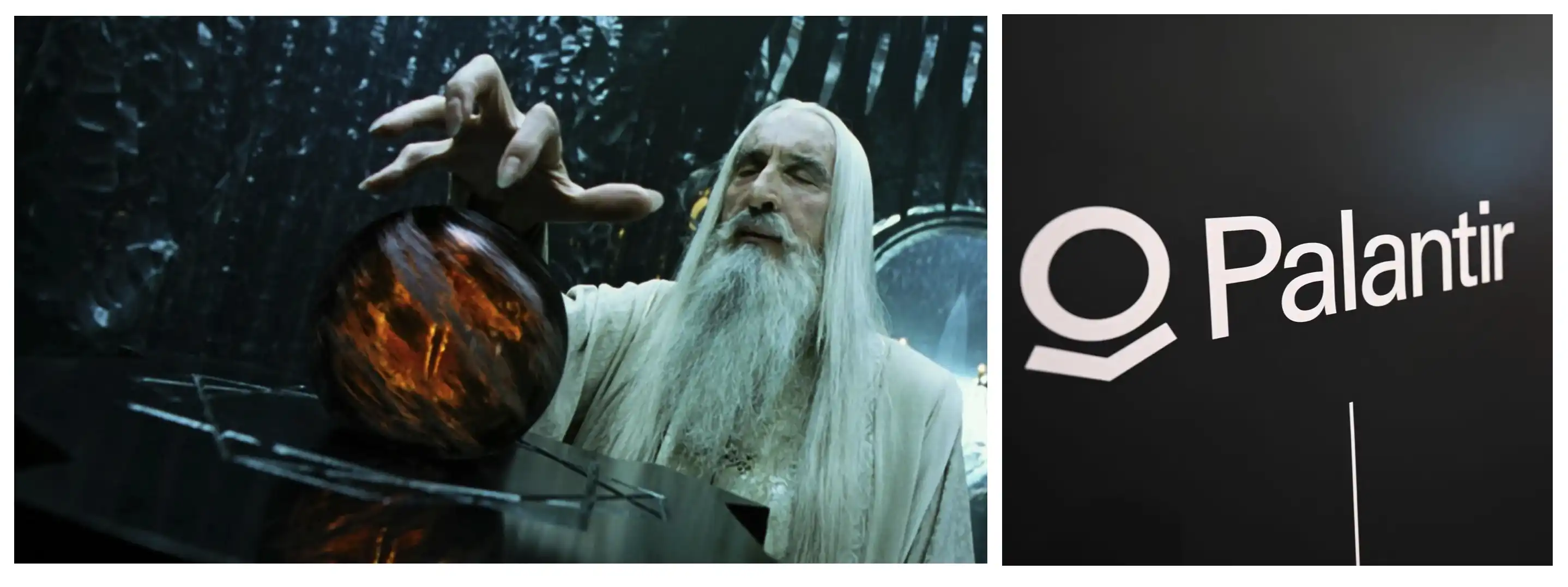
Image of the Palantír from the movie "The Lord of the Rings" and Palantir's logo
In its early stages, Palantir received support from the CIA's investment arm, In-Q-Tel, but later lost out in competition with major rivals like Amazon and Google. However, Trump's presidency turned the tide for Palantir, and they began winning significant government contracts. Due to investments during the election period, Thiel was able to advocate for his products in the U.S. military. Once again, he applied PayPal's development model to expand Palantir's clientele to governments and special agencies worldwide.
In a recent speech at the University of Cambridge, several audience members protested one after another, accusing Palantir of playing an evil role as a data contractor for the Israeli military in the current Israel-Palestine conflict and accusing Peter Thiel of having "blood on his hands." Thiel responded, "I have a theory that we are always entangled in the justice and evil of technology, but most technologies are actually useless. In this sense, useless technology is 'bad.' Today someone complains about Palantir, at least showing that Palantir's technology is really useful. In a world where most technology is useless and false, even if you are evil, you are not useless. In a completely incompetent world, you are even 'good.'"
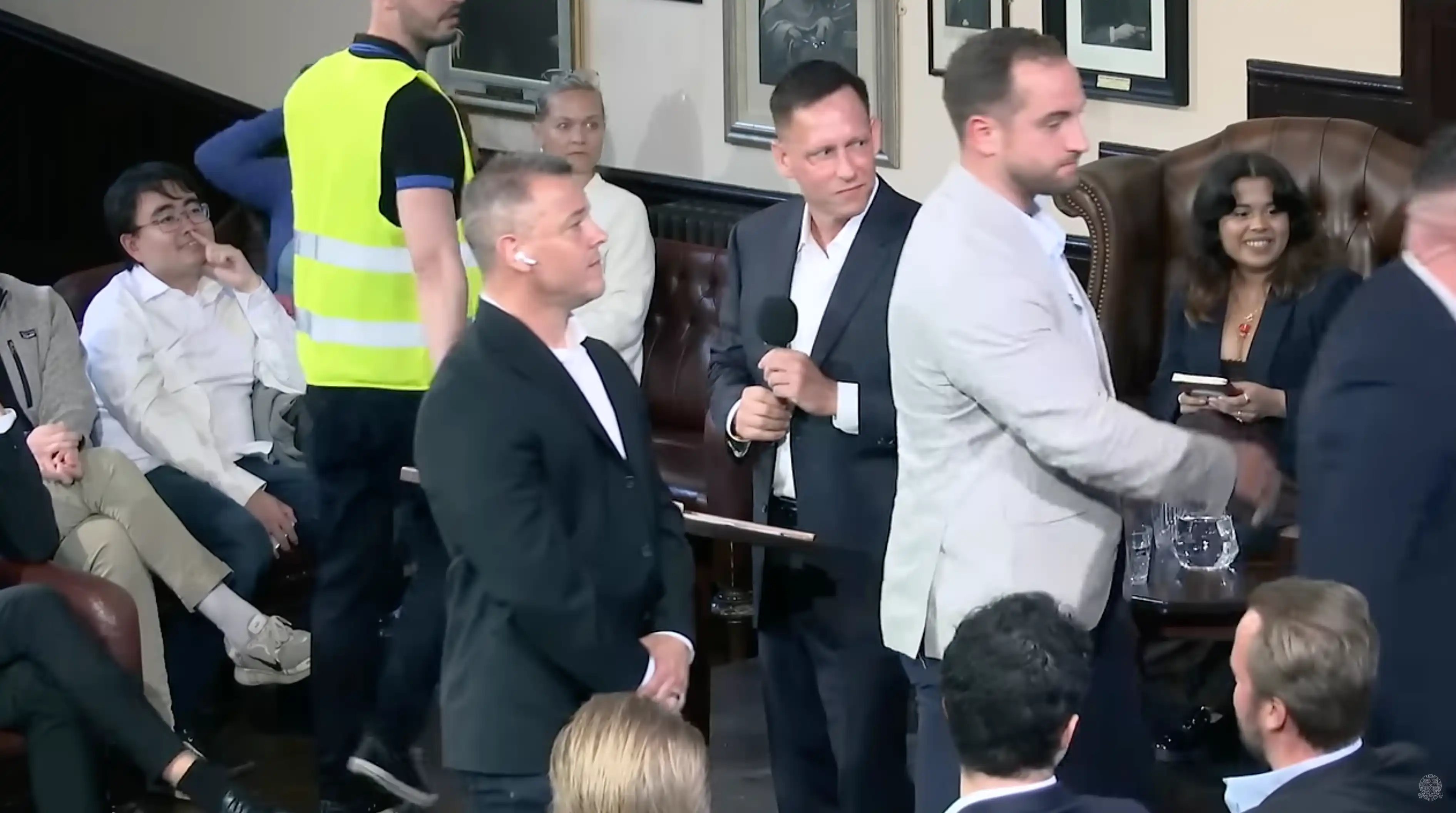
Peter Thiel's recent speech at the University of Cambridge was disrupted by protests
Thiel has never minded being seen as a villain, saying in 2016 when he supported Trump: "Silicon Valley wants a villain, and the Republican Party wants a hero," apparently feeling that role suited him well. When talking about "The Lord of the Rings", he believed the essence of elves is immortal humans, and then asked, "Why can't we become elves?" In his pursuit of immortality, Thiel is often referred to as a vampire in the public eye.
Peter Thiel believes that behind every successful company is a "hidden secret in plain sight," and he seeks "non-consensus," which is about disruption and development. He believes that America is currently in an innovation rut and blames the fundamental cause on decades of American society's pursuit of diversity, saying, "We wanted flying cars, but instead we got 140 characters."
However, Thiel is not a visionary like Jobs; he cannot provide a clear direction for the future.
Many who understand Peter Thiel would say that he himself does not know what he wants. Setting aside his philosophical thoughts, Thiel is indeed a supercontradictory figure: he is gay but founded a right-wing publication during his Stanford days criticizing multiculturalism and feminism; he advocates for a company's monopoly model in "Zero to One" and praises autocracy, yet openly opposes the monopolistic behavior of large tech companies; he advocates for tech libertarianism but believes democracy and freedom are incompatible.
Peter Thiel is more like an arsonist; he will do everything possible to change the trajectory of a person, a company, or even a society, but he will not take responsibility for the consequences of where the ship will turn. Before Silicon Valley Bank crisis, Founder's Fund was the first to exit organization. In New Zealand, the filming location of "The Lord of the Rings," Thiel spent millions to buy a 500-acre estate. In a 2016 interview, OpenAI CEO Sam Altman revealed that if a global catastrophe occurred, he would fly with Thiel to seek refuge here. Yes, if Peter Thiel really sets this world on fire, you probably have no way out, and he has already prepared his exit plan.
Woke, Wealth Tax, Lina Khan, and the "Biden Totalitarianism" Turning Silicon Valley Against It
In September 2021, The Washington Times published an article titled "Democrats' Totalitarian Overreach Threatens Americans' Livelihood," accusing the Democratic Party's radicals of willfully suppressing minority voices in the public discourse, using science as a pretext for imposing school policies, undermining parental rights, disregarding the harm caused to young children by masks and gender identity education.
The term Totalitarianism originated from the West's description during the Cold War of similarities between Nazi Germany, fascist nations, and the Soviet Union, where Totalitarians suppress opposition parties and control citizens' public and private lives through state propaganda machinery and mass media. In the early days of the Biden administration, this term appeared only occasionally in conservative media outlets like The Washington Times and some far-right forums, suggesting that political correctness, content censorship, and big government constitute America's "new totalitarianism."
However, in a recent episode of a podcast update last week, Ben Horowitz, co-founder of A16Z, also began to use the term "totalitarian" to describe Biden's Democratic government. He believes that in the past four years, a far-left force within the Democratic Party has seized regulatory power in the vacuum created by Biden's appointments, aggressively targeting Silicon Valley and its invested startups with hostility. This has caused A16Z, a former Democratic supporter, to lean towards Trump in this election.
At the beginning of the year at an Axios Tech Conference, David Sacks, a friend of Peter Thiel and founder of Craft Ventures, also stated that he has "greater disagreements with Biden than with Trump," and shortly after, he invited Trump to participate in a well-known podcast, "All In Podcast," co-hosted by him.
While Peter Thiel's personal influence is undoubtedly important, Silicon Valley has never lacked kingmakers. Behind the successive defections of these powerful individuals lies the efficiency erosion of Silicon Valley under Woke culture and the significant conflict between Biden's big government policies and the billionaire economy.
「No, Mr. President, They Are Not Your Children」
「My Son Died」, Elon Musk said in this week's live interview,「He was killed by the Woke Mind virus (referring to Dead Naming)」. During the interview, Musk openly discussed the fact that his eldest son transitioned. During the pandemic, Musk's son Xavier struggled with gender dysphoria. Ultimately, Musk, in a state of incomplete information and fearing Xavier's potential suicide, signed off on his son's gender reassignment surgery. Musk later blamed this on the American education system's approach to gender identity.
A year ago, the White House official X account shared a voice clip video where Biden said, 「These (LGBTQ+ minors) are our kids, they are our neighbors, not someone else's children」. The next day, Musk replied, 「You are the government. They are not your children」. The voice clip in the video was from comments made by the Biden administration during the "White House Pride Month" event held that month. During the event, transgender model Rose Montoya's topless display at the White House sparked a significant public outcry across major media outlets.
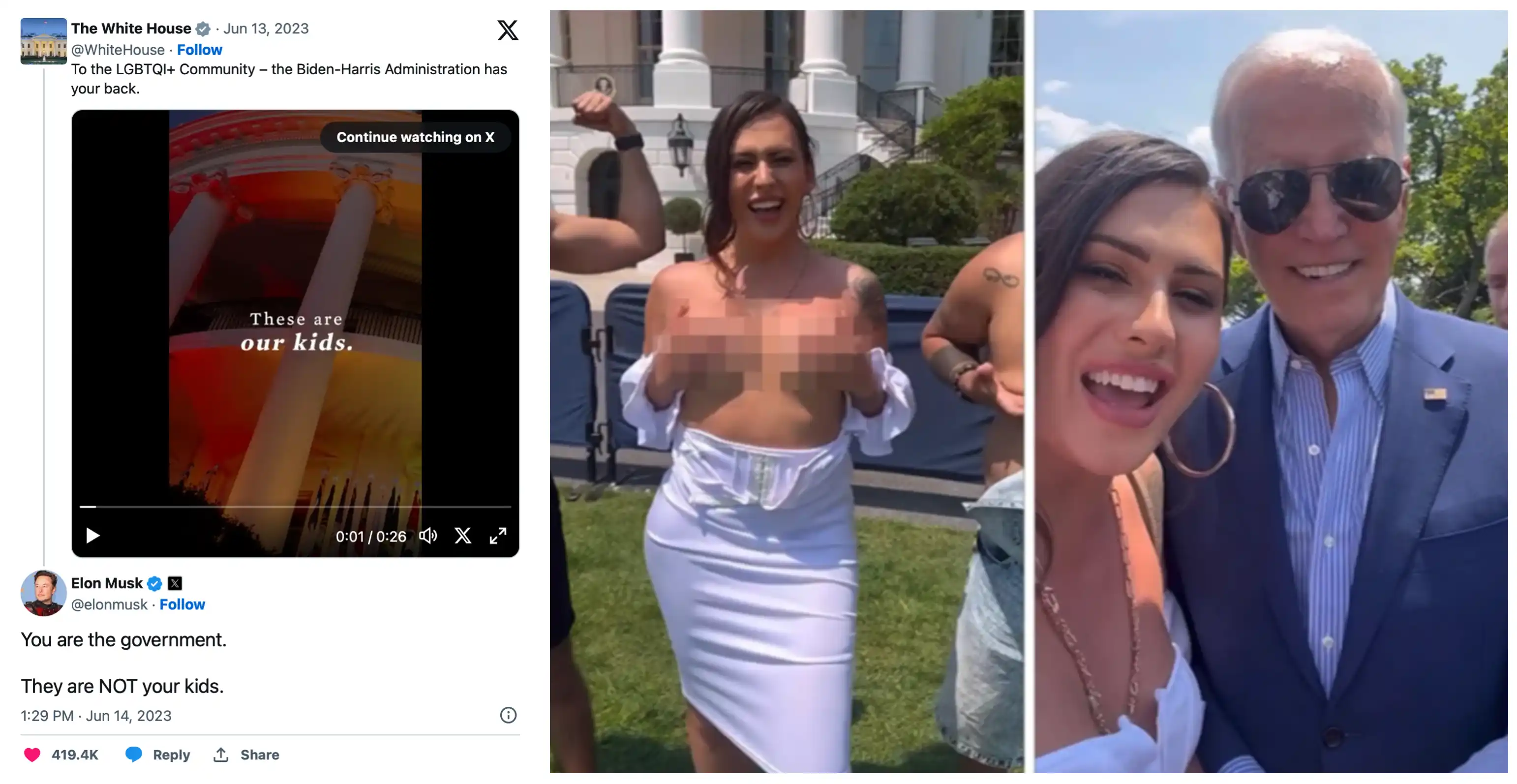
"White House Pride Month" On-Site Photo with Official Tweet
Over the past two years, whether gender identity content should be taught in K-12 schools and whether schools have an obligation to inform parents when students want to change their gender identity has become one of the most contentious topics in American society.
During the 2022 midterm elections, Virginia Democratic gubernatorial candidate Terry McAuliffe vowed that parents should not be telling schools what to teach, stating that he "won't let parents come into schools, parents shouldn't be telling schools what they should teach." On the conservative side, legislative actions have frequently opposed this stance. In March, Florida Governor Ron DeSantis signed a Parental Rights in Education bill that prohibits the state's public schools from teaching gender identity topics in kindergarten through third grade and allows parents to determine when to introduce such topics to their children.
Meanwhile, polling data shows that a majority of Americans, regardless of political affiliation, support such parental rights legislation. In several federal court lawsuits, Florida student parents have accused schools of following a "gender-affirming" agenda, allowing students to choose pronouns or a different gender identity without parental consent and assisting students in deceiving parents or refusing to comply with their wishes.
In April of the same year, President Biden spoke at the annual teacher event saying, "They're not somebody else's kids, when they're in that classroom, they're your kids," and later at the following year's teacher event, he reiterated, "There's no such thing as 'somebody else's children,' our nation's children are all our children." Biden's remarks have been seen as attacks against conservatives and student parent opposition movements, with right-wing media criticizing this as an attempt to "replace the parent-child bond with loyalty to the 'Woke cause' in order to achieve control over the younger generation."
Since the MeToo movement, the "Woke" culture has begun to widely develop in the United States, reaching its peak during the Black Lives Matter movement. After Biden took office, Woke culture began to radicalize, with the assistance of mainstream media such as CNN and social media platforms like Twitter, becoming a hyper-sensitive topic in social discourse. Subsequently, "Cancel Culture" has been seen as a tool used by far-left individuals to attack other social groups. During the pandemic, media coverage by outlets like CNN and MSNBC of riots in the Black community was mocked by many American netizens, as reporters stood in front of burning scenes describing them as "mostly peaceful protests in a fiery but peaceful setting."

Media Coverage During Black Lives Matter
In Wall Street, Woke culture has also sparked dissatisfaction among some traditional leftists. In a recent interview, "The Little God of Stocks" Bill Ackman expressed his disappointment with the Democratic Party's changes in recent years, saying, "Today, if you say something offensive to someone, you might lose your job directly, you might be 'canceled'... I am a 'Clinton-style Democrat,' I don't want to be associated with today's Democratic Party." Later that month, New York Magazine published an in-depth article titled "Bill Ackman's War with Harvard, MIT, and D.E.I," reporting on Bill's vendetta against the MIT president and his wife for using D.E.I. initiatives for personal gain.
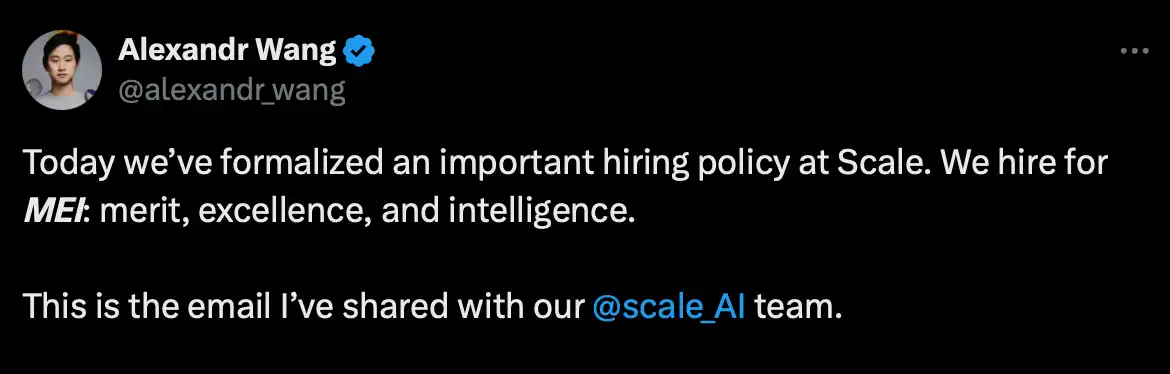
Under the leadership influence of the Biden administration, Woke culture is impacting American corporations and startups in the form of the D.E.I movement (Diversity, Equity, and Inclusion), with the growing disdain for D.E.I gradually becoming an open secret in Silicon Valley. Many Silicon Valley entrepreneurs and executives believe that D.E.I initiatives hinder companies from making optimal decisions in areas such as recruitment and business partnerships, ultimately leading to a setback in corporate profitability, with some tech companies even attempting to abolish D.E.I recruitment plans. Last month, Scale AI founder Alexandr Wang posted on X, proposing the M.E.I concept (Merit, Excellence, and Intelligence) as a replacement for D.E.I recruitment plans, garnering support from tech titans like Musk.
In the "anti-D.E.I crusade," Peter Thiel has been very vocal, publicly stating multiple times that "D.E.I is just woke communism." In a speech at the University of Cambridge earlier this month, Thiel once again referenced his university-era work "The Diversity Myth," pointing out that the D.E.I movement diverts people's attention from crucial issues such as economic development and technological innovation, leading to a decrease in societal efficiency.
According to The Washington Post, Thiel has been focused on changing American culture since 2021, providing funding to the "anti-Woke" cause, including right-wing film festivals and conservative dating apps. Musk, on the other hand, has referred to Woke culture as the "Woke-Mind virus" and has attempted to maintain neutrality of public opinion by acquiring Twitter, a move that received Thiel's "spiritual support." The issue of his eldest son's gender transition deeply affected Musk, leading him to launch a fierce criticism of California's transgender medical policies for minors. Musk's announcement that X and SpaceX headquarters will be relocated from California was seen as directly triggered by California Governor Gavin Newsom signing the AB-1955 bill.
The Great Government Bet, Tax Stick Swings at Silicon Valley Elites
After Biden took office, the U.S. federal government embarked on a "consumption frenzy," passing a $1.9 trillion economic relief plan in the first year of his term. In an article titled "Biden bets bigger government, and the pandemic is helping him," The Washington Post pointed out that Biden is becoming an ambitiously transformative president, with the federal government undergoing its largest expansion in half a century.
Due to the economic shutdown and social turmoil, millions of Americans lost their jobs, and public resistance to government expansion gradually softened. In late February, the stimulus plan garnered about 65% public support in a poll. Biden is seeking to seize the current public sentiment as an opportunity for major expansion and swiftly advance his big government agenda.
Since taking office, Biden has been portrayed by the media as the vessel for America's second attempt at The Great Society program. In the early 1960s, President Johnson's Great Society program was seen as the federal government's last expansion attempt, but it ultimately faced strong opposition under the pressure of the Vietnam War. Reagan's takeover in the 1980s, marked by his strong anti-Washington sentiment, set the political tone for decades of anti-government expansion in America's future. However, Biden is betting that the pandemic can help him rewrite history and achieve what other Democratic presidents have been unable to accomplish.
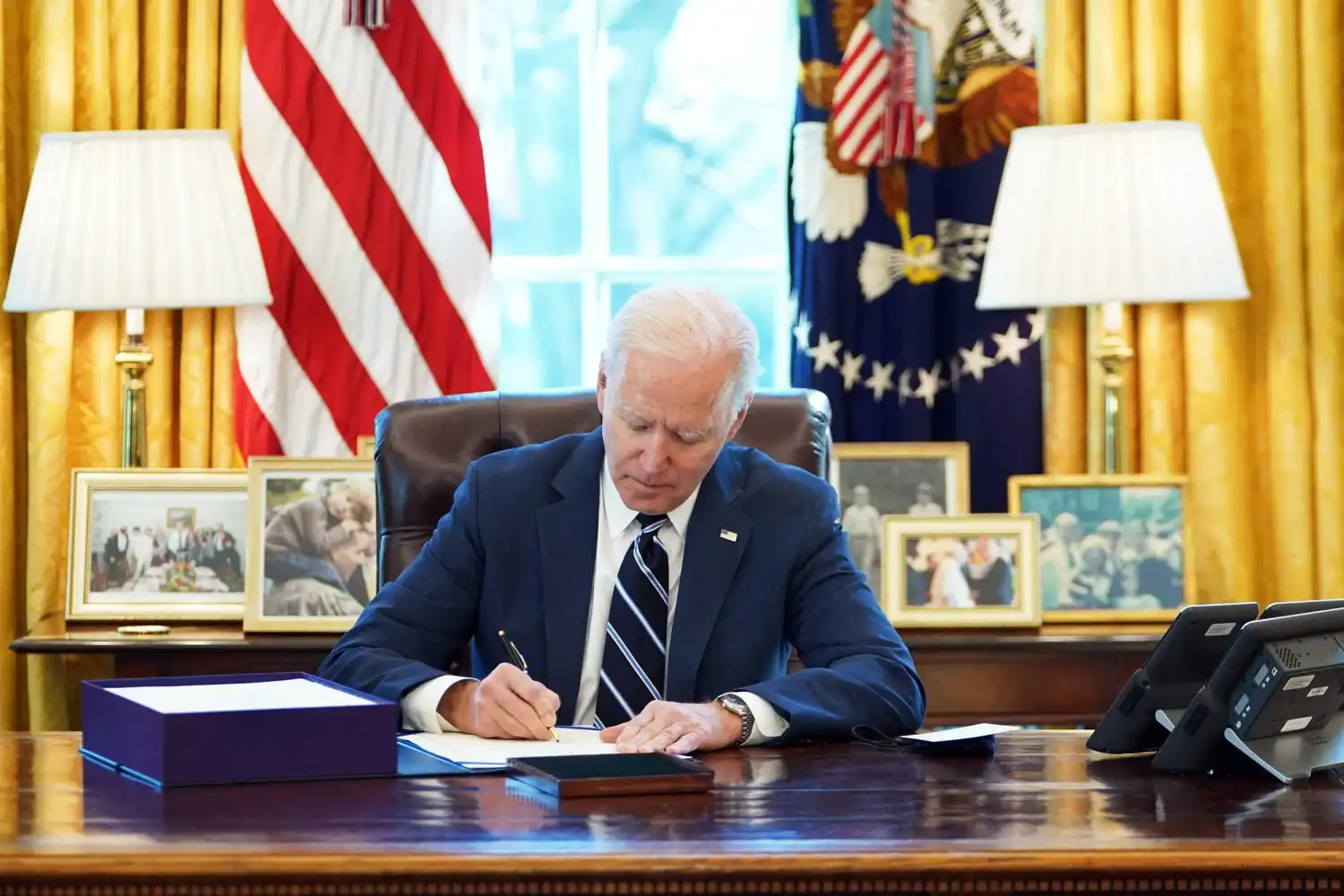
Biden Signs $1.9 Trillion Stimulus Plan, Image Source: CNBC
The following year, the Biden administration introduced a $2 trillion fund to support the "Build Back Better" agenda large-scale infrastructure plan, further expanding the role of national funding in the socio-economy. In addition to social spending, Biden also significantly increased the defense budget during his term, raising defense spending to $800 billion in early 2023, a 3.2% increase from the previous fiscal year. It was referred to by the media as one of the largest annual defense budgets in U.S. history during peacetime. Meanwhile, federal employees also saw a 5.2% salary increase, the largest salary hike for U.S. civil servants in forty-three years since a 9.1% raise in 1980.
High spending implies high taxes, and the funding source for the $2 trillion large-scale infrastructure plan cannot rely solely on government debt. Biden decided to target American corporations and the wealthy. Corporate taxes are seen as the main source of White House infrastructure plan funding, with rates increasing from 21% to 28%, federal subsidies to fossil fuel companies being terminated, the global minimum tax rate rising from 13% to 21%, and forcing multinational companies to pay U.S. tax rates. This marks the first significant federal tax rate increase since 1993, directly reversing the trend of substantial corporate tax cuts promoted by the Trump administration since 2017.
In addition, the affluent class and investors have also become targets for increased revenue to fund social priorities in the infrastructure plan. When unveiling the 2023 budget, Biden proposed a new tax plan targeting the wealthy, imposing a 25% minimum income tax on individuals with a net worth of over $1 billion, which includes both standard taxable income and annual gains on "tradable assets" (such as stocks, bonds, mutual funds, and other securities). The plan, referred to by the White House as the "Billionaire Minimum Income Tax," signifies the Biden administration's first explicit call for a Wealth Tax, with an estimated $360 billion in revenue for the federal government over the next 10 years.
According to a 2021 report by ProPublica published, Biden's billionaire tax would result in tech titans like Bezos and Musk paying between $350 billion and $500 billion in taxes. In that year, the news of "Musk's $110 Billion Tax Bill" became a hot topic, marking the highest individual tax payment in U.S. history.
After increasing the 2025 fiscal year budget to $7.3 trillion, Biden once again proposed taxing unrealized gains and planned to tax the unrealized gains of trusts, businesses, and other non-corporate entities with no recognition events in the past 90 years. Given the complexity of asset valuation and liquidity issues, as well as the significant challenges of specific implementation, this conceptual measure has rarely been used in the U.S.'s past tax framework. Biden's proposal, now signed into law, raises the highest marginal rates for long-term gains and dividends to a staggering 44.6%, reaching the highest level in U.S. history.
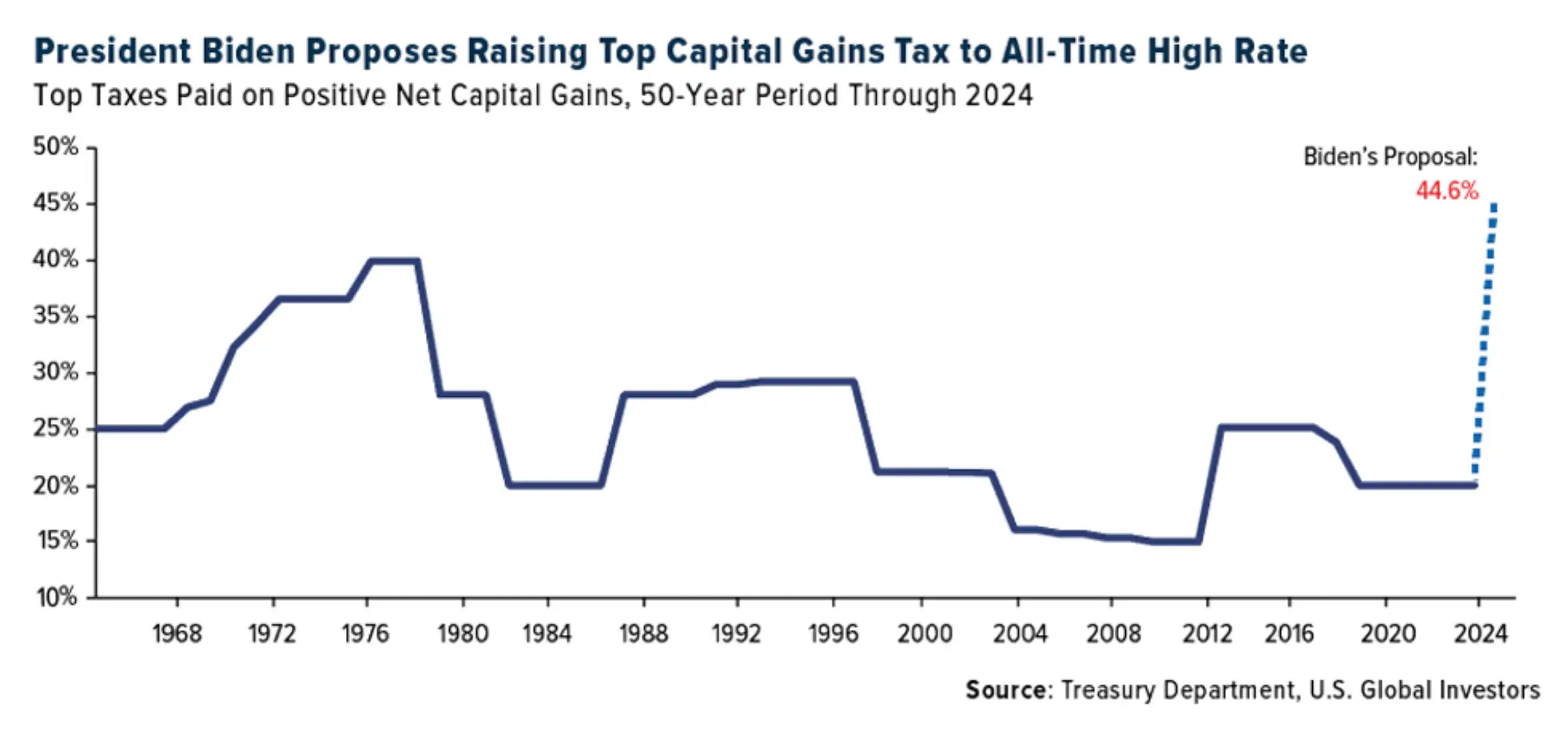
Under the new regulation, the U.S. capital gains tax will reach a historic high, image source: U.S. Department of the Treasury
Taxing unrealized gains means that when an individual or entity (with a net worth above $1 billion) holds tradable assets such as stocks, bonds, etc., and their value appreciates, they will need to pay a minimum income tax of 25%, even if these assets have not been sold yet. For the venture capital world where valuations are everything, this is tantamount to a declaration of war.
Bill Ackman, when discussing the tax plan, stated that the Democratic Party should not pursue a tax policy that would "destroy the U.S. economy," saying, "If someone invests in your startup at a $10 billion valuation and you own 50% of the company, you would immediately owe $1 billion in taxes... Every startup company in America would go bankrupt, and no one will want to start a business in the U.S. anymore." In a recent episode of their podcast, two founding partners of A16Z also expressed similar views.
David Sacks, speaking at a tech conference earlier this year stated that this kind of taxation could kill the system of stock options that startups offer to founders and employees, saying, "This is a big reason why Silicon Valley is seriously thinking about who it should vote for." The investment community believes that this tax policy will significantly distort the investment behavior of American investors, especially when it comes to small-cap stocks and startups. These companies are usually the engine of economic growth and innovation, but they rely on investors willing to take risks for future returns. However, when unrealized gains are also taxed, investors will no longer favor growth-oriented businesses because the valuations of these companies often fluctuate more than those of larger, more mature companies.
The opposition to the unrealized gains tax is not only from the wealthy class; a poll shows that over two-thirds of U.S. citizens (including 76% of independent voters) reject such tax policies, believing that the federal government should not interfere with private property. Some mainstream media outlets argue that the currently deeply divided Congress is unlikely to muster the votes needed to approve this policy.
Regulatory Gang: Targeting Big Tech, Strangling Small Tech
In 2007, Obama held a private dinner with a group of Silicon Valley CEOs in Woodside, California. During the dinner, then-Apple CEO Steve Jobs secretly showed Obama a prototype of the original iPhone. The former Democratic president quipped on the spot, "If it were legal, I would buy a boatload of Apple stock. This thing is going to be really big."
Over the past decade, the Silicon Valley tech industry has maintained a close relationship with Democrats. For example, former Democratic Vice President Gore joined the venture capital firm Kleiner Perkins in 2007, and many tech companies, including Apple, Google, Airbnb, and Uber, later hired numerous former members of the Obama administration.

Obama dined with Silicon Valley giants like Jobs, Zuckerberg, and Schmidt at Woodside, California, image source from The New York Times
However, under Biden's administration, the cozy relationship between Silicon Valley and the White House abruptly cooled, and the government's attitude towards Big Tech became very tough. Many venture capitalists believe that under the Biden administration, the Democratic Party has further shifted to the left and has begun to "demonize" successful entrepreneurial billionaires, leading to a more distant relationship with the tech industry because "no one likes to be repeatedly told they are evil." In May of this year, Sequoia Capital partner Shaun Maguire even publicly criticized Biden's career for its "double standards."
What disappoints Silicon Valley is that Lina Khan, the Federal Trade Commission (FTC) chair appointed by Biden, has been actively blocking the mergers of large companies. After 2022, the startup industry entered a downturn: high interest rates caused capital to flee high-risk areas, coupled with the poor IPO market environment, making mergers one of the few exit opportunities for the venture capital industry. Additionally, Gary Gensler, the Securities and Exchange Commission (SEC) chair selected by Biden, has shown hostility towards cryptocurrency companies, much to the dissatisfaction of many Silicon Valley venture forces.
After taking office, Biden made combating the monopolistic behavior of large tech companies a key issue, with Silicon Valley giants such as Apple, Amazon, and Google almost all being targeted. In July 2021, he signed an executive order on promoting competition in the American economy, stating that "Capitalism without competition isn't capitalism," and directly or indirectly appointed key figures such as Lina Khan, Gary Gensler, and Jonathan Kanter.
In Silicon Valley, Lina Khan has become the ultimate supervillain that unites everyone. According to Puck's report, despite executive divergences in support factions, anger towards Lina Khan is a common topic for all. In their view, Lina's aggressive efforts to thwart mergers and reduce the competitiveness of American companies are unnecessary.
A graduate of Yale Law School, Lina Khan is the first South Asian to lead the Federal Trade Commission and, at just 35 years old, is the youngest chair in FTC history. In 2017, Lina published an article titled "Amazon's Antitrust Paradox" in the Yale Law Journal, asserting that Amazon is a monopoly organization and explaining why she believed U.S. antitrust oversight of large corporations was failing. This article garnered significant attention in academia and politics, propelling Lina Khan directly into the heart of America's commercial antitrust struggle.
After taking office, Biden appointed the young Lina Khan as FTC Chair. In September of the following year, the FTC, together with over a dozen states, sued Amazon, accusing it of engaging in illegal business practices that allowed it to wield monopoly power. Several months later, the FTC filed a series of lawsuits against Google and Meta, seeking to unwind Meta's ownership of Instagram and Whatsapp. In March of this year, the FTC once again launched an attack on Big Tech, suing Apple for abusing the iPhone's monopoly power. Apple stated in a subsequent public statement that the FTC's lawsuit "threatens who we are" and that if successful, it would "create a dangerous precedent that gives the government more say in designing general-purpose technologies."
Following a lawsuit by the FTC in 2022, Nvidia abandoned its $40 billion acquisition of chip design company Arm Holdings, which was what SoftBank CEO Masayoshi Son had most hoped to see. However, this "antitrust pioneer" has also lost several battles in the war against giants, including blocking Microsoft's acquisition of Activision Blizzard and preventing Meta's acquisition of the virtual reality startup Within.
Nevertheless, aggressive antitrust policy has become a defining feature of the Biden administration, and Biden and Lina Khan's broader agenda is to fundamentally reset the federal government's stance on corporate competition in ways unseen for decades. It is clear to everyone that if Biden is re-elected, regulatory pressure will undoubtedly continue.
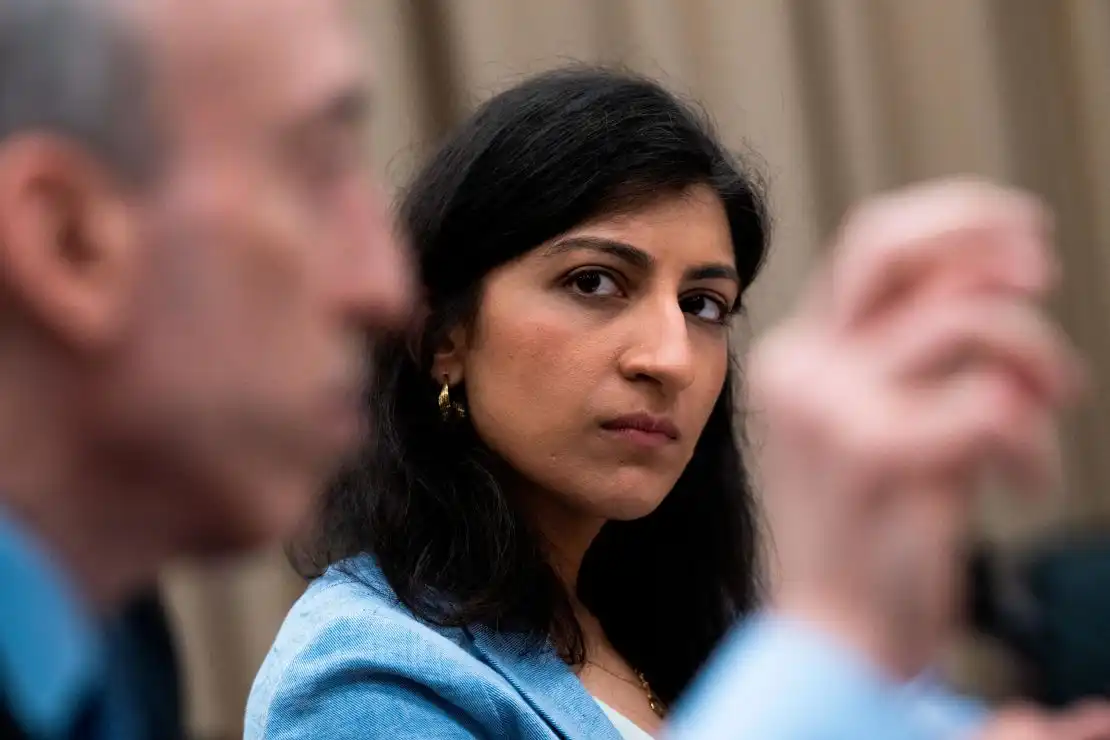
FTC Chair Lina Khan and SEC Chair Gary Gensler testify at a House hearing, image source from CNN
In the cryptocurrency space that has seen renewed attention from Marc Andreessen's A16Z and Peter Thiel's Founders Fund, hostility from the SEC has become a major headache. From 2020 to 2022, the SEC has successively sued Ripple, Coinbase, BlockFi, Kraken, and many other crypto companies for unregistered securities offerings, demanding settlement amounts ranging from $30 million to $1 billion. In the Binance case, this amount surged to a staggering $4.3 billion. After the FTX rug-pull in November 2022, Gensler viewed it as a case of setting an example, leveling multiple charges against SBF, which the media dubbed the "Salami Witch Trial."
Around 2023, the SEC once again shifted its regulatory focus to crypto staking services. In March, it sent a Wells Notice to Coinbase link, and in June, in a lawsuit, stated that Coinbase's staking service was unregistered and constituted a security. In the same month, the SEC sued Ethereum staking protocols Lido and Rocket Pool for the same reason. This year, the SEC's hostility towards cryptocurrency has become increasingly apparent. Between April and May, it sent Wells Notices to three crypto and crypto-related companies: Uniswap, ConsenSys, and Robinhood. A16Z founding partner Ben Horowitz referred to this as a "nuclear bomb" on the industry.
Additionally, the Biden administration seems to have initiated a cross-agency coordination plan known to the industry as "Operation Chokepoint 2.0" to obstruct the flow of funds between banks and crypto companies.
Between December 2022 and January 2023, crypto-friendly banks including Signature, Silvergate, Custodia, and Metropolitan Commercial successively reduced or shut down their crypto-related businesses. They were rejected by the Federal Reserve on grounds of "safety and soundness" when applying to join the Federal Reserve System. The National Economic Council (NEC) issued a policy statement strongly advising banks not to engage in direct transactions with crypto assets or maintain exposure to crypto holders.
In March, Silicon Valley Bank (SVB) collapsed, triggering bankruptcies and liquidations of multiple banks, notably affecting crypto-friendly banks like Signature and Silvergate. According to Barron's report, around 20% of Signature's deposits came from crypto companies. Following the bank's collapse, crypto businesses will struggle to find alternative liquidity providers, posing significant challenges to the industry's cash flows. Former Signature Bank board member Barney Frank publicly stated that Signature's seizure was because regulators "want to send a very strong anti-crypto message."
Shortly after, the SEC released SAB121 (Staff Accounting Bulletin No. 121), which required entities conducting cryptocurrency custody activities to reflect asset value fluctuations on their balance sheets. This meant that if the price of Bitcoin dropped, the bank would be liable for users' losses, forcing banks to steer clear of cryptocurrency custody business. In April of this year, the anti-SAB121 bill was passed in both the Senate and the House with bipartisan support, only to be vetoed by Biden in the end.
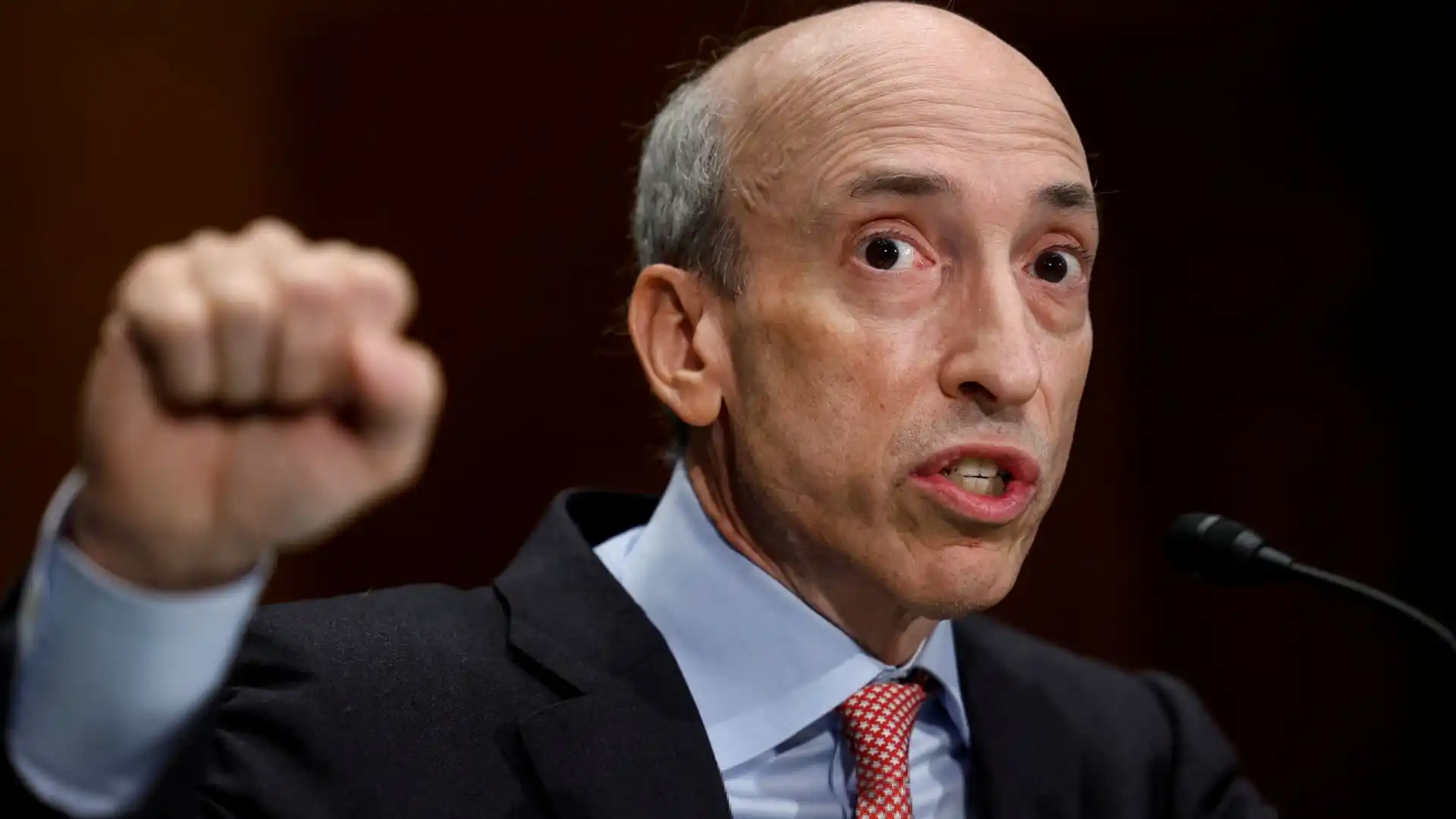
Gary Gensler testifying before the U.S. Senate committee, image source CNBC
In February last year, following the SEC's adjustments to regulatory rules concerning investment advisor protection, A16Z criticized the new rules in an open letter, stating that the regulations would prevent RIAs (registered investment advisors) from holding and trading cryptocurrency for clients. Ben Horowitz recently stated in a podcast that over the past two years, more than 30 companies in A16Z's portfolio received Wells Notices from the SEC, with one fintech startup unexpectedly being sued by the FDIC after the pandemic, refusing to disclose reasons to the team and A16Z, "I have never seen this in my career; startups simply don't have the money to fight the government," Horowitz said in the podcast.
From the $2 trillion infrastructure plan to establishing 31 state innovation centers, and even to antitrust competition laws, each of Biden's initiatives seems grandiose, but they severely clash with the interests of his "campaign donors" in practice. In some instances of government action with "hidden agendas," they have even formed personal vendettas with Silicon Valley giants. At a White House meeting for business leaders in 2022, Biden did not invite Musk to attend and referred to GM, producing 26 electric cars a year, as the "leader in the new energy field," thus sparking a personal feud with Musk. According to Puck's report, in April of this year, Musk, along with Thiel, Sacks, and other prominent investors, held an "anti-Biden" dinner party in Hollywood, where attendees discussed fundraising and methods to oppose the Democratic Party.
The growing hostility between Silicon Valley and the Biden administration was evident during this year's Silicon Valley trip, as Biden received a much less enthusiastic welcome. From any angle, his big government gamble seems to have failed.
From SBF to A16Z, the Tide Turns Starting with Cryptocurrency
Last month, Trump held a fundraiser at the San Francisco mansion of Peter Thiel's friend David Sacks in the affluent area, where he portrayed himself as the "Crypto President," vehemently criticizing the Democratic Party's regulatory hostility towards the industry and stating that he would stop Gary Gensler's crackdown on the crypto industry "within one hour of taking office." During the event, Sacks and the Winklevoss brothers discussed their own cryptocurrency investments with Trump, and ultimately, Trump raised $12 million from this fundraiser.
Trump has not been a fan of cryptocurrency, at least not until 2023. He has always emphasized the threat Bitcoin poses to the dollar, tweeting as president in 2019 stating that he didn't like Bitcoin's "air value" and post-presidency in 2021 telling the media that Bitcoin "could be a disaster waiting to happen." However, at the Bitcoin conference over the weekend, he claimed that the threat to the dollar is no longer Bitcoin but central banks. From a "Dollar Warrior" to a "Bitcoin President," Trump's political stance shift took only 2 years.
Now, Trump is fully embracing cryptocurrency and frequently catering to this community, a move that has rallied not only his own campaign team but also much of the Republican Party. At the recent 2024 Bitcoin Nashville Conference, several Republican senators, in addition to Trump, delivered speeches in support of the crypto industry. Clearly, the Republican Party is aligning donations and votes from the crypto community by promising a more permissive regulatory environment.
This strategy has already shown some success. Following Trump's public embrace of pro-crypto policies, he immediately received support from A16Z, where the two founding partners mentioned a fresh face at the SEC and FTC under Trump's administration. Even SBF, with a deep blue background, joined the fray. Earlier this year, SBF, who was still in prison at the time, publicly stated that he might "switch to the Republican Party." Back in 2022, he redirected over $80 million in assets from the FTX platform for election donations, making him the second-largest donor to the Democratic Party at the time. When the election dust settled, one-third of Congress members had received funds tied to FTX.
For much of its history, Bitcoin and cryptocurrency have been bipartisan topics as neither the Republican nor Democratic Party understood or cared about this fringe group. However, it is now emerging as a growing political force, influencing the stances of both parties during campaigns. Many interpret politicians' favorable gestures towards cryptocurrency as a fundraising strategy, with renowned investor Mark Cuban even calling it a "Bitcoin game" that has propelled prices upward through Silicon Valley's embrace of Trump.
But for Trump, obtaining campaign funds may be just one side of the coin. He astutely recognizes that cryptocurrency is a "wedge issue" between Silicon Valley, the crypto industry, the liberal community, and the Democratic Party, helping him unite his voter base on multiple fronts and open up new campaign avenues.
Kingmakers Want a "Bitcoin Government"
"I and Anderson are back," A16Z founding partner Ben Horowitz wrote in a blog post last December. From 2014 to 2016, A16Z faded from Washington's view, embarking on what Marc Andreessen called a "spiritual hike" of political reflection. Nearly a decade later, the two decided to end this spiritual journey and return to the world of political fundraising. Horowitz wrote, "We believe in the critical importance of advancing technology for the future of humanity, so we will engage in politics for the first time by supporting candidates who align with our technological vision and values."
The content of this blog post echoes Marc Andreessen's comments two months earlier, where he published an article in October titled "The Techno-Optimist Manifesto," criticizing government regulation as the Democratic Party's radical "anti-technology, anti-life" E.S.G. and D.E.I. cultural restrictions, sparking strong reactions in Silicon Valley. This manifesto serves as Andreessen's political litmus test, as he will support all vision-aligned politicians and oppose those who diverge from it.
In the crypto space, when it comes to sheer influence, it has to be Marc Andreessen. After investing over $7 billion in the crypto space, A16Z has become Silicon Valley's largest "crypto bull." Following the launch of Ethereum in 2014, A16Z shifted its focus from traditional investments and launched dedicated crypto funds. The fundraising amount leaped from $300 million in the first fund to $4.5 billion in the third fund, with the first fund generating returns exceeding tenfold, marking it as A16Z's best-performing fund in history.
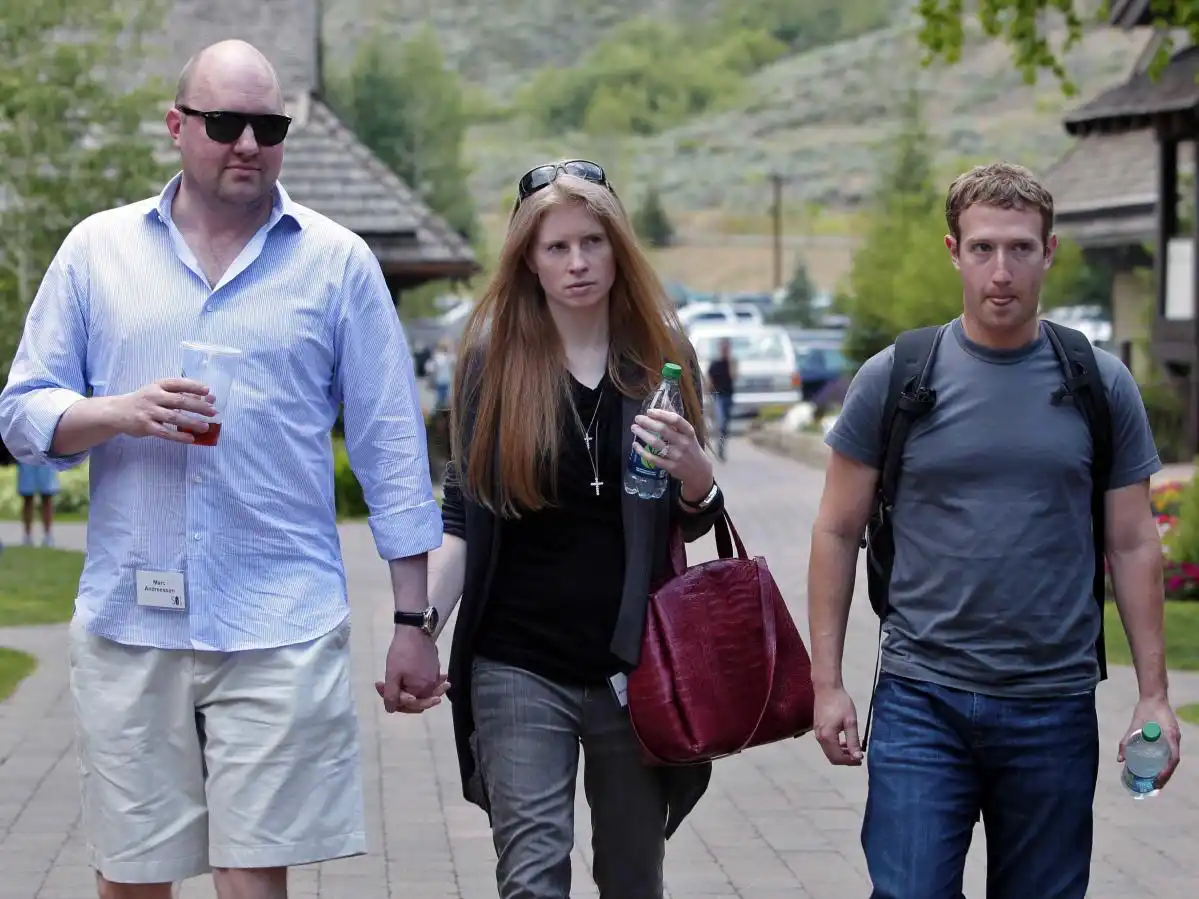
2015 Marc Andreessen and his girlfriend meeting with Mark Zuckerberg, image source from Yahoo Finance
However, during a market downturn, A16Z saw billions of dollars in paper gains wiped out, with the fund's value plummeting by around 40% in six months. On one hand, companies in its portfolio like Ripple, Coinbase, and Uniswap faced legal challenges, while on the other hand, regulatory slowdown significantly hampered crypto investments (the third fund did not deploy cash, a historical first). A16Z also tried to engage with the SEC under Gensler, but after more than ten attempts, Gensler still refused to meet. Similar situations unfolded for Bitcoin mining companies, where Marathon Digital repeatedly attempted to engage with the Biden administration, but their requests were never accepted.
The inability to make progress with regulatory bodies and the lack of effective communication with government authorities left A16Z and other crypto investors and companies extremely frustrated. It was in this scenario that Trump emerged with his pro-crypto policies. Initially, he voiced support for U.S. miners at a Bitcoin Miners President's Roundtable and later took a broader pro-crypto stance, stating his intention to halt the Biden administration's crackdown and shape the future of cryptocurrency in America.
Less regulation has always been a political goal pursued by the crypto industry, so Trump's friendly attitude quickly gained support, particularly highlighted after Kamala Harris became the Democratic vice-presidential nominee. Many feared that if Harris were to win in November, she would continue to advance Biden's stringent financial regulation agenda, posing a significant problem for Wall Street and cryptocurrency. Backed by Democratic Senator Elizabeth Warren, Harris, known for her tough stance against banks during her time as California Attorney General, is often seen as "even more left than Biden."
Just like Mark Anderson, who has recently finished his "spiritual hike" and his close friend Peter Thiel, became an openly right-wing figure in Silicon Valley, attending various conservative podcasts and befriending anti D.E.I. and populist figures. And his A16Z also learned an important lesson from SBF that if you want your startup to survive, you must attract all of Washington's attention. So long before Trump appeared, this top Silicon Valley venture capital firm had already taken action.
Earlier this year, Anderson and Horowitz quietly held a fundraising event for Republican Congressman Thomas Earl Emmer at the A16Z Menlo Park office, followed by another major fundraising event with top crypto investment firm Paradigm for Republican Senator Cynthia Lummis of Wyoming. OpenSecrets data shows that Anderson and Horowitz rank seventh in this election's donor list, and this ranking will continue to rise after the two make new donation commitments.
Of course, Anderson's "political awakening" is unlikely to end with personal donations and fundraising events. Shortly after publishing the "Tech Optimist Manifesto," he and Horowitz announced the establishment of Fairshake. This super PAC focused on the crypto space aims to "make America the home of innovators building the next generation internet," and in recent months, it has frequently appeared in political donation news.
According to the Federal Election Commission (FEC) filings, Fairshake has currently raised $200 million, spent over $83 million, and still has $120 million in cash, making Fairshake surpass the MAGA super PAC to become the third-ranked PAC in the United States. Looking at the donor list, A16Z and its portfolio are the main sources of funding for Fairshake, including A16Z's own $47 million, Ripple's $50 million, and Coinbase's $23.5 million. In addition, mainstream crypto platforms such as Circle, Kraken, Tether, the Winklevoss brothers' Gemini, as well as top-tier crypto funds like Jump Crypto, Electric, Multicoin, and Paradigm, are all involved, forming a powerful "crypto alliance."
While many donors tend to support the Republican Party, Fairshake's strategy is to focus on areas strongly leaning toward a single party and support pro-crypto candidates in primaries, regardless of their party affiliation, so that the primary winners have a better chance in the general election. This is fundamentally similar to the strategy used by the GMI PAC funded by SBF during 2022, with GMI's strategist at the time, Michael Carcaise, currently serving in the same role at Fairshake. According to Public Citizen's data, in the six primaries Fairshake intervened in this year, only one candidate failed, boasting an over 80% success rate.
Unlike traditional PACs, super PACs do not allow direct donations to campaign activities, but by purchasing ads supporting or opposing candidates, Fairshake can exponentially expand its influence on election outcomes. In several elections this year, this has become a nightmare for anti-crypto politicians.
In March this year, Democratic progressive star Katie Porter raised over $30 million in campaign funds and had a significant chance of winning a Senate seat in California. However, Porter followed Elizabeth Warren's political stance and played a crucial role in the Harris banking feud, thus being identified by Fairshake as a potential "anti-crypto ally" of Warren, as reported by Yahoo Finance.
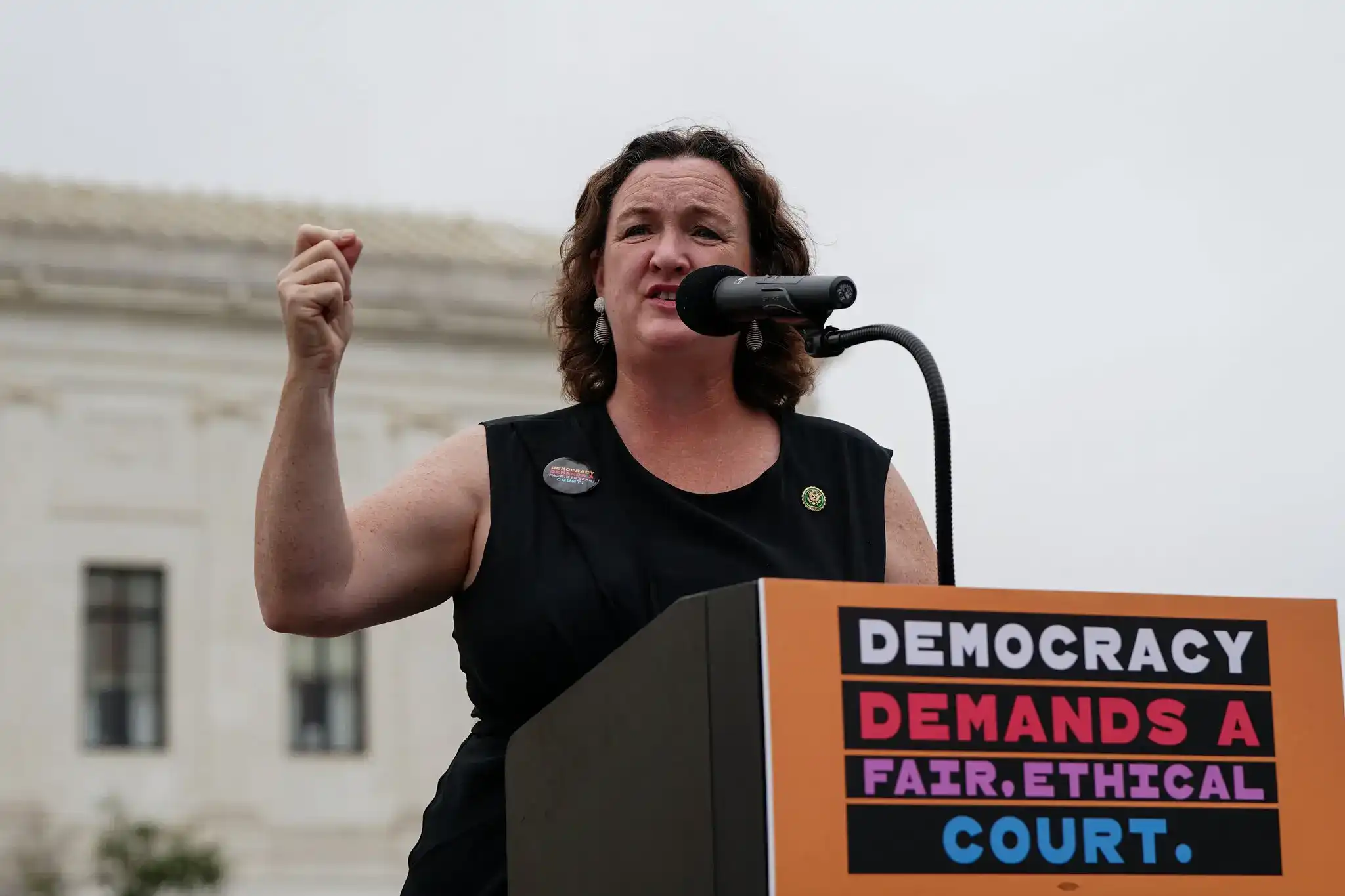
Katie Porter giving a campaign speech, image source from CNBC
During the California primaries, Fairshake invested over $10 million to undermine Porter's young voter base. Sharp comments about Porter were plastered across Hollywood billboards and on trucks on the Walk of Fame, promoting misleading claims about her supporting bills favorable to big corporations. In the end, about a third of Porter's campaign funds were countered by Fairshake, leading her to fall behind her Democratic colleague Adam Schiff and miss out on the fall general election.
When assessing a candidate's stance on crypto, FIT21 and anti-SAB121 have become primary litmus tests. Democratic Congressman Jamaal Bowman from New York's Westchester County district was targeted by Fairshake with $2.1 million in negative ads and ultimately lost the election due to his two votes against SAB121. In another contrasting example, in Alabama, Shomari Figures, in a close fundraising race with other candidates, secured a primary victory because of an additional $2.4 million in ads funded by Fairshake.
Crypto supporters understand that the likelihood of ousting the "public enemy number one" Warren is slim, but taking cues from defeats of Bowman and others, the crypto industry can apply pressure to other anti-crypto politicians. Fairshake's message is clear: if you advocate for crypto regulation, we will not only make you lose funding but also lose voters.
Cryptocurrency has become the barbarian at the gates of Washington, with Fairshake seen as one of the biggest money powers in this round of presidential elections, marking "the rapid rise of money politics." Their spokesperson Josh Vlasto recently stated that Fairshake has enough resources to sway campaigns at all levels and shape institutions. Indeed, this barbarian has breached the gates, now boasting not just a crypto-friendly Vice President but also a cohort of other political figures.
Left to Right? The Crypto-Obscurantist Extinction Saga
After rejecting Donald Trump's donation request last September, Peter Thiel's stance took a turn upon learning of Vance's entry into the vice presidential shortlist. According to Axios's report, Thiel, Musk, Sachs, and others were still lobbying for Vance until the day before Trump announced his VP pick. The bestselling author's ties to Silicon Valley run deep, with his venture capital firm, Narya Capital, not only backed by Peter Thiel but also receiving support from Marc Andreessen and former Google CEO Eric Schmidt.
Vance's positioning on the political stage aligns more with the ideology of Silicon Valley right-wingers, a stance he held even before becoming the VP nominee. Vance's 2021 cryptocurrency statement clearly addresses an issue of great concern to right-wing tech libertarians. Following FDIC Chairman Martin Gruenberg's sexual harassment scandal, Vance was quick to attack him and push for legislation to weaken the FDIC's regulatory powers over banks.
Now, from Trump to Vance and on to Congress, the entire Republican Party seems to be under the influence of this "ideological extension." Polling data indicates that currently 28% of Republicans hold or have bought cryptocurrency, with 60% of Republicans favoring clear congressional crypto regulations. In May of this year, Congress passed the FIT21 Pro-Crypto Bill, also led and promoted by Republicans.
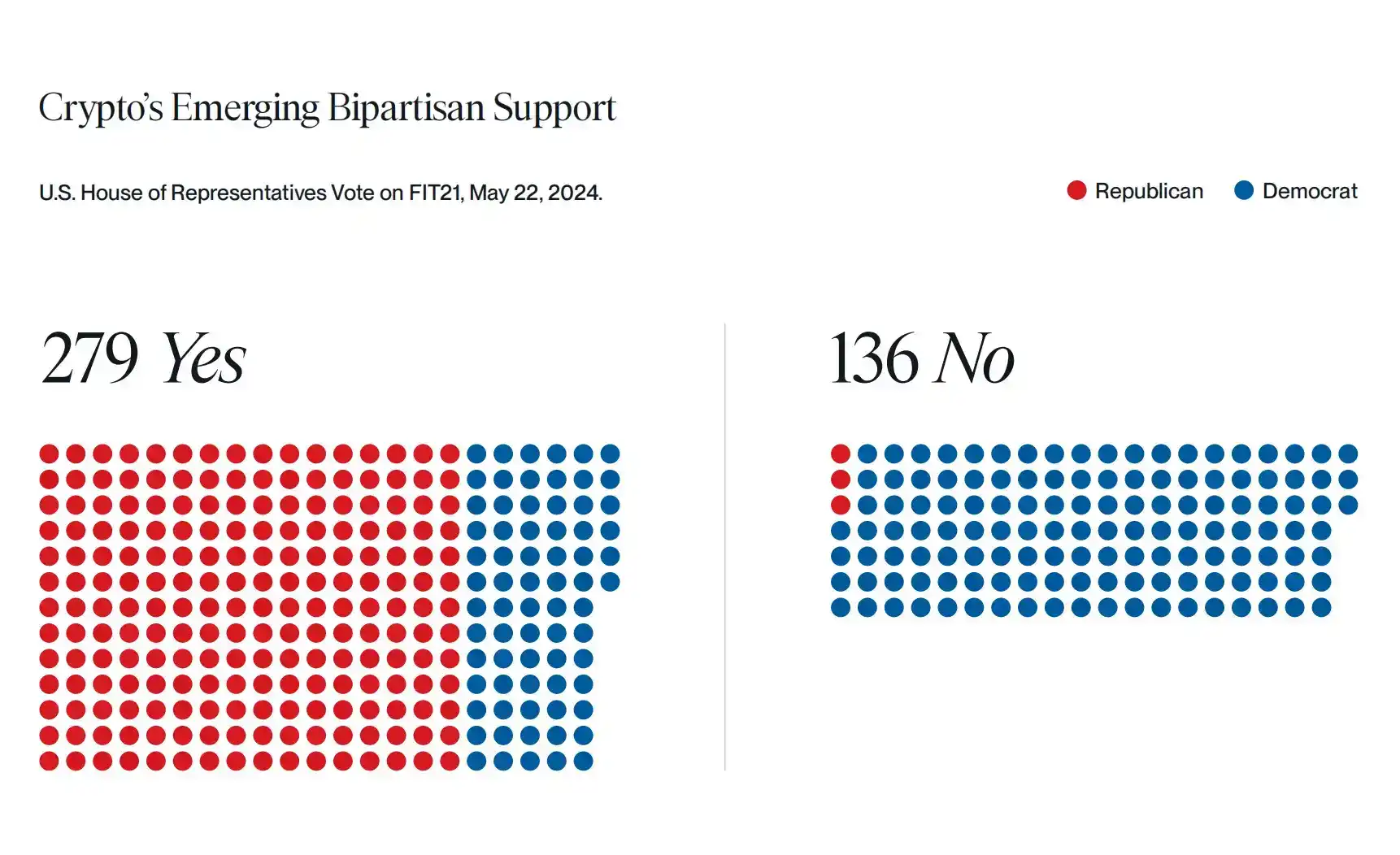
Of course, a high-profile pro-crypto stance is by no means just about "making money"; the marriage between the crypto industry and the Republican Party also has ideological factors.
In November 2023, Trump hosted a luxurious banquet at his Mar-a-Lago estate for VIP holders of the Trump Card, where anyone who had purchased at least 47 digital cards could buy a ticket. The Trump Card is a series of NFT digital trading cards issued by CIC Digital, featuring various Trump portraits such as Superman and a cowboy, with each card priced at $99. The NFT was launched at the end of 2022 amid the tail end of a market frenzy, so its price surge quickly fizzled out.
However, this did not dampen the enthusiasm of Trump's fans for their pilgrimage; they traveled thousands of miles to Florida to see their idol president. Trump unexpectedly found that an NFT card, which was originally just another branding experiment, effectively brought together a "crypto MAGA" community where young people were knowledgeable about technologies like NFTs and deeply identified with MAGA culture.
At the VIP dinner in May this year, Trump's friendly attitude towards the American crypto industry received a warm welcome from a large number of populist supporters. David Bailey, CEO of Bitcoin Magazine, was also very surprised by this. He recently revealed in a podcast that he has been providing professional advice in the crypto field to the Trump team for the past few months but did not expect such a strong response.
The Trump team immediately captured this voter sentiment and began their own political reformation project. At the end of May, at the Libertarian Party's national convention, the team's assessment was validated. Trump's speech was repeatedly interrupted by boos and jeers, but when he made a commitment to pardon Ross Ulbricht (Bitcoin's Silk Road developer), the atmosphere in the hall instantly reversed, leading to uninterrupted cheers and applause. Soon after the convention ended, Trump thoroughly completed his political pivot.
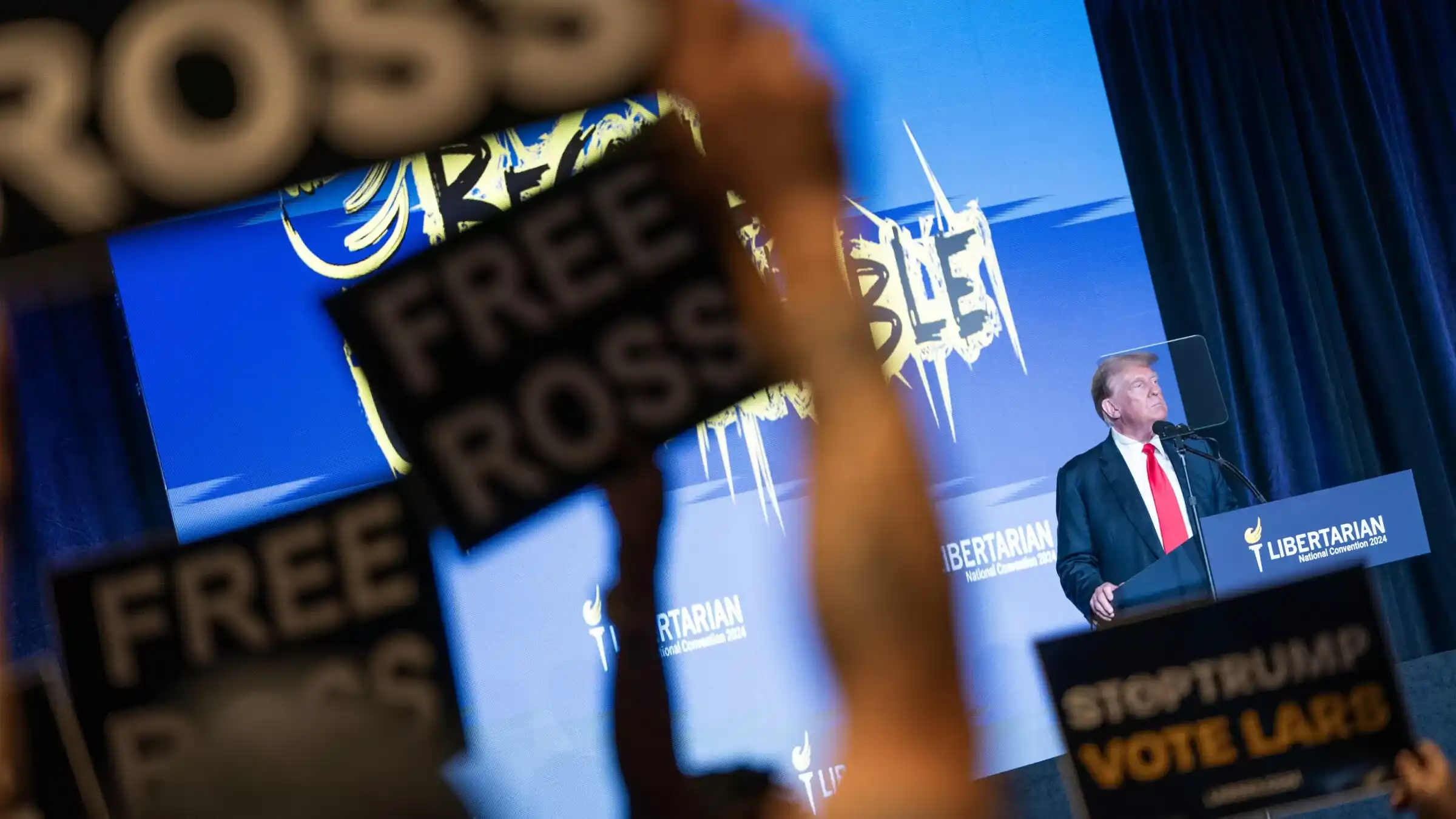
Trump at the Libertarian Party National Convention, image source from Reason
In the 2016 book "The Politics of Bitcoin: Software as Right-Wing Extremism," author David Golumbia points out that supporters of Bitcoin and blockchain identify with a form of "networked libertarianism" that is heavily reliant on far-right political thought. Golumbia had previously explained in several papers the origins of this political ideology: on one hand, the widespread adoption of Bitcoin by libertarian and anti-state political groups following the "PayPal blocks WikiLeaks" incident, and on the other hand, the promotion of anti-central bank ideas by openly extremist right-wing groups in the United States.
This "techno-right" phenomenon can be traced back to the early days of the internet in the early 2000s. In 2007, during his presidential campaign, Ron Paul found that in addition to the militia groups (Paul's voter base), a large number of internet geeks also strongly identified with his ideology, which includes free-market economics, a return to the gold standard, distrust of the central bank, and personal freedom and privacy. Clearly, these ideologies also align closely with the beliefs of the Bitcoin holder community (outside of Bitcoin itself).
After the birth of Ethereum and the rise of the ICO frenzy, the liberal element of the cryptocurrency community saw a significant increase. However, a 2018 study by Coindesk revealed that the proportion of left-leaning and right-leaning individuals in the crypto community was 45% and 52%, respectively, with the right-wing still dominating (Ethereum community had a 55% left-leaning proportion). Following the narrative explosion of DeFi, NFTs, and other trends in 2021, the ideological stance of cryptocurrency has gradually been diluted due to the internationalization of the industry. Nevertheless, the crypto community, especially in the United States, has consistently shown ideological overlap with the right-wing of the Republican Party.
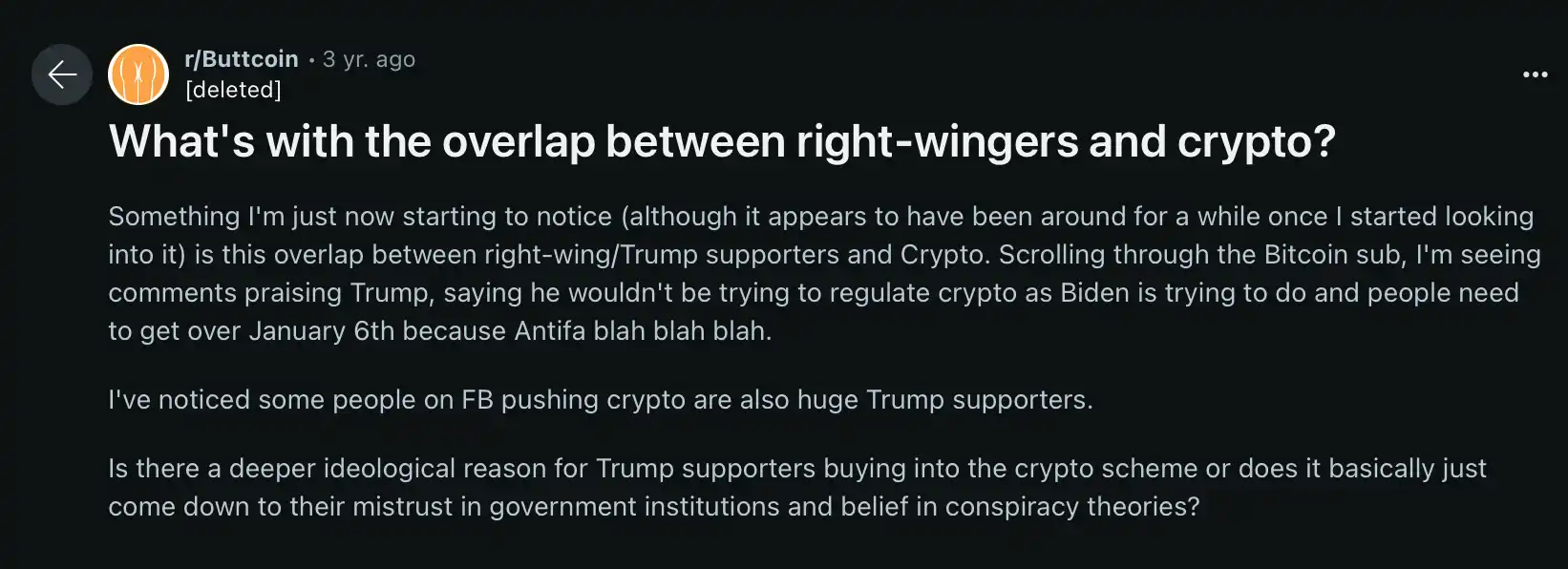
This potential political inclination was noticed by Trump, who leveraged the ideological overlap to seamlessly integrate liberalism, populism, and Trumpism into his pro-crypto policies.
In the new Republican Party platform, liberalist ideas are manifested in terms of anti-regulation, with Trump advocating for the protection of citizens' rights to transfer and trade assets freely, and the prohibition of central bank digital currencies (CBDCs) representing central bank power. Populism is mainly reflected in emphasizing the innovation and development of the cryptocurrency and mining industries in the United States, promoting the revival of the energy industry, and bringing more crypto job opportunities back to the U.S.
This policy framework has received strong endorsement from figures like Marc Andreessen, with Peter Thiel particularly impressed by the subtle detail of placing cryptocurrency ahead of AI. In a debate with LinkedIn co-founder Reid Hoffman in 2018, Thiel stated, "Cryptocurrency is libertarian, while AI is communist."
The sudden resurgence of the right-leaning wave has even stirred up a storm of discourse in the industry. For example, long-time Trump supporter and Messari CEO Ryan Selkis stirred controversy in a debate on X, suggesting that he hoped to "send all U.S. immigrants back to their home countries." Shortly after the incident, Ethereum co-founder Vitalik Buterin posted urging the cryptocurrency industry not to blindly vote for politically motivated pro-crypto politicians and to try to maintain neutrality in terms of ideology.
However, this is almost impossible. In addition to being entangled in political agendas, the influence of Silicon Valley Kingmakers on the cryptocurrency ideology is also beyond imagination. The narratives and explorations in the cryptocurrency field in the past one or two years, especially those related to concepts such as Network State, Longevity, and DeSci in the Ethereum ecosystem, can almost all be traced back to Peter Thiel, embodying his imagination and pursuit of the future.
Around 2010, Peter Thiel began exploring the concept of Seasteading, which is the idea of creating autonomous micro-nations on international waters. Thiel believed this was a realistic path to liberalism in a short period. For this purpose, he provided substantial funding to establish the Seasteading Institute, stating that "the question of feasibility is irrelevant because it is absolutely necessary." However, due to slow progress after six years of exploration, Thiel eventually cut off funding to the Seasteading Institute in 2015, and this concept evolved into Network States, migrating to the cryptocurrency field to continue exploration.
Longevity is also a research area that Thiel believes has long been neglected. Extending life and stopping the footsteps of death has always been Thiel's grand vision. He believes that most people passively accept aging, but he does not want that for himself. He plans to live to at least 120 years old and takes daily doses of human growth hormone for this purpose. He has donated over $6 million to multiple longevity research foundations and has signed a "cryogenic agreement" with the low-temperature technology company Alcor, where his body will be immediately frozen upon death. Additionally, in his reflection on the slowdown of technological advancement, Thiel believes that the corruption of science today is the fundamental reason, and these ideas have promoted exploration in the cryptocurrency industry in the fields of Longevity and DeSci.
Recently, Thiel once again co-invested with Vitalik in the political prediction platform Polymarket. Despite facing regulatory pressure, this cryptocurrency prediction platform has become a more respected political forecasting tool in this year's election than polling data. Within the industry, it is seen as the first truly killer application of the crypto industry. However, in Thiel's eyes, Polymarket's value proposition may be roughly similar to Palantir's, creating an overflow effect by providing more reliable predictions based on public sentiment output that is more accurate than polling. When economic interests are added to the equation, people's behavior often becomes more genuine. Today's on-chain world is already filled with such data, but they are as ignored as the cookies thrown in the corner by Google in the early 2000s.
Likewise, as Silicon Valley's most well-known "media investment company," A16Z also has a strong ideological influence on its crypto investment portfolio. In a March article titled "Money, Power, Politics, and the Next Battle of the Internet," Marc Andreessen, Horowitz, and Senior Partner Chris Dixon discussed the political issues of cryptocurrency.
From A16Z's perspective, Bitcoin is a political movement, and "Web3" (a concept proposed by A16Z) is a tech movement that has evolved from a political movement. As more resources and time of the younger generation shift to the internet, cryptocurrency will become a solution for internet politics and governance structures. This viewpoint is evidenced in its recent investment of hundreds of millions of dollars in the decentralized social network Farcaster.
Cryptocurrency, sandwiched between Silicon Valley and Washington, is inevitably politicized, where people's investments are not only in language and emotion but also in their own economic interests. When a technology can directly impact ideology through economics, or when ideology influences the economy, its impact on society, in terms of depth and breadth, will be unprecedented.
Perhaps cryptocurrency will replace social media and become the ultimate technological platform for the next generation of ideological confrontation.
Reference:
《The Contrarian: Peter Thiel and Silicon Valley's Pursuit of Power》
《Peter Thiel helped build big tech. Now he wants to tear it all down.》
《Peter Thiel is taking a break from democracy》
《The Republicans Have a Peter Thiel Problem》
《The Black Box of Peter Thiel's Beliefs》
《Some of Silicon Valley's Most Prominent Investors Are Turning Against Biden》
《Why the Biden Administration Is Suing Apple and Investigating Big Grocers》
《Marc Andreessen Eats Washington》
《Bitcoin as Politics: Distributed Right-Wing Extremism》
Welcome to join the official BlockBeats community:
Telegram Subscription Group: https://t.me/theblockbeats
Telegram Discussion Group: https://t.me/BlockBeats_App
Official Twitter Account: https://twitter.com/BlockBeatsAsia