DePIN: The superposition of double curves builds a decentralized value network
Original title: "DePIN - The superposition of double curves to build a decentralized value network"
Original author: Evan, Waterdrip Capital
Introduction
DePIN is gradually realizing large-scale interaction between the physical world and Web3, and gradually subverting the operation mode of traditional infrastructure. Through the combination of sensors, wireless networks, computing resources and AI with blockchain technology, and using cryptoeconomic incentives to promote crowdsourcing development. Analysis of most DePIN projects shows that DePIN's business model contains an important feature: hardware revenue is used as the first growth curve, and on this basis, the realization of data services is superimposed to form a second growth curve. This is one of the key factors that DePIN can lead the current cycle of growth. It also shows how DePIN-like projects can create huge wealth effects in the process of building a decentralized infrastructure network, and ultimately form a large-scale decentralized value network.
1. Build a decentralized world of the Internet of Everything
The decentralized physical infrastructure network (DePIN) is defined in the 2023 Messari report as "the deployment of real-world physical infrastructure and hardware networks using cryptoeconomic protocols." This concept foreshadows an application scenario full of imagination: the common infrastructure around us, including communication base stations, car charging piles, photovoltaic panels, billboards, and data storage and computing equipment behind the operation of the Internet, will no longer be controlled by centralized entities and institutions, but will be divided into units of the same size and held by individuals or large-scale miners. And the physical infrastructure of the same type is highly standardized and scaled, forming a carpet-like coverage.
Through a decentralized approach, the layout and utilization of infrastructure can achieve higher efficiency and lower costs, while enhancing the security and resilience of the overall system. Not only that, from energy production to data processing, all kinds of facilities have the potential to transform to a decentralized model. The total market size of the above DePIN-related industries has exceeded 5 trillion US dollars. Therefore, Messari predicts that the potential market size of the DePIN field is estimated to be about 2.2 trillion US dollars, and is expected to reach 3.5 trillion US dollars by 2028.
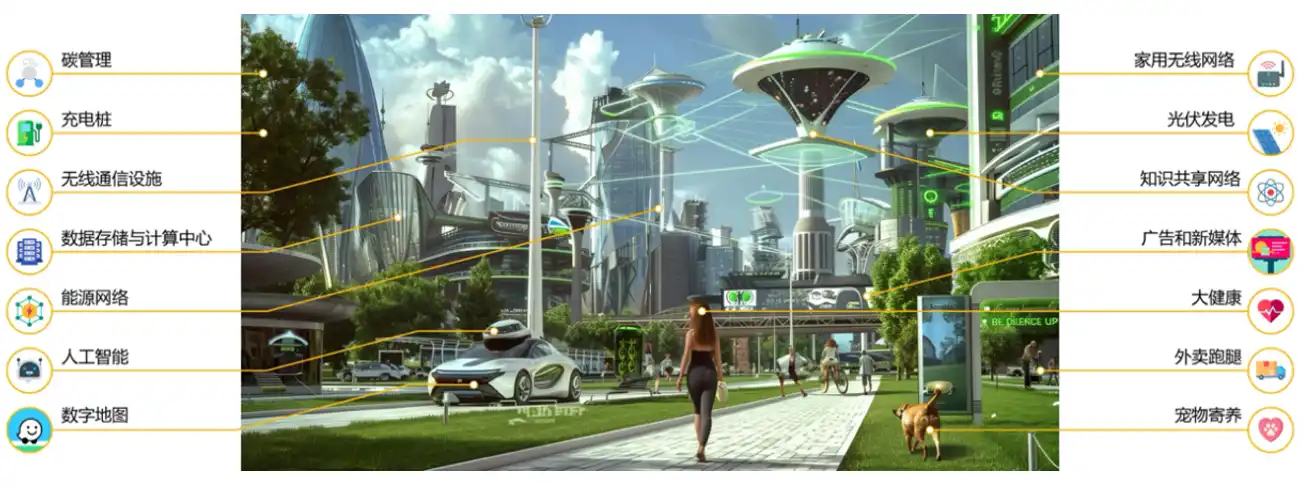
Decentralized Internet of Everything effect diagram, reference: Messari
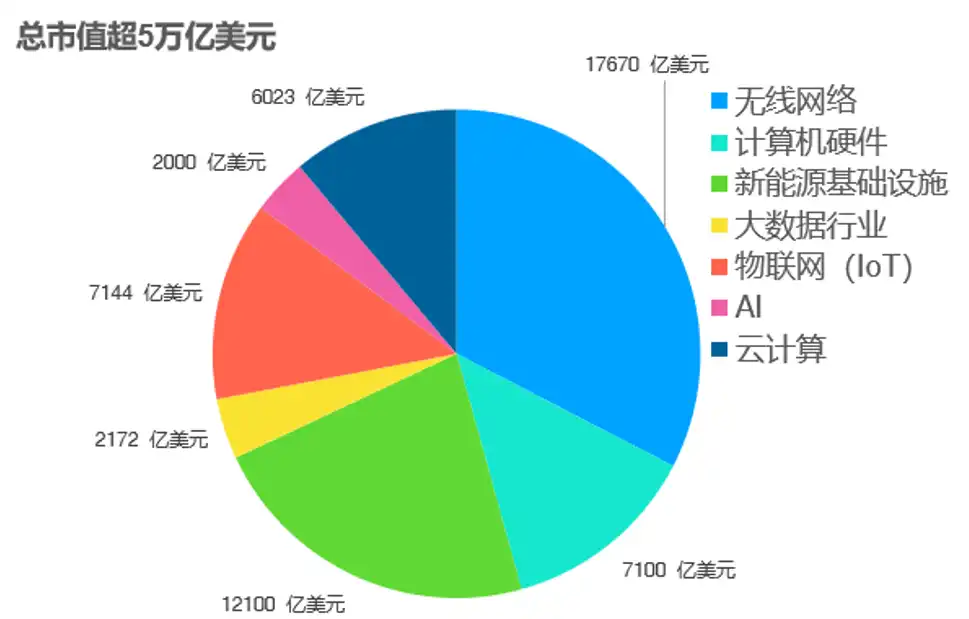
DePIN-related industry market size data, data source: Statista
1.1 DePIN track division
The DePIN track covers six sub-fields: computing, AI, wireless communications, sensors, energy and services. DePIN can be divided into the following from the perspective of the supply chain:
· Upstream: hardware manufacturers and supply-side users as "miners".
· Midstream: project platform, blockchain responsible for data verification and token settlement, and on-chain layer 2 protocol serving DePIN; as well as modular service components for developing and managing the DePIN network (such as platform interface, data analysis and standardization services), SDK toolkits developed by DePIN, API interfaces, etc.
· Downstream: dApp applications and interfaces for docking demand side. Except for IoTeX and the former Helium (now the mainnet has been migrated to Solana), most DePIN projects rarely cover every link in the DePIN business. They usually choose Solana or IoTeX as the settlement layer of the token economy. AI and cloud computing projects in the sub-field focus more on the settlement on the chain and the development and management of the project platform. The underlying hardware devices dispatch idle electronic devices such as mobile phones or computers equipped with high-performance consumer-grade GPUs through middleware.
1.2 Overview of DePIN Industry Development
According to DePIN Ninja data, the number of DePIN projects that have been launched has reached 1,215, with a total market value of approximately US$43 billion. Among them, the total market value of projects that have issued coins and are online on Coingecko's DePIN sub-section exceeds US$25 billion.
In October last year, this figure was only 5 billion US dollars. It has increased fivefold in less than a year, which shows the rapid growth of the DePIN industry. This shows that the market demand and recognition for decentralized physical infrastructure networks are constantly increasing. With the launch of more projects and the expansion of application scenarios, the DePIN industry is expected to become an important field for the combination of blockchain technology and real-world applications.
2. Inspiration from DePIN business logic
The prototype of DePIN can be traced back to the concept of IoT + Blockchain in the previous cycle. Projects such as Filecoin and Storj have transformed centralized storage into a decentralized operation mode through cryptoeconomic models, and have been put into practical use in the Web3 ecosystem, such as on-chain NFT storage and front-end and back-end resource storage of DApps.
The Internet of Things + blockchain only reflects the characteristics of decentralization ("De"), while DePIN emphasizes the construction of physical infrastructure and large-scale Internet networks. "PI" in DePIN stands for physical infrastructure, and "N" stands for network, which is the value network formed after the DePIN hardware reaches a certain coverage scale.
The most typical example is Helium. Helium was founded in 2013, and it was not until 2018 that it determined to use blockchain as an incentive for decentralized deployment of the Internet of Things. So far, Helium has almost met all the elements of DePIN: node economy, miner model, value network, crowdsourcing incentives, and is the leading project in the field of DeWi (decentralized wireless communication); in addition, at the end of last year, Helium Mobile and T-Mobile launched a $20 communication package service for traditional users. When users use the Helium network for data transmission, they can not only get token rewards, but also enjoy reliable communication services. At the same time, Helium also helped T-Mobile solve the signal coverage problem in remote areas of the United States, forming a win-win situation for all three parties. The large number of traditional users undertaken by its terminals has greatly promoted the momentum of DePIN to break the circle, and is expected to accelerate the large-scale adoption of blockchain technology and Web3 networks.
Helium and Filecoin both belong to the category of DePIN, but the difference between the two is that Helium places more emphasis on hardware, enabling it to support the growth of data services in the second curve through hardware revenue, build an independent ecosystem, and reap Alpha and Beta benefits at the same time. Although Helium was involved in false propaganda last year and faced problems such as difficulty in development due to unpopular programming languages, a series of actions at the end of the year have restarted Helium's second curve growth; and as the largest DePIN project that has come out first, it undoubtedly brings us some inspiration for the DePIN ecosystem.
3. DePIN’s explosive growth is based on the dual curve theory
The “Second Curve” is a concept in management and innovation theory, originally proposed by management scholar Charles Handy. It refers to the need to introduce new innovations or changes when an organization, product or business reaches the peak of its traditional growth curve to start a new growth curve and avoid stagnation or decline.
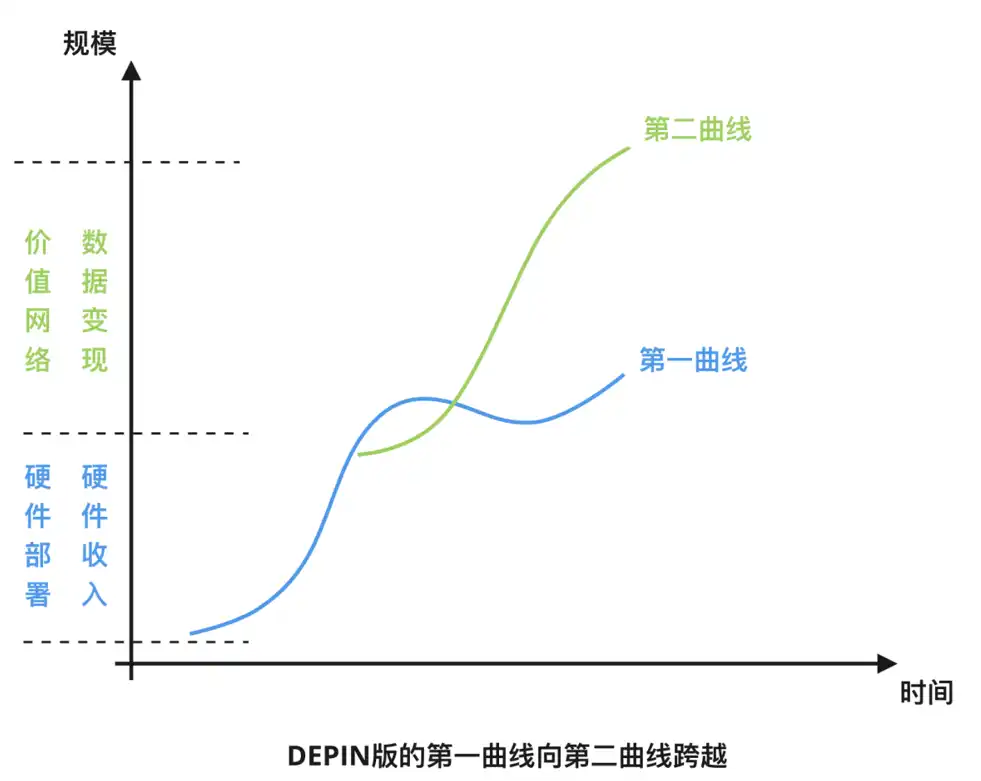
DePIN dual curve, reference: The Second Curve: Thoughts on Reinventing Society
From the previous successful DePIN project experience, it can be seen that DePIN's business logic naturally points to hardware sales as the first curve of project development, and the data value network monetization is superimposed on the first curve as the guiding ideology of the second curve of development;
Product research and development, operational capabilities are the key to ensuring the growth of the first curve; then how to start the growth of the second curve requires two capabilities, first the organizational ability of the decentralized system, and then the service ability on the demand side.
Corresponding to the DePIN ecosystem, the project party needs to ensure the good operation of the data value network on the premise of having the ability to organize a hardware network that can undertake large-scale data transmission, so that the demand side can be smoothly connected and finally provide high-quality, standardized data services. Finally, the double growth of the hyperbolic business is completed, forming a positive cycle within the project ecosystem.
3.1 Hardware value is the first curve of value creation
On the first growth curve, the business will experience rapid growth in the early stage and then gradually reach its peak. The growth momentum of the first curve of the DePIN project comes from the revenue and profit generated by the sale of hardware.
Traditional infrastructure, especially in areas such as data storage and communication services, has a linear business logic of centralized service providers or entities: the business needs to invest in infrastructure construction in the early stages, and then provide services to end users (C-end) after the facilities are complete. Therefore, the development of such businesses often requires the participation of giant companies to bear high costs in the early stages of business operations, including hardware purchases, land leasing, deployment, and the employment of maintenance personnel. Quoting BCG's deconstruction of the data value network, its traditional Internet of Things operating model has created a data value chain as shown in the left figure below. In this model, data is transmitted in an independent and linear manner as a factor of production, and each ecosystem is completely independent.
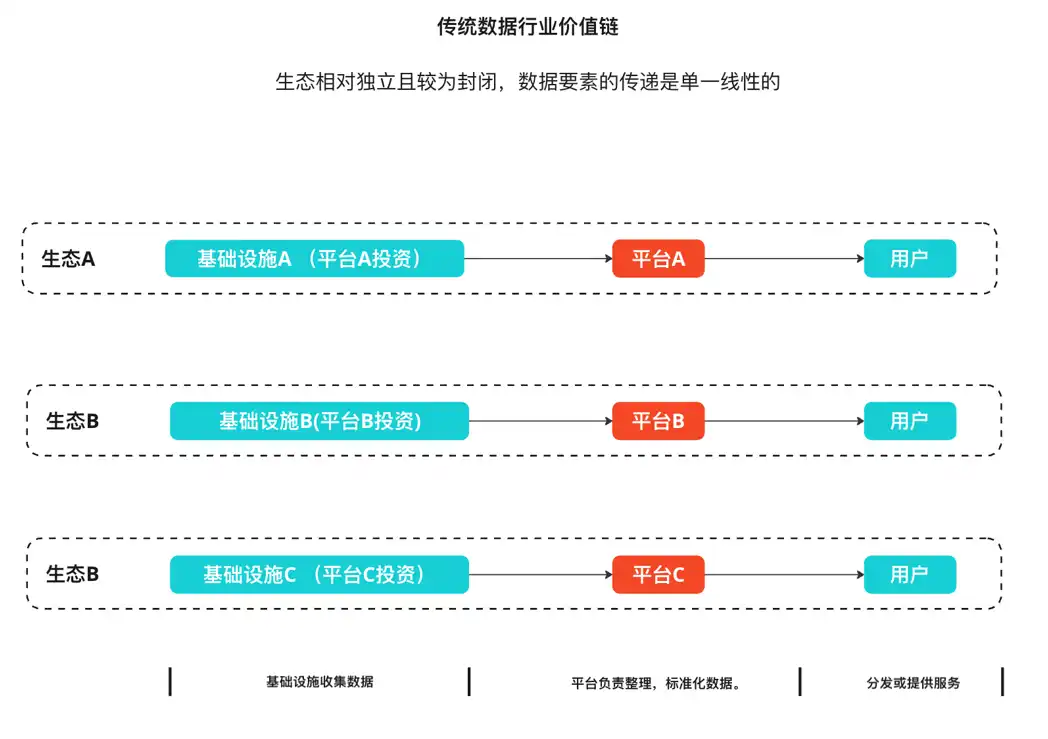
Traditional data infrastructure value chain, reference: BCG, "Data Value Network"
The DePIN project splits the centralized supply side and makes it crowdsourced to complete the establishment of the hardware network.
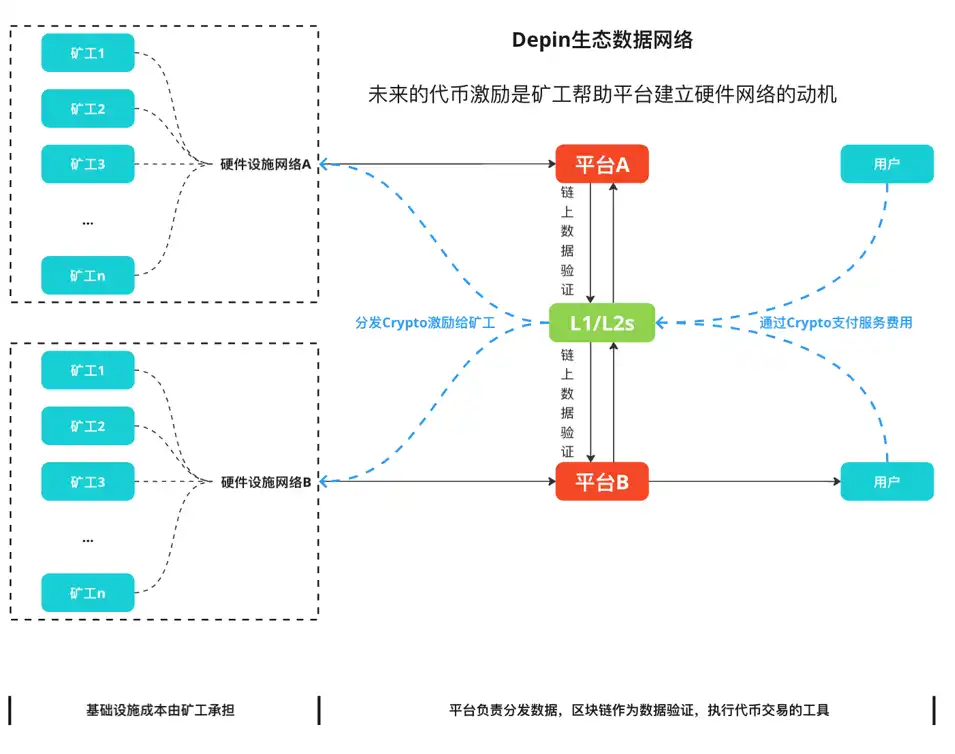
Decomposition of DePIN hardware network business model, reference: BCG, "Data Value Network"
Therefore, the first step of dismantling centralized infrastructure is the key to achieving the first curve growth of the DePIN project.
The DePIN project must first work hard to promote itself, spread its own narrative, and attract the participation of supply-side users through a series of operational means, including pre-sale of "mining machines" and purchase of airdrops; transfer the huge infrastructure investment costs to the supply-side users to achieve a low-cost lightweight start-up. Supply-side users also become "shareholders" of the project party in the form of holding hardware, and help the project party deploy the hardware network with the expectation of making money from mining in the future.
Not only that, unlike traditional centralized equipment providers, the update and maintenance of DePIN equipment is jointly completed by the project party and miners, that is, the equipment provider is only responsible for the update, research and development and sales of the equipment, and the update and maintenance are completed by the supply-side users. In the process of jointly maintaining and building the hardware network, the interaction with the project party and the middleware strengthens the community identity of the miners (supply-side users) and their sense of identity with the DePIN project.
If a DePIN project can smoothly run through the narrative marketing, mining machine sales, and community operations, then the project's first growth curve elements have been gathered, and eventually form the first curve of increasing network coverage - increasing token incentives - attracting more miners to join.
The following is the data on the number of active nodes so far. Hivemapper, Helium, and Natix rank in the top three, and all have deployed more than 100,000+ nodes around the world.
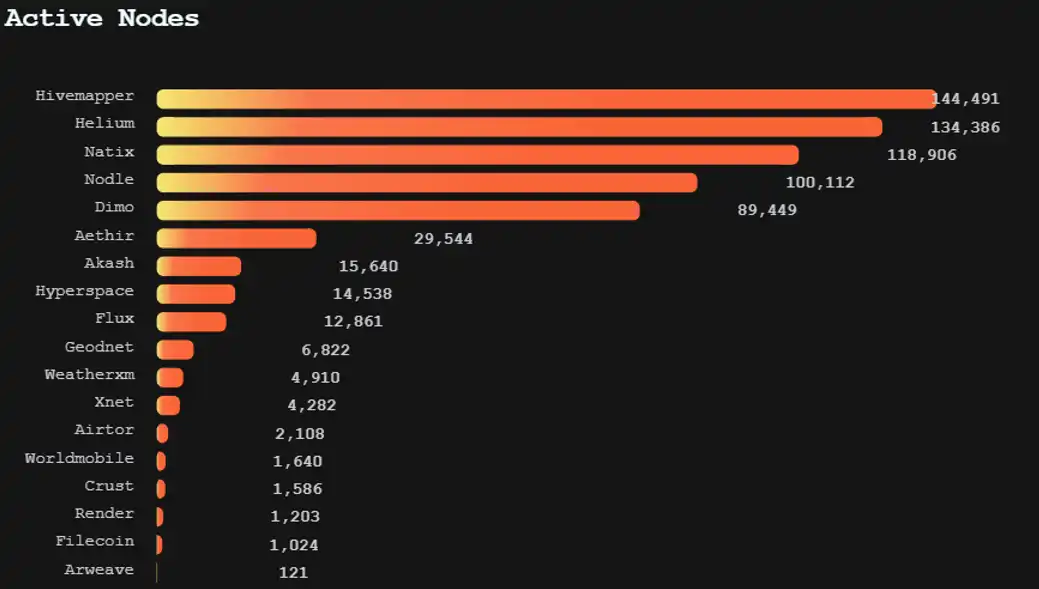
Data source: DePIN Ninja
The node deployments of Hivemapper, Helium, Natix and Nodle have exceeded 100,000, among which Helium and Hivemapper have achieved outstanding business performance:
Helium
· Helium is a decentralized wireless network whose main businesses include Helium Hotspot, which provides low power wide area network (LoRaWAN) coverage; and Helium Mobile, a mobile communication service launched in cooperation with T-Mobile and TEF.
· The $20 communication package service launched on January 25 in cooperation with T-Mobile has grown from 0 to 93,000 subscribers in 5 months.
· Partnering with Telefónica (TEF), one of the largest telecommunications service providers in Mexico, to enter the Mexican market with a population of 126.7 million further enhances Helium's revenue stream and market influence.
Hivemapper
· Hivemapper is a decentralized mapping platform that aims to create a global, real-time updated mapping ecosystem through blockchain technology and crypto-economic incentives. Hivemapper's main business includes HiveMapper Dashcam, a driving recorder that allows users to collect geographic data while driving.
· This device is priced at $549. Based on the current number of node deployments, Hivemapper's revenue from hardware sales alone has reached more than $60 million.
· So far, the map data collection network established by Hivemapper has covered most of Europe and the United States. Hivemapper's data service revenue has also increased significantly.
· In terms of hardware revenue, other projects have also taken a different approach and achieved good growth. For example, Jambo has achieved outstanding sales results in the African market with mobile phones as its selling point. OORT has technical barriers in cloud computing and edge computing, and has achieved significant hardware sales revenue through its innovative model. As a project in the GameFi track, Ordz Game cleverly integrates DePIN elements to attract a wave of popularity. Through their respective innovative models and technological advantages, these projects have successfully achieved breakthroughs in hardware revenue and explored new ways to integrate DePIN in various industries:
Jambo
· Web3 wallets are the traffic entrance for all crypto users, and Jambo intends to use DePIN+ wallets to achieve large-scale adoption of Web3 in the African market. By selling price-friendly Jambo phones and using Web3 phones as a selling point, it attracts a large number of traditional Web2 users. Through the pre-installed Web3 wallet application, users can use the one-stop wallet application to play games or watch ads and get JAMBO native token rewards. The Jambo project cooperates with some large data service providers in Africa to achieve a closed loop in business by selling the generated data to service providers.
· In the future, Jambo mobile phone will also launch a number of incentive activities such as on-chain data mining. In addition, by pre-installing dApp, users can use Jambo mobile phone to manage DePIN mobile phone. At present, Jambo mobile phone has been launched in more than 120 countries and regions, with the main market concentrated in Africa. The Jambo mobile phone, priced at US$99, is very affordable and has sold more than 400,000 units. And 1.23 million non-custodial wallet addresses have been activated.
OORT
· OORT is a decentralized verifiable cloud computing platform designed for artificial intelligence applications. It utilizes global resources from data centers to local edge devices and adopts a proprietary blockchain-based verification layer to ensure the security of all transactions and computing processes from data crowdsourcing, labeling to model training and local inference.
· OORT officially provides the Deimos DePIN device as its decentralized edge node, priced at $379. At present, more than 5,500 edge nodes have been deployed worldwide, covering most countries and regions in the Americas, Europe, and Asia. These nodes together build a powerful decentralized edge computing network, providing reliable data processing and computing capabilities for artificial intelligence applications.
Ordz Game
· As the first game platform in the Bitcoin ecosystem, Ordz Game uses the Ordinals protocol to mint each level of retro games into nfts. Players can play games to earn points, and top-ranked players will receive Games token rewards (formerly brc20 tokens ORDG) based on their points; creating "Play
to earn" to attract players to participate.
· Currently, Ordz Game has entered the fifth phase of testing, having completed four quarters of public beta testing, with a total number of login wallet addresses exceeding 260,000. In the future, a handheld version of BitBoy will be launched, priced at 0.01 BTC each. The 1,000 pre-sold handhelds with NFTs were sold out within the first few hours of the launch, and more than 2,000 regular versions have been sold. As the "mining machine" of the Ordz Game platform, BitBoy empowers the Games tokens issued by the platform, forming a flywheel effect of playing games for mining - token incentives - attracting more players - token value increase.
The above examples all show that hardware sales play a vital role in the early revenue of the DePIN project. It not only affects the initial capital flow of the project, but also determines the speed of large-scale hardware network deployment. Only on the basis of the stable development of the hardware network can the DePIN project smoothly transition to the second phase of the data value network and start the second wave of growth curve.
Except for some specific scenarios that require special data acquisition (such as Hivemapper dashcams collecting road data), most C-end data can actually be mined through personal consumer devices such as smartphones and smart watches. The supply chain of such projects is already very mature, and the project party can promote it on a large scale and reach a wider C-end market without investing a lot of R&D efforts. Due to the high profit margins of these devices, the project party is able to obtain significant initial revenue growth.
In addition, DePIN's large hardware (such as photovoltaic panel matrix) may be able to be put on the chain as RWA in the future. Combined with the mature Defi second-layer protocol on the chain, it may unlock more product innovations and financial service gameplay, and enhance the liquidity of the hardware network and the popularity of the hardware trading market.
3.2 Data value, the realization of network value is the second curve of DePIN's growth
As mentioned above, the business logic of the traditional model is relatively linear and closed. After the increment reaches the top, the only thing that can be done is to find ways to improve the user retention rate and the increasingly large new activities; in addition, if it is a traditional infrastructure provider, it also needs to bear the cost of updating and maintaining the facilities. Therefore, after reaching the incremental ceiling, it will face a large degree of decline.
After the DePIN project has accumulated a certain amount of income by selling hardware in the early stage, that is, before the growth of the first curve of equipment sales is about to reach the critical point, the second curve will be opened after the business of equipment sales in the early stage reaches the peak. The core of the growth of the second curve lies in the data value network established on the basis of the mature hardware network based on scale.
DePIN aggregates a series of value links, splits the centralized supply side, and aggregates multiple demand sides using the public chain, and finally forms a data value network under the DePIN model.
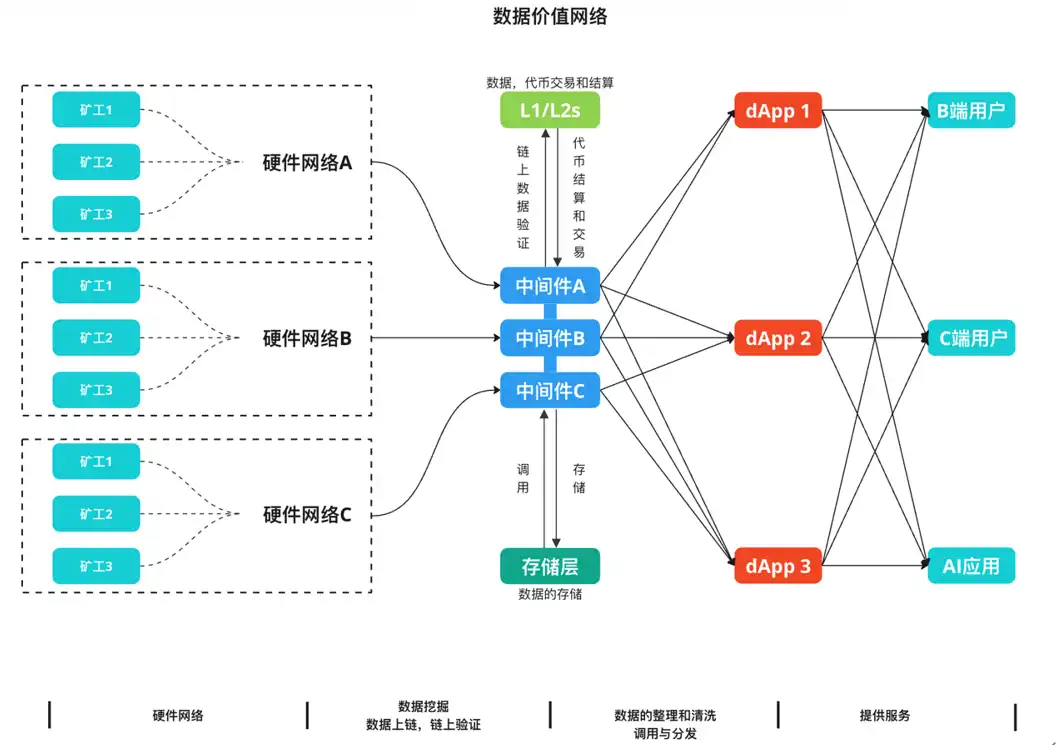
The final version of DePIN's data value network
Although the DePIN project emphasizes physical properties, its core business logic revolves around how to obtain value from data. After data verification and confirmation of ownership at the blockchain storage layer, data becomes a highly liquid transaction object and circulates in the data value network. These data not only flow between different ecological projects, but also directly or indirectly exchanged between the supply side and the demand side.
Once the data value network can maintain a positive incentive cycle - usually determined by token economics, the number of nodes, and a good match between supply and demand - the entire ecosystem will create a huge wealth effect around data.
Token economics is the economic foundation of the value network
Among them, token economics, as the economic foundation of the data value network, is the key to whether the DePIN project can run well. The two mainstream ones are BME (burn and mint equilibrium) and SFA (stake for access).
BME is a token burning mechanism. Users on the demand side will destroy the tokens after purchasing services, and the degree of deflation is determined by demand; that is, the stronger the demand, the higher the value of the token; SFA requires users on the supply side to stake tokens to become qualified miners, and the supply determines the degree of deflation, that is, the more miners provide services, the higher the value of the token.
This depends on whether the DePIN product will rely more on the demand side or the supply side. Generally speaking, middleware or platform-based DePIN projects are more inclined to use SFA. The scale and service quality of the supply side determine the upper limit of the project. For example, OORT and Helium both require users on the supply side to pledge tokens to become nodes. The demand side is that application-based DePIN projects on the C end are more suitable for using the BME model to maintain the operation of the business. Similar projects include Render Network.
BME and SFA constitute the basic core framework of the DePIN project, and the empowerment of tokens improves the token economy. For example, using points as a pre-mining commitment to miners, tokens are exchanged at a certain ratio after issuance, or an economic model of points + tokens is adopted. Endowing tokens with governance functions allows holders to participate in major network decisions, such as network upgrades, fee structures, or reallocation of funds. The staking mechanism encourages users to lock tokens and maintain the stability of token prices; project parties can also use part of their income to purchase tokens and pair them with other major cryptocurrencies or stablecoins to join the liquidity pool to ensure that the tokens have sufficient liquidity, which is convenient for users to trade without significantly affecting prices. These mechanisms help ensure that the interests of users on both the supply and demand sides are consistent with the interests of the project party in the long term, thereby achieving the long-term success of the project.
The DePIN value network will promote the improvement and growth of the AI industry
After the large-scale data network has achieved good operation and the supply side can provide stable services, a large part of the final value of the DePIN network will flow to the AI industry.
AI has become an important driving force for global economic transformation and industrial upgrading. Its development and application cannot be separated from the support of large amounts of data and computing power. Since 2012, people's demand for computing power has increased by more than 300,000 times, far exceeding the 12-fold growth of Moore's Law. There is no doubt that the explosive growth of AI has a huge impact on the demand for computing power.
In theory, decentralized computing networks such as io.net and Render Network can dispatch distributed idle computing resources to fill the huge market demand for computing resources, track and store data through blockchain technology, ensure the security of AI training, and use cryptocurrency for incentive distribution. Although this set of business processes is very convincing, the actual demand still needs further verification. In the C-end market, these decentralized computing networks will directly face fierce competition from traditional companies such as AWS, Azure, and GCP; in the B-end market, these networks can only reach small and medium-sized enterprises that do not have the ability to build their own computing networks, while large-scale enterprises prefer to use mature and stable traditional centralized cloud service providers.
On the other hand, data for training AI has been declared in short supply. According to Epoch AI's research forecast, if the current data consumption and productivity remain unchanged, humans will run out of low-quality language data between 2030 and 2050, run out of high-quality language data by 2026, and run out of visual data between 2030 and 2060.
AI requires a large amount of raw data and trusted data to support its training process, so DePIN is particularly important in this process. The large number of devices deployed by DePIN can obtain a large amount of raw data at a very low cost, and its decentralized distribution characteristics make the data more valuable and unique. Therefore, the data collected by sensors in the DePIN subfield is naturally conducive to the training of AI models.
In general, based on AI's strong demand for computing power and data, decentralized cloud computing and sensors that provide data for AI training are the two DePIN subfields that are most likely to be the first to realize the data value network.
3.3 Middleware infrastructure will play an important role in connecting the two waves of growth curves
At the beginning of the article, the supply chain perspective was analyzed to deconstruct DePIN, in which the middleware of the upstream is the key channel from the physical world to the digital world.
If the first curve is driven by hardware and the second curve is driven by data, then to smoothly cross from the first curve to the second curve requires a very critical role to connect the equipment and the miners and users on both ends of the supply and demand, that is, the middleware that provides standardized interfaces and toolkits, the public chain or second-layer chain that realizes token trading and settlement, and the second-layer protocol that enhances liquidity.
First, blockchain, as the settlement layer of DePIN project tokens, is responsible for more settlement and data verification of project tokens:
Solana
· Currently, Solana is the preferred platform for most DePIN projects, and its low latency and high performance are very suitable for the deployment of DePIN projects. For example, Helium and HiveMapper are deployed on Solana. However, the mainstream public chain was mainly used for transactions at the beginning, and the toolkit of SDK optimized for DePIN projects cannot fully meet the needs of DePIN projects.
· The DePIN project needs a specialized customized public chain with features such as data verification and openness to AI as a foundation. For example, Near Chain began to emphasize its narrative around AI, while IoTeX emphasized its public chain customized for IoT devices as early as the last cycle. This customized public chain can better meet the special needs of the DePIN project and ensure its efficient operation in data processing and device connection. Iotex also provides a series of standardized interfaces and plug-and-play open tools, so that a DePIN application involving on-chain links can be quickly deployed on the Iotex chain.
Peaq
· A chain designed specifically for DePIN. Peaq includes a series of multi-functional modular DePIN functions, including self-sovereign identity of machines/things (peaq ID), role-based access management (peaq access), peer-to-peer payment (peaq pay), and data verification (peaq verify). The Web3 machine control center (peaq control) provides a holistic way to connect any machine, device, sensor, vehicle or robot to the network. Project parties can use such modules to easily deploy DePIN applications on the Peaq chain. Peaq can also achieve seamless multi-chain interaction, allowing data from other projects to be easily migrated to the Peaq chain.
In addition, the middleware that connects devices and DePIN's network is also very critical, providing a very friendly one-stop service for developers who want to enter DePIN but do not understand the crypto economy. This is also one of the deterministic requirements for the prosperity of the DePIN ecosystem. This part of the project not only includes developer-friendly tools and one-stop services such as DePHY and Swan; there is also a re-staking protocol Parasail that specifically serves DePIN, which aims to enhance the liquidity and value utilization of the native tokens of the DePIN network.
DePHY
· DePHY provides open source hardware solutions, SDKs, and tools for the DePIN project, and significantly reduces the manufacturing and network messaging costs of hardware products bridging blockchains by synchronizing the 500ms-level off-chain network nodes running on blockchains.
· For example, Starpower, which is developed based on DePHY, has a product called Starplug, which is a smart socket that records users' electricity usage behavior and electricity consumption and gives token rewards. DePHY
opened various customizable hardware design solutions to the community, helping Starpower quickly complete the hardware design of Starplug and enter the mass production stage. In addition, DePHY also shared its hardware production resources, providing Starpower with great manufacturing convenience and cost efficiency. Starpower also uses the DID system and open source hardware solution with built-in TEE module provided by DePHY to ensure data security and immutability.
Swan Chain
· Swan Chain (formerly known as FilSwan) is a full-stack AI smart chain based on OP Stack technology, a decentralized cloud computing network dedicated to AI. Through Swan Chain, enterprises, data centers, cloud providers, and cryptocurrency mining operators contribute idle GPU resources to the network and monetize computing assets through the UBI incentive model to obtain stable income. At the same time, enterprises, developers, and AI enthusiasts can use Swan Chain's global computing resource network to build and deploy decentralized AI models and applications, which is expected to save up to 70% of computing power costs.
· Developers often encounter complexity issues when managing tokens and using various SDKs, distracting from the main functions of the product. The lack of convenient Web3 application access tools hinders the efficient creation of decentralized applications (dApps), slows down development, and limits economic potential. In response, Swan Chain provides a set of development tools that allow developers to access resources across multiple blockchains, simplify storage provider selection and data management. And by introducing a cross-chain consensus layer, it provides a comprehensive infrastructure solution to help developers use cross-chain tools to seamlessly access Web3 resources on multiple blockchain networks. These tools include payment channels and Web3 infrastructure, which simplifies the development process.
· In addition, Swan Chain supports the use of a single cryptocurrency to pay for Web3 services on all different chains, which reduces the barriers to use and saves developers time and energy in connecting to various Web3 services.
· Public information shows that during the testnet stage, the active addresses on the Swan Chain chain have exceeded 25M, the number of computing providers in the entire network has exceeded 2,000, and more than 2,100 GPUs have been provided. The computing resources cover more than 30 regions in 17 countries around the world, ensuring the efficient execution of computing tasks and the security of data. As the only AI DePIN project in the fourth phase of the Binance Labs incubation program, Swan Chain has received investment from Binance labs, SNZ, Waterdrip Capital, Protocol Labs, Chainlink and other institutions.
Unibase
· The current data availability solutions such as EigenDA, Celestia, and Avail are mainly designed for ledger transactions, and have the following problems: they cannot support the big data scenarios of AI and DePIN in terms of performance and capacity, and they perform off-chain data verification based on DAC or DAS, which lacks the security and legitimacy of Ethereum.
· The data used for AI training has always needed to solve the problem of data credibility. Therefore, Unibase provides a set of AI data verification solutions based on zero-knowledge proof, allowing anyone to safely and economically deploy decentralized, verifiable, and autonomous AI applications on Unibase. Unibase is also a DA layer and storage layer, supporting millions of DePIN devices to contribute storage, computing power and bandwidth for mining, providing secure, highly available storage and data verifiable reasoning services, and supporting DePIN to provide high-quality native data for AI training. Compared with swan, unibase's main service objects will be closer to the AI application side.
Parasail
· Parasail is a re-staking protocol specifically for DePIN services. The DePIN project has the potential to generate sustainable revenue through decentralized infrastructure and services, but its widespread adoption and trust building are often difficult and costly. Parasail provides economic guarantees for DePIN services by activating idle assets in mature networks (such as staked or re-staking tokens), helping DePIN projects attract more users and service providers.
· Currently, Parasail mainly provides re-staking services on the Filecoin chain, and will open re-staking services on chains such as Iotex, Arbitrum, and Ethereum in the future. Here is how Parasail works using FIL as an example:
· Tokenization of pledged FIL: Storage providers can pledge FIL and mint pFIL tokens at a 1:1 ratio.
· Open market for pFIL: Storage providers can sell pFIL to obtain liquidity, and token holders can purchase pFIL to obtain FIL mining rewards.
· Risk recovery and reward distribution: When the staked FIL is released or the miner receives a block reward, the Repl protocol recovers FIL and repurchases pFIL through an auction, and the excess income is distributed as a reward.
· Parasail's TVL exceeded 10 million US dollars in the first two weeks after its launch. According to Defillama data, Parasail's TVL has exceeded 60 million US dollars.
On the other hand, the integrated product of AI + Data, which combines decentralized storage and decentralized computing for AI training, is also worthy of attention. At the recent Data+AI Summit, Databricks released many new features and applications that combine big data and AI. Founder Ali Ghodsi clarified the team's mission at the meeting, which is to "democratize DATA + AI", and emphasized the importance of promoting the combination of AI + Data.
Databricks
· Databricks is a general data analysis platform whose products integrate data warehouses, data lakes, and ultra-fast big data query engines. The company has now announced its entry into the field of AI and is trying to combine AI with the big data analysis industry, launching a data analysis application scenario based on natural language input. In 2023, Databricks' valuation has exceeded US$38 billion, with revenue exceeding US$1 billion, and an average annual growth rate of 70%. Therefore, a general data analysis platform based on decentralized storage and decentralized cloud computing is very imaginative.
Kyve
· Kyve is a Web3 project similar to Databricks that provides data aggregation as a service, including decentralized general data analysis services such as data lakes and data pipelines. The Kyve network enables decentralized data verification, immutability, and retrieval by providing fast and simple tools. Uploaders collect data from sources, store it on decentralized providers such as Arweave, and submit it to the data pool for verification by network participants (validators). Data consumers can access verified data to build decentralized applications without trusting Kyve or any intermediaries.
4. Thoughts on the DePIN narrative, limitations and challenges beyond the growth curve
The DePIN track covers a wide range of categories, including storage, computing, data collection and sharing, communication technology, etc. The existing markets in each field present different degrees of competition. In the bull market cycle from 2020 to 2022, the decentralized storage and computing track has been the darling of the crypto market. Based on this trend, Waterdrip Capital was fortunate to strategically deploy many projects that are now classified as DePIN in the early stage, actively participating in and promoting the development of this field. However, although DePIN has shown great potential, its development also faces many limitations and challenges, but there are also opportunities to dig out high-quality targets.
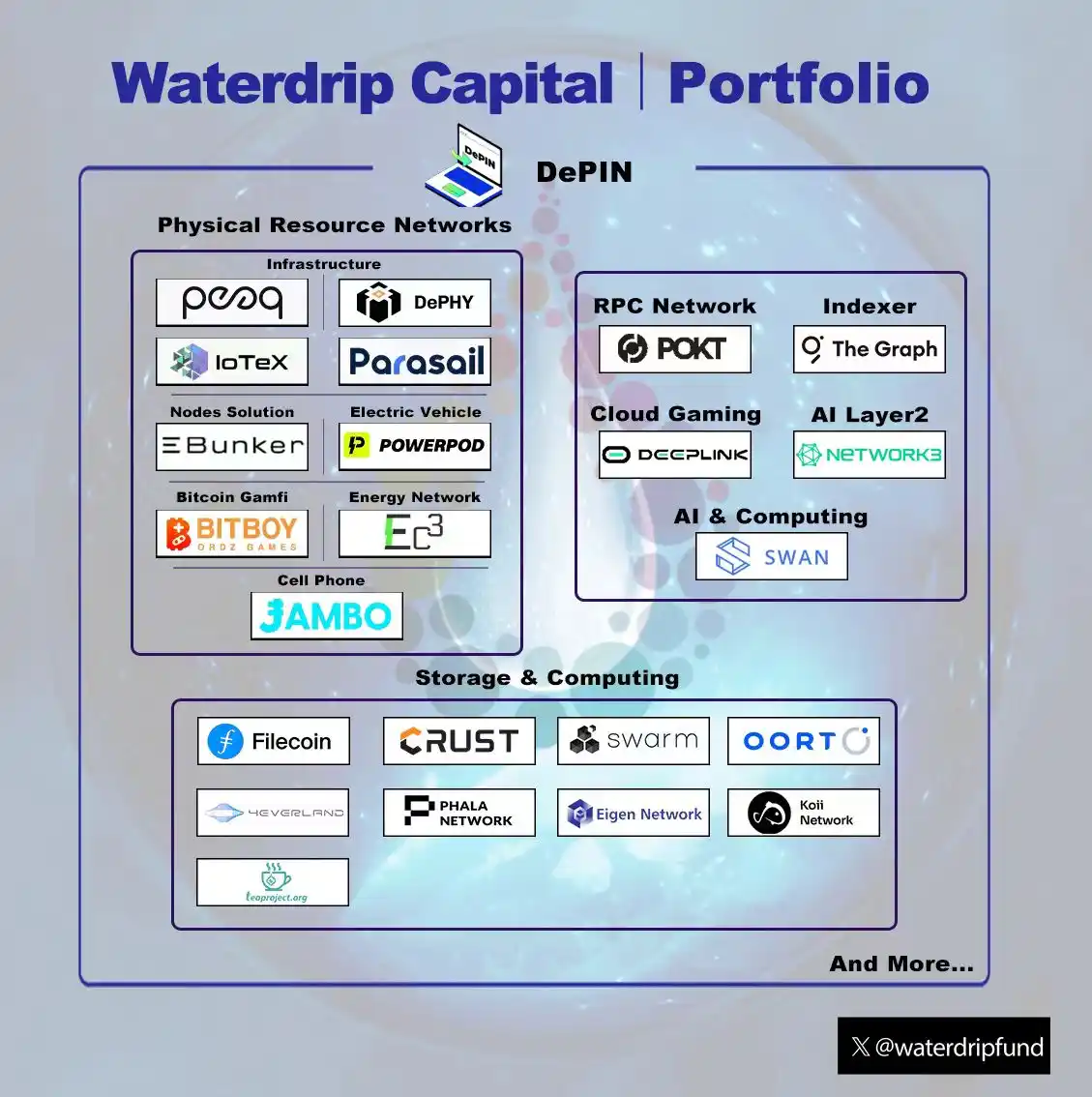
Waterdrip Capital DePIN track ecological layout
DePIN projects with hardware supply chain and sales channels have greater growth potential
The concept of DePIN is a form of crypto economy based on physical hardware. Projects with strong hardware supply chain capabilities can achieve rapid business growth in the first curve through equipment sales and agency models. While achieving a large-scale network, it can obtain a considerable profit income with a lower cost advantage (the price of DePIN equipment is already very high compared to the cost); it can provide large-scale hardware infrastructure for the business growth of the second curve of the project, and have good cash flow support in the subsequent acquisition, operation and maintenance of the project.
Cross-chain interoperability can maximize the value of data
Currently, most DePIN projects are deployed on Ethereum, Solana, Peaq, and IoTeX. Although there are many mature solutions for cross-chain transactions, for DePIN projects, achieving data interoperability between multiple chains will maximize the value of data. This is not only a potential outbreak point for the DePIN track, but will also enable cross-chain protocols to directly benefit from this wave of growth.
Data credibility is critical to the development of AI
The data used to train AI may involve risks of ethical, legal, and moral issues. If the data is contaminated or maliciously tampered with by hackers, the results of AI generation will be affected. The traceability and verification mechanism of blockchain helps to improve the credibility of data, ensure the integrity of data and transparency of sources, and prevent data from being tampered with. In addition, by combining the crypto-economic model, it can incentivize the generation of high-quality data on the supply side, which will further promote the improvement and large-scale adoption of the AI industry. IBM and other technology companies are already exploring how to use blockchain technology to improve the credibility and security of AI data.
References:
Messari: State of DePIN 2023, https://messari.io/report/state-of-DePIN-2023
FMG Group: THE FUTURE OF DEPIN, https://docsend.com/view/54umt32m7y3xwv4i
borderless_cap:DePIN Thesis 2.0: https://borderless.docsend.com/view/5t3tsu3apqewc3ce
State of AI Report 2023: https://www.stateof.ai/
BCG Data Value Network: https://web-assets.bcg.com/77/1c/30afc5e048deba352aaae316a16c/bcg-data-value-networks-cn-mar-2024.pdf
Charles Handy: The Second Curve: Thoughts on Reinventing Society
Ryze Labs 10,000-word research report: A comprehensive interpretation of the DePIN track, https://www.theblockbeats.info/news/46686
Htx Research: https://htxresearch.medium.com/DePIN-%E8%B5%9B%E9%81%93%E7%8E%B0%E7%8A%B6%E5%8F%8A%E5%8F%91%E5%B1%95%E9%A2%84%E6%B5%8B-fb7ef475087c
Youbi Capital: Born on the edge: How does the decentralized computing power network empower Crypto and AI? https://mp.weixin.qq.com/s/S6Td3L8ydiI9c7QjupzN8Q
OORT Docs: https://docs.oortech.com/oort
Swan Chain: https://s.foresightnews.pro/article/detail/62762
Swan Chain Docs: https://docs.filswan.com/
Kyve: https://docs.kyve.network/learn
Peaq Article: https://www.peaq.network/blog/what-are-decentralized-physical-infrastructure-networks-DePIN
Parasail Docs: https://docs.parasail.network/
DePIN Ninja Dashboard: https://DePIN.ninja/leader-board
This article is from a contribution and does not represent the views of BlockBeats.
Welcome to join the official BlockBeats community:
Telegram Subscription Group: https://t.me/theblockbeats
Telegram Discussion Group: https://t.me/BlockBeats_App
Official Twitter Account: https://twitter.com/BlockBeatsAsia

 Related Articles