With Binance Labs’ investment, what is unique about Stacks’ lending market Zest?
Original title: "Binance Labs participates in the investment, an article interprets the Stacks lending market Zest"
Original author: Nan Zhi, Odaily Planet Daily
On May 13, Zest Protocol announced the completion of a $3.5 million seed round of financing, led by Tim Draper and participated by Binance Labs. It is reported that the protocol uses the Nakamoto upgrade of Bitcoin Layer 2 Stacks and the cross-chain asset sBTC to implement lending services that are completely native to the Bitcoin network. In recent years, Binance Labs has made few investments in the Bitcoin ecosystem. Is Zest unique? Odaily Planet Daily will analyze Zest's business in this article.
Zest Analysis
Zest was founded in 2021, released the Zest Protocol prototype in the second quarter of 2023, and completed the audit in the fourth quarter. Will follow Stacks' Nakamoto upgrade to lend native Bitcoin lending services.
Zest Lending Solution
The existing lending solutions on Stacks rely heavily on centralized entities. The lender is usually a trusted committee or a custodian alliance. The underlying operation is very opaque, and centralized organizations will incur additional costs, making lending activities uneconomical.
Stacks is about to undergo a Nakamoto upgrade, which solves the above-mentioned centralization problem, and Zest Protocol will use this upgrade to create a native Bitcoin lending service. First of all, what is the Nakamoto upgrade?
Nakamoto is a milestone update for Stacks. After the update, the block time will be shortened to about 5 seconds (before the upgrade, it was consistent with Bitcoin, about 10 minutes or more). In addition, this upgrade will also introduce sBTC, a secure and efficient version of encapsulated Bitcoin that is naturally integrated with the Stacks consensus mechanism. Previously, depositing BTC was equivalent to depositing money to a centralized institution and delivering a token of the same name created on the network. The upgraded sBTC has achieved a decentralized, trustless two-way anchor, which is equivalent to BTC being able to freely cross-chain between the Bitcoin mainnet and Stacks.
After the upgrade, Stacks has gained high BTC liquidity and network performance, and Zest will use this liquidity to carry out lending business. Users cross-chain native Bitcoin to obtain sBTC and enter Zest's pool to obtain income.
Zest's BTC liquidity pool is divided into two types, lending pool and income pool. The former is no different from the conventional lending model. It adopts the form of pool-to-pool lending. Users borrow/loan in the pool of the corresponding currency and pay or receive corresponding interest.
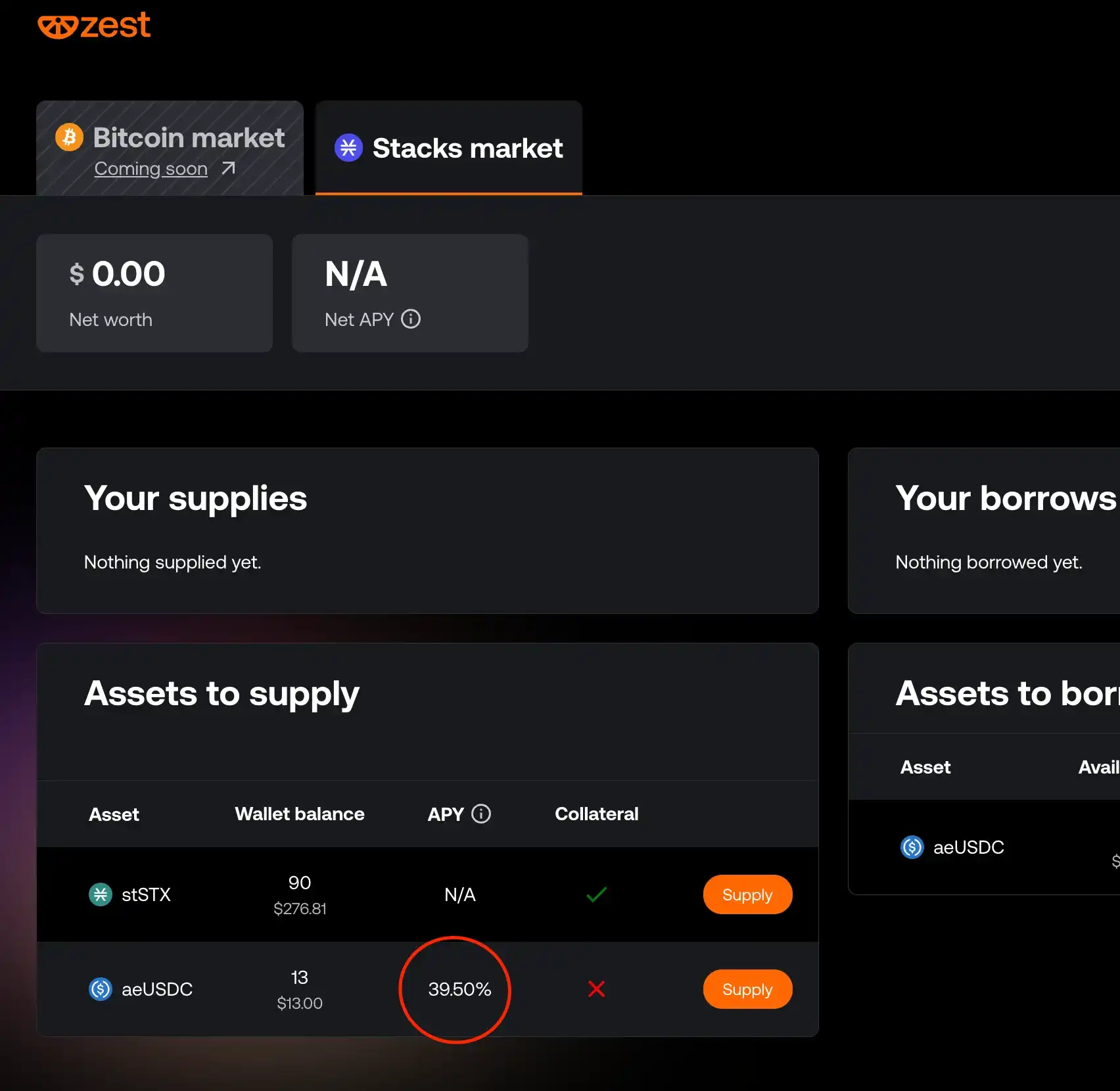
In the income (Earn) pool, users only participate as lenders. Zest introduces a third-party role for the income pool, namely the pool delegates, credit experts who start and manage the liquidity pool. The pool delegates conduct due diligence and negotiate terms with the borrowers. The pool delegates need to review the reputation, expertise and performance of the borrowers to evaluate the loan terms. Once the borrower and the fund pool representative agree on the borrower interest rate and collateral ratio, the fund pool representative will provide funds for the loan from the fund pool it manages.
The borrowers of the yield pool are limited to institutions, including market makers, exchanges, centralized lenders, miners and enterprises that accept Bitcoin payments. The borrower needs to contact the fund pool representative, join the permission whitelist, create a specific loan vault to deposit assets, and then submit a loan request. What is more special is that the yield pool also supports borrowers to extend the loan, that is, when the repayment date is approaching, a separate loan contract is signed to extend the loan, and only the interest due needs to be paid.
Financing
On May 13, Zest Protocol completed a $3.5 million seed round of financing, led by Tim Draper, with participation from Binance Labs, Trust Machines, Flow Traders, Hyperithm, Bitcoin Frontier Fund, DeSpread, Tykhe Block Ventures, Asymmetric, Primal Capital, Gossamer Capital, Scimitar Capital, etc. This is also the only round of financing at present.
As for Binance Labs, recent investments in the Bitcoin ecosystem include BounceBit on April 11 this year, Babylon on February 27, and Lorenzo Protocol at the end of 2022. Its investment in Bitcoin is relatively scarce.
He Yi commented on the investment, saying: "Zest Protocol's technology meets the needs of Bitcoin holders and borrowers, unlocking the potential of Bitcoin's programmability and interoperability. At Binance Labs, we are always looking for pioneers who lead the industry, and we look forward to seeing Stacks' Nakamoto upgrade drive the growth of Zest Protocol."
Zest Protocol founder Tycho Onnasch said: "We aim to redefine Bitcoin lending. We are here to complete the long-unfinished task of migrating the Bitcoin lending market to the chain, which is where they belong."
Conclusion
Zest's business model is relatively traditional and has no major innovations, but the bound Stacks ecosystem is not fully developed but has a high degree of attention, has great market potential, and coupled with Binance Labs' investment attributes, it has a certain value of attention.
Original link
Welcome to join the official BlockBeats community:
Telegram Subscription Group: https://t.me/theblockbeats
Telegram Discussion Group: https://t.me/BlockBeats_App
Official Twitter Account: https://twitter.com/BlockBeatsAsia

 Related Articles