How does Core Chain unlock the 200 billion market value of BTC DEFI?
TLDR:
This article will delve into the outstanding advantages of CoreDAO in the Bitcoin DeFi field.
· The current state of the Bitcoin market and its potential value to be unlocked.
· CoreDAO's unique "Satoshi Plus" consensus mechanism, which adopts the Bitcoin PoW mechanism and 50% hash power pledge to jointly ensure the security of the Core chain.
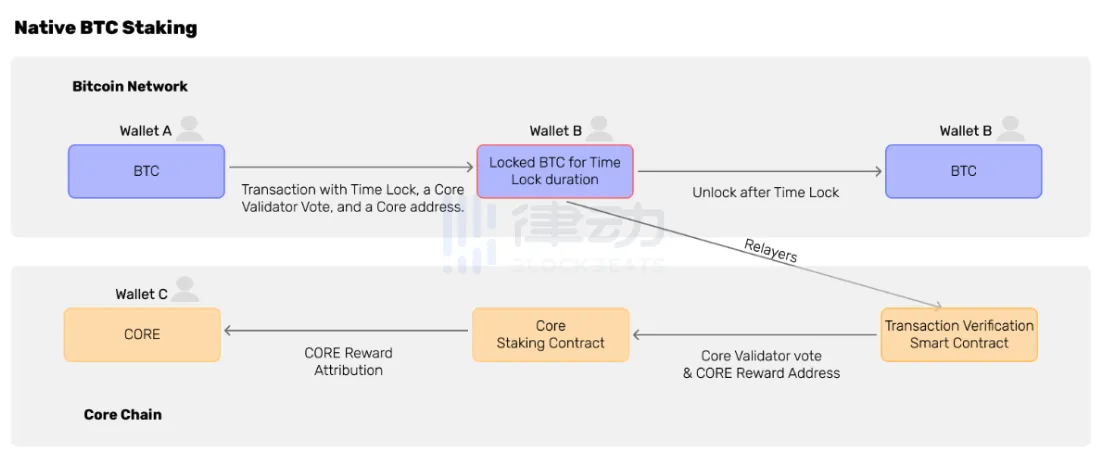
· Upcoming non-custodial Bitcoin staking feature, ensuring the security of native Bitcoin assets through time lock mechanism, while earning CORE rewards, significantly increasing TVL of Core chain.
· The innovation of CoreBTC lies in its complete decentralization, introduction of "custodians", "carriers", and "liquidators", and prevention of malicious behavior through collateral mechanisms and multiple supervision.
· HTLC atomic swaps enable trustless native asset exchanges between Core chain, Bitcoin, and other EVM public chains without the need for central authorities, oracles, or relays.
Starting from early 2023, the heat of the Bitcoin ecosystem has been continuously rising, especially with the continuous development of the Ordinals and BRC-20 ecosystems. Inscription technology is even widely attempted on various public chains, leading to a surge in market value.
More importantly, with the SEC approving the listing of a Bitcoin ETF, which is an important milestone in the history of cryptocurrency, the price of Bitcoin has been on the rise, reaching a new high since December 2021, breaking through $64,000. According to Companies Market Cap data, the market value of Bitcoin has exceeded $1 trillion, surpassing Tesla, TSMC, Eli Lilly, Berkshire Hathaway, and ranking after Meta, becoming the tenth most valuable asset in the world.

Data source: Companies Market Cap
Meanwhile, the total market value of cryptocurrencies has recently surpassed $2 trillion, with Bitcoin's market dominance at 49.4%, nearly reaching its highest point in the past two years, confirming Bitcoin's strong leadership position. More and more traders and investors are "returning to basics" and returning to the Bitcoin ecosystem.

Data source: coingecko
It is obvious that after the "cooling-off period" of the inscription, the Bitcoin ecosystem is moving towards a diversified development path. The community's demand for more advanced infrastructure is increasing, and expectations and consensus are constantly strengthening. In particular, the BTCFi ecosystem, including Bitcoin Layer 2, DeFi, and cross-chain tracks, has great prospects in expanding the functional scope of Bitcoin, including the implementation of smart contracts and decentralized applications.
Core Chain, the Engine Unleashing Bitcoin's DeFi Potential
Among the numerous BTCFi projects, Core DAO has also observed the growth potential and market demand in this field.
As a new public chain based on the consensus of Bitcoin PoW and capable of realizing non-custodial Bitcoin collateral, Core Chain can release the security and usability value of Bitcoin while building the most prosperous and decentralized financial ecology belonging to Bitcoin.
Core Chain is the first EVM blockchain that is aligned with the height of Bitcoin, aiming to complement Bitcoin while serving as a highly scalable smart contract platform. The mainnet of Core Chain has launched the "Satoshi Plus" consensus, which combines delegated proof of work (DPoW) and delegated proof of stake (DPoS) to incorporate Bitcoin miners and mining pools into a secure and scalable smart contract platform.
Bitcoin collateral in the past required "wrapping" Bitcoin (converting it to Wrapped BTC) because the Bitcoin mainnet does not have smart contracts. The wrapped BTC is then bridged to the target chain and held in the target chain's smart contract. This process is not only cumbersome, but also makes it easy for collateral providers to suffer asset losses due to contract attacks.
The Core chain enables "non-custodial staking" without transferring Bitcoin out of one's own address. This can be done directly on the Bitcoin mainnet, making the staking process easy and convenient. Bitcoin holders do not need to bridge their Bitcoin to the Core chain or entrust it to smart contracts for custody. Instead, they can control the address where the staked Bitcoin is held, achieving "self-custody" and greatly enhancing asset security. Under any circumstances, the BTC staked by users will not be compromised, even if validators act maliciously and are punished. BTC stakers will only lose staking rewards at most, and their staked assets will not suffer any losses.
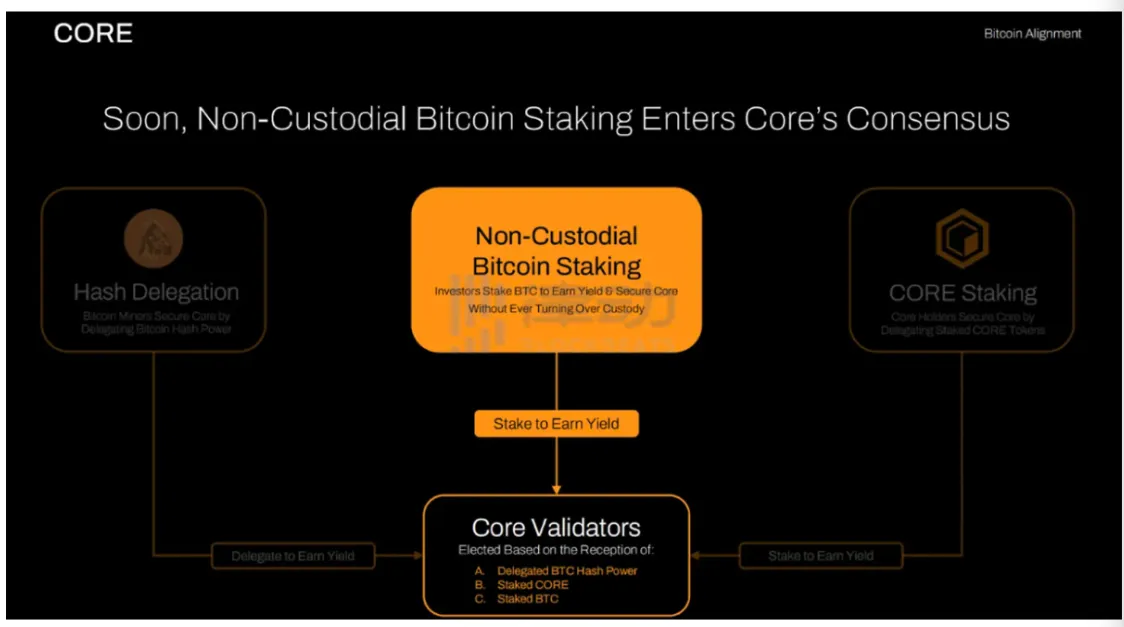
Non-custodial collateralization" will greatly release the liquidity value of Bitcoin, and more importantly, the Core chain is an EVM-compatible public chain, which makes it possible to build large-scale dApp groups through smart contracts that cannot be realized on the Bitcoin mainnet. There are currently many well-known dApps in the Core chain ecosystem, including Metamask, SushiSwap, Ankr, 1RPC, Dapp Radar, etc.
"Non-custodial collateral" + EVM compatibility, Core Chain will take the usability of Bitcoin to a new level, unleashing the huge potential of Bitcoin DeFi.
Related reading: "Core: BTC 2.0 new public chain, exploring the huge potential of Bitcoin's security and usability". Before delving deeper into Core DAO, let's first discuss the market space in front of Core DAO. How big can it be?
What is the potential of Bitcoin DeFi?
According to CoinGecko's data, the current market capitalization of DeFi tokens on various chains exceeds $90.5 billion, with a total locked value (TVL) of over $82.8 billion. DeFi products in this category include decentralized lending, decentralized trading, decentralized derivatives, and decentralized stablecoins. Among these DeFi products, the proportion on the ETH chain is 25.4%.
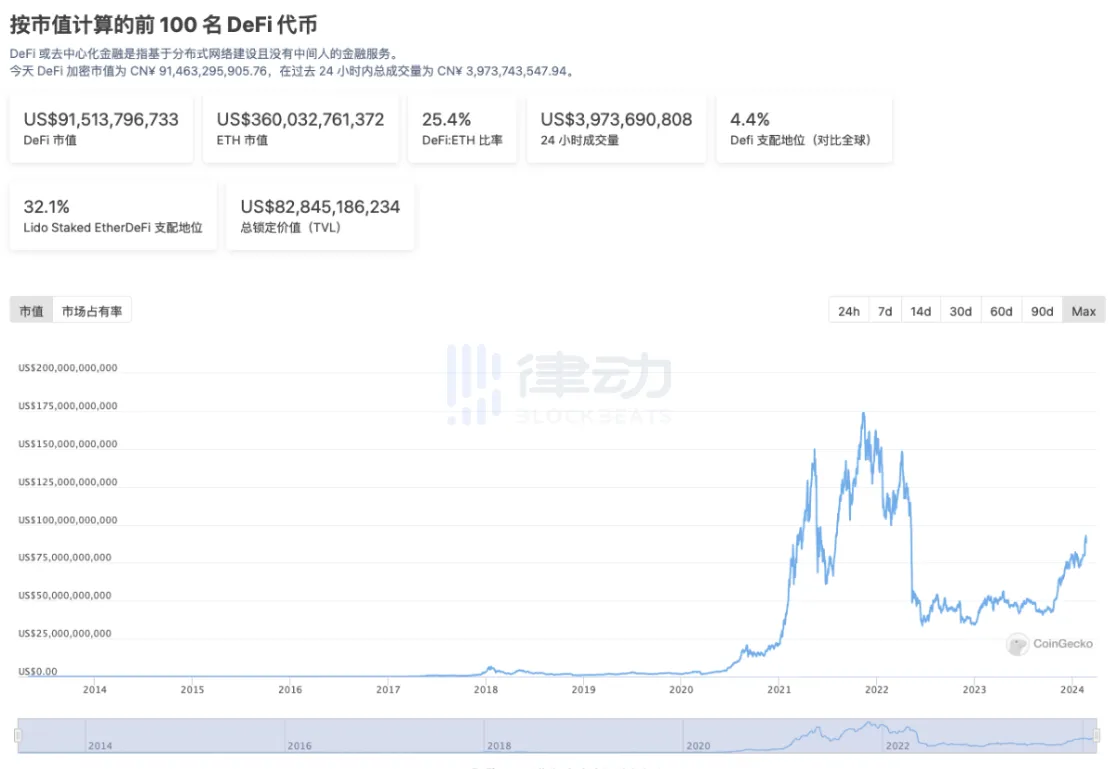
According to current market share calculations, Bitcoin's market share (49.4%) is about three times that of Ethereum (16.5%). Therefore, based on conservative estimates, the market value of Bitcoin DeFi will be at least three times that of Ethereum DeFi.
How do professionals view this issue? What will be the market value of DeFi on Bitcoin? Franklin Bi, a partner at Pantera Capital, expects that the market size on Bitcoin will reach $225 billion (25% of Bitcoin's market value) assuming that Bitcoin's market value remains unchanged. Over time, it may fluctuate between $72 billion to $450 billion (8% to 50% of Bitcoin's market value).
Pantera Capital analysis shows that currently Ethereum dominates the DeFi field and carries out most of the activities. Historically, decentralized applications on Ethereum account for 8% to 50% of Ethereum's market value, and currently this number is about 25%. If we estimate the DeFi market value of the Bitcoin network based on this proportion, it could reach about $225 billion.
Related reading: "Pantera Capital: Bitcoin-based DeFi market could reach $225 billion".
Obviously, if Bitcoin DeFi develops, the market value of the entire Bitcoin ecosystem and the entire DeFi track will be greatly improved.
coreBTC


The elegance of this system lies in the fact that any participant can call it in a completely trustless manner, making access and participation more democratic. It not only expands the practicality of HTLC, improves efficiency and user experience, but also maintains the decentralization and trustlessness of the Bitcoin blockchain.
In addition, market makers also receive incentives for providing liquidity, as they can exchange settlement swaps by adding transaction fees. This innovative mechanism has played a key role in the development of Bitcoin DeFi, providing users with a safer and more convenient way to exchange assets.
Comparison with other BTC DeFi projects
After introducing the unique advantages of the Core chain in building a Bitcoin-based DeFi ecosystem, let's now compare the differences between the Core chain and other protocols with similar features.
Stacks
Although Stacks is a second-layer protocol for Bitcoin, it has a similar purpose to the Core chain, aiming to introduce DeFi ecosystem ideas into Bitcoin. As of February 16th, the total locked value (TVL) of Stacks has exceeded $100 million. However, Stacks' lack of EVM compatibility has become a key bottleneck. In comparison, the Core chain provides developers with a more flexible and barrier-free development environment through EVM compatibility. In addition, the Core chain maintains a clear advantage in block time and transaction volume per second.
Rootstock
Rootstock is also a veteran Bitcoin sidechain, but due to being an EVM equivalent chain rather than EVM compatible, similar to Stacks, although it attempts to support Bitcoin DeFi, building it is actually extremely challenging and has not yet attracted a large number of developers and users. In contrast, the block time of the Core chain is ten times faster than that of Rootstock, and the transaction volume per second is several times the theoretical amount of Rootstock, making it more outstanding in terms of block time and transaction volume per second.
Botanix
Let's take a look at Botanix again. Botanix attempts to bring the advantages of the Ethereum Virtual Machine to Bitcoin through the Spiderchain primitive. However, like Rootstock, Botanix is also EVM-equivalent rather than EVM-compatible, which presents additional challenges for developers. Its experimental nature and multi-signature-based structure also pose potential risks, while the Core chain is more robust in these aspects.
Sovereign Rollups
Unlike the previous solutions, Sovereign Rollups process transactions off-chain and anchor summaries or proofs to the Bitcoin blockchain, thereby improving transaction throughput and smart contract functionality. However, this relies on a single sequencing model and may face fraud proof issues. In contrast, the design of the Core chain emphasizes decentralized trust and is more mature in implementing smart contract functionality.
Babylon
As a Bitcoin re-collateralization protocol, Babylon allows users to collateralize idle Bitcoin without using bridging or relying on trusted intermediaries, and exchange the yield of alternative coins, but its goal is not to create a DeFi ecosystem supported by Bitcoin. The "Satoshi Plus" consensus mechanism and potential support for re-collateralization on the Core chain will enable it to more comprehensively meet user needs in the future.
Overall, the design of the Core chain in terms of EVM compatibility, block time, transactions per second, and decentralized trust gives it a competitive advantage in the Bitcoin DeFi field.
Summary
In the future, as time goes on, the governance of the Core chain may expand to Bitcoin holders and Bitcoin miners. This can further increase the consistency between Bitcoin and the Core chain, making asset bridging easier. The expansion of governance structure is expected to promote more active participation from Bitcoin holders, injecting more momentum into the development of the Core chain. Future updates may also directly allocate Bitcoin as a reward to Bitcoin holders.
In addition, the Core chain may also introduce a local fee market to make Bitcoin transactions faster, more predictable, and more economical. This is expected to achieve the fast, low-cost, predictable, and scalable transactions envisioned in the original Bitcoin vision. By integrating the consensus mechanism of the Core chain with multi-signature wallets, the trustlessness of coreBTC will be enhanced, while providing more collateral options for lockers and expanding the potential range of lockers.
The Core chain will also modify the staking mechanism, allowing holders to participate in decentralized finance (DeFi) without the need for wrapping, thus enabling users to retain their assets in their native form.
With the continuous development of the Core chain, we look forward to seeing Bitcoin make greater breakthroughs in the field of decentralized finance, providing users with more choices and a more convenient experience. The Bitcoin ecosystem will continue to flourish, and the Core chain, as an important part of it, will play a key role in its future development.
Welcome to join the official BlockBeats community:
Telegram Subscription Group: https://t.me/theblockbeats
Telegram Discussion Group: https://t.me/BlockBeats_App
Official Twitter Account: https://twitter.com/BlockBeatsAsia