Cooperation stopped after several months of renewal, is the tug-of-war between Aave and Gauntlet finally over?

Table of Contents
· Gauntlet and Aave part ways
· Aave DAO representative Marc Zeller opposes Gauntlet's renewal
· Gauntlet has had multiple conflicts with Aave stakeholders
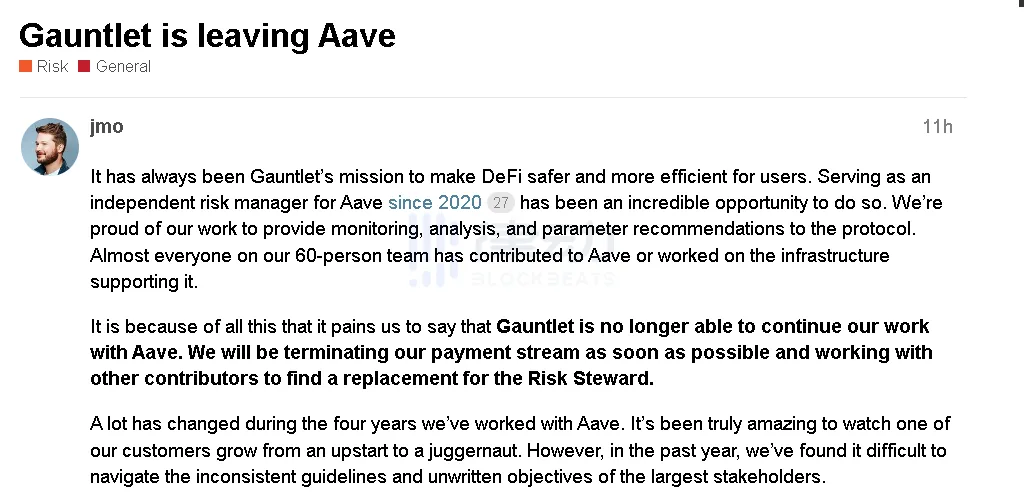
BlockBeats news, on February 22nd, according to the Aave governance forum announcement, DeFi risk management company Gauntlet announced that it will stop working with Aave. Gauntlet will terminate payment flows as soon as possible and work with other contributors to find a replacement for the risk manager.
It is reported that Gauntlet has been serving as an independent risk manager for Aave DAO since 2020. During this period, the company is responsible for monitoring the risks of the Aave lending market, such as liquidation risks, deployment on new blockchains, and accepting new assets as collateral. Aave is the largest lending protocol on Ethereum with over $8.3 billion in deposits, and it is managed through a DAO structure, which means that AAVE token holders can propose and vote on changes to the protocol and its management.
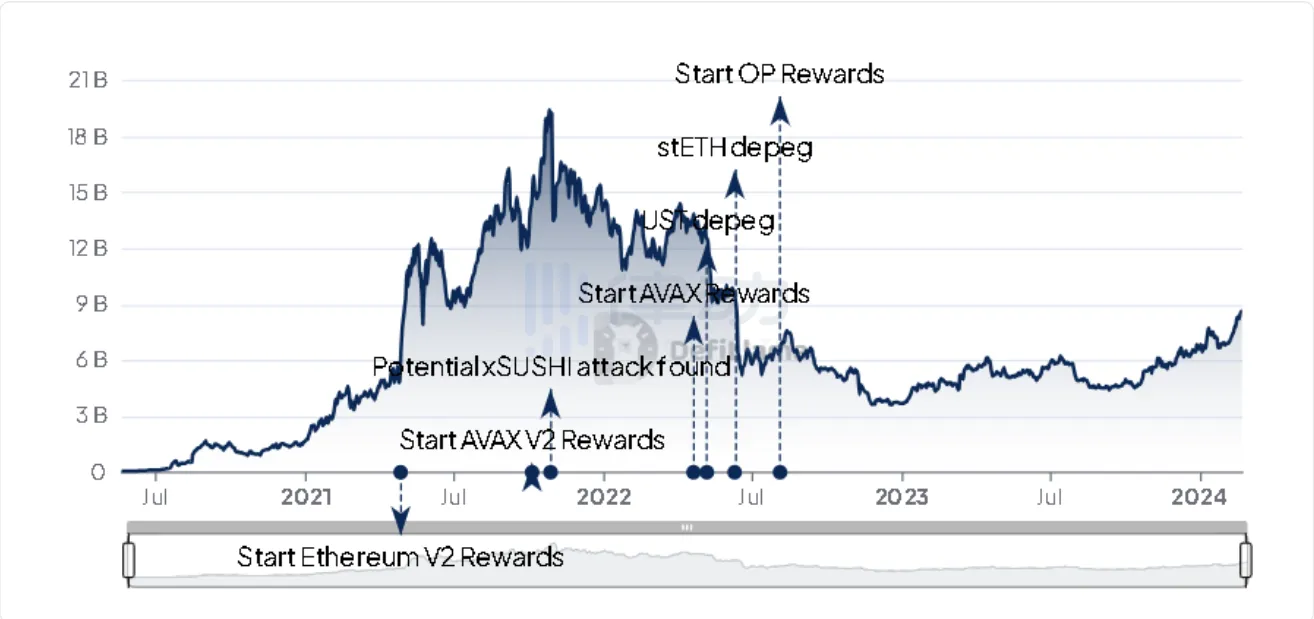
Total Aave investor deposits, image source: DLNews
Gauntlet and Aave part ways
On February 22nd, Gauntlet announced that it will stop working with Aave. Gauntlet will terminate payment flows as soon as possible and work with other contributors to find a replacement for the risk manager.
Gauntlet's Chief Operating Officer and Co-founder, John Morrow, stated that Gauntlet's mission has always been to make DeFi safer and more efficient for users. Since serving as an independent risk manager for Aave DAO in 2020, nearly all 60 members of the Gauntlet team "have contributed to Aave or participated in supporting its infrastructure work."
However, in the past year, Gauntlet has found it difficult to cope with conflicting guidance and unwritten goals from its major stakeholders. "As a result, the best place to continue Gauntlet's mission is elsewhere."
Aave DAO representative Marc Zeller opposes Gauntlet's renewal
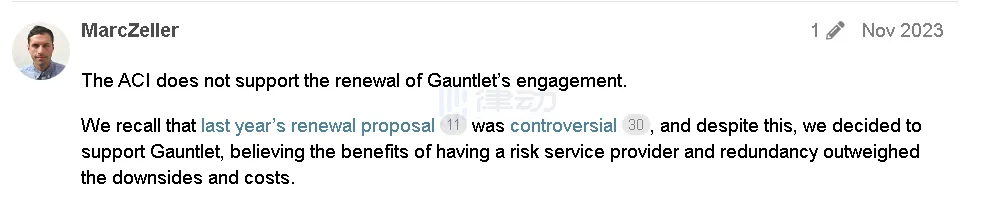
As early as November of last year, Aave DAO representative Marc Zeller made it clear that he was dissatisfied with Gauntlet. When Gauntlet proposed a renewal, Marc Zeller directly stated in the governance forum that "ACI does not support renewing Gauntlet".
Gauntlet has been serving as an independent risk manager for Aave DAO since 2020. The last renewal was on November 29th of last year. Gauntlet initiated a proposal to "Renew the 12-month partnership agreement with Aave" in the Aave community, aiming to continue market risk management, maximize capital efficiency, and reduce bankruptcy and liquidation risks, thus achieving long-term sustainable development.
Marc Zeller pointed out that there was controversy over the renewal, but the community "believes that the benefits of having risk service providers and redundancy outweigh the disadvantages and costs", so the renewal was agreed upon. Now, Aave DAO is in a stronger and more stable position, "and with experience, we can step back and consider the benefits of working with Gauntlet."
It is reported that Gauntlet has provided an analysis on how the suspension of Aave can generate bad debts, which is very valuable for making wise decisions in the war room environment. However, because it was published on a public forum during the event, it may cause unnecessary panic. Marc Zeller believes that "this behavior is inappropriate and lacks strategic vision."
The most important thing for Marc Zeller is that DeFi should be a 24/7 job, but "Gauntlet is the slowest service provider so far and is simply not suitable for a 24/7, uninterrupted DeFi environment."
In order to achieve a fast and ungoverned process for taking action on supply and borrowing limits, introducing a risk steward is an important tool to ensure that growth is not artificially limited. However, Gauntlet's Risk Steward has been in a semi-failed state for a long time. And on Gnosischain, it took Gauntlet 4 days to respond to Chaos Labs' proposal.
During this period, there were many examples of difficult cooperation with Gauntlet. Marc Zeller described Gauntlet's behavior as "seemingly adopting a zero-sum game mentality with the risk service providers of DAO", that is, "part-time direct competition". This evaluation is both the main reason why Marc Zeller opposes Gauntlet and a reason for Gauntlet's withdrawal.
Gauntlet has had multiple conflicts with Aave stakeholders
As John Morrow said in the governance forum, Gauntlet has had multiple conflicts with Aave stakeholders during its four years as an independent risk manager for Aave DAO.
Regarding the proposal to upgrade the wETH parameters in the Aave V3 ETH pool, Marc Zeller proposed the AIP-371 proposal to adjust slope1 to better align with the current yield of stETH and reth. At that time, the yields of stETH and reth were 3.3% and 3.07%, respectively.
According to AIP-371, there are two optional ways to change the target of slope1, among which the conservative option sets slope1 to 3.2%, which is 10 basis points lower than the yield of stETH but higher than the yield of rETH; the aggressive option sets slope1 to 2.8%, which is 50 basis points lower than the yield of stETH and 23 basis points lower than the yield of rETH, making both profitable. AIP-371 also suggests reducing optimalRatio to 80% to mitigate liquidity risk.

However, interestingly, even before AIP-371, Gauntlet had already proposed a similar proposal, AIP-368. According to AIP-368, Gauntlet suggested setting the WETH Uopt of v3 Ethereum to 80% and setting Slope 1 to 3.3%, and adding additional content on how these options affect borrowing rates and income.
Except for proposal duplication, Gauntlet's proposals have been criticized by Aave community users.
Last February, Gauntlet received criticism for proposing a method to distribute ARB tokens to Aave users, but a similar proposal to distribute OP tokens received overwhelming support a few days later.
At the end of the year, Gauntlet suggested that Aave DAO wait until its GHO stablecoin is traded according to the expected USD peg before introducing the GHO stable module. This protocol allows anyone holding GHO to exchange the token for USDT or USDC on a one-to-one basis. However, during the voting process, Aave token holders voted to immediately implement the GHO stability module.
Among this series of conflicts, the proposal to freeze CRV has been the longest lasting.
On June 15th of last year, Gauntlet suggested freezing CRV on Aave v2 in order to significantly reduce loss risk. Users were encouraged to migrate to Aave v3, as Gauntlet stated that v3's risk parameters were more suitable for the CRV lending market. Freezing the CRV market on v2 would limit user operations, including deposits and borrowing.
Regarding this, Marc Zeller responded stating that users should be free to use the protocol and that implementing a "solution" that may bring more negative impacts than benefits should be approached with caution. Currently, artificially increasing the liquidation probability by increasing the reserve factor (RF) or lowering the liquidation threshold (LT) may not be the wisest method. The Aave community also voted against this proposal.
Later, Gauntlet launched two proposals in the Aave community here, suggesting to freeze Curve tokens and set the Curve loan-to-value ratio to zero on Aave v2, in order to mitigate the risk of Michael Egorov, the founder of Curve Finance, who has a $65 million loan position on the crypto lending protocol.
Due to the previous proposal being rejected by the community, Gauntlet's move has been criticized by Aave DAO representative Marc Zeller, who believes that Gauntlet is trying to confuse and take advantage of the situation to get the proposal approved. However, Gauntlet's CEO and founder Tarun Chitra denies this accusation.
From the results, if Gauntlet decides to terminate the one-year contract just a few months after renewal solely because of the disagreement with DAO, it will inevitably damage Gauntlet's reputation. Future clients should be aware that contractual obligations can be terminated at any time for any reason.
Welcome to join the official BlockBeats community:
Telegram Subscription Group: https://t.me/theblockbeats
Telegram Discussion Group: https://t.me/BlockBeats_App
Official Twitter Account: https://twitter.com/BlockBeatsAsia

 Related Articles