Understand the Bitcoin L1 Runes protocol two months in advance. What are the Alpha opportunities?
Original author: 0xSea.eth
Two months in advance, what are the alpha opportunities to understand the Bitcoin layer one Runes protocol?
If Ordinals and Atomicals, the two strongest BTC L1 protocols currently, were born when no one cared, then Runes was launched under the attention of the entire industry. As the founder of the Ordinals protocol, which opened the "Pandora's Box" of the Bitcoin ecosystem, Casey Rodarmor (@rodarmor) received attention from the entire ecosystem after announcing the launch of the Runes protocol in September last year.
Now, with only two months left until the official launch of Runes, what are the Alpha opportunities available?
1/ Why are there Runes?
In the first chapter of the previous article "A Brief History of BTC L1 New Protocol that 60-Year-Old Grandmothers Can Understand", we mentioned that Casey originally created the Ordinals protocol for art/NFT on-chain, not for issuing coins. However, the emergence of BRC-20 broke this situation, and the transaction volume of BRC-20 has always dominated the entire Ordinals protocol. But with the two waves of BRC-20 fever last year, the industry accepted the existence of this inscription token, and Casey also changed his view: although 99% of tokens are scams and gimmicks, they will not disappear like casinos. Creating a good token protocol for Bitcoin may bring considerable transaction fee income, attract more developers and users, and ultimately expand the usage of BTC. Therefore, on September 26, 2023, Casey first fully released the concept of Runes through his blog, which is to build a new homogenized token protocol on Bitcoin. Article link: https://rodarmor.com/blog/runes/
In this article, he pointed out some issues with existing protocols such as BRC-20, RGB, and Taproot Assets, and proposed that a better BTC token protocol should be simple, not rely on off-chain services, and be based on UTXO. This is the core idea and origin of Runes, which is commonly referred to as the "Rune Protocol" in the Chinese community. By the way, the unofficial symbol for Runes is ▣, while the symbol for Ordinals is ◉.
2/ Runes Release Date
Just 5 days before Casey published the article on September 21st, the atomic protocol @atomicalsxyz also released the first token $atom, which was minted for free using proof of work (PoW) within five hours, bringing another innovation to Bitcoin L1. Therefore, in the following months, the market also had high expectations for Runes, and many people were making various preparations to try to grab the first token on the Runes protocol.
However, during these past few months, the Casey team has been maintaining the normal upgrade of Ordinals while also dealing with sudden situations caused by peculiar bugs like Curse Inscriptions (introduction article: https://twitter.com/_0xSea_/status/1743512063593546052). The release date of Runes has also been uncertain. It wasn't until December 16th, when Casey announced at the Taipei Blockchain Week event, that the Runes protocol will be launched on the mainnet at Bitcoin block height 840,000, which is also the time of BTC's 4th halving. The release is expected to be around late April.

Now, there are less than 2 months until the official release of Runes. Hopefully Casey has already completed Baldur's Gate 3 and won't delay the release of Runes any further.
3/ But it seems that there are already several protocols called Rune
As mentioned above, Casey announced the concept of Runes on September 26th and has been updating the code related to Runes on Github for several months. Although the Runes protocol has not officially launched, many developers are interested in using it for their projects.
There are two types of projects here, one is related to Runes protocol, and the other is specific projects. Let's talk about the protocol first, which mainly includes two projects: the first one is @PipeBtc protocol developed by Benny, which is the first protocol based on the concept of Runes and has a very fast action. If you don't know Benny, you can read the second chapter of the article "A Brief History of BTC L1 New Protocol that Even a 60-Year-Old Grandma Can Understand". Benny is a technically savvy speculator with abundant energy and many ideas, and has launched multiple coins.
The second one is @runealpha_btc, which was launched in December and is similar to Pipe. The first token on Runealpha is Cook, but it does not limit the total number and quantity of tokens, but limits it to 150 blocks (equivalent to limiting time). Anything minted within the block range counts. Last week, I saw Runealpha's financing BP and the project's positioning on other channels. The goal is to become the infrastructure of the Runes protocol, including browsers, indexes, and trading platforms. The $Cook token is also expected to migrate to the Runes protocol, but the specific rules cannot be determined yet.
4/ There are also some Runes concept projects
Aside from the aforementioned protocol category, the second category is specific projects. These projects have emerged in the past 1-2 months, with the main logic being: to simulate and prepare for the official release of Runes at block 840,000, take advantage of strong market expectations, issue NFTs on Ordinals to establish community consensus, and then issue project tokens on the Runes protocol and airdrop them to NFT holders after the protocol is officially deployed. Below are some of the projects I have been paying attention to. If there are any omissions, please forgive me and feel free to add them in the reply section below.
1) RSIC
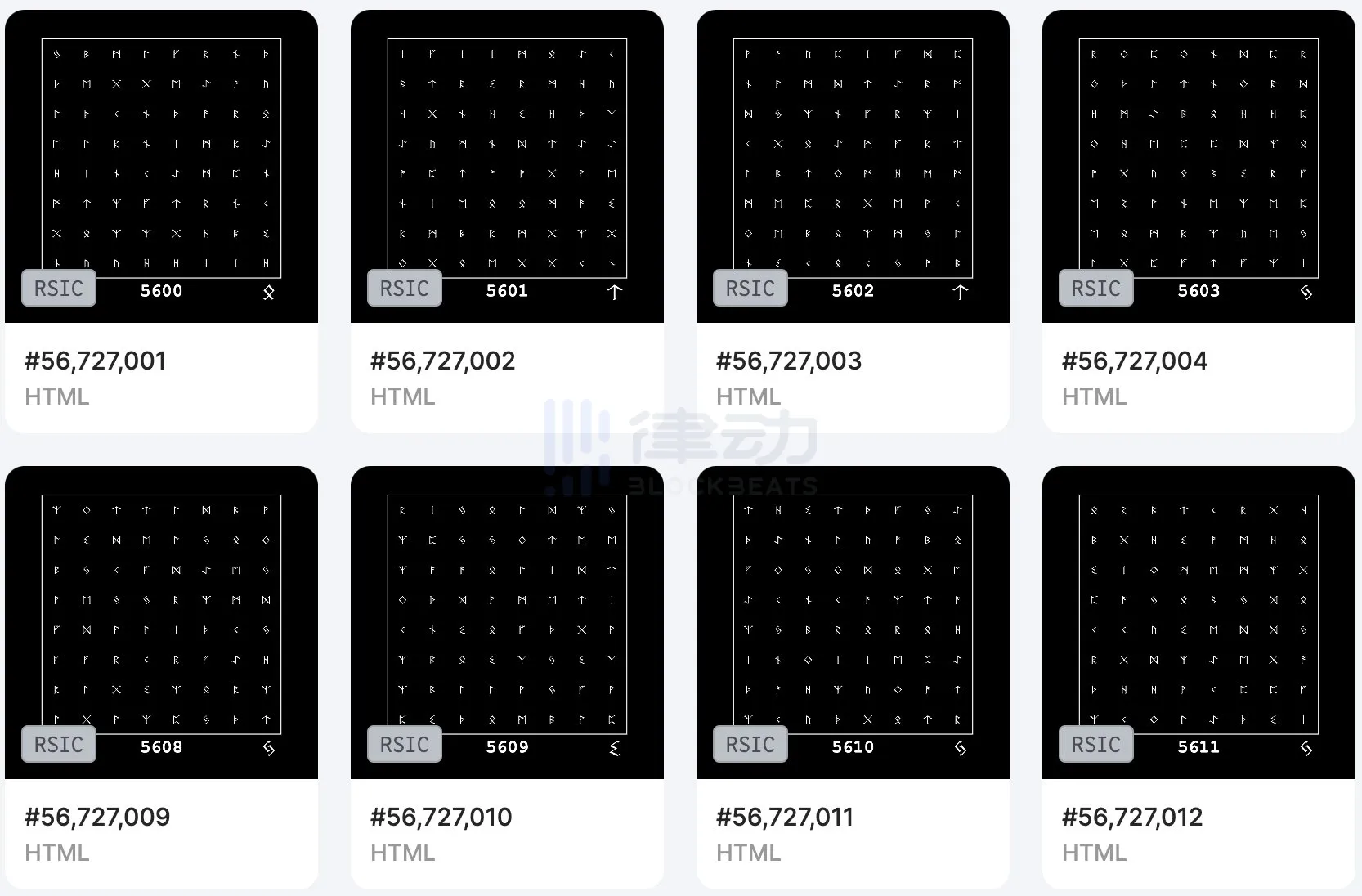
RSIC is short for Rune Specific Inscription Circuits, which is an NFT on Ordinals with a total of 21,000 pieces, 10% of which are reserved by the project party. 90% of RSICs were airdropped by the project party at their own expense to holders who spent more than 3 BTC, which was highly praised by the community for its large scale. The specific airdrop rules and standards have not been announced, but it is speculated that they are mainly based on the blue-chip NFTs held in the wallet. As it is an airdrop, some wallets may not know that they have received the NFT, so a transfer (buying/selling/transferring to oneself) is required to activate it. Once activated, "mining" begins, which mines token shares of a future token that the project party will deploy on Runes. This also fully demonstrates that the RSIC project party is an OG in the Ordinals ecosystem, otherwise it would be difficult to obtain fast support from the Ordiscan browser. Due to space limitations, more details about RSIC are not discussed here. Those who are interested can refer to the article written by @lilyanna_btc: https://twitter.com/lilyanna_btc/status/1749639096853745957
· Official Twitter: @rune_coin
· Official website: https://runecoin.io
· More documents: https://ordiscan.com/inscription/126 You can browse multiple child inscriptions here to excavate more interesting details.
· Magic Eden Collection: https://magiceden.io/ordinals/marketplace/rsic
· Mining Query: You can enter your wallet address at http://ordiscan.com and query in the Runes column.
2) RSIC
Boost RSIC is an additional tool launched by the RSIC project. This time it is not an airdrop, but requires holding RSIC in the wallet to mint (costing over $170), which can accelerate the mining process of RSIC. This measure further screens active wallets on the chain, increases market gameplay, and once again proves that the project team knows how to make things happen.
Currently the total amount is 3.9K, Magic Eden collection: https://magiceden.io/ordinals/marketplace/rsic-boost
3) Rune Mania Miner
As expected, a project called Rune Mania Miner quickly airdropped to RSIC Boost holders (who also hold RSIC). The total supply is 3,800, with 3,547 airdropped to the community and 253 reserved by the team. Like RSIC, it also needs to be transferred once (to oneself is also fine) to activate mining.
· Official Twitter account: @RuneManiaMiner
· Official website / Documentation: https://ord.io/61549984
· Magic Eden Collection: https://magiceden.io/ordinals/marketplace/rmm
· Mining Query: None
4) Runestone
Welcome to join the official BlockBeats community:
Telegram Subscription Group: https://t.me/theblockbeats
Telegram Discussion Group: https://t.me/BlockBeats_App
Official Twitter Account: https://twitter.com/BlockBeatsAsia

 Related Articles