UTXO: Tracing the development of BTC L2 that strings together inscriptions and is intent-oriented.
Original author: OneKey Chinese
UTXO: The Development of BTC L2 Focused on Inscription and Intentions
Recently, @NervosNetwork announced the promotion of CKB to become the first "POW+UTXO" Bitcoin L2, causing a significant increase in the price of $CKB.
Previously, when discussing BTC L2 solutions, the industry was heavily influenced by the concept of Ethereum's L2 Rollup. Various quickly built EVM-based L2 solutions have been criticized for their native security issues, despite their mature technology and low development threshold. Additionally, these types of L2 solutions require users to switch between BTC and EVM wallets, resulting in a poor user experience. In short, until these issues are resolved, the "picky" OGs and whales in the BTC community may not be easily swayed by FOMO. Under these circumstances, whether UTXO homomorphic L2 solutions can become a new way forward has become a hot topic of discussion in recent times.
This article is aimed at beginners and provides an introduction to the development of inscriptions and CKB's "non-cross-chain bridge" BTC L2, starting from the "source of all evil" UTXO.
What are UTXO and eUTXO?
UTXO (Unspent Transaction Output) is literally translated as "unspent transaction output". For example, if you receive a transfer of 10 BTC and do not spend it on someone else, that 10 BTC is a UTXO.
Let's understand through comparison and examples.
Currently, there are two mainstream transaction record models in the blockchain industry, namely the UTXO model and the account model. Ethereum adopts the account model, which is easy to understand and similar to bank accounts, Alipay and WeChat accounts. Under this model, the total amount of funds in the account is displayed as a balance, and the system only needs to track the changes in the user's account balance. For example, if you have a balance of 1000 yuan in your account and you purchase a OneKey Classic for 600 yuan, the system will deduct 400 yuan from your account and add 400 yuan to OneKey's account.
Compared to the account model used by Ethereum, Bitcoin's UTXO abstraction is more like a real "wallet" and "cash" transaction, more like a real cash transaction. For example, imagine you have a wallet bag with many different denominations of banknotes. Each banknote can be seen as a UTXO, which is money you can use. In a system like Bitcoin, when you receive Bitcoin transferred by someone else, the money is like a new banknote in your wallet, which you haven't used to pay for anything else yet, so it is "unspent".
Every time you make a transaction, such as using a 1000 yuan banknote to buy a OneKey Classic for 600 yuan, you will receive 400 yuan in change. In the Bitcoin system, this operation is equivalent to creating two new UTXOs using one UTXO (1000 yuan): one is paid to OneKey (600 yuan), and the other is returned to yourself (400 yuan). You "spend" the original UTXO (1000 yuan) and "generate" new UTXOs (600 yuan and 400 yuan).
With the concept of eUTXO (Extended Unspent Transaction Output), which refers to an extended version of unspent transaction outputs, explained in the previous text, it is easy to understand. In systems like Cardano that use the eUTXO model, it not only records the amount of money but can also contain more complex data and logic (for example, the money can only be used to purchase specific goods or services). As a result, each transaction not only transfers funds but can also execute certain conditions or even smart contract content. This makes transactions more flexible but also more complex.
BRC-20 has what relationship with UTXO?
If you are familiar with the BRC-20 protocol, you will quickly realize that "Wow, what they are doing is running an account model on top of the UTXO model." After all, the name of the protocol is derived from the ERC-20 token standard used by Ethereum, which uses an account model.
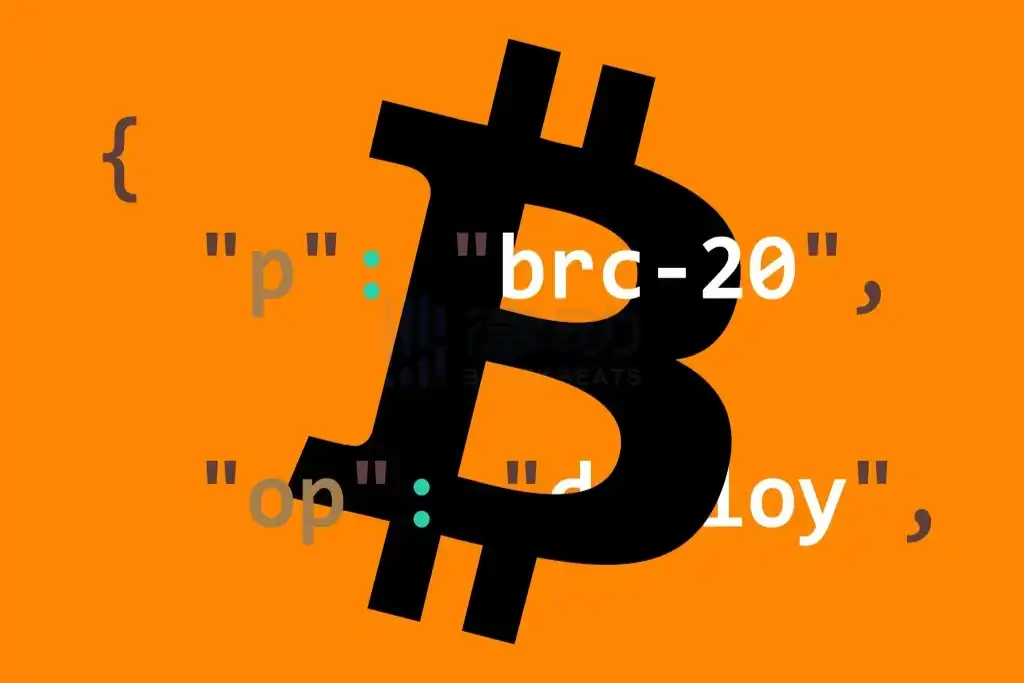
In BRC-20, token operations, including deployment, minting, and transfer, are implemented by embedding JSON-formatted data in Bitcoin's UTXO transactions. This is equivalent to writing on the "banknotes" we mentioned earlier. This approach allows for the free issuance of tokens on the Bitcoin chain. However, Bitcoin cannot manage the account model, and the content of BRC-20 is placed in Segwit's Taproot script, which Bitcoin cannot recognize and calculate the numbers inside. This is like a bank system only recognizing the denomination of banknotes and not caring about what you write on them. Fortunately, unlike centralized banks, all Bitcoin transactions are public, and we can see what is written on all "banknotes". As long as we follow certain rules (ordinal theory) to do the ledger, we can calculate the additions and subtractions off-chain. Therefore, BRC-20 currently adopts the approach of building an index server off-chain to implement various ledger calculations for BRC20 tokens. However, this approach obviously carries the risk of centralization-the service that maintains the ledger does not have a fair game mechanism of POW or POS to ensure that it does not do evil. So this also explains why BRC-20 is seen as adding unnecessary complexity and technical regression in the eyes of some Bitcoin core developers and geeks.
So various new token standards have been developed to address the shortcomings of BRC-20. For example, ARC-20 and Runes use a similar method to calculate token balances by directly equating the token quantity to the Bitcoin quantity in the UTXO (unit: satoshi), i.e. 1 token = 1 satoshi, instead of counting separately. This is like putting a "special mark" on the smallest denomination of banknotes to represent another currency, which is essentially the ancient "colored coins" in the cryptocurrency world. The advantage of this approach is that no off-chain system is needed for tracking transactions or calculating balances. Only an indexing server is required to identify the "special mark", which reduces the cost of the indexing server. However, this also introduces a new problem. In order to reduce spam transactions, the Bitcoin network has a minimum transaction output limit (546 satoshi), which means that token standards like ARC-20 cannot be split into finer granularity transactions, resulting in liquidity similar to NFTs rather than true fungible tokens. But to introduce the calculation of split transactions, it is necessary to perform centralized off-chain indexing transactions. ARC-20 has been stuck on this issue for a long time, with no solution for several months. Currently, the project team seems to be hoping to implement staking split calculations inspired by BitVM's AVM, which is not an easy development task.
CKB如何实现无跨链桥的L2?
From the perspective of expansion, the Lightning Network is already a great L2 solution. The Lightning channel achieves trustlessness through game theory (based on punishment-revocable commitment transactions) and has been running for many years. However, the state channel architecture of the Lightning Network is mainly limited to payments and cannot achieve more complex intentions. As mentioned earlier, implementing a relatively secure and elegant L2 solution that follows the BTC UTXO model and adopts the eUTXO concept for expansion may be a way out. Public chains Ergo and Cardano have both made progress in the eUTXO model and implemented smart contract functionality. However, CKB was the first to think of implementing an L2 solution.
The answer for CKB is to propose the extension protocol of RGB, which is called RGB++. It is more like a "major overhaul" than an extension. CKB's extension inherits the core of the RGB protocol, but adopts different virtual machines and verification schemes. RGB protocol is an open-source smart contract system protocol designed to run scalable, robust, and private smart contracts on UTXO blockchains such as Bitcoin and Liquid. Currently, v0.11 has not been released yet, and its virtual machine AluVM still has a certain distance to go before it can be fully implemented (some say it may not even be possible to complete it until the end of this bull market). Its technical focus is "isomorphic binding", which maps Bitcoin UTXOs to Nervos CKB's Cells - a modified version of UTXOs that can be combined to achieve smart contract capabilities. For the verification scheme, all RGB++ transactions will be synchronized on both BTC and CKB chains, with each having a transaction. The original off-chain client verification has been changed to on-chain public verification of CKB, which is much more user-friendly as users do not need to use independent clients or save original transaction data themselves. Roughly speaking, it means that RGB++ assets issued on the Bitcoin layer can be used for various complex intentions on the CKB layer using smart contracts. CKB does not use any cross-chain bridges but uses native client verification schemes.
In a sense, this is a relatively cutting-edge idea - to expand cross-chain capacity through intent rather than traditional asset cross-chain.
L2 always tries to find ways to lock BTC in L2 using various methods, but to achieve scalability and complex applications, perhaps it is only necessary to focus on intent-based applications in L2?
Although RGB++ is currently just a concept and has not been extensively practiced, this solution is believed to provide a new path for the legitimacy exploration of BTC L2. The future is promising.
Original Link
Welcome to join the official BlockBeats community:
Telegram Subscription Group: https://t.me/theblockbeats
Telegram Discussion Group: https://t.me/BlockBeats_App
Official Twitter Account: https://twitter.com/BlockBeatsAsia

 Related Articles