Connecting multiple blockchains, how does Axelar drive new prospects for cryptocurrency interoperability?
The Original Title: "Universal Interoperability with Axelar: Connecting all Blockchains"
The Original Author: Francesco
The Original Translation: Luccy, BlockBeats
Editor's Note:
Cryptocurrency researcher Francesco introduces the characteristics and advantages of the Axelar network, as well as its position and role in the cryptocurrency field. As an interoperability protocol, Axelar is committed to solving the problems of fragmentation and poor user experience in the current blockchain ecosystem, providing developers and users with a better cross-chain application development and usage experience.
The article provides an in-depth analysis of the architecture, technical composition, and functions of the Axelar network, as well as its impact and significance for the future development of the cryptocurrency field. By explaining the advantages of Axelar in terms of security, development efficiency, and user experience, it provides readers with a comprehensive understanding and knowledge of this emerging technology. BlockBeats has translated the original article as follows:
With the success of Celestia, another network focused on cryptographic infrastructure components is poised to become a key driver of cryptocurrency interoperability, namely the Axelar Network.
Axelar is a proof-of-stake (PoS) network developed using the Cosmos SDK, aimed at serving as a communication bridge between the Ethereum Virtual Machine (EVM) and Cosmos.
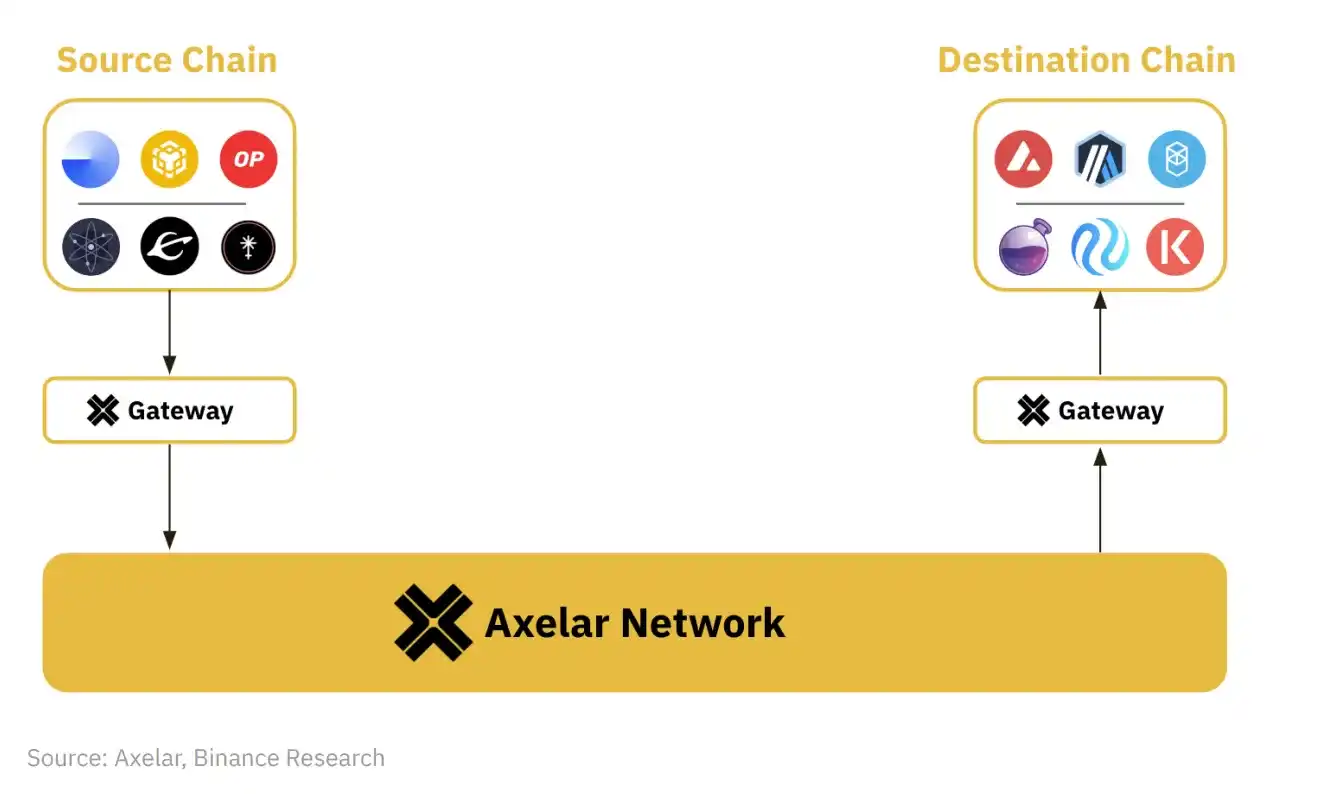
The core value of the Axelar network is to solve the fragmented and painful user experience faced by developers and end users in today's blockchain ecosystem.
In short, Axelar transcends the boundaries of blockchain networks. Therefore, it is also known as a "universal coverage network", ensuring the connection of all blockchain ecosystems, assets, and users, allowing developers to build on the best blockchain network for their specific use case.
You can think of Axelar as:
· An air traffic control system that handles traffic, routing, and border control (verification) between blockchain networks.
· A multilingual translator, referring to the translation between different protocols.
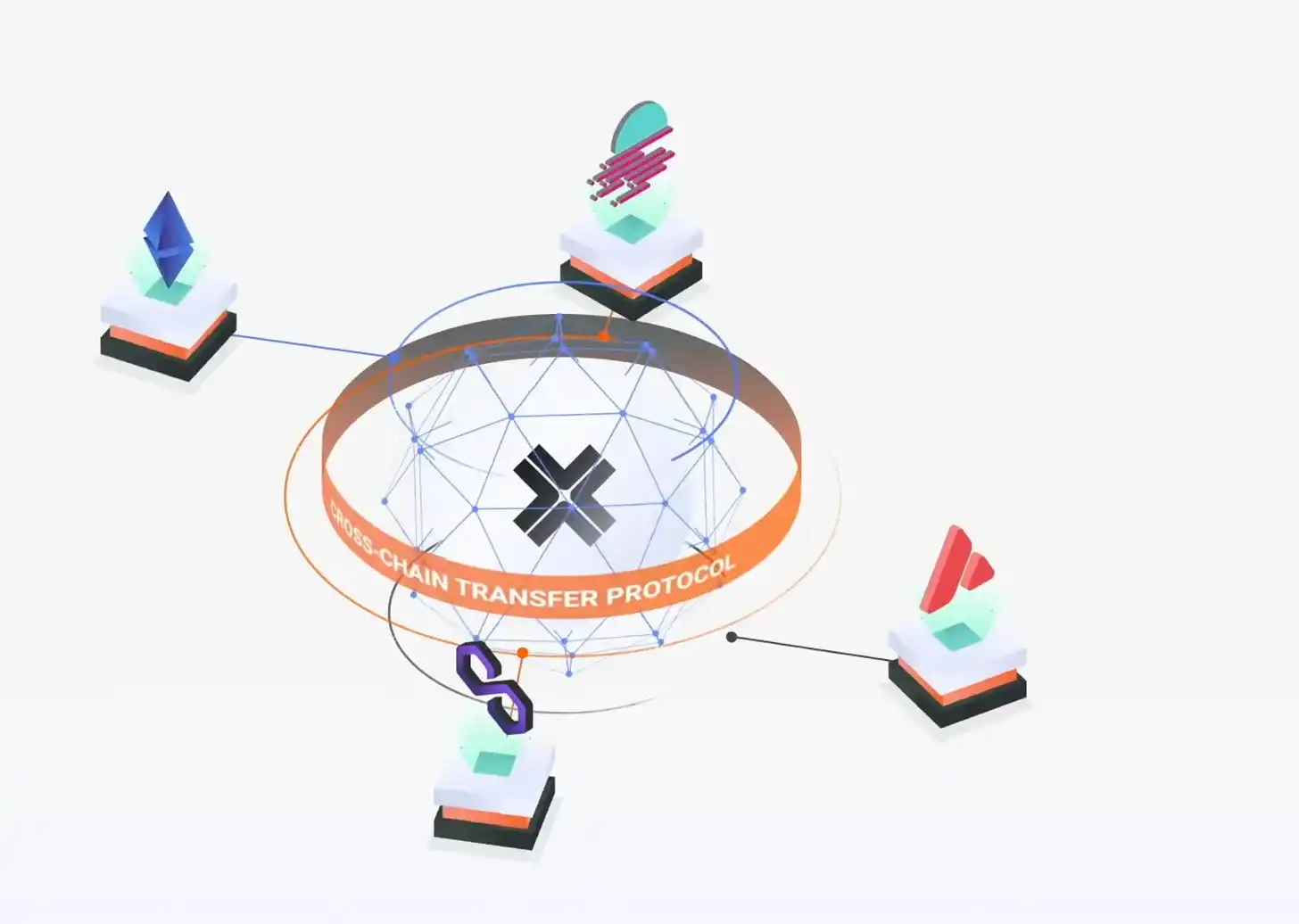
Axelar is particularly focused on empowering developers to develop cross-chain applications more efficiently. The network supports asset transfers, application composability, and universal message passing in any blockchain ecosystem through protocols and APIs.
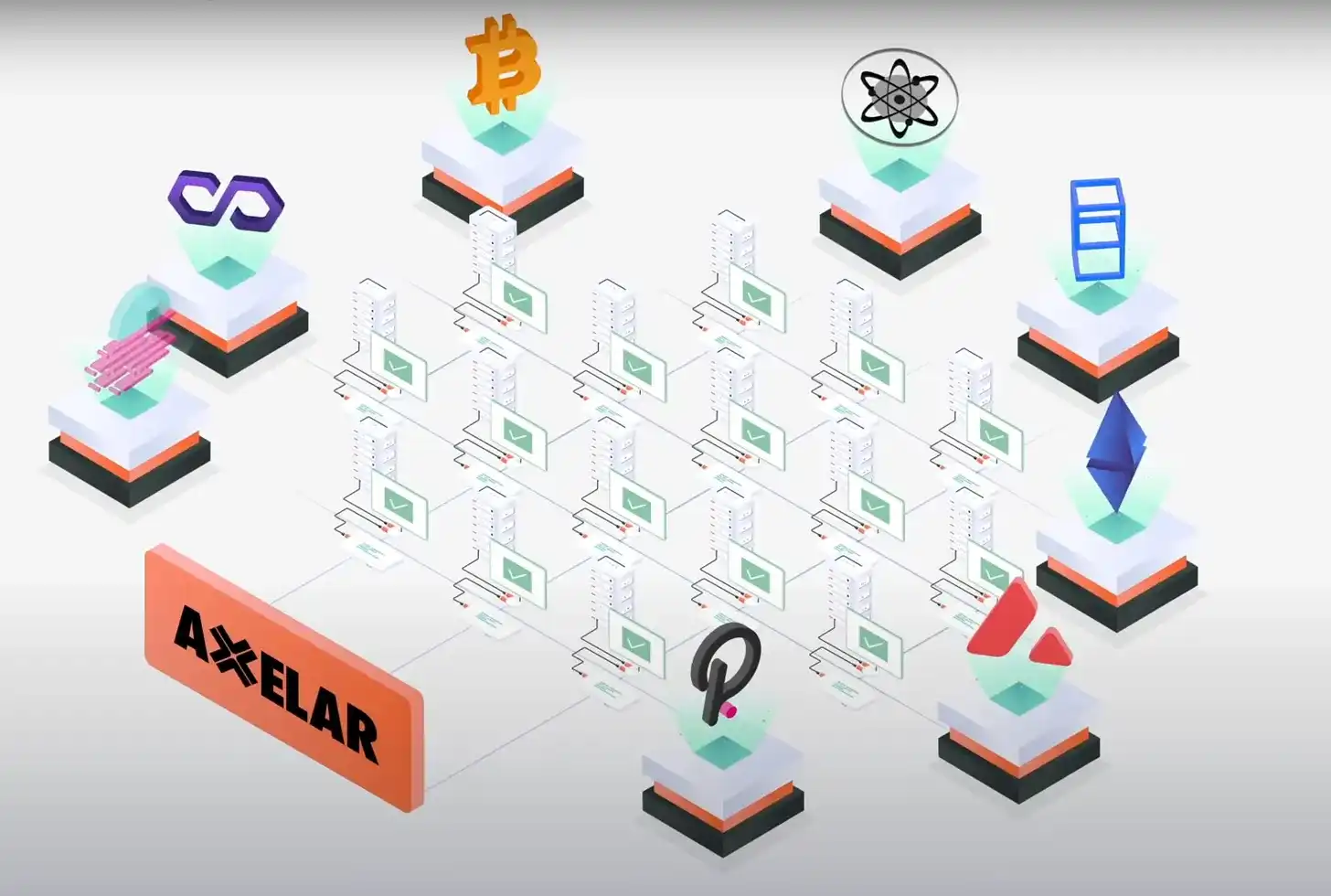
This means that developers can build their dApps on a blockchain and allow their users to interact with assets, users, and dApps on other blockchains.
Axelar 的组成部分有哪些?
What are the components of Axelar?
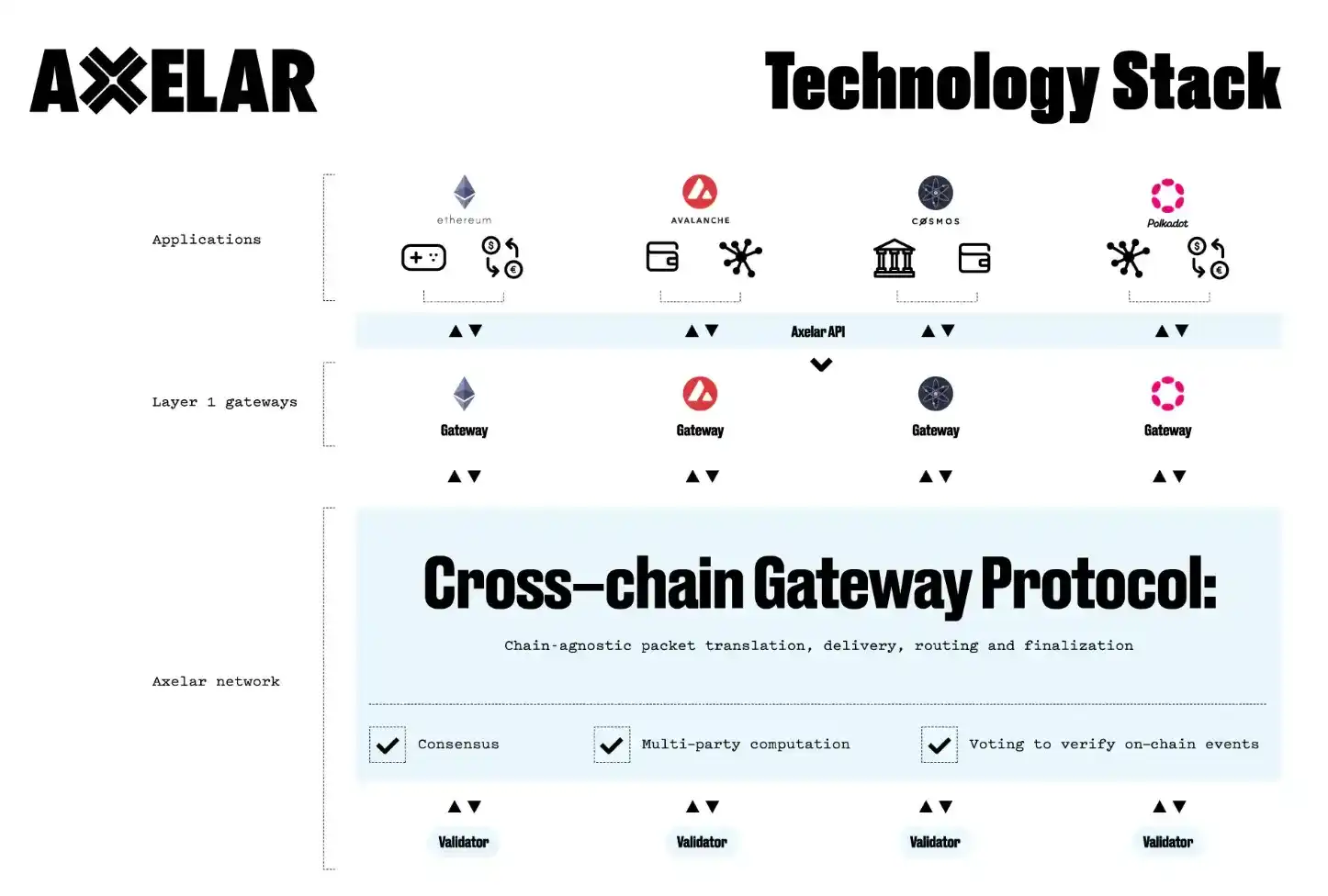
Axelar Network consists of three components on two levels.
A decentralized network: The core of Axelar is a decentralized network operated by a dynamic and permissionless set of validators, responsible for supporting cross-chain interoperability requests. The responsibilities of validators include:
· Maintain the network (running cross-chain gateway protocol).
· Execute transactions (perform read and write operations, and verify these on-chain events through POS consensus).
Gateway Smart Contract: All blockchains connected to Axelar have gateway smart contracts. Validators monitor incoming transactions to these contracts and then:
· Reading· They have reached a consensus on their status.
Together with validators, the gateway contract represents the infrastructure layer of Axelar.
APIs and Developer Tools: These tools and libraries allow developers to access the Axelar application development layer with just a few lines of code, adding "universal interoperability" to their dApps and networks. Some of these include:
· Axelar Gas Services, automatically converts it to $AXL and the target chain gas token.
· One-time deposit address automatic routing, similar to the entrance used by centralized exchanges, but decentralized.
· Cross-chain token service enables developers to issue and manage cross-chain tokens, including interchangeable and customizable cross-chain tokens.
In addition, Axelar also has General Message Passing (GMP) functionality, allowing applications to send and receive any data payload across chains, including function calls, data, and encapsulated assets, achieving a "one-click" cross-chain user experience.
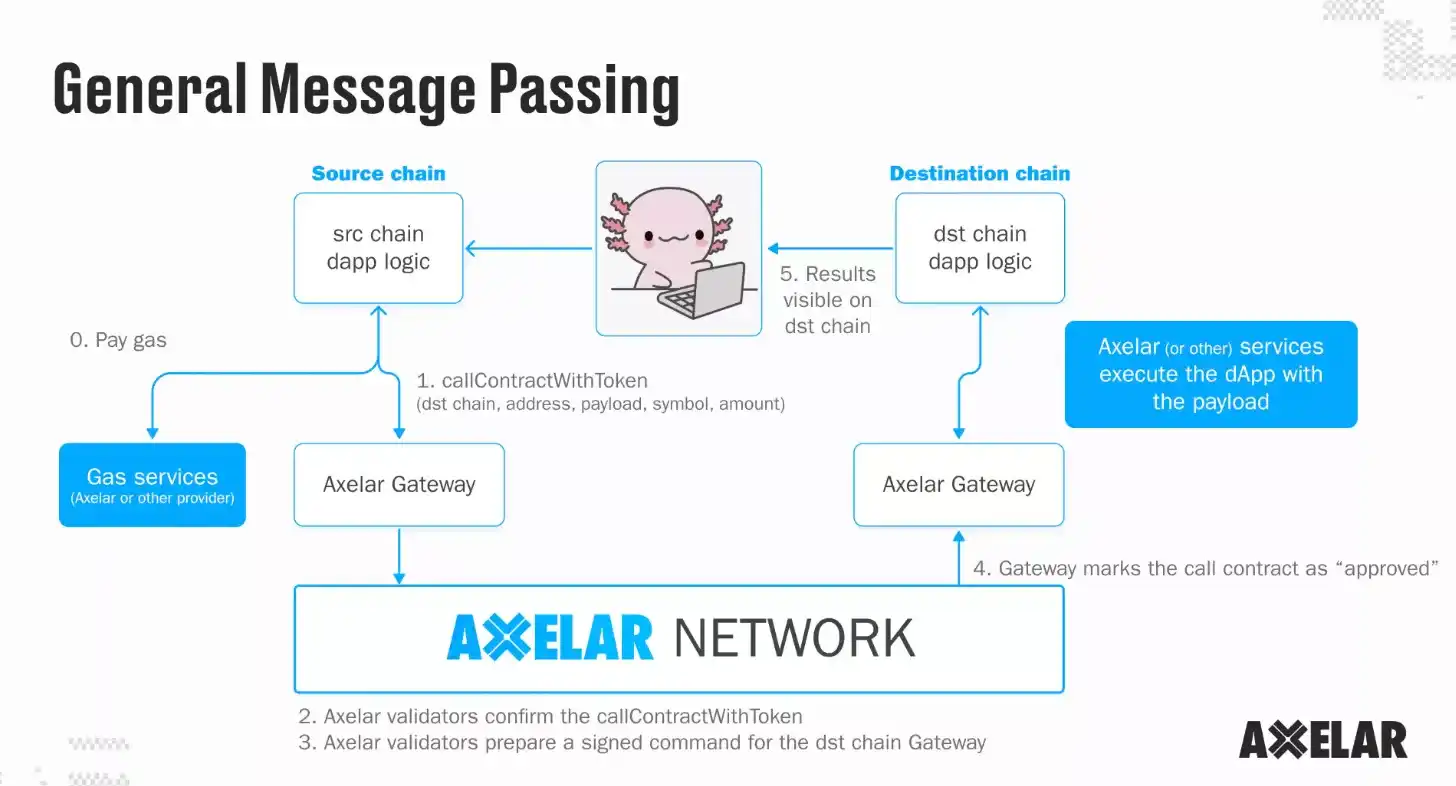
Through GMP, Axelar can synchronize states across all supported ecosystems. This is a game-changing move for application development, as cross-chain limitations have constrained traditional bridging and blockchain infrastructure. Axelar GMP should not be seen as another bridging application, but rather as a new method of cross-chain communication.
GMP Advantages
· Cost-effectiveness: Because it moves function calls and data instead of casting and packaging assets (lower gas costs).
· Minimizing Fragmentation: Assets are kept on a single chain, making it easier to track their status and origin.
· One-click user experience: Folding the entire transaction into one interaction.
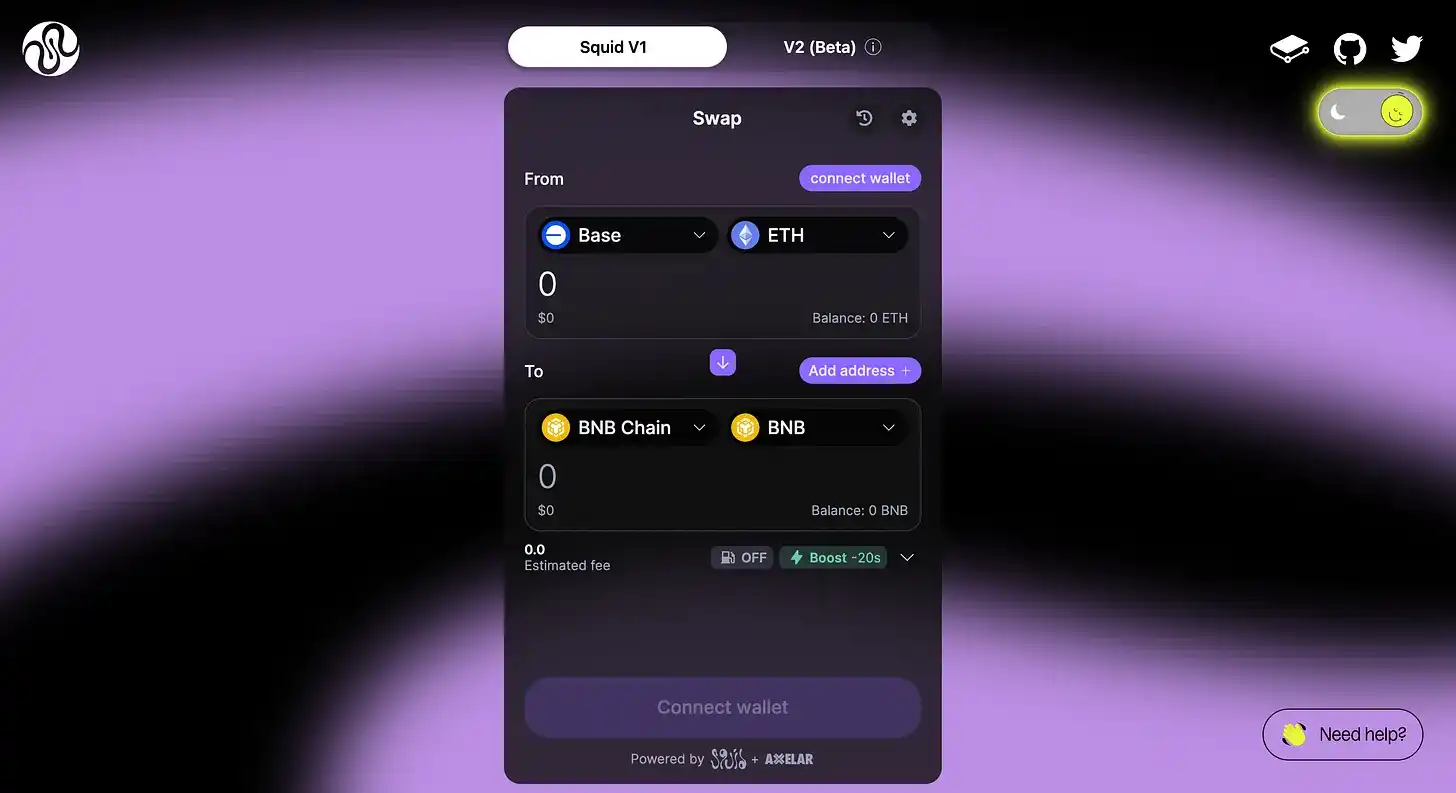
Its working mechanism is to deploy smart contracts on each chain of the Axelar network. These contracts serve as the infrastructure for managing cross-chain communication when Squid users conduct transactions.
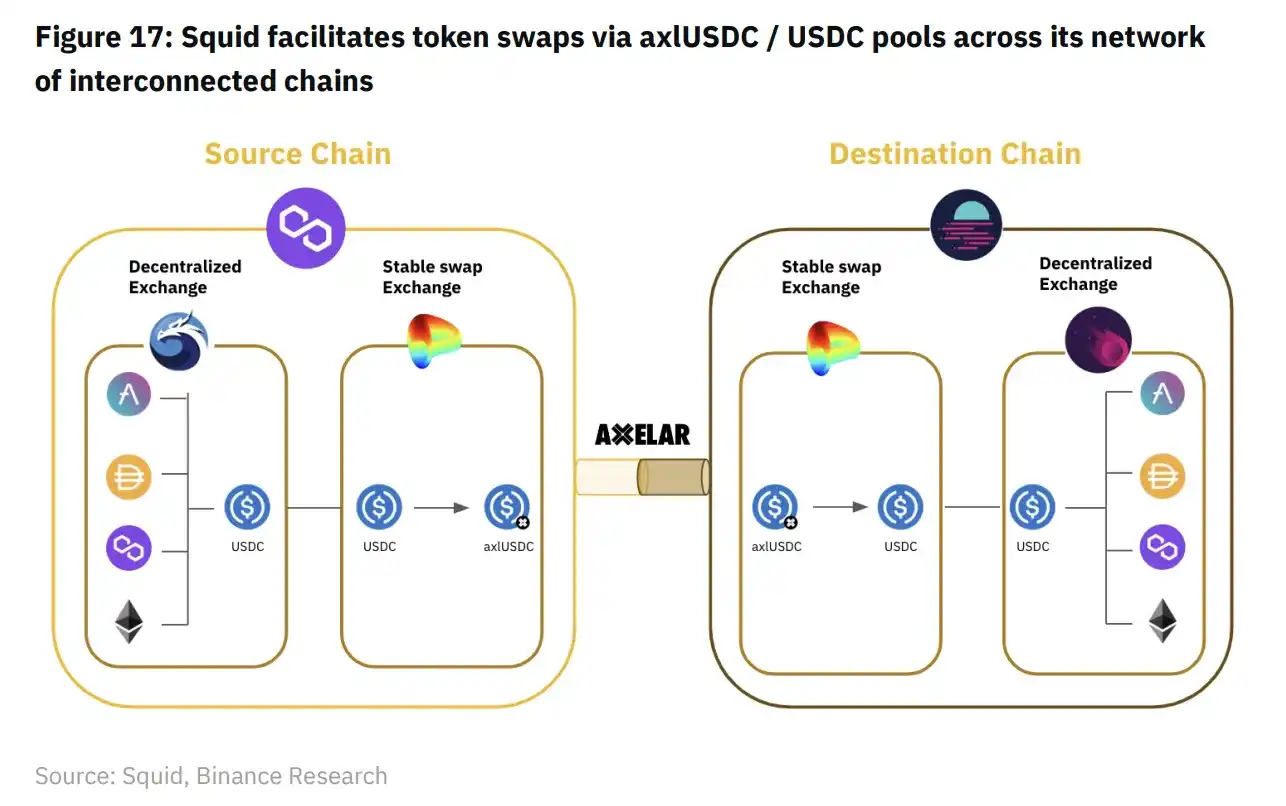
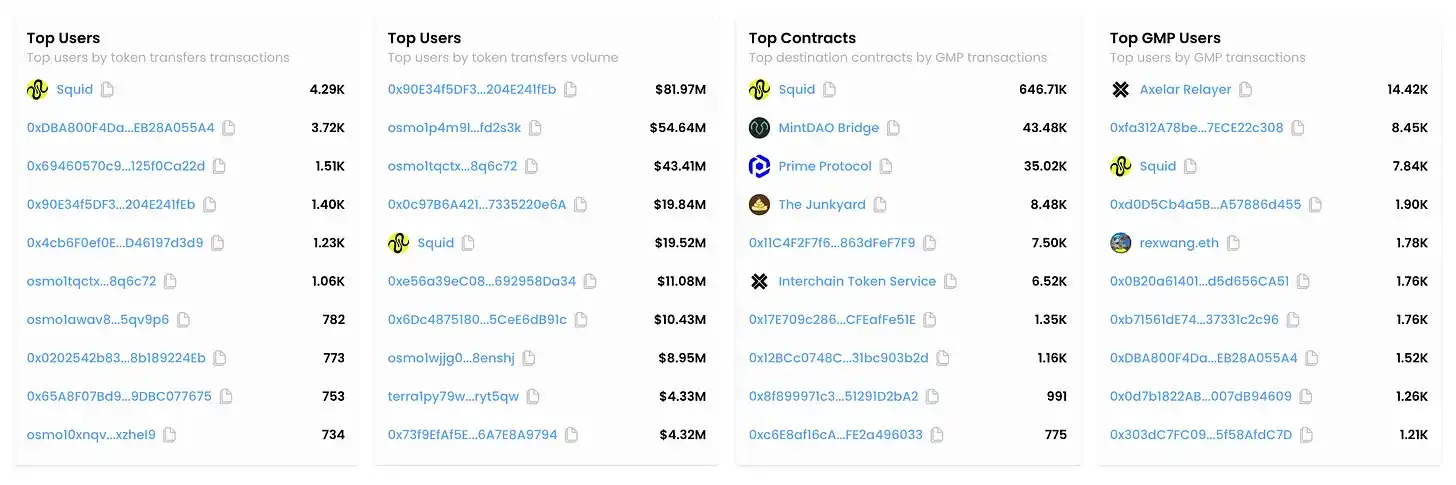
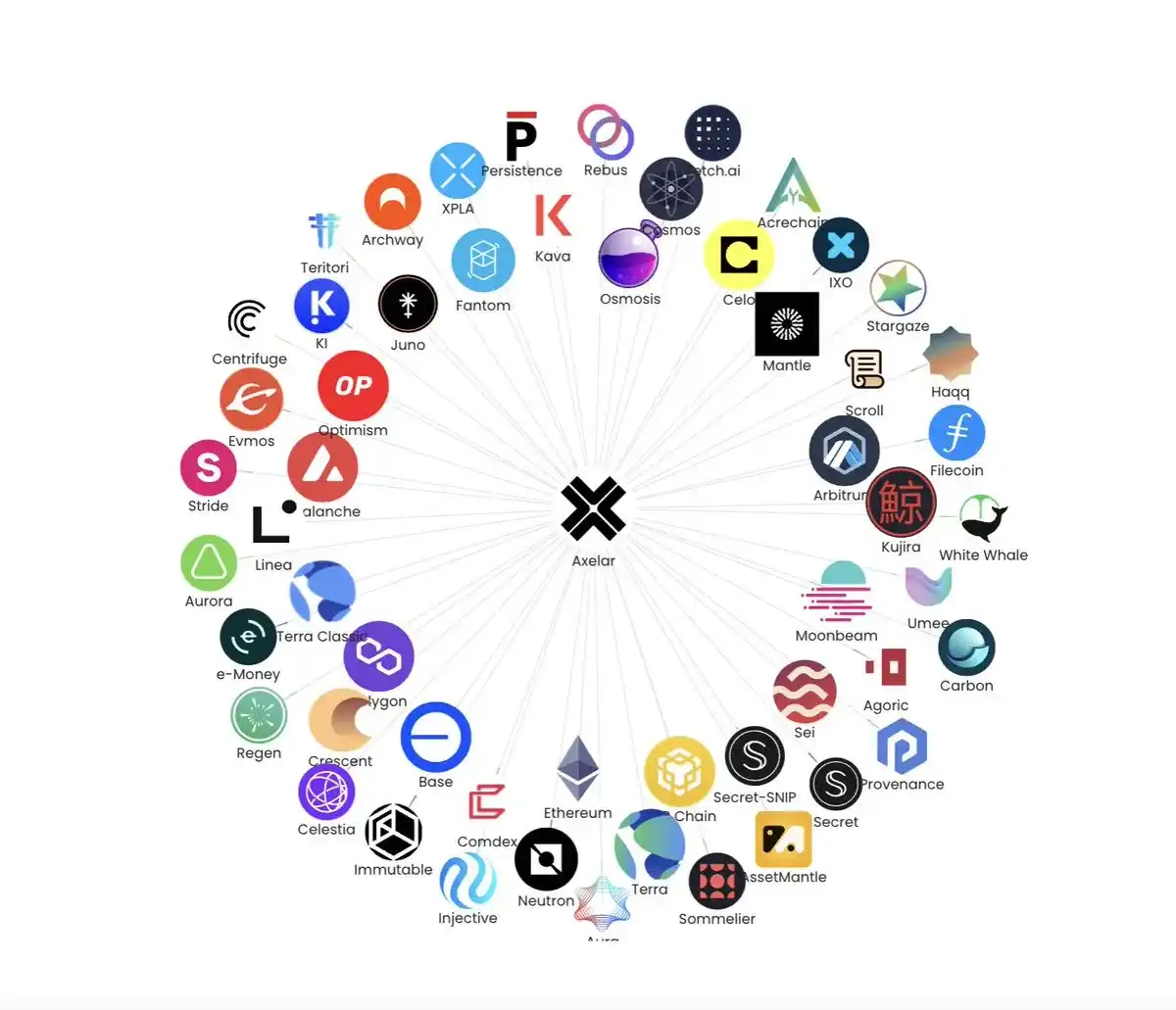
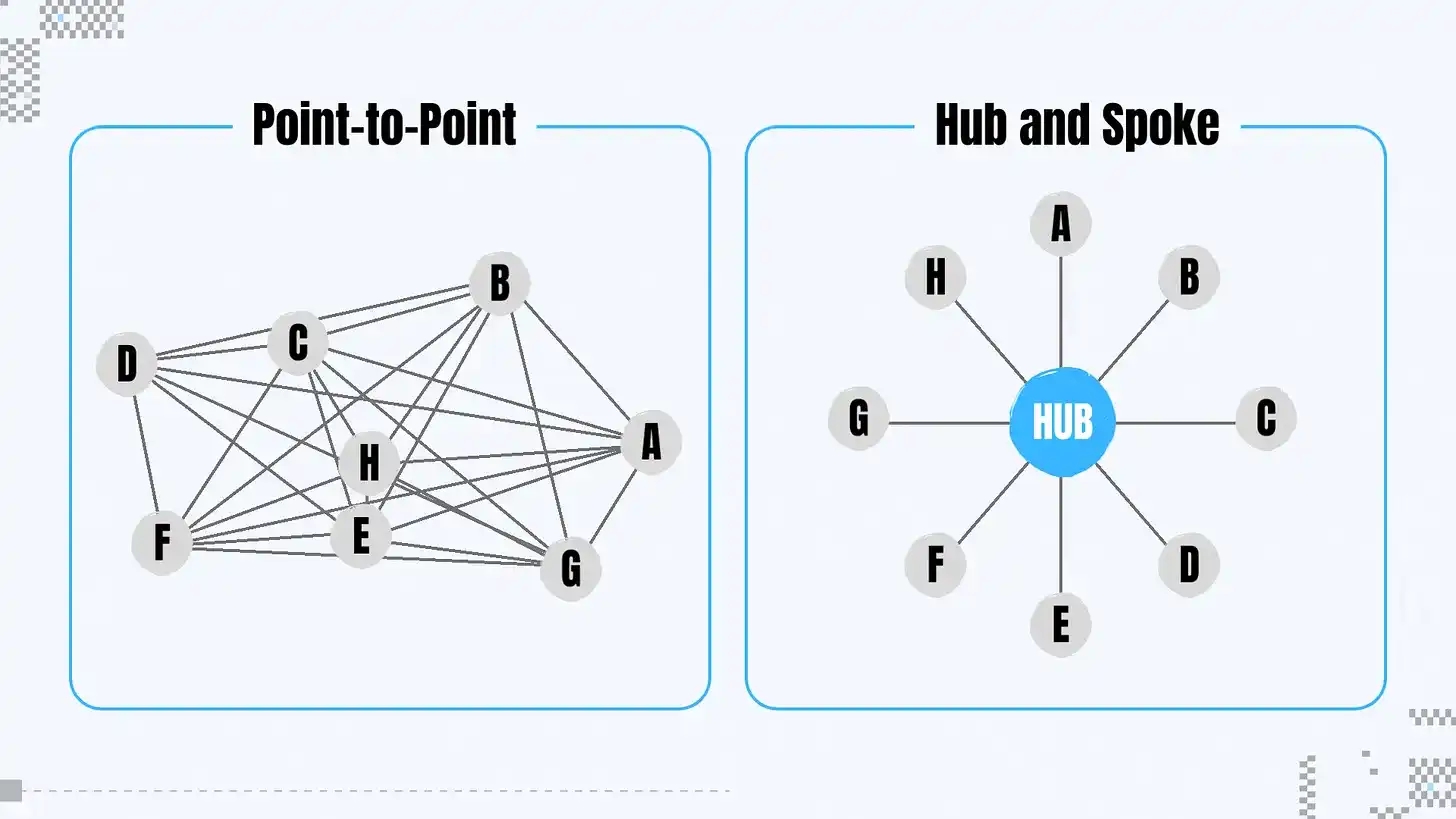
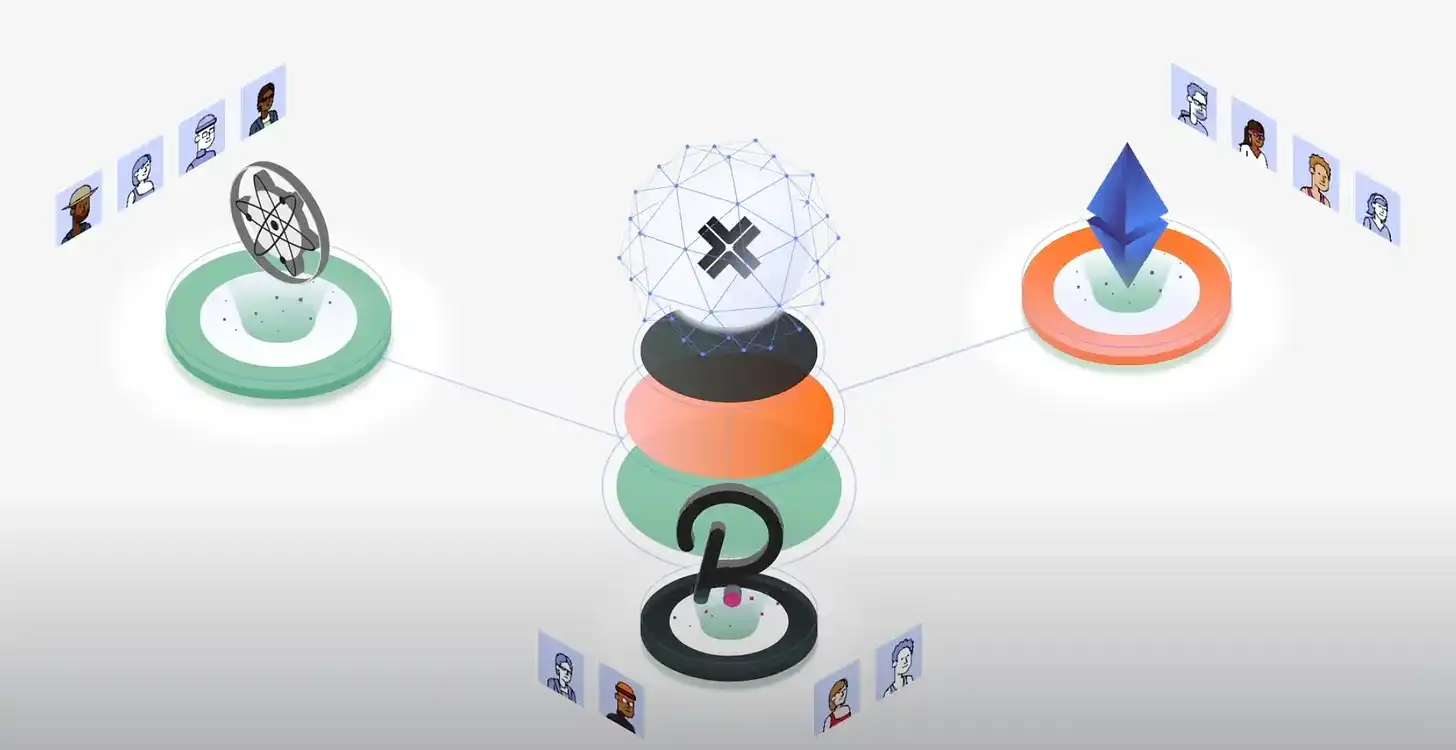
Most other solutions provide "one-to-one" connections, which require specific settings to connect chains to each other. In contrast, with Axelar routing, any network can immediately connect to all networks supported by Axelar.
Compared to current practices, this design greatly improves security and saves a lot of development time.
Axelar acts as a central hub, connecting blockchains to it instead of directly to each other, enabling a "one-to-many" connection. This is why Axelar-wrapped tokens such as axlUSDC and axlETH can move freely between chains.
This is also a security feature of Axelar, because a problem on one chain "can be contained within it", and the central hub and radiating network can isolate the problem. In contrast, in a peer-to-peer network, each one-to-one connection does not know whether other connections are under attack, but still continues to perform cross-chain exchanges, transactions, or bridging.
Development Time
Currently, most cross-chain work is done using non-reusable components, and each new chain connection requires a very long development time. This makes it very difficult to economically scale clients on all chains, as developers must repeat this process on all chains.
On the contrary, Axelar Virtual Machine (AVM) achieves full-stack interoperability, enabling anyone to utilize interoperability as a programmable layer.
Through the development of Axelar, the speed of in-chain operations has increased by 10 times, allowing anyone to directly program on the interoperability layer. Developers can optimize the parameters they want, such as the speed of cross-chain transactions.
Through the Axelar service portal, developers can easily deploy cross-chain contracts and immediately make them compatible with another ecosystem.
By using template contracts, the process has become very smooth. The protocol can run and manage their dApps across chains, simplifying multi-chain deployment.
In this regard, the Axelar stack can be seen as a fully customizable programmable layer. Developers can take full advantage of it, for example, customizing security, adding zk proofs, or light clients.
This week, FraxFinance launched their Fraxtal chain, which has interoperability from day one due to its integration with Axelar.
Axelar prioritizes security in its design, utilizing a POS mechanism and achieving complete decentralization at the consensus layer with a fully decentralized set of over 75 validation nodes, compared to approximately 20 for other competitors.
值得思考
translates to
Worth Thinking About
With the increasingly interconnected landscape, solutions like Axelar have emerged at the perfect time. Until now, most of the development work in the cryptocurrency space has had to deal with the creation of Layer 1 and Layer 2.
Now all of these networks have been created, and the next step will be to connect them, ensuring complete composability and interoperability between the networks.
As an interoperability protocol, Axelar's partnerships are crucial to the appeal of its products. As long as they continue to integrate and support new networks, these tools will become one of the best practices for blockchain deployment.
One of the biggest challenges facing the cryptocurrency industry is abstracting the complexity of interoperability through a very simple user interface. Axelar has contributed to achieving this vision through programmable interoperability.
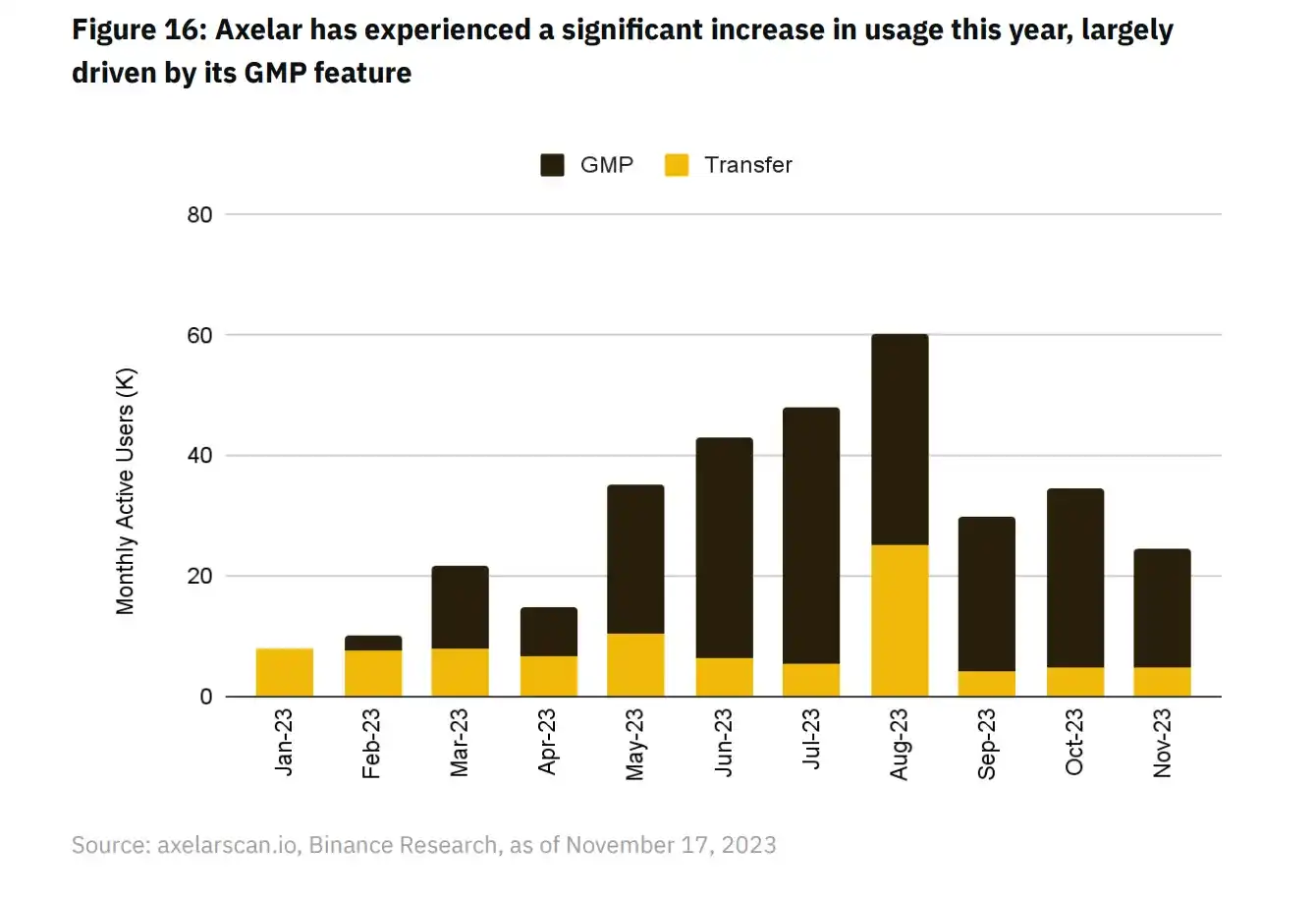
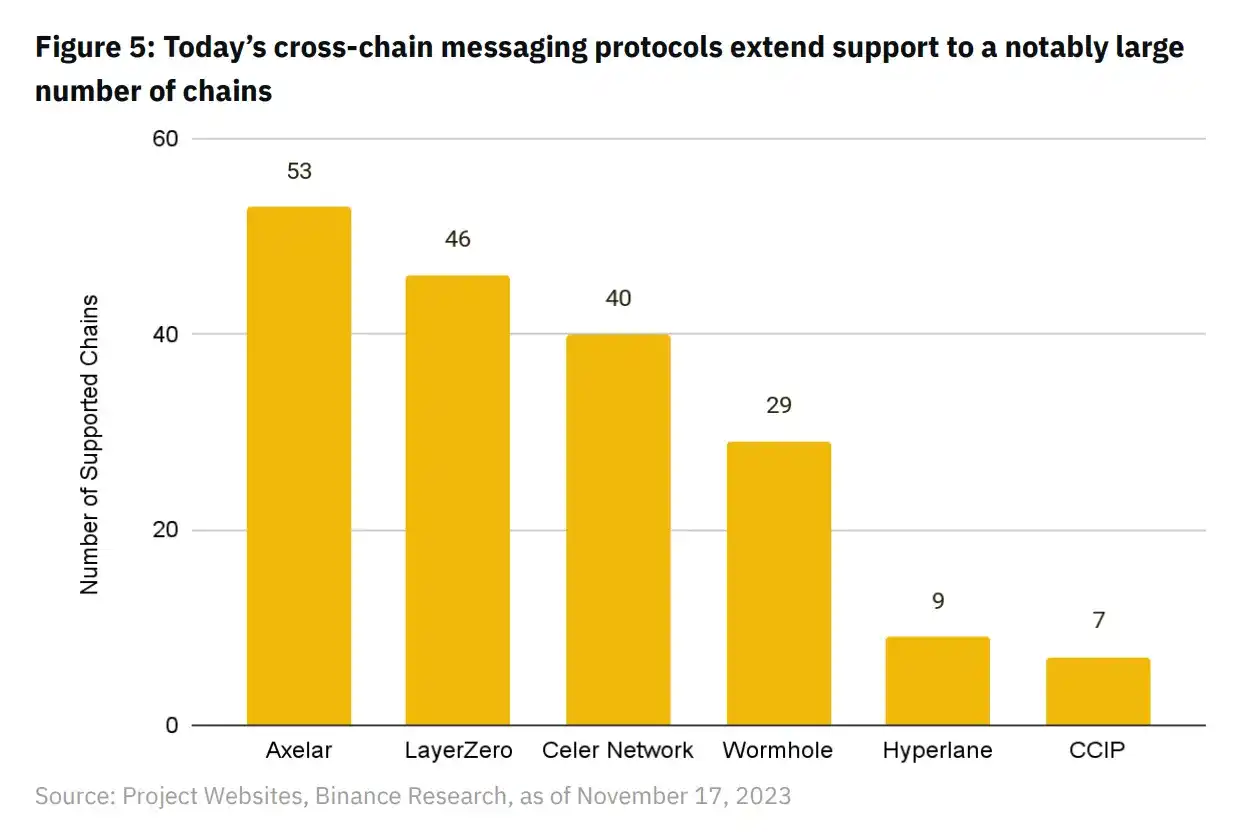
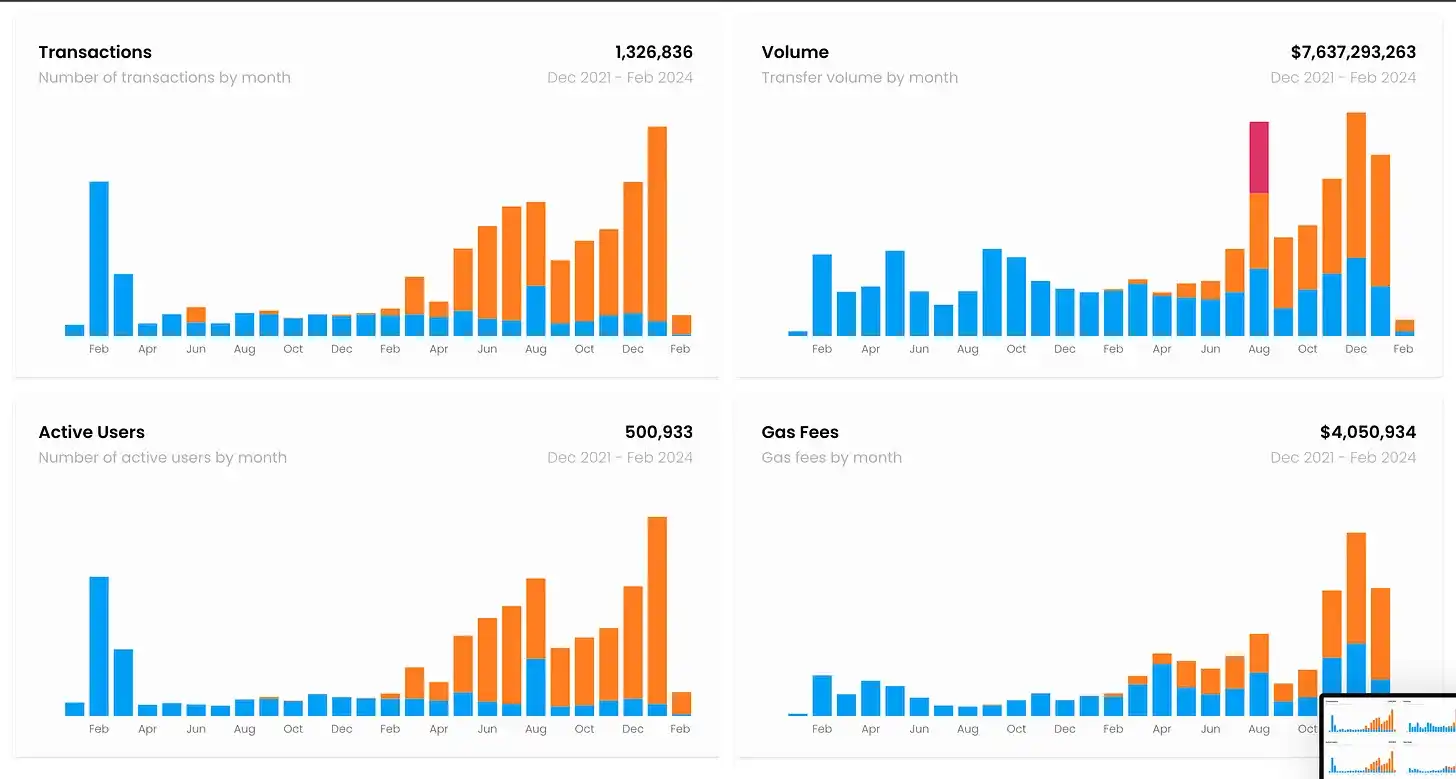
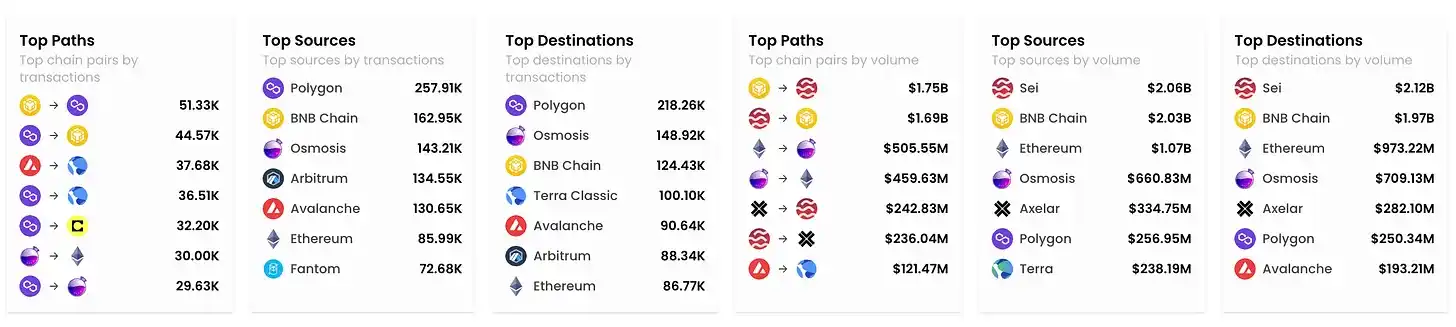
Focus on Data
The chart speaks for itself.
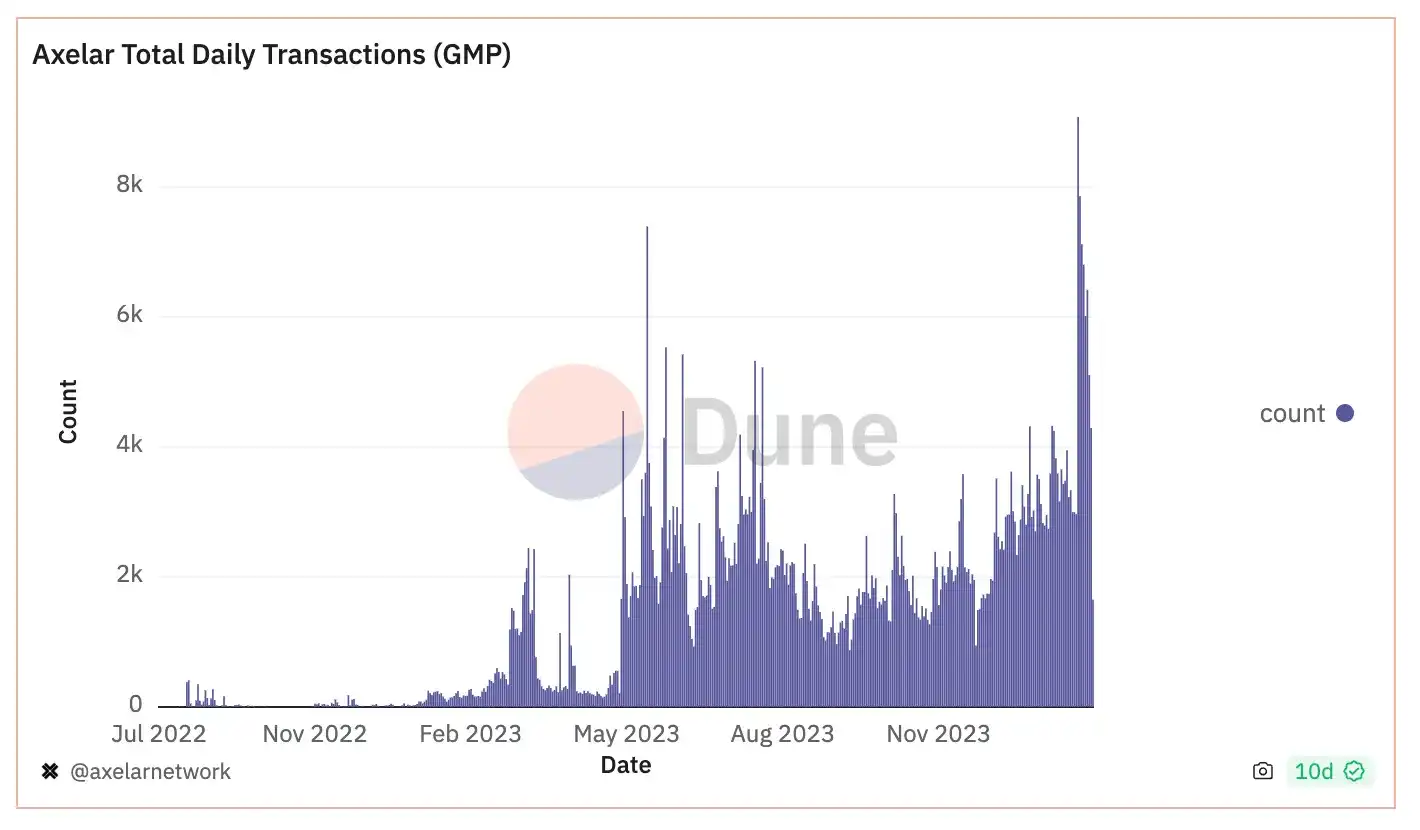
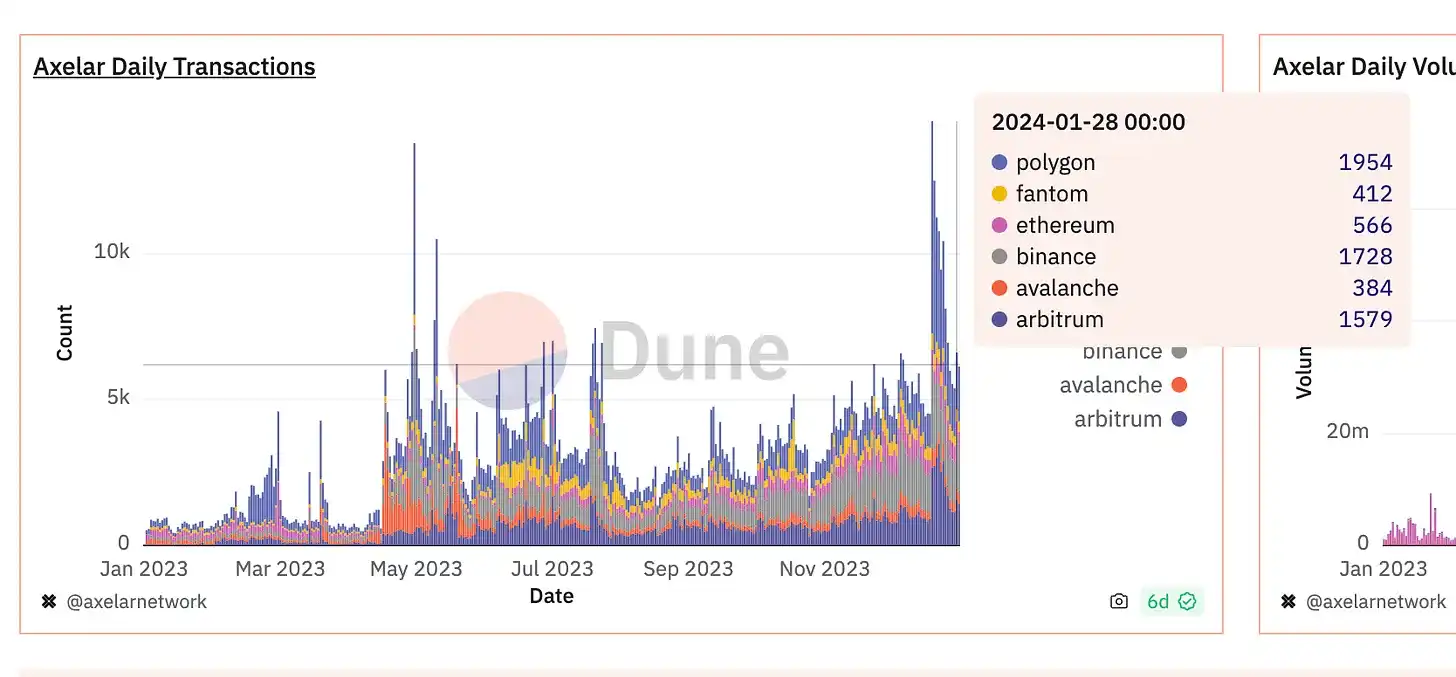
https://twitter.com/zerokn0wledge_/status/1734910258773115373
"Original article link"
Welcome to join the official BlockBeats community:
Telegram Subscription Group: https://t.me/theblockbeats
Telegram Discussion Group: https://t.me/BlockBeats_App
Official Twitter Account: https://twitter.com/BlockBeatsAsia

 Related Articles