What is the recently discussed ERC404 protocol, and how will the representative project Pandora evolve?

Original Title: "Surging 27x in One Week, What Is the ERC404 Protocol That OGs on the Internet Are Ecstatic About? Can PANDORA Become a Phenomenon Project?"
Original Source: Followin
These past few days, a niche project has brought OG players to a climax, especially NFT players, feeling that it is likely to be the savior of the NFT track mired in a quagmire.
This project is called PANDORA, a 10k NFT project. No, a token... well, it doesn't seem right.
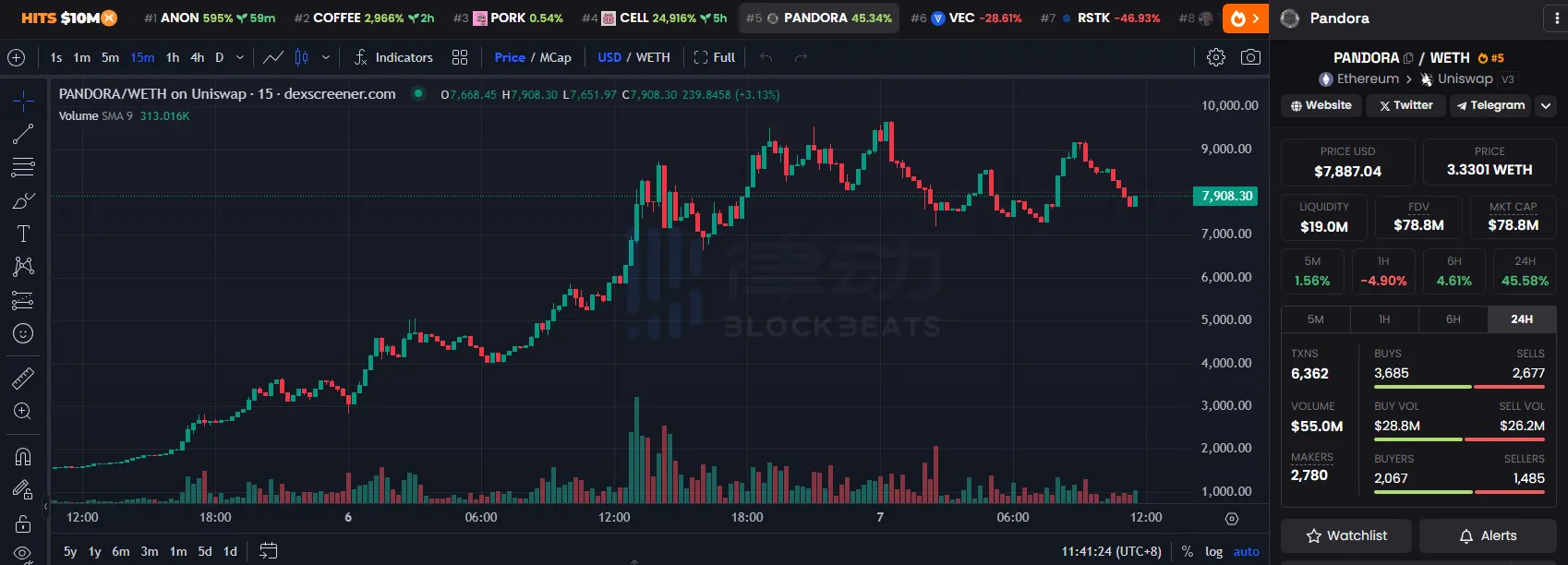
Anyway, from the data, a week ago, the price of one token was $200, and it is currently at $7900. As of the time of writing, the PANDORA pool has approximately $20 million in liquidity, a 24-hour trading volume of $55 million, and a market cap of $79 million.
What Is the ERC404 Protocol?
To talk about PANDORA, we must first talk about what the ERC404 protocol is.
According to the official documentation, ERC404 is an experimental, hybrid ERC20 / ERC721 implementation, featuring native liquidity and fractionalization.
That sounds abstract, in plain language, the protocol allows NFTs to be traded like tokens, an art token exchange protocol.
Imagine that ownership of a costly, illiquid blue-chip NFT like PUNK can be traded on mainstream exchanges as a liquid asset, as if it were a common ERC20-like token asset.
This means that the ERC404 protocol addresses the liquidity issue of NFTs. However, it differs from the previously popular method of solving NFT liquidity through fractionalization. The ERC404 protocol can amalgamate art tokens but still enable separate buying and selling.
Now let's take a look at the official and more hardcore yet obscure explanation: While these standards were not designed to be used together, this implementation aims to hybridize in the most robust way possible while minimizing trade-offs. In the current implementation, ERC404 effectively isolates ERC20 / ERC721 standard logics or introduces paths where possible. Paths can best be described as a lossy encoding scheme where token quantity data and IDs share space, assuming that there are neglectable token transfers that do not or should not occupy ID space.
This new concept standard is purely experimental and has not yet undergone full external review. Due to the overlapping nature of the standard, most integrated protocols have not fully understood its hybrid functionality.
Currently, the ERC404 protocol is fully open source, so developers can both use it to launch their own projects based on the protocol and engage in secondary development of the protocol itself.
It sounds fantastic, but it must be noted that the project is still in its early stages.
Firstly, the ERC404 standard has not yet been through the ERC standard protocol review process. To become an ERC standard protocol, it needs to go through processes such as EIP proposal, experimentation and demonstration, review and audit, community involvement, documentation, and specification. The current status of ERC404 is likely in the second or third stage. As additional information, there are currently 391 ERC standard protocols, with only the well-known ERC-721 and ERC-1155 related to NFTs.
Secondly, there is no official website, only a Telegram group.
Thirdly, only a few OG players are sharing about it.
Currently, we have not seen the project team but have only come across information stating that the project was developed by a former Coinbase engineer.

What is the Meteoric Rise of PANDORA?
Pandora is the first project built on the ERC404 token standard, a 10k NFT project corresponding to 10k PANDORA ERC20 tokens.
Buying a PANDORA token means that an NFT is minted and automatically appears in your wallet, selling the token means the NFT is burned. Transferring the token also involves the destruction and re-minting of an NFT. However, transferring an NFT does not change the NFT itself.
This means you can sell your NFT to Uniswap's liquidity pool without having to list it on a trading platform and wait, unlike mainstream NFT trades.
However, this Pandora NFT has 5 rarity levels. If you specifically desire to own a certain rarity of NFT, then you should directly purchase the NFT. If you are unconcerned about the rarity of the NFT, buying the token for automatic NFT synthesis will display its corresponding rarity.
"We believe this is not just a novelty. Pandora showcases the potential of ERC404 as a token standard, capable of achieving persistent native liquidity and the fractionalization of future NFT collections." the project team stated.
What features come to mind when you think of Pandora? That's right, a bit like the recent hit project Peanut NUTS on Solana, isn't it? In fact, early players jokingly referred to Pandora as Ethereum's Peanut NUTS.
According to Dextool's data, as of the time of writing, the PANDORA token price is at $5465, with pool liquidity of around $15 million, 24-hour trading volume of $27 million, and a market cap of $54 million.
Looking at the recent price increase and market cap, it's quite scary and expensive.
Additional information shows that Lbank.com has tweeted that they have listed PANDORA on their Innovation Zone.
In addition to Pandora, the official "sample" project based on the ERC404 protocol, there have been some new projects following suit, with the first project officially retweeted being ANON.
How will ERC404 and Pandora evolve? Can you participate?
The ERC404 protocol has a very "charming" narrative that allows for fractionalized trading of NFTs, solving the thorny issue plaguing the entire NFT space. Combined with the success of the Peanut NUTS, the concept of token duality is likely to experience a small explosion.
In the overseas community, some have also seen the potential of development and iteration based on ERC404, which has made them very excited.
Some OGs shared views stating: The protocol inherently gives NFTs the properties of NFT-Fi.
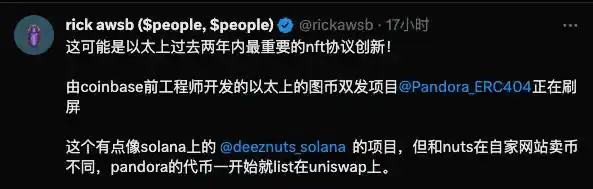
Twitter user @rickawsb commented: The native tokenomics adding a new dimension to asset gameplay instantly. We may soon see more creativity. This could be the most significant NFT protocol innovation on Ethereum in the past two years!
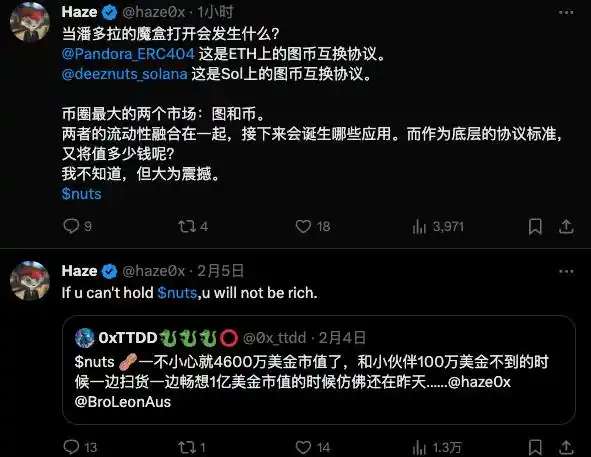
KOL @haze0x said, the two biggest markets in the crypto world are tokens and NFTs. When the liquidity of the two merge, what kind of applications will emerge next? And as the underlying protocol standard, how much value will it hold? I don't know, but I'm greatly impressed. Starting to experiment with token-to-token swaps to further unleash the bidirectional liquidity of NFTs and tokens. This is an iteration of cognition and thinking, bringing the widest range of participants into a project, anticipating the wealth effect.
A well-known research account in the first-class cabin posted, saying it's quite fun, and we're still at a very early stage. They recommend everyone to pay attention to it quickly. Remember to manage your position size when you join the game. I'm already on board anyway.
A reminder once again, this project is still very early, and it has not yet been professionally audited. Please carefully assess the trading risks.
Original Article Link
Welcome to join the official BlockBeats community:
Telegram Subscription Group: https://t.me/theblockbeats
Telegram Discussion Group: https://t.me/BlockBeats_App
Official Twitter Account: https://twitter.com/BlockBeatsAsia