When the Bitcoin ecosystem is in general decline, why is only BRC-420 rising?

Author: Jaleel, BlockBeats
Editor: Jack, BlockBeats
In the past few weeks, as Bitcoin has fallen, the inscription market seems to have entered a small "low tide" again, and "classical" assets such as ORDI and SATS have also fallen to varying degrees. This month, ORDI fell by 21% and SATS fell by 34%. Fortunately, the news of several protocols being launched on OKX in recent days has made several related inscription assets more active and has seen some gains.
Recently, a table showing the rise and fall of Bitcoin community assets on January 24th, compiled by the community, has been widely circulated. It is obvious that on that day, BRC-420 assets rose against the trend when Mingwen ecological assets fell across the board.

BRC-420 protocol is developed by the Bitmap Tech team (formerly RCSV team), which allows the combination of multiple inscriptions in a recursive manner to create complex assets such as game items, animations, effects, or game modules. BRC-420 also combines usage rights and royalties, providing users with the ability to allocate usage rights and set prices for inscriptions they own.
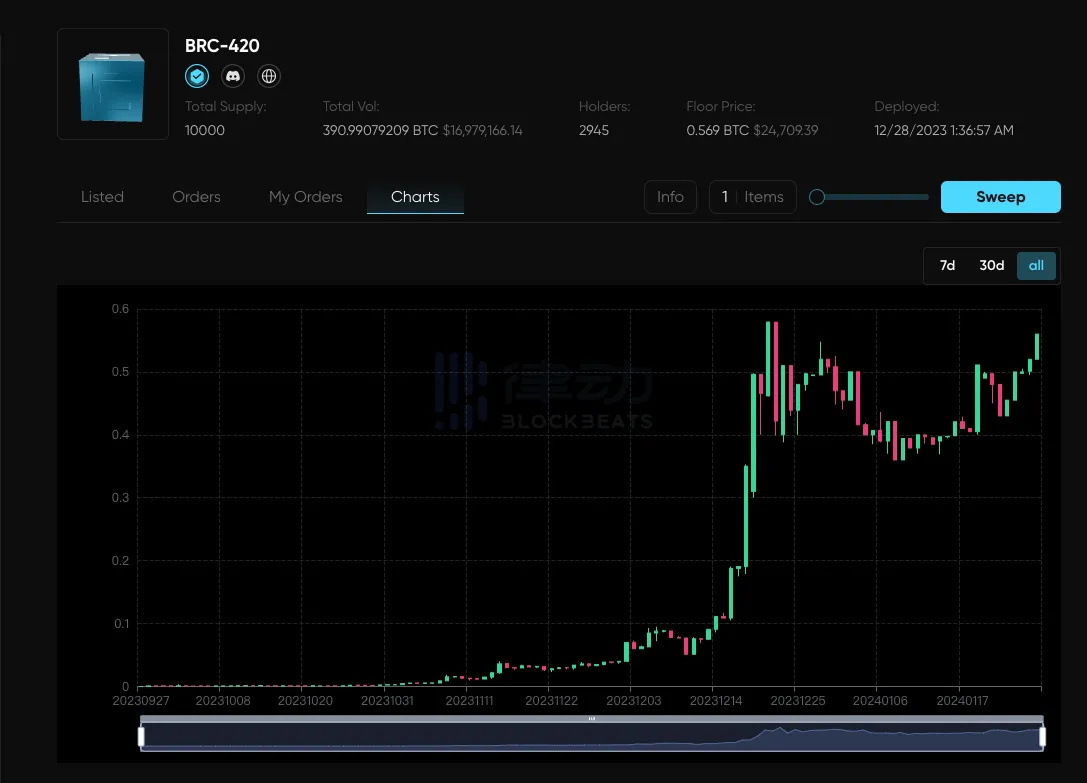
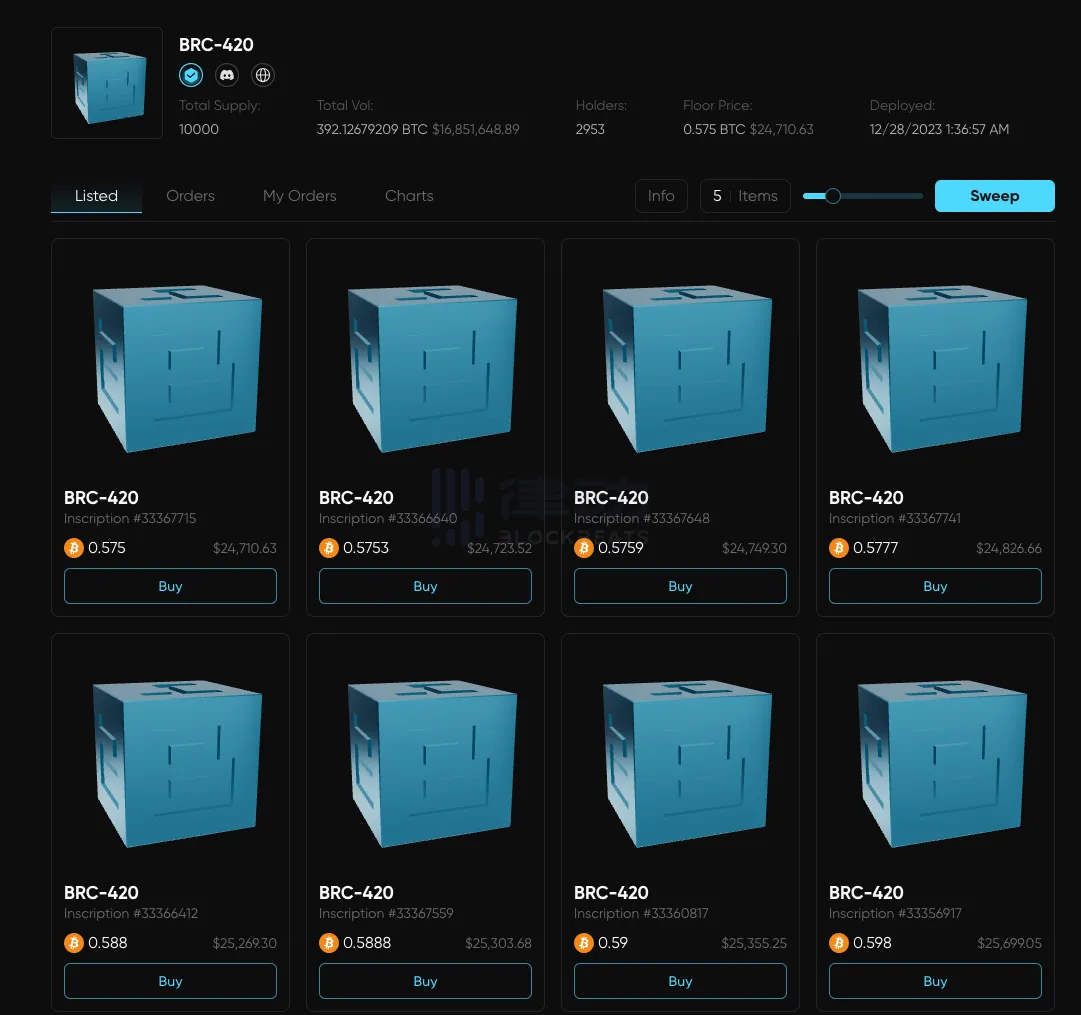
Initially in September, the minting cost of the largest asset in the BRC-420 market, Blue Box, was as low as $1. However, as of the time of writing, the floor price has reached nearly $25,000. The increase is already astonishing just by listening to the numbers, but when compared to the leading Bitcoin ecosystem, ORDI, the increase is even more striking. At that time, the cost of one ORDI (which includes 1000 coins) was between $2 and $3. Based on the price of $60 per ORDI, the current price of one ORDI is $60,000, which is an investment with an increase of over 20,000 times. However, ORDI took nearly 10 months, while Blue Box took 4-5 months.
It is worth noting that on December 26th, Recursiverse announced the upgrade of its main brand to Bitmap Tech and announced its four businesses. At that time, the overall market value of Bitmap Tech had exceeded $500 million.
Continuing on January 19th, Bitmap Tech (formerly Recursiverse) officially announced that it will launch the Bitcoin Layer 2 network Merlin Chain, which is built on the basis of native assets, protocols, and products of the Bitcoin Layer 1 network. Merlin will bridge multiple Bitcoin Layer 1 native assets to Layer 2.
Riding in the passenger seat of Bitcoin Layer2
Riding on the Bitcoin Layer2 bandwagon may be a key factor in the BRC-420's counter-trend surge.
From the beginning of last year to now, the Bitcoin ecosystem has experienced several downturns. After a year of hype, it seems to be at a critical moment. The undisputed consensus in the market is that the Bitcoin ecosystem will still be the biggest hotspot for a long time to come. Therefore, the market is now looking for new opportunities in the BTC ecosystem, and many users at home and abroad believe that the outbreak point in the later stage will be Bitcoin Layer2.
Therefore, in the recent Bitcoin ecosystem, it is evident that there are more and more Bitcoin Layer2 projects. Currently, there are over thirty Bitcoin Layer2 projects in the market. Clearly, both in the project side and the community, Bitcoin's Layer 2 solutions are becoming increasingly popular.
It is worth noting that Bitmap Tech's four businesses include: in addition to the metaverse platform of Bitmap.Game, the BRC-420 asset protocol and trading market, and Recursiverse's recursive application matrix, the most important business is the Bitcoin Layer 2 network Merlin Chain, which is currently undergoing testing.
Merlin Chain's Bitcoin Layer 2 solution integrates key modules such as the ZK-Rollup network, decentralized oracle network, and on-chain fraud proof for the purpose of empowering Bitcoin's native assets, protocols, and application ecosystem.
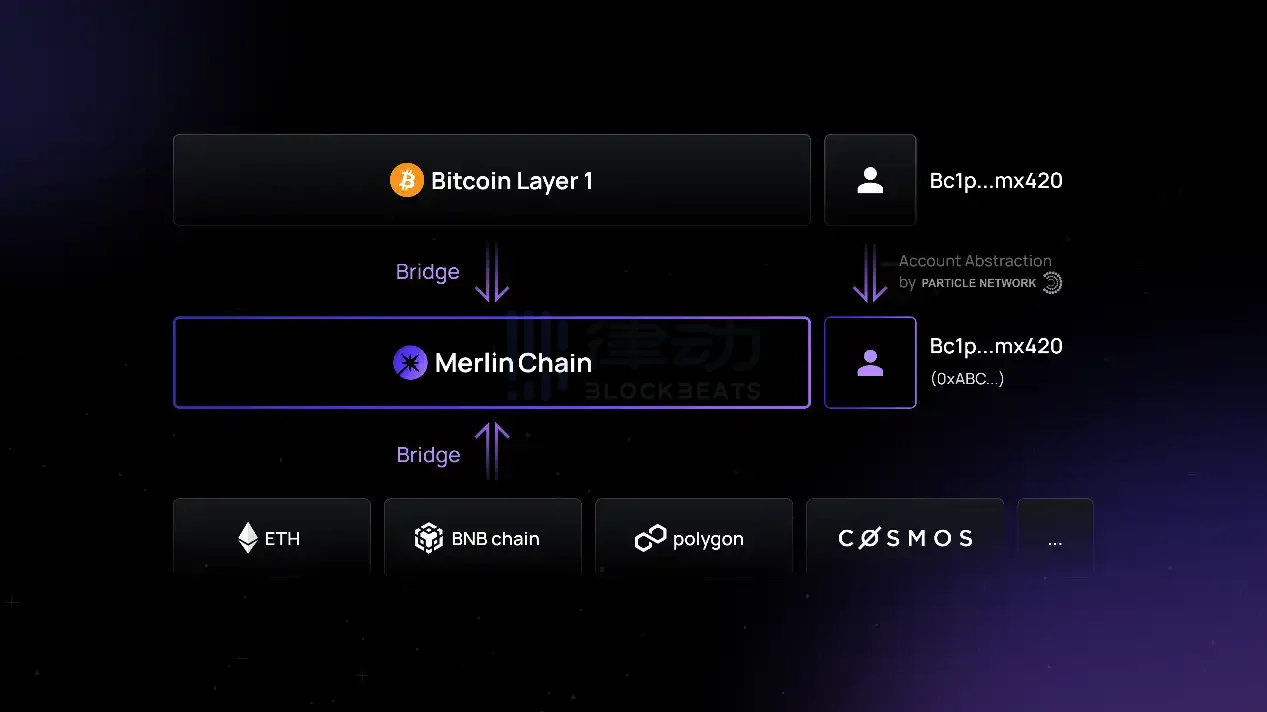
Merlin Chain has a specific plan for Bitcoin Layer2, which can be seen from some more detailed directions in the official announcement of several strategic partners.
Bitmap Tech has officially announced three new strategic partners, namely Particle Network and the newly launched BTC Connect solution, which provide account abstraction services for BTC; Lumoz designs and builds ZKEvm for BTC Layer 2; and iZUMi Finance provides efficient decentralized trading and liquidity solutions for BTC Layer 2.
Among them, iZUMi has launched DaaS service and collaborated with the Bitcoin Layer 2 network Merlin Chain to launch Merlin Swap. Merlin Swap is operated by an independent team with official support from Merlin Chain and technical support from izUMi Finance. It is committed to providing a centralized exchange-like experience in the DeFi ecosystem by leveraging the stability of the Bitcoin ecosystem and the interoperability of Merlin EVM. Moreover, 80% of the total supply of Merlin Swap's tokens will be fairly distributed to traders and liquidity providers of Merlin Swap to incentivize ecosystem development, and airdrop rewards will be provided to users of izUMi Finance and Merlin Chain.
Although it was previously announced that there would be no incentive plan for the Merlin Chain testnet, NanFeng, CEO of Lumoz (formerly Opside), a partner of Merlin Chain, announced during the Space event hosted by BlockBeats on January 29th that Merlin Chain will officially launch in February this year and will introduce some incentive activities at that time.
In addition, Merlin Chain has adopted the Cobo MPC solution to ensure that funds are in a non-custodial state, thus ensuring security. After all, since its inception, Cobo has been focused on how to securely manage private keys and the security and risk control measures needed around private key management, and has had a certain influence in the industry.
The interaction of Bitcoin's first layer has a certain threshold for new users, which limits the influx of new funds. Merlin hopes that the second layer will become the "starting point" for users, where users can experience the native gameplay of BTC on Merlin, whether they deposit BTC or other tokens such as USDT/USDC/ETH/BNB.
One Layer Asset, Recursive Matrix
About combination, recursion, and the past summer of DeFi, it was actually a form of expression, and it was the DeFi Lego blocks like DEX, aggregation, and lending that triggered the appearance of Lego blocks. In the NFT field, it is difficult not to mention Loot, which can be said to have opened a new era of NFT composability.
Loot, also known as OG Loot, was launched on August 25, 2021, with a total of 8,000 units, of which 7,779 are currently in circulation on the market. Each NFT represents a loot bag containing 8 pieces of equipment, with each line of text describing the corresponding equipment: one item for the adventurer's feet, hands, chest, neck, and head, as well as one ring, belt, and weapon. Due to the openness of Loot, it has greater imaginative potential. Some community users have already used it for simple building, such as generating artwork.

In BRC-420, the composability of assets refers to the ability to combine multiple components or elements together when creating digital assets, in order to create new and more complex assets. This feature allows asset creators and users to innovate and customize based on existing assets, thereby increasing the flexibility and diversity of assets. Through composability, it is easier to create customized assets that meet specific needs and functions, which is particularly important in fields such as gaming, art, and the metaverse.
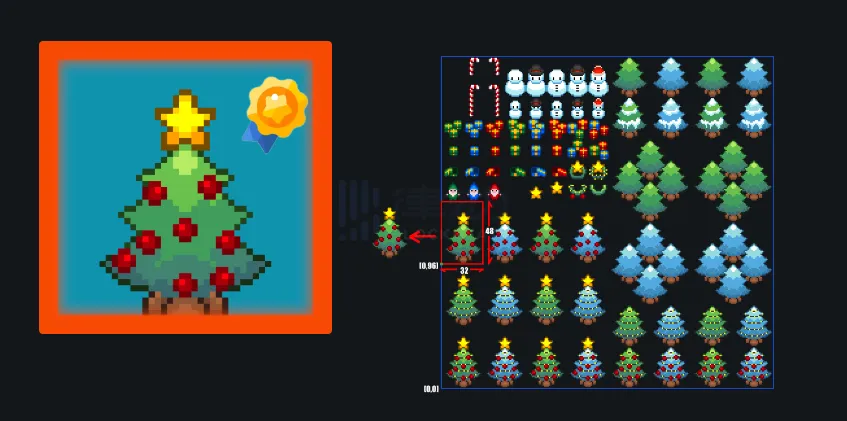
This method not only enhances creativity and engagement, but also brings richer and more diverse possibilities to the ecosystem of digital assets. Moreover, BRC-420 will greatly reduce the pressure of block size limitations.
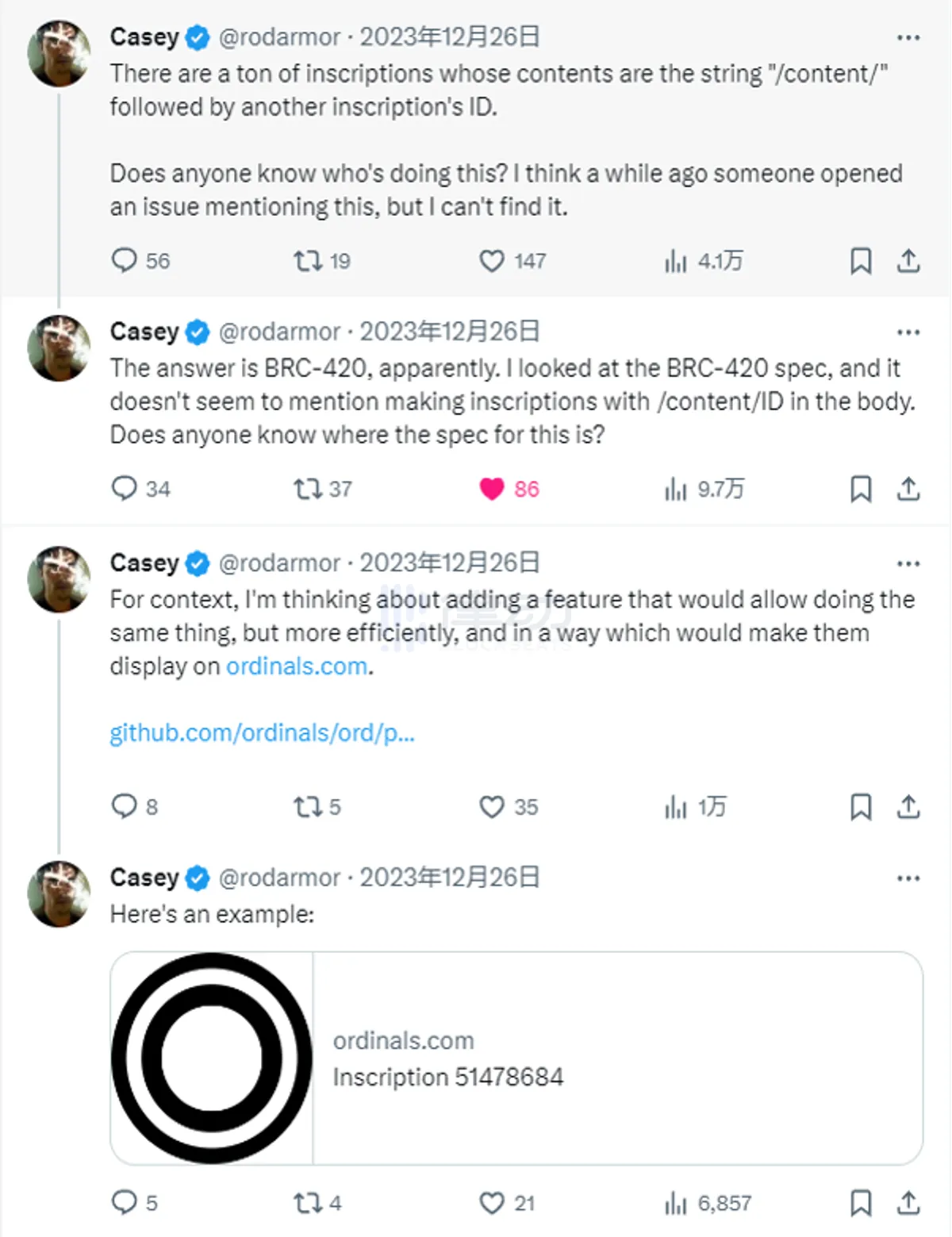
Regarding the composability of Bitcoin assets, Casey has expressed his strong interest in a straightforward manner. He also mentioned some observations and thoughts about Bitcoin on-chain inscriptions in his tweets.
On December 26th last year, Casey discovered that many inscriptions started with "/content/", followed by the ID of another inscription. He questioned who was performing this type of operation and recalled someone mentioning this issue before. Although Casey initially could not find information about these "/content/ID" inscriptions in the BRC-420 specification, he found relevant information after being prompted by community members and KOL Bitrelli. This discovery inspired Casey's innovation of the delegate field, which was included in the latest upgrade of Ordinals and has been applied in DERP's airdrop.
Welcome to join the official BlockBeats community:
Telegram Subscription Group: https://t.me/theblockbeats
Telegram Discussion Group: https://t.me/BlockBeats_App
Official Twitter Account: https://twitter.com/BlockBeatsAsia