How important is Farcaster's new feature Frames from the perspective of Web2?
Editor's note:
As a SocialFi application favored by Vitalik, Farcaster has attracted a surge of attention with its unique interactive experience brought by the recently launched Frames feature. On January 29th, Dan Romero, co-founder of Farcaster, announced that the daily active users of Farcaster exceeded 10,000 for the first time on January 27th. Antonio García Martínez, former product manager of Facebook, discussed the uniqueness of Farcaster Frames from the perspective of Web2 products. The following is compiled by BlockBeats:
Original title: "Why Farcaster Frames are important"
Original author: Antonio García Martínez
Original translation: Joyce, BlockBeats
In 2011, Facebook was still a private company and many people doubted its viability as a business. The advertising system was awkward and only good at convincing brands to spend money collecting "likes" on Facebook, but they didn't know what to do next. At the time, I was one of the few Facebook product managers who tried to change this situation (but failed).
Amid the revenue crisis prior to its initial public offering, Facebook's core team (of which the advertising business was only a distant and insignificant part) decided to make a huge bet, according to my memoir "Chaos Monkeys".
It involves a product with a vague title called Open Graph, whose first version was released at the Facebook Developer Conference F8... It added a language dictionary with a "like" button, expanding Facebook's vocabulary to "play", "listen", "watch", or "buy". This is the new subject-verb-object language of everything you do online.
Antonio García Martínez listened to "Only Once" by Wax Tailor on Spotify.
Instead of just expressing vague approval through "likes," Facebook users can now broadcast everything they do with the help of external developers who embed Facebook's new syntax into their products. By doing so, these developers make their products "social" and potentially viral. As the exchange that injects data into Facebook at full speed, these external developers - such as music players like Spotify or publishers like The Washington Post - gain distribution through News Feed, attracting more users to their content and services. This was a dream, at least at the time.
This is a great idea: why concentrate the internet user experience on Facebook, Twitter, and other rapidly splintering networks? Independent media apps like Spotify and Netflix are growing rapidly: why not connect all consumer experiences with social networks for mutual benefit?
In fact, the entire effort and its accompanying advertising products were a huge failure, threatening the company's upcoming initial public offering. It was only in the following year, with the crazy product building war, that most of the advertising products were launched, making Facebook the multi-trillion dollar company it is today.
Ironically, the relatively forgotten Open Graph Protocol has recently been resurrected to support the hottest new feature in Web 3: the "Frames" feature in the on-chain social network protocol Farcaster. For those unfamiliar with Farcaster, it can be thought of as a Twitter/X product built on blockchain. Farcaster is just the underlying protocol (like SMTP is to email): to actually use it, you need a client like Warpcast to "view" the actual social network.
We have in Frames a new Web 3 primitive that Web 2 can never truly offer: a simple way to run application X while the user is still in application Y, with almost no coordination needed between X and Y. The blockchain and seamless handling of money and digital ownership make it possible for a real and universal user graph across consumer applications, something even Facebook in its heyday could not achieve.
Frames provides the basic elements of Web 3 that have never been truly realized in Web 2: an easy way to run application X while the user is still in application Y, with little coordination between X and Y. The interoperable identities and transaction records of blockchain, as well as seamless handling of currency and digital ownership, make it possible to establish a truly universal user operation map between consumer applications, something that even Facebook couldn't achieve at its peak.
Frames is a seemingly simple experience: users only need to share a link to a website, which is decorated with OG tags defined years ago using the Open Graph Protocol. Frames are like portals that open to another application, allowing that application to access the user directly. From the perspective of Web 2, it seems no different from the <iframe> that a website typically opens to another part of the web, except that the shared state of the blockchain makes the embedded experience as local as the application itself.
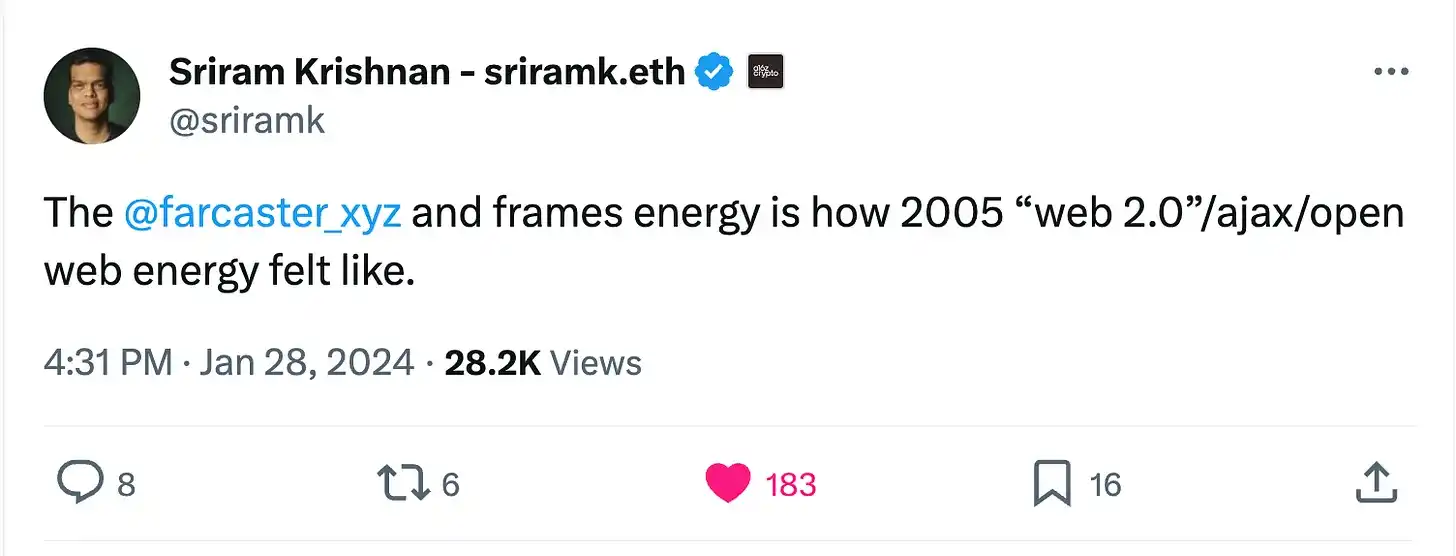
Since the launch of Frames, the daily active users of Farcaster have surged, and developers have started building some local encryption features, such as declaring or casting NFTs and playing games. These features still happen in separate, closed experiences (just like in Web 2.0). According to Spindl's statistics, since the product went live last Friday, 313 applications have launched 526 Frames. Interestingly, someone even came up with a way to run Doom game within Farcaster (as shown in the cover photo above), demonstrating the heights that Frames business can reach.
Frames represent a new primitive way of Web 3 that was difficult to achieve in Web 2: a seamless way to run application X while the user is still in application Y, with little coordination needed between the two. The interoperable identities and decentralized transaction records of blockchain, as well as the smooth handling of currency and digital ownership, make it possible to create a truly universal user action graph between consumer applications. This realizes the vision of Open Graph, even if the rest of the original protocol is only facilitated by the <meta> tag, with blockchain handling the rest.
This completely changes everything about the consumer experience.
The entire user funnel of Web 2 is based on users clicking through to a landing page of another application, going through login and/or conversion sub-funnels (remember: identity and payment are difficult in Web 2), and finally reaching a confirmation or experience page. Web 3 compresses all of these unnecessary clicks and logins into an inline experience, placing user experience (and user control) at the core, replacing the lengthy funnel with a network that operates around users-publishers-developers. There are no middleman Facebook giants; no patchwork waterfall structures of cookies, logins, and credit card payments.
Imagine these user stories:
You shared a selfie wearing a newly purchased Uniqlo sweater, shared a link to the product page, generated a preview card and a 10% discount coupon for the same product. You immediately made a one-click purchase: the influencer received a commission, the publisher received a reward, and you enjoyed the discount on the sweater. Everything happened seamlessly.
Someone shared a song they are currently enjoying: a player widget appeared next to the post, offering options to play from your favorite music streaming service. Everything is running smoothly.
You are reading an announcement about a newly launched protocol and token on a media website: right next to the text is an intuitive purchase interface that allows you to easily analyze and buy some thriving tokens. There is no similar experience in the traditional financial world.
Someone wrote a long article about a viral blog post and shared a link to the content: with just one click, you can see the article you are interested in, pay the author (and give the referral points to the original sharer). The amount spent is negligible, and you don't even have to think about it.
In Web 2, the technology and coordination issues involved in making these user stories a reality are insurmountable, which is why Facebook's platform strategy (and similar attempts) failed, but in Web 3 it is almost automatic. Of course, this is not just a feature of the Warpcast and Farcaster protocols. Embedded transaction widgets, Telegram bots with inline operations, aggregators/marketplace combinations, where the front-end seamlessly uses the protocol back-end; coupling consumer experience with on-chain mechanisms without permission is very natural in Web 3. By creating Frames, Farcaster adds a social networking experience on top of the blockchain, which has long been buried under unfriendly user experiences like wallet transaction flows.
To make Web 3 successful, it needs to do two things: implement cool features that traditional Web 2 cannot achieve, and make users largely unaware that they are even on the blockchain. With Frames, we have finally achieved these two points.
Welcome to join the official BlockBeats community:
Telegram Subscription Group: https://t.me/theblockbeats
Telegram Discussion Group: https://t.me/BlockBeats_App
Official Twitter Account: https://twitter.com/BlockBeatsAsia

 Related Articles