Interpreting CoinList's new project Meson: Another rising star in the DePIN field.
Original Title: "Interpreting Meson, the New Star in the DePIN Field of CoinList's New Project"
Original Author: Loopy, Odaily Star Daily
Today, CoinList announced the launch of the DePIN project Meson Network.
Meson Network is at the forefront of the DePIN trend, which is currently hot. It is a decentralized bandwidth trading market with a large number of users and node resources. The project originated from decentralized storage business and gradually expanded its service scope, including social, blockchain, and artificial intelligence data collection fields.
Below, Odaily Star Daily will take you on a quick tour of Meson's token information and project overview.
Token Sale Information
Meson's native token is called MSN. The token sale will begin at 18:00 UTC on February 8, 2024 (02:00 on February 9, Beijing time). Details are as follows:
· Quantity: 2,500,000 MSN tokens, accounting for 2.5% of the total supply.
· Price: 1.75 USD/coin
· Lock-up period: around March 15, 2024, 1/6 of the unlocked tokens, and the remaining tokens will be unlocked every month within 6 months.
· Initial purchase limit: minimum $50, maximum $3,000, limited to USDT and USDC only.
Remark: Meson can decide whether to provide an additional 2,500,000 MSN tokens (2.5% of the total supply) for this sale period.
· Eligibility: Before the registration deadline (UTC time February 5th 12:00, Beijing time February 5th 20:00), users must hold a minimum purchase amount (50 USDT or USDC) in their CoinList wallet. This sale is not open to residents of the United States, China, Canada, South Korea, and certain other jurisdictions.
Token Usage
As the incentive and governance token of Meson Network, MSN has a total supply of 100,000,000. Its main functions are as follows:
· Reward miners;
· Miner staking;
· As a payment method for users;
· Participate in protocol governance (vote on the development or modification of protocol parameters);
· Tokens are distributed to miners as rewards for providing server resources.
Currently, due to the transfer function of Meson test tokens being locked on Ethereum, there are no benefits to staking tokens. Users of the service will pay with MSN to obtain additional bandwidth. These tokens will then be repurchased and rewarded to miners.
Token Economics

The token distribution method is as follows:
Private token sales: 26,000,000 MSN (26%)
Public Token Sale: 5,000,000 MSN (5%)
Ecosystem: 27,000,000 MSN (27%)
Foundation Reserve: 20,000,000 MSN (20%)
Technical team: 15,000,000 MSN (15%)
Partner: 6,000,000 MSN (6%)
Testnet Mapping: 1, 000, 000 MSN ( 1% )
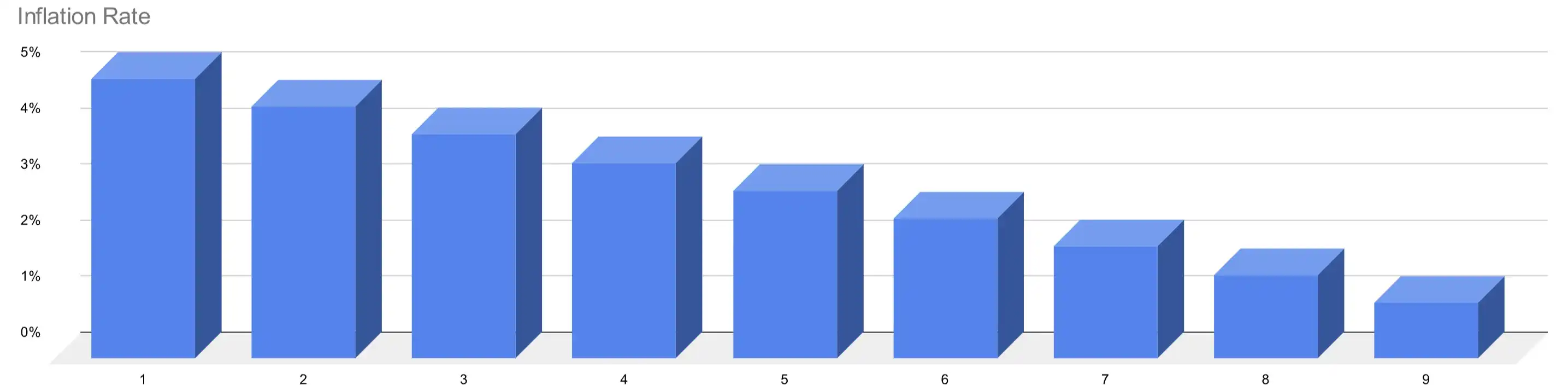
All future token inflation comes from mining rewards. The mining inflation rate is 5% in the first year, and the inflation rate decreases by 0.5% each year thereafter.
Project Overview
Today, Meson Network announced on X that the project has completed a new round of strategic financing led by Presto Labs with a valuation of $1 billion. The specific amount of financing has not been disclosed.
Meson Network focuses on DePIN+AI, aiming to create a decentralized physical network authorized by humans. The Meson Network "DePIN" node is developed with user-friendly technology and can accommodate various hardware, such as personal laptops, servers, IoT devices, and more. By utilizing the idle bandwidth of these network nodes, Meson establishes an economic cycle that connects idle resources with business needs. Its vision is to become the cornerstone of a decentralized storage, computing, and thriving Web3 Dapp ecosystem.
In short, the logic of this business is very simple and clear: rent out unused bandwidth resources from users to other users.
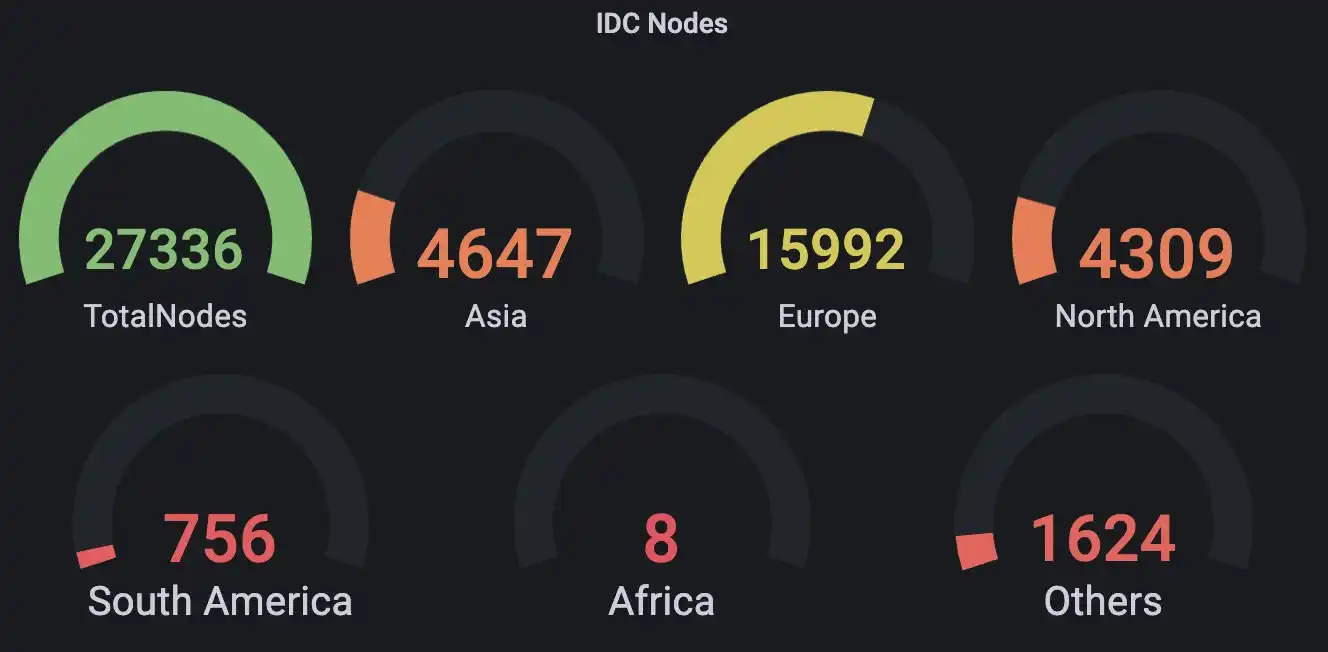
Meson's official website shows that its total number of nodes has exceeded 100,000, currently at 115,194 nodes. Its IDCs are widely distributed around the world. Its bandwidth capacity is about 20 Tb/s, with an average latency of 90 ms.
Meson's protocol model provides flexibility and scalability, aiming to create a decentralized bandwidth market. Under the Meson model, users can exchange their remaining bandwidth for tokens, making it easier for those in need to access global bandwidth resources. This will be an interesting attempt to activate the long-tail market.
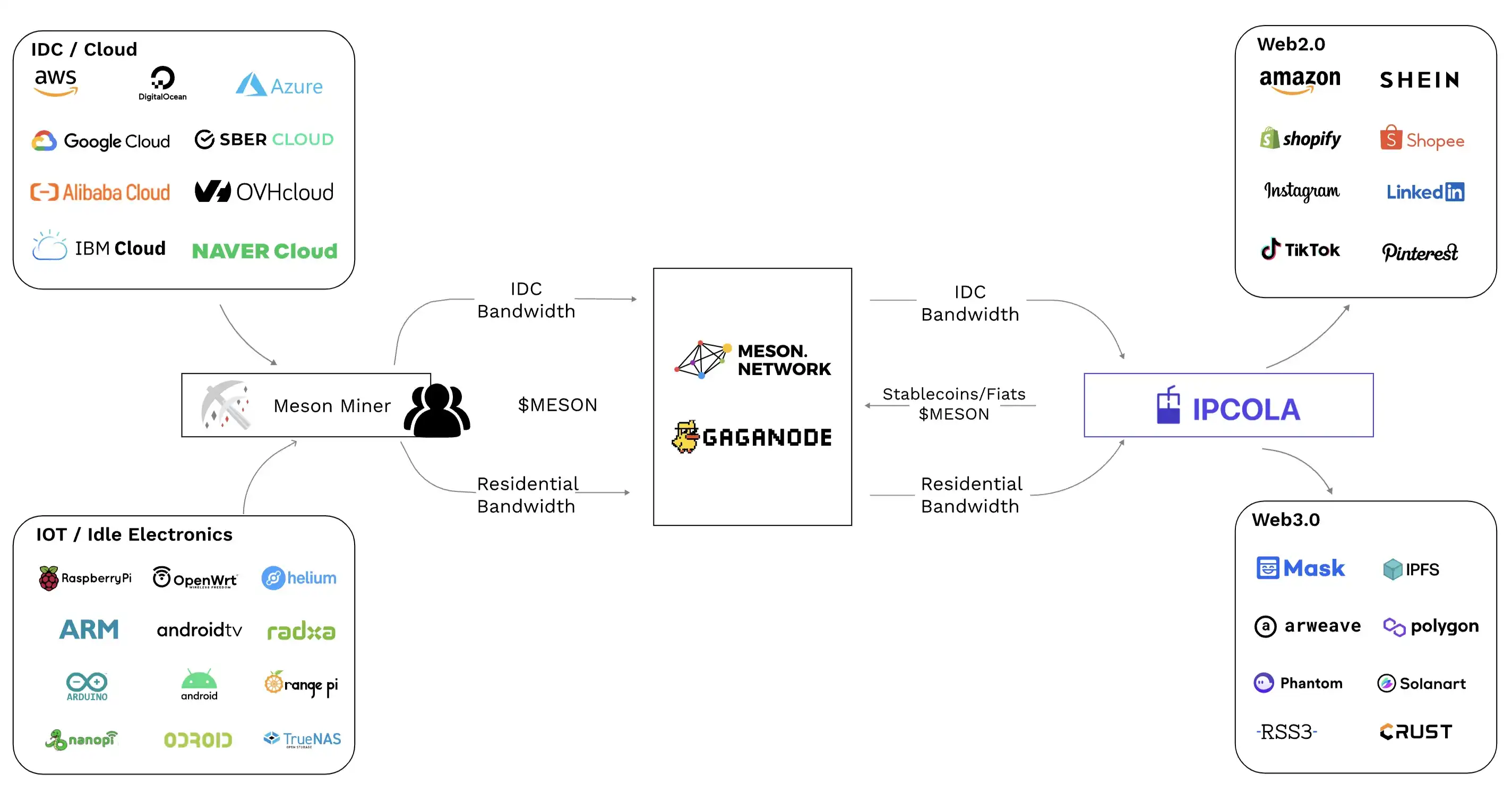
The working principle of Meson
而 Meson's another business scenario is the ledger data of the growing Web3 network.
For example, BNB Chain utilizes Meson Network's global node distribution to shorten the time it takes to synchronize the entire chain's state snapshot. The transaction data of BNB Chain has already exceeded 2.5 TB, and synchronizing snapshot data between different nodes takes about 20 hours. Therefore, synchronizing data between BNB Chain nodes located around the world has always been a complicated task. However, with the use of Meson, the time it takes to synchronize the entire network snapshot has been reduced to about 1 hour.
For developers, Meson also provides the Meson Cloud developer platform, which includes three products: Gateway X, mCloud, and mPad.
Gateway X is a gateway service provided by Meson, serving as a bridge between Web3 technologies such as Arweave/IPFS and traditional Web2. GatewayX provides developers with unlimited caching storage capacity and charges based on bandwidth usage. It also offers dedicated gateway connections and supports various Web3 domain name resolution acceleration services, making seamless interaction with Web2 networks possible. In addition, it supports the "one-click import" function, providing one-click migration/backup for Arweave and IPFS files.
mCloud is a Web3 PaaS solution that provides hosting and deployment services for developers' applications. It supports full-stack applications and docker deployment technology, with reliability and high redundancy. Developers can deploy applications on both traditional data centers and various blockchain nodes to prevent service unavailability caused by single-point dependencies.
mPad is a new way of content distribution. The underlying protocol does not require a platform carrier and can achieve multi-protocol object storage, reducing the risk of file loss. It supports P2P transmission protocols such as Arweave, IPFS, and Bittorrent, and uses GatewayX to improve retrieval speed. The service is also resistant to censorship, distributed through the underlying protocol, breaking the limitations of regional distribution, and allowing for free transmission and sharing of content.
Original article link
Welcome to join the official BlockBeats community:
Telegram Subscription Group: https://t.me/theblockbeats
Telegram Discussion Group: https://t.me/BlockBeats_App
Official Twitter Account: https://twitter.com/BlockBeatsAsia