Bankless: Re-staking Summer is coming, how big will the EigenLayer airdrop be?

Original Title: "Welcome to Restaking Summer"
Original Author: Jack Inabinet, Bankless
Translated by: Luccy, BlockBeats
Editor's Note:
On January 25th, according to information on the EigenLayer official website, EigenLayer TVL reached 806,700 ETH, worth approximately $1.788 billion. In addition, the team is introducing a new method of distributing re-staking points, which will set the upper limit of re-staking points allocated to any LST, LRT, or individual deposit at 33% of the total future issuance.
Bankless analyst Jack Inabinet delves into the philosophy behind EigenLayer and details its point mechanism, analyzing its potential airdrop value. BlockBeats has translated the original article as follows:
Only a few cryptocurrency projects have created at least one billion dollars in wealth for early users during the initial airdrop, but we may soon see another popular protocol join this list.
Re-pledging commitment has become a transformative cryptographic economic primitive, and EigenLayer is at the forefront of efforts to make it a reality.
Today, we will explore why EigenLayer is a disruptive game-changer, provide examples of service types built on top of it, explain why EigenLayer is the next billion-dollar airdrop opportunity, and estimate the scale of airdrops to be expected after participating in EigenLayer.
Why is EigenLayer a disruptive innovator?
EigenLayer has created a decentralized marketplace that allows Ethereum holders to "re-stake" their tokens, providing security for not just other cryptographic applications on the Ethereum network.
As a programmable trust network, EigenLayer allows developers to create decentralized networks while avoiding the difficulties of launching and operating their own trust networks.
Due to the fact that protocol developers no longer need to worry about running validation node networks, they can focus more on important matters such as building their applications, rather than working too hard to support the market value of their staked tokens that protect their decentralized network.
This lowers the barrier to entry for creating one's own decentralized network and gives the long tail of encrypted security applications more power.
The protocol using EigenLayer is "renting" the economic security from existing Ethereum stakers. This practice of reusing already staked Ethereum to provide security for multiple applications brings capital efficiency to staking, effectively reducing the cost of securing additional networks, while maintaining strong trust guarantees for individual services.
For the stakers of EigenLayer, the protocol provides two opportunities for enhanced earnings. Stakers can not only earn enhanced rewards by securing other networks, but they are also eligible to receive airdrop qualifications from the protocols that use their services.
What services can be built on EigenLayer?
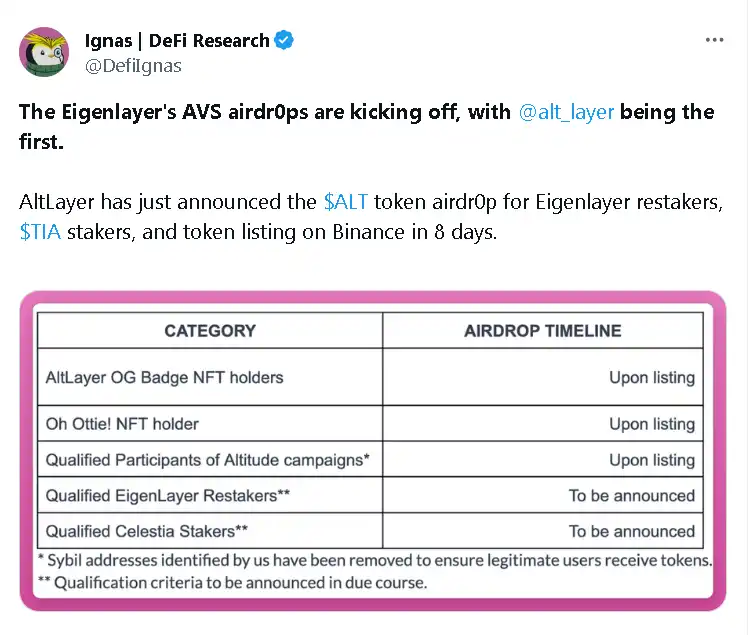
EigenLayer Active Verification Service (AVS) refers to any system that requires its own distributed verification node network for verification and relies on EigenLayer to provide security. The term "AVS" is actually a true general term that can be applied to any decentralized verification application within a wide range of protocols and services.
Stakers delegate their staking to AVS operators, who operate the infrastructure of EigenLayer and use the stakers' Ethereum as collateral for their services in exchange for the ability to use the staked Ethereum as collateral.
The most famous AVS is EigenDA, which is EigenLayer's data availability solution.

Although EigenDA is not yet online, it is expected to significantly reduce the cost of publishing data on rollups, and is expected to provide a more cost-effective solution than the leading DA solution Celestia, thanks to the cost-effectiveness of re-staking compared to operating an independent L1 blockchain in the Celestia model.
However, EigenLayer's ability to protect networks extends far beyond the Ethereum ecosystem, with various applications being built on the Cosmos ecosystem.
For those who do not wish to launch their own token and validator node set in the Cosmos ecosystem, Cosmos Hub (ATOM) has long been the primary provider of cross-chain security, but EigenLayer hopes to soon take this crown.
Ethereum OS and Lay3r are two AVSs that will enable the Cosmos chain to launch its L1 using EigenLayer's existing trust network, providing a more attractive (and cost-effective) security alternative for the Cosmos Hub.
Just like EigenLayer's AVS can be used to provide security for L1 and L2 blockchains, they can also verify various other encryption systems, including decentralized guardians and oracle networks.
EigenLayer aims to improve interoperability: their fast finality AVS will allow any transaction to benefit from instant settlement, and the bridging protocol can leverage AVS to use EigenLayer's re-staking Ethereum network as collateral, reducing waiting time for settlement during user transaction transmission.
Although the intersection of artificial intelligence and cryptography is just beginning to be explored, EigenLayer may become an important participant in unifying these two environments. Onchain AI interfaces may soon be able to use AVS to verify the integrity of their algorithms by generating zero-knowledge proofs, while EigenLayer's capital efficiency in the re-staking model makes it more cost-effective than alternative ZKML technologies.
EigenLayer's airdrop will be how big?
It is already difficult enough to accurately value cryptographic protocols with actual cash flow, let alone those that do not yet exist. Although there is no directly comparable EigenLayer, Celestia provides a close enough competitor to base its valuation on.
The only possible use of Celestia may be as a data availability layer, but the network's TIA token currently has a fully diluted valuation (FDV) of $15 billion, slightly lower than the peak of $20 billion reached briefly last week.
Compared to Celestia, EigenLayer's advantage lies in its provision of various additional services. In addition to data availability, there are multiple revenue-driving factors, which means that the market may view EigenLayer as a more attractive investment opportunity than Celestia.
Unfortunately, the valuation of EigenLayer has been impacted by the fact that it is not a blockchain network, which means that the EIGEN token cannot accumulate L1 premium as expected.
Actually, this means that the utility of EIGEN is lower than TIA because it will not become an asset for pledging AVS. This factor will reduce the demand for the token, which may result in EigenLayer trading at a lower valuation.
EigenLayer can choose to enhance the utility of EIGEN by using it as a payment token for services provided by the network. However, this is not a very effective source of demand and will be partially offset by inevitable selling pressure from re-stakers and AVS operators who use it as compensation and hope to cash out and switch to another asset.
Considering all these factors, it seems reasonable to assume that EigenLayer will trade similarly to Celestia's FDV, possibly with a valuation of around 10 to 20 billion US dollars at initial launch.
Welcome to join the official BlockBeats community:
Telegram Subscription Group: https://t.me/theblockbeats
Telegram Discussion Group: https://t.me/BlockBeats_App
Official Twitter Account: https://twitter.com/BlockBeatsAsia

 Related Articles