Comprehensive debunking of the “nine” common misconceptions about Bitcoin
Original author: Yassine Elmandjra
Translated by: Yvonne
Last week's events showed that despite Bitcoin being increasingly accepted by more institutions, it is still severely misunderstood.
· Jamie Dimon claims that Satoshi Nakamoto controls Bitcoin.
· Vanguard claims that Bitcoin's volatility is too high to be a viable investment.
· UBS claims that Bitcoin has no practical value in the real world.
In this article, I will revisit the most common misunderstandings about Bitcoin.
We are still too early.
Viewpoint 1: Bitcoin has no support.
Refutation: Bitcoin is supported by the world's most powerful computing network.
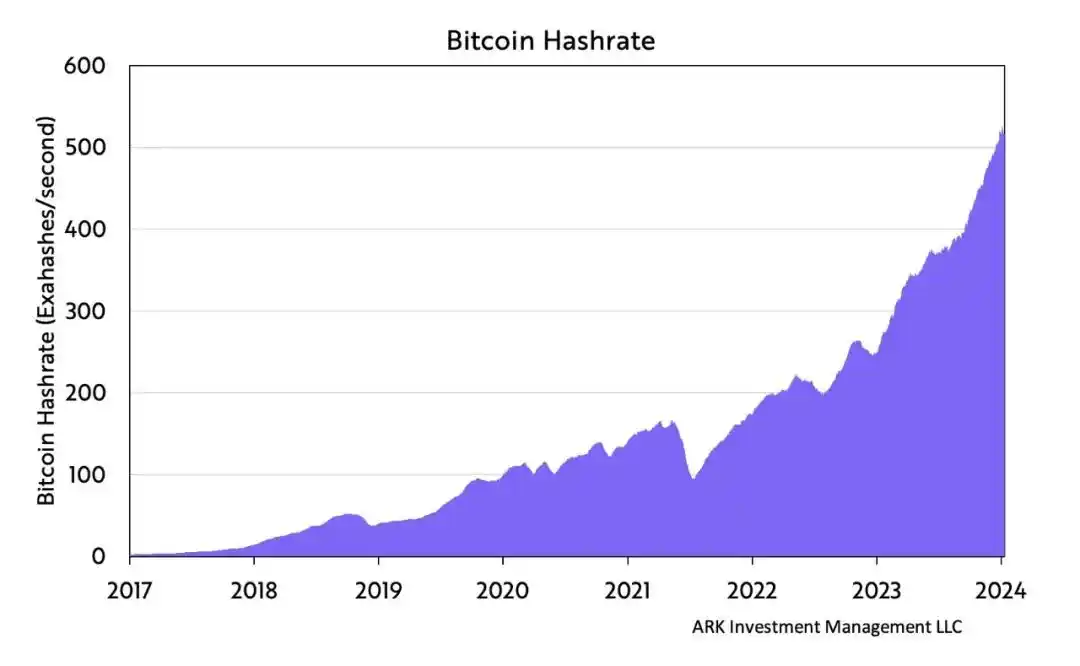
"Supporting" Bitcoin's computing power has reached 500 exahashes/second, surpassing the total of the world's largest computing networks. This computing power is not centralized in one place, nor is it controlled by a single entity. It is distributed throughout the global network, ensuring the ability to decentralize and resist attacks or failures.
Miner support > Government support
Viewpoint 2: Bitcoin has wasted too much electricity.
Refutation: The energy consumed by Bitcoin is not wasted. It is purposefully allocated to maintain a network that has profound implications for the future of currency.
The energy consumption of Bitcoin is an important design feature that provides necessary security for a decentralized, independent, global, and automated currency system. Bitcoin mining requires high computational power and is costly, thus the system established by Bitcoin makes any attempt to attack the network highly impractical.
In addition, a significant portion of Bitcoin's energy consumption comes from renewable energy sources. The free market principles of Bitcoin mining provide powerful incentives for miners to seek out cheap electricity, inadvertently leading them to adopt more sustainable energy solutions. Many mining operations are strategically located near abundant sources of renewable energy. These miners take advantage of energy that would otherwise go to waste, particularly in regions where renewable energy production fluctuates and does not always align with demand. In this way, Bitcoin mining can serve as a stabilizer for renewable energy grids, providing a consistent demand for energy and helping to fund and support the expansion of renewable energy infrastructure.
It is also worth noting that the wasteful nature of Bitcoin is largely dependent on the directness and clarity of its energy consumption, which is in stark contrast to the more hidden and dispersed energy costs of other systems, including traditional financial systems.
The energy consumed by Bitcoin mining should be balanced against the intrinsic value of a decentralized, global, secure, transparent, borderless, and politically agnostic currency. Therefore, the energy consumption of Bitcoin is not a waste, but an investment in the global financial network, which allows anyone, anywhere, to use Bitcoin without discrimination. It symbolizes a collective commitment to supporting an open global economic system based on free market principles.
Sorry, skeptics, you can only choose one.

Viewpoint 3: Bitcoin's transaction processing speed is slow.
Refutation: Bitcoin provides strong transaction settlement protection.
The transaction speed of Bitcoin reflects its prioritization of security and decentralized design choices.
In a decentralized global currency system, "transaction immutability" is a better measure of performance than "transaction speed". Although block time affects the initial confirmation speed of transactions, it does not guarantee transaction immutability. Compared to financial settlement networks with "higher throughput", Bitcoin's decentralized settlement guarantee is unparalleled. When measured by the time it takes to ensure that transactions are ultimately completed, Bitcoin is the "fastest" blockchain.
In addition, the "small" block size of Bitcoin is designed to balance transaction throughput and individual participation in the network without requiring excessive data resources. Its 10-minute block interval is also a carefully considered design choice to allow sufficient time for network synchronization and stable transaction verification.
Viewpoint 4: Bitcoin is too unstable.
Refutation: Bitcoin's volatility highlights the credibility of its monetary policy.
Volatility is a natural result of Bitcoin's monetary policy. Unlike modern central banks, Bitcoin does not prioritize exchange rate stability. Instead, based on the quantity theory of money, Bitcoin limits the growth of the money supply, allows for free capital flow, and abandons stable exchange rates. Therefore, the price of Bitcoin is a function of demand relative to supply.
The volatility of Bitcoin is not surprising.
However, as time goes on, the volatility of Bitcoin will gradually decrease. With the increasing adoption of Bitcoin, the marginal demand for Bitcoin will account for a smaller proportion of its total network value, thereby reducing the amplitude of price fluctuations. For example, under other equal conditions, the impact of $1 billion new demand with a market value of $10 billion on the price of Bitcoin should be greater than the impact of $1 billion new demand with a network value of $100 billion on the price of Bitcoin.
It is important to note that we believe volatility should not exclude Bitcoin as a potential store of value, primarily because volatility often coincides with significant price increases in Bitcoin.
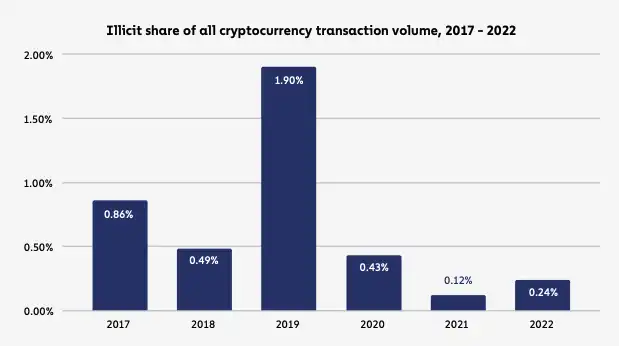
Viewpoint 5: Bitcoin is used by criminals.
Welcome to join the official BlockBeats community:
Telegram Subscription Group: https://t.me/theblockbeats
Telegram Discussion Group: https://t.me/BlockBeats_App
Official Twitter Account: https://twitter.com/BlockBeatsAsia
 Related Articles