Read Particle: The leverage trading platform that allowed Arthur Hayes to take action again after a year.

Recently, BitMEX founder Arthur Hayes invested in a new project called Particle, which is a leveraged trading platform based on the AMM mechanism, after a year of absence. On January 12th, Particle announced the completion of its seed round financing, with Polychain Capital leading the investment and Nascent, Inflection, Neon DAO, Naveen Jain, and Arthur Hayes participating.
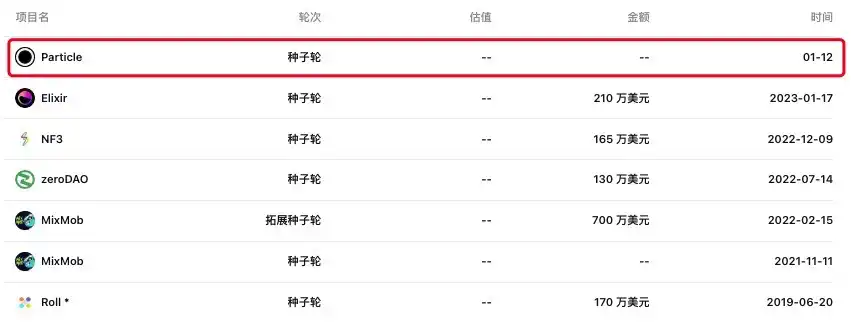
Arthur Hayes' investment project
Why is Particle favored by Arthur Hayes? It is reported that Particle has introduced the centralized AMM mechanism of Uniswap V3, borrowing liquidity from a predefined LP range, allowing the protocol to have liquidity without borrowing, and enabling the creation of permissionless liquidity pools for any token.
Particle's "LAMM" Mechanism
Most leveraged trading protocols can only trade a small number of mainstream tokens, while Particle envisions a truly permissionless leveraged trading protocol. Just as Uniswap allows for trading of any token, Particle will allow for trading of any token through leverage.
Particle has created a protocol called "LAMM" that allows traders to borrow directly from the liquidity pools of AMMs with concentrated liquidity (from Uniswap v3). Token leveraged positions can be built without the need for a separate lending protocol.
LAMM has set price boundaries for LP tokens, concentrating liquidity within this range and ensuring that the tokens can always be converted within these boundaries. However, if the price of LP tokens falls below the predefined lower limit, Particle will automatically convert and liquidate all assets into one of two tokens based on a preset formula. This process effectively allows for borrowing LP tokens to establish leverage positions.
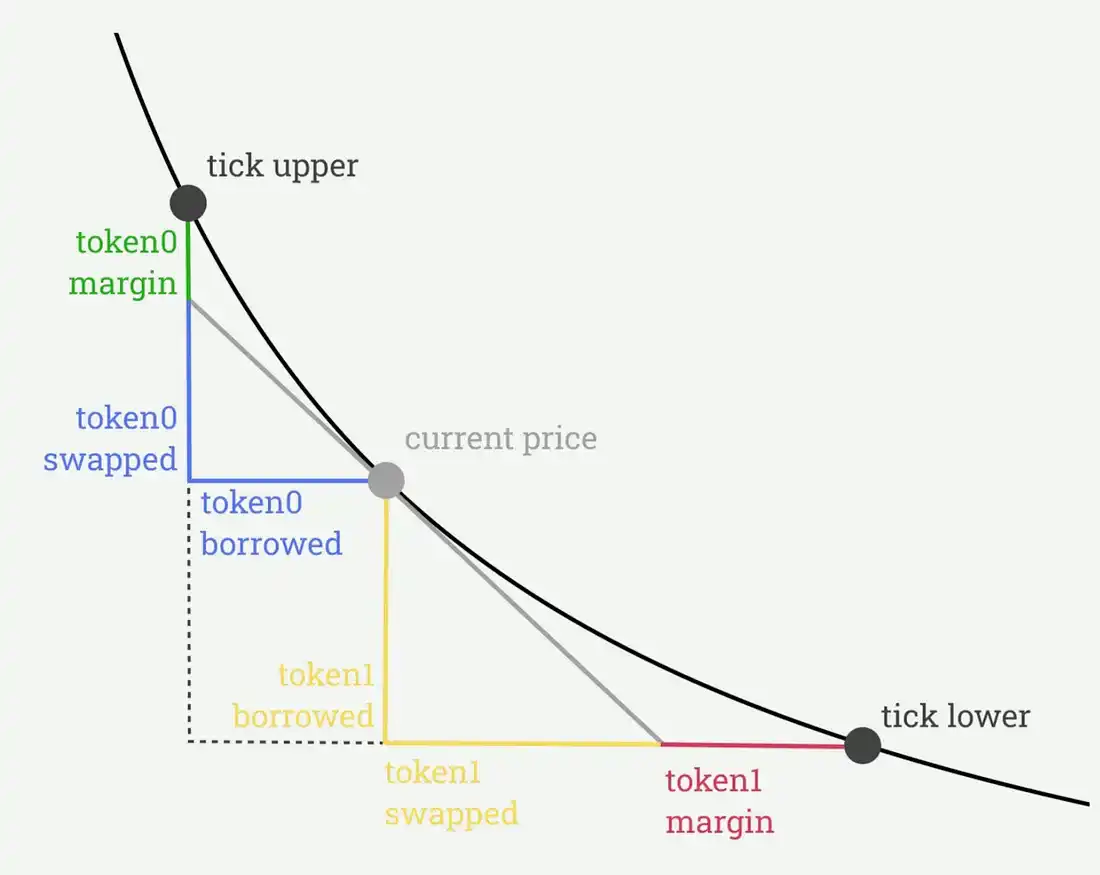
Regarding the clearing mechanism, LAMM can ensure that the assets borrowed by LP will always exist under any price conditions and will not lose liquidity.
The clearing mechanism of traditional derivative agreements relies on accurate price oracles and external liquidity from the market. Under this mechanism, long-tail assets with insufficient liquidity face significant risks. Particle solves this problem in a different way, defining the number of tokens to be converted at all price points mathematically for any concentrated liquidity position of token pairs. When borrowing from a concentrated liquidity position, the protocol calculates the exact amount required for replenishment so that the contract locks enough tokens to prevent adverse price movements towards the price boundaries.
In addition, by recording the accumulated swap fees during borrowing and repayment, this agreement ensures that the interest paid by the borrower is not lower than the swap fees earned from the original funding pool. In this way, Particle can generate strictly higher interest fees for LPs without incurring higher impermanent losses than its original swap liquidity provisions.
Example:
Considering the ETH/USDC LP position, focus on the price range of [1800, 2200] USDC/ETH.
The current ETH price is 2000 USDC; using USDC to long ETH for position, according to Uniswap's mathematical calculation, borrowing 10¹⁴ units of liquidity for the current price LP position will result in withdrawing 0.104 ETH and 229.495 USDC. Assuming no price impact, converting 229.495 USDC to ETH at the current exchange rate (2000 USDC/ETH) will yield 0.115 ETH.
If the ETH price falls below the lower limit (1800 USDC/ETH), the liquidity of 10¹⁴ units will be concentrated in 0.225 ETH (and no USDC). Traders will need to invest 0.006 ETH, which is calculated as 0.225 - 0.104 (borrowed ETH) - 0.115 (exchanged ETH). This ensures that LP can recover the liquidity of 10¹⁴ units regardless of the return price of ETH. This is because at the lower limit, regardless of the combination of ETH and USDC, the maximum amount of ETH can cover the borrowed liquidity.
Leverage Analysis: Traders can leverage liquidity worth 0.219 ETH by using only 0.006 ETH. This is equivalent to a leverage ratio of 36.5 times.
Through this design, the Particle protocol eliminates the need for price oracles, thereby eliminating many potential attack scenarios and market manipulation possibilities. In addition, for most traditional perpetual contract platforms, traders (such as long positions) trade against another trader (such as short positions). These platforms require complex mechanisms to manage counterparty risk by balancing incentives for both parties (such as dynamic funding rates).
On Particle, leverage comes from the relative value increase or decrease of the underlying assets. This means that profit and loss (PnL) is determined by the performance of the assets themselves, rather than the losses of the counterparty. The scalability of the Particle protocol means that as long as there is sufficient available liquidity, the protocol can effectively support various trading positions.
LP and Trader Incentive Mechanism
Particle protocol provides an advanced model with a fixed borrowing period of 7 days. When opening a position, traders choose a portion of liquidity as a premium. The position earns interest calculated based on the rate equivalent to borrowing liquidity in its original pool as a swap fee. Technically, the Particle contract records a cost tracker on the liquidity boundary when opening a position. The current cost tracker allows for proportional calculation of the swap fee for borrowing liquidity.
When LP decides to withdraw liquidity and stop earning interest, the un-borrowed liquidity can be withdrawn at any time. Particle provides the function of preempting liquidity after a 7-day fixed-term loan. Whenever the interest is exhausted or the loan term expires, anyone can act as an external liquidator to close the position and earn part of the premium as a liquidation reward. The share amount and 7-day parameter can be adjusted later.
From the perspective of liquidity providers, there are two methods for yield enhancement in Particle.
Transaction fee: For each leveraged position opened, traders are required to pay a fee of 0.05% of the leveraged amount. This transaction fee does not include standard interest earned through swap activities on borrowed liquidity. This mechanism aims to ensure that LPs earn significantly higher fees by lending and borrowing within the Particle ecosystem. The Particle treasury and LPs providing liquidity share the transaction fees, which will be used to further incentivize and improve liquidity for different token pairs.
Excess liquidity borrowing: Typically, when a centralized liquidity position exceeds its price range, it will stop earning the usual swap fees. However, in Particle, traders can still borrow this excess liquidity for leveraged trading and directly pay position fees to these LPs. This pattern allows LPs to continue earning profits from liquidity, even if it exceeds the active trading range.
From the perspective of traders, this arrangement reflects the advantages of interest-free leverage, provided that prices do not recover within the range of concentrated liquidity.
Based on these designs, the Particle protocol coordinates the interests of multiple parties. For token projects, it can increase attention and faster price discovery. In addition, leveraged trading involves the exchange of actual assets in the spot market, directly promoting an increase in token project trading volume. For liquidity providers, they will receive income from borrowing liquidity and swap fees. Additionally, the LAMM architecture of the Particle protocol is built on top of a liquidity-concentrated AMM. Since each transaction in the protocol involves trading in the spot market, the underlying AMM will also receive fees.
Enter the NFT Derivatives Track?
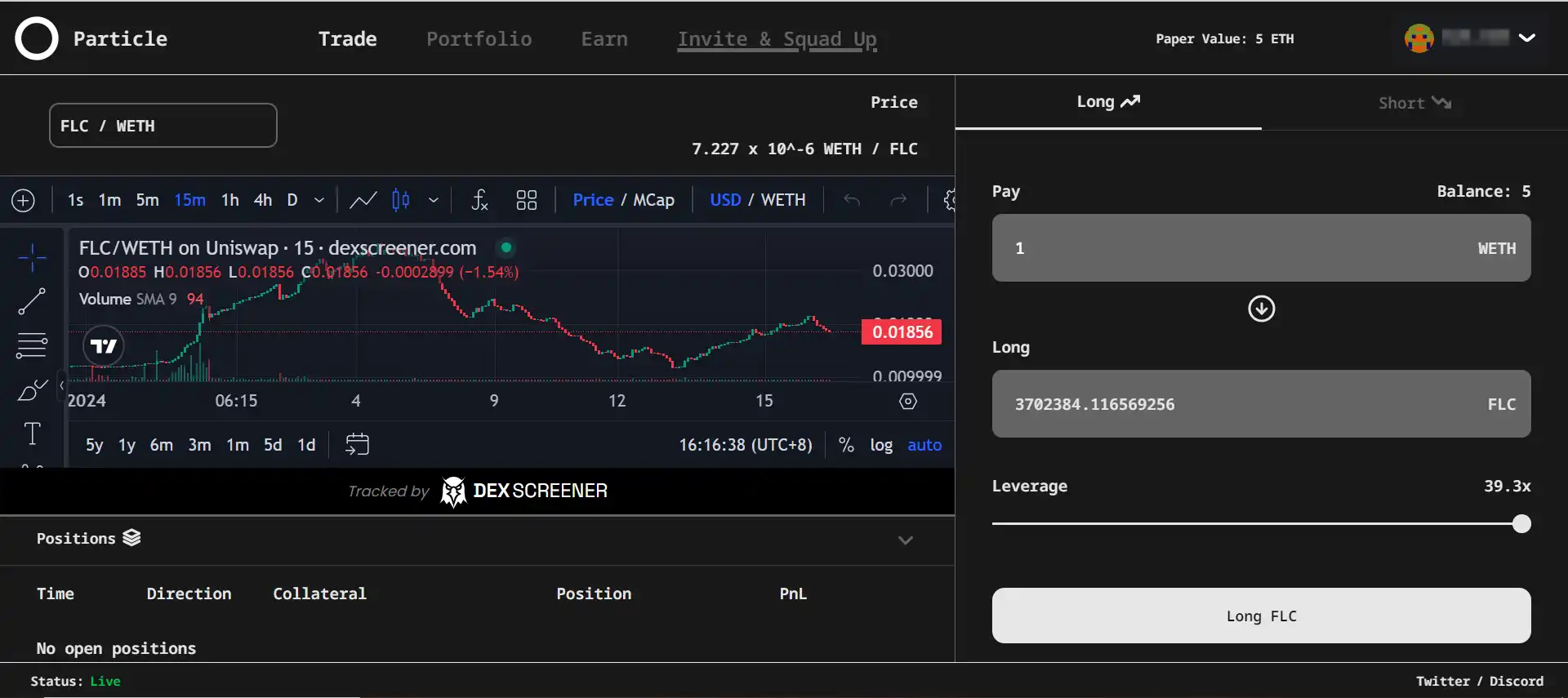
As it happens, today (January 19th) is the last day of Particle's Alpha testing, and the decentralized perpetual contract protocol for NFTs, nftperp, also unveiled its V2 interface today. BlockBeats previously introduced nftperp, which allows for leveraged shorting of NFTs. Its V1 was shut down six months ago due to the inability to scale the vAMM model.
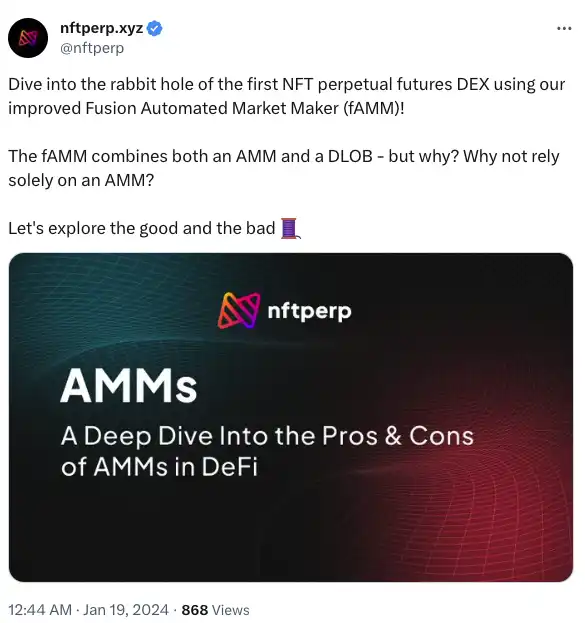
Related reading: "Can you short NFTs with leverage? Reviewing the NFT perpetual contract market with nftperp."
According to the introduction by the Particle team on Discord, they had previously launched a product related to NFT liquidity solutions before the release of Particle. However, Particle did not provide specific information about the team, only revealing that team members have years of work experience in companies such as Google and Facebook, and the founder dropped out of MIT and entered the Web3 entrepreneurship field.
Welcome to join the official BlockBeats community:
Telegram Subscription Group: https://t.me/theblockbeats
Telegram Discussion Group: https://t.me/BlockBeats_App
Official Twitter Account: https://twitter.com/BlockBeatsAsia