Core: BTC 2.0 new public chain, exploring the huge potential of Bitcoin’s security and usability
In 2023, the Ordinals protocol brought "Inscriptions" to the Bitcoin ecosystem, greatly unleashing the potential value of the Bitcoin ecosystem, making it the biggest theme of 2023. Currently, the circulating market value of Bitcoin exceeds 900 billion US dollars. Although "Inscriptions" has reactivated the vitality of the Bitcoin ecosystem, Bitcoin still has huge value waiting to be "unlocked" due to its inherent problems such as lack of support for smart contracts and difficulty in scaling.
In order to build a decentralized financial ecosystem for Bitcoin and unlock its huge potential value, projects in the Bitcoin ecosystem have been working on two fronts for a long time. One is to reuse its PoW mechanism based on the consensus of the Bitcoin mainnet to unlock the security value of Bitcoin. The other is to enhance the liquidity of Bitcoin by introducing mechanisms such as Bitcoin collateral, unlocking the availability value of Bitcoin.
So, is there a solution that can release both of the above values at the same time? In the rapidly growing world of Bitcoin projects, Core has presented an impressive answer. As a new public chain based on Bitcoin PoW consensus and capable of achieving non-custodial Bitcoin collateral, Core can release the security and usability value of Bitcoin while building the most prosperous decentralized financial ecosystem for Bitcoin.
Reuse Bitcoin's PoW mechanism to unlock the security value of Bitcoin
PoW allows Bitcoin to achieve decentralization and security, ultimately establishing Bitcoin's position as digital gold. People can circulate funds without trusting each other or centralized financial institutions. One of the core reasons for the explosive growth of the Ordinals protocol last year is its direct implementation on the Bitcoin mainnet, which fully and directly grows under Bitcoin's PoW mechanism, inheriting 100% of Bitcoin's security value.
Core has introduced a new consensus algorithm called "Satoshi Plus". As the name suggests, the basis of the "Satoshi Plus" consensus algorithm is still the Bitcoin network. This consensus algorithm does not abandon Bitcoin to develop a new PoW mechanism, but directly inherits and uses the proven PoW system of Bitcoin. Specifically, the PoW component of "Satoshi Plus" allows Bitcoin miners to directly delegate their computing power to their preferred validation node to participate in the election of Core validators.
The existence of "verification nodes" is a direct embodiment of the "Satoshi Plus" consensus algorithm, which not only inherits the proven PoW system of Bitcoin, but also combines the delegated proof of stake (DPoS) mechanism with Bitcoin PoW. The problem with the PoS mechanism is that the high staking threshold excludes small token holders who are willing to maintain network security. In order to create a more fair competitive environment, the DPoS mechanism of "Satoshi Plus" gives all $CORE holders the right to participate in maintaining network security. By staking $CORE to eligible verification nodes, small token holders can participate in the validator election of the Core network and improve fairness through the delegation of governance rights.
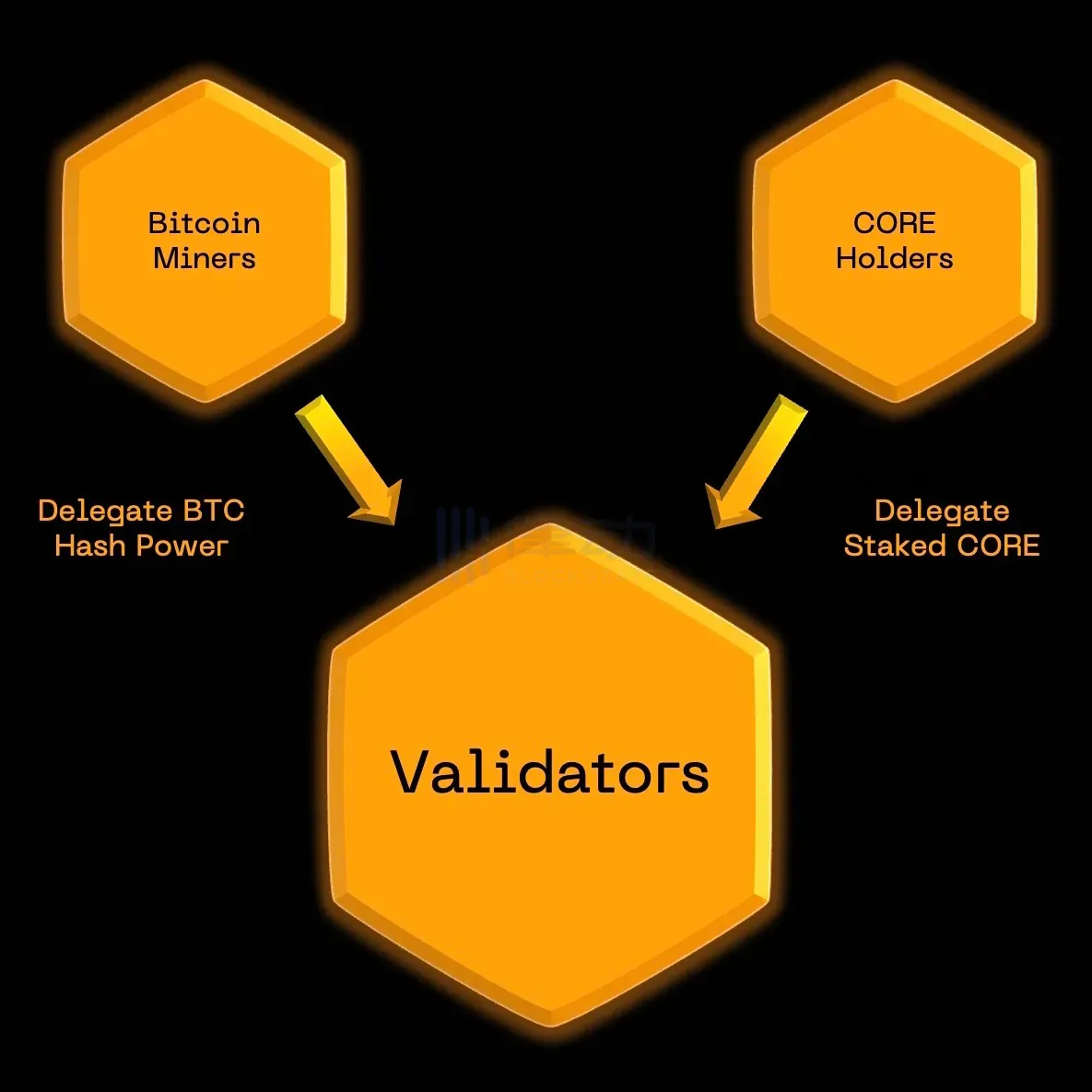
Therefore, while maintaining the security of Bitcoin, Bitcoin miners are also working with $CORE stakers to maintain the consensus of Core. By extending the governance of Bitcoin by miners to Core, Core perfectly inherits the consensus value and security value of Bitcoin. As long as Bitcoin is running securely, Core is decentralized and secure.
Ordinals protocol and BRC-20 protocol based on Ordinals protocol have increased the income of Bitcoin miners, but also caused congestion on the Bitcoin mainnet and a large number of "garbage" UTXOs. While activating the vitality of the Bitcoin ecosystem, there are also some hidden dangers. However, delegating computing power to Core will not cause these adverse effects on the Bitcoin network. Core and the Bitcoin network have a mutually beneficial relationship, and also provide ideal opportunities for Bitcoin miners to earn diversified income.
Currently, nearly 40% of Bitcoin's computing power is staked on Core's validation nodes to maintain the security of the Core network. Major CEXs such as OKX, Huobi, and Bitget serve as validation nodes for Core and work together to maintain the Core network.
Unmanaged Bitcoin Collateral and EVM Compatibility, Unlocking the Liquidity Value of Bitcoin
Bitcoin collateral in the past required "wrapping" Bitcoin (converting it to Wrapped BTC) because the Bitcoin mainnet does not have smart contracts. The wrapped BTC is then bridged to the target chain and held in the target chain's smart contract. This process is not only cumbersome, but also makes collateral holders vulnerable to asset loss due to contract attacks.
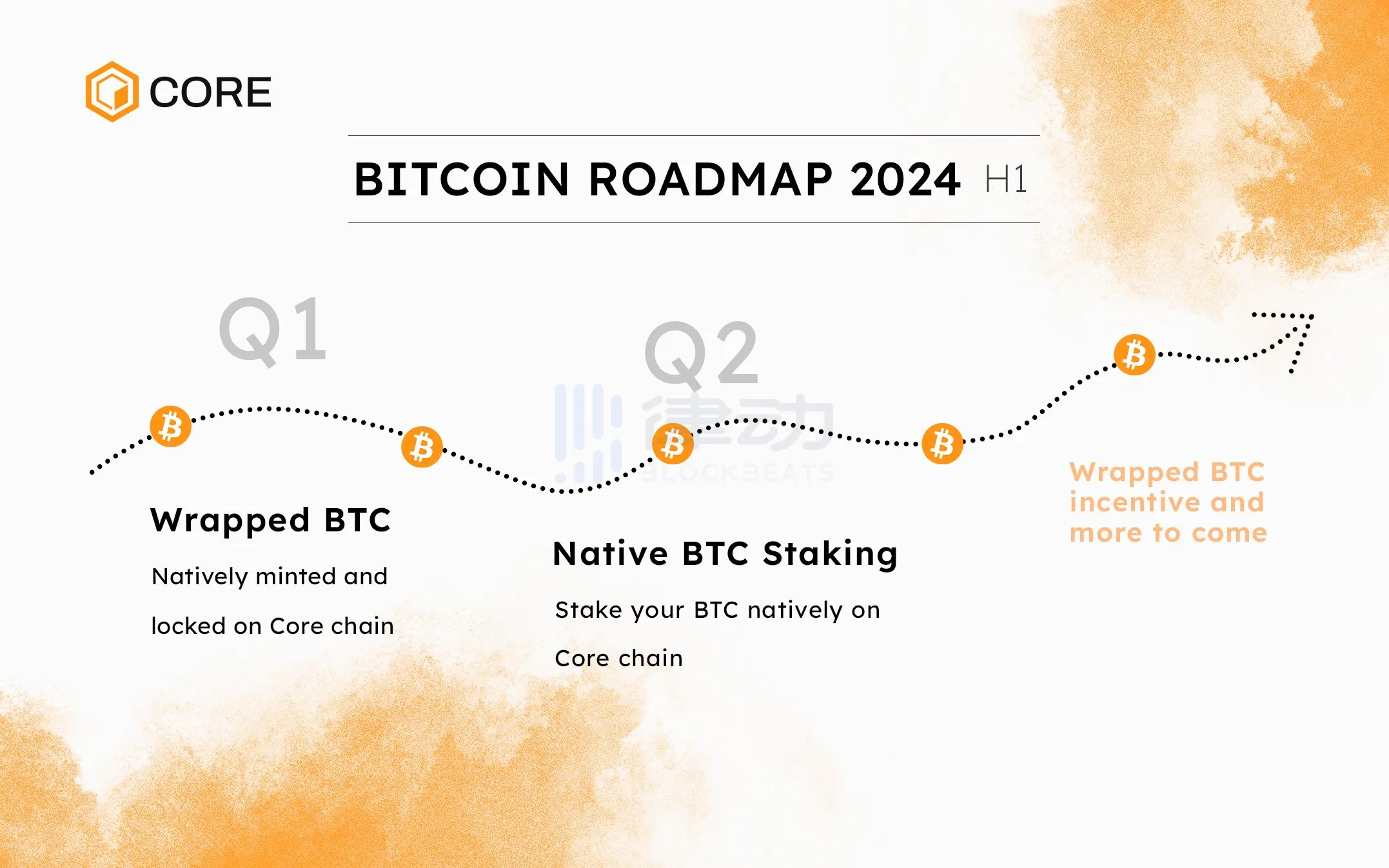
Core enables "non-custodial staking" that can be completed without transferring Bitcoin out of one's own address. This can be done directly on the Bitcoin mainnet, making the staking process easy and convenient. Bitcoin holders do not need to bridge their Bitcoin to the Core network or entrust it to smart contracts for custody. Instead, they can control the address where the staked Bitcoin is held and achieve "self-custody", greatly enhancing asset security. Under any circumstances, the BTC staked by users will not be compromised, even if validators act maliciously and are punished. BTC stakers will only lose staking rewards at most, and their staked assets will not suffer any losses.
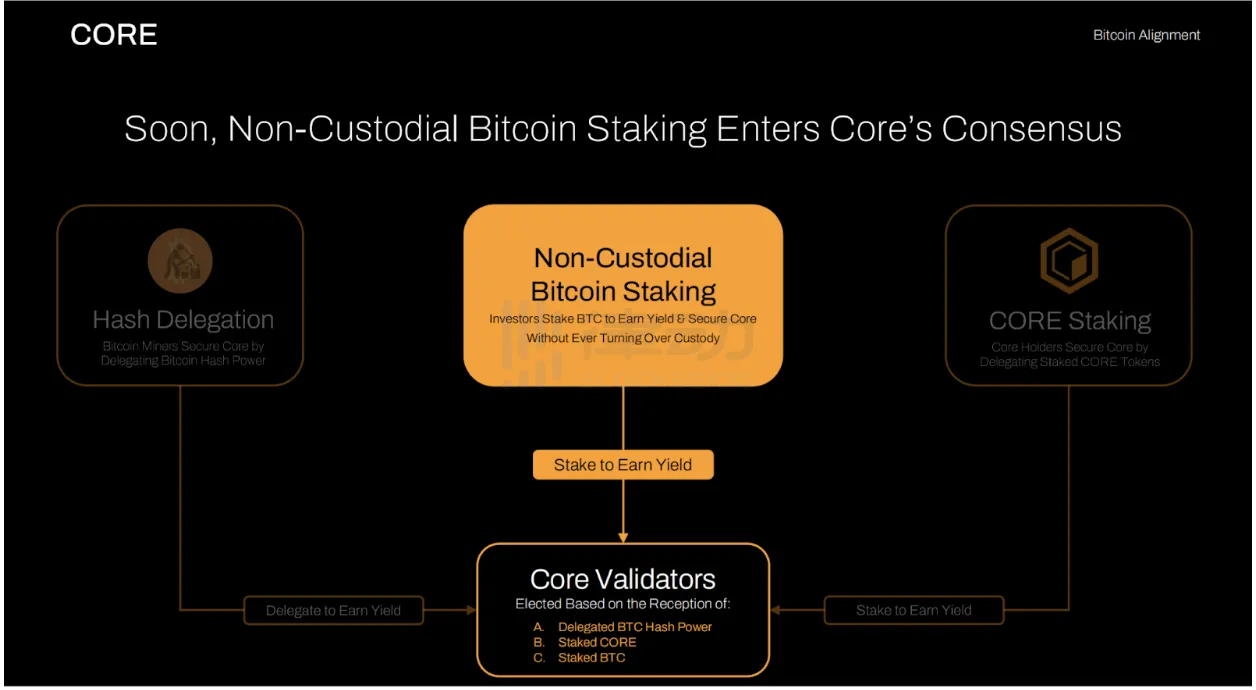
Non-custodial collateralization" will greatly release the liquidity value of Bitcoin, and more importantly, Core is an EVM-compatible public chain, which makes it possible to build large-scale dApps through smart contracts that cannot be achieved on the Bitcoin mainnet. Many well-known dApps have already settled in the Core ecosystem, including Metamask, SushiSwap, Ankr, 1RPC, Dapp Radar, etc.
"Non-custodial collateral" + EVM compatibility, Core will take the availability of Bitcoin to a new level, unleashing the infinite value of Bitcoin liquidity.
Tokenomics
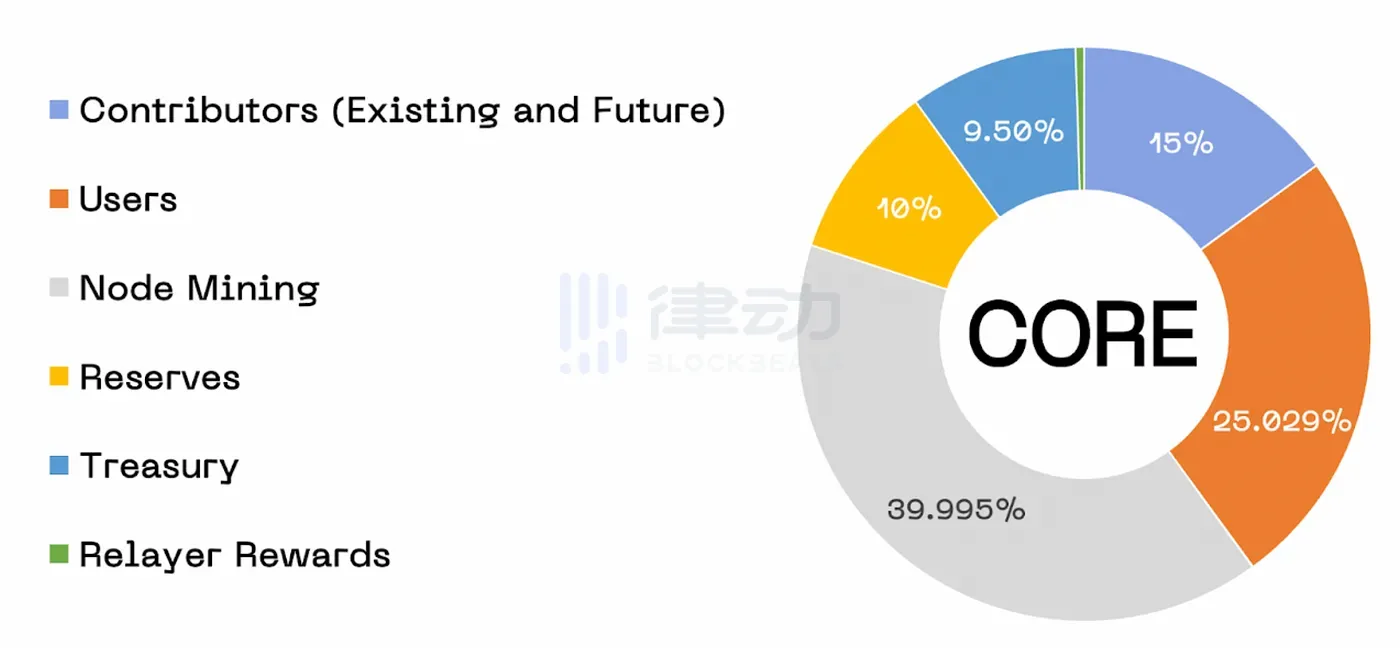
The total supply of Core's native token $CORE is 2.1 billion, which is composed of six parts: miner rewards, user rewards, contributor rewards, relay rewards, treasury reserve for construction, and project reserve.
The miner reward accounts for 39.995% of the total supply (a total of 839.9 million tokens), which is used to incentivize miners to continuously maintain the security of the Core network. Each year, the block reward will decrease by 3.6% compared to the previous year, and this portion of tokens will be fully distributed in approximately 81 years.
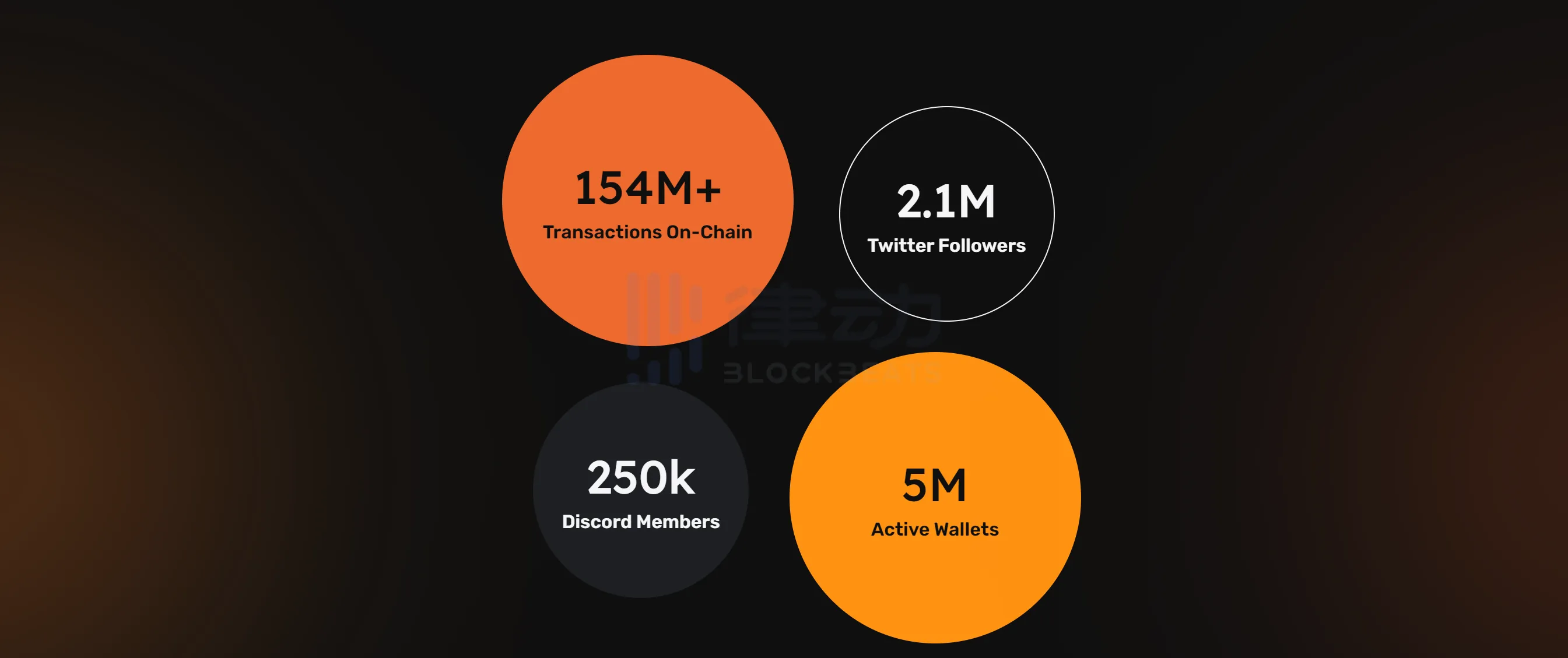
The user reward accounts for 25.029% of the total supply (a total of 525.6 million tokens). Core has created one of the largest airdrop campaigns in the history of cryptocurrency on the airdrop platform Satoshi App, with over 2 million users claiming $CORE on the chain, laying a solid foundation for the formation of a large user community for Core.
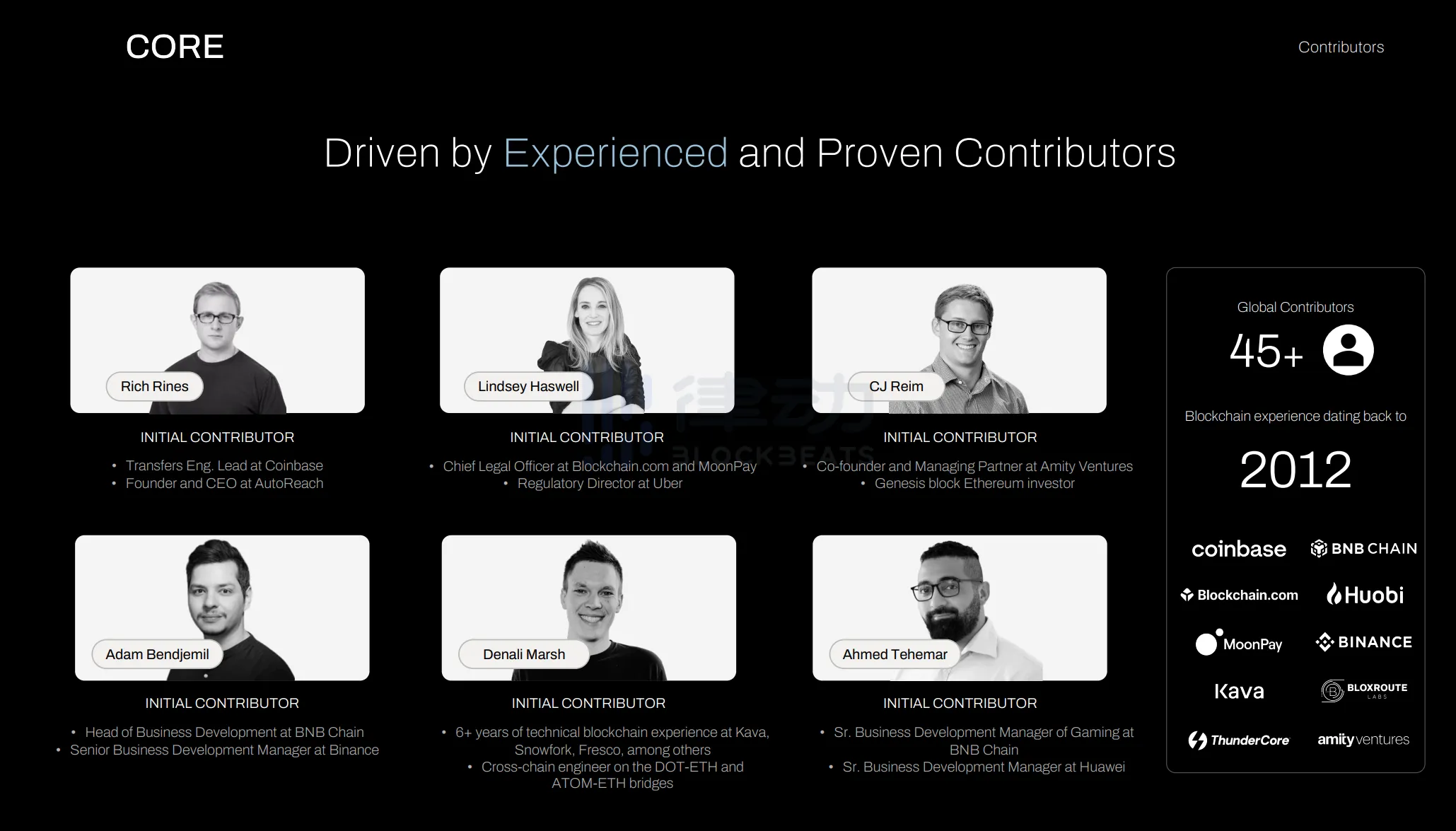
Contributor rewards account for 15% of the total supply (a total of 315 million tokens).
The relay reward accounts for 0.476% of the total supply (10 million coins in total).
The reserve fund for vault construction accounts for 9.5% of the total supply (199.5 million coins), which is used to provide funds for the construction of the ecosystem to DAO.
The project reserve accounts for 10% of the total supply (a total of 210 million tokens). As time goes on, this portion of tokens may be used to provide operational funds for the Core Foundation without centralizing the tokens.
The utility of $CORE will include, but not limited to:
- Payment transactions/Gas fees
- Staking on the Core network- Participating in the governance of the Core network
It is worth mentioning that Core recently announced on Twitter that the contributor token, originally scheduled to be unlocked in 2024, will be delayed by one year. The linear unlocking time has also been extended from 4 years to 6 years. This reflects Core's development philosophy of prioritizing ecology and adhering to long-termism.
Welcome to join the official BlockBeats community:
Telegram Subscription Group: https://t.me/theblockbeats
Telegram Discussion Group: https://t.me/BlockBeats_App
Official Twitter Account: https://twitter.com/BlockBeatsAsia