(3,3) of the new cycle? The “Ponzi expectation” of TIA’s pledge-led airdrop model
Original author: @TaikiMaeda2
Original translation: Luccy, BlockBeats
Editor's note:
The TIA re-staking and DYM airdrop are undoubtedly one of the hottest topics in this bull market, and various re-staking projects have received attention as a result. Those who missed out on DYM are eager to search for re-staking projects to potentially receive airdrops. In response, TaikiMaeda2, founder and CEO of cryptocurrency research company HFAresearch, expressed his thoughts on TIA in a lengthy post on social media.
TaikiMaeda2 believes that TIA's re-staking narrative and bearish expectations are similar to OHM's, as buyers become increasingly insensitive to price due to airdrop expectations, causing TIA to fall into a (3,3) situation. TaikiMaeda2 pointed out that there will come a day when staking TIA will become meaningless, but at the same time, he also believes that we have not yet reached that point. BlockBeats has translated the original article as follows:
Why TIA will be (3,3) in this cycle?
This will be a long thread, but I hope it will be an interesting read for those who study cryptocurrency Ponzi economics, human greed, and market bubble rules. So let's get started.
This article will be divided into 4 parts:
· What is Celestia?
· What is the description surrounding TIA?
· What are the similarities between TIA and (3,3)?
· What preparations am I making for this?
Before you get mad at me, let me clarify that I am not saying Celestia is a Ponzi scheme. In fact, I believe it is one of the most significant technological advancements we have seen in a long time.
TLDR: Celestia makes it easier, or rather cheaper, to deploy new projects with new rollups and blockchains.
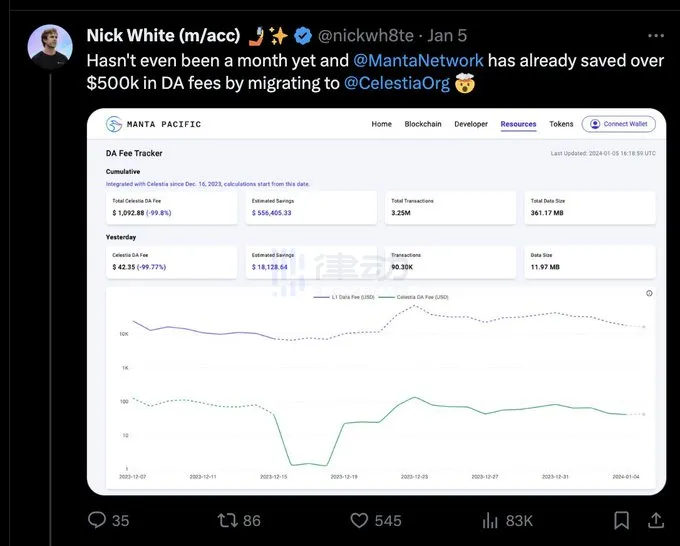
For example, @MantaNetwork saved over 99% of costs for users by implementing data availability (DA) through Celestia instead of Ethereum.
This is another resource that can help you better understand it. As I don't want this article to be too long, I will continue to discuss the narrative behind the TIA token and the reasons that have led to the crazy price surge since the TGE in November.
I believe that TIA is the purest way to understand the airdrop story of 2024-25. We have learned that TIA stakers have received two airdrops (@Sagaxyz__ and @dymension), and more airdrops have been confirmed, such as @MantaNetwork.
Celestia makes it easier to launch the new rollup. Some rollups will be airdropped to TIA stakers, and L1/L2 tokens have a premium in the market.
Therefore, we see the following statement forming: "The price of TIA is not important, as the airdrop is enough to compensate for it."
For example, my DYM airdrop has already covered the cost basis of my investment in TIA at a price of $4 on @aevoxyz. Therefore, if I choose to liquidate my airdrop, this position has already earned back its cost. However, I do not plan to do so, but that is another topic for discussion.
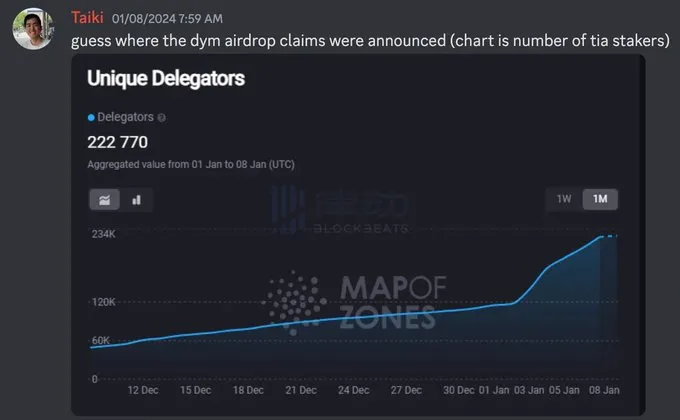
You can see that this may be a reflexive cycle. As more and more airdrops occur, we should see more buying and staking of TIA for future airdrop needs. We have already seen an increase in the number of delegates, which is closely related to the price of TIA.
Pledging TIA tokens also aligns with my view on the highly anticipated alt-L1 trading returns. Instead of trying to pick L1/L2 tokens in the upcoming cycle, why not choose to pledge TIA and passively receive airdrops?
For most people, this is a narrative that is psychologically comfortable.
I also observed some similarities in the perspectives of Solana/Cosmos. During the bear market, many teams have been developing and raising a lot of funds from venture capital firms. Some of these teams will airdrop to the stakers of ATOM, OSMO, and TIA, which will further strengthen this narrative.
But what makes it a (3,3) cycle? Here is the progress:
· A large number of airdrops (i.e. DYM) have appeared in the market.· The market is expecting more airdrops.· People dream of the scale of these airdrops.· Buyers are becoming less sensitive to prices due to the expectation of airdrops.
We can simplify the market pricing of TIA to this general function: TIA's valuation = future value of the DA layer + meme + narrative + future expectations for TIA stakers. But to be honest, no one knows how to evaluate this.
So naturally, our brains simplify the description of airdrops. If we can stake $1000 and receive an airdrop worth more than $1000, who cares about the valuation of TIA, right?
This sounds familiar, doesn't it?
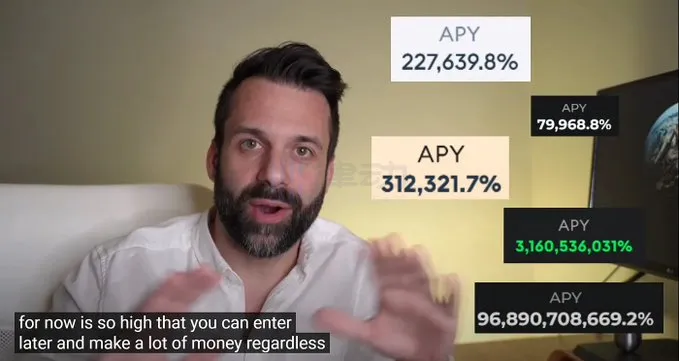
"OHM's price can rise by 99%, but you'll be fine because APY will make up for it."
"The price of TIA is not important, as airdrops can make up for it."
This is two completely different projects, but the narrative has similarities. It has the characteristics of a future bubble.


Welcome to join the official BlockBeats community:
Telegram Subscription Group: https://t.me/theblockbeats
Telegram Discussion Group: https://t.me/BlockBeats_App
Official Twitter Account: https://twitter.com/BlockBeatsAsia