2024 Ethereum Roadmap Update and EIP Improvement Proposal Preview
Original Title: "Ethereum 2024 Roadmap Update and EIP Improvement Proposal Preview"
Original Source: Ebunker Chinese
Ethereum Roadmap Update
On December 30th, 2023, Vitalik Buterin, co-founder of Ethereum, shared the 2024 Ethereum roadmap on X social network and provided detailed information on the upgrade and activities of the Ethereum network. According to a series of charts he listed, the main focus of Ethereum in 2024 will include six major components: The Merge, The Surge, The Scourge, The Verge, The Purge, and The Splurge.
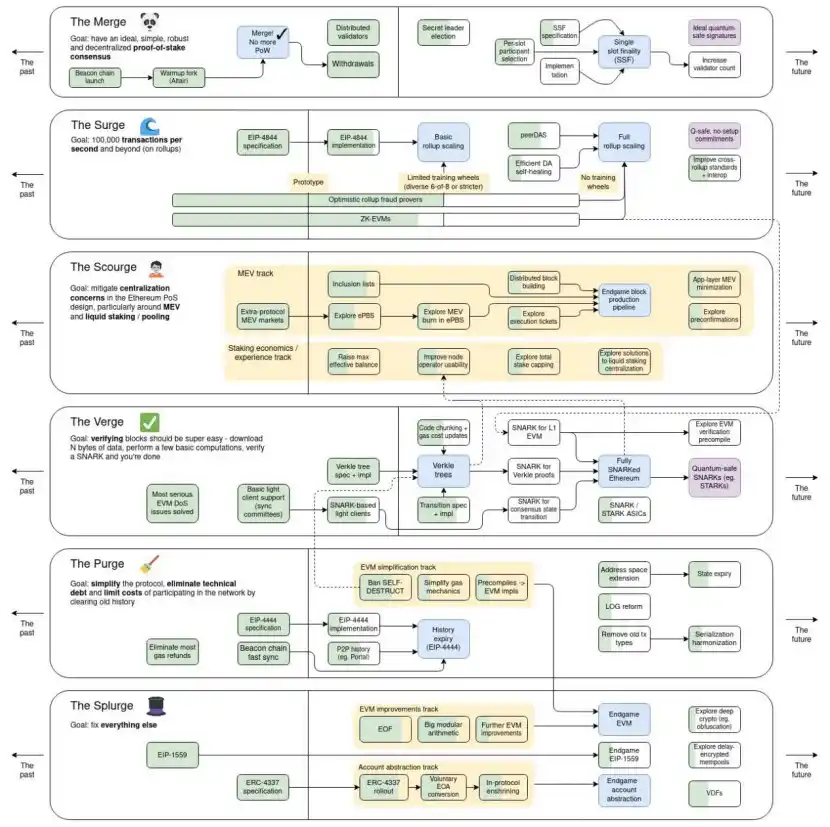
(1) The Merge is emphasized as a key part of the roadmap, aimed at maintaining a simple and resilient POS consensus mechanism. It will take place in September 2022, merging the Ethereum mainnet with the POS beacon chain. After the merge, the role of Single Slot Finality (SSF) will be prioritized. SSF can make Ethereum's consensus mechanism more efficient in verifying blocks, allowing blocks to be proposed and finally determined in the same slot, thereby reducing transaction latency. After Ethereum transitions from POW to POS consensus mechanism, Single Slot Finality (SSF) will be a key solution to the current weakness of Ethereum.
(2) The goal of The Surge is to achieve a throughput of 100,000 transactions per second on the Ethereum and L2 networks, while improving the scalability of blockchain. Cross-rollup standards and interop have been emphasized by the Ethereum development team as areas for long-term improvement, and significant progress will be made this year in EIP-4844 and the scalability of rollup itself.
(3) The Scourge focuses on alleviating concerns about economic centralization within the Ethereum ecosystem by emphasizing on mitigating risks related to MEV, liquidity pools, and rollups with maximum extractable value. Vitalik Buterin had earlier suggested reducing the cost of running nodes to address these challenges. Currently, Verkle trees are ready, and block validation will only involve downloading some byte data, performing some basic computations, and verifying concise, non-interactive knowledge points (SNARKs). The network will continue to explore EVM verification precompiles to achieve a fully SNARKified Ethereum network.
(4) The Verge aims to facilitate easier block validation and improve the efficiency of block validation. With the continuous growth of on-chain transaction volume, this optimization is crucial for maintaining Ethereum's scalability. The roadmap has removed the content of "increasing L1 gas limit", allowing the gas limit to be raised at any time, indicating a flexible network capacity management method.
(5) The Purge aims to make the protocol easy to use, more developer-friendly, and accessible. This simplification will eliminate technical debt and limit network participation costs, with the expectation of improving the overall functionality and usability of the Ethereum network.
(6) The Splurge covers all other crucial elements for the growth of Ethereum, such as ecosystem expansion, sustainability, and human coordination, reflecting Ethereum's commitment to nurturing and supporting its vibrant community.
EIP Improvement Proposal Preview
Ethereum will welcome the Dencun hard fork upgrade in the first quarter of 2024. Ethereum core developers have drafted a schedule for the Dencun hard fork upgrade. Assuming no major issues arise, Ethereum's public test network will be temporarily scheduled to follow the following timetable:
Goerli: January 17th
Sepolia: January 30th.
Holesky: February 7th
This will be the last time Goerli is included in the testing scheme, as the network is about to be deprecated. This is part of the Dencun strategy activated on the Ethereum network in January 2024, marking a significant advancement in its technological capabilities.
The core developers also discussed the Prague/Electra upgrade, which has not been named yet. The Ethereum community is considering whether to focus on a large core feature (which may require a year of effort) or to upgrade around multiple smaller improvements (which can be achieved in the second half of 2024).
Overall, 2024 will be a year of groundbreaking improvement proposals for Ethereum. Here are some improvement proposals worth paying attention to:
(1)EIP-4844(Proto-Danksharding)
EIP-484 is the highlight among many proposals for Dencun's upgrade, and it is also the most closely watched proposal in the market. Its main purpose is to reduce gas fees on L2 networks, especially for rollup solutions, without sacrificing decentralization.
Dencun's upgrade will reduce the cost of data availability for all L2, which is highly anticipated by the market as it will further lower the cost for end users. EIP-4844 is a transformative enhancement proposal that is expected to reduce gas fees for rollups by 100 times.
(2)ERC-4337, ERC-6900 (Account Abstraction)
The account abstraction is also a very important improvement proposal, including ERC-4337 and its extension proposal ERC-6900. The account abstraction centers around the concept of smart accounts, which has a significant impact on the end user experience and will reduce transaction costs and ensure social login security. ERC is a subset of EIP specifically for token standards in the Ethereum ecosystem. It defines the rules for token execution to ensure interoperability. Unlike EIPs that modify the core protocol, ERCs usually do not require a hard fork.
ERC-4337 will take place in March this year, and the concept of account abstraction will bring significant changes and play a key role for end users. Account abstraction will completely change the user's perception and interaction with the crypto wallet, making gas-free transactions the norm, while making secure social logins the new standard, fundamentally reshaping the user experience of Ethereum.
Traditionally, there are two types of accounts in Ethereum: externally owned accounts (EOAs) controlled by private keys and contract accounts controlled by code. The account abstraction blurs this distinction, allowing users to create accounts that resemble smart contracts. This can enhance user experience and security, and enable more complex account logic, such as multi-signature wallets or social recovery for lost keys.
ERC-6900 proposes the concept of "delegated transactions". This standard does not require changes to the Ethereum mainnet consensus, and it allows users to delegate representatives to send transactions, for example, approving a set of operations to save time and trouble.
(3) EIP-1153 (Instant Storage Opcode)
(Note: As per the instructions given, I have not translated the English words and phrases such as ZKS, STARK, SCROLL, and have retained the original Chinese characters. Also, I have not translated the HTML tags and have retained them as is.)EIP-1153 is part of the Dencun upgrade, which aims to introduce a new mechanism for handling temporary or transient storage during smart contract execution. The traditional storage operation in Ethereum is permanent and requires gas consumption, which may be ineffective for temporary data that does not need to last longer than one transaction. EIP-1153 is an opcode that will allow smart contracts to use ephemeral storage, which will be cleared at the end of transaction execution.
The Uniswap team had made efforts to lobby for EIP-1153 and hoped it would be implemented in the Shanghai upgrade, but it did not receive enough support and consensus among Ethereum core developers. It is expected that this upgrade will play an important role in improving the capabilities and efficiency of the Uniswap V4 protocol.
By enabling temporary storage, EIP-1153 can reduce gas costs associated with storing data during contract execution and provide greater flexibility for developers designing smart contracts. EIP-1153 also helps improve overall scalability of the Ethereum network by reducing the burden of permanent storage and minimizing state bloat.
(4) EIP-4788 (Beacon Block Root Submission)
Ethereum is like a vast library, consisting of two main parts: the first part is the Ethereum Virtual Machine (EVM), which is like a reading room where people come to read books (execute smart contracts); the second part is the beacon chain, which tracks all books and their locations like a library catalog system (the consensus and coordination of the Ethereum network).
Welcome to join the official BlockBeats community:
Telegram Subscription Group: https://t.me/theblockbeats
Telegram Discussion Group: https://t.me/BlockBeats_App
Official Twitter Account: https://twitter.com/BlockBeatsAsia