Beyond Ethereum, how Solana and Celestia build their own moats
Original Title: "Three Crypto Pioneers on Crypto's Monolithic vs. Modular Debate"
Source: Unchained Podcast
Translation: Kaori, BlockBeats
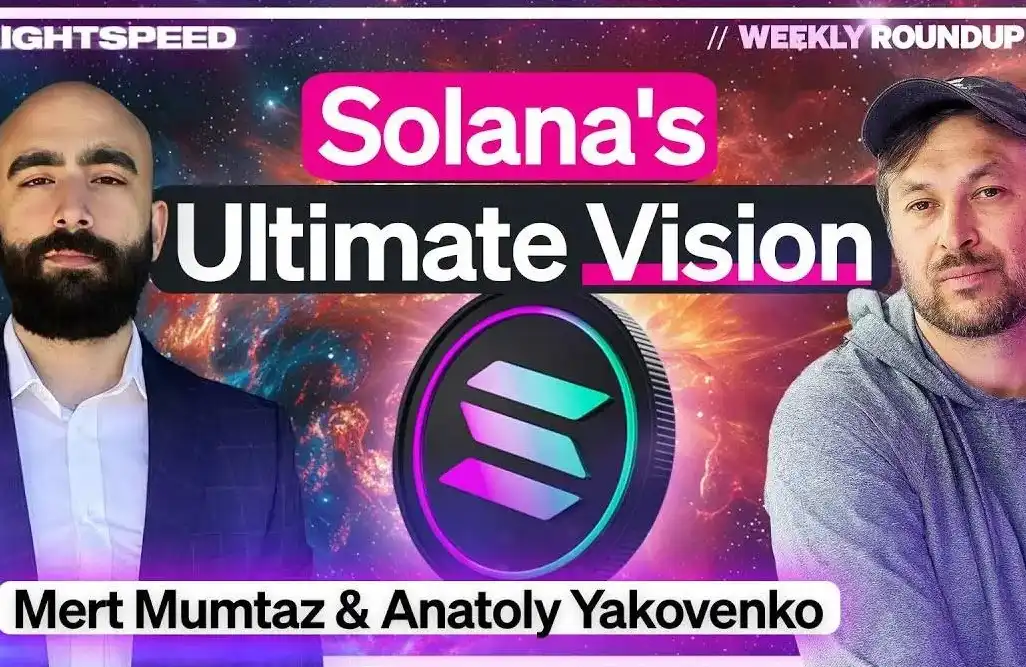
On January 2nd, the famous cryptocurrency podcast Unchained released a new episode titled "Debate on Single Chain vs. Modularization by Three Cryptocurrency Pioneers". In the program, Solana Labs co-founder toly, Celestia Labs' Chief Operating Officer Nick White, and others expressed their views on Solana, Celestia, Bitcoin, Ethereum, the security and future market predictions of the cryptocurrency market. The main points include how Solana, as one of the fastest blockchains, can prepare for large-scale use and scalability, the philosophical similarities and execution differences between Solana and Celestia, and why Solana's virtual machine (SVM) may surpass Ethereum's virtual machine (EVM) in user adoption. The following is a compiled and organized content for readers' reference.
Debate topic: Single-chain vs Modular Blockchain
Host: Laura Shin
Guest:
Solana Labs co-founder Anatoly Yakovenko.
表示,该公司已经与 ZKS 建立了合作关系,以在其 Layer2 上实现更高效的隐私保护。
此外,Celestia Labs 还计划与 STARK 和 SCROLL 等其他加密项目合作,以推动加密技术的发展。
Celestia Labs' Chief Operating Officer Nick White has announced that the company has established a partnership with ZKS to achieve more efficient privacy protection on its Layer2. Additionally, Celestia Labs plans to collaborate with other encryption projects such as STARK and SCROLL to promote the development of encryption technology.
Former Ark Invest crypto lead and current Placeholder VC partner Chris Burniske.
Laura Shin: Chris, you are the person who proposed this special program. Please describe for the audience how you define these two blockchain models. If you have any opinions on which method will win or be superior, you can also explain.
Chris Burniske: In a modular system, the different layers of the stack allow a single protocol to perform best in specific tasks or very limited functions. Therefore, modularity often involves key terms such as data availability, settlement, and execution. In this regard, Celestia performs best in terms of data availability, becoming a true model for leading and defining data availability. In addition, the integration perspective emphasizes the importance of tightly integrating these stack layers together to achieve a more seamless developer and user experience than using a modular approach.
There is a long-standing debate about which method is more economical, faster, and more scalable. An analogy can be used to understand this, for example, iOS adopts a vertical integration approach, while Android is pieced together from various parts. Although many people use Android, iOS has built a valuable ecosystem, supporting Apple to become one of the most valuable companies in the world.
As an investor, one should not only lean towards iOS or Android. Investors with a growth mindset, when faced with a choice, will choose to invest in both. This is also the position of Placeholder, who collaborates with Toly and Nick. In my opinion, Celestia is the most eye-catching startup company in 2023. Every year there is a startup company that defines that year, and Solana is the phoenix that rose from the so-called low point in 2022. Although 2022 may be a huge challenge for Solana, it has united in adversity, further consolidating the position of SOL and proving many people wrong about its development direction.
Regarding integrated stacks, I believe that currently Ethereum is more integrated than modular, although it is gradually moving towards modularity. However, in the current development environment, developers tend to choose Ethereum and EVM, or Solana and SVM.
Laura Shin: Both Solana and Ethereum have become stronger from the FTX incident. Anatoly, why don't you talk about the integration approach that Solana is pursuing?
Anatoly Yakovenko: I have an obsession, which is to synchronize all the information in the world into a single memory, just like the RAM of a computer. This is the fastest place to store information. No matter how big we make this memory, we will replicate and expand it around the world, just like throwing information into a bucket, and then it will spread rapidly around the world, allowing everyone to know instantly, just like the speed of light allows. The reason for doing this is that if we can achieve this, we can discover prices more timely than exchanges such as the New York Stock Exchange or NASDAQ. Even if these systems use technologies such as attosecond matching engines, information still needs to be spread around the world.
For example, some important market news happened in Singapore and needs to be transmitted at the speed of light through paths such as fiber optics or satellites to traders in New York, so that they can view it on their terminals. This information must hit the internal algorithms of the New York Stock Exchange before the algorithms can take action in the market. At the same time, if someone in Singapore sends a state transition to Solana's localized and concurrent block producer, the block producer will quickly spread the transaction around the world, just like news. Therefore, when New York traders view the market, the information has already been reflected in Solana's state, just as the news event has already had an impact on the market.
Therefore, there is no longer any arbitrage space between New York or decentralized systems run by a group of volunteers, and hardware has become a common commodity. This is really exciting, like science fiction. If we can achieve this, I believe it will make the world more fair. I think this is a huge engineering achievement, and I am proud of it.
In addition, I believe that this actually creates value for the world, making finance more transparent, better, and cheaper, which is good for consumers. This is the problem I want to solve. If the modular approach is a better engineering solution, I will not hesitate to abandon all Solana code, copy Celestia's code, and adopt this approach. I have no doubt about the implementation, and we are doing our best. So far, we have made significant progress.
Laura Shin: Now please let Nick explain what Celestia is.
Nick White: Celestia is the first modular blockchain network, which is unique in its ability to scale with the increasing number of users and nodes in the network. Its core value proposition is to provide developers with the ability to easily deploy custom blockchains. Modular blockchains differ from integrating all the functionalities required to build decentralized applications into one protocol, but rather breaking it down into different component protocols. These protocols can be optimized for specific needs, and developers can choose and combine these components to build a complete working product.
This method gives developers new flexibility and customization, allowing them to build unique products that cannot be achieved with conventional methods. Modular blockchain emphasizes the concept of permissionless innovation, which is different from the situation where there is only one protocol or team, as this singularity limits the scope of innovation because all decisions are made by one protocol.
In modular settings, anyone can freely innovate execution methods or data availability methods, which promotes wider innovation in the cryptocurrency field. Compared to a centralized top-down decision-making infrastructure stack, modularity is a bottom-up approach that allows developers and builders to construct their own components, with the best choice determined by the free market.
Celestia focuses on data availability and adopts a new technology called data availability sampling, which allows blockchain to be verified on consumer-grade hardware such as smartphones. As the number of light nodes increases, the block size can also grow, marking the first time there is no longer a fixed capacity or throughput, but rather an expansion with the increase of users and nodes.
Solestia: The "Different Paths, Same Destination" of Solana and Celestia
Laura Shin: Modular approaches do offer more possibilities for customization. I think the world is increasingly moving towards the SaaS model, or software as a service. In the future, if Celestia has multiple competitors, developers may choose solutions that better suit their needs, such as having better options for data availability. As for phone choices, Anatoly uses Saga Phone, which is not an iPhone, while Chris and Nick may use iPhones, which can be seen as a vote for the Solana approach to some extent. I would like to hear everyone's thoughts on the future and how people will build in these two areas, rather than focusing on what most people will ultimately use.
Anatoly Yakovenko: Defending Nick, I believe that developers cannot be marketed to. You cannot sell them things, but you can motivate them to build. Modularity is like an operating system, with a complete school of thought called modular operating systems, which is completely opposite to the design of Linux. In Linux, coding is subject to many restrictions, while the modular approach provides developers with more expressiveness and flexibility, such as QNX.
It is correct to give developers the choice, as there will always be developers interested in specific optimizations. In this process, you must choose the targets to optimize, and they are doing so. From our perspective, we care about attracting developers who are truly interested in specific optimizations. The pain of developers can be seen as a Pareto efficiency curve, picking a pain point they are willing to bear and coding around it.
Laura Shin: I want to raise a question that I'm not sure if we covered in our previous interview. In November, you may have seen a paper written by an anonymous author Polynya titled "The Horrific Inefficiency of Sharding". They believe that by proving the validity of blockchain, it can be scaled and they predict that when these proof methods are used to scale blockchain, we will see an increase in usage on mobile devices globally. Some people see this as an implicit criticism of Solana. What is your response to this?
Anatoly Yakovenko: If you want to have 100,000 nodes globally, you need to synchronize 1GB of bandwidth every 400 milliseconds, but 1GB of bandwidth is not allowed. We have the technology to meet the demand for synchronizing multiple boxes with Solana status. Therefore, from an engineering perspective, it is incorrect to say that Solana cannot scale to a large number of replicas, nodes, or bandwidth. Because current technology, such as the 20-gigabit home fiber provided by Google, will become common in homes in North America and Europe in the next five to ten years.
You can see that the normal development of networks and computers has already surpassed people's awareness. Technology is advancing at an exponential rate, which is truly difficult to comprehend. On the hardware side, we have already supported networks with very high throughput. The difficulty on the software side is that, for example, it takes two days to ship twice the number of cores from Amazon, while reliable software for shipping requires six to twelve months.
Laura Shin: Do you think the founders of startups building on Bitcoin are at a disadvantage compared to those building on Ethereum and Solana? Or do they have an advantage because Bitcoin is a leading digital asset with mainstream acceptance?
Yakovenko: It is very difficult to build projects on Bitcoin while reducing costs unless using sidechains. In contrast, it may be more practical to use Solana or Celestia and bring Bitcoin into them through bridging. I think people may succeed in this field, but it is similar to the high-cost environment faced when building projects on Ethereum Layer 1. Although companies can make money through high transaction fees, it is difficult for successful companies to expand to hundreds of millions of users who want to join the ecosystem.
Chris Burniske: BitVM。
Nick White: BitVM. Yes, if that works, it's very exciting and can actually turn Bitcoin into a settlement layer, which I think could be the best outcome. Although I don't know if the biggest Bitcoin maximalists will be happy about it.
Chris Burniske: Modularization has to some extent reshaped the Bitcoin community. People no longer just see Bitcoin as a layer for transferring digital gold, but more as a layer for data availability, which can be used for publishing NFTs and even running rollups. There are teams actively exploring running rollups on Bitcoin, including schemes similar to EVM rollup. Although this is exciting, Bitcoin has some fundamental limitations and is not well suited as a data availability layer or settlement layer due to its low data availability throughput and lack of true settlement functionality. Recently, a paper detailed how to verify execution on Bitcoin Layer 1, but I forgot the name.
I believe that Bitcoin maximalists should have an open mind, as with the decrease in Bitcoin's supply inflation, transaction fees will need to replace miners' inflation income. As digital gold, relying solely on transaction fees may not be enough. Over the past year or so, we have seen some exciting developments, such as Ordinals, which provides miners with a significant amount of fee income, which is crucial for Bitcoin maximalists who seek to make Bitcoin digital gold. Many teams are researching Layer 2, which requires some opcode changes to create a true Layer 2. Currently, a true Layer 2 does not have independent security parameters, but actually uses the security of Layer 1. Therefore, most of them are currently sidechains. We are working with Stacks, and Muneeb has been working hard to develop it into a Layer 2, although it currently looks more like a sidechain.
It would be amazing to give Bitcoin Layer 2 more expressiveness. These Layer 2s will actually provide more value to Bitcoin than Ethereum Layer 2s because Ethereum Layer 2s only extend the expressiveness of Ethereum. Bitcoin's script language is very limited, so having expressive Layer 2s will improve both scalability and expressiveness, which is very important. However, one problem faced by many teams building in the new Bitcoin ecosystem is that they have not received the expected cooperation from Bitcoin whales. In contrast, many whales are on-chain in the Ethereum or Solana fields because they are excited about innovation and willing to support new projects. Bitcoin's OG whales usually keep their coins in deep freeze, making it more difficult to obtain these coins to support Bitcoin DeFi and other projects. Therefore, the Bitcoin ecosystem faces resistance from the OG community, which adds friction. Friction will slow down development momentum. These are the problems that the Bitcoin ecosystem needs to solve, but I am excited to see Bitcoin being paid attention to again.
Ethereum will eventually succeed?
Laura Shin: If we consider Ethereum to be Modulithic, do you think there is a world where Ethereum can compete with Celestia in terms of cost or data availability? Or was it not designed for that world in the first place, and Celestia was specifically built for that world?
Anatoly Yakovenko: Ethereum is like driving a $300 billion ship, with every change carrying huge risks. People may underestimate the merge and Ethereum's progress over the past few years. From a design perspective, danksharding can scale to accommodate all of Solana's data. However, adding things internally to Ethereum involves economic and social factors, and whether it is feasible is another question. Despite facing huge challenges, I believe they are moving in the right direction.
Chris Burniske: So what do you think, Nick?
Nick White: The Ethereum community continues to iterate and innovate on a large scale, which is commendable. Compared to Bitcoin's rigid protocol, Ethereum maintains flexibility. However, making any changes while driving a large ship is extremely challenging due to complex dependencies. The transition from modularity to monolith is more ambitious than the shift from proof of work to proof of stake, touching on multiple aspects of the protocol. The design and effort put into danksharding are excellent, but its launch will be a very difficult task. The researchers and engineering teams in the Ethereum ecosystem are among the best, and although the road ahead may be relatively slow, they will ultimately succeed.
Encryption Market Forecast
Laura Shin: I want to ask what the next bull market cycle will be. In 2013, Bitcoin gained attention mainly because it was the first cryptocurrency. However, based on my observation, speculation in the past two cryptocurrency market cycles has been driven more by technology. In 2017 and 2018, ICOs were the main driving force; in 2021, despite DeFi leading, it is more like NFT. In my opinion, in this bull market cycle, the upcoming spot Bitcoin ETF will actually put Bitcoin at the core, even before the halving. I am interested in what you think the main driving force of this bull market cycle is, or whether it can be seen as the beginning of a super cycle, that is, the era when we leave the bull and bear market.
Chris Burniske: I don't think this will be a super cycle, but it will be a notable cycle. It will expand in all aspects, including users, value, integration, and connection with daily life around the world. The Bitcoin ETF is a significant event that will further integrate Bitcoin and cryptocurrencies into the real world. With traditional financial giants such as BlackRock and ARK Invest participating, the launch of the Bitcoin ETF will guide wealth advisors in training and introducing Bitcoin to millions of clients. This may spark curiosity about Bitcoin, followed by curiosity about other digital assets, such as ETH ETF, and this process will continue.
From the perspective of education, awareness, and capital flow, Bitcoin ETF is crucial and highly anticipated for this industry. The development of this cycle will coincide with the increase in global liquidity and potential interest rate reductions. Although the situation of inflation may lead to some instability, we are approaching peak interest rates. Interestingly, some comics reflect discussions about the Fed's raising and lowering of interest rates. In addition, Toly mentioned the relationship between value and the federal funds rate, which has profound reasons. As interest rates decrease, value itself will expand, which is in line with the inevitable trend of capitalism.
We are entering a period of inflow for Bitcoin ETFs, while interest rates are decreasing and liquidity is increasing. Looking back at the ICOs of 2017, they were static substitutes that laid the foundation for the development of DeFi. Now, I describe it as an internet financial system that gradually transitions from static to dynamic, and then to mature dynamic. In the next few years, I believe we will see more mature dynamic finance at the institutional level, whether on platforms such as Solana, Avalanche, or Ethereum. Celestia plays a key role in providing infrastructure for anyone who wants to publish DA transactions.
Irreplaceable products usually lag behind replaceable products by one cycle of development because they are more complex and sometimes considered worthless, such as the six-figure monkey JPEG. In 2021, irreplaceable products went through a static development phase similar to replaceable products in 2017. In the next few years, we will witness the emergence of many dynamic irreplaceable products, with gaming possibly being the most notable area. For example, experiments like DRiP on Solana demonstrate the potential of irreplaceable products in building loyalty or creator-audience mechanisms. These low-cost and scalable practices are also becoming the cornerstone of new social media and interpersonal interactions.
Laura Shin: Anatoly, Nick, what do you think will be the focus of this bull market cycle?
Anatoly Yakovenko: I think Chris has covered all aspects comprehensively. In this process of expanding applications, I look forward to seeing more practical applications, such as payments. I hope that encrypted payments like Solana Pay will begin to compete with traditional financial services, as I believe this is one of the keys to adoption. If we can launch a decentralized version of WeChat with payment functionality and seamlessly integrate it with traditional financial systems, it will help liberate users from traditional financial systems and enable them to make payments and perform various tasks in a single super app. I believe that breakthroughs in payment use cases will be a crucial step.
We are currently in a phase where decentralized technology allows us to deconstruct financial services. In DeFi, we have seen multiple competitors for each financial function. In the future, a decentralized version of WeChat with billions of users may emerge. I believe that such an application may actually be more valuable than its underlying infrastructure layer. This will lead to a recognition of the importance of applications as the key point of customer interaction, with all funds flowing through the application, while the underlying layer is more like a medium for information. Although the specific timing is uncertain, I believe this may be the second stage of development.
Nick White: One of the key themes of the next cycle will be modularity and monolithicity. Over the past few years, we have been emphasizing the concept of modularity, but it has remained theoretical until now, when we have actually reached the stage of mature modular stacks. As Chris said, this may be the first wave of modular stacks, and it may take multiple waves of development to truly achieve full dynamic maturity. But we have finally reached the stage from theory to practice, and we can witness the operation of modular stacks, with people building and demonstrating the ability of modular blockchains and the unlocking they can provide.
Celestia and Solana are leading the way in integration, while Ethereum and its L2 extensions and wider modular ecosystem are also driving the development of modularity. It remains unknown where users and developers will ultimately choose to land. Overall, I believe this will be an exciting moment as we explore new use cases. This is similar to when Ethereum was first launched, before which if you wanted to launch an application, you had to build your own blockchain, just like you had to... If you wanted to create Litecoin, you had to issue... Litecoin is basically just a token, right?
When Ethereum was launched, issuing tokens and writing DeFi applications became easier. Modular blockchains have achieved similar innovations at a deeper level of protocol and execution. I believe this will trigger a new explosion of experimentation, just as Ethereum has led the development of DeFi and NFTs. I look forward to discovering new, market-adaptive popular applications. Payments are an area that excites me very much, while games and social applications have the potential for virality and can quickly spread to hundreds of millions of users, as long as the right incentives are set.
The exploration of identity by Coinbase and Worldcoin is also an important breakthrough, as many applications are still limited by the inability to truly own citizenship, identity, or reputation. This is a big unlock, although we are still in the early stages. I thought I might be too late to enter the cryptocurrency industry when I entered in 2017, but over time, I gradually realized that this would take a long time, but it will be an interesting journey.
Chris Burniske: Toly, are you worried that Solana will become a victim of its own success like Ethereum did in 2021?
Anatoly Yakovenko: Yes, I have experienced a similar situation when building the operating system Brew for Qualcomm. It was a top-notch project and one of the coolest things with outstanding mobile download records. We actually had the first true mobile platform, and the design of the iPhone was in our hands. However, Verizon pushed back because they thought they knew what to do. We were concerned about being stuck in the middle, too big to adjust and too small to surpass once Apple shipped. Therefore, we were concerned about moderate changes. Our single focus on performance made it easier for engineers to reach consensus, accelerate the chain, and ensure high priority and stability.
But what is the next problem? We are making this change to unlock the next level of performance. We have a culture of driving things forward through singular focus, which has been successful. However, as things mature, change and other aspects must be approached more cautiously. We need to slow down a bit, but also have more resources. We hope the ecosystem can maintain this pace, even though it is a scary thought. Yes, Firedancer is launching a second implementation, so eliminating single points of failure is our top priority for everyone.
Laura Shin: On the day we recorded, a widespread vulnerability affected a large number of decentralized applications on multiple blockchains. This was related to a former Ledger employee becoming a victim of a phishing attack, which allowed hackers to update Ledger's Connect Kit software. This software connects different dApps on multiple blockchains, and the hackers uploaded malicious code that drained users' wallets. This incident clearly caused chaos and a lot of trouble. I want to know your thoughts on the future of the industry, because I believe that in order to push this technology to the masses, these kinds of things should not continue to happen. What are your thoughts on this?
Anatoly Yakovenko: I believe that technology is improving. I am using the Fuse wallet that was released two months ago. This is an on-chain wallet that allows users to set up different supply chains as signers on multiple hardware devices. These solutions already exist and are live, but they need time to spread widely across the globe so that people are no longer vulnerable to these attacks. Promoting these solutions is very difficult because it requires users to change their behavior and a series of downstream updates. In the long run, I believe that these problems can be overcome, although it will be a bumpy journey.
Nick White: I believe we are currently in the early stages of blockchain development. In this stage, risks are inevitable, especially in terms of protocols and the entire stack (including wallets). Although there have been hacks, it is actually a process that drives progress because it reveals problems that need to be fixed. Once fixed, we hope similar issues will not occur again. It's like we're setting up an ongoing bug bounty, and although it may not be intentional, this process is constantly pushing us towards a more robust system. We hope that blockchain can become the cornerstone of the future global financial system, although this is a process that requires continuous effort rather than shortcuts, and occasional hacks are just part of this process.
Welcome to join the official BlockBeats community:
Telegram Subscription Group: https://t.me/theblockbeats
Telegram Discussion Group: https://t.me/BlockBeats_App
Official Twitter Account: https://twitter.com/BlockBeatsAsia

 Related Articles