Major events in the DeSoc field in 2023: A year of breakthroughs and changes, exploring new trends in blockchain social media
Original Author: HashBrown Research
Original Title: "Dissecting DeSoc in the Year 2023"
Translated by: Logicrw, BlockBeats
Translator's note: This article, jointly released by research firm HashBrown Research, Tako Protocol, and Mask Network, comprehensively reviews the important developments and innovations in the field of decentralized social media (DeSoc) in 2023, revealing the profound impact of blockchain technology on the social media industry and its possible future directions. The article delves into the progress of DeSoc in privacy protection, data sovereignty, and user experience improvement, particularly in the technological innovation and application practices of key projects such as Lens Protocol and Farcaster Network. In addition, specific case analyses of how projects such as Friend Tech and Stars Arena utilize blockchain technology to connect traditional social platforms like Twitter demonstrate how DeSoc transforms users' social behavior into investment behavior, bringing new value and experiences to creators and fans alike. Furthermore, the article emphasizes the main challenges facing the DeSoc field, including interoperability, modularity, censorship systems, and security issues, the resolution of which is crucial for the long-term development of DeSoc.
In 2023, a notable feature of the cryptocurrency market is the increasing popularity of decentralized social (DeSoc) and decentralized finance (DeFi) options and leveraged trading among institutions and retail investors, following the bankruptcy of FTX in 2022. In terms of market performance, the overall market capitalization of the cryptocurrency market has significantly increased in 2023, thanks to the sustained demand for the two mainstream cryptocurrencies, Bitcoin and Ethereum. The price of Bitcoin has risen from its low point of $16,000-$17,000 in January to over $42,000 currently. Meanwhile, Ethereum has also rebounded from its low point of $1,200-$1,300 to over $2,200, thanks to the growing interest in DeFi and Layer 2 scaling solutions built on the Ethereum mainnet.
2023 Cryptocurrency Market Review
In 2023, there was a significant change in the regulatory environment for the cryptocurrency industry. Governments and financial regulatory agencies around the world began to develop clearer guidelines for the industry, which increased regulatory certainty, boosted investor confidence, and further promoted institutional adoption of cryptocurrencies. The penalties and fines imposed on Sam Bankman Fried and CZ provided further clarity, with the former facing a maximum sentence of 115 years for fraud and commingling customer funds with his trading team Alameda Research, and the latter paying a $4.3 billion fine for non-compliance with Know Your Customer (KYC) guidelines and money laundering charges, and being forced to resign from Binance.
In addition, the rise of central bank digital currencies (CBDCs) in multiple governments in 2023 has attracted attention. Countries, including some major economies, have begun to explore the development and implementation of their own digital currencies, which not only brings new competition to the cryptocurrency market, but also indirectly recognizes blockchain technology. At the end of the year, with the news of BlackRock pushing for a Bitcoin ETF, Bitcoin has attracted more attention. Many analysts predict that this ETF may be approved by US regulators in the first quarter of 2024. The entire crypto market then speculated that Ethereum may be the next asset to receive ETF approval. All of this happened against the backdrop of the Federal Reserve's pause in raising interest rates. Earlier this year, the Federal Reserve raised interest rates to curb inflation. Ultimately, the Federal Reserve indicated that it would not raise interest rates further, and the market showed a bullish trend towards volatile assets such as cryptocurrencies.
Blockchain Technology Advancement
In terms of technological advancements, 2023 witnessed continuous innovation in blockchain technology, including the development of new protocols and decentralized applications. There are two main types of Layer 2 scaling solutions that have been launched: optimistic rollups (such as Arbitrum and Optimism) and blockchain-based on zero-knowledge proofs (such as ZK Sync and Polygon's ZK EVM). These technologies aim to address the scalability issues of existing blockchain networks like Ethereum, making transactions faster and more cost-effective. These breakthroughs have led leveraged traders who previously used centralized trading platforms like FTX to turn to on-chain perpetual protocols like Perpetual, GMX, and DYDX on Arbitrum and Optimism. In late 2022 and early 2023, there were also innovations on the Bitcoin network, including the first Ordinal NFT engraved on a Bitcoin block and the emergence of new BRC-20 asset categories, which are new tokens issued directly on the Bitcoin network. Although Bitcoin developers have raised concerns about these activities, arguing that the Bitcoin network should not be used for such purposes, it has only further pushed the acceptance of these novel digital assets.
Overall, 2023 is a year of rapid growth and maturity for the cryptocurrency industry, driven by increases in adoption, regulatory development, and technological advancements, which have collectively propelled the continued expansion and mainstream acceptance of cryptocurrencies.
DeSoc Mainstream Trends
In 2023, the DeSoc industry underwent several major changes. One notable trend was the rise of blockchain-based social media platforms, such as Nostr, DeSo, Lens Protocol, and Farcaster Network. These decentralized social graphs and their clients allow users to have complete control over their data and identity, thanks to the distributed nature of blockchain. Users can securely interact and share content without relying on centralized entities and data storage methods to maintain ownership of their data. This highlights an important trend: user privacy and data security are increasingly being emphasized in traditional social media's censorship, non-monetization, and opaque algorithm issues. As concerns about data leaks and privacy violations intensify, DeSoc platforms have become the focus due to their prioritization of user privacy. These platforms have adopted powerful encryption protocols and enhanced security measures to ensure the confidentiality and security of user information, preventing the platform itself from profiting by selling user data to third parties.
In addition, content moderation has become a hot topic in the DeSoc field in 2023. To address the risks of spreading false information and harmful content, these platforms have adopted innovative content moderation methods, such as community-driven moderation processes that allow users to actively report and review content, and the use of NFT technology to prevent robot attacks on users. In addition, the concept of decentralized governance has also received increasing attention in 2023. These platforms have introduced transparent and inclusive decision-making processes through a community governance model. Users are given the right to vote on platform policies, feature updates, and even platform resource allocation. This approach ensures that decision-making power is distributed among users, rather than being concentrated in an unregulated central authority. Overall, 2023 is a year of change and growth for DeSoc. It has witnessed the development of blockchain-based platforms, increased focus on privacy and data security, innovative content moderation methods, and the rise of decentralized governance models.
DeSoc Investment Brief
In 2023, Lens Protocol, supported by Aave, raised $15 million in seed funding in June, while Orb and Phaver, based on Lens, raised $2.3 million and $7 million respectively in September and October. The intersection of DeSoc and cryptocurrency witnessed a strong investment boom. In October, Lenster and Lenstube were renamed "Hey" and "Tape" respectively, indicating that all applications will compete and build on a shared social network. Tako Protocol claims to be the social monetization layer of Web 3 social, and raised $2 million in early seed rounds in August from major companies such as Mask Network and DWF Ventures. Tako then strategically invested in Jam, the second largest client in Farcaster's DeSoc graph, and renamed it JamFrens, indicating its willingness to grow together with a wider field. CyberConnect even listed its CYBER token on Binance in August, following the trend of social media applications in the cryptocurrency field. These foundational projects and their communities are accumulating momentum for the expected 2024 cryptocurrency bull market, but with the arrival of Farcaster Network V3 and Lens Protocol V2 and more users joining, competition is becoming increasingly fierce. Let's delve into the innovative moves of these DeSoc field leaders.
Lens Protocol and Farcaster Network
To delve deeper into the DeSoc field of SocialFi, it is necessary to learn more about Lens Protocol and Farcaster Network, as they are leading the way in creating open and decentralized social graphs, upon which developers can build application layers. This means that users can access multiple decentralized applications with one account, such as new decentralized versions of YouTube, Twitter, Facebook, Instagram, and even Pinterest. However, their relationships and online interactions will be stored in a social graph, which ensures data privacy and may be governed by a decentralized autonomous organization for social graph auditing decisions. At the same time, it allows dapps to experiment and build freely on top of it, with almost no limitations.
For example, Lens has many different types of application layers built on its social graph, targeting different types of content. For instance, Phaver is similar to Instagram, but with a point system and staking feature. JamFrens and Hey are more like decentralized versions of Twitter, with JamFrens allowing users to invest in their favorite Lens creators by trading personal profile keys. Tape focuses more on video content, similar to YouTube or Vimeo, while other applications on the Lens social graph optimize various functions such as creating memes, making friends, and obtaining cryptocurrency information. Warpcast and Flink are two dapps built on the Farcaster network, more similar to Reddit, but with almost limitless possibilities for building. The account I use on Warpcast can also be used on Flink, and vice versa. Other platforms based on Farcaster also allow me to log in using the account I created for Flink.
Lens and Farcaster both extensively use NFT technology to ensure that users can bring their accounts to any of these dapps and seamlessly interact with their social graphs. In both ecosystems, your account is associated with an NFT located in your crypto wallet, so using it on a new platform simply means connecting that wallet to their frontend and signing transactions. Once you send content and interact with users there, it all gets sent to the social graph of either the Farcaster network or the Lens protocol, depending on which one you're using. This is a major innovation because it means using one account in your crypto wallet can be used for new YouTube, Reddit, Twitter, and Instagram in Web 3, instead of constantly logging in, forgetting passwords, and resetting emails. But this is only part of the DeSoc innovation story, which is still unfolding.
Farcaster Innovation
Farcaster initially introduced the concept of on-chain identity connected to encrypted wallets (or multiple wallets), which was later adopted by Lens, making access to all applications running on the social graph permissionless. To prevent robot attacks and spam attacks from airdrop hunters, Farcaster requires invitation and Lens requires holding the Lens handle NFT. These defense mechanisms have somewhat hindered user growth as they encourage users to create valuable content. However, with the launch of Farcaster V3, they are now open to any user who wants to join the network, with new users only needing to pay a one-time fee of $7 plus on-chain transaction fees to use any dapp built on the Farcaster network, from Warpcast to Flink to JamFrens. With their openness, the number of users has increased, with over 6,807 people registering without permission, while according to the Dune dashboard, 1,402 users have registered in a trusted manner. From a small sample, the ratio of untrusted accounts to trusted accounts is close to 4.85:1, indicating what core users of Farcaster are interested in.
Farcaster V3 has also launched a feature called 'warps', which allows users to earn and share within its application. This is specific to its application and not applicable to the entire social graph. Due to the constantly changing network gas fees, the number of warps required to perform specific on-chain operations may vary, but the cost on the Farcaster network Optimism is extremely low. As of now, the total number of users on the Farcaster network has exceeded 46k.
Farcaster V3 has launched a new feature on its main client, Warpcast, called "warps" that allows users to earn and share money on dapps. This feature is specific to the application and not available to all users on the social graph. Warps are a convenient way to perform on-chain actions directly within the Warpcast application, such as adding new Farcaster applications or minting specific NFTs. Unlike the open operations of Lens, which we will delve into next, warps are centralized and off-chain and are similar to rewards for frequenting your favorite coffee shop. The more you use Warpcast, the more warps you can earn. Users with warps can connect to Farcaster applications, pay their friends' Farcaster network fees, or give 100 warps to someone else every day. The number of warps required to perform specific on-chain actions will vary based on the network's gas fees, but the cost on the Farcaster network Optimism is extremely low. As of now, the total number of users on the Farcaster network has exceeded 46,000.
Lens Innovation
At the same time, the Lens platform has not yet been opened to everyone, and is currently only open to those who have purchased Lens handle NFTs or have been invited by existing handle users. Stani, the founder of the Lens Protocol, stated that Lens will also be opened to the public soon.
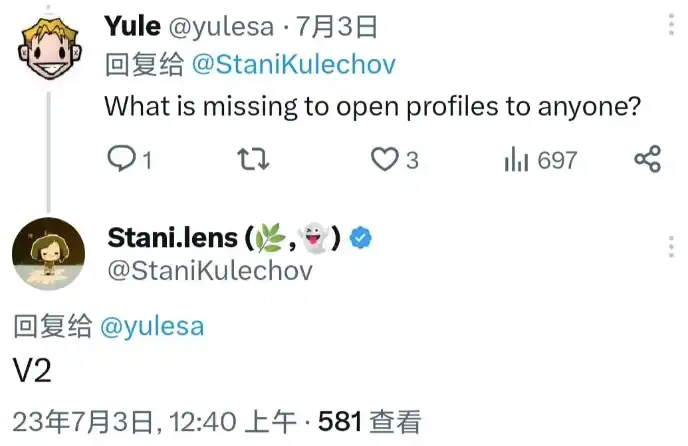
As of today, Lens has 125,964 user profiles and its V2 version has been launched and applied to all related dapps. The Lens V2 is special because it introduces multiple innovations that improve the current paradigm of social media content creators. Creators and developers are welcome to use smart contract technology to gamify social media, which is a new paradigm in both blockchain and social media fields. Before V2, Lens introduced the concept of collecting posts on its social graph through buttons on the application layer (such as Hey). Over 400,000 posts were collected and users collectively minted over 3.5 million NFTs, highlighting the huge success of its DeSoc paradigm. Now, they have iterated and updated this feature with a new function called "Open Operations," where developers can build custom operations related to posts or content publishing. They call these new user operations "publishing operations," which are executed by Lens configuration files. The innovation here is to associate the operation chain with users and content, rather than like anonymous tips, where content creators cannot associate or quantitatively evaluate them with their own works.
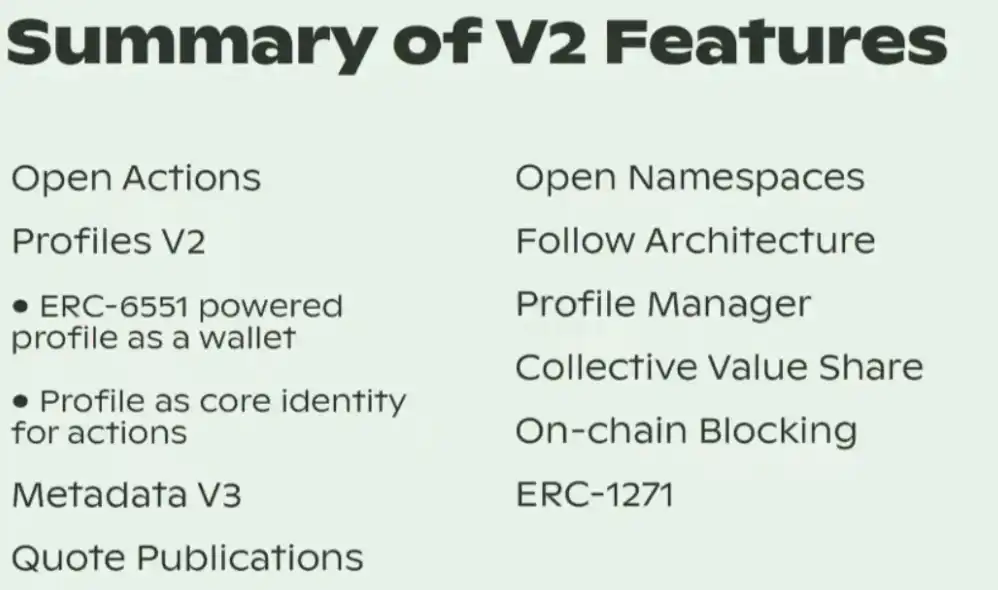
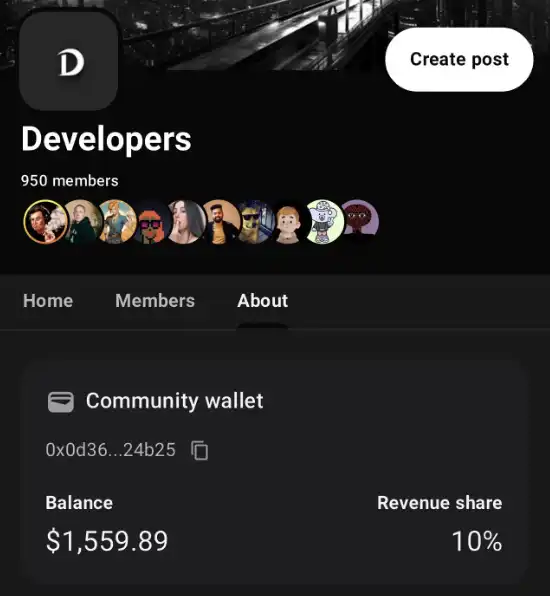
The use of tipping operations allows indexers to link ERC-20 transfers to the Lens post that executes the operation. This allows creators like Lenny to track the amount of tips received for each publication, or he can track which handles are his top tippers, this is just one use case. The publishing operation can also provide rewards through a recommendation system, such as Lenny setting tipping behavior to reward users who interact or spread his published content, if they help him get tips, they can get a portion of the tips. Therefore, if Jeff quotes Lenny's post and Jan sees Lenny's publication because of Jeff's quote, when Jan tips Lenny, Jeff will get a portion of it as a commission. This not only applies to quotes, but also to other user actions that help share published content, such as mirroring and commenting. These innovations on Lens truly help highlight the potential of gamifying social media. Another noteworthy innovation is implemented by the Lens-based Dapp Orb, which makes community sub-wallet sharing possible, as long as users choose to create it.
Tako Protocol responds quickly to the DeSoc and SocialFi trends in 2023, positioning itself as the monetization layer for Web 3 social. It aims to provide basic smart contract functionality for various social applications. Due to its interoperability and open source nature, Tako supports developers to develop without permission. Its modular and generic design is suitable for various social graphs and their client dapps. Tako strategically invested in Jam and was renamed JamFrens, which has been launched on the Lens Protocol. It introduces tradable user profile keys and plans to launch on the Farcaster network by the end of the year. This is intended to differentiate it from other client dapps and showcase its interoperable gamification technology. The gamification of decentralized social graphs with blockchain is crucial. Middleware like Tako allows developers to focus on front-end and back-end development, while integrating Tako's SDK or API only when the user base is ready to accept smart contract gamification methods. To this end, Tako collaborates with Lens to plan the DeSoc Codex annual online hackathon in 2024. The event aims to invite global developers to innovate based on its DeSoc gamification technology and receive guidance from heavyweight players in the field such as Polygon Labs, Mask Network, Phaver, and Consensys.
SoFi So Good
These trends are worth our attention because they pave the way for a more user-centric and democratized social media landscape, working in synergy with the tokenization and gamification capabilities of blockchain. However, it is worth noting that the guardians of privacy and data sovereignty are still sleeping giants and far from being the biggest winners in the constantly evolving and unclear consensus-reaching world of encrypted social media. The leading position is reserved for those dapps that are not so decentralized but still based on blockchain, which directly connect to traditional social media such as Twitter and provide new ways for users with large fan bases and audiences to make money through existing social media.
Specifically, applications like Friend Tech and Stars Arena utilize Twitter's API to connect to Layer 2 blockchains such as Base and Avalanche. Friend Tech, in particular, became a phenomenon overnight, popular among users and creators, creating billions of dollars in ETH trading volume as it was the first time that Twitter profile keys or shares could be bought and speculated on. Since its launch on August 10, 2023, Friend Tech has exploded in growth, attracting over 250,000 independent traders in just over a month, generating over $9.76 million in protocol fees for the platform. Creators and fans both benefit from Friend Tech's unique bonding curve feature, with 5% of trading volume going directly to the creator key being traded and another 5% going to the Friend Tech protocol. Anyone can become a creator, and anyone can invest early in creator keys, leading to a frenzy of speculation on Twitter accounts activated on Friend Tech, attracting everyone from bots and speculators to genuine fans in the Ethereum ecosystem.
Friend Tech quickly brought cryptocurrency into the mainstream by transforming fans' consumption behavior into investment behavior, sparking a new connection between social media and blockchain. Creators can directly interact with fans who are now key holders. Another unique aspect of Friend Tech is that it bypasses Google Play and Apple App Store by creating a progressive web app (PWA), which allows for faster iteration and reduces the share of revenue for intermediaries and gatekeepers, embodying the spirit of cryptocurrency. Many industry builders have noticed Friend Tech's overnight success, and although there have been some imitators, Friend Tech remains the only winner in this unique SocialFi market. Despite its success, the price of creator keys on Ethereum has reached its peak, creating barriers for new entrants and causing growth to stagnate.
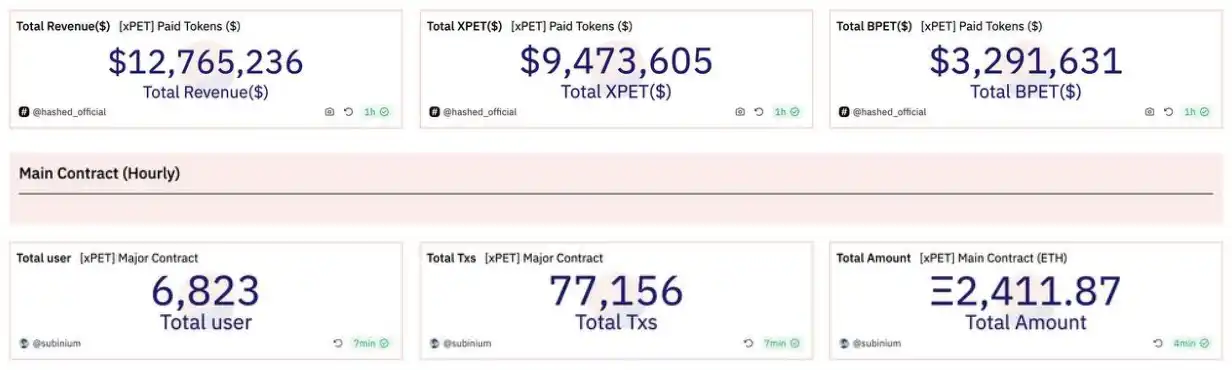
The mode of connecting traditional social media platforms such as Twitter with Dapps through APIs has shown promising results in XPet, a Twitter plugin game based on Arbitrum. XPet has occupied a niche market in the field of electronic pets previously dominated by FrenPets based on Base Chain in the crypto space. Users only need to link their Twitter accounts to directly obtain a pet on the Twitter interface, which roams in the lower left corner of the subscription source. Users can feed and take care of their pets directly in a new window on Twitter. The game website encourages users to take good care of their pets and earn cryptocurrency rewards through this.
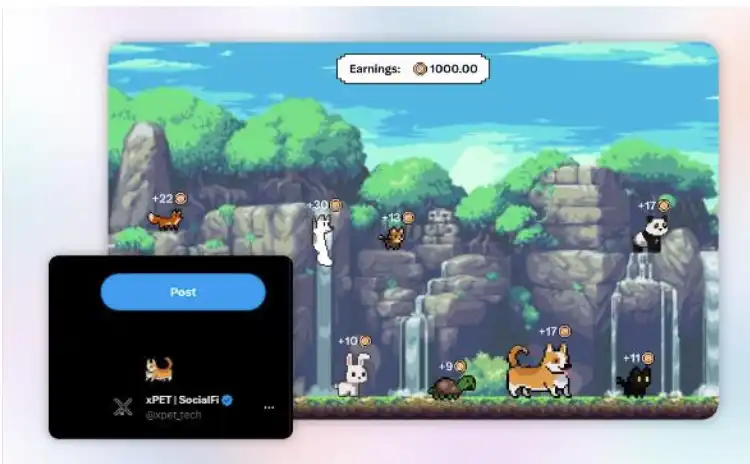
XPet's total revenue has approached $13 million, with over 6,823 unique users conducting over 77,000 transactions on the platform in just over a month. XPet's success strongly indicates that there is still great potential to be discovered in conducting innovative experiments on existing social media platforms, while providing novel interactive ways for users, creators, and curators to earn monetary rewards.
2024 Year DeSoc Storyline Observation
Based on this, the following are our main narrative predictions for the SocialFi and DeSoc fields in 2024:
Interoperability
The project team that successfully breaks down the barriers between the largest encryption communities on the blockchain will be the biggest winner. For users, sticking to a single chain means missing out on emerging ecosystems and airdrops aimed at bringing liquidity and user stickiness to the DeFi community. Similarly, from a project perspective, social media channels cannot exist in isolation. Therefore, the chain-agnostic methodology of Lens Protocol and Tako Protocol is particularly important.
Security
If Dapps and protocols cannot defend against hacker attacks or have single points of failure, they will not be able to continue to exist or gain substantial user bases. Due to its decentralized nature, DeSoc has certain advantages in terms of security, but not all SocialFi protocols can achieve this, as demonstrated by issues with vulnerability to attacks or corrupt centralized leadership in protocols such as Stars Arena.
Early attention to the latest trends in DeSoc and SocialFi fields will bring rich rewards to users. So far, no DeSoc or SocialFi project has issued tokens to users, although almost all projects have established a platform points system. In short, this means that early participation is beneficial!
Original article link
Welcome to join the official BlockBeats community:
Telegram Subscription Group: https://t.me/theblockbeats
Telegram Discussion Group: https://t.me/BlockBeats_App
Official Twitter Account: https://twitter.com/BlockBeatsAsia