Summary and Outlook of Bitcoin Current Situation in 2023
Original Title: "State of Bitcoin: 2023"
Original Source: thesis
Original Translation: Plain Language Blockchain
When people think of blockchain around the world, the first thing that comes to mind is Bitcoin. Despite countless developments and innovations in decentralized technology over the past decade, from GameFi to DeFi to NFT, Bitcoin remains the most outstanding digital asset in the world. Therefore, its health, recent developments, and future indicators are crucial.
Looking ahead, the possible approval of the first Bitcoin exchange-traded fund (ETF) by the cryptocurrency industry could unleash a significant amount of new investment, meaning that 2024 could be a critical year in the long-term development of decentralized economies.
So, did Bitcoin intentionally disrupt the order? Will DeFi exist on top of Bitcoin through protocols such as Taproot Assets and BitVM, or are they just different attempts that have not succeeded? Will Bitcoin have a successful scaling solution? This article will provide in-depth analysis and data interpretation on these questions and the state of Bitcoin in 2023.
2023 will be a year of great leap for Bitcoin. In the difficult times of digital assets and traditional markets, Bitcoin continues to create historic milestones, consolidating its legitimacy as a global asset and network.
Bitcoin is no longer just a digital non-mainstream speculative tool, but the cornerstone for builders and investors to realize their visions. This has driven the trend of innovation, continuously expanding the functions of Bitcoin, while aligning with the core concepts of decentralization and permissionless.
New technologies such as Lightning Network and new token standards demonstrate the continuous evolution of Bitcoin, whose functionality is becoming increasingly similar to other popular networks, but without relying on the centralized patches and workarounds that support many blockchain projects. The development of Bitcoin goes far beyond technological innovation and includes innovations in fields such as financial services and gaming platforms. By 2024, Bitcoin is expected to make even greater strides.
One, in 2023, people's confidence in Bitcoin will be significantly strengthened
When evaluating the health of Bitcoin, price often becomes the headline of news. However, behind the ups and downs of the market, on-chain data reveals a fascinating story: mainstream adoption is constantly expanding, while long-term holders remain steadfast in their belief in Bitcoin.
1. Mainstream investors widely participate
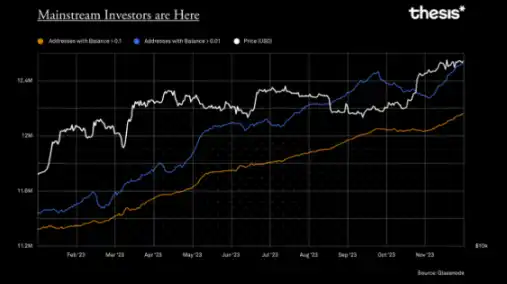
Over the past year, the number of addresses holding a balance between 0.01 BTC and 0.1 BTC has gradually increased, indicating growing interest in Bitcoin among retail investors. With uncertainty in traditional markets, investors are seeking strong alternatives. Bitcoin's scarcity and monetary policy add to its appeal as a safe store of value. Now, the increase in retail participation has laid the foundation for the next wave of adoption.
2、Long-term holders demonstrate strong beliefs
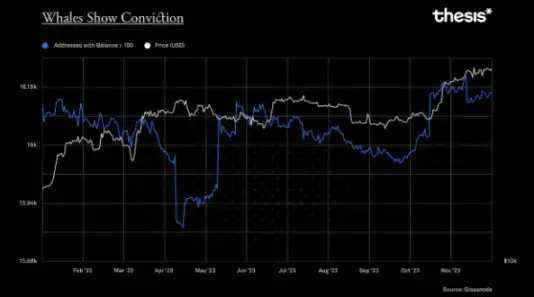
With the influx of new investors into the market, seasoned Bitcoin holders have increased their positions in the price fluctuations, which are related to market trends. As the price reaches a high level, some people begin to take profits. The divergence between holder behavior and market prices indicates a strong belief. Continuous accumulation often indicates an upward trend in prices, indicating that holders expect changes to occur soon.
Large holders with more than 100 bitcoins drive short-term volatility, reflected in the number of addresses. In the fourth quarter, these individuals reached a new annual high, suggesting a resurgence of institutional investment interest. The data proves the attractiveness and resilience of Bitcoin to experienced investors.
3. Loss of assets on trading platforms, investors accept self-custody
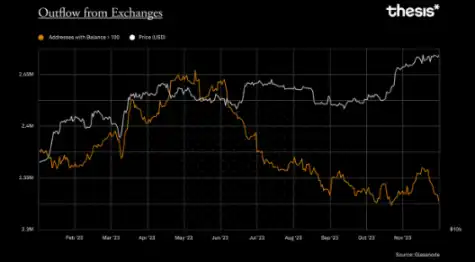
The decrease in assets on trading platforms and the increase in self-custody create a sharp contrast. Investors prefer to directly control their assets and not be affected by overall market trends. This migration has compressed the liquidity of trading platforms while enhancing the potential for Bitcoin's supply inelasticity to drive upward price movements.
The number of self-hosted addresses continues to rise, while assets on trading platforms continue to decrease. This trend, along with the accumulation of long-term holders during price consolidation, demonstrates a long-term confidence in Bitcoin as an investment and store of value. Continuous accumulation often indicates a significant price increase. The data highlights the importance of holder confidence in volatile markets, as well as the advantage of Bitcoin's non-elastic supply curve. As large institutions integrate Bitcoin supply, even as prices rise, the incentive to sell decreases. This supply pressure and growing mainstream and institutional investment interest indicate an upcoming bull market.
The trend of self-custody, the accumulation of high-confidence holders, and the demand from larger investors have paved the way for the next wave of widespread adoption of Bitcoin. This macro background provides optimistic prospects for long-term investment in Bitcoin. In the market downturn, strong demand still exists, and the selling motivation is no longer obvious even if the price rises. Only high-confidence assets can withstand market tests. Self-custody is the best embodiment of the pure intention of long-term holding.
4、The momentum for the next bull market is strengthening
If the signs of blockchain are reliable, Bitcoin is preparing to launch the next important growth cycle. The key conditions are in place: mainstream and institutional participation is expanding, long-term holders are continuing to accumulate, and self-custody is showing an unshakable trend. The composition of investors and the behavior of holders suggest that momentum is building, which will drive Bitcoin towards the next adoption phase.
For long-term believers, the emerging narrative of Bitcoin represents early opportunities. The foundation is constantly strengthened, gradually moving towards the perfect vision of decentralized currency.
二、比特币的扩展问题
Translation:
II. Bitcoin's scalability issues
In 2023, expanding Bitcoin to meet the growing demand remains a top priority. While innovations such as the Lightning Network have improved capabilities, there will be new second-layer protocols in 2023 that can achieve unlocking without sacrificing functionality. These include parallel and interoperable sidechains with Bitcoin.
The different layers of Bitcoin can improve performance without changing the underlying layer, just like advanced Internet protocols enhance TCP/IP. Examples range from Lightning Network for fast payments to complex smart contracts in Stacks and RSK. Bitcoin emphasizes stability as a settlement base layer while encouraging innovation in upper layers. These layers can support applications that require comprehensive smart contracts, high throughput, and privacy, based on Bitcoin's solid foundation.
This modular thinking reflects the idea of Bitcoin - expanding functionality while minimizing trust. Keep the base layer simple, keep it permissionless, and make the network more adaptable to different needs. Many layered protocols are dedicated to achieving the versatility of Bitcoin without compromising its decentralization.
1. Technical Overview
The core concept of ZK Rollups is to bundle multiple transactions into a single transaction on the Bitcoin blockchain. This process uses zero-knowledge proofs to verify the bundled transactions without revealing details. Sovereign and Starkware are leaders in driving zk rollup innovation on Bitcoin.
2、Centralization Issues and Decentralization Efforts
The current version of zk rollups has raised concerns about centralization because they mainly rely on centralized sequencers. In many existing implementations, a single entity is responsible for aggregating transactions, generating validity proofs, and submitting batch data to the Bitcoin network. This has led to significant trust in the sequencer. In the long run, a hybrid model may emerge that combines multiple types of attestors to adapt to different use cases.
Given that this is inconsistent with the philosophy of Bitcoin, people are actively trying to decentralize the role of the sorter. The goal is to distribute the responsibility for transaction collection, proof generation, and block submission to multiple entities. This decentralization of trust is more in line with the decentralized design of Bitcoin.
But what is the Lightning Network? The LN micro-payment channel establishes a relationship between two parties, allowing them to continuously adjust their balance without broadcasting every transaction to the blockchain. This delays the total balance between the two parties from being broadcasted to a future point in time, effectively processing the total balance in a single transaction.
This method allows financial relationships to be trustless and free from the risk of default by the other party. These micropayment channels use real Bitcoin transactions, but choose to delay broadcasting these transactions to the blockchain. This allows both parties to confirm the current balance on the chain, while the actual payment is made outside of the channel.
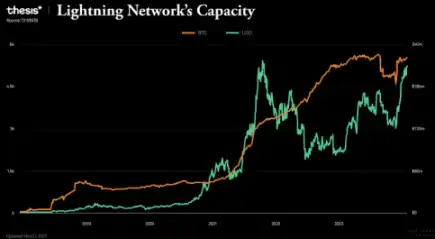
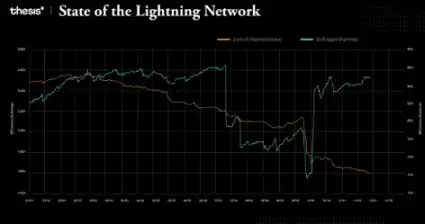
In October 2023, the number and total value of Lightning Network channels experienced a contraction, possibly due to integration events or responses to external market factors. However, both of these indicators subsequently recovered, demonstrating the network's resilience. Despite fluctuations, the overall value of channels has increased, indicating an expansion of network capacity.
1. Enterprise infrastructure becomes more robust
November marks another leap forward for the Taproot Asset Protocol v0.2. This toolkit provides support for issuing assets through LN and Bitcoin, and customizable asset destruction functions provide compliant controls for regulated industries.
LN has now established diversity for enterprises, from tokenized securities to programmable contracts within restricted jurisdictions.
2、Nostr integrates and opens up P2P economy
The demand trend indicates that the decentralized payment channel of Bitcoin may continue to penetrate into communication and community development applications.
In 2023, major retailers accelerated the penetration of the Lightning Network (LN) in the consumer sector. Stripe's "Pay with Bitcoin" button opened up the Lightning Network for businesses. Twitter and Zebedee also integrated LN, allowing users to easily tip quality content and conduct fast Bitcoin transactions in games. LN finally fulfilled its promise as a globally adopted scaling layer, improving Bitcoin transaction speed and reducing fees. However, to make LN more widely used, more integration with payment, e-commerce, and social media is still needed to reduce usage barriers.
3、Hosting Challenges
Hosting services are facing regulatory pressure, in stark contrast to the breakthroughs in non-custodial wallets. New asset designs and scaling protocols suggest enhanced functionality. Despite setbacks in Bitcoin's application and infrastructure, overall progress is gradual. Miniscript and RGB are promising extensions of Bitcoin's programmability.
Looking ahead, despite the progress made by the Lightning Network, it still faces growing pains that are not in line with external success. The high cost events caused by network congestion have exposed ongoing scalability limitations. The departure of core developers highlights technical risks. About 90% of transactions are completed through custodial wallets, reflecting user experience barriers to non-custodial use. Although Lightning promises great potential, it is not yet a mature product.
Temporary fluctuations should not negate the innovation of Bitcoin. Lightning has already changed the lives of millions of people worldwide and seems to be preparing to move towards a new stage through optimizations such as Anyons and group settlements. Bitcoin continues to iterate, turning challenges into progress. History has shown that setbacks in Lightning may become opportunities for development.
Five, Ordinals: Inscriptions on Bitcoin
In the development of Bitcoin, a prominent technological innovation is the emergence of satoshis. It can convert a single satoshi into a unique digital artifact capable of carrying rich data. Satoshis are the smallest part of Bitcoin and can record data such as text or images. Once each satoshi is recorded, it becomes a unique digital asset.
The Ordinal Protocol was first proposed by founder and developer Casey Rodarmor on January 21, 2023. It leverages the Taproot upgrade from 2021 to enhance the functionality of Bitcoin, allowing for data attachments of up to 4MB per transaction. This technological advancement utilizes Bitcoin's existing infrastructure, opening up new possibilities for embedding richer data on the blockchain and distinguishing itself from traditional digital assets and NFTs.
In February, Yuga Labs announced the first Bitcoin NFT series based on ordinal records.
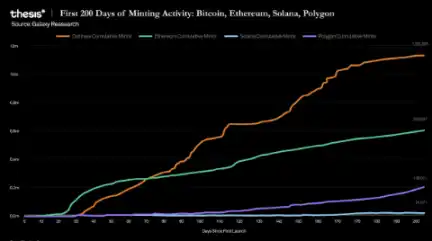
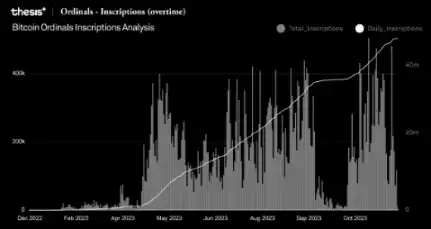
With the rise of ordinal numbers, NFT sales decreased by 8.7% from $4.2 billion in September 2021 to $3.8 billion in October 2023. The introduction of ordinal numbers led to a surge in Bitcoin transaction fees and block sizes, resulting in an astonishing 45.0745 million engravings on the chain. On November 12, 2023, the number of Bitcoin ordinal engravings reached a daily historical high of 505,345.
1. Technical Deep Dive: Understanding the Ordinal Protocol
The content you provided is:
刻录过程. Translated to English, it means:
Burning process.
The size of uploaded files and network congestion will affect the transaction fees for burning. Finally, you need to specify an unused receiving address to receive the newly created ordinal.
This system enables each Satoshi to be identified with a unique ordinal number, allowing for the tracking of asset transfers. Each Satoshi is assigned a sequence number based on mining time, with a maximum of 2,100,000,000,000,000 ordinal numbers available. The ordinal system assigns rarity based on mining and engraving time.
Different from many NFTs, all information related to ordinal numbers is permanently recorded on the chain and does not rely on third-party services to store data. This feature can retrieve data from existing engravings through recursive protocols to generate new engravings.
2、Support for ordinal wallets
Hiro Wallet: Supports secure storage, transmission, and quick creation of ordinal NFTs for Bitcoin. Compatible with platforms such as Gamma and OrdinalsBot, and can be engraved within the browser.
MetaMask: Manage Bitcoin Taproot keys, verify ordinal addresses, provide key storage. Support hardware wallets and explore ordinal with Generative Marketplace.
OKX Wallet: Integrated with Taproot upgrade, supports viewing and transferring sequence numbers, and has cross-chain operations and BRC20-S standards.
3、Bitcoin Ordinals market trading volume has grown comprehensively
Various Bitcoin Ordinals markets, including OKX, Uniswap, Magic Eden, and Gamma, have all shown significant increases in trading volume.
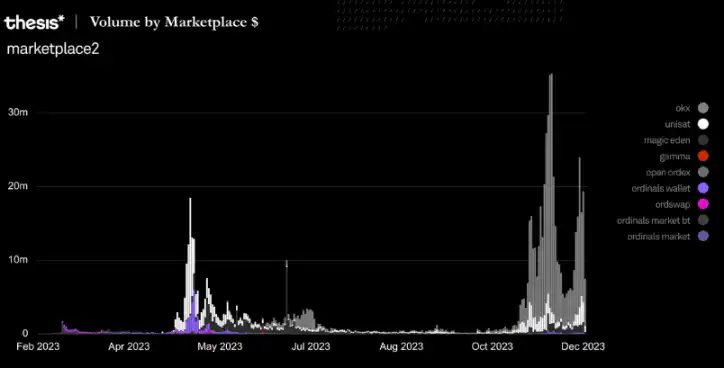
交易总数:A total of 1,173,402 transactions were conducted in these markets in 2023.
This protocol enables developers to directly host large files such as applications and video games on the Bitcoin network, providing possibilities for building more advanced applications and smart contracts.
Despite some controversy surrounding recursive SNARKs, with concerns that they are maintained by more centralized developer organizations and contradict the ideals of Bitcoin, others welcome this development as it has the potential to reduce storage redundancy and transaction costs.
9、Application scenarios of ordinal numbers:
Market: OpenOrdex is a very interesting market, completely open source, and strictly uses decentralized tools for trading. It uses Partially Signed Bitcoin Transactions (PSBT) to achieve trusted listings and purchases of inscriptions.
Browser: OpenOrdex, Gamma, and Ordinals.com are research tools used for analyzing ordinal/inscription activities. These browsers also provide data on transaction IDs, addresses, output values, weights, Satoshi numbers, and locations.
Mingwen Service: The casting of ordinals is very complex, so Mingwen Service is introduced to help collectors create collections. OrdinalsBot, OrdSwap, Gamma, Bitcoin Bandits, and Luxor Mining are some popular Mingwen service providers that are responsible for various steps in ordinal creation.
Wallet: Currently, Bitcoin wallets lack the ability to select satoshis, which is necessary when sending orders to other addresses. However, wallets such as Sparrow, Electrum, and Xverse, which offer UTXO selection functionality, are widely used for order collection.
Data and Discovery: OrdinalHub and Ordinal Directory are platforms for collectors to discover popular and new collectibles and analyze bottom price data.
In mid-October, Lightning Labs announced the Alpha version of "Taproot Assets", which is a meta-protocol that can issue and manage any asset on the Bitcoin blockchain. With Taproot Assets, interchangeable and non-interchangeable tokens can be created, and the metadata of assets can be stored in existing UTXOs. This provides a foundational tool for building a multi-asset network on Bitcoin.
Taproot assets are closely integrated with the Lightning Network, enabling cheap and fast transactions using these assets. This move is considered to usher in a new era for Bitcoin, allowing various global currencies to become Taproot assets and enabling instant forex trading on the Lightning Network. But what impact will this have on Bitcoin? Supporters and skeptics have differing opinions on its impact, with some concerns including the possibility of fee spikes similar to SegWit and BRC-20, and whether the entry of different assets into the Bitcoin network will bring regulatory scrutiny to the Lightning Network.
1. Core Mechanism of Taproot Asset Protocol (TAP)
Taproot assets are protocols built on a data storage method based on the Taproot network upgrade, similar to BRC-20. However, unlike BRC-20 and other interchangeable token protocols, Taproot assets use the "universe" to track token ownership information. The process of creating Taproot assets is complex and involves the use of special Merkelized Abstract Syntax Trees (MS-SMT) and Taptweak to construct asset information. This includes the outpoint used for minting assets, the asset label chosen by the minter (such as the hash of a brand name), and metadata related to the asset, such as links, images, or documents. All of this information is stored in a 32-bit asset ID, while the UTXO is the unique identifier for newly created assets.
Handling Taproot Assets:
Once created, Taproot assets can be transferred on the Bitcoin blockchain or directly through Lightning Network channels. Compared to other interchangeable tokens, Taproot assets enable multiple asset operations (such as minting, sending, and receiving) in a single chain transaction, improving on-chain efficiency and reducing congestion and fees. In contrast, BRC-20 has caused significant congestion on the Bitcoin network and pushed up fees (with fees reaching as high as $30 during the ordinal frenzy).
One of the most notable applications of Taproot assets is their compatibility with the Lightning Network (LN). Although the assets are issued on the Bitcoin blockchain, bridging with LN allows for lower costs and faster transactions, enhancing the usability of the assets. In the future, they will also be able to be deployed directly on the Lightning channel.
It is very easy to trade with Taproot assets on LN; there is no need to select payment methods as routing channels. Bitcoin can provide liquidity for different assets, so routing node operators are incentivized to help route Taproot assets and earn more routing fees paid in satoshis.
Here is an example scenario: L-USD (Lightning Network US Dollar, a type of Taproot asset stablecoin) can be paid with BTC and ultimately settled as L-USD, thanks to edge liquidity: LN nodes willing to exchange value with BTC allow you to pay any LN invoice with Taproot assets or receive any asset by issuing standard Lightning invoices.
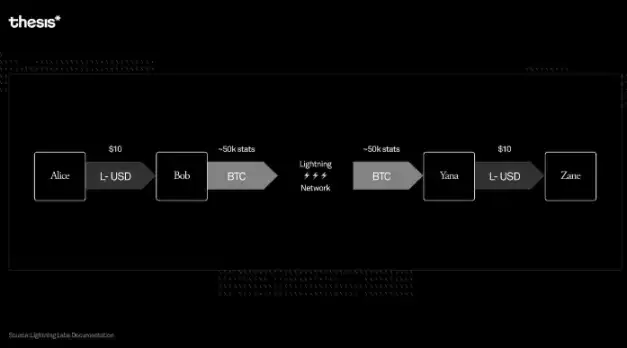
Please note that intermediary transactions do not directly transfer stablecoins themselves - as long as there is available BTC liquidity, transactions can be routed. Invoices settled with Taproot assets can be paid with BTC or any other asset, and anyone with a Taproot asset balance can pay any lightning invoice.
As mentioned above, the custody and ownership of Taproot assets are different from other homogenous tokens on Bitcoin.
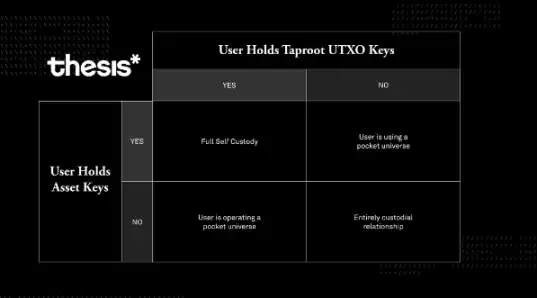
Taproot Asset Universe is a storage repository for assets and their proofs, essentially a full node for specific assets, providing historical data for verification. The universe will contain all relevant information about tokens, such as issuance, recent transfers, quantities, etc., but this information can only be made public at the discretion of the "universe operator". Therefore, compared to blockchain browsers, the Taproot universe is more private.
Pocket Universe is a way of collectively storing Taproot assets and using the TAP (Taproot Asset Protocol) without giving up asset ownership. Pocket Universe controls the Taproot key of a UTXO, but does not control the keys of the Taproot assets (which may be multiple) held in that UTXO. Asset holders can use Pocket Universe to efficiently batch their transactions.
3、Taproot Asset's Advantages and Disadvantages
Overall, we can take a look at the benefits that Taproot assets may bring to Bitcoin, and understand some of the advantages and disadvantages of this upgrade.
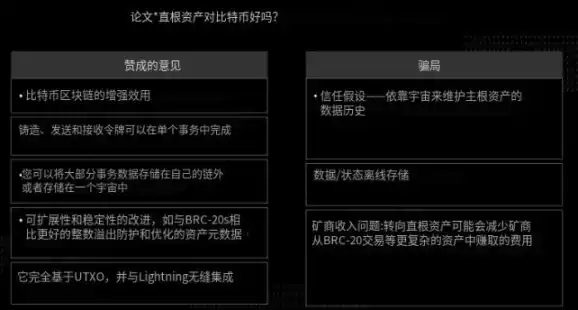
Data Statistics
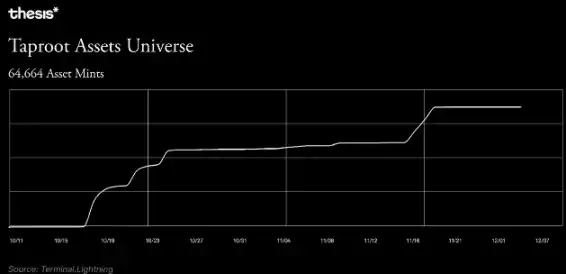
Taproot assets and consumer-facing Bitcoin applications have driven the practical use and adoption of Bitcoin, making it a part of the global financial system.
The BRC-20 protocol enables enhanced token creation and management on the Bitcoin network. Using ordinal technology, this protocol allows tokens containing JSON data to be seamlessly transferred and interacted with on the Bitcoin network. This standard provides developers with a framework for creating various tokens on the Bitcoin network, bringing a wide range of possibilities for programmable assets.
1. RC-20 Trends and Market Performance:
The initial ORDIToken was quickly minted with a market value of $1.4 billion, but its market value subsequently declined significantly, falling from $990 million to $379 million, a decrease of 62%. This token accounts for more than 80% of the trading volume in the BRC-20 market, and its price fluctuations directly affect the market value of other BRC-20Tokens.
Despite the fluctuation in value of BRC-20Token, the overall ecosystem shows stability. Activity remained relatively stable between May and July 2023, with a rebound towards the end of September and October 2023. Of particular note, in November 2023, BRC-20Token set a new historical record by minting over 492,000 tokens.
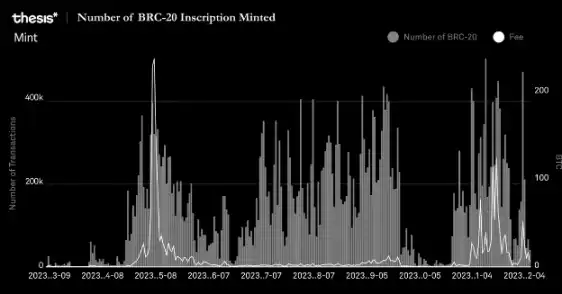
Important discovery:
Eight, Fold: Bitcoin Rewards and User Adoption Case Studies
The high trading volume and accumulated 65 billion satoshis of Bitcoin earnings highlight Fold's success in the financial trading and Bitcoin investment fields. This success proves the increasing popularity of Bitcoin in daily financial transactions.
The popularity of Fold indicates a trend of accepting Bitcoin in daily transactions among not only experienced cryptocurrency users but also a wider audience. This suggests that Bitcoin has the potential to become a more common part of the financial system.
The success of Fold represents the overall trend adopted by Bitcoin, demonstrating how innovative platforms utilize the characteristics of cryptocurrency to provide new solutions and promote the wider integration of digital currency into daily life.
In recent years, pledged assets have received much attention in the field of cryptocurrency, especially in the DeFi sector. Users can obtain benefits such as fee distribution by pledging assets, which has become a mainstream trend in the market. However, many participants are cautious about projects that do not generate profits. Although the concept of profits involves unsustainable design and requires relinquishing control of assets, there are still projects that attempt to introduce profits into the Bitcoin network in a secure and ethical manner.
Babylon has created a way to ensure various proof-of-stake chains for Bitcoin without bridging to other chains, providing security. Through remote staking, the staked Bitcoin is locked in a contract on the Bitcoin chain. When other chains violate rules, similar to shared security solutions like Ethereum or Cosmos, these stakes will be reduced.
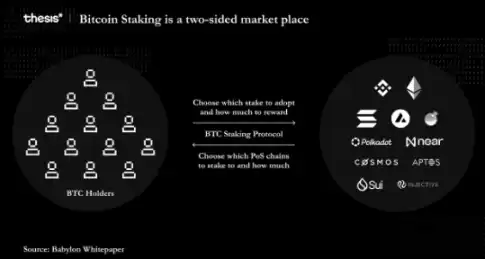
Due to the lack of smart contract functionality in Bitcoin, Babylon can create a remote staking environment by utilizing advanced encryption technology, consensus protocol innovation, and optimized use of Bitcoin script language. The main features of Babylon include:
Bitcoin timestamp can help synchronize the proof-of-stake chain with the Bitcoin network and enable fast unlocking of staked Bitcoin.
可提取一次性签名(EOTS)允许在恶意质押者的情况下对质押的比特币进行削减。
The Extractable One-Time Signature (EOTS) allows for the reduction of pledged bitcoins in the event of a malicious pledger.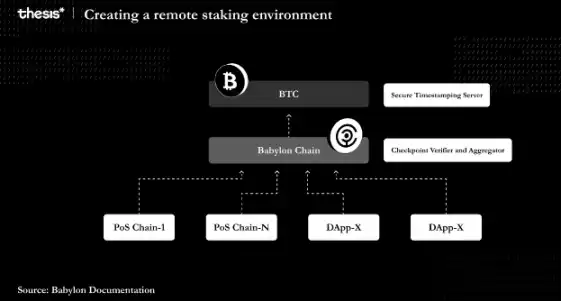
Native staking on Bitcoin has multiple values in protecting other proof-of-stake chains. Firstly, this feature is completely independent of the Bitcoin network, eliminating the risk of bridging Bitcoin and increasing the demand for the Bitcoin network, which helps to increase miner payment fees. Secondly, it provides a new way to earn income on Bitcoin, enhancing its feasibility as an asset and value store. Finally, extending the security of Bitcoin to other proof-of-stake chains can increase the economic security of these chains, which is of great value to Babylon and native Bitcoin staking.
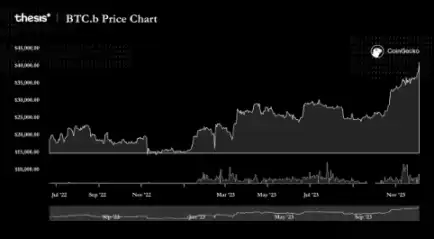
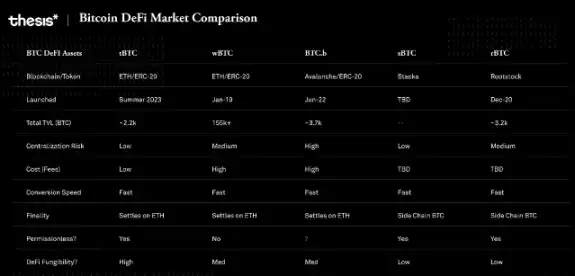
Bitcoin wrapping is becoming increasingly popular for transferring Bitcoin wealth across different ecosystems. Some popular wrapping options include BTC.b on Avalanche. BTC.b is an ERC-20 Token in the Avalanche ecosystem designed specifically for the Avalanche C-Chain. Its bridge securely wraps Bitcoin into the Avalanche ecosystem, allowing users to trade and exchange wrapped Bitcoin on the Avalanche C-Chain. As of December 4th, 2023, the market capitalization of BTC.b is approximately $152.4 million, with trading activity taking place on multiple decentralized exchange platforms.
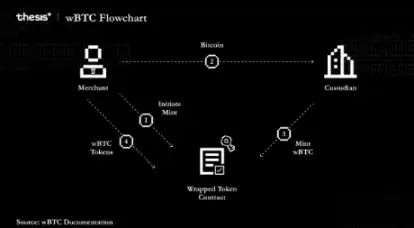
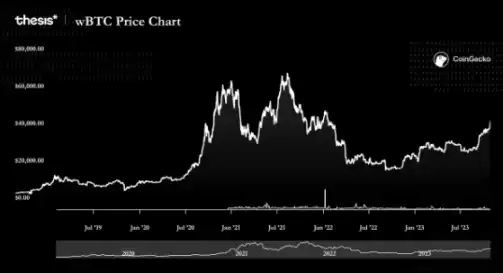
1、wBTC Coin
2、Threshold and tBTC
tBTC is the tokenized version of Bitcoin on the Ethereum blockchain developed by Threshold. It aims to integrate Bitcoin into other blockchains and promote its participation in DeFi applications. tBTC adopts a decentralized model, eliminating the need for KYC protocols and protecting user privacy and autonomy. It has been integrated into multiple blockchain networks and has demonstrated market demand and value.
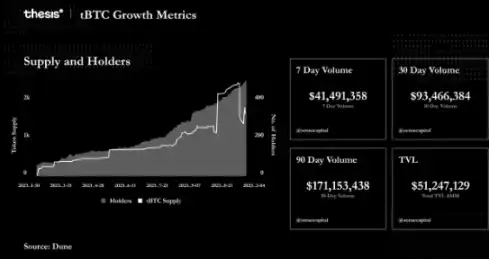
Threshold has partnered with Wormhole and others to enhance tBTC's cross-chain capabilities and expand its presence in over 20 blockchain ecosystems. Other BTC DeFi assets may begin to challenge wBTC, which is the market leader and holds the majority of the market share.
Ten, Bitcoin ETF: Institutional Adoption of Bitcoin and Regulatory Development of Bitcoin
2023 will be a historic year for Bitcoin in the US financial market. Despite facing regulatory scrutiny, Bitcoin is still thriving. The world's largest asset management company has submitted multiple Bitcoin ETF applications, and approval is expected to come soon. The launch of Bitcoin ETFs will bring institutional investment and wider acceptance of Bitcoin. Despite controversy, ETFs will bring new uses for Bitcoin as an investable asset, such as a store of value. Institutional interest and investment in Bitcoin have already emerged, and the approval of ETFs will attract more funds into the Bitcoin market, creating greater liquidity.
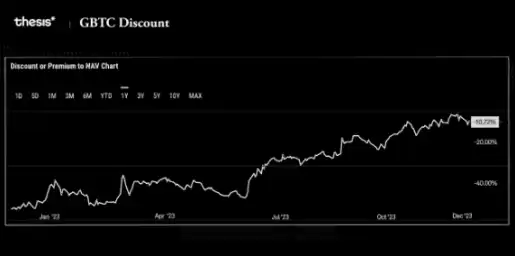
Currently available traditional stock market tools (such as iShares Bitcoin Futures ETF, BITO) have already met the demand for Bitcoin assets and reached the highest asset management scale in history at the end of November.
1. The Rise of Bitcoin as a Store of Value
Bitcoin's rise as a store of value has been widely recognized, especially among institutional investors. Bitcoin is seen as a digital asset equivalent to gold, which can be used to hedge against inflation and for safe haven purposes. However, institutional investors remain cautious about Bitcoin and have reduced their investments to some extent. Nevertheless, the approval of a spot Bitcoin ETF is still highly anticipated, which will open up investment channels for both retail and institutional investors. It is expected that the price of Bitcoin will significantly increase as a result. Overall, Bitcoin's position in the financial market continues to consolidate and gain more attention and acceptance globally.
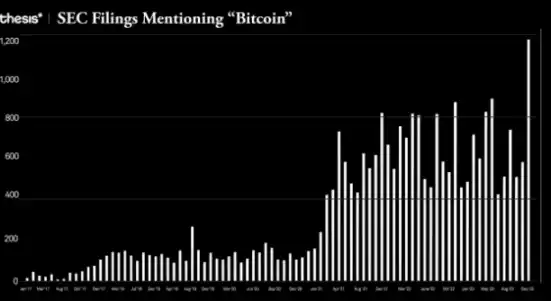
Despite the sudden bullish sentiment in the United States, the global attitude towards Bitcoin regulation is far from consistent. Different countries have adopted different strategies, ranging from enthusiastic acceptance to complete prohibition.
2、Friendly Jurisdiction:
El Salvador: Pioneering Bitcoin Integration. In 2021, El Salvador made Bitcoin a legal tender, leading a new chapter in the history of cryptocurrency. The government requires businesses to accept Bitcoin payments and provides citizens with the Chivo digital wallet for transactions. El Salvador exempts capital gains tax on Bitcoin transactions, which has helped promote the adoption of cryptocurrency.
The United States: Regulatory situation is unstable. US regulatory agencies consider Bitcoin as a commodity and are considering treating it as a security.
The European Union: Building a Unified Framework. The European Central Bank recognizes Bitcoin as a currency and promotes the exploration of regulatory frameworks. The "Market in Crypto-Assets" (MiCA) plan aims to unify the regulation of cryptocurrencies among EU member states.
3、Strict Jurisdictional Area:
India: Regulatory uncertainty. The Reserve Bank of India has expressed concerns about cryptocurrencies and banned banks from dealing with them. The government is currently discussing a cryptocurrency bill, which may result in a ban or the establishment of a regulatory framework.
Russia: Diverse regulations. Russia recognizes that cryptocurrency is not a legal tender, but allows ownership and trading. Mining and trading activities need to be registered with the authorities, and more regulatory measures may be introduced in the future.
4、Summary
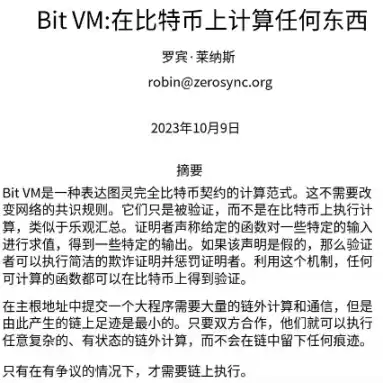
Eleven, BitVM: Perform any computation on Bitcoin
Welcome to join the official BlockBeats community:
Telegram Subscription Group: https://t.me/theblockbeats
Telegram Discussion Group: https://t.me/BlockBeats_App
Official Twitter Account: https://twitter.com/BlockBeatsAsia
 Related Articles