Variant: Building in the Dark, Mapping the Current Cryptographic Privacy Landscape.
Original Title: "Building in the Dark: Mapping the Current Crypto Privacy Landscape"
Original Author: Derek Walkush, Variant
Translated by: Luccy, BlockBeats
Editor's Note:
With the rapid development of the cryptocurrency industry, privacy infrastructure and applications have become an indispensable part.
Derek Walkush, a partner at Variant, delves into the various characteristics, advantages, and disadvantages of privacy solutions such as Trusted Execution Environments (TEEs), Zero-Knowledge (ZK) proofs, Multi-Party Computation (MPC), and Fully Homomorphic Encryption (FHE). He believes that each solution has its unique trade-offs and is suitable for different application scenarios. In this dynamic and complex field, it is difficult to determine which method will ultimately dominate.
In the long run, most transactions on the blockchain may become more private.
The transparency nature of cryptocurrency has brought certain constraints to many application developers. Application developers can use sensitive user data to build more extensive designs, covering various aspects from games to private order books to MEV infrastructure.
Between 2015 and 2022, data breaches have more than doubled, and technology consumers now have a higher concern for the protection and vulnerability of their personal data, whether in web3 or traditional technology. Although the attention to privacy may fluctuate, a more obvious trend is that as the collection of large-scale data and the monetization based on data grow, people's online footprints become increasingly easy to be traced by technology giants and external opponents.
In mature application fields, some old-fashioned enterprises are facing challenges from emerging privacy-first challengers. Take the rise of encrypted communication applications Telegram and Signal as an example, with a time span from 2019 to 2021. In the field of cryptocurrency, Brave has achieved remarkable growth in the recent bear market, with its highest monthly active users (ATH MAU) reaching about 66 million as of November 2023. From another perspective, this is roughly equivalent to about 15% of Firefox's user base in 2022. Therefore, many encryption projects are now competing to launch eye-catching productization tools and solutions to simplify the process of building private applications as much as possible.
In the encryption industry, there seems to be endless examples of using privacy technology. On the consumer side, we have seen some exciting experiments, such as completely on-chain private games like poker and fog of war. In the DeFi field, some are building "dark order books," which are trading environments invisible to public market participants. (For better understanding, dark pools accounted for about 40% of traditional stock trading volume executed in April 2019.) Even more secretive liquidity can be achieved by reducing MEV to drive more efficient market outcomes. Due to the complete openness of blockchain, many complex trading firms are prohibited from executing complex strategies, so more privacy may even open the door for more professional financial participants to enter the encrypted ecosystem.
In the field of encryption, the lack of user perception of privacy is still a bottleneck for more widespread adoption. In order to meet new privacy expectations, builders of encryption applications must prioritize privacy from the very beginning.
So, how should encryption application builders navigate in the field of privacy solutions?
Methods to protect user privacy
Currently, the main methods for constructing private applications can be summarized as Trusted Execution Environments (TEEs), Zero Knowledge (ZK), Multi-Party Computation (MPC), and Fully Homomorphic Encryption (FHE). Below is a brief overview of each method and representative projects.
The entire field is still in its very early stages, so the following comparisons are only projections of the development of each technology in the next few years. These methods are not equivalent or interchangeable; broadly speaking, they can be divided into specialized hardware (TEEs) and cryptography (ZK, MPC, FHE). In addition, many of these methods effectively overlap in practice. For example, FHE must be used in conjunction with ZK and/or MPC. Overall, observing the development trajectory of each method can provide feasible insights into how broader privacy categories will develop.
TEEs
· Description: Trusted and secure offline computing environment.· Projects: ARM TrustZone, AWS Nitro, Intel SGX, Secret Network.
ZK
· Description: Applying zero-knowledge cryptography to verify private data and computations.· Projects: Aleo, Aztec, Mina, Nocturne, Privacy Pools.
MPC
· Description: Joint computation of separated fragments of private data.· Project: Nillion
FHE
· Description: Perform calculations on encrypted data.· Project: Fhenix, Inco, Sunscreen, Zama
The two key factors in choosing infrastructure are privacy trust assumptions and performance; both terms are very subtle, and the following two matrices expand on these concepts. They show the assumptions made to keep data confidential (which is very important for developers considering building confidential applications) and the trade-offs involved in achieving specific performance levels.

With the passage of time, we can expect market forces to drive many of these technologies towards more efficient outcomes. Hardware acceleration and other catalysts may significantly improve the performance of these new technologies, although the time frame remains somewhat unclear. In the long run, each of these methods may control a portion of the market.
The chart below compares each method on key dimensions, including composability, the ability to interact with other applications and private states; technical complexity; potential for creating decentralized protocols; current performance level, i.e. potential throughput; and best use cases based on the dimensions mentioned earlier. This chart can be seen as a trade-off each method makes for its performance level.
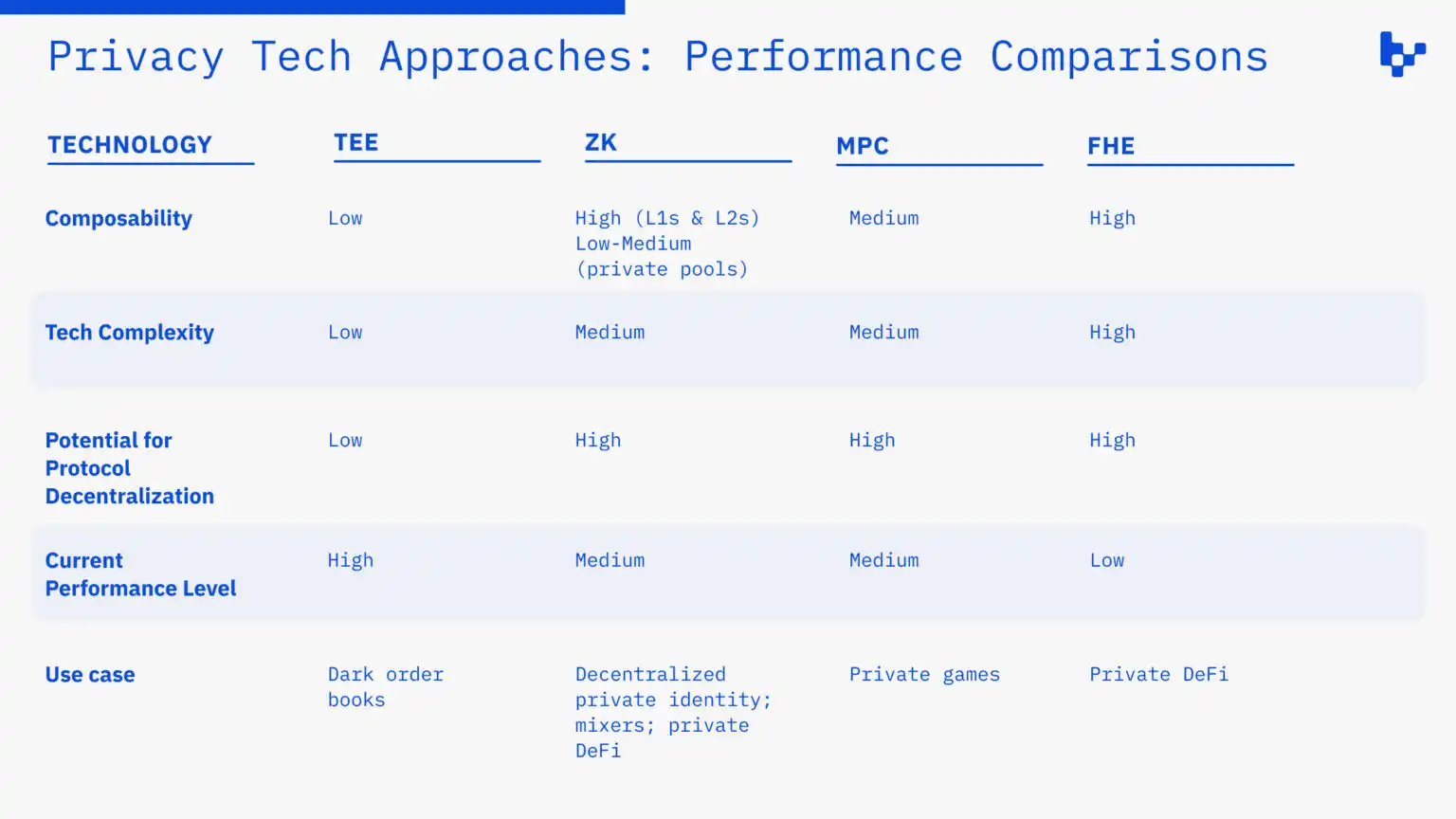
As shown above, each method comes with different trade-offs. There is not one that is fundamentally better than the others, but each method is most suitable for specific types of applications based on its optimization goals. For example, companies building more centralized dark order books can use TEEs, while projects building private lending agreements can choose FHE or ZK.
Please note that many of these technologies can be combined, and their intersection is often one of the most interesting approaches. For example, zero-knowledge proofs can be used to remove operator functionality from TEE-based dark order books, while MPC is often used to distribute encryption keys in FHE. The purpose of these classifications is to distill the highest-level technical considerations for each independent method. Finally, there is a clear regulatory impact on potential illegal activities in this field; infrastructure builders must pay attention to compliance.
Advantages and Disadvantages of Each Method
TEEs
Trusted Execution Environments (TEEs) involve offline computing in a trusted and secure environment. Many cryptographic organizations have already used TEEs in various tasks, and private applications are just a small use case. They can be software-based or hardware-based, but the most common are trusted hardware. Because this infrastructure is offline and in an isolated environment, transactions remain hidden from public market participants.
ZK
MPC
FHE
· In the current state, the performance is very poor.· Relies on other technologies such as ZK and MPC, which have their own flaws and trust assumptions.
Looking into the Future
In the field of encryption, privacy infrastructure and applications are now essential and still in the early stages of development. We expect the landscape of these solutions to continue to rapidly expand.
Each privacy solution introduced here has different trade-offs and is most suitable for different application suites. The privacy category is in a very early and broad stage, and a single method winning out simplifies the problem.
Overall, it is inevitable that many new technologies related to privacy will emerge. This category is one of the most dynamic and rapidly developing in the field of encryption, but it is also the most opaque. However, it is clear that this stage is only the first era of innovation.
"Original article link"
Welcome to join the official BlockBeats community:
Telegram Subscription Group: https://t.me/theblockbeats
Telegram Discussion Group: https://t.me/BlockBeats_App
Official Twitter Account: https://twitter.com/BlockBeatsAsia

 Related Articles