OKX Ventures' latest research report: Understanding the development pattern and future direction of stablecoins in one article.
Original Title: "OKX Ventures Latest Research Report: Understanding the Development Pattern and Future Direction of Stablecoins in One Article"
Original Source: OKX Ventures
One, Summary
From the bull market of 2021 to the bear market of 2023, significant changes have occurred in the cryptocurrency market. The total market value has decreased from $3 trillion to $1 trillion, but the market value of stablecoins has only decreased by 30%, indicating the strong ability of stablecoins to resist market downturns. This proves their importance in the cryptocurrency ecosystem and their continued rapid expansion trend.
As of December 2023, CoinGecko data shows that the total market value of stablecoins is approximately $130 billion, with Tether (USDT) accounting for about 70% and USDC accounting for about 20%. The remaining market value is distributed among other centralized and decentralized stablecoins. Especially in the current high government bond yield environment (>5%), Tether can easily earn $3 billion in profits each year, making the stablecoin market a very attractive field. In addition, governments around the world are formulating virtual currency trading policies, and central banks are also beginning to research their own stablecoins, which further drives the growth of the stablecoin market.
Other than Tether and USDC, we have also seen the emergence of many on-chain stablecoins, which reflects the demand for different types of stablecoins (collateralized, borrowed, and leveraged) in the DeFi field. The innovative points of these emerging stablecoins include diversified collateral, collateral liquidation mechanisms, and profit-sharing mechanisms for the community. Their success depends on factors such as maintaining liquidity and attracting access to large DeFi protocols.
Despite the emergence of numerous on-chain stablecoins, over 90% of the market value is still concentrated in centralized stablecoins. With the strengthening of regulatory discourse and the trend of central bank digital currency issuance, centralized stablecoins have once again become the focus. Some startups are trying to challenge the dominance of Tether and USDC by using high US Treasury yields, but the long-term development of centralized stablecoins requires more cooperation with traditional financial institutions and regulatory authorities. This includes compliant custodians, capital injection, and obtaining virtual asset trading licenses.
To create the next super stablecoin like USDC and USDT, the author believes that at least four key conditions need to be met to fully leverage the advantages of centralized and decentralized stablecoins:
1. Stablecoin based on US dollar: The US dollar has a wide global acceptance and its underlying assets have broad applicability.
2. Global regulatory recognition and licensing: Super stablecoins need to be deployed in the global market from the beginning and obtain recognition from major regional regulatory agencies and global licenses.
3. Innovative financial attributes: Super stablecoins should have innovative financial attributes, such as profit distribution mechanisms, to establish community support and sustained growth.
4. Integrating into the DeFi ecosystem: Super stablecoins need to become the default currency in DeFi protocols to ensure their widespread use in the DeFi space.
In short, stablecoins play a crucial role in the cryptocurrency ecosystem and are expected to continue to grow and expand. To successfully create the next super stablecoin, a series of DeFi advantages need to be met, and partnerships with traditional financial institutions and regulatory agencies need to be established.
二、Stablecoin Classification
Decentralized Stablecoin
In order to solve the problem of centralized stablecoins, decentralized stablecoins have introduced innovative solutions. These new stablecoins are built on blockchain protocols, making them more secure and transparent. For example, Curve's crvUSD, Aave's GHO, and Dopex's dpxUSDSD are all stablecoins based on on-chain protocols, which do not rely on central authorities, reducing the financial and management risks of central authorities themselves. Decentralized stablecoins can be divided into two main categories:
1. Overcollateralized Stablecoins:
(Note: The content contains HTML tags and English characters, which are not translated and returned directly. The Chinese characters are translated as requested.)• Mortgage-backed stablecoins are the most common type of decentralized stablecoins, whose asset support usually comes from other cryptocurrencies such as Ethereum or Bitcoin to maintain their value stability. For example, MakerDAO's DAI is supported by Ethereum collateral. The latest trend is to expand the collateral from traditional centralized stablecoins and large traditional digital currencies to a wider range of digital currencies, or to nest them in multiple layers to increase liquidity and provide more application scenarios. For example, the largest collateral in Curve's crvUSD is steth, and Ethena's stablecoin is also based on Ethereum and LST.
• Advantages: Mortgage-backed stablecoins make decentralized stablecoins not only a payment tool, but also a wider range of digital asset management and investment tools, providing users with more choices and flexibility.
• Disadvantages: The challenge of collateralized stablecoins is that too much collateral may lower asset utilization, especially when the collateral is a currency with high price volatility such as Ethereum, which may lead to forced liquidation due to high risk.
2. Algorithmic Stablecoins:
• Algorithmic stablecoins are one of the most decentralized types of stablecoins. They maintain their fixed price by utilizing market demand and supply without the need for actual collateral support. These stablecoins use algorithms and smart contracts to automatically manage the supply to maintain price stability. For example, Ampleforth is an algorithmic stablecoin designed to keep its price close to $1. It uses a mechanism called elastic supply to automatically adjust the supply based on market demand to balance the price. When the price is above $1, the supply increases, and when the price is below $1, the supply decreases.
• In addition, there are also some hybrid algorithmic stablecoins that combine algorithms and fiat reserves. For example, Frax is an algorithm-based stablecoin designed to maintain a price close to $1. It adopts a hybrid stablecoin mechanism, where part of it is supported by fiat reserves, and the other part is managed by algorithms to maintain price stability.
• Advantages: The decentralization of the stablecoin itself provides the best prospects. Compared with other solutions, stablecoins have the fundamental advantage of scalability. Algorithm-based stablecoins use transparent and verifiable code, which makes them attractive for building trust.
• Cons: Sensitive to market demand, when the market demand for algorithmic stablecoins decreases, its price may fall below the target value, ultimately leading to the risk of market collapse. Additionally, since the operation of algorithmic stablecoins relies on smart contracts and community consensus, there may be governance risks, such as code defects, hacker attacks, human manipulation, or conflicts of interest.
Centralized Stablecoin
Centralized stablecoins usually have fiat currency as collateral, which is held in offline bank accounts and serves as a reserve for on-chain tokens. It solves the problem of anchoring the value of virtual assets, linking digital assets to physical assets such as the US dollar or gold, stabilizing their value. At the same time, it solves the problem of accessing virtual assets in a regulatory environment, providing users with a more reliable way to store and trade digital assets. The centralized stablecoin market still accounts for more than 90% of the market share.
Currently, besides the US dollar and the British pound, many centralized stablecoin projects use US Treasury bonds as collateral. This means that holding on-chain tokens is equivalent to holding US Treasury bonds, which are typically held by institutions and can be redeemed. Tokenizing them increases the liquidity of underlying financial assets. In addition, it provides DeFi components with interactive opportunities, such as leveraged trading and borrowing. This allows projects to obtain USD funds from crypto users at zero cost, use them to purchase US Treasury bonds, and directly benefit from bond yields.
However, centralized stablecoins also have some flaws.
1. Financial and regulatory risks: Centralized stablecoins typically rely on central institutions for issuance and management, which poses financial and regulatory risks for the issuer. If the issuer faces financial problems or regulatory sanctions, the value and availability of the stablecoin may be affected.
2. Limited application areas: The main application area of centralized stablecoins is mainly limited to the payment field, lacking diversity and innovation.

Source:The Relentless Rise of Stablecoins, Brevan Howard Digital 2023
In the long run, the most promising application scenario for stablecoins is in the payment field, especially in cross-border payments. Stablecoin issuers can cooperate with Web2 payment companies to integrate stablecoins into users' payment processes, especially in cross-border payment applications.
2. Public Blockchain
Table: TVL Ranking of Major Stablecoin Projects on Top Public Chains
Source: DefiLlama, November 2023
A. BUSD Impact on BSC TVL
BUSD supports 6 public chains, mainly circulating on Ethereum and BSC, with a cumulative market value that has dropped to 2B. The decline in the market value of stablecoins on the BSC chain is mainly due to the decline in the market value of BUSD stablecoins. As of the eve of the release of this report, on November 29, 2023, Binance announced announcement that BUSD will be removed and fully exchanged for FDUSD.
Native stablecoins on public chains have an important impact on the TVL and ecological development of public chains. The stablecoin has decreased by 44%, and the corresponding protocol's TVL lock-up amount has decreased by 66%. It can be seen that the decline in stablecoin market value has a certain impact on the construction of the BSC ecosystem.
Along with the withdrawal of BUSD from the stablecoin basket of Binance exchange, Binance is also increasing its support for the FDUSD ecosystem. It has a significant presence in both its Launchpool and Earn businesses.

Source:DefiLlama, 2023 November
B. TUSD's Impact on the Tron Ecosystem
After a series of operations after February 2023, the market value of TUSD increased from around 1B to 2-3B.
Table: TUSD Compliance Operations

C. USDC and Public Chains
USDC has been issued on 15+ public chains, with ETH, Solana, and Polygon ranking in the top three in terms of TVL. USDC is seeking to expand its use cases, primarily for payment, especially in cross-border payment scenarios.
Table: TVL Distribution of USDC on Different Public Chains

Source:State of the USDC Economy, Circle Annual Report, 2023
• USDC<> Solana: Recently, Visa announced a partnership with Circle to use Circle's USDC as an on-chain settlement tool on the Solana blockchain. This collaboration is an important step in the integration of traditional financial services and cryptocurrency technology, aimed at providing faster and lower-cost cross-border payment solutions. Solana blockchain was chosen due to its high throughput and low transaction costs, making it suitable for processing large volumes of small payments. This innovative payment method is expected to have a significant impact on the global payment industry, especially in accelerating cross-border transaction processing.
• USDC <> Polygon: In October 2023, Circle announced support for native USDC issuance on the Polygon PoS mainnet. Mainstream protocols in the Polygon ecosystem, such as AAVE, Compound, Curve, QuickSwap, and Uniswap, have expressed their support for native USDC and will invest in developer support. Additionally, Circle expects to achieve integration of CCTP with the Polygon PoS Bridge by the end of 2023, thereby enabling cross-chain interoperability.
• USDC<> Sei: In mid-November 2023, Circle strategically invested in Sei Network to support on-chain native USDC. The official announcement stated that Sei's performance is superior to Sui, Solana, and Aptos, with a TTF of 0.25s.
D. Dapp launches stablecoin and public chain
The impact of stablecoins issued by DeFi protocols on public blockchains is an area worth observing. Taking Curve and AAVE as examples, their actions in the stablecoin field have significant implications for the entire cryptocurrency market and the application of blockchain technology.
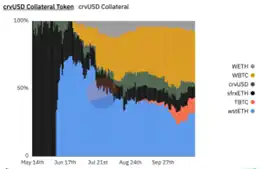
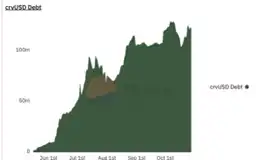
Curve's crvUSD stablecoin, launched in May 2023, is a protocol that uses stablecoins as a medium to achieve on-chain asset collateralized lending. The protocol supports users to use a range of encrypted assets (such as ETH, WETH, wstETH, WBTC, etc.) as collateral to mint crvUSD. In particular, after June 2023, the support for WBTC as collateral has greatly promoted the growth of crvUSD. As of November 2023, the scale of collateral has exceeded $100 million.
In May 2023, most of Curve's collateral was sfrxETH backed by FRAX, but later supported wstETH from Lido and WBTC issued by BitGo. These newly supported collaterals quickly took up the majority of the market share. This indicates that Curve has a huge influence on which tokens are supported as collateral. Curve's strategy not only expands its influence in the DeFi field, but may also have far-reaching effects on asset liquidity and stablecoin usage on public chains.
Initiatives like these from DeFi protocols demonstrate the innovation and dynamism of the DeFi space, while also highlighting the important role these protocols play in the cryptocurrency ecosystem. As more DeFi protocols participate in the issuance and management of stablecoins, we can expect this to bring new changes and challenges to the use of public chains, the liquidity of cryptocurrencies, and the stability of the overall market.
crvUSD collateral
crvUSD TVL
Source:https://dune.com/Marcov/crvusd, 2023 November
Aave, as the largest lending protocol with a TVL of 5.64 billion, has launched GHO, a stablecoin backed by over-collateralization. Therefore, all tokens supported by Aave v3 protocol can be used as collateral, which continues to generate revenue in the lending protocol. Since its launch in July, the cumulative TVL has exceeded 20 million.

Source:Dune Analytics, 2023 November
3. Stablecoin Issuers
Currently, the underlying assets of most stablecoin projects are mainly the US dollar and short-term assets with high liquidity such as T-bills, and the risk of default of the underlying assets is almost zero. The centralized institution of stablecoin issuers needs to ensure smooth channels for users to purchase and exit, and the biggest risk lies in the event that the issuer fails to redeem during the user exit process, which may lead to the collapse of the ecosystem.
It is important for ecosystem participants to find a trustworthy and stable coin issuer. When comparing the cryptocurrency ecosystem with traditional financial markets, native custody service providers in the crypto industry as well as traditional financial institutions such as banks and asset management platforms have absolute credibility. For example, Fireblocks, Bitgo, BNY Mellon, BlackRock, and others are more suitable as stable coin issuers.
The management method of ETF assets can be used for reference. The transparency and credibility of fund storage and flow extraction will also be improved by multiple parties through the "monitoring sharing protocol". In addition, third-party on-chain audits and on-chain data tracking platforms such as OKLink are used to jointly supervise fund safety.
4. Regulatory Agencies
The regulatory framework for cryptocurrencies in the United States has not yet been formally established. Prior to this, according to the U.S. Federal Securities Law, if a digital asset meets the four-part test defined by the Securities Act of 1933 and the Securities Exchange Act of 1934 and is considered an "investment contract," then the asset is considered a "security." In 2017, the U.S. Securities and Exchange Commission (SEC) applied the Howey test (a legal test used to determine whether a particular transaction qualifies as a security) to digital assets for the first time. Although the 2019 framework listed many non-determinative factors that the SEC may consider when determining whether a digital asset is a security, SEC Chairman Gary Gensler stated in April 2022 that he believes almost all digital assets are securities.
Some senators in the US Congress are creating a broad regulatory framework for digital assets and plan to give the Commodity Futures Trading Commission (CFTC) most of the supervisory responsibilities. In April 2023, the first regulatory bill on payment stablecoins was introduced and revised in July 2023. This indicates that there is currently no specific stablecoin regulatory framework in place. However, stablecoin issuers must comply with existing regulatory and legal requirements, such as anti-money laundering and customer identification (KYC) requirements of the Financial Crimes Enforcement Network (FinCEN), and obtain currency transaction licenses from various states. But the bill does not specify who the federal payment stablecoin regulatory agency is.
In addition, Circle has established a partnership with BlackRock, the world's largest asset management company, to create the Circle Reserve Fund. The fund is registered with the SEC and is primarily responsible for managing the reserves of USDC. Currently, about 94% of the reserves are held by this institution.
For centralized stablecoins, since the underlying assets they anchor are usually off-chain assets, human participation in the operation process should be minimized and automated as much as possible. This can reduce losses caused by human errors, increase system transparency and efficiency. Automated processes not only improve consistency and reliability of operations, but also help reduce the possibility of manipulation and fraud, providing users and investors with a higher level of protection. In short, by establishing SPVs in Delaware, implementing asset segregation and automated operational processes, the security and stability of centralized stablecoins can be greatly improved, which is crucial for the healthy development of the cryptocurrency industry.
7. On-chain infrastructure
M^ZERO Labs provides a prominent example of on-chain infrastructure. M^ZERO Labs focuses on building decentralized infrastructure that allows institutional participants to allocate and manage assets on-chain. The platform operates in a fully transparent, open-source, and composable manner, connecting certified financial institutions that comply with local regulations and other decentralized applications to enable on-chain value transfer and collaboration among participants.
Five, Summary
In summary, stablecoins are not just a branch of the cryptocurrency market, they play a crucial role in connecting the traditional financial world with the digital currency world. Its development will be a continuous process that requires constant innovation, adaptation, and collaboration to find its position in a dynamic market and regulatory environment. In this process, understanding and adapting to these changes will be the key to achieving long-term success for market participants.
Appendix: Stablecoin List
Source: https://messari.io/assets/stablecoins, 2023 November


Disclaimer: The content of this article is based solely on industry research, and any commercial or policy information included is publicly available. This article does not endorse or promote any specific project.
This article is from a submission and does not represent the views of BlockBeats.
Welcome to join the official BlockBeats community:
Telegram Subscription Group: https://t.me/theblockbeats
Telegram Discussion Group: https://t.me/BlockBeats_App
Official Twitter Account: https://twitter.com/BlockBeatsAsia

 Related Articles