Why does Amazon need a stablecoin?
Original Title: "Why Amazon is Launching a Bezos Stablecoin?"
Original Author: RICHARD HOLDEN
Original Translation: Block unicorn
Facebook has failed, but another tech giant may soon succeed in preparing for enterprise digital currency.
Buying and selling cryptocurrencies is a massive business. For example, in 2021, Bitcoin processed transactions worth $3 trillion, more than twice the size of American Express. However, most of these transactions are used for speculation, and the number of transactions involving the purchase of actual goods and services is so small that it is difficult to measure.
What kind of development could make cryptocurrency replace the US dollar as the main medium of exchange in the United States? This may look similar to the Libra stablecoin (later renamed Diem) proposed by Facebook (now known as Meta). Despite suffering a major setback in 2021 and being rejected by US Treasury Secretary Janet Yellen, it does not mean that the related model cannot succeed. In fact, Yellen's refusal to support Diem indicates that she believes private digital currencies could be a potential serious competitor to the US dollar, and therefore a competitor to the US Treasury.
Here, I summarize the reasons for promoting private digital currencies and explain why a currency like Libra, which was proposed by Facebook and later renamed Diem, may soon emerge in the United States.
Company's Cash Assets
The concept of private digital currency can be traced back to at least 1994, when the late Edward de Bono proposed the concept of "IBM dollars". In de Bono's vision, "large manufacturing companies" should create their own currency to purchase their products. He primarily viewed this plan as a way for companies to smooth out sales fluctuations and make their business more predictable.
How can another private digital currency succeed where Facebook's Libra proposal failed?
It is important to quickly attract a large number of customers. Sometimes this is referred to as the "startup flywheel" - that is, a scale large enough to benefit consumers from network effects. Facebook's user base may have been able to provide such a customer base, but there is some psychological distance between social media and money.
For other potential supporters of private digital currencies, this gap may be much smaller. Joshua Gans and Hanna Halaburda pointed out in an important paper in 2015: "Each currency can be seen as a platform, and its attractiveness depends mainly on people's acceptance of this platform."
Bezos Stablecoin
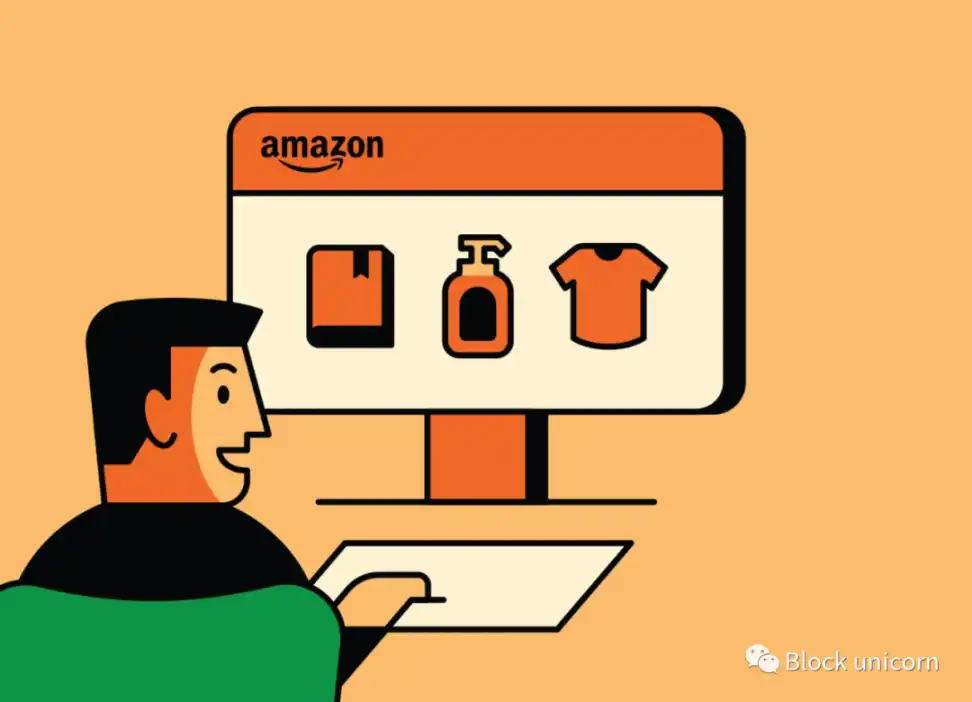
Considering Amazon, which has over 200 million unique visitors per month and an annual revenue of approximately $500 billion. What's astonishing is that 167 million Americans have Amazon Prime membership, which offers discounts or free shipping for an annual fee of $139, making Amazon their preferred choice for shopping. This massive and loyal customer base makes it possible for Amazon to launch its own digital currency. Drawing on some of Libra's concepts, this digital currency could be as follows:
Amazon's stablecoin will have four main pillars:
The first pillar involves the Amazon platform
Amazon will announce that users can continue to use credit cards for shopping payments, and can also use a digital currency called "Amazon Coins" (amazons) from now on. (I like to call it "Bezos Coins" or BBs, but this may not be a reasonable name for Jeff Bezos.) Customers can exchange US dollars for Amazon Coins, and at least in the short term, they can also exchange them back to US dollars at a 1:1 exchange rate as needed, perhaps for a small fee.
Using Amazon Coins for shopping will allow users to enjoy discounts on regular shopping prices, possibly up to 2%. This will provide people with an incentive to use Amazon Coins. In fact, Amazon has already launched a virtual currency called "Amazon Coins" that can be used to purchase specific applications and games in the Amazon Appstore, as well as for in-app purchases. Therefore, Amazon Coins will be a natural extension of this concept.
As a platform connecting buyers and sellers, Amazon has considerable market power and influence. In principle, Amazon can require sellers to accept Amazon coins instead of US dollars in sales on the Amazon marketplace. However, such an arrangement may not be feasible in the short term, as Amazon coins are of no use to retailers who need to pay suppliers in US dollars, at least initially.
However, if Amazon Coins are widely used, this will not be a problem. For Amazon, the challenge is to promote the adoption of its currency without punishing sellers on its platform. A wise approach would be to pay sellers a portion of the sale price in Amazon Coins, initially perhaps 10%, with the remainder paid in US dollars. Each seller would have a digital wallet into which Amazon Coins would be paid, and the coins could be smoothly converted into US dollars.
This method will create a subtle but useful default for Amazon. Although it is not difficult for sellers to convert Amazon Coins to US dollars, having Amazon Coins in a digital wallet that can be used elsewhere on the Amazon platform at any time will become an incentive to use them.
Depositing and earning interest in a digital wallet will incentivize sellers to keep their funds in Amazon's digital wallet instead of transferring to a bank where they earn little interest. Introducing these features will provide Amazon with a natural way to offer additional financial services to small businesses.
Second Pillar
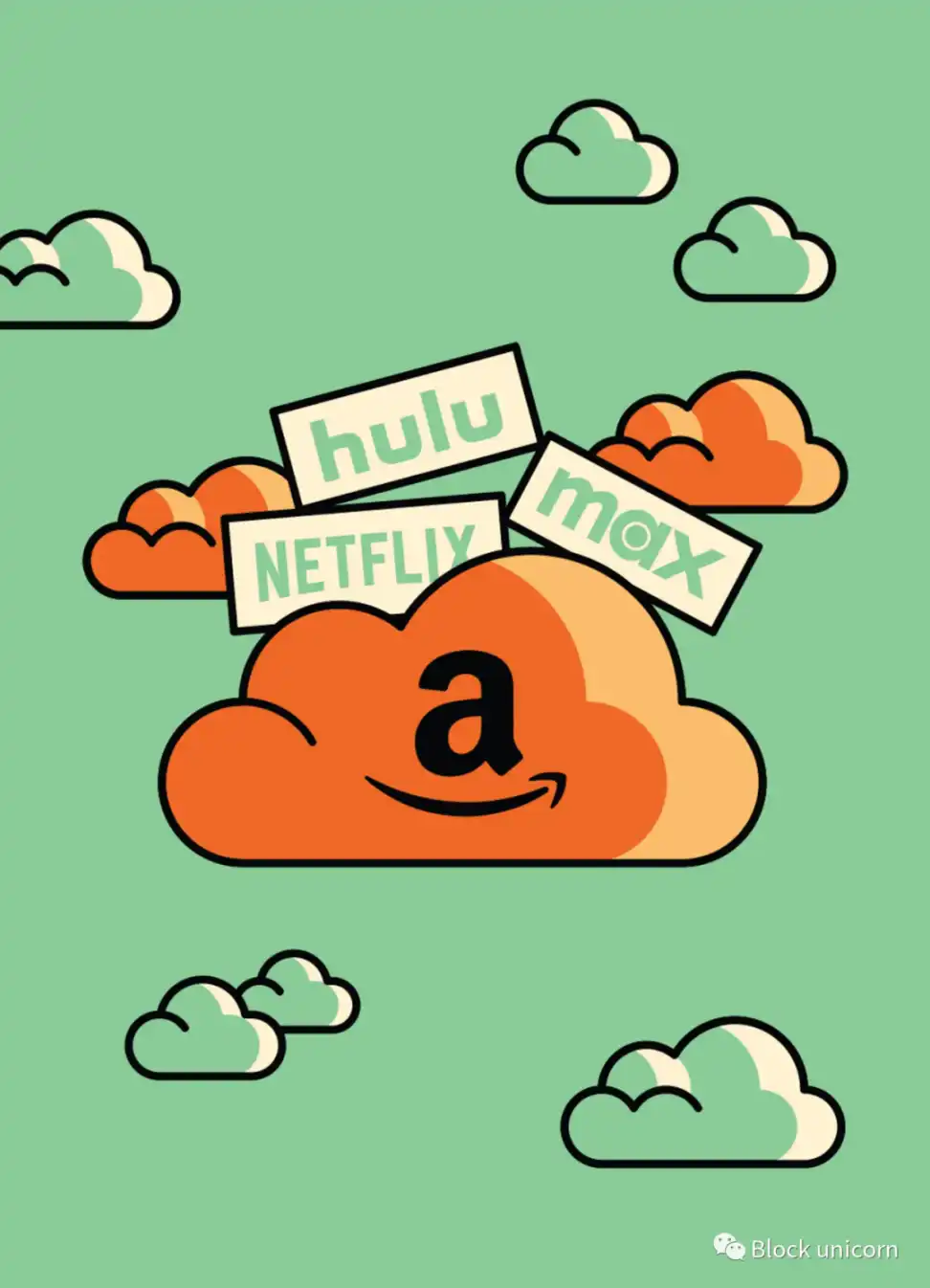
The second pillar involves Amazon Web Services (AWS), which is the world's largest cloud computing company. Initially, it was created to run Amazon's own platform, but later developed into a company that provides similar services to other companies and even university researchers.
Netflix is AWS's largest customer, followed closely by Twitch and LinkedIn in terms of monthly spending. Other major cloud service companies operating on AWS include Baidu, BBC, ESPN, Facebook/Meta (for third-party collaborations with existing AWS users), and Turner Broadcasting. It's like telling these big companies that they must hold a certain amount of Amazon stablecoins in advance, without providing any additional benefits, which is a bit like asking these companies to pay AWS service fees in advance, rather than billing them in the usual commercial way. This is like transferring working capital (funds for daily operational activities) directly from AWS to its customers, which is very beneficial for AWS. It is unlikely that the practice of adding additional costs to customers in this way will be successful. However, Amazon/AWS can form a partnership with some or all of these large companies, which will increase the likelihood of success in acquiring private digital currencies.
But please remember what happened a few years ago, when Facebook's Libra Association lost key payment companies including Visa. These companies had two main concerns.
The first is whether the Libra Association will fully comply with regulatory requirements. At the October 2019 hearing of the House Financial Services Committee, Representative Maxine Waters (Democrat, California) asked Facebook project leader David Marcus whether the company would wait for Congress to consider appropriate regulation. Marcus replied, "I promise to wait until we have all the appropriate regulatory approvals and address all issues before moving forward." Waters said, "That's not a commitment." Marcus seems to be implying that Facebook will comply with existing regulations, while lawmakers on the committee have made it clear throughout the hearing that such a significant innovation may require significant new regulations.
Joshua Gans and Hanna Halaburda pointed out in an important paper in 2015: "Each currency can be viewed as a platform, and its attractiveness depends mainly on people's acceptance of this platform."
The second concern is Facebook's reputation and past behavior, including its involvement with Cambridge Analytica. Cambridge Analytica is a British company that collected a large amount of personal data from Facebook users without their consent in the 2010s and used it for political advertising purposes.
These concerns were most clearly expressed by New York State Assemblywoman Alexandria Ocasio-Cortez (D-N.Y.), who said to Facebook founder Mark Zuckerberg, "I think you understand the importance of using someone's past behavior when making decisions about future behavior. In order for us to make decisions about Libra, I think we need to look deeply into your past behavior, Facebook's past behavior in our democracy. Mr. Zuckerberg, when did you personally first become aware of the Cambridge Analytica affair, what year and month?"

Welcome to join the official BlockBeats community:
Telegram Subscription Group: https://t.me/theblockbeats
Telegram Discussion Group: https://t.me/BlockBeats_App
Official Twitter Account: https://twitter.com/BlockBeatsAsia

 Related Articles