Chainflip: A new competitor in the native cross-chain exchange market

Original title: "MT Capital Research Report: Chainflip - A New Competitor in the Native Cross-Chain Exchange Market"
Original source: Severin, MT Capital
TL;DR
Chainflip can achieve native inter-chain value conversion, with higher decentralization, security and composability. $FLIP tokens will remain inflationary in the short term, and we expect that the token repurchase and destruction brought by trading volume in the short term will not be enough to make $FLIP enter deflation. Chainflip has a better product experience and design than Thorchain, but Thorchain itself has first-mover advantages, such as high market awareness and market share. Therefore, we predict that Chainflip will hardly completely replace Thorchain in the short term. Chainflip's market value is about 90M, and its fully diluted market value is about 460M. Thorchain's market value is 2.1B, and its fully diluted market value is 3B. From the perspective of comparable valuation, $FLIP still has room for imagination close to 8x. However, Thorchain's market value relies on its total transaction volume of 68B and the recent daily transaction volume of 100M+, while Chainflip has not yet generated any transactions. We will generally remain cautiously optimistic about the subsequent trend of $FLIP, and will pay special attention to whether the incentive plan of Chainflip's recent mainnet launch can drive a significant increase in transaction volume.
Chainflip: Decentralized cross-chain liquidity network
Native inter-chain value conversion
Unlike cross-chain solutions that use wrapped assets or require mint/burn assets in the middle process, Chainflip chooses to use a native inter-chain value conversion method.
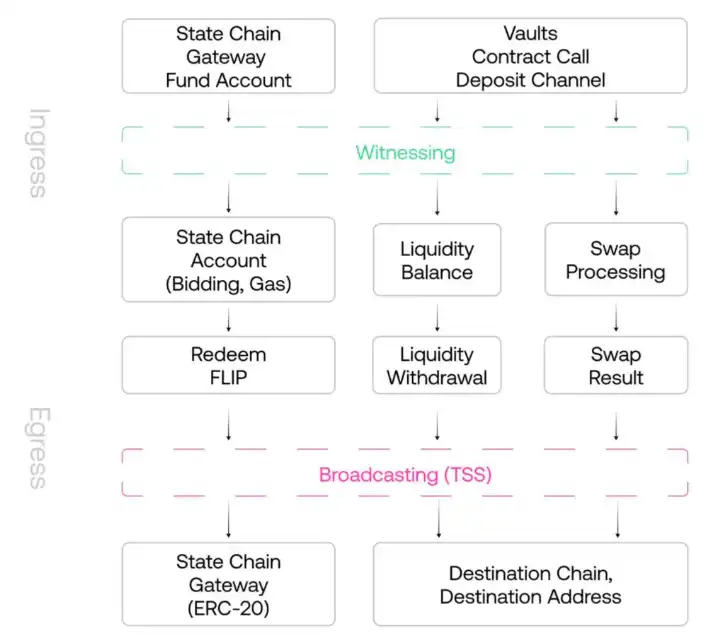
This means that on each chain supported by Chainflip, there is a liquid native asset pool, thus forming a universal settlement layer between chains to meet users' needs for inter-chain asset conversion. The advantages of value conversion between protogenesis chains are as follows:
·Value conversion is independent of the chain and wallet. Chainflip supports users to use ordinary wallets to convert value on any chain.
·Value conversion does not involve any wrapped assets, synthetic assets or other assets. Users only need to submit an ordinary transaction to exchange. After the exchange is completed, users will not face any other asset risks.
·Chainflip does not need to deploy or execute other protocols on a specific chain, has higher compatibility and versatility, and puts as much computing process as possible off-chain to reduce users' Gas consumption.
·Chainflip's native chain value conversion method can lower the user's operation threshold, reduce the user's risk exposure, and bring users a better user experience.
source:Image source
Decentralization
Compared with other solutions, another major advantage of Chainflip is its higher degree of decentralization. Chainflip's verification network consists of up to 150 verification nodes. Verification nodes will maintain network security, participate in consensus, monitor external chain events, and jointly control system funds. The process of becoming a validator node is also permissionless. Users only need to stake enough $FLIP and bid higher in the auction to become a member. The core of Chainflip's idea is to use MPC (multi-party computation), especially TSS (threshold signature scheme) to create an aggregate key held by a permissionless network of 150 validators. All operations and state changes in Chainflip need to obtain more than 2/3 of the node consensus confirmation to ensure higher security. Compared with the cross-chain value exchange of centralized exchanges and some highly centralized cross-chain bridges, users do not need to worry about the malicious risks of centralized exchanges and the malicious risks of centralized servers of cross-chain bridges. Chainflip avoids single point failures and malicious risks of single nodes through a higher degree of decentralization, thereby greatly improving the overall security of the system.
source:Image source
JIT AMM
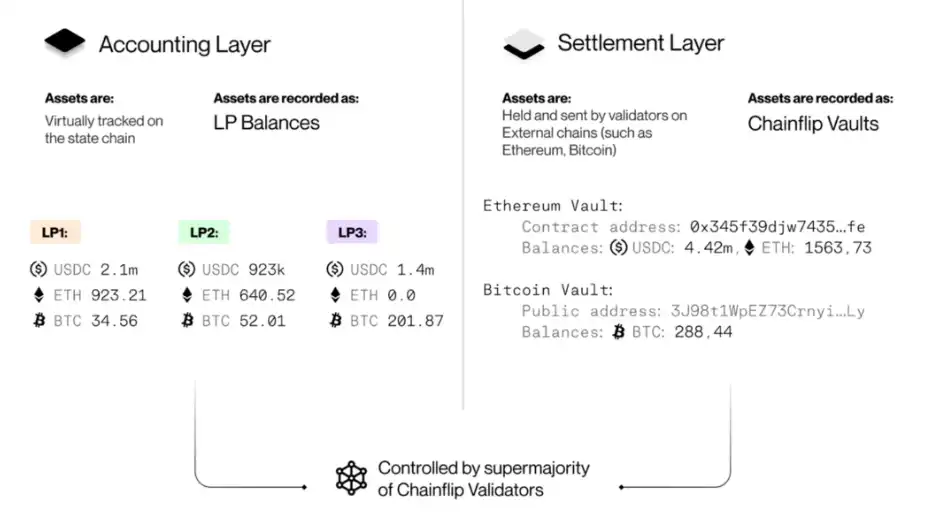
The calculation process of inter-chain value conversion is completed by Just In Time AMM (JIT AMM) on the state chain built by Chainflip based on Substrate. JIT AMM is built on Uni V3. The difference is that JIT AMM is not a series of smart contracts on different chains, but only performs virtual calculations on the state chain for value conversion. That is, Chainflip's accounting and calculation functions are stripped off and completed on the state chain, while the underlying settlement is implemented by the vaults set up by Chainflip on each chain. **This workflow greatly simplifies the operational complexity of performing inter-chain value exchange calculations, accounting, and settlements on different chains, and can effectively reduce users' Gas costs. In addition, Chainflip's state chain can also support more customized needs of JIT AMM. **For example, Chainflip supports LP to update limit orders in a timely and dynamic manner for incoming order quotes, prevents MEV robots from preempting transactions through LP competition, improves LP's capital utilization efficiency, and enables users to obtain better market prices with lower slippage.
source:Image source
Composability
Chainflip also has better composability than existing cross-chain bridges. Developers can easily integrate Chainflip's native inter-chain value exchange functions into existing protocols or products through the Chainflip SDK. Just as Uniswap's Swap function is widely integrated by DeFi use cases, higher composability will bring more use cases to Chainflip. With the current burst of highly composable use cases represented by full-chain games, when the Lego blocks of the application layer continue to stack, it will also stimulate users' demand for the liquidity of underlying assets between multiple chains. However, the current situation is that the liquidity split between L1 and L2 is becoming more and more serious. The value exchange between native chains represented by Chainflip may become an indispensable embedded function for multi-chain projects.
Team Background
Chainflip's team consists of 26 experienced global talents. Simon Harman is the founder and CEO of Chainflip, and he is also a member of the board of directors of Oxen Foundation. Before Chainflip, Simon led the team to build products including Session, a messaging application based on the Signal protocol. CTO Martin was previously the founder of Covariant Labs and the CTO and CSO of Finoa. The Chainfllip team has rich experience in Crypto background, and nearly 60% of the staff are developers, and the overall team composition is relatively high-quality.
Token Economic Model
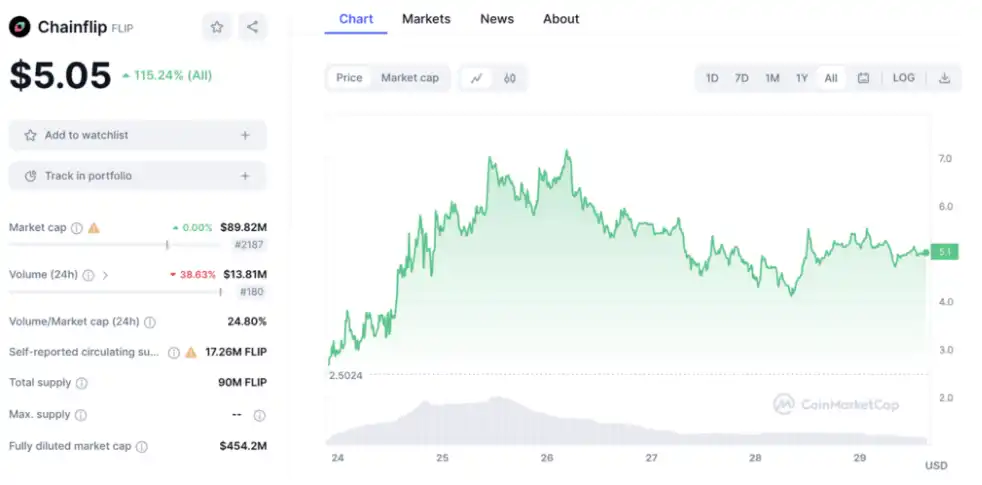
On November 23, 2023, Chainflip announced the launch of the mainnet and issued $FLIP tokens. After its release, $FLIP quickly became popular in the market. The current price is around US$5, which is nearly 2.7x higher than the ICO price of $1.83.
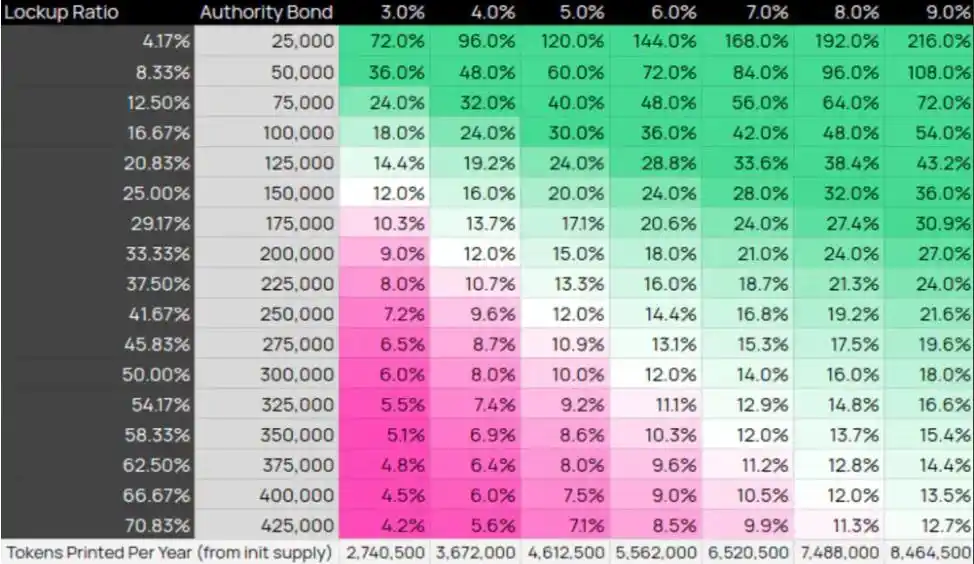
$FLIP is Chainflip's ERC-20 native token with an initial supply of 90M, following a dynamic token supply model. Currently, Chainflip expects an annualized token inflation of 8% to incentivize verification nodes. In addition, Chainflip's transaction fees will also repurchase and burn $FLIP, making $FLIP likely to be deflationary. The token empowerment of $FLIP is mainly reflected in its use for staking verification and value capture of the protocol.
source:Image source
$FLIP staking verification
Similar to most verification networks, since 150 Chainflip nodes will control all funds and operations of the system, in order to avoid nodes from doing evil, nodes must stake enough $FLIP as a penalty to participate in verification. The more $FLIP nodes staked, the higher the chance of becoming an authoritative verification node, thereby obtaining additional verification rewards.
It is currently expected that an annualized 7% token reward will be equally divided among the authoritative verification nodes. Ordinary backup verification nodes will also be allocated an annualized 1% token reward according to the proportion of $FLIP staked. Therefore, it is not difficult to find that the amount of $FLIP staked will significantly affect the validation rewards of the validator, which will amplify the node's demand for holding and staking $FLIP tokens. Chainflip also expects the staking rate of $FLIP to account for 37%-66% of the total supply. A large amount of token staking is conducive to maintaining the stability of token prices and reducing market selling pressure.
source:Image source
$FLIP value capture
Chainflip charges a 0.1% handling fee for each token exchange conducted through Chainflip. The fee will be collected in the form of USDC and used to purchase $FLIP. The purchased $FLIP tokens will be burned directly. Similarly, the gas fee on the state chain will be used to purchase $FLIP and burn it. Chainflip aims to use the token repurchase and burning mechanism to dynamically reflect the value generated by the protocol in the $FLIP price, give back to $FLIP holders, and enhance the value capture ability of $FLIP. Of course, since $FLIP itself has token inflation, Chainflip also needs to obtain enough daily trading volume, and its token repurchase and burning can drive up the price of $FLIP.
Future Expectations
Potential Market
With the launch of a large number of L1 and L2, the problem of liquidity fragmentation between chains has become increasingly serious. According to DeFiLlama data, there are a total of 71 chains with TVL above 10M. The rise of Rollup as a Service and application chains will further aggravate the problem of liquidity fragmentation. Traditional cross-chain bridges with frequent hacking problems are no longer the first choice for users to solve cross-chain liquidity. Native chain token exchange solutions represented by Thorchain and Chainflip may become mainstream. Currently, the accumulated value on the cross-chain bridge is about 12B, while Thorchain's TVL is only about 300M. There is still a market space of dozens of times for native chain token exchange solutions.
Comparison with Thorchain
Overall, Chainflip's market positioning is similar to Thorchain, but there are some differences in product experience and product design:
1.Product experience: Thorchain requires a separate multi-chain wallet, while Chainflip only requires an ordinary on-chain wallet, which makes the user experience more convenient. Of course, Thorchain is currently also making it compatible with mainstream wallets to gradually close the gap in wallet experience.
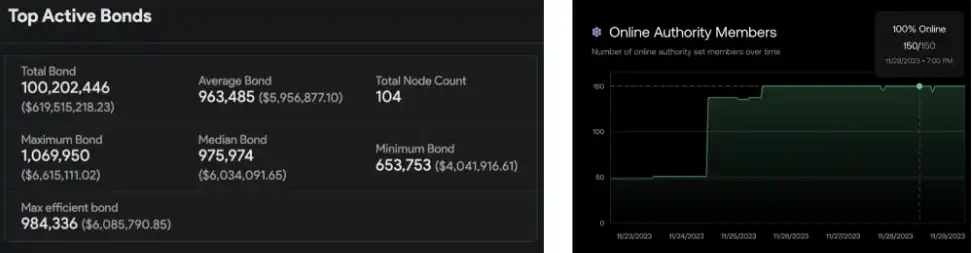
2.Degree of decentralization: Thorchain currently has a total of 104 nodes to maintain the security of the on-chain vault, while Chainflip's decentralized verification network consists of 150 nodes. In terms of the number of nodes, Chainflip's degree of decentralization will be relatively higher, but there is no obvious difference between the two.
3.Product Design: Thorchain's fund pool and token exchange rely on $RUNE as an intermediary, while Chainflip does not rely on a specific token. Therefore, Chainflip's fund pool and token exchange process will not be exposed to the risk exposure of a specific token, and the security is relatively higher.
source:Image Source 1 & Image Source 2
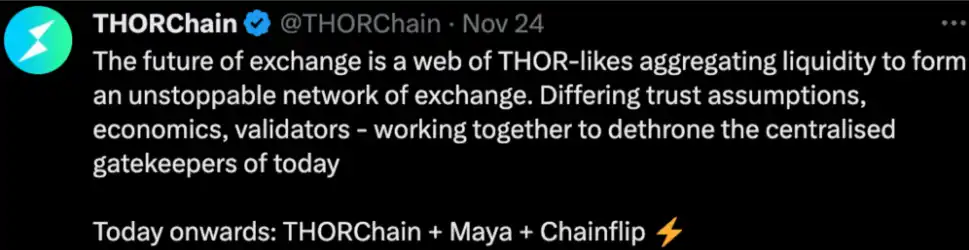
To sum up, the user experience, decentralization and security of Chainflip are slightly better than Thorchain at present, but Thorchain's own first-mover advantage, market popularity and market share are also its important competitive advantages. Therefore, **we predict that Chainflip will hardly completely replace Thorchain in the short term. **It is more likely that, as Thorchain's official Twitter said, Chainflip will continue to erode the market share of cross-chain bridges together with Thorchain.
source:Image source
Currently, Chainflip's market value is about 90M, and its total market value is about 460M. Thorchain's market value is 2.1B, and its total market value is 3B. From the perspective of comparable valuation, $FLIP still has room for imagination close to 8x. However, Thorchain's market value relies on its total transaction volume of 68B and the recent daily transaction volume of 100M+, while Chainflip has not yet generated any transactions. Therefore, we will generally remain cautiously optimistic about the subsequent trend of $FLIP, and will pay special attention to whether Chainflip's recent mainnet launch incentive plan can drive a significant increase in transaction volume.
Reference
3.https://blog.chainflip.io/just-in-time-jit/
4.https://www.techflowpost.com/article/detail_14648.html
MT Capital
MT Capital is headquartered in Silicon Valley and is a crypto-native fund focusing on Web3 and related technologies. We have a global team, and our diverse cultural backgrounds and perspectives allow us to have a deep understanding of the global market and seize investment opportunities in different regions. MT Capital's vision is to become a leading global blockchain investment company, focusing on supporting early-stage technology companies that can generate huge value. Since 2016, our investment portfolio has covered various fields such as Infra, L1/L2, DeFi, NFT, GameFi, etc. We are not just investors, but also the driving force behind the founding team.
Official Website: https://mt.capital/
Twitter: https://twitter.com/MTCapital_US
Medium: https://medium.com/@MTCapital_US
Original link
Welcome to join the official BlockBeats community:
Telegram Subscription Group: https://t.me/theblockbeats
Telegram Discussion Group: https://t.me/BlockBeats_App
Official Twitter Account: https://twitter.com/BlockBeatsAsia

 Related Articles