Starknet hints at launching its own token, STRK. Which DeFi protocols are worth interacting with?
Original title: "Coin issuance is imminent, Starknet updates roadmap, which DeFi protocols are worth focusing on?"
Original source: Foresight News
Recently, Starknet released a new roadmap, which confirms plans to support the use of STRK for transaction fees in the V3 transaction structure, implying that the STRK token will soon be launched.
What are the five main items on the Starknet new roadmap? What stage has the Starknet token process reached? And which DeFi protocols are worth highlighting for interaction?
Starknet Roadmap Major Update Confirms Five Key Items
According to the latest roadmap released by Starknet, Starknet has identified 5 major issues, including network stability improvement, V3 transactions, transaction fee market, using EIP-4844 to reduce L1 fees, and reducing transaction costs through the Volition mode.
Regarding network stability improvements, Starknet released the v0.12.0 version in July of this year, which is considered a "quantum leap" and focuses on improving network throughput and making significant improvements to the sequencer. Subsequently, Starknet v0.12.1 (optimized transaction efficiency) and v0.12.2 (enabled P2P identity verification and improved maximum throughput and TPS) were successively released on the mainnet. This month, Starknet v0.12.3 (removing support for the Starknet feeder gateway) was released on the testnet.
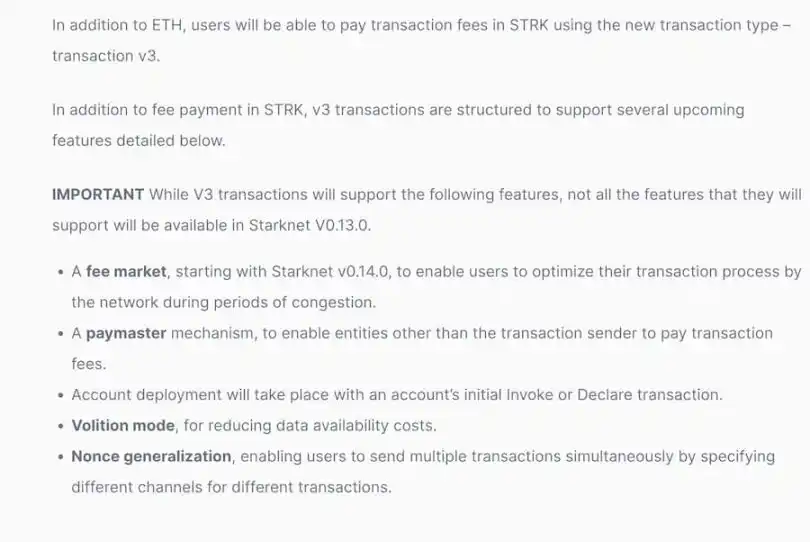
In the V3 transaction structure being built by Starknet, payment of transaction fees will be supported using STRK. The V3 transaction structure will also support the following features (not all of which are available in Starknet V0.13.0):
Fee Market: The fee market introduced in Starknet v0.14.0 allows users to optimize their transaction process during congestion.
Paymaster mechanism: Similar to EIP-4337, it enables entities other than the transaction sender to pay for transaction fees through fee abstraction.
Volition Mode: Used to reduce the cost of data availability and introduce hybris state design, allowing users to choose their preferred data availability mode.
Nonce Generalization: Allows users to send multiple transactions simultaneously by specifying different channels for each transaction.
The deployment of the account will be carried out in the initial invocation or declaration transaction of the account.
According to the SNIP 10 proposal regarding STRK fee tokens, one of the main purposes of STRK is to serve as a payment token for fees on Starknet. However, the original transaction version will continue to use ETH as the fee token. The Starknet sequencer will use the off-chain STRK <> ETH price feed provided by Pragma Oracle. Starknet explains that this is only a temporary solution for centralized situations, and a proposal for a decentralized protocol will be released later.
In addition, Starknet also plans to use EIP-4844 to reduce L1 fees. EIP-4844 reduces transaction fees by introducing blobs to carry transactions.
Starknet network upgrade has the following planned dates:
On December 11th, 2023, V0.12.3 mainnet will be launched.
On December 5th, 2023, V0.13.0 Goerli testnet will be launched. If necessary, the date may be postponed for a week until December 13th.
January 22, 2024: V0.13.0 mainnet, pending governance vote.
Starknet Token Distribution Model and Progress
In November 2022, Starknet will deploy its token STRK on the Ethereum mainnet with contract address: 0xCa14007Eff0dB1f8135f4C25B34De49AB0d42766. STRK will be used as a staking token for participating in the Starknet consensus mechanism, a governance token, and for paying transaction fees.
Regarding transaction fees, Starknet previously stated that fees are expected to be paid only with the native STRK token. The plan to use both STRK and ETH as transaction fees may only be transitional.
There is a heated discussion on the Starknet forum regarding the potential risks that the decision to use both STRK and ETH as transaction fees simultaneously may bring to the sequencer.
STRK collateral can also be used to ensure the activity and security of the network, which may include sequencing, achieving temporary L2 consensus before reaching L1 finality, STARK proof services, and data availability supply.
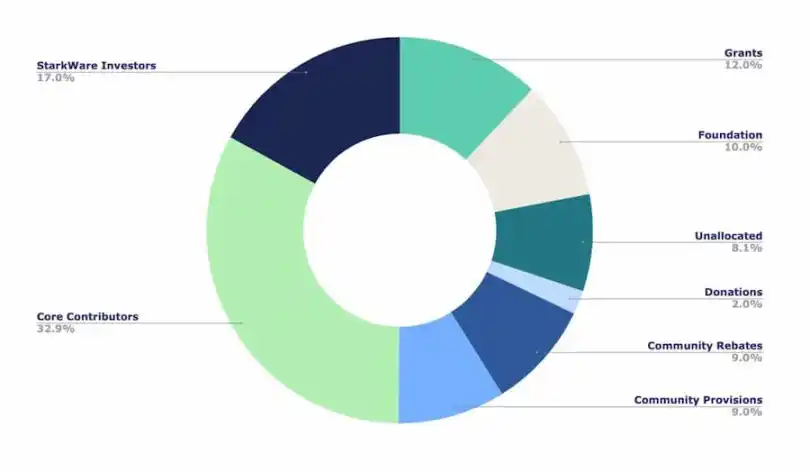
Starknet disclosed its token economics in mid-2022. The maximum total supply of STRK tokens is 10 billion, including:
17% is allocated to StarkWare investors;
32.9% is allocated to core contributors, including StarkWare and its employees and advisors, as well as Starknet software development partners;
50.1% granted by StarkWare to the Foundation for distribution, of which:
9% is allocated to the community (Community Provisions), which applies to individuals who work for Starknet and provide support or development for its underlying technology.
9% is used for community rebates (used to partially pay for the cost of joining Starknet from Ethereum); 12% is used to fund research and work on developing, testing, deploying, and maintaining the Starknet protocol.
10% is used as a strategic reserve fund to support ecosystem activities that are consistent with the mission of the foundation;
JediSwap
Ekubo
mySwap
SithSwap
AVNU
AVNU has also introduced a points system, allowing users to earn points through transactions. The number of points is related to the number of transactions, transaction amount, frequency, etc.
zkLend
zkLend is a native L2 currency market protocol built on Starknet. In March 2022, it completed a $5 million seed round of financing, led by Delphi Digital, with other investors including StarkWare, Three Arrows Capital, Alameda Research, MetaCartel DAO, Amber Group, and Genesis Block Ventures.
zkLend officially launched on the Starknet mainnet in October this year, with features including inputting multiple calls and supporting more assets (including wstETH). According to zkLend's roadmap, cross-chain lending and zkLend institutional MVP will also be launched in the fourth quarter.
zkLend has disclosed its token economics on its official website. The total supply is 100 million tokens, with 17% allocated to private and public investors, 15% allocated to the team and advisors, 17% allocated to the ecosystem, and 35% allocated to staking and distribution rewards.
The zkLend whitepaper states that ZEND tokens can be staked and exchanged for stZEND. Holders of stZEND can share in protocol revenue, increase their release rewards, and gain governance rights.
Nostra
Nostra is developed by Tempus Labs, the team behind the tokenization of yield and fixed-rate protocol Tempus. As a liquidity layer on Starknet, Nostra supports lending and trading services. Nostra will also launch UNO, a Starknet-native stablecoin pegged to the US dollar. Users can deposit ETH into Lending and convert it to iETH-c, which will be used as collateral for minting UNO.
Tempus Labs allocated 5 million DAI to Nostra in August last year to support the development of the Nostra ecosystem.
Reminder: Most Starknet native projects are in the early stages of development, and users should be cautious when interacting with them. Before investors interact with any protocol, they should conduct sufficient research and due diligence to understand its risks and potential returns.
Reference:
https://www.starknet.io/en/roadmap
https://community.starknet.io/t/starknet-next-versions-v0-12-3-v0-13-0-and-sepolia-testnet-migration/106529
https://community.starknet.io/t/announcing-the-early-community-member-program/102092
https://github.com/starknet-io/SNIPs/blob/main/SNIPS/snip-8.md
https://github.com/ob1337/SNIPs/blob/snip-10/SNIPS/snip-10.md
Original article link
Welcome to join the official BlockBeats community:
Telegram Subscription Group: https://t.me/theblockbeats
Telegram Discussion Group: https://t.me/BlockBeats_App
Official Twitter Account: https://twitter.com/BlockBeatsAsia

 Related Articles