In-depth analysis of blockchain games: Bubble or a new revolution?
Original Title: "In-depth Analysis of Full-chain Games, Bubble or New Revolution?"
Original Author: Fred, Ryze Labs
Navigation Menu
Introduction: What is a full-chain game?
二、为什么人类需要全链游戏?
"二、为什么人类需要全链游戏?" translates to "2. Why do humans need blockchain games?"3. Analysis of the current situation in the full-chain gaming industry.
4. The Core Advantages of Full-Chain Gaming
Five, challenges and limitations of the full-chain game.
Six, Reflections on the Extension of the Full-Chain Game Business Model.
7. Summary
1. Introduction: What is a Full-Chain Game?
Recently, the Pass card fomo of the full-chain game Sky Strife has reached 21000ETH, which has amazed many non-full-chain game players and demonstrated the magic of this track. Since the launch of "Pong" in 1972, the gaming industry has been skyrocketing, from classic 8-bit games like "Super Mario" and "The Legend of Zelda" to highly complex and social network games like "Fortnite" and "League of Legends". Gaming is no longer just a simple form of entertainment. The social, competitive, and immersive experiences provided by these games have surpassed our past imagination.
However, with the rise of blockchain technology and the development of cryptocurrencies, the gaming industry is reshaping our experiences in unprecedented ways. From innovative works like Axie Infinity that tightly integrate gaming with the crypto economy, to gaming projects like Stepn that focus on social and innovation, blockchain games are gradually being seen as a hope for Crypto Mass Adoption. People are also gradually exploring new ways to combine gaming and blockchain, besides asset chaining, can more elements be chained? Thus, the birth of the full-chain game.
So what is the difference between blockchain games and traditional games?
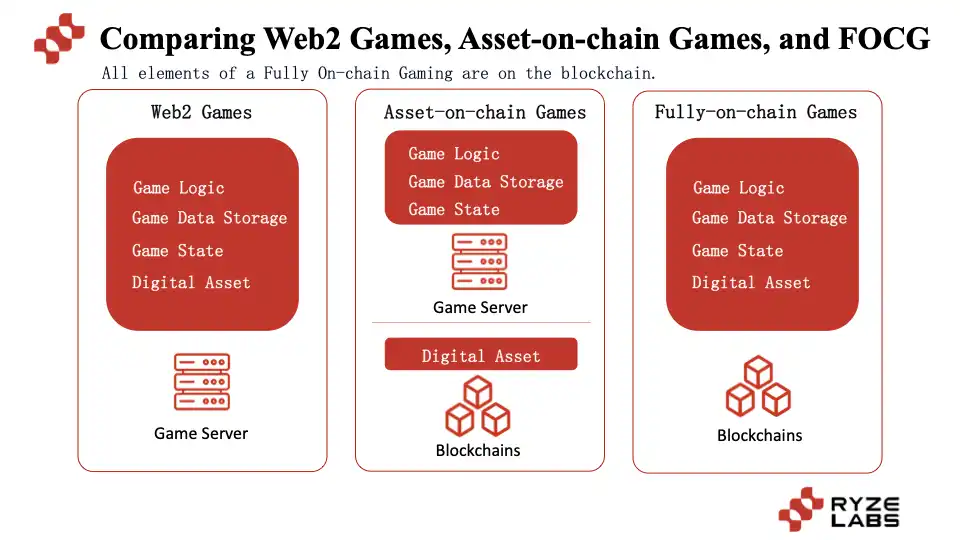
In traditional games, all game logic, data storage, digital assets, and game states are stored in centralized game companies. For example, when we play games like Honor of Kings, Genshin Impact, and Dungeon Fighter Online, all game content including in-game assets are owned by centralized companies.
The asset-chaining games that appeared later (commonly known as Web2.5 games), such as Axie and Stepn, will chain assets. On the one hand, players can have ownership of assets, and on the other hand, they can increase the liquidity of assets. However, when faced with the closure of the game, game assets will still face the dilemma of losing circulation value. Compared with substitution, the relationship between asset-chaining games and traditional games is more like a supplement, similar to the relationship between takeaway and catering stores. Similarly, Web2.5 games also face competition from Web2.5 games of the same kind and traditional Web2 games.
Recently, the fully-chained game that has received much attention has put all game interactions and states on the chain, including the game logic, data storage, digital assets, and game states mentioned earlier, all of which are processed by the blockchain, thus achieving a truly decentralized game.
For the convenience of everyone's understanding, I have summarized the characteristics of the full-chain game into the following four points:
The authenticity of the data source is ensured by the blockchain. The blockchain is no longer just an auxiliary storage for data, but the true source of game data; it is not limited to recording asset ownership, but is the storage center for all critical data. This approach fully utilizes the characteristics of programmable blockchains, achieving transparent data storage and permissionless interoperability. The game's logic and rules are implemented through smart contracts. For example, various operations in the game can be executed on the chain, ensuring the traceability and security of the game logic. Game development follows the principle of an open ecosystem. Game contracts and accessible game clients are both open source, providing a broad creative space for third-party developers. They can output content creatively and share it with the entire community through plugins, third-party clients, and interoperable smart contracts, and even redeploy and customize their own game experience. The game is independent of the client. This is closely related to the previous three points, because the key to truly native encrypted games is that even if the core developer's client disappears, the game can still continue. This depends on the ability of the game data to be stored without permission, the logic to be executed without permission, and the community to independently interact with the core smart contract, without relying on interfaces provided by the core team. This truly achieves decentralization.
二、为什么人类需要全链游戏?
Translation:
2. Why do humans need blockchain games?
Before we delve into why a full-chain game is necessary, let's first briefly understand the current situation and operating model of the traditional gaming industry.
Full-chain games are essentially games. It is important and necessary for us to understand and analyze the future of full-chain games by understanding the operation mode of traditional games.
1. Current Status of Traditional Gaming Industry
With the development of the gaming industry, many excellent Web2 games have emerged during our growth, whether it is FPS games like Counter-Strike and CrossFire, RPG games like Dungeon Fighter Online and Dragon Nest, MOBA games like League of Legends and Honor of Kings, or card games like Onmyoji and Hearthstone. Games have accompanied our generation's growth and have become a very important part of our entertainment life.
According to Fortune Business Insights, the global gaming market is expected to reach $249.55 billion in 2022 and is projected to surpass $280 billion in 2023, with an estimated market size of over $600 billion by 2030. In comparison, the global film and entertainment industry is expected to reach a market size of $94.4 billion in 2022. This highlights the significant role that the gaming industry plays in economic development as a leisure and entertainment industry, with many opportunities for commercialization and exploration in terms of depth and breadth of types. It can be said that gaming is the crown jewel of the leisure industry.
1) Why do humans love playing games?
According to data from Statista, the current number of gamers worldwide has exceeded 2.5 billion, approaching 3 billion. So how can games attract more than one-third of the world's population to participate? The most fundamental reason can be summarized as satisfying human needs and weaknesses in multiple ways.
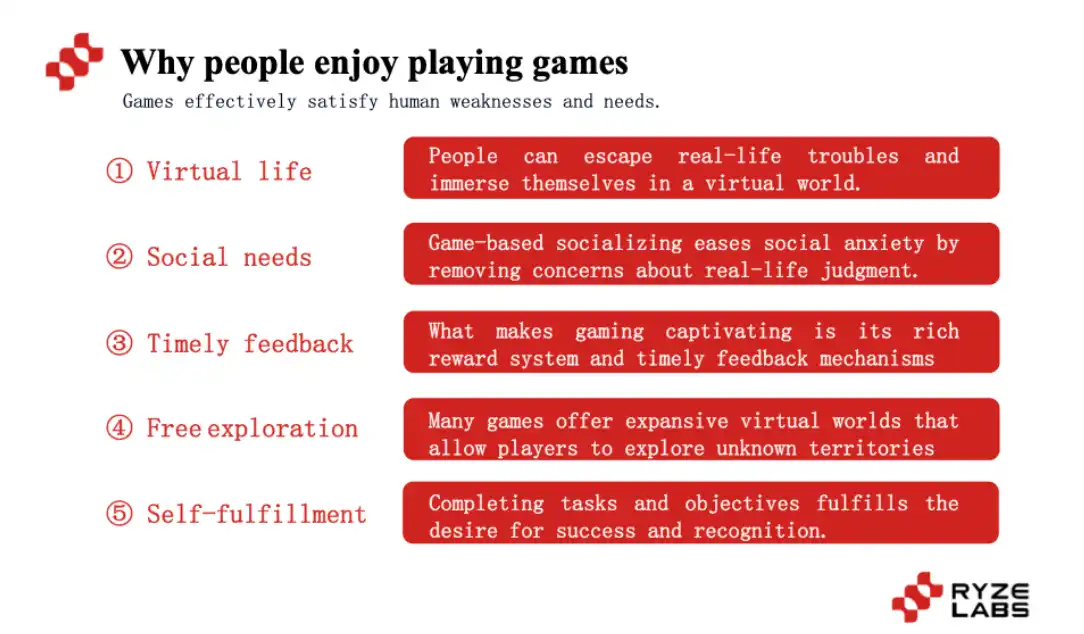
Escape reality and restart life: Games provide a place where people can escape the pressures and challenges of daily life. In games, people can free themselves from the troubles of reality, immerse themselves in a virtual world, and have a second life.
No Burden Socialization: For multiplayer games, the game provides a platform for social interaction, which is more friendly to people with social anxiety. Players don't have to worry about the gaze of others in real life, so they can do what they want and establish relationships with others.
Rewards for timely feedback: Unlike the struggles of students and workers in real life for their studies and work day after day, the charm of games lies in providing a rich reward system and timely reward mechanism. After making efforts, leveling up by defeating monsters, and completing challenges, players can quickly gain new skills, unlock new levels, or obtain new items. This incentive mechanism can stimulate people's motivation to continue moving forward.
Low-cost free exploration: Many games provide rich virtual worlds that allow players to explore unknown areas, interact with NPCs and other players, and drive the development of the plot, satisfying humans' innate desire for adventure and exploration. In the real world, however, the cost of exploration is much higher than in the game world due to constraints such as money, energy, time, and geographic location.
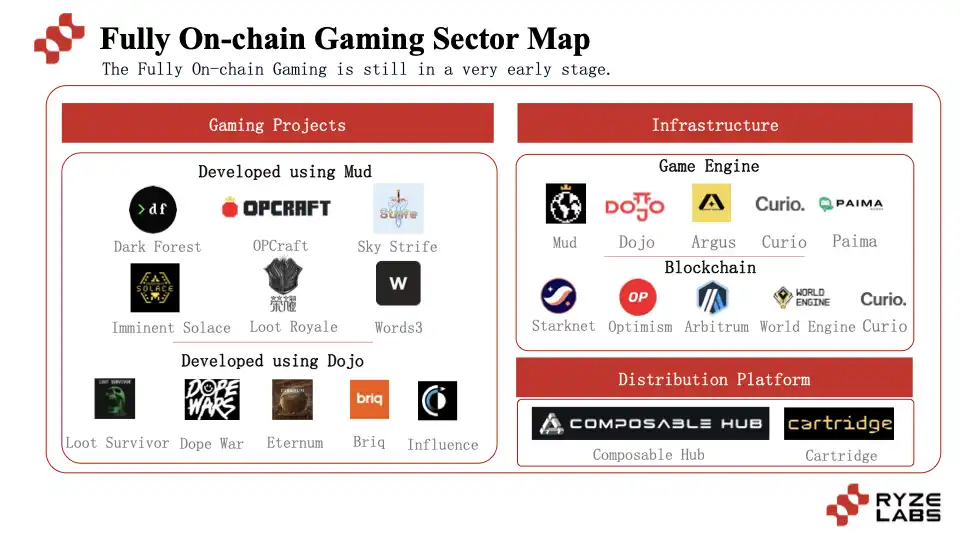
Currently, all full-chain game projects are in very early stages. Next, we will analyze several full-chain game projects to understand the current state of full-chain gaming.
In terms of game projects, there are early well-known ones like Dark Forest, as well as recent ones like Loot survivor, Sky Strife, Imminent Solace, and Loot Rayale. Most of the projects that can be experienced are still in the testing phase, and the number of playable full-chain games on the market does not exceed two digits. The overall game is mainly SLG (strategy type), and there are currently many new project parties trying to move towards simulation management.
Due to the fact that most games are still in development and not playable, here we mainly introduce several playable and distinctive full-chain games.
1)Dark forest
First, let's take a look at the representative work of the entire chain game, Dark Forest. Simply put, Dark Forest is a decentralized strategy game created on Ethereum using zkSNARKs.
Dark Forest is developed by Brian Gu, a graduate of MIT, under the pseudonym Gubsheep. Some of the inspiration comes from Liu Cixin's science fiction novel "The Dark Forest". Other members include Alan, Ivan, and Moe. This game project is not funded, but the team's new project, Argus Labs, recently raised $10 million.
The Dark Forest is one of the earliest incomplete information games built on a decentralized system. As a space conquest strategy game, players explore the infinite universe by starting their journey on their own planet, discovering and occupying other planets and resources to develop their empire.
Dark Forest has three major highlights: two of which were just mentioned when introducing the full-chain game. The first is that the game logic, data, and state are all on the chain, and centralized entities cannot control their behavior and results. The second is a free and open high-combination game ecology: the open-source full-chain game model gives Dark Forest permissionless interoperability. Essentially, it is an Ethereum smart contract that any address can interact with, thus giving rise to a thriving secondary creation ecology (plugins) and generating more ecological communities.
For example: Project Sophon has created the Dark Forest local library, allowing users to start a game on or off the chain; Ukrainian gaming organization Orden_GG has built a trading market for artifacts and added liquidity pools; MarrowDAO|GuildW @marrowdao, a Chinese-speaking DAO, has developed many plugins including an artifact trading market and GPU mapping tools. Its UGC ecosystem is very interesting.
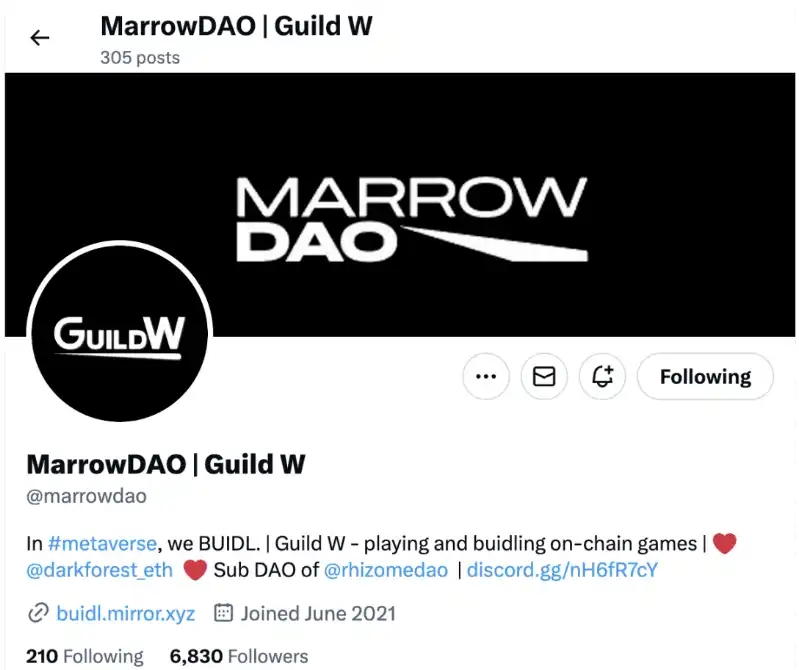
(Source: MarrowDAO official Twitter)
Another highlight of Dark Forest is the use of zk-SNARKS technology for information hiding. For strategy games, if all information is transparent, opponents will know their position, and it will be impossible to implement strategic confrontation under full transparency. Dark Forest uses zk technology to hide most of the universe and opponents when players first enter the game. They only become visible when players explore hidden areas. Every time a player moves, they send a proof to the blockchain to prove that the move is valid without revealing their coordinates in the universe.
After the official v0.6 version Round 5 ends in February 2022, Dark Forest has not opened a new game version. Currently, the entire game is in a state of abandonment. If you want to experience the game, you can participate in some community-organized rounds, such as creating a small universe in the Arena system developed by dfDAO.
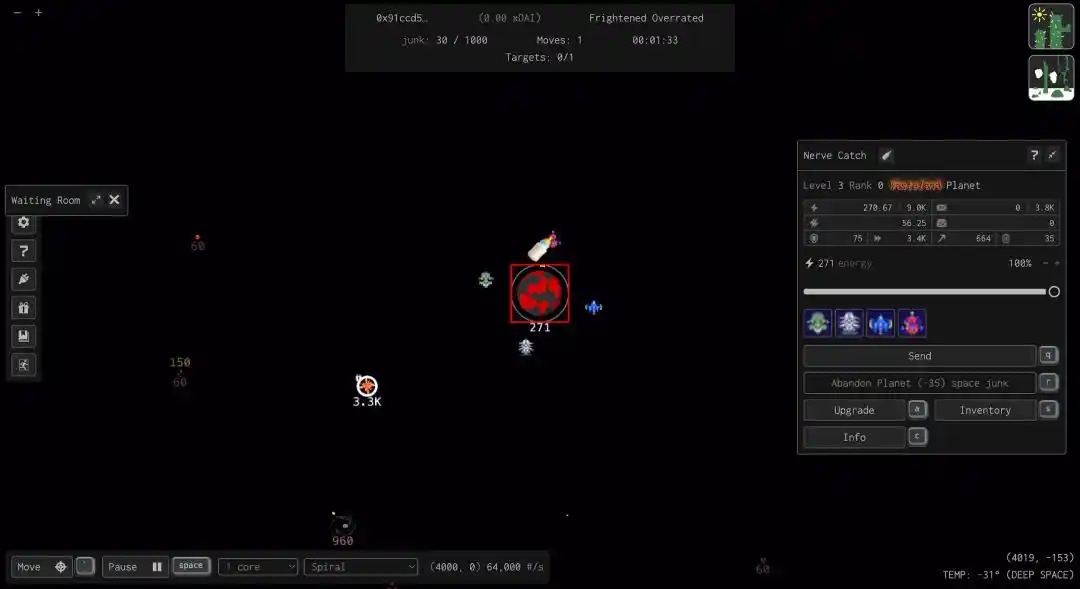
(Source: Fred created a new universe in the Arena system developed by dfDAO)
Overall, Dark Forest has redefined the possibilities of Web3 gaming. Many people praise it as a perfect example of the intersection between gaming and cryptography, and it has inspired many subsequent blockchain gaming projects. According to previous reports, the total number of players in its history has exceeded 10,000+.
However, the significance of Dark Forest is not only in its game itself. As the first highly anticipated full-chain game, it is more like the spiritual totem of full-chain games, allowing industry builders to discover that there are so many free and open combination gameplay and prosperous secondary creation ecology based on full-chain games. This has given people a stronger confidence in the possibility of achieving "Autonomous Worlds" - a world of autonomy.
After creating Dark Forest, the Dark Forest team and several other teams formed 0xPARC. The Lattice sub-project of 0xPARC found that the existing development cost was extremely high when developing blockchain games, so it started the MUD project in 2022, hoping to create a user-friendly blockchain game engine based on the ECS framework to solve problems such as the synchronization of contract and client states, continuous content updates, and interoperability with other contracts, thereby reducing the development threshold and greatly promoting the development of blockchain games. In a sense, Dark Forest is a huge symbol and development booster for the blockchain game industry.
2)Loot survivor
Next, let's take a look at Loot Survivor. As a game developed by the BibliothecaDAO team, Loot Survivor is an important part of the Loot ecosystem.
Loot was released by @Dom Hofmann on August 28, 2021. Unlike common PFP-type NFTs such as BAYC and Crypto Punks, each NFT of Loot consists of white text on a black background. The interpretation of these texts is highly open and flexible, and the community-driven and autonomous nature of Loot has attracted a large number of ecosystem contributors and related derivative projects.
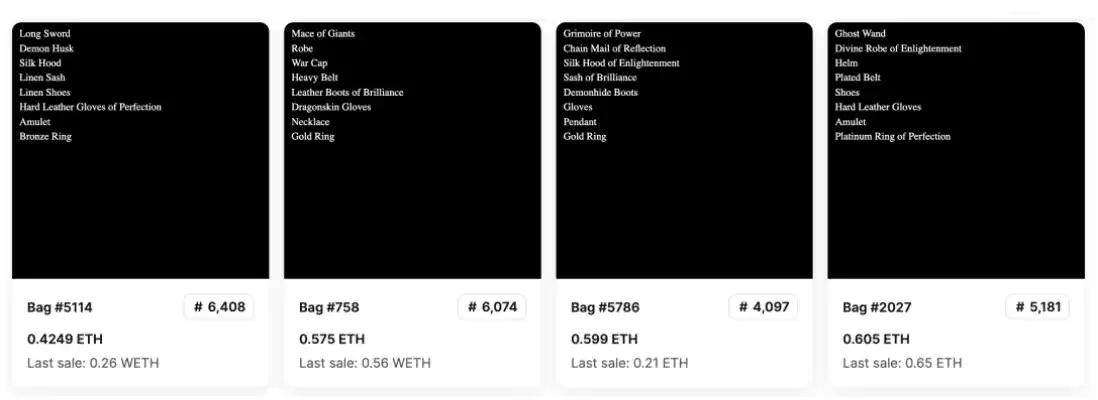
(Source: OpenSea)
Among them, Loot Realms has been committed to the development of Lootverse since its launch on September 1, 2021. Core contributors @lordOfAFew and @TimshelXYZ played important roles in this project, building the underlying narrative of Loot and presenting the gamification of the narrative through Realms' first project, Eternum.
The team proposed the core concept of "Play 2 Die" as early as February 2022. Originally planned as an expansion of the Realms series, it was created under the name "Realms: Adventurers". However, during the iterative development process, the team decided to quickly launch a smaller-scale single-player full-chain game, and thus Loot Survivor was born.
Loot Survivor is a text-based dungeon or Roguelike game that debuted at the Lisbon Full Chain Game Summit on May 25th of this year (also the author's birthday) and has received a lot of attention.
The overall gameplay of the game is relatively simple, using text interaction to fight monsters until death, and hoping that users will continue to challenge themselves through the leaderboard.
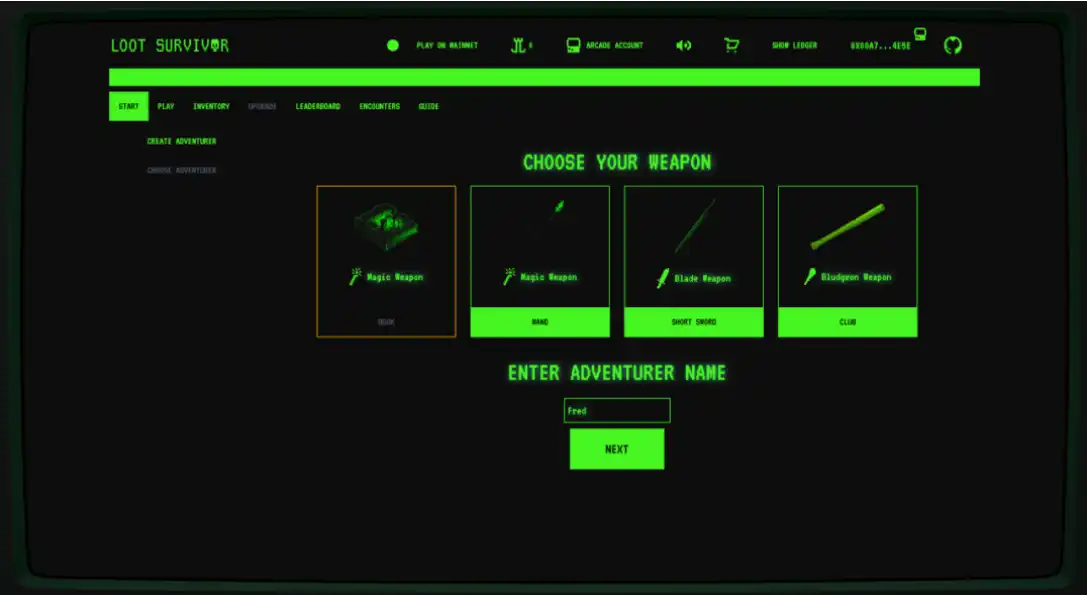
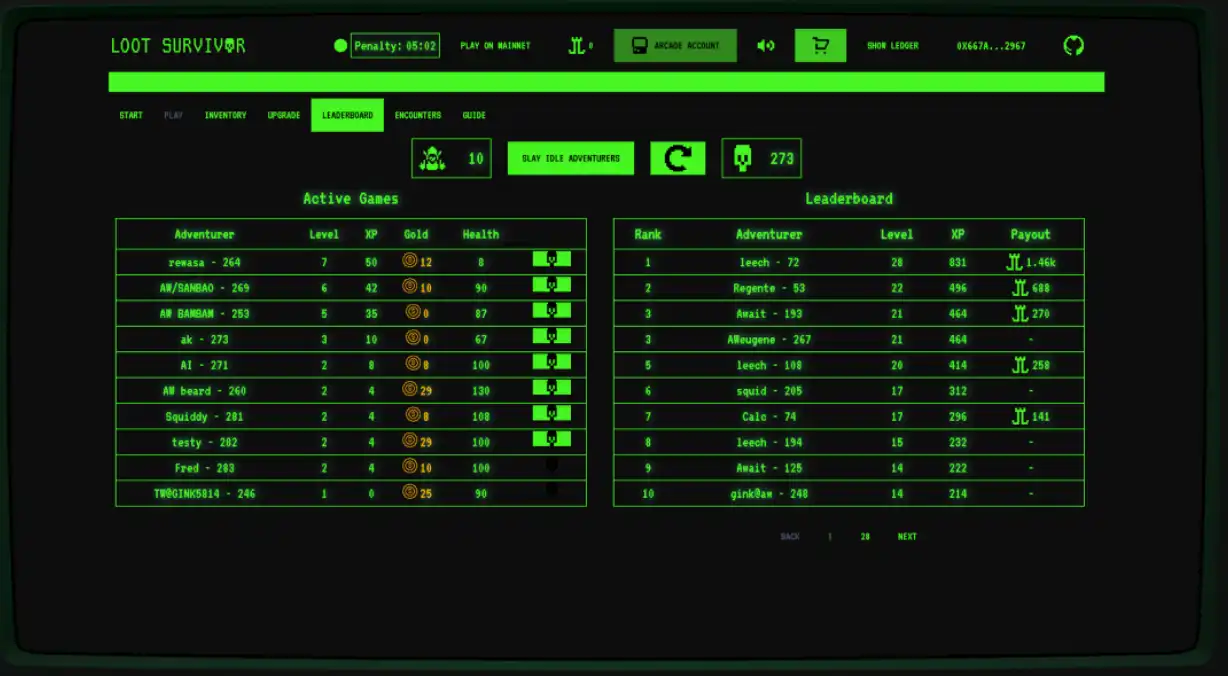
(Source: Fred's game screenshots and performance rankings on Loot Survivor)
Overall, the game has a small scale and playability, and focuses more on inheriting the Loot ecosystem in game creation and adding gamified storytelling to the Loot ecosystem. In addition, as one of the flagship projects of the Dojo engine ecosystem, it has given a boost to both the Dojo engine and Starknet ecosystems.
3)Imminent Solace
Imminent Solace is a recently launched treasure battle royale game based on the ZK war fog, developed using the Mud engine. The project team is developed by PTA DAO, a Chinese team that focuses on the entire chain of games, integrating PVP looting, independent world exploration, and PoW resource mining. The gameplay is similar to the Dark Forest, but with simpler operations and a better user experience.
The ultimate goal of the project is to create a war simulation game similar to EVE, where players will experience real losses in resources and assets during gameplay, and face strategic challenges.
Imminent Solace is one of the more playable games in recent full-chain games, and the game's interaction and experience are quite good.
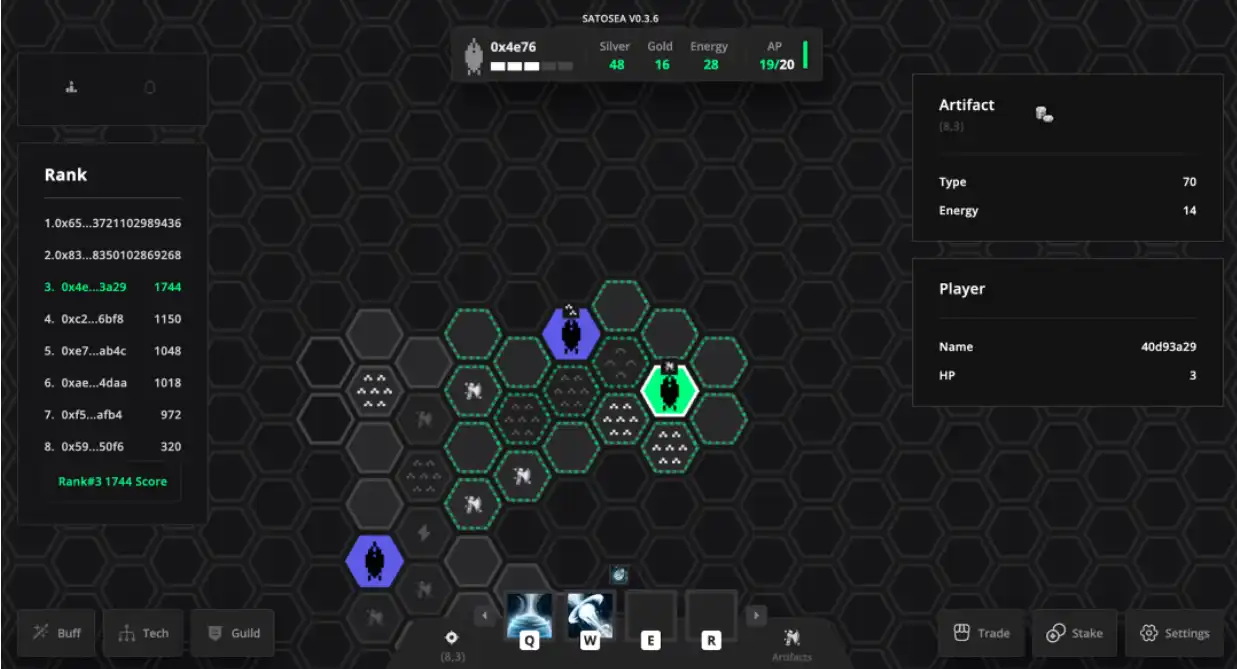
(Source: Fred in Imminent Solace game screenshots and rankings)
In addition, there are Lattice's self-developed text games Word3 for Sky Strife, OPCraft, and SmallBrain, as well as the Web3 version of Werewolf game Framed, and battle royale game Loot Rayale, and cultivation and management game Genki Cats, etc. exploring the path of blockchain gaming. Most of them are still in the testing phase, and there are still only a few playable games currently being developed.
Through research, it has been found that currently, most blockchain games are web-based, with very few available on PC or mobile platforms.
On the one hand, this is also related to the feature that the full-chain game does not require a client. Since the full-chain game can have multiple front-ends, the most important thing for the project party is to quickly create an MVP version for the community and users to play. Compared with PC and mobile development, web development is faster and cheaper, which has become the best solution and even the only choice for everyone. On the other hand, the full-chain game is still in the concept verification stage, and how to quickly create a playable game to verify the value of the game is the key.
Mud
Dojo
4、Full-chain game aggregator/publishing platform
Finally, let me introduce the aggregator/publishing platform for the emerging full-chain games. Currently, due to the very early stage of full-chain games, there are very few playable full-chain games on the market. According to data from Composable Hub, including alpha, beta, and fully launched games, the number of playable games does not exceed 30.
So currently, for players of the entire chain game, finding the entire chain game can only rely on word of mouth and the spread of some small circles. There are no aggregators like defi and gamefi in mature tracks to help users explore and choose.
Currently, there are two main platforms specializing in full-chain game aggregators, Composable Hub and Cartridge.
Composable Hub
Currently, Composable Hub has aggregated 56 full-chain games, of which 14 have been launched and 12 are in the testing phase, while the remaining 30 games are still under development.
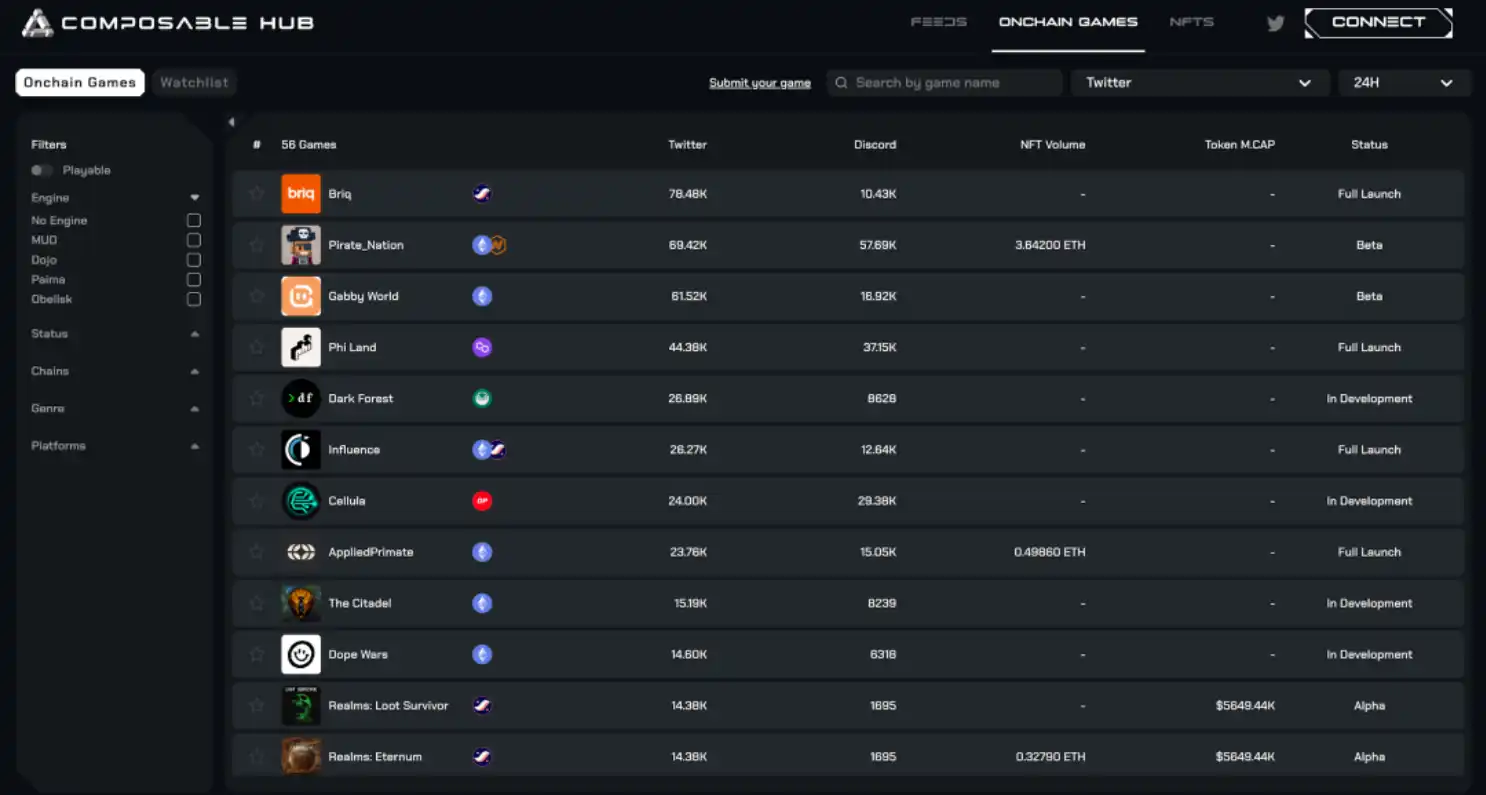
(Source: Composable Hub)
Cartridge
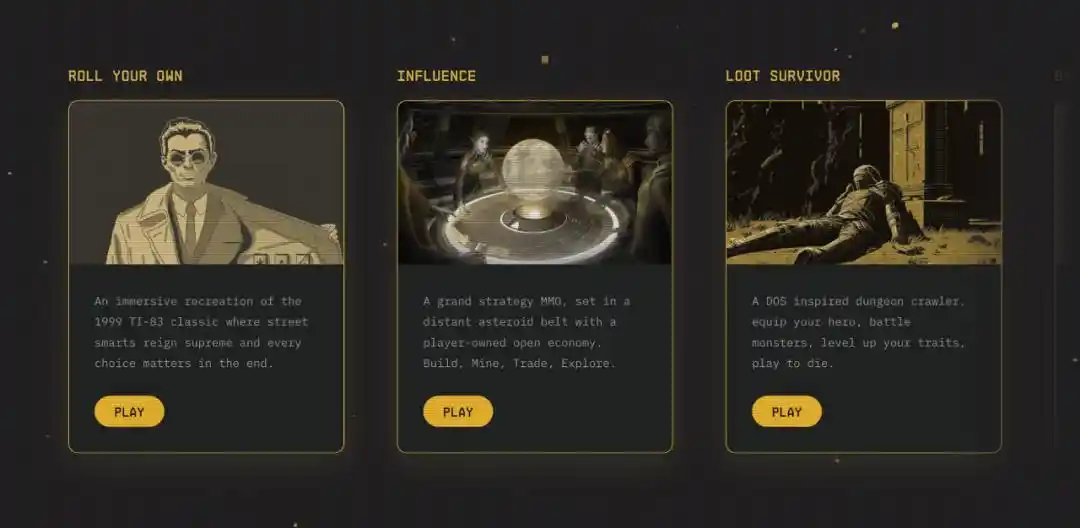
Cartridge is a full-chain game aggregator in the Starkware ecosystem, dedicated to creating a Web3 Steam. Currently, it aggregates 5 games in the Starknet ecosystem: Dope Wars-Roll Your Own, Influence, Loot survivor, Briq, and Frens Land.
In addition, the Cartridge team has also been promoting the development of the Dope Wars-Roll Your Own game, and is also the core contributing team of the Dojo engine.
(Source: Cartridge)
This openness allows games to shift from the traditional binary relationship between game companies as providers and players as consumers, to a new model where every player can become a builder and creator of the game.
In traditional games, all of our game content is provided by the official company, whether we are playing games like King of Glory, Genshin Impact, Fortnite, or Overwatch, we are all participants in the PGC (Professional Generated Content) mode as gamers. Of course, we also have the right to create, and we can create some fan fiction around the game's content, such as character roles and novel writing, to achieve a certain degree of UGC (User Generated Content).
However, this type of creation does not involve the core of rules and gameplay. We can only be consumers of game rules rather than creators. We are powerless when it comes to strengthening or weakening game characters, colliding game values and environments, and are still subject to the standards of PGR (Professional Generated Rules). For players who aspire to create, it is to some extent a shackle. In the real world, humans who are frustrated always yearn for the right to become gods, and they yearn for UGR (User Generated Rules), whether it is through novels, movies, or games.
Most traditional games are reluctant to make open attempts due to considerations such as business models, security, and stability. However, we can find that some projects are beginning to transition to openness and PGR in many games, using mods to allow other developers to develop official game content. The most well-known example is Minecraft, which allows players to create and run their own game servers. Third-party developers can implement custom game modes, rules, and content, creating gameplay that is different from the original game, including Minecraft version of "chicken dinner" and even online graduation ceremonies during the epidemic.
Although Minecraft allows users to create multiple servers to create game modes, these new servers are disconnected from each other and need to compete for players' attention and time. The data accumulated by players in this gameplay cannot be circulated in the servers of new gameplay. This UGR is castrated, it is their own small universe, not a shared universe for everyone.
The creation of new gameplay modes in Minecraft requires the setup of new servers, while the difference in full-chain games lies in sharing the same backend, where interactions between different modules and smart contracts only affect the frontend, allowing data to be shared and circulated among different clients.
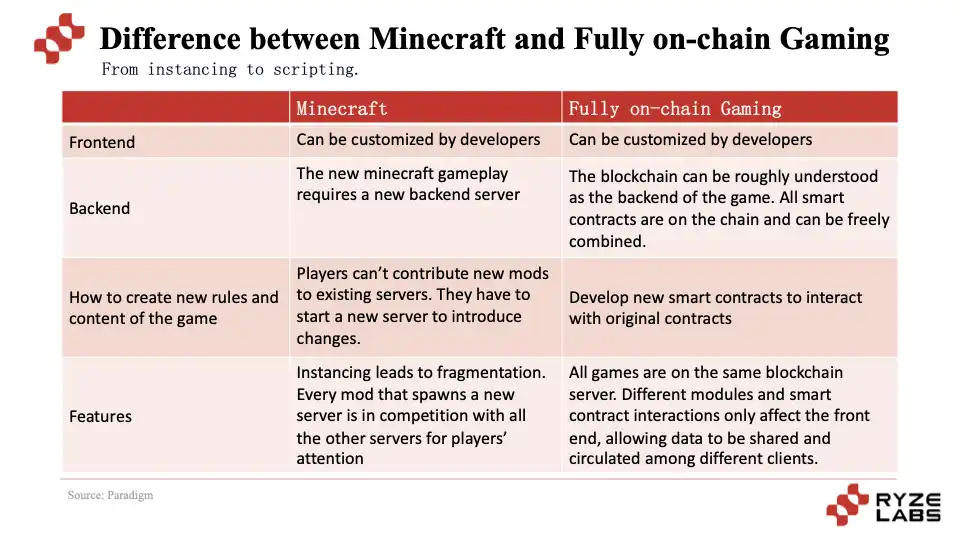
The full-chain game, due to its game logic and rules on the chain, and support for permissionless interoperability, allows players to freely build and create various game functions and experiences, and they are not isolated from each other. This great potential for creative freedom enriches the content and functionality of the game, such as trading markets, embedded games, custom clients, etc., making the game experience more diverse and achieving the transition from PGR to UGR.
This also reminds me of the virtual world Jiuzhou created by Chinese online writers Jiangnan, Jinhezai, and Dajiao more than a decade ago. They created a Jiuzhou universe through collective storytelling, which formed a vast world from literary works to film, television, games, and other industries.
Actually, if we compare it to our daily life, the whole-chain game is very similar to playing cards. The playing cards themselves only have fixed suits and numbers, but people have developed various gameplay and created different games such as Landlord, Texas Hold'em, Tractor, Upgrading, Nervousness, and Golden Flower, demonstrating the diversity and flexibility of game rules. The whole-chain game is also like this. By supporting open creation and interoperability, players can build various different game experiences on the basis of basic rules. In traditional games, everyone can only be a consumer of the game, but in the whole-chain game, people can become the makers of game rules.
In summary, the advantages of the full-chain game lie in its openness and permissiveness, which give players greater creativity and freedom, allowing them to participate in the creation of game rules and content, thus forming a diverse, personalized, and vibrant game ecosystem.
2. Fairness and transparency, an experience of a non-manipulated gaming environment
The other major advantage of the full-chain game industry lies in the transparency of its game logic and rules after they are all put on the chain.
Especially for games related to gambling and betting, fairness and transparency are crucial.
Just like in the previously popular movie "21", the gambling apps used by players are controlled by centralized companies, and all outcomes may not be random, but predetermined. For card games like Texas Hold'em and Golden Flower, the opacity of game processes and states can lead to countless players being cheated, which is one of the reasons why many Web2 money-based gambling games are widely criticized.
The transparency of the entire game logic and rules in the full-chain game can ensure the openness and transparency of the rules. Combined with some encryption technologies (such as Dark Forest and Imminent Solace games that combine ZK-SNARK), it enables game types that require fairness to be experienced on the full-chain game, which is difficult to achieve in Web2 and Web2.5 games.
Five, Challenges and Limitations of Full-Chain Games
With the continuous improvement of infrastructure, the wind of the whole-chain game has begun to blow. However, although there are some unique highlights in the whole-chain game, there are still many limitations and challenges that need to be faced.
1. Poor User Experience
Overall, the consensus among players in the blockchain industry is that the current playability of blockchain games is generally much worse than that of Web2 and Web2.5 games. On the one hand, most of the current blockchain games have relatively primitive or rough graphics, and on the other hand, there are also four major challenges in terms of interactive experience:
1) Starting is difficult: difficult to match with players of the same level
For multiplayer PVP games, it often requires four people to play together. However, due to the current low number of players in full-chain games and the frequently low number of people online, many multiplayer games can only be played by creating a room and inviting others to join. This lack of matchmaking often leads to losing interest in the game at the beginning stage.
2) Halal or non-halal: Some games have a high artificial barrier to entry.
除了游戏体验之外,很多游戏还设置了许多人为的门槛,比如某些游戏只能在固定的时间才能玩,某些游戏在玩之前还需要入场费,比如买了某些 token 或者 NFT 后才能玩,从而限制增加了玩家的游戏成本。
Translation:In addition to the gaming experience, many games also set up many artificial barriers, such as some games that can only be played at fixed times, some games that require entrance fees before playing, and some games that require the purchase of certain tokens or NFTs before playing, thereby increasing the cost of playing for players.
Just like the two sides of a coin, the other side of openness is chaos. Due to human nature being lazy, for players who only want to consume without creating, what people who are used to the traditional PGR game mode care most about is still the playability of the game.
The people who truly design games find it difficult to hand over the content of the game to others. This is because each user has different abilities, and ordinary gamers may design games from their own perspective, making it difficult to grasp the playability and balance of the game.
Should the task of being professional be left to professional game developers or should the power be given to everyone? This is a very worthwhile real-world issue to explore. Balancing democracy and elitism is a difficult problem to solve.
Therefore, for the development team of the entire chain game, it is crucial to have both interesting and stable core gameplay, as well as leaving room for players to create and extend new gameplay. Achieving balance is important. Otherwise, it is easy to fall into the two extremes of the game being too centralized or the game being too hollow to attract players to participate in the creation of new gameplay.
For teams in the blockchain gaming industry, it is important to play the role of the "initial god" and design the core gameplay of the game. Through reasonable incentive mechanisms, they can attract more players to create and enrich the game world together.
Six, Extension of Business Models for Full-Chain Gaming
Finally, let's discuss together the business model considerations for the full-chain game, which is a topic of great concern for both project parties and investors.
Mid-1990s: With the popularity of the Internet, multiplayer online games began to rise. Some gaming companies introduced subscription services, where players needed to pay a monthly fee to access game servers. A representative example is "World of Warcraft".
Mid-2000s: The advertising model and prop fees gave rise to the free-to-play game model, where the game itself is provided for free but players can purchase virtual items or in-game currency to obtain additional props. Meanwhile, some games adopted the advertising model to generate revenue by displaying ads within the game.
2020 Decade: Cloud Gaming Subscription Model
Recently, cloud gaming has also entered people's field of vision. Players can stream games through cloud servers without downloading and installing them. At the same time, some game subscription services such as Xbox Game Pass and PlayStation Now have also begun to emerge, allowing players to access a series of games through subscription services.
With the emergence of Gamefi, the commercial models mainly include the following categories, from Axie to Stepn:
DeFi and Financial Product Integration: Some GameFi integrate DeFi elements to provide financial services such as loans, liquidity mining, and trading. Players can use DeFi products to earn profits or make investments in the game. For example, in Decentraland, players can buy virtual land and create their own buildings, which can be used for investment or trading. The value of some land may also appreciate in the virtual world.
For the very early stage of the blockchain gaming industry, the choice of business model is still being explored by the project parties. However, considering the characteristics of blockchain gaming, the future of blockchain gaming will definitely prioritize playability rather than DeFi. Simple Ponzi schemes are no longer able to deceive experienced users.
The business model of the whole-chain game should better combine its own characteristics to enhance playability. The future business models can be roughly divided into three directions according to the type of game:
For lightweight games such as simulation and pet raising, NFT+Token token charging can be considered, where it is free-to-play but paying is required to become stronger. For open-ended narrative games with high playability, a paywall similar to that of indie games and related subscription and membership models can be considered. However, in the case of generally low playability in the early stages, a business model similar to that of lightweight games can be adopted to attract users to play. For games like chess and cards, the business model can refer to the commission-based approach in traditional/offline models.
However, the entire blockchain gaming industry is still in the stage of exploration and value verification. We also look forward to more interesting modes that can emerge and become the next mass adoption.
Overall, the gaming industry has been developing for decades since its inception and its integration with blockchain. Humans are not satisfied with being just consumers of PGR games, but also have a desire to become creators of UGR games.
The developers of Warcraft's map editor may not have anticipated the emergence of globally renowned games like Dota and the frenzy surrounding MOBA games. On the path of user creation, it often takes time and opportunity to give birth to new blockbuster products.
The same is true for the entire chain game. In today's era of exploration, there are still many shortcomings such as poor user experience and low playability. If you want to become mass adoption, you need to face the difficult problem of attracting new users. In order to attract more Web2 players, it is unavoidable to overcome the threshold for users to enter Web3. The process of registering a wallet, learning to purchase NFTs, purchasing tokens, etc. all have a very high learning cost, which has become a stumbling block for all Dapps. Even if the difficulty of entering the game and depositing funds is simplified through account abstraction and the built-in exchange of Web3 projects, it still faces the biggest problem: What needs of game players does the entire chain game actually solve?
For the sake of narration, and for the sake of being on the chain, it is ultimately like holding a hammer to find a nail. How to make good use of the characteristics of UGR and fairness in the whole chain is a problem that every builder of the whole chain game cannot escape. The unique characteristics of the whole chain game not only can provide fairness (for example, the daily turntable function in the non-whole chain game Fren Pet that was just launched recently can obtain more fairness if it is executed on the chain, to some extent reducing users' impression of it as a "money game"), but also give the game a new journey from PGR to UGR, allowing every user to have the possibility of becoming a god.
The development of Web3 cannot avoid the wealth effect, and the essence of games cannot avoid playability. How to combine the wealth effect and playability still requires further exploration. Looking forward to continuous exploration in the full-chain game track, truly emerging game projects that leverage the characteristics of the full-chain and solve real needs. Also looking forward to the future of full-chain games, where new universes will grow in the open ocean.
Finally, I would like to express my sincere gratitude to Ni Laoshi, Constance, Joven, Karvin, Yolo, Xiaohu, Manda, Xiaoran, Norman, Alex, Carl, Justin, Frost, Haiyu, Nico, Golem, Yafon, Gink, Robinn and other partners for their help, as well as everyone who has been patient and willing to share during the communication process. I truly hope that all the builders in this field will continue to improve!
Original article link
Welcome to join the official BlockBeats community:
Telegram Subscription Group: https://t.me/theblockbeats
Telegram Discussion Group: https://t.me/BlockBeats_App
Official Twitter Account: https://twitter.com/BlockBeatsAsia

 Related Articles