Buffett's 60-Year Sidekick, Reflecting on Investment Maestro Charlie Munger's Multifaceted Life

Original Title: "In His 90s, Still Driving and Design-Obsessed: The Many Lives of Charlie Munger, Warren Buffett’s Longtime Business Partner"
Original Source: The Wall Street Journal
Original Translation: Bitpush News
There is no more renowned business partner adept at playing the "sidekick" role than Charlie Munger.
Warren Buffett’s closest friend and advisor for six decades, a billionaire, and Berkshire Hathaway’s vice chairman, Munger passed away peacefully at a California hospital on Tuesday at the age of 99.
In public, especially in front of the tens of thousands of attendees at the Berkshire annual meeting, Munger would hand over the microphone and spotlight to Chairman Buffett. Munger often would say in a hoarse voice, "I have nothing to add."
Privately, however, Buffett often heeded Munger's advice.
Munger Changed Buffett
In 1971, Munger persuaded Buffett to acquire See’s Candies at a price three times its net worth—later, Buffett recalled this as a "high price," far above what he was accustomed to paying for businesses.
In the coming decades, See's will continue to bring about $2 billion in cumulative profits to Berkshire.
As Buffett wrote in 2015, "The acquisition put an end to my search for 'cigar-butt' investments' — buying mediocre companies at a 'cheap' price — and led me to search for outstanding businesses selling at [reasonable] prices." He added, "Charlie has been pushing me to learn this lesson for years, but I've been slow."
Buffett referred to Munger as the "abominable no-man" because he turned down potential investments, some of which Buffett might have pursued. However, Munger's fascination with engineering and technology also led Buffett, who was tech-averse, to make significant bets on the electric vehicle maker BYD and the Israeli toolmaker Iscar.
Munger himself is a brilliant investor. He began managing investment partnerships in 1962. From then until 1969, the S&P 500 rose by an average of 5.6% per year. Buffett's partnerships averaged a 24.3% annual return. Munger did even better, with an average annual return of 24.4%.
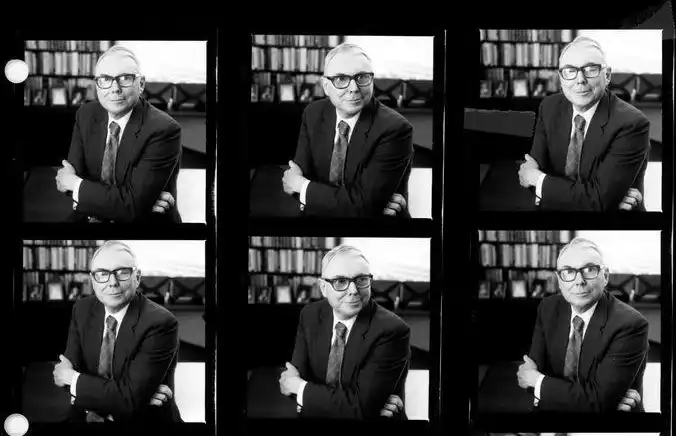
In 1975, shortly before joining Berkshire as vice chairman, Munger closed his partnership. Over its 14-year history, his investment portfolio grew by an average of 19.8% per year; the S&P 500 grew by only 5.2%.
Over the long term, these two individuals' investment approaches have differed. Buffett, influenced by his mentor Benjamin Graham, would almost buy any company, even distressed, as long as it was cheap enough.
Berkshire Hathaway is one of the fruits of the 'cigar-butt' investment idea. When Buffett acquired the company in 1965, it was a rundown textile manufacturer.
As Buffett transformed Berkshire Hathaway into a diversified holding company encompassing insurance, he continued to look for cheap mediocre businesses. In contrast, Munger focused on sizable businesses at acceptable prices, believing their future cash generation capacity would offset the premium paid upfront.
After years of discussion, Munger persuaded his partner to make a change.
In 1988, Buffett said, "Charlie has taught me a great deal. How much more successful I would have been if I had only listened to him.?"
In 2015, Buffett wrote that Munger taught him, "Forget what you know about buying fair businesses at wonderful prices; instead, buy wonderful businesses at fair prices."

Buffett added that Berkshire "has been built to Charlie's blueprint."
Early Life
Charles Thomas Munger was born on New Year's Day in 1924 in Omaha, Nebraska. His mother, Florence, was a homemaker and avid reader.
Munger majored in mathematics at the University of Michigan and left school during World War II to join the U.S. Army Air Corps. He was first sent to the University of New Mexico and Caltech to study thermodynamics and meteorology, then stationed at an airbase in Nome, Alaska, where he served as a weather forecaster.
After the war, Munger convinced a dean at Harvard Law School to admit him without an undergraduate degree, and he graduated with honors.
Before settling in Southern California, he considered joining his father's practice in Omaha. He and several partners eventually established their own law firm in 1962. Today, the firm, named Munger, Tolles & Olson, has approximately 200 lawyers.
His first marriage to Nancy Huggins ended in divorce. In 1956, Munger married his second wife, Nancy Barry Borthwick, who passed away in 2010. They had four children, two from Munger's previous marriage.
Munger's life also witnessed great sorrow: in 1955, his 9-year-old son Teddy died of leukemia.
Munger recalled walking the streets of Pasadena in despair: "I was losing a child inch by inch." More than sixty years later, the pain of losing his son still brings tears to his eyes.
In 1978, a surgeon's error during a cataract surgery left Munger blind in one eye, requiring surgical removal. However, he did not blame the doctor, noting that 5% of such surgeries result in complications. To him, as always, the numbers mattered most.
Munger taught himself Braille, only to discover that his eyesight was still good enough to read.
In his early 90s, he was still driving himself, which often surprised friends and family.
The operators of Berkshire Hathaway met in 1959 when Munger had moved to Los Angeles to attend a dinner in his hometown, which Buffett also attended.
They already knew each other by name: Munger had worked at a grocery store owned by Buffett's grandfather when he was young. One of the first investors in Buffett's partnership gave him money because he said, "You remind me of Charlie Munger."
Buffett's first wife, Susan, recalled that dinner in 1998, saying, "I think Warren thought Charlie was the smartest person he'd ever met, and Charlie thought Warren was the smartest person he'd ever met."
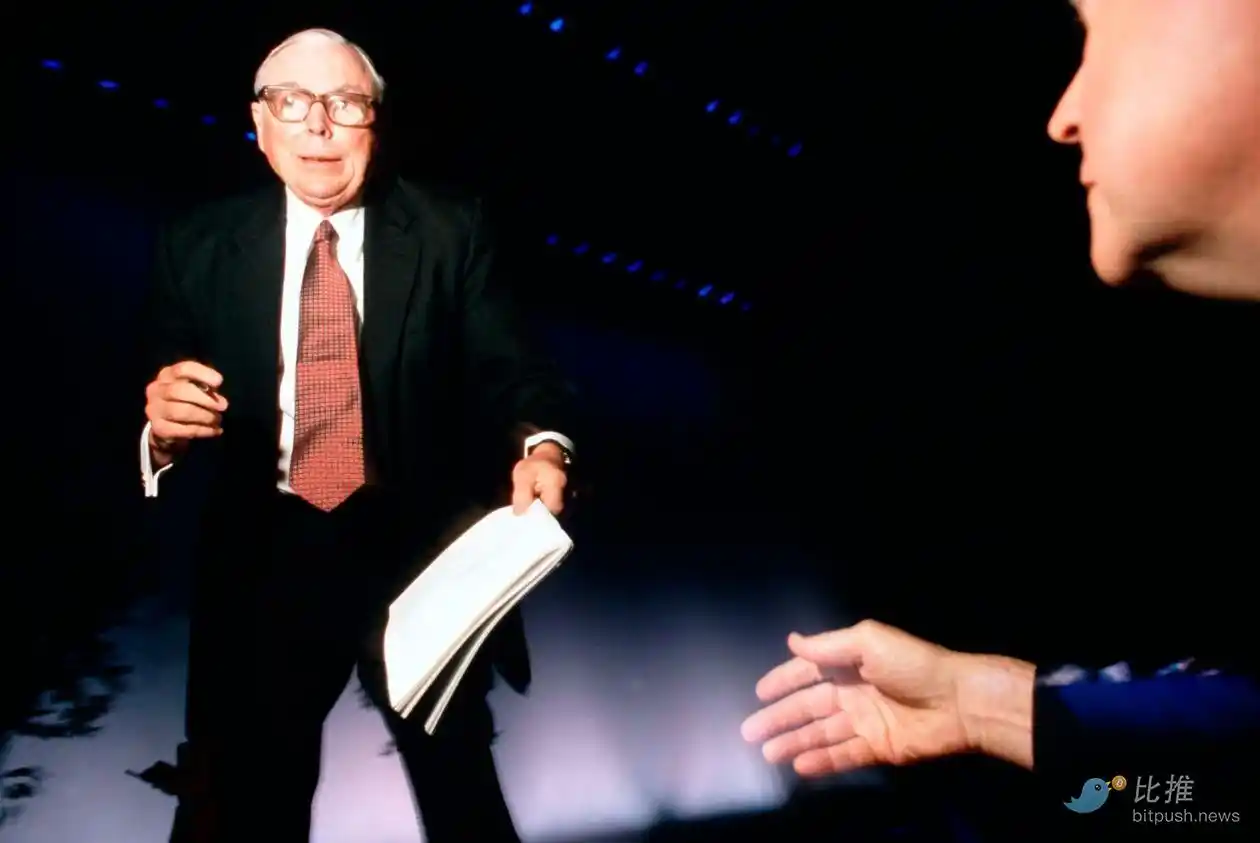
They hit it off, soon becoming inseparable and often talking several times a day.
A photo from a trip to Savannah, Georgia, in the 1980s captured the astonishing resemblance of the two investors: speaking and walking in sync, both wearing khaki pants and open-collared blue dress shirts. From height to hairline, from eyeglass frames to folds in their clothes, everything seemed to match.
The Humorous Investing Shark
Munger's hero was Benjamin Franklin, admiring his curiosity, originality, and wisdom. Munger's own common sense, sharp wit, outspokenness, and disdain for conventional wisdom have made him a legend among investors.
During the Q&A session at the Berkshire annual meeting, while Buffett expounded at length, Munger would often remain silent. Those familiar with him knew Munger was about to display his humor.
At the 2000 Berkshire meeting, a shareholder asked how speculation in internet stocks would affect the economy, and Buffett gave a nearly 550-word answer.
Munger, however, summed it up in one sentence: "Even if you mix raisins with excrement, they are still excrement."
When a shareholder inquired about Berkshire's executive compensation setting at the 2004 meeting, Buffett talked for over five minutes, but Munger calmly said, "Well, I'd rather throw a snake in my shirt than hire a compensation consultant."
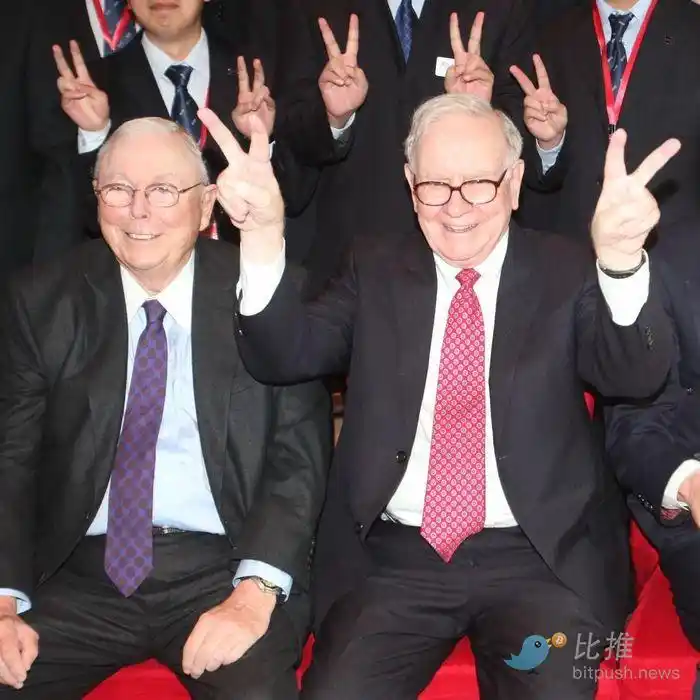
In 2023, at the age of 99, Munger penned a column for The Wall Street Journal urging the U.S. government to ban Bitcoin and other cryptocurrencies, calling cryptocurrency "a speculative contract of almost 100%." Previously, he had referred to Bitcoin as a "noxious poison" and "rat poison."
errorIn a speech in 2007, he said he liked diligence because "it means sitting down and doing it." He often said the key to successful investing is years, if not decades, of lying in wait for the right pitch and then "swinging at it with a positive and eager attitude."
He liked equanimity because it reflected his philosophy on investing and life. Munger often mentioned that every few decades the stock market will fall by 50%, and every investor should be able to handle it with composure.
Even in his nineties, Munger maintained his sense of humor, despite being nearly blind, unable to even walk, and his beloved wife Nancy having passed away years earlier.
Around 2016, a friend asked him, in his long life, who he was most grateful for. Without hesitation, Munger replied, "My second wife's first husband, for letting me love this woman for 60 years just because I was less bad than he was."
Original Article Link
Welcome to join the official BlockBeats community:
Telegram Subscription Group: https://t.me/theblockbeats
Telegram Discussion Group: https://t.me/BlockBeats_App
Official Twitter Account: https://twitter.com/BlockBeatsAsia

 Related Articles