Is the old public chain Neo rising again? Crazy rise in fuel token GAS attracts attention
The original title: "Weekly increase nearly tripled, interpreting the GAS token and the underlying mechanism of the NEO public chain"
Source: Odaily Star Daily
Editor's note: Recently, the token GAS has seen a significant increase in price, and community discussions have been frequent. The author of this article introduces the NeoN3 mechanism, explains the relationship between NEO and GAS, GAS distribution rules and token incentive mechanisms. The significant increase in GAS token price is also a reflection of the positive future development prospects of the Neo public chain.
Recently, the crazy surge of GAS token has sparked widespread discussion in the cryptocurrency community. In the past week, the price of GAS token has skyrocketed from 2.3 USDT to a high of 8.8 USDT, currently trading at 8.3 USDT, with a maximum increase of nearly three times. Although BTC has experienced a slight correction in the past two days, GAS has shown an independent trend and steadily risen.
Speaking of GAS tokens, it is impossible to avoid mentioning the underlying blockchain - Neo. The Neo blockchain was co-founded by Da Hongfei and Zhang Zhengwen in 2014, initially known as Antshares. It was later renamed Neo in 2017 and has been developing ever since. It has been hailed as the "Chinese Ethereum".
During the era when smart contracts were prevalent, Neo was highly sought after in the industry due to its unique dual-token mechanism. Although the new governance mechanism implemented during the NeoN3 migration in 2021 effectively revitalized the public chain, the development of its own ecosystem is still relatively slow.
The short-term rise is just superficial, and the prosperity of the ecosystem is the moat of the public chain. The recent frenzy of GAS tokens is closely related to the underlying mechanism and recent actions of the Neo public chain. Odaily Star Daily will explore the logic behind the rise of GAS tokens from these two aspects.
One, NeoN3 Mechanism, Injecting Vitality into Governance
One notable feature of the Neo public blockchain is its dual-token economic mechanism:
1. NEO tokens, as governance tokens, have a total supply of 100 million, with 50% allocated to early investors and 50% reserved for the development of the Neo public chain. The minimum unit of NEO tokens for governance voting is 1. NEO holders can participate in the management of the Neo network, including consensus node voting and network parameter modification.
2. GAS serves as the fuel token responsible for the operation of the public chain. There is no limit to the total amount, but there is a mechanism for destruction. The current circulation is about 101.2 million tokens, with 5 GAS tokens produced per block.
Early GAS token distribution plans were relatively simple, with GAS tokens being evenly distributed among NEO holders based on specific conditions (specific conditions being transferring NEO or voting).
At first glance, such a distribution plan seems very decentralized, but this distribution method can easily lead to governance apathy among NEO token holders. NEO's governance mechanism does not have an upward incentive. In other words, as long as I participate, I can get GAS tokens, and the governance process may not be important.
Neo team also migrated from NeoLegacy to NeoN3 in 2021 in order to solve this dilemma.
Neo N3 governance model consists of candidates, committee members, and consensus nodes. The committee is responsible for adjusting the mainnet parameters and maintaining the on-chain environment, while the consensus nodes are responsible for packaging transactions and generating blocks. Committee members and consensus nodes are selected from a certain number of candidates with the most votes. See the following diagram for the new governance mechanism.
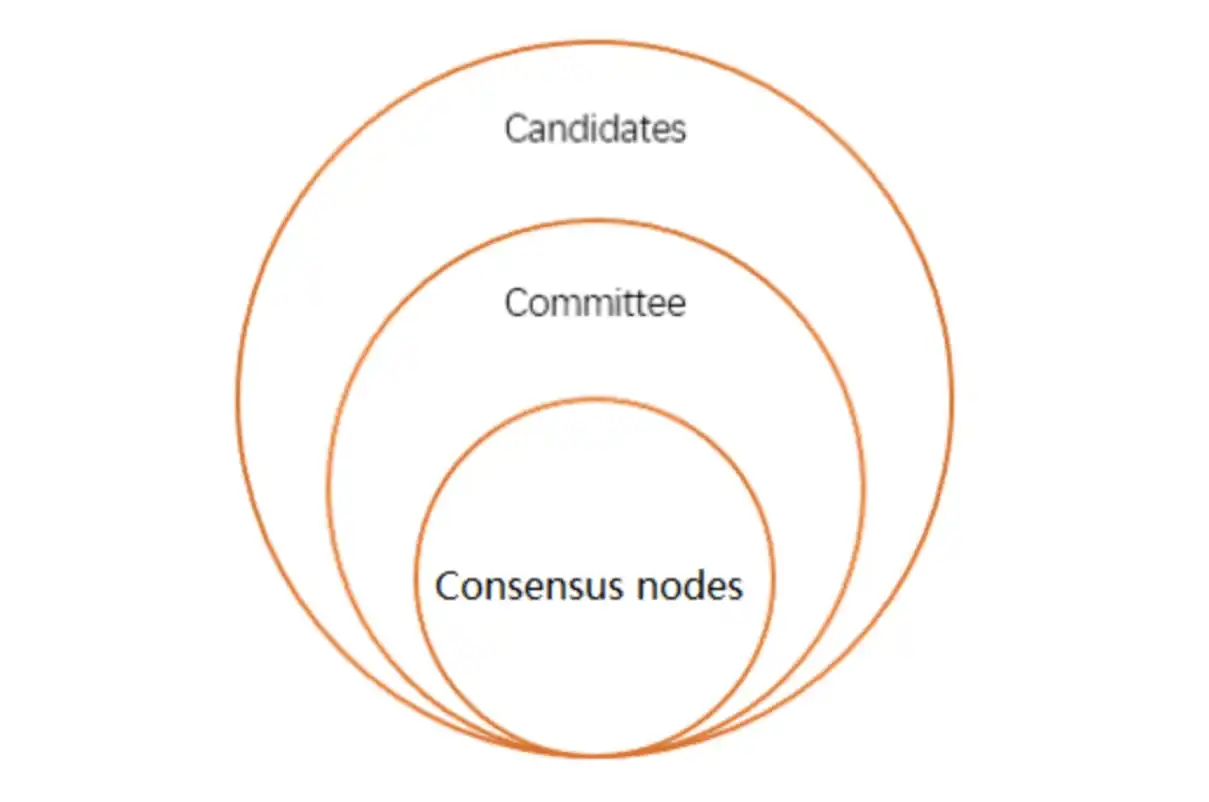
The function of NEO tokens remains unchanged, just like in the NeoLegacy phase. The distribution rules for GAS tokens are subdivided according to different functions, and GAS token incentives are provided accordingly:
1. NEO holders own 10% of the tokens. Similar to NeoLegacy, this portion of GAS tokens is not voluntarily distributed to NEO holders. It is calculated based on the holding period of NEO and distributed to the wallets of NEO holders after they complete transfers or votes.
2. Committee and consensus nodes 10%. Used to reward 21 committee members for their contributions to the management and governance of the Neo blockchain. Every 21 blocks (called an Epoch), the votes for committee members are recalculated and the incentive shares are redistributed accordingly. In addition, the speaker will receive the network fees for transactions included in the current block.
3. Voters account for 80% of the total. Most of the GAS tokens generated will be used to incentivize NEO holders to vote for committee members. Only those who successfully vote for elected committee members will receive this portion of the reward, which is calculated and distributed every Epoch (21 blocks). In other words, this portion of the reward is divided into 28 parts (21 for committee members and 7 for consensus nodes). NEO holders who vote for elected consensus nodes will receive 2/28 of this portion of the reward, while NEO holders who vote for elected non-consensus committee members will receive 1/28 of this portion of the reward.
Through the above GAS token distribution mechanism, NeoN3 will shift from a single governance mechanism to a highly incentivized model, forming a more effective governance structure while also providing upward incentives for NEO holders who participate in governance correctly.
二、推出兼容 EVM 侧链,加入 EVM 生态大本营
Translation:
2. Launching EVM-compatible sidechains and joining the EVM ecosystem
Previously, the relationship between GAS and NEO was explained from a fundamental perspective. Reasonable planning of the production and distribution of GAS tokens is the underlying logic for NEO to attract applications. However, the subsequent development of the NEO project relies on the construction of its ecosystem and the demand scenarios for GAS tokens.
Recently, the founder of Neo, Da Hongfei, announced a major initiative: Neo is creating a sidechain that can resist Miner Extractable Value (MEV) attacks and is compatible with the Ethereum Virtual Machine (EVM). The Neo sidechain will be released by the end of 2023.
Neo sidechains leverage the advantages of NeoN3, such as the dBFT consensus mechanism developed by Neo and NeoVM (the first non-EVM smart contract system).
At the same time, Neo's sidechain provides a solution to resist malicious MEV attacks, including innovative features such as transaction packaging and proxy contracts. Transaction packaging allows users to encrypt transaction content and metadata, effectively hiding sensitive information that potential attackers cannot access. Proxy contracts enhance privacy by hiding user identities, disguising the true sender of transactions, and introducing anonymity to prevent abuse.
The most important thing is to be compatible with the features of EVM, so that developers who are used to Solidity language can more easily migrate their projects to the Neo sidechain. Especially in today's public chains, Ethereum is the absolute core, and most applications are built using EVM.
This makes the Neo ecosystem more attractive, while the entry of projects into the Neo ecosystem will greatly consume GAS tokens, empowering the GAS token.
Three, the logic behind the crazy rise of GAS tokens
One of the important reasons for the recent rise in GAS tokens is the expectation of Neo's future development.
Another important reason is that the circulation of GAS token is relatively low, with only 101.2 million tokens and a market value of only $84 million (ranked 298), which is relatively low. Compared with governance token NEO, in terms of the functional mechanism of tokens, the supply and demand of GAS tokens are more prominent, while the demand side of NEO tokens is not obvious enough, which is also the dilemma of most governance tokens. They cannot be empowered.
Meanwhile, GAS token, as a functional token on the Neo blockchain, in addition to the fuel mechanism, the entry of ecological projects will also empower GAS token, thereby increasing its demand, while the supply side tends to be stable output, naturally increasing the possibility of GAS token's rise.
As a veteran project in the industry, Neo has gone through multiple bull and bear cycles and is still constantly seeking direction, a spirit that is admirable. However, the future development of Neo is still unclear. The most important aspect of a public chain is the construction of its ecosystem. While everyone is discussing L2 and even L3, can the ecological construction measures of a veteran public chain attract market attention?
Welcome to join the official BlockBeats community:
Telegram Subscription Group: https://t.me/theblockbeats
Telegram Discussion Group: https://t.me/BlockBeats_App
Official Twitter Account: https://twitter.com/BlockBeatsAsia