Interpretation of Vitalik’s latest article: Buterin draws us the future roadmap of Bitcoin
Editor's note: Bob Bodily is the CEO of bioniqMarket. In response to Vitalik's recent article, Bob Bodily offers a fresh interpretation, believing that although Vitalik's new article analyzes different types of L2 solutions on Ethereum, it also has crucial reference value for the Bitcoin network.
Source: "Vitalik just gave us the future roadmap for Bitcoin"
Author: @BobBodily
Translation: Sharon, BlockBeats
Vitalik recently published a new blog post about different types of L2 solutions on Ethereum. I believe this is closely related to Bitcoin. Below, I will explain in detail.
Differentiation between L2
Vitalik believes that we are gradually seeing the L2 solutions on Ethereum become more heterogeneous, which means that there is no single type of L2, but rather a series of L2 solutions with different trade-offs.
The trade-offs here can best be explained through the blockchain trilemma (proposed by Vitalik himself), which highlights the trade-offs between three key aspects of blockchain technology: security, scalability, and decentralization.
Some L2 solutions
Option 1: Slower speed, higher cost but more secure;
Plan 2: Faster speed, lower cost, but with more trust assumptions;
Plan Three: In the middle position in terms of speed, cost, and security.
Below I will give examples to illustrate:
In some cases, these L2 solutions are part of L1 and they choose to become L2 (for example, Polygon gradually transitioning from an Ethereum sidechain to Polygon 2.0 as an Ethereum L2 Rollup).
In other cases, they are fully centralized systems that hope to decentralize certain parts of their technology stack. There are also some gaming/social media platforms that hope to achieve decentralization, but may not necessarily require high security.
In each case, you want to make different trade-offs on the blockchain trilemma, which means you want different solutions (or L2 solutions) to accomplish different tasks.
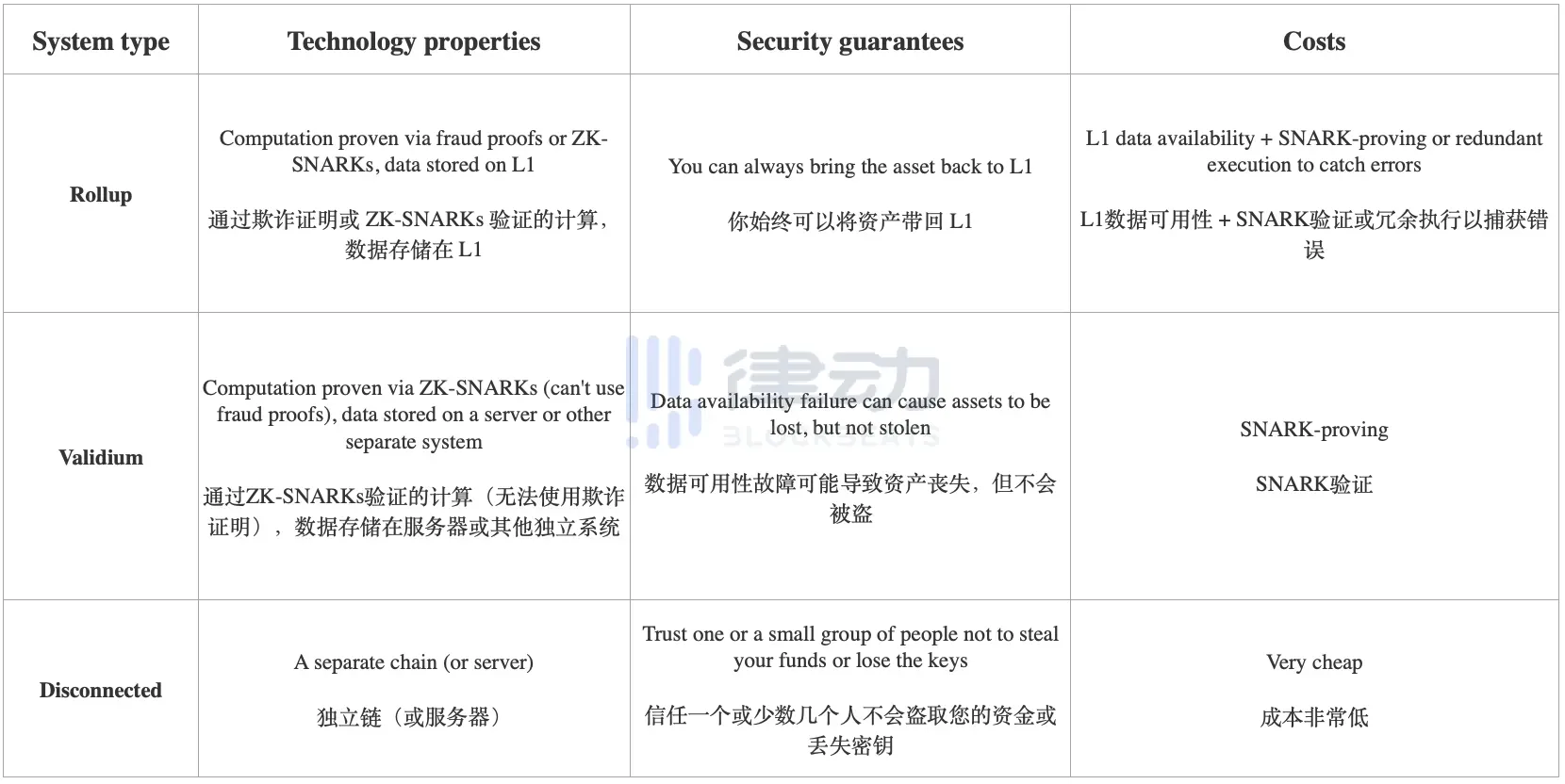
There are three L2 solutions (which are actually more like a gradient) mentioned by Vitalik in his article, including three main types of L2 solutions:
Option 1: Rollups;
Option 2: Validiums;
方案三:Disconnected systems。 Translation:
Solution Three: Disconnected systems.
Rollups
Rollups are the zero-knowledge proof Rollups that we know and love, because you can always bring assets back to L1 without trust.
Calculations are verified through fraud proof or validity proof, and all data is stored on L1. Currently, there are no ZK Rollups on Bitcoin because Bitcoin cannot verify validity proof. However, on Ethereum, many projects are working to achieve this.
These are usually quite expensive because you need to fully provide data availability on L1 and generate expensive proofs.
Validiums
Validiums are a type of downgrade solution compared to Rollups. In Validium, data is stored off-chain and only proofs are stored on L1. This means that Validiums are much cheaper than Rollups, but they add an additional trust assumption for off-chain data storage.
Under Validiums, if off-chain data is lost, your assets may also be lost (rather than stolen). In this model, the main cost is proof cost. You transfer data storage costs off-chain, but retain proof generation costs.
Disconnected systems
Disconnected L2 is essentially a sidechain. You have a completely independent blockchain or server, trust a certain multisig or group of people to protect your coins, and then enjoy all the benefits of the sidechain (faster transaction speed, lower cost, etc.).
L2 solution has gradient nature
It is important to note that Vitalik pointed out that L2 solutions are not discrete categories, but rather have a gradient nature. This means that an L2 solution may be exactly between Validiums and Rollups, or between Disconnected L2 solutions and Validiums.
Another important aspect of L2 solutions is their "connectivity" with L1. Vitalik breaks this down into two parts, and these properties also exist on a gradient range:
Part 1: Security of Ethereum Extraction;
Part Two: Reading the Security of Ethereum.

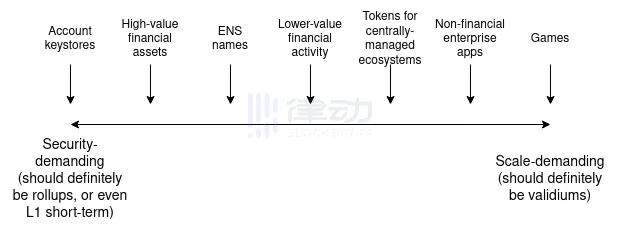
Finally, he discussed the security spectrum, with the left side requiring higher security and the right side requiring higher scalability.
Welcome to join the official BlockBeats community:
Telegram Subscription Group: https://t.me/theblockbeats
Telegram Discussion Group: https://t.me/BlockBeats_App
Official Twitter Account: https://twitter.com/BlockBeatsAsia