Modulus Labs: How does Variant’s investment infrastructure use ZK proofs to test AI?

Author: Luccy, BlockBeats
Editor: Jack, BlockBeats
BlockBeats News, on November 2nd, Modulus Labs, a project aimed at introducing cryptographic security into artificial intelligence, completed a $6.3 million seed round of financing with participation from Variant and 1Kx. The core concept of Modulus Labs is to use zero-knowledge proofs to provide verification for AI systems, ensuring that AI queries remain unchanged and unaltered. This paves the way for AI to be integrated into a wider range of Web3 applications.
"Artificial intelligence is changing the world," seems to have become a consensus. In just a few months, the AI language model ChatGPT developed by OpenAI has swept the world. The future where AI algorithms can diagnose cancer or conduct billions of dollars in transactions on the stock market no longer seems like science fiction.
Whenever we seek advice from artificial intelligence, queue up for the latest credit score, or refresh our chosen social media resources, big data pushes always bring us surprises. However, the computational cost of AI operations is too high to run directly on the chain. This means that to introduce AI functionality into smart contracts, we need to trust that AI operators can always run models without manipulation.
And in the context of cryptocurrency, trust is almost always a very bad idea. Modulus Labs, invested by Variant and 1Kx, introduced ZK proof technology into AI for the purpose of verifying artificial intelligence, namely zero-knowledge machine learning (zkML). So how does zkML achieve this? BlockBeats has collected existing information and organized it as follows.
Modulus Labs How to Integrate Encryption Security into Artificial Intelligence
Currently, we have not seen major new artificial intelligence applications in the blockchain field, because the threshold for deploying machine learning models on the chain is much higher than that for traditional software settings. The computational power of blockchain validation that affects user operations is crucial to its functionality. So far, artificial intelligence has not performed well in this regard, with most machine learning models running on opaque servers and black box algorithms adjusted by relatively unscrutinized operators.
In a trust-dominated world, existing machine learning mechanisms are difficult to meet verification requirements. As risks increase, people's motivation to research, influence, and even replace artificial intelligence algorithms with algorithms that better serve their interests is also increasing.
Modulus Labs is building a zero-knowledge proof-based trustless artificial intelligence to make the technology cheaper and easier to use for encryption protocols.
利用 ZK 检验 AI
Using ZK to Verify AI
Modulus Labs focuses on zero-knowledge machine learning (zkML) to verify artificial intelligence.
zkML refers to a machine learning model that can prove correctness whether the computation is performed in an open environment or a private centralized server. This means that artificial intelligence agents and machine learning models can now begin to serve as a natural extension of smart contract logic. Specifically, we believe that zkML can help unlock more advanced decentralized protocols by minimizing the need for human governance of complex dynamic functions.
Blockchains like Ethereum are slow and decentralized computers. The larger the program, the longer it takes for the blockchain to run it. To solve this problem, developers run the program off-chain or on private servers using succinct proofs. They then transfer the proofs onto the blockchain, and people only need to solve the proofs to verify if the code is executed correctly, instead of checking every line of the program.
Now, startups are pushing the use of zero-knowledge proofs for machine learning, which they call zkML.
In order to help achieve this vision, Modulus Labs will be launching multiple ZKML applications in the coming months, starting with a collaboration with NFT evaluation leader Upshot.
Upshot uses AI to provide accurate and timely NFT prices (evaluated over 100 million times per hour with a MAPE of 3-10%), which means there is an opportunity to open up new financial markets for long-tail assets. Modulus Labs aims to transmit Upshot's AI pricing onto the chain without compromising blockchain security. The result is a combination of AI superpowers and blockchain security that creates NFT prices, which is achieved through Modulus' ZK proof.
In addition, Modulus Labs has also partnered with AI Arena, a video game where AI warriors learn from human players. Humans pit the warriors against each other, with the winner receiving cryptocurrency. Due to the economic incentives, players need to trust that their opponents are not unfairly manipulating or influencing the warriors. To give users this confidence, Modulus Labs is developing custom zero-knowledge proofs to verify that the AI fighters trained by players are the same ones deployed in the matches.
Utilizing tamper-proof AI to enhance dAPP user experience
Modulus Labs believes that cryptography is the only tool responsible for algorithms.
In order to give dApps powerful AI capabilities, sometimes it is necessary to sacrifice decentralization security and take on centralized risks. Modulus Labs relies on ZK verification to bring artificial intelligence into the blockchain without giving up decentralization security.
When applied to artificial intelligence, zero-knowledge cryptography allows us to verify whether the AI model is "correctly" executed without revealing the secrets behind the model. In other words, Modulus Labs uses mathematics to check whether the results of artificial intelligence are secretly manipulated. By verifying this "proof of correctness" on the chain, we can achieve security comparable to that of blockchain at a small fraction of the cost.
Through zero-knowledge proofs, external observers can verify whether a company or developer has used the promised artificial intelligence algorithm. For example, OpenAI, the giant behind ChatGPT, can prove that its chatbot wrote a poem without revealing the algorithm's "weights" or what the AI model learned after being trained on a large amount of data.
Through cryptography's determinism, we can know whether the AI co-pilot provides code for secret tampering, whether credit scores are influenced by biased banks, and whether social media information is affected. Modulus Labs calls this "responsible AI".
Currently, Modulus Labs has opened the waiting list for "on-chain artificial intelligence" API. Users can apply to add anti-tampering AI to their dAPP.
Funding Status and Team
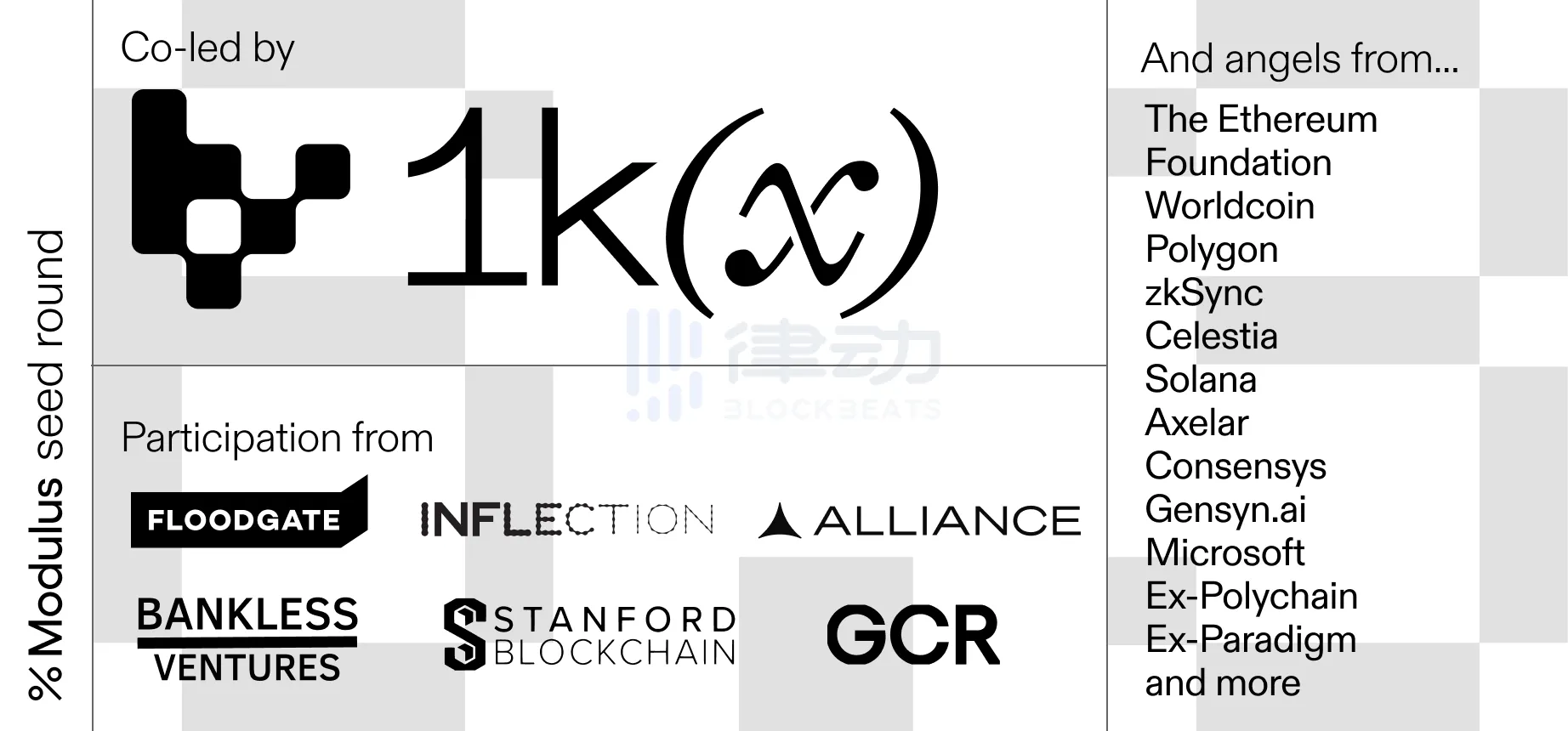
On November 2nd, Modulus Labs completed a $6.3 million seed round of financing, with participation from Variant and 1Kx. Angel investors included Ethereum Foundation, Worldcoin, Polygon, CelestiaSolana, Microsoft, Gensyn.ai, among others.
During an interview with Fortune magazine, Ali Yahya, a general partner at a16z, stated that "we are definitely interested in investing in this category because we believe it will be very important." However, he pointed out that as an investor, he is focused on the application of zkML in the field of cryptography, rather than other fields.
The protocol lead of Tools for Humanity, the company developing Worldcoin, Steven Smith, also said, "This is a huge research area for us and a very promising one." Worldcoin is a project founded by Sam Altman, the CEO of OpenAI, and is a prominent player in the emerging field. One of its developers has organized a Telegram group dedicated to the field, and its related foundation plans to provide funding to the zkML project and researchers.
Even small companies are paying attention to zkML. Tom Walton-Pocock, founder of deep tech venture capital firm Geometry, said, "At some point in the future - whether it's today, six months from now, or four months from now - it may be time for deep tech investors to take action early."
In August 2022, 23-year-old Daniel Shorr was scrolling through Twitter in a gray dorm room at Stanford University when he came across a post featuring a painting of a woman walking past a neon-lit storefront. The painting was created by Stable Diffusion, an artificial intelligence model that generates images from text prompts, inspired by "Nighttime in Los Angeles." The algorithm's artistic ability left Shorr with a "WTF moment."
Welcome to join the official BlockBeats community:
Telegram Subscription Group: https://t.me/theblockbeats
Telegram Discussion Group: https://t.me/BlockBeats_App
Official Twitter Account: https://twitter.com/BlockBeatsAsia