WalletConnect bans Russian users and blocks front-end IP as a new way of DeFi compliance?

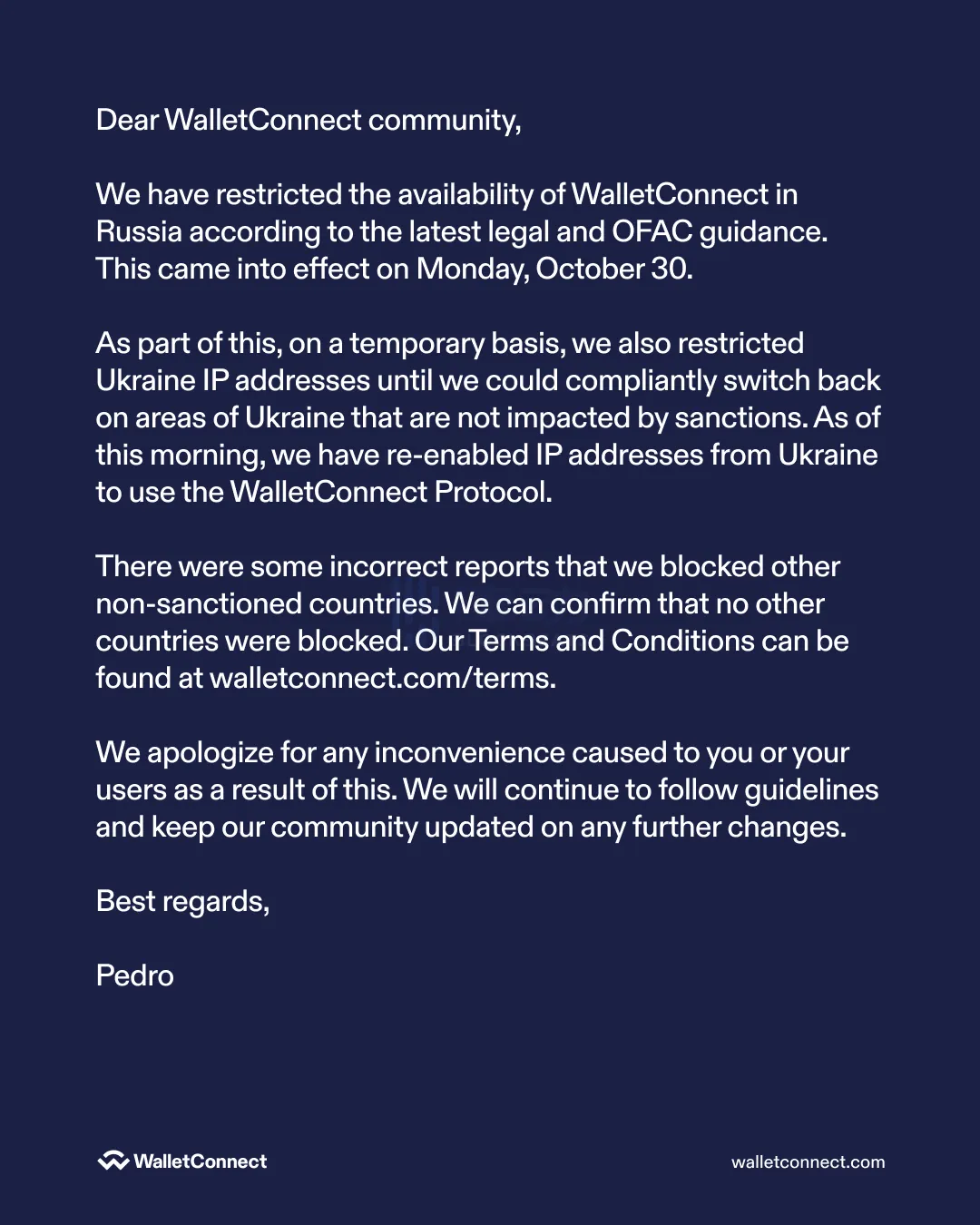
BlockBeats Reported on November 1st that WalletConnect, a Web3 communication protocol, announced that its availability in Russia has been restricted in accordance with the latest laws and guidelines from the US Department of the Treasury's Office of Foreign Assets Control (OFAC).
Multiple DeFi projects choose IP restrictions and other measures to avoid violations
BlockBeats Previously reported, on October 23, due to "compliance concerns" with the FCA regulations in the UK, Marinade Finance, a leading DeFi protocol in the Solana ecosystem, blocked UK users from accessing its website. The login page for UK users displayed a warning message and stated that "users can extract liquidity, apply for delayed bills, or delay unlocking pledges through our SDK." In addition, Orca Finance, a Solana ecosystem DEX, also added geoblocking for UK users.
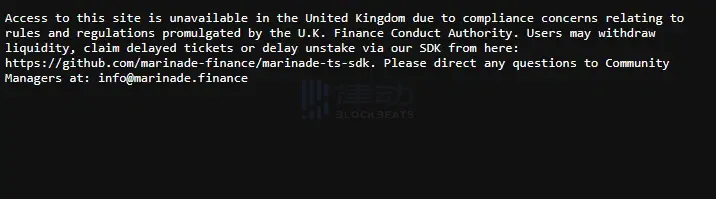
Although Marinade Finance has not yet made an official statement, the move to block UK users' access is closely related to the new regulations that the FCA aims to regulate the marketing of cryptocurrency-related products or services.
This is not the only case in the encryption industry where users are restricted due to their IP addresses. Earlier, modular blockchain network Celestia announced in September that US users were prohibited from receiving TIA token airdrops, while dApps such as 1inch had already imposed geographical restrictions on US users as early as 2021.
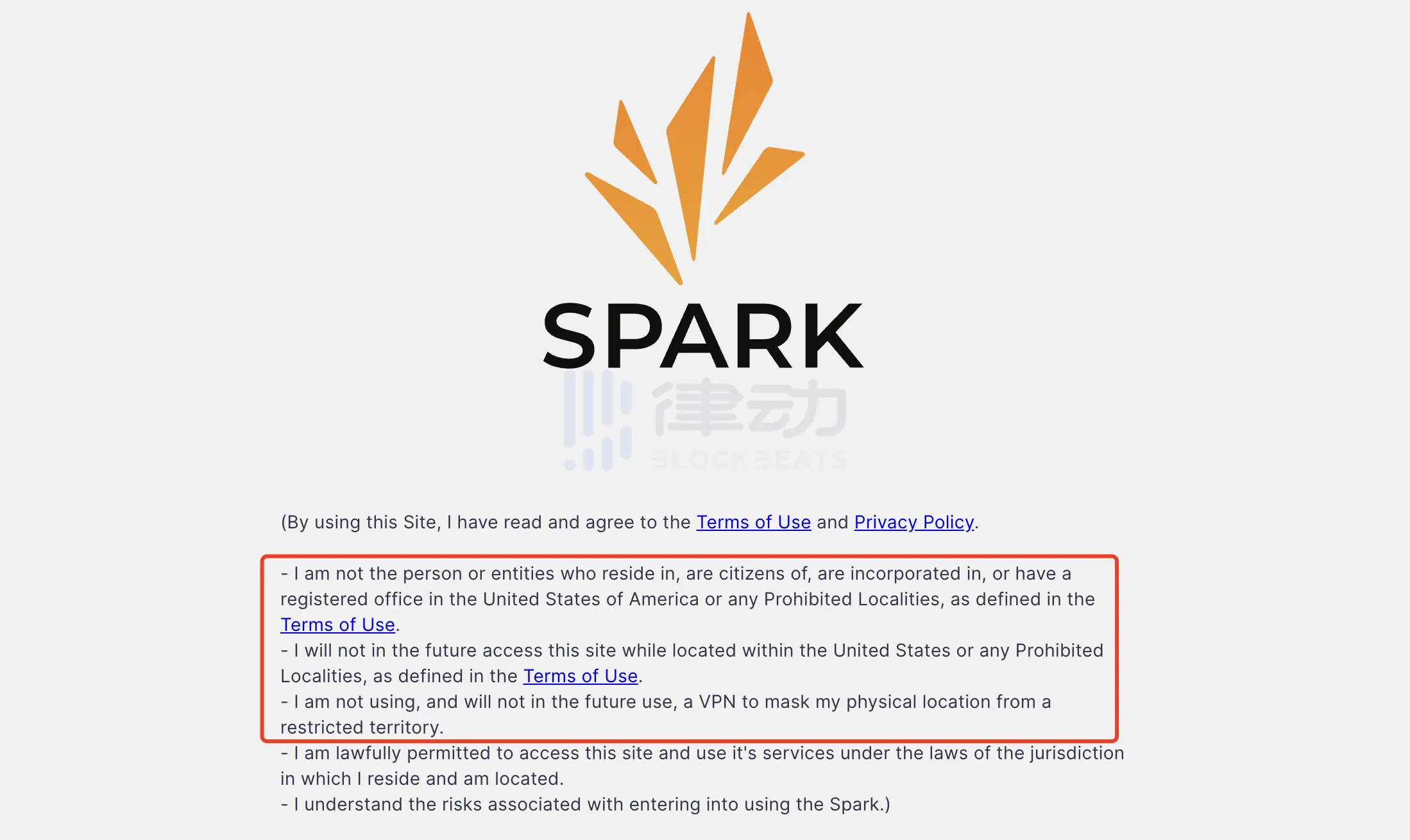
除了限制具体国家或地区的用户使用,还有可能连 VPN 使用也被禁止。5 月 9 日,去中心化稳定币协议 MakerDAO 宣布推出以 稳定币 DAI 为中心的 DeFi 借贷协议 Spark Protocol,但美国地区或 IP 地址不可用,其服务条款还禁止美国用户使用 VPN 来隐藏其美国居住地,其他非美国地区的用户使用 VPN 也被禁止。
Translation:In addition to restricting users from specific countries or regions, it is also possible to prohibit the use of VPN. On May 9th, MakerDAO, a decentralized stablecoin protocol, announced the launch of the Spark Protocol, a DeFi lending protocol centered around the stablecoin DAI. However, it is not available in the United States or for users with a US IP address, and its terms of service also prohibit US users from using VPN to hide their US residence. The use of VPN by users from other non-US regions is also prohibited.
In September, according to BlockBeats' report, after the US CFTC accused Opyn, Inc., ZeroEx, Inc., and Deridex, Inc. of violating the Commodity Exchange Act (CEA) and CFTC regulations, decentralized options platform Opyn restricted the use of its website by users in the United States. The accused violations include failure to register as a swap execution facility (SEF) or designated contract market (DCM), failure to register as a futures commission merchant (FCM), and failure to adopt a customer identification program.
Decentralization may only exist in the protocols of DeFi in the future, while the front-end of DeFi will choose to accept regulation in order to achieve compliant development.
How do governments plan to regulate DeFi?
The UK's new encryption regulations mentioned at the beginning of the article refer to the cryptocurrency marketing rules that came into effect on October 8th by the Financial Conduct Authority (FCA) in the UK. The regulations state that cryptocurrency services will be classified as a high-risk investment category for UK marketing materials from October 8th, and all platforms worldwide will need to display clear risk warnings to UK customers and have any public promotional activities approved by authorized companies. Failure to comply with the rules and continue to promote cryptographic assets to UK customers may constitute a criminal offense, punishable by unlimited fines and/or up to 2 years imprisonment.
This year, the UK's encryption policy regulation has continued to tighten, leading to multiple CEXs announcing the suspension of cryptocurrency trading services in the UK. Meanwhile, the regulation of the encryption field in the United States is also "in hot water", with every news item involving the SEC or CFTC attracting attention. The US's encryption regulation has always been merciless towards DeFi.
In the United States, various aspects of DeFi may be subject to regulation by multiple federal agencies, including the United States Securities and Exchange Commission (SEC), the Commodity Futures Trading Commission (CFTC), the Financial Crimes Enforcement Network (FinCEN), The Office of Foreign Assets Control of the US Department of the Treasury (OFAC), and the Internal Revenue Service (IRS).
These regulatory platforms' regulations are not limited to the DeFi field, so more and more cryptocurrency companies have compliance supervisors or positions specifically for policy departments.
Related reading: "Is the US launching a "whole-of-government" crackdown on the crypto industry, causing crypto resources to flee?"
"In preparation for cryptocurrency legislation, the US House Financial Services Committee has created a subcommittee for digital assets, marking the first time in congressional history that a dedicated organization has been established for digital assets. Secondly, there is strong hostility towards cryptocurrency among regulators in Washington, with a group of politicians turning the fight against cryptocurrency into a political correctness issue. This atmosphere has allowed regulatory pioneers like Gary Gensler, Chairman of the US Securities and Exchange Commission, to implement policies with ease."

Senator Elizabeth Warren wants to "build an anti-encryption army" in the United States.
Aside from the various countries that have enacted regulatory laws, the Financial Action Task Force (FATF) has also released new guidelines for Virtual Asset Service Providers (VASPs), with a focus on DeFi. FATF suggests that its members can combat DeFi without KYC and appropriate AML monitoring. On June 27th, FATF released a report urging countries to quickly implement FATF's recommendations on virtual assets and VASPs, including travel rules, and emphasizing the financial risks of DeFi and peer-to-peer transactions.
Perhaps you think that IP address blocking is too blunt, but because we are still exploring the path of compliance, projects such as Marinade Finance have set up "blocking" plans within their risk tolerance based on factors such as location, products and services provided, and the location of front-end users. In the traditional world with centralized regulation, decentralization of finance is not just a few words on a white paper, but requires step-by-step exploration of the compliance path in the world of encryption.
Abandoning Front-end for Protocols: Uniswap Explores Web3 as a "Startup Path"
DeFi leader Uniswap has also stumbled in terms of compliance, but it is indeed the leader in exploring the path of DeFi compliance.
Last week, Uniswap announced a 0.15% exchange fee for certain tokens in its web application and wallet. This decision has caused dissatisfaction among Uniswap token holders and sparked many speculations about the future development of Uniswap Labs in the community.
Cryptocurrency researcher Haotian (@tmel0211) stated that the Uniswap protocol and Uniswap labs are two different things. Uniswap is attempting to inform the Uni community that only the Uniswap protocol is decentralized, while the web and mobile terminals are owned by Uniswap Labs. Additional fees are expected to be the beginning of centralized measures, and KYC regulatory policies will also be inevitable on these channels, as no company can develop without compliance issues. The 0.15 fee was announced without a vote, which indicates that voting is only effective for changes to the Uniswap protocol itself."
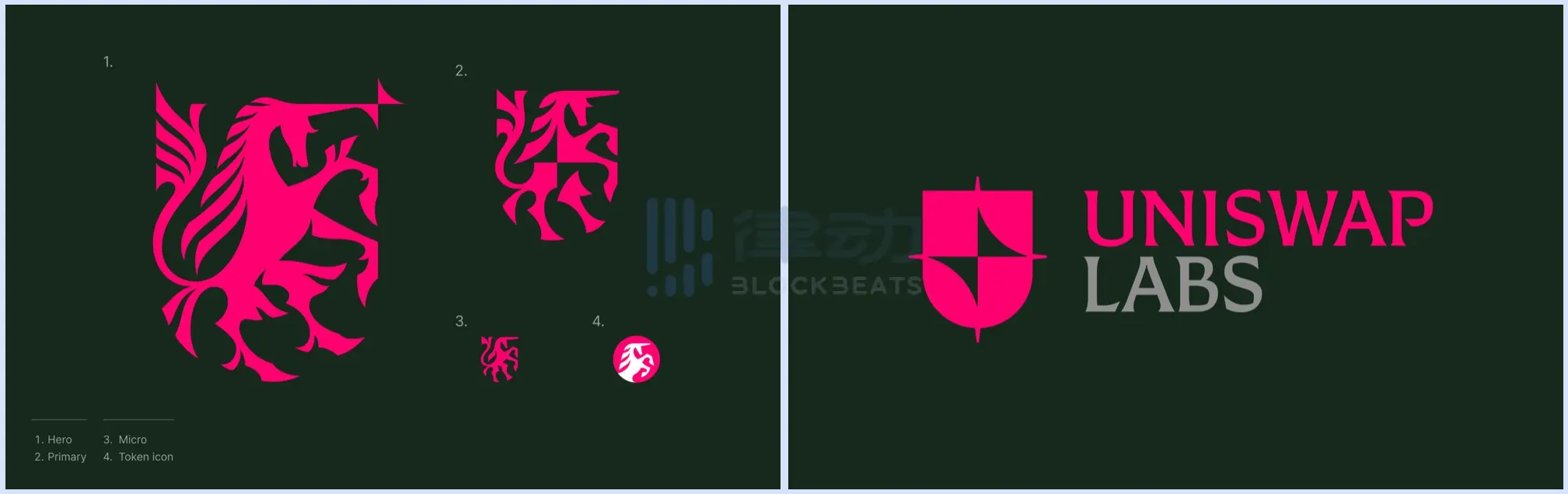
In 2021, Uniswap updated its logo. The left logo represents the Uniswap protocol, while the right logo represents Uniswap Labs. Image source is from Uniswap.org.
Front-end charging and open-source agreements have also brought new insights to how other DeFi projects can make profits and comply with regulations. Previously, BlockBeats conducted a comprehensive analysis of Uniswap, and Uniswap Labs has a clear idea in this regard - they want to take the path of separating the team (front-end) from the protocol.
Related reading: "Uniswap, the most successful US internet fintech company under the Web3 dividend".
"The Uniswap protocol is the largest decentralized trading and automated market-making protocol on Ethereum... The Uniswap Labs team is the main contributor to the Uniswap protocol and is now focused on building a suite of products to support the Uniswap ecosystem." This statement from the Uniswap official recruitment page indicates that the team's goal of separating from the protocol was already on the agenda from the beginning of the company's establishment.
One of the main objectives of the Uniswap protocol and team is to gain more flexibility and even advantages in terms of regulatory compliance.
Front-end compliance, open protocols may become the new norm for DeFi regulation?
WalletConnect's decision to ban the use of its services in Russia has left some members of the community puzzled. WalletConnect does not hold funds, manage payments, or issue transactions, but simply sends signed messages from point A to point B. Well-known KOL and CEHV partner Adam Cochran stated, "I can't find any OFAC order attempting to expand its applicability in this way, to the point where WalletConnect should even consider that they would be caught up in it."
However, in the context of the widespread enactment of sanction laws in the United States, OFAC's decision may apply to technology providers who may not even come into contact with any funds in their transactions.
Welcome to join the official BlockBeats community:
Telegram Subscription Group: https://t.me/theblockbeats
Telegram Discussion Group: https://t.me/BlockBeats_App
Official Twitter Account: https://twitter.com/BlockBeatsAsia

 Related Articles