Arthur Hayes: Turbulence from the fringes will become a new driver of Bitcoin prices

Original Title: "The Periphery"
Original Author: Arthur Hayes
Original Translation: Kaori, BlockBeats
(The following views are the author's personal opinions and should not be used as a basis for investment decisions, nor should they be considered as recommendations or suggestions for engaging in investment transactions.)
When it comes to war and the precious loss of life, my words may seem ironic and frivolous. The truth is, I believe soldiers around the world should be praised for their willingness to risk their lives to fight for fictional national concepts. I myself am not willing to do so, so I believe I have no right to vote to support any country's involvement in war. I strongly despise those politicians who sit on the throne of power and do not take risks to participate, but send good people to war. Most of these politicians have no family members serving directly in the military, nor have they served themselves. However, they are willing to send others to risk death for personal political and economic interests. War is not a video game, war is wasteful, war is terrible, war is deadly. So, to all these weak liars, F* YOU!
Life experiences are filled with a series of events that we cannot control. You did not choose where or to whom you were born. Life dealt you a hand, and your reaction defines who you are and your success or failure.
The response is more important than the incident itself. The United States responded to the "war on terror" as a response to the 9/11 attacks in 2001. Across three presidents and two political parties, the United States has waged wars in Iraq, Afghanistan, Syria, and many other undisclosed locations. After more than 20 years of waging a conceptual war without clear success metrics, what remains? Millions of people have lost their lives and nearly $10 trillion has been wasted. And what triggered this disproportionate response was an incident that resulted in the deaths of thousands of Americans and the destruction of several buildings, which have long since been repaired or rebuilt.
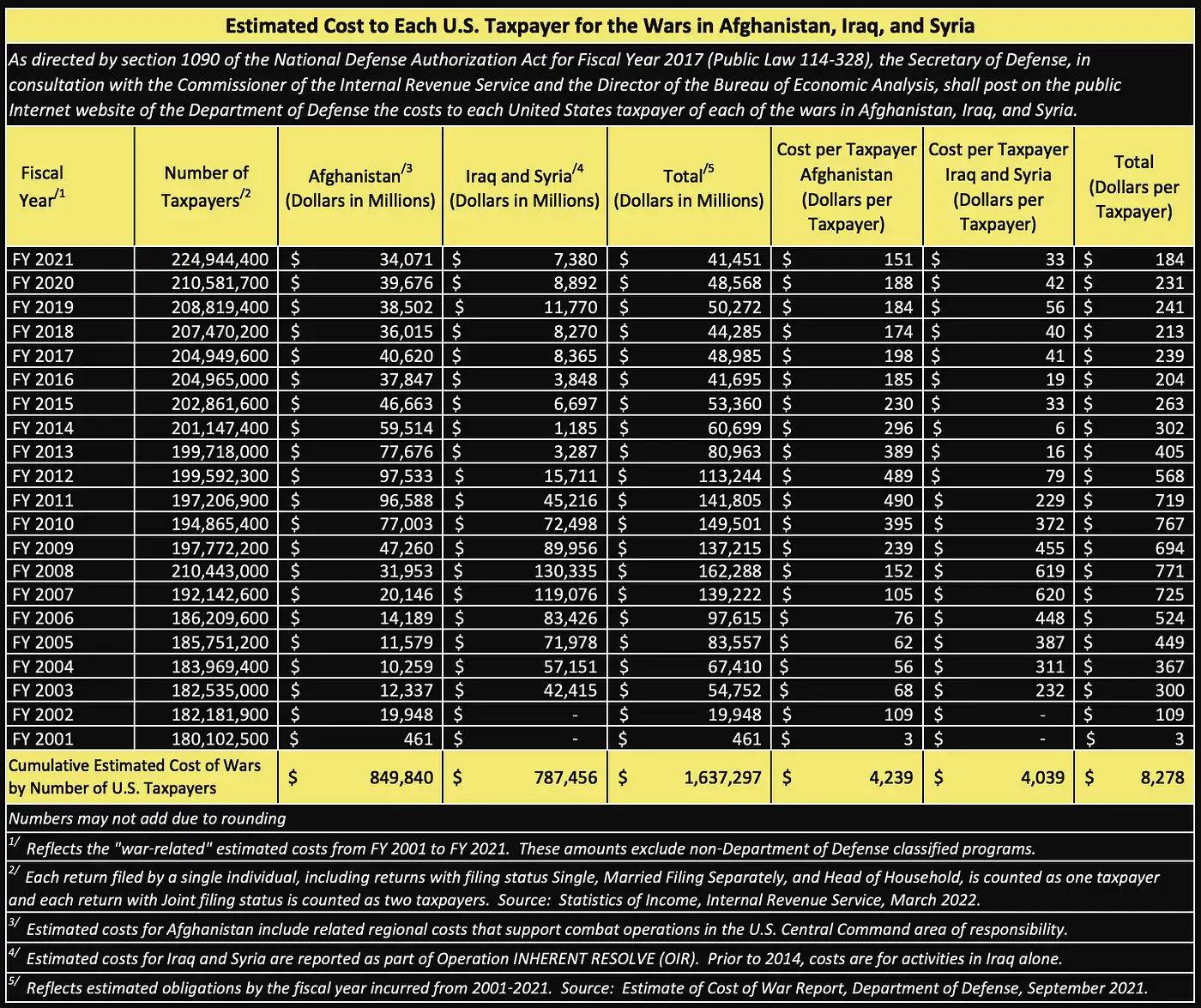
The decline of the empire was due to multiple threats that occurred simultaneously on the edge. The peace under the rule of the United States was not directly threatened by anything happening in the Gaza Strip. However, the pet of the peace under the rule of the United States, Israel, needs billions of dollars every year to protect itself in a hostile environment. For the aristocrats of American-style peace, this cost is worth it because it preserves the powerful image of the United States and establishes the Fifth Corps in the oil-rich Middle East.
A person cannot abandon any ally when needed - otherwise, your other allies will no longer pledge allegiance to the flag. This is how the United States was dragged into the Ukraine-Russia war and the current Hamas-Israel war. Therefore, "peace under the American rule" must be bankrupted to support its ally Israel.
"Make the empire go bankrupt? How could tens of billions of dollars possibly bankrupt the economic hegemon of the United States?" Some readers may ask.
I admit that bankruptcy is a heavy word - I will soften this statement and increase its debt cost to an unbearable level. Once the government is unable to bear the debt, the central bank must intervene and print money to provide funds for the government. This is when the fun of fixed supply financial assets such as gold and cryptocurrencies really begins. The long end of the US Treasury market has reasonably underestimated such a future: the United States will be forced to spend billions or even trillions of dollars through proxies not only in Ukraine, but now in Israel, and possibly in a wider Middle East region to launch wars. The last time the United States entered the Middle East, it cost 10 trillion US dollars; how much will it cost this time?
We won't go back to review the lessons of history and speculate on military strategy, but rather look at the market's reaction to recent events. What I find interesting is the US Treasury market's response to recent statements by members of the Federal Reserve Board and US President Biden. The financial instruments I am focusing on are 10-year and 30-year Treasury bonds, as well as the long-term US Treasury Exchange Traded Fund (ETF) TLT. Finally, I will compare the reactions of gold and bitcoin to fluctuations in American-style and risk-free reserve assets.
Task Completed
The Federal Reserve believes that it can combat inflation by raising policy rates (federal funds) and reducing the size of its balance sheet (primarily composed of US Treasuries and Mortgage-Backed Securities (MBS)), thereby increasing borrowing costs. When monetary conditions are sufficiently tight (a vague concept), they will stop raising rates. This is what Sir Powell has repeatedly stated in various press conferences and speeches.
During the news conference at the Federal Reserve's September meeting, Powell basically indicated that the Fed's rate hike action was very close to completion. Subsequently, several Fed officials spoke out in support of this view, stating that the rise in long-term interest rates (US Treasury yields>10 years) meant that the Fed no longer needed to raise interest rates, as the market was also limiting monetary conditions.
Minneapolis Fed President Neel Kashkari said on Tuesday that it is "possible" that further rate hikes may not be necessary. - Reuters, 10/11/23
The Federal Reserve's Logan: Rising yields may mean a reduced need for rate hikes - Bloomberg, 10/9/23 - Bloomberg, October 9, 2023.
The Federal Reserve's Daly said that rising bond yields may replace rate hikes - Bloomberg, 10/10/23 - Bloomberg, October 10, 2023.
The Federal Reserve has halted its tightening policy, causing a severe sell-off in the US Treasury market and leading to a surge in yields. A rare phenomenon in modern financial history has emerged: the dreaded "bear market rate hike." Bear market rate hikes refer to a situation where yields generally rise, with long-term yields rising more than short-term yields.
If the Federal Reserve does not intend to combat inflation through interest rate hikes, why should anyone hold long-term bonds? This seems counterintuitive, but please put down the TikTok videos and think with me.
The specter of inflation still haunts us. Manipulated US government inflation statistics show that the core consumer price index (CPI) is more than twice the Federal Reserve's 2% target. The Fed should continue to raise interest rates until there is an economic recession or a major financial services company goes bankrupt. Once either of these things happens, the Fed will cut interest rates because inflation will decline in a weak economic environment. The market is forward-looking. Therefore, during the interest rate hike cycle, as long as the Fed is committed to suppressing inflation through interest rate hikes, the yield curve will eventually invert (long-term interest rates will be lower than short-term interest rates) because long-term investors expect the future economic situation to be weak.
When an economic recession or financial crisis occurs, as the Federal Reserve actively lowers policy rates, short-term rates will quickly decline. This is the so-called "oh, no" moment. The yield curve will turn from inverted to upward (long-term rates higher than short-term rates), but in the case of an overall decline in yields, the curve will become steeper. This is called the "bull market accelerator" and is a typical trend in the yield curve in modern financial history.
Currently, the United States has not experienced an economic recession or financial disaster. For traditional financial supporters like Paul Krugman, regional bank crises do not count; they need to see companies like Bank of America go bankrupt to recognize the deep-seated corruption in the US banking system. Therefore, the market (i.e. those who are vigilant in the bond market) expects the Federal Reserve to continue to raise interest rates to combat inflation. However, the Federal Reserve has announced a pause in interest rate hikes, so the scenario of a bull market accelerating upward will not occur. So why do the vigilant ones continue to hold long-term bonds? They will not do so, but will express their views by selling long-term bonds on the margin.
2-year and 10-year yield spread (white), 2-year and 30-year yield spread (yellow).
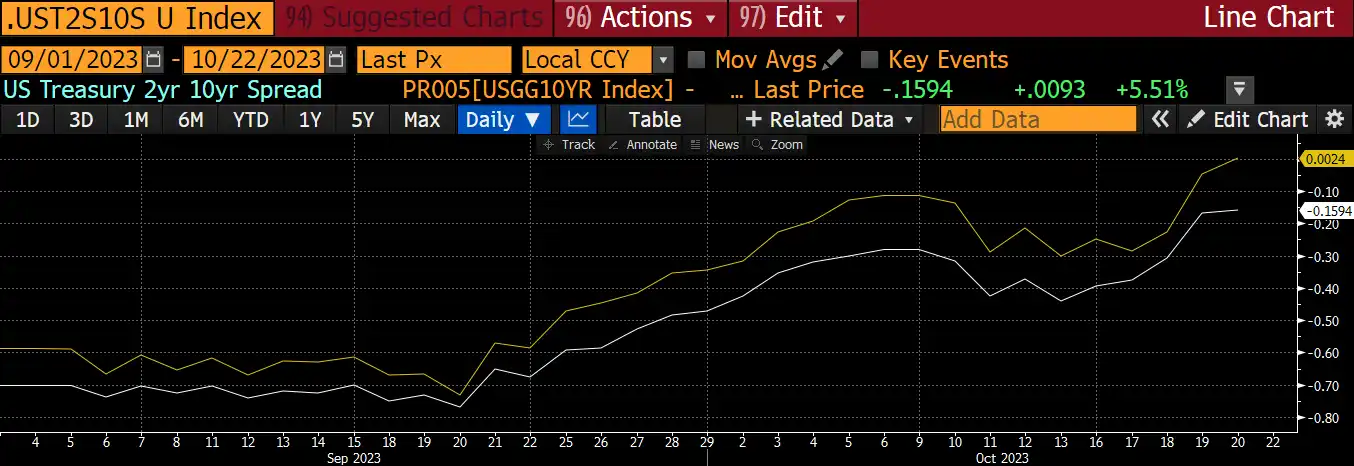
The Federal Reserve's September meeting ended on September 20th, and it was observed that the bear market accelerated its deterioration after the Fed announced a pause.
Except for the Federal Reserve failing to fulfill its responsibilities, people suddenly began to pay attention to the huge debt that the US Treasury Department must sell to fund the government's operations. This does not mean that this data was not known before - anyone can download the debt maturity and sales plan, which clearly shows the upcoming debt tsunami. However, after the Federal Reserve hinted at a possible pause, the market began to pay attention to this issue, as we can see from various comments by famous investors in mainstream financial media.
In recent weeks, opponents of the bond market have been challenging Yellen's policies by raising bond yields to levels that could trigger a debt crisis. In this situation, higher yields will crowd out the private sector, leading to credit tightening and economic recession. As the root cause of the problem is profligate fiscal policy, the government will have to cut spending and raise taxes to appease the opponents of the bond market, which will exacerbate the economic recession.
The Federal Reserve is too timid to raise interest rates, and the federal government's spending is even higher than Sam Bankman-Fried's consumption of ketamine, making the market nervous. But why is raising interest rates during a bear market so dangerous? Well, let me tell you.
Lions, tigers, and bears, oh my!
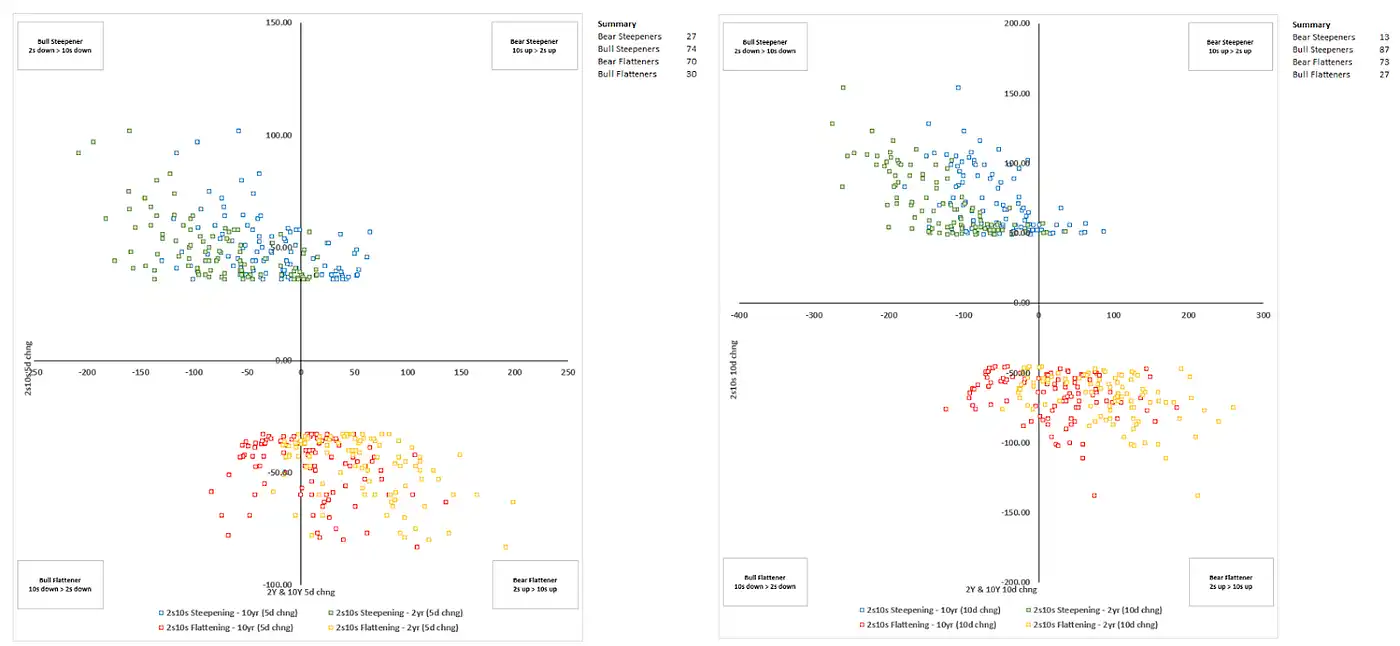
So, what is the solution? As interest rates rise, traders must short more and longer-term bonds. At this point, banks may fall into a deadly spiral of negative convexity.
Here is the fatal spiral of negative enthusiasm in the banking transaction department:
The bear market has intensified the situation of interest rate hikes.
The duration of the trading department has increased.
Due to the current net short position held by banks, the total loss of the bond investment portfolio has increased.
Repeat steps 2 to 4.
I used a simple example of a mortgage loan hedged with government bonds. I know that the hedging methods in the mortgage loan sector are not exactly like this, but using this simple example can give readers a general understanding.
In order to provide complete and accurate information to those who are familiar with the situation, I must quote my OG volatility fund manager David Dredge:
Under the record-breaking profit, the "too big to fail" banks around the world hide a ticking time bomb. I'm referring to banks like JPMorgan Chase, Goldman Sachs, BNP Paribas, and Nomura. They sold trillions of nominal amount of these products to desperate pension and insurance companies and will now find themselves suffering losses greater than those of Third Arrow Capital. To hedge and prevent losses, these banks must trade in the same way. The more they hedge, the more they lose. All of this is attributed to the bear market interest rate, which is directly caused by the policies of the Federal Reserve and global central banks. Let's talk about the "human snakes" in the traditional financial system.
The scale of the problem is invisible to global banking regulators. These products are traded bilaterally over-the-counter. Banks report some things and not others. Banks and their clients go to great lengths to legally hide risks. Banks want to take on more risk for bigger bonuses based on accounting profits. Clients don't want to admit they are insolvent. It's a deliberately ignorant, dirty swamp. As a result, no one knows at what interest rate everyone will go bankrupt or how big the losses might be. But rest assured, global citizens, when the financial system teeters on the brink of collapse, your central bank will print the necessary currency to save this dirty fiat monetary system.
We know that some unusual things are happening because the bond volatility and yield measured by the MOVE index are both rising. This tells me that selling is causing more selling in an index-like manner. This is what is causing the increase in volatility. Then, the market will suddenly erupt, seemingly unexpectedly, and the "corpse" of a systemically important traditional financial institution will surface.
MOVE Index (white) and the 2-year minus 10-year yield spread (yellow).
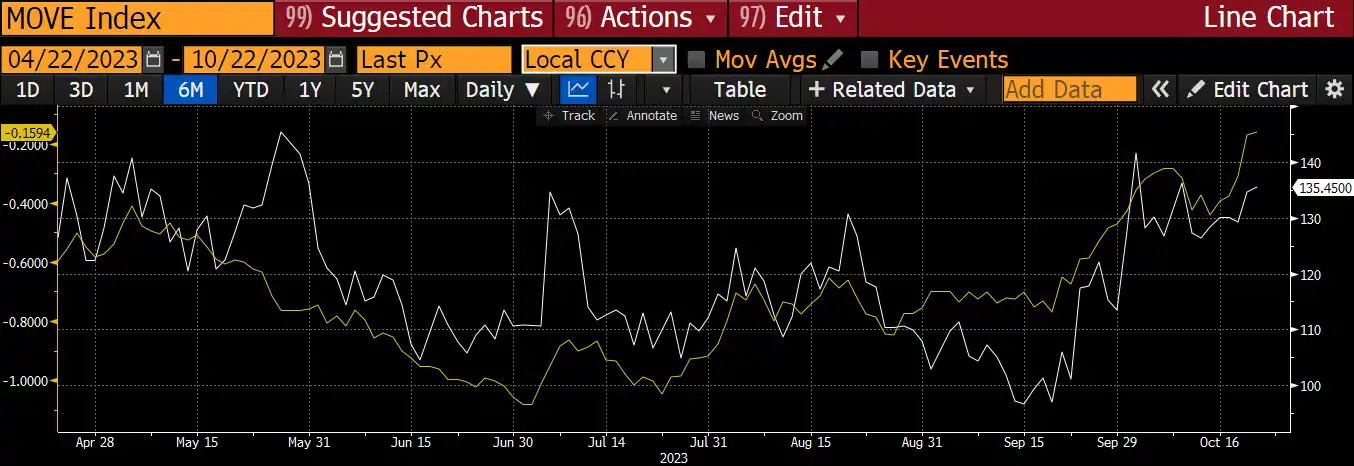
They seem highly correlated.
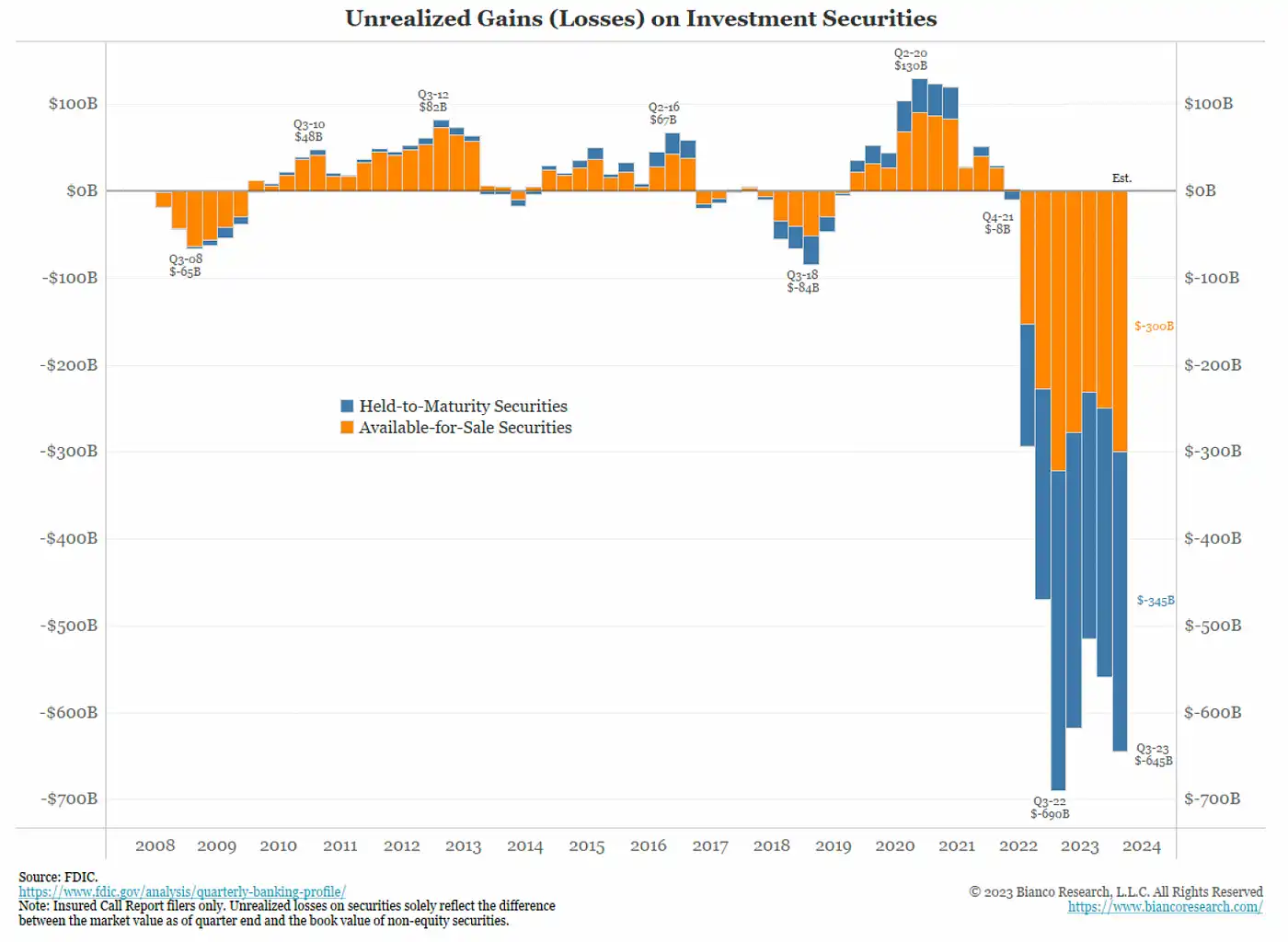
This article introduces the concept of bear market interest rates and how they impact banks, with the aim of explaining why long-term interest rates will rapidly rise in a self-reactive manner. It also highlights another issue faced by the Federal Reserve and the US Treasury.
Knee-jerk reflex
Does this make any sense?
The oil price may slowly rise as Saudi Arabia's Crown Prince Mohammed bin Salman (MBS) continues to cut production. There were rumors that MBS would increase production after normalizing relations between Saudi Arabia and Israel. However, this easing has now been put on hold as MBS needs to stand with Arab and Muslim brothers and sisters. More importantly, young Saudis strongly support Palestine. MBS has no choice but to fully support Palestine.
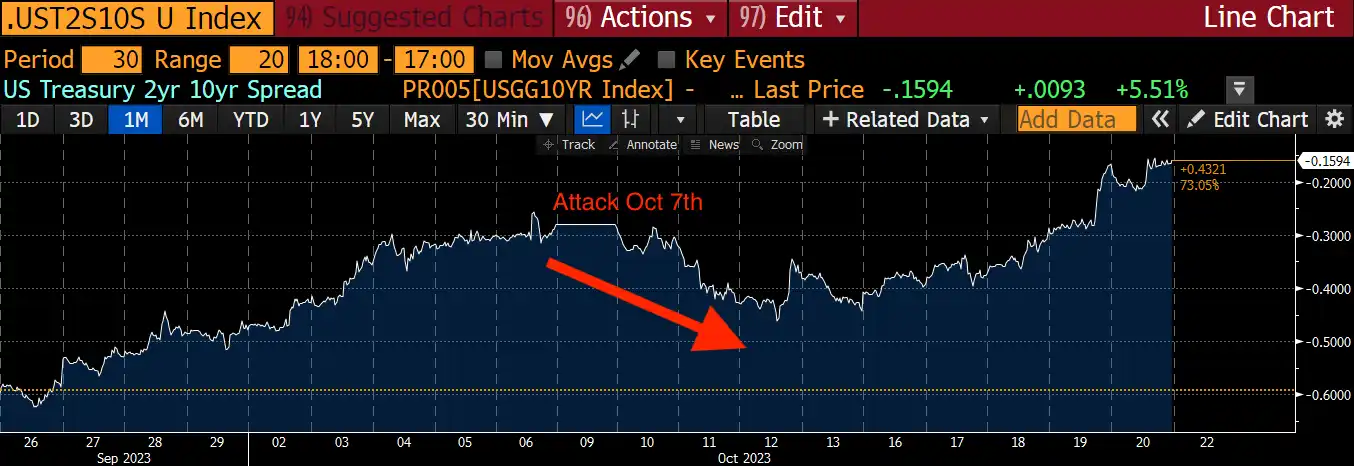
The market is once again filled with confidence, and investors are buying US Treasury bonds, especially long-term bonds. The yield curve between short-term and long-term bonds has become more negatively sloped in subsequent market movements, which clearly indicates this trend.
However, as things develop, it is clear that Israel will not pass this night quietly.
On the contrary, Israeli Prime Minister "Bibi" Netanyahu announced that the Israeli Defense Forces (IDF) will strongly retaliate against Hamas. He authorized the IDF to take decisive action to eradicate Hamas and declared that their actions will affect generations. Bibi is taking a tough stance.
Each Hamas terrorist has died.
– Bibi The Strong
All of this is well and good, but Israel is surrounded by Arab and Persian countries that believe that the Palestinians are suffering in a racially segregated state. If Israel retaliates too fiercely, these Arab countries will have to respond because they are concerned that their people will urge them to take measures to protect their religious and ethnic relatives, leading to domestic unrest. In addition, the refugee crisis that could be sparked by the migration of Palestinians to neighboring countries would also bring problems. Specifically, many other Arab countries do not want Hamas' ideology to challenge their rule, which is why they prefer Hamas to stay within Israel. The biggest problem is whether Iran and its proxies, Hezbollah, will engage in open conflict with Israel?
If Iran joins, does it mean that the United States will also join? Israel's aggressive foreign policy is based on unwavering support from the United States. What about Russia? If its ally Iran faces the United States, will Russia intervene through proxies? If Russia intervenes, how will China respond?
There are many questions without simple answers. How about US Treasury bonds?
As you know, I am a cynical person. I have repeatedly said that the most important thing in politics is re-election.
Israeli Prime Minister Benjamin Netanyahu is currently on trial for bribery, fraud, and breach of trust. The trial is ongoing. For a politician who is facing difficulties on all sides, the best hope is a war that will make fearful civilians support their leader at all costs.
The Hamas attack is terrible for those who have died and those who are still imprisoned, but it is helping Bibi restore his political reputation. Therefore, he must respond in the most positive way possible, assuring Israeli citizens - and perhaps those who judge him guilty or innocent - that he will ensure their safety, making him the best candidate for the job of eliminating Hamas and its ideology.
The United States can support Israel, but it also risks being drawn into a war with Iran and other Middle Eastern countries. For whatever reason, Iran has stated that its red line is the Israeli Defense Forces' ground invasion of the Gaza Strip. This is a flashpoint.
This is just two examples. As Israel continues to carry out airstrikes in parts of the Middle East, I believe there will be more similar situations that will "regress" the Middle East to the Old Testament era.
Biden can control this situation by telling Israel that US support is limited. The threat is that if Israel continues this behavior, the US will stop providing financial support. Seeing this, other US allies may reconsider whether it is worth following US advice. This is because many governments have marginalized minority groups that call for greater political voice or economic benefits. These minority groups are sometimes suppressed by force. Such use of force may embarrass the US, as it is considered a country that supports human rights. Without US support, coexisting with hostile neighbors will be even more difficult for many allies.
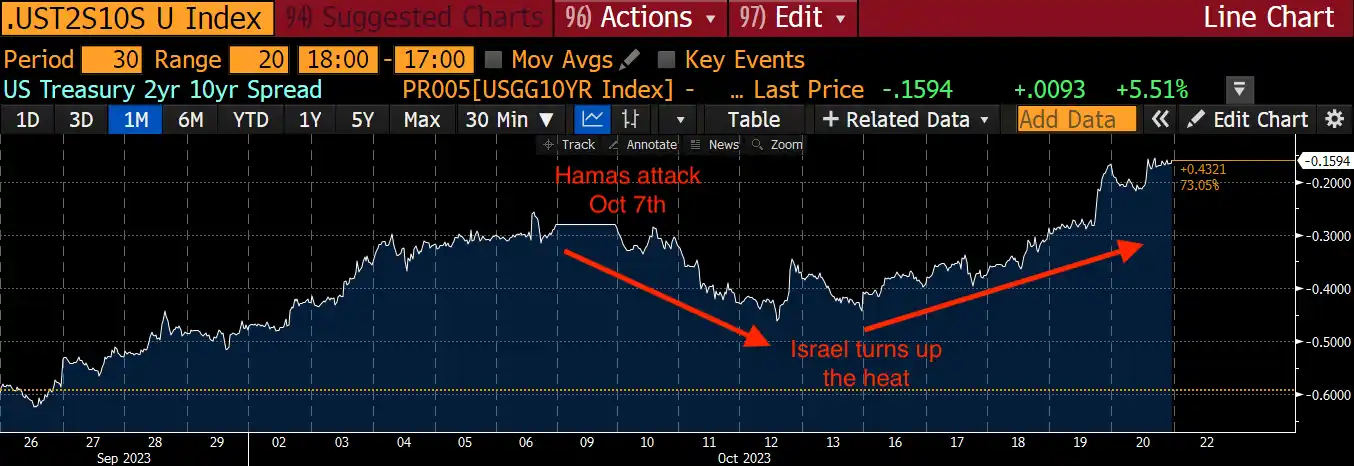
This is just the beginning of Biden's firm support for Israel promised by the United States. Biden basically stated that the United States will spare no effort to ensure that Israel obtains everything it needs to continue to fight against Hamas.
The United States definitely participated in this war. Now it's your turn, Iran?
If Iran intervenes, the support for Israel will reach trillions of dollars and will take less time than approving the Blackrock Bitcoin ETF. Never underestimate the bald white man in New York City!
100 billion US dollars for Ukraine and global humanitarian aid.
The reason why Ukraine needs assistance is because weapons are needed for President Zelensky and his group of temporarily conscripted soldiers to continue fighting. If the funding for the war is stopped, there will be no need for more humanitarian aid. If the US continues its current policy, Biden will continue to seek more funding from Congress, even though it may not be clear what that policy is in reality.
140 billion dollars will be used for border assistance to address drug smuggling and fentanyl issues.
Some people believe that the fentanyl crisis is a modern opium war launched on American soil. In the 19th century, China was forced to allow the British Empire to sell drugs on a large scale within its borders under the threat of military force. Many iconic buildings on the Bund in Shanghai and in Hong Kong were built by opium dealers such as Jardine Matheson, the Keswick family, and the Sassoon family. This was not illegal, as it was approved by the British Parliament. Wishing everyone happiness and good health!
Is it possible that some countries have not taken strict measures to crack down on the export of cheap fentanyl to the United States? Regardless of who is responsible, this is another attack on the edge of the United States, and there seems to be no end in sight.
I bet that if Taiwan elects a pro-independence presidential candidate in January 2024, China will become more aggressive in the Taiwan issue and wield its "military sword". I don't think China will attack Taiwan, but if China can force the United States to spend more money supporting Taiwan, it will weaken the empire's financial strength. This is the strategy that the United States used to weaken the Soviet Union, ultimately leading to its partial disintegration. It forces the enemy to constantly increase military spending out of fear, while eroding their domestic economy to an irreversible degree. For the Soviet Union, it was nuclear weapons; for China, it will be the expanding military aid from the United States to Taiwan and other Asian countries.
If you are an investor who holds US Treasury bonds for a long time, the most worrying thing is that the US government does not believe that its spending is excessive. This is what US Treasury Secretary Yellen said when asked if the US can afford two wars.
Grandma Yellen: Of course, the United States can afford to support Israel and meet Israel's military needs, and we can and must support Ukraine in its fight against Russia. The US economy has performed very well.
Well, next is the selling off of long-term US Treasury bonds in the market.
2-year and 30-year yield spread.

This is why bonds are being sold off and yields are rising.
Since Israel increased pressure on Gaza, the price of gold has risen. This indicates that the market is discounting the possibility of an escalation of the conflict if the US upgrades its support for Israel in the future, which could involve Iran. As investors do not want to hold bonds of a country involved in two endless wars, they are starting to invest their wealth in safe havens with no political bias, such as gold.
Bitcoin had a muted response at the start of the conflict between Hamas and Israel. However, as US Treasury yields rose and the bear market deepened, Bitcoin surged sharply, breaking through $30,000.
Both gold and Bitcoin have not yielded investment returns. Therefore, if they rise when US Treasury yields soar, this tells me that both of these safe-haven assets are discounting a future of more government spending and inflation.
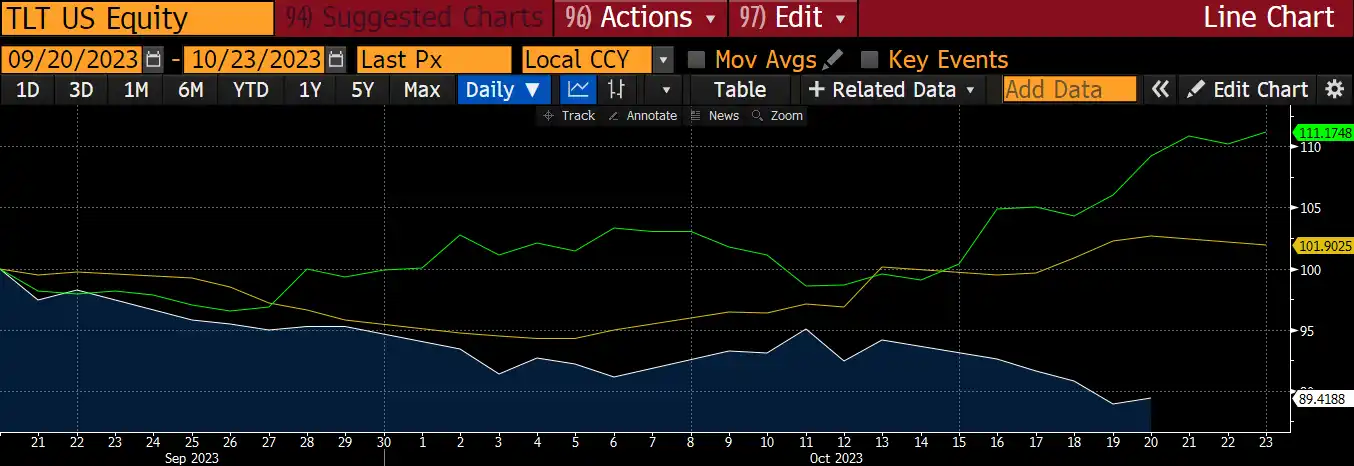
Since the Federal Reserve's meeting on September 20, 2023, long-term US Treasury bonds (i.e. TLT) have fallen by 11%, while Bitcoin has risen by 11% and gold has risen by 1%. The market is concerned about inflation, not economic growth, which is why Bitcoin and gold have risen along with long-term bond yields.
In this article, I mainly talked about the difficulties the United States is facing in both financial and moral aspects. But what if the world is plunged into proxy wars between the United States and Russia/China in various places? All major economies must increase the production of war materials to supply their allies. For example, due to increased rail traffic between North Korea and Russia, some speculate that North Korean leader Kim Jong-un is providing ammunition and weapons to Russia to continue the fight. Every dollar, ruble, or yuan spent on buying a bullet is a dollar, ruble, or yuan that is not used to produce the food and other materials we need.
Everything needs energy, and without inflation there would be no war.
If this is the new reality, I don't want to hold any country's bonds. This is all bad news. Gold and Bitcoin are starting to convey this message to us.
Fund Flow
The Federal Reserve has told us that interest rate hikes will continue until inflation is eliminated. As a direct result, US Treasury bond holders have begun selling long-term bonds. As a result, the yield curve has trended in a bearish manner, with yields rising on the 2-year vs. 10-year and 2-year vs. 30-year bonds. This has sparked a spontaneous action by global banks, which must sell more bonds in some way, leading to increased volatility as yields rise.
As Biden has stated, the United States will firmly support its allies and make an indefinite commitment to invest all necessary funds in military efforts to support Israel. With the addition of Ukraine's spending, the US military budget will truly skyrocket - especially if Hamas' allies, such as Iran, respond by intervening in the conflict through their proxies. This will increase future government borrowing, and the amount of capital that could be wasted in the war is infinite. Therefore, due to the expected expansion of future US spending on surrounding wars, bonds are being sold off and yields are rising.
The structural hedging needs of banks and the borrowing needs of the US war machine are reflected in each other in the US Treasury market.
If long-term US Treasury bonds no longer provide security to investors, their funds will seek alternative solutions. Gold, and more importantly Bitcoin, will begin to rise due to real concerns about global wartime inflation. So what should I do with my investment portfolio?
In an ideal scenario, I had hoped to wait for a financial crisis or a change in policy by the Federal Reserve to begin lowering interest rates. However, the market rarely gives you opportunities that perfectly align with your expectations. Biden is attempting to drag the United States into another conflict with no clear end in sight. Of course, the US Congress can say no, but there are few politicians with enough courage to oppose the military-industrial complex, and even fewer who will take a stance against supporting Israel. If Afghanistan has cost $8 trillion, how much money will be wasted in a war with real adversaries like Iran?
Bitcoin soared to over $30,000 due to false rumors that the US Securities and Exchange Commission had approved BlackRock's ETF for spot Bitcoin trading. When the cryptocurrency Twitter hinted that Cointelegraph (the source of the rumor) may have made a 100x leveraged long trade, spreading false rumors, and then dumping on the public, the price of Bitcoin quickly fell back to $27,000.
But now, after Biden's speech, Bitcoin and gold are rising against the backdrop of a sharp drop in long-term US Treasury bonds. This is not speculation about whether ETFs will be approved, but a discount on the very inflationary global war that Bitcoin may face in the future.
When the yield rises too high, the ultimate result will be the Federal Reserve ending the disguise of the US Treasury market as a free market. Instead, it will become its true form: a Petermikin village, where the Federal Reserve determines interest rates at politically convenient levels. Once everyone realizes the game we are playing, the bull market of Bitcoin and cryptocurrencies will be fully unleashed.
Welcome to join the official BlockBeats community:
Telegram Subscription Group: https://t.me/theblockbeats
Telegram Discussion Group: https://t.me/BlockBeats_App
Official Twitter Account: https://twitter.com/BlockBeatsAsia

 Related Articles