The paradigm shift of Bitcoin RWA, in a market with a scale far exceeding 9 billion US dollars, is currently underway.


Author: Sharon, BlockBeats
Editor: Jack, BlockBeats
With the approach of the fourth Bitcoin halving, a new paradigm shift has emerged in the Bitcoin and its computing power market.
On June 20th, HAG Holding Limited (HAG), a Bitcoin mining company, announced the official issuance of the world's first compliant digital security (STO) based on Bitcoin perpetual computing power, and provides monthly Bitcoin dividends to investors. On September 23rd, Lumerin, a decentralized computing power routing protocol, announced the launch of a decentralized Bitcoin computing power market on Arbitrum. On October 2nd, the Bitcoin RWA project, Merlin Protocol, announced the completion of testing on the testnet.
The stablecoin USDT issuer Tether is also actively expanding, announcing the launch of the Real World Ecosystem (RWE) and also vigorously developing Bitcoin mining operations.
Compared to traditional centralized Bitcoin mining companies (referred to as mining enterprises in the following text), Bitcoin hashrate and RWA may be becoming a new trend in the Bitcoin mining market for profit.
Centralized Mining Enterprises: Leveraging Bull Markets and Seeking a Way Out in Bear Markets
Since the comprehensive ban on Bitcoin mining activities in mainland China in June 2021, the Bitcoin computing power center has shifted from China to North America. In fact, the migration of this computing power center began as early as 2020, and by the end of 2021, its changes were visible to the naked eye. According to the Bitcoin mining map developed by the Cambridge Bitcoin Electricity Consumption Index, if the average monthly hash rate share is used as the standard, the global Bitcoin mining center was still in China in January 2021, but by December 2021, this center had already shifted to North America.
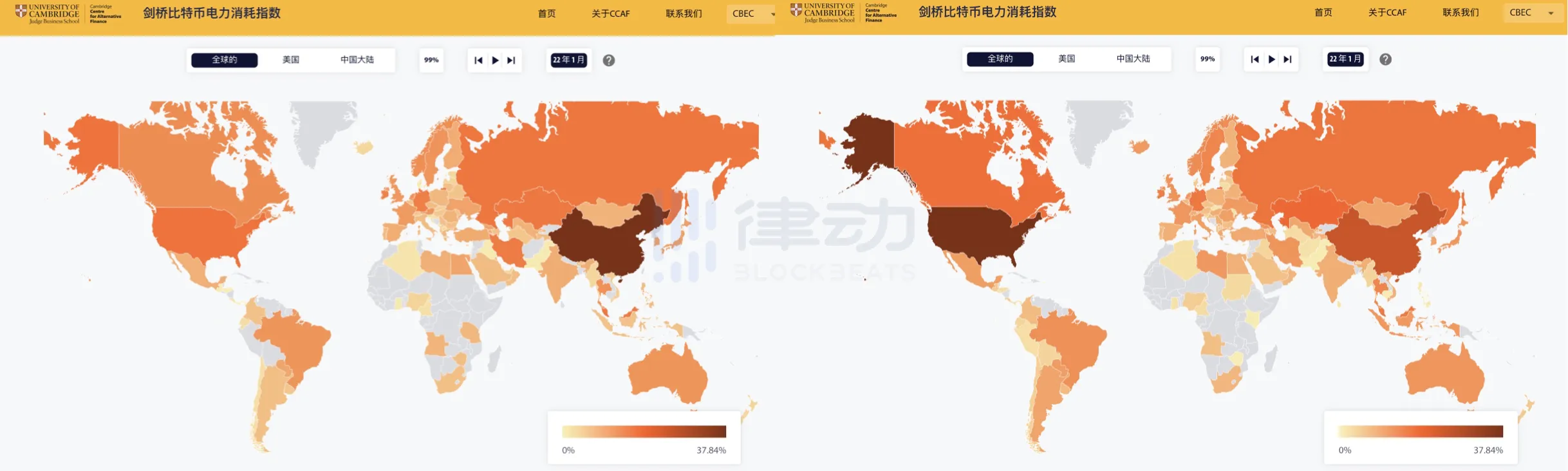
Left image: January 2021; Right image: December 2021. Image source: Cambridge Bitcoin Electricity Consumption Index
Behind this transformation is the continuous rise of mining companies in North America. Since 2020, leading North American mining companies such as Core Scientific (NASDAQ: CORZ), Riot Platform (NASDAQ: RIOT), Bitfarms (NASDAQ: BITF), and Iris Energy (NASDAQ: IREN) have been purchasing large quantities of mining machines and listing on North American stock exchanges, embarking on a path of compliant operations.
Bit Digital (NASDAQ: BTBT) went public in February 2020;
Bitfarms, Hut 8 (TSE: HUT), and HIVE Digital (CVE: HIVE) went public in June 2021;
Iris Energy went public in November 2021;
Core Scientific will go public in January 2022;
Riot Platform, formerly a biopharmaceutical company, took off after joining the mining wave.
These mining companies' main business is Bitcoin mining, so their development is highly correlated with the price of Bitcoin. During the bull market period from January 2021 to May 2022, their stock prices soared. According to Nasdaq data, compared to their initial public offering, the stock prices of Core Scientific, Bitfarms, Hut 8, and HIVE Digital rose by a maximum of 57%, 707%, 371%, and 228% respectively during the cryptocurrency market bull run.
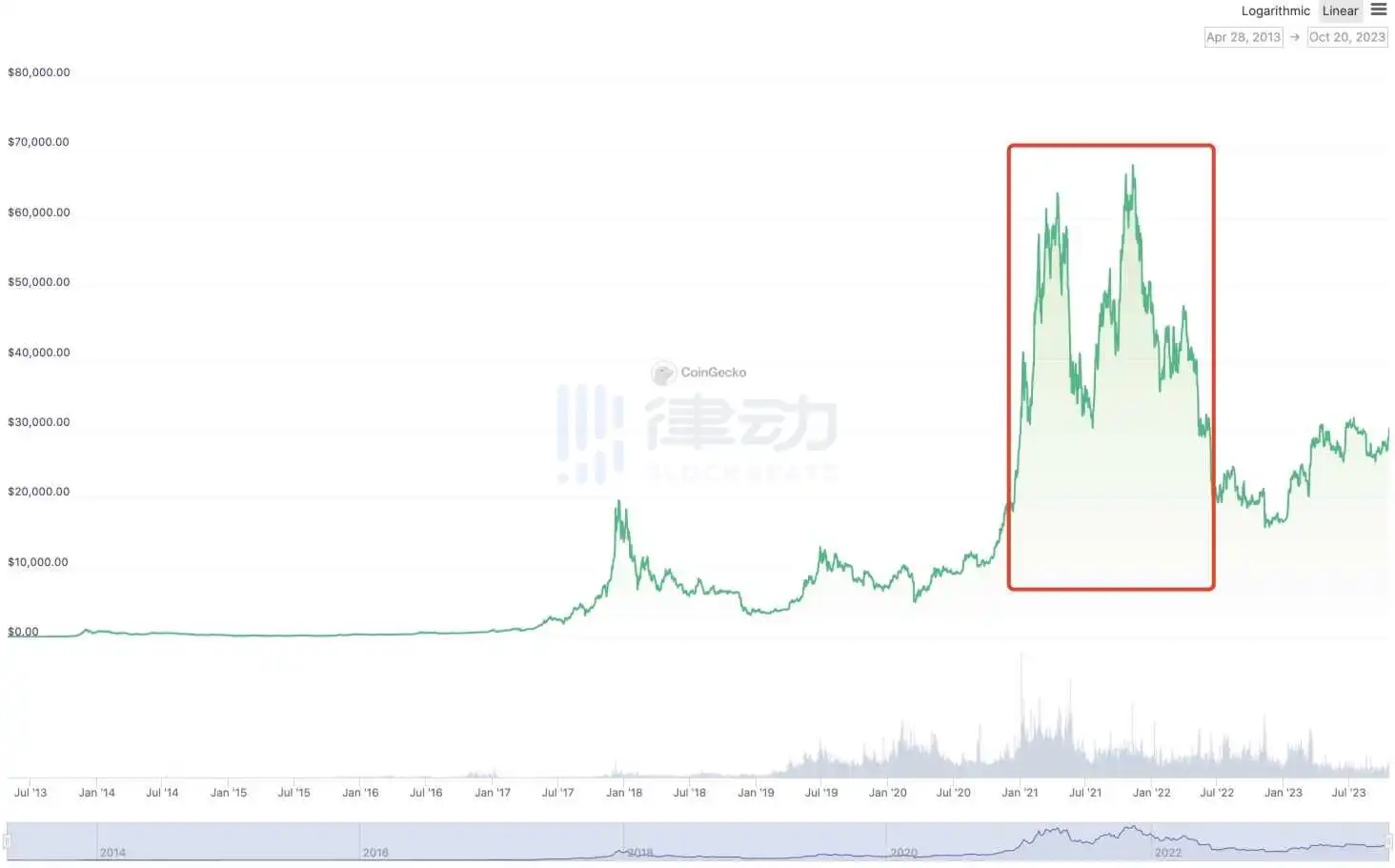
Bull market conditions from January 2021 to May 2022. Source: Coingecko
During this period, most mining companies achieved profitability through mining with computing power and financing through debt/equity. Taking Marathon Digital (MARA) as an example, its main business is self-operated Bitcoin mining. Its strategy is to purchase mining machines through financing and deploy them in mining farms. After paying for the production and operating costs in cash, it holds Bitcoin as a long-term investment. Data shows that in 2021, Marathon Digital spent $120 million to purchase 30,000 Antminer mining machines from Bitmain in one go, and also obtained a $100 million revolving credit line from Silvergate Bank. It plans to continue purchasing mining machines by raising $500 million in debt through the issuance of senior convertible notes, and has become the largest Bitcoin holder in North American mining companies at one point.
It's not just Bitmain, Core Scientific is even more exaggerated, operating over 200,000 Bitcoin mining machines in five states in the United States. In June 2022 alone, it produced more than 7,000 Bitcoins. In addition, Core Scientific has received a $54 million investment from Celsius and signed a $100 million equity investment agreement with investment bank B. Riley.
However, due to its highly leveraged business nature, the sudden bear market caught these mining companies off guard.
First up is Marathon Digital, which recorded a net loss of $686.7 million for the entire year of 2022; Riot Platform had a net loss of $509.6 million in 2022; Bitfarms had a net loss of $239 million in 2022; and Core Scientific had a net loss of over $1.7 billion in the first 9 months of 2022 alone, leading to the company being on the brink of bankruptcy by the end of 2022 (source).
According to a report from Hashrate Index, the collective debt of mainstream centralized mining companies will exceed $4 billion by the end of 2022. Core Scientific has the highest debt, owing creditors $1.3 billion as of September 30, 2022. Marathon Digital owes approximately $851 million, but most of it is in convertible notes. The third debtor is Greenidge Generation, owing $218 million.
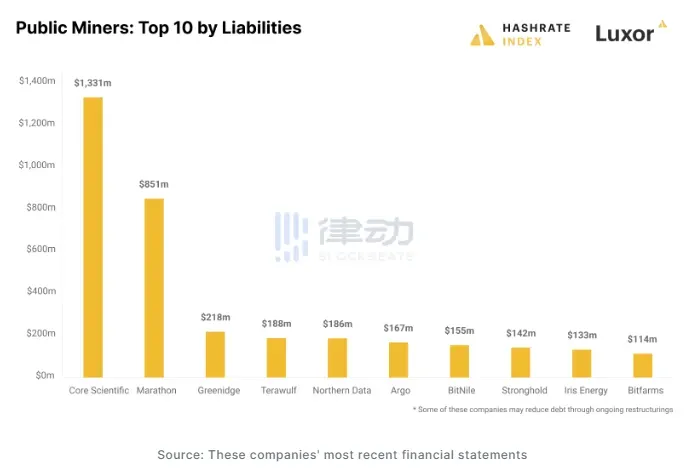
Source: Hashrate Index
Many institutions believe that the development of centralized mining enterprises is highly correlated with the price of Bitcoin. Therefore, the "business model of financing to purchase Bitcoin mining machines for mining" is a severe test of the company's cash flow management ability in a bear market and is also prone to the risk of insolvency.
Related reading: "Life and death speed under the Bitcoin mining industry winter: Marathon Digital Holdings (MARA) analysis and investment insights".
Many Bitcoin mining companies went into heavy debt during the bull market of 2021, which had a very negative impact on their profitability during the subsequent bear market.
The difference between the business models of buying mining machines to mine and hoard coins (Mara, Hut 8, Riot) and producing and selling mining machines (Cannan) is that the former has less research and development expenses but higher capital expenditures, and its income lacks resilience and can only rely on improving BTC mining efficiency and BTC appreciation to make profits. The debt ratio is relatively high and the leverage is large, so the revenue of mining-listed companies is more closely related to the price of Bitcoin, and the price fluctuations are more severe. At the same time, they face the potential threat of insolvency in a bear market.
Currently, Core Scientific is facing restructuring, Marathon Digital is struggling to survive by selling Bitcoin and private placements, Riot Platform is seeking strategic transformation through a name change (previously known as Riot Blockchain), and Iris Energy is seeking to transform into the generative AI market. Some centralized mining companies are looking for new ways out in the bear market, while others continue to advance their layout in the Bitcoin mining market, holding on in the dark before the dawn, waiting for the arrival of the bull market.
Outside of the narrative of the development of centralized mining enterprises, the value of Bitcoin itself is still highly regarded by the entire market. Therefore, even in the current bear market, new narratives are still emerging in the market.
Bitcoin RWA: Paradigm Shift of Decentralized Dividend
Centralized mining companies raise funds through listing on the US stock market, and investors buy their stocks to profit from the rise in stock prices. This also leads to the fact that during a bull market, mining company stock prices can soar, but during a bear market, they can continue to fall. Therefore, many people who hope to profit from mining and rising coin prices have turned to new paradigms outside of centralized mining companies - Bitcoin and its computing power RWA.
RWA (Real-World-Assets) refers to the assets in traditional markets that are mapped onto the blockchain in the form of tokens, allowing Web3 users to buy and sell them. It is also considered a gateway for traditional financial markets to enter the Web3 industry.
BlockBeats has learned that there are two new ways for Bitcoin RWA currently, one is anchored to Bitcoin computing power, and the other is anchored to Bitcoin price.
Anchor Computing Power: Mining Bonus Tokenization, Arbitrage Based on Mining Machine Price Fluctuations
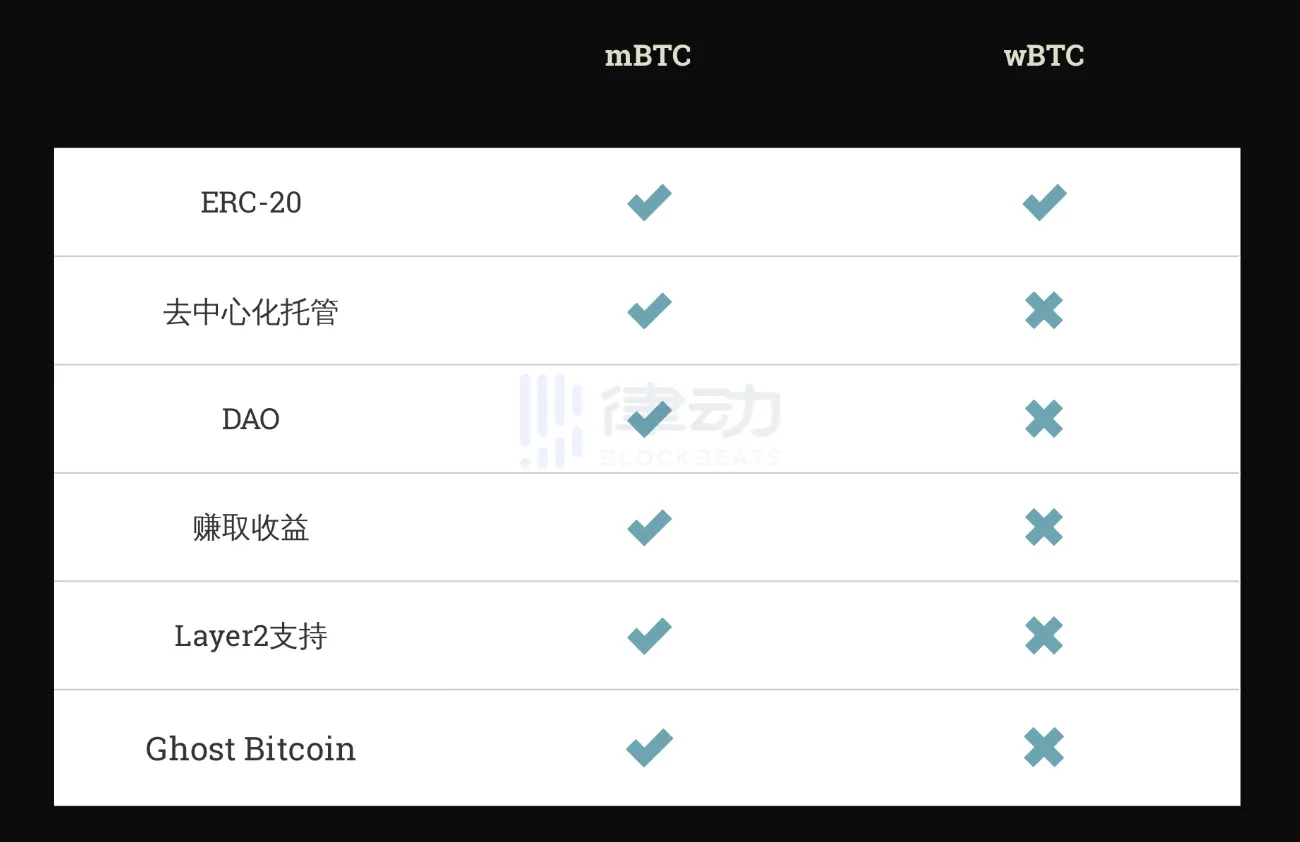
As the "world's first STO based on perpetual Bitcoin computing power issued in accordance with US securities laws", the core members of HAG Holding Limited come from Goldman Sachs, TSMC, SoftBank, and Bitmain. They issue STOs (security token offerings) in compliance with SEC regulations, and then bring Bitcoin computing power revenue into the Ethereum and DeFi world through a mechanism similar to "holding dividends".


On September 22nd, Paolo Ardoino, the Chief Technology Officer of Tether, announced on his social media platform that Tether's new global strategy will be fully implemented by 2024. According to his implication, the new global strategy may include investment and financing cooperation, AI, new energy Bitcoin mining, education, and global business expansion. In October, the CTO also announced that the "Real World Ecosystem (RWE)" of Tether will be launched soon.

In fact, as early as August 26th, Paolo posted on social media that Tether's Bitcoin mining farm in Latin America was planning to start operations in a few weeks. According to Bitcoin Magazine, Tether participated in the investment of a renewable energy power plant in El Salvador, which plans to build 169MW of photovoltaic solar energy and 72MW of wind energy, and also plans to build a Bitcoin mining farm in the park, as previously reported.
Tether has previously partnered with a licensed company in Uruguay to launch sustainable Bitcoin mining operations. A few months ago, they also launched the "Tether Energy" plan to build renewable energy production and Bitcoin mining facilities. Meanwhile, as of August 6th, Tether may have become the 11th largest Bitcoin holder in the world, with an estimated 55,022 Bitcoins worth $1.6 billion.
Launch RWE, invest in building Bitcoin mining farms, and hold a large amount of Bitcoin. All signs indicate that Tether may make a bigger layout in the Bitcoin RWA market.
Regardless of the layout of HAG, Merlin Protocol, Lumerin, or Tether, although their operating mechanisms and profit models are different, it can be seen as a whole that Bitcoin is becoming an important part of the RWA narrative. Many teams choose to enter the game at this time, and there are multiple reasons behind it.
Market size far exceeds 9 billion US dollars, the imagination space of Bitcoin RWA
In fact, it is not difficult to understand why choosing this time to enter the Bitcoin RWA market. On the one hand, during the bear market, the price of mining machines is at a low point in the market, and now entering the market can purchase a large number of mining machines at a relatively low price, with lower basic costs. On the other hand, as the RWA concept gradually heats up, a good underlying asset can help project parties achieve stable development and help investors profit at lower risks, and Bitcoin is recognized by most people in the cryptocurrency industry as a "good underlying asset".
More noteworthy is that the future potential and scale of this market may exceed the imagination of many people.
RWA Narrative Mainstreaming
Other than the increasing attention on the value of Bitcoin itself, the gradually popularized concept of RWA in recent years is also a major driving force behind the rise of Bitcoin RWA.
Related reading: "RWA Discussion: Underlying Assets, Business Structure, and Development Path"
The cryptocurrency market is not currently in a bull market, and there is a lack of sufficient narrative even in the native cryptocurrency market. RWA is one of the few tracks that has solid income support and may achieve explosive growth in business.
HAG co-founder Joe pointed out that with the recent resurgence of RWA narratives, Bitcoin's computing power has once again received attention. The focus of HAG is to enable ordinary people to participate in computing power while protecting investors. Merlin Protocol also recognizes this, stating that "as the cycle rotates, RWA will become a narrative that will last long after the wave, just like public chains, DeFi, GameFi, etc." Merlin co-founder Eason told BlockBeats in an interview.
Eason also mentioned MakerDAO, the most well-known player in the RWA field, and believed that its greatest success lies in empowering its DAI ecosystem through US Treasury bonds: "Finance is about higher capital utilization and greater productivity. MakerDAO is actually quite meaningful in this regard. It uses its own issued general equivalent to invest in RWA, which most projects do not have. So we also want to develop and expand the RWA industry in the future by issuing a Bitcoin-anchored stablecoin."
Imaginative "Bitcoin Financial World"
According to BlockBeats, the OTC market for Bitcoin mining is even larger, with To G business even existing. An insider revealed to BlockBeats that the volume of these transactions far exceeds the expectations of many people.
Eason pointed out that the future market size of Bitcoin RWA-based finance is very considerable. Especially for many miners, as the fourth halving cycle of Bitcoin approaches, miners also need to formulate strategies in advance for the situation in 2024, seek new revenue opportunities, and at the same time improve machine efficiency, reduce power costs, or reduce other operating costs.
In addition, there are more and more voices in the industry that believe that Bitcoin may achieve a "revival", which to some extent has helped to expand the Bitcoin RWA market. On October 20th, Paolo Ardoino, the Chief Technology Officer of Tether, stated in an interview that the adoption of Bitcoin's scaling solution is expected to achieve a "huge leap" in the coming years.
According to BlockBeats observation, behind the topic of "Bitcoin Renaissance", there is not only the development of the Bitcoin network and ecosystem itself, but also the promotion of the traditional world. Also on October 20th, Paul Grewal, the Chief Legal Officer of Coinbase, expressed confidence in the approval of Bitcoin ETF by the US Securities and Exchange Commission in an interview with CNBC. Previously, analysts at JPMorgan also predicted that Bitcoin ETF would be approved in the coming months.
With the arrival of the halving cycle, if Bitcoin ETF is officially approved, it may bring more opportunities and positive sentiment to the Bitcoin mining market. In addition, in the current situation where miners are looking for diversified profit-making methods, mining machine prices are at a market low point, and RWA narrative has become mainstream, the Bitcoin and its computing power market may usher in greater opportunities and "revival".
Welcome to join the official BlockBeats community:
Telegram Subscription Group: https://t.me/theblockbeats
Telegram Discussion Group: https://t.me/BlockBeats_App
Official Twitter Account: https://twitter.com/BlockBeatsAsia