a16z: How to design a reward system for Web3 governance
Original title: Designing reward systems for web3 governance
Original author: LLC, AH Capital Management
Original translation: Lucy, BlockBeats
The key to democratizing online governance systems is how to incentivize long-term citizen participation through rewards. Current Web3 governance systems mainly use tradable tokens, but this approach has obvious limitations, such as a tendency towards oligarchic rule, low Sybil attack resistance, and incentives to sell tokens to exit. To overcome these limitations, we need to go beyond token voting. In this article, I will contrast reputation-based and token-based governance participation reward systems, outline the various factors that these governance reward systems need to consider, and explore how these rewards are obtained and what kind of power they may translate into.
Historical precedents for rewards for contributors
Political influence is often based on wealth rather than ability
Throughout history, social and political influence has often been based on wealth rather than individual talent. For example, in ancient Rome, membership in the senator class was based largely on family background and land ownership. During the Renaissance, wealthy families like the Medici of Florence used their wealth to influence politics, religious affairs, and cultural movements. Even in many liberal representative democracies today, wealthy individuals and corporations influence political affairs through donations and lobbying. And other social systems designed to reward individual talent, such as college admissions, often reward wealthy and well-connected individuals through legacy admissions and alumni donations.
If Web3’s goal is to enable truly democratic online systems, the challenge is how to prevent the re-creation of wealth-based hierarchies. How can we prioritize individual talent, merit, and contribution over wealth and connections?
Merit-based reputation systems are difficult to scale beyond niche environments
Reputation has always been a way for society to measure the value of an individual. For centuries, we have been finding ways to collect and aggregate signals to identify who is trustworthy, competent, or worthy of recognition, and then determine how to translate those signals into social status, access to resources, and decision-making power. These systems include: guilds in medieval Europe, for example, which certified the skill of artisans; word-of-mouth reputation in close-knit tribal communities; academic accreditation at universities; and credit ratings, which assess the likelihood that someone will default.
In today’s digital landscape, tech platforms have explored ways to represent reputation based on observed behavior rather than wealth. For example, Google’s PageRank algorithm, Reddit’s karma ratings, and Amazon and Yelp’s user reviews. However, these systems, while often less tied to wealth and personal connections, tend to be specific to specific contexts and fail to generalize to broader contexts; moreover, they are often susceptible to fraud and abuse. Of course, large-scale reward systems are not without significant social risks: for example, China’s social credit scoring system, or Saudi Arabia’s blacklisting of individuals via spyware, are cautionary tales of how centralized design can lead to dystopian outcomes. The key, therefore, is balancing the power of technology with the goals of decentralized design.
Web3 enables us to design and implement rewards across contexts and at scale, opening up the possibility for performance-based online governance
For the first time in history, Web3 provides us with the ability to design and implement highly trustworthy, universally usable reward systems at scale. For example, the immutability of blockchains ensures that rewards are tamper-proof and securely recorded, while smart contracts can transparently automate the implementation of rewards, reducing the need for intermediaries. MakerDAO's representative compensation system is an example of a reward system being explored in Web3, and I will discuss other examples later in this article. These reward systems, based on new mechanisms for building trust and distributing rewards, have the potential to be designed with broad user participation to democratize the governance process of entire technology platforms or other online communities.
Two Core Difficulties in Designing Reward Systems
There are two very important questions at the root of designing reward systems. What should be rewarded? Who gets the reward?
What should be rewarded?
Historically, models such as university accreditation or credit scores have indeed been crude representations of trust, contribution, and skill value. The key question in deciding what should be rewarded is determining whether the signal represents a true representation of reputation. For example, in online governance, users may receive reputation scores for actions such as voting, attending town hall meetings, or submitting governance proposals. Besides recording how often someone performs these activities (quantity), is there any way to assess the effort and value (quality) of that behavior?
Who Gets Rewarded?
In Web3 governance, the core problem of determining who should be rewarded is aggregation. The tricky part is creating a standardized way to interpret signals, translating them across different contexts in a common language. In the case of reputation, metrics are often context-specific: for example, credit scores reflect financial creditworthiness, driving records measure driving responsibility, and online restaurant reviews assess cooking skills. These metrics are not interchangeable, and an excellent credit score is not proof of one’s culinary prowess. But in online communities using reputation-based governance, it may make sense to adopt a more holistic notion of reputation.
So how should we weigh these different reputation components, and how do they fit into a broader social context (e.g., social graph-based verification)? Should reputation designs encompass everything in someone’s crypto wallet, including finances, identity, and even virtual art and property?
Overview of Reputation and Token-Based Systems
Token-based rewards are transferable, while reputation-based rewards are non-transferable. The choice of which to use depends on the specific scenario and goals. Early experiments in Web3 governance were often token-based, but there is a gradual trend toward reputation-based systems as the default, as it has clear advantages if successfully implemented (as shown in the table below).
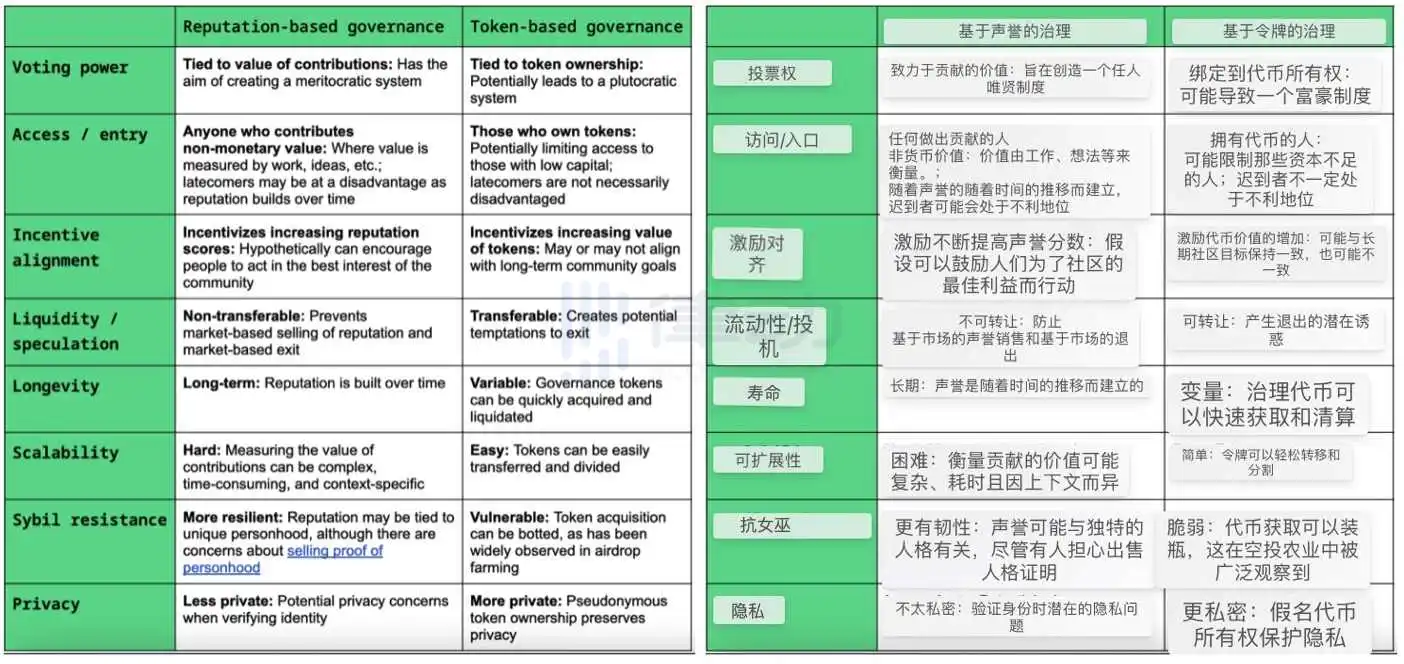
In summary, the choice between reputation-based governance and token-based governance depends on the goals and needs of the project. For meritocratic systems that value long-term community alignment, reputation-based governance may make more sense; for projects that value scalability and liquidity, token-based governance may be more appropriate.
On the access/entry dimension, reputation-based systems may be more favorable to early community members, as they can start accumulating reputation earlier. However, token-based systems may be more attractive to wealthy individuals. On the Sybil-resistance dimension, reputation-based systems aim to overcome Sybil vulnerabilities inherent in token-based systems, such as the Beanstalk hack, by associating reputation with identity. However, this may raise privacy concerns, although these concerns may be addressed by using zk-SNARKS or other types of zero-knowledge proofs.
In practice, it may make sense to combine tokens and reputation scores. For example, reputation can lead to some but not all governance functions. Optimism's bicameral system is an example of achieving this goal, which includes a reputation-based citizen house and a token-based token house, but the design space is large. Past research has argued that reputation systems should rely on a pair of tokens, one for representing reputation and the other for providing liquidity. Other projects are exploring dual governance models in which stake token holders have veto power over governance token holders. In Lido’s case, both the LDO and stETH tokens are transferable, though one could imagine incorporating non-transferable reputation-based governance tokens into a similar dual-token model.
Token-Based Systems
“Token-based governance” refers to an incentive or reward system tied to the ownership or acquisition of fungible tokens that can be traded on the open market. For example, Uniswap’s UNI token can be used to vote in Uniswap governance. The transferability of these tokens makes it easier to attract new participants to protocol governance than reputation-based systems. However, these systems can lead to a plutocracy, where those with more capital have greater influence. Token holders have a direct financial stake in the success of a project, so they are incentivized to vote to promote long-term financial value. Unfortunately, the financial interests of token holders do not always align with long-term non-financial community interests. Examples of such tokens include ERC-20 tokens in Ethereum, ICS-20 tokens in Cosmos, and SPL tokens in Solana.
Currently, most projects adopt a “one token one vote” model, where voting power is proportional to token wealth and is used to vote on project decisions. For example, in MakerDAO, MKR token holders have voted on protocol changes, such as risk parameters for collateral backing the DAI stablecoin. In decentralized lending protocol Aave, AAVE token holders have voted on which projects should receive funding from the Aave ecosystem reserve. In decentralized trading platform Uniswap, UNI token holders have voted on the fee structure of the UNI token, which will affect how trading fees are distributed between liquidity providers and token holders.
Some examples of reward mechanisms for distributing transferable tokens implemented in token-based systems include:
Airdrops: Tokens are distributed to wallets at a discrete point in time based on specific eligibility criteria. Airdrops are often used to incentivize certain behaviors, promote new projects, or distribute ownership more broadly within the community. DeFi protocols like Uniswap, layer-2 solutions like Optimism, blockchain identity solutions like ENS, and even NFT projects like Yuga Labs’ Bored Ape Yacht Club have experimented with airdrop rewards.
Backdated Reward Funding:Optimism has implemented multiple rounds of this token distribution method, sending OP tokens to the wallets of users who support the development and adoption of Optimism’s “public goods”, thereby supporting the broader OP Stack ecosystem. Examples of public goods include adding code to the developer ecosystem, contributing to user experience and adoption, or actively participating in Optimism’s governance. Winners are selected through community nominations and voting in the Optimism Citizen House.
Liquidity Mining:Users are rewarded with tokens for providing liquidity to decentralized exchanges or liquidity pools. Decentralized lending protocol Compound Finance and derivatives liquidity protocol Synthetix are examples of protocols that issue token rewards through liquidity mining. Unlike airdrops, which are implemented at one or more discrete points in time, liquidity mining provides users with a continuous issuance of tokens to lend and borrow. This is similar to anonymous mining in Tornado Cash, where users are rewarded with tokens after depositing coins into an anonymous pool.
Voting Staking:To participate in governance, users must lock tokens into voting stakes. Users can increase their voting power by locking their tokens for longer periods of time. For example, DeFi exchange Curve Finance implements voting staking through veCRV (Voting Staking CRV token). In Curve, locking veCRV for longer periods of time can provide a greater boost, in addition to increasing voting power. This can also serve as a mechanism to defend against flash loan-based governance attacks.
Reputation-Based Systems
Reputation is earned, not bought. While reputation may take the form of a token, its implementation differs from fungible tokens that can be bought and sold on the open market. In practice, reputation is often implemented as a non-fungible token (NFT), such as the ERC-5114 (“soulbound” badge) token in Ethereum. The Optimism Citizen House badge and Polygon’s proposed Polygon ID-based reputation voting are typical examples of current identity-based governance systems. Reputation governance may take a variety of forms in practice, including peer attestation, automated scoring based on observable behavior, or centralized selection (later in this article, I will outline the trade-offs between different reward mechanisms).
In theory, reputation tokens could take the form of fungible tokens that are non-transferable (e.g., transfer functionality is disabled in the ERC-20 contract). One could use non-transferable fungible tokens to assess contributions of community members in a more granular manner, for example, a number of reputation tokens could be easily split up and used to assign ratings to community members on a continuous scale, rather than the discrete scale created by a few reputation badges represented by NFTs. These reputation-based governance systems could more fairly distribute influence and potentially provide better Sybil resistance. However, reputation-based systems do present inherent challenges, such as scalability and subjective measurement of contribution.
Reputation-based governance rewards are still in the early stages of implementation. Some potential avenues for earning reputation include:
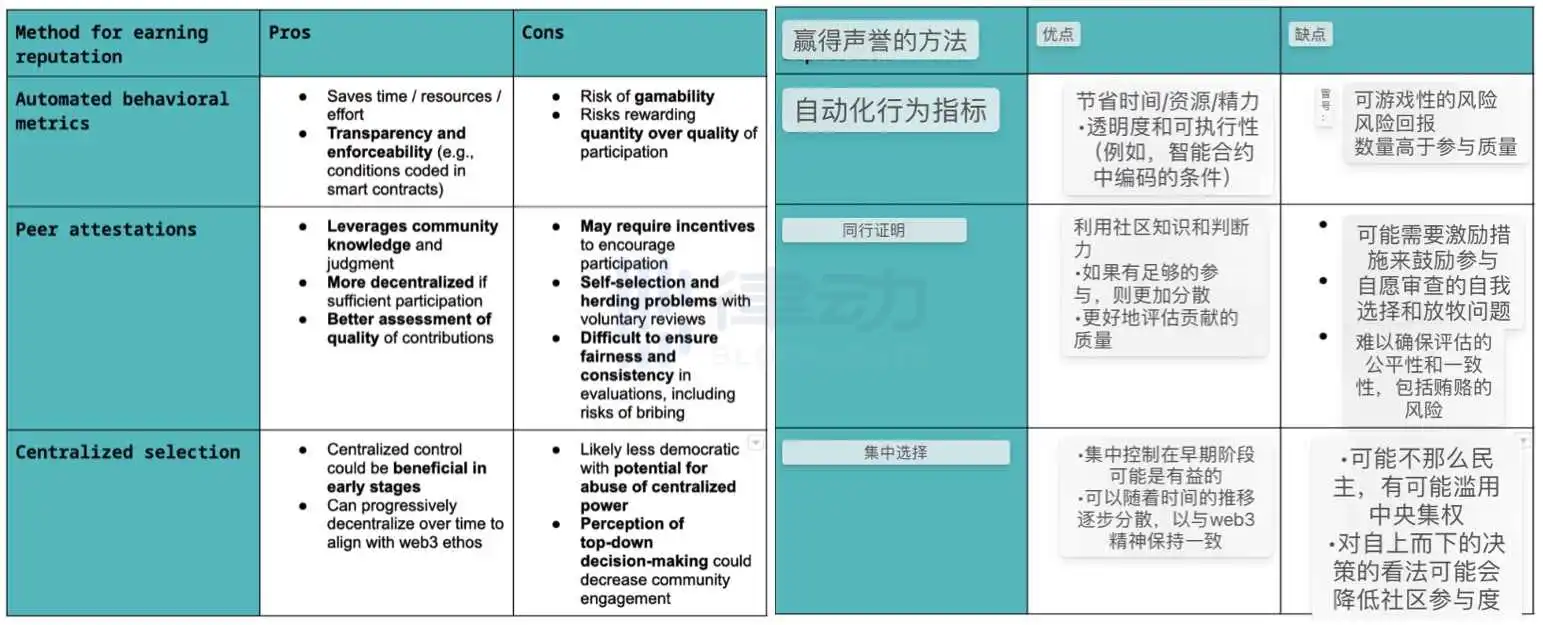
Automated behavioral metrics:Reputation is automatically calculated based on the observable behavior of users within the system. For example, if a person attends a town hall meeting, they might earn one point toward their reputation score, while voting might provide five points. Such behavioral metrics could potentially be hard-coded into the smart contract. To overcome manipulability, one could imagine recording town hall attendance at random 30-second intervals during the meeting, rather than only at the beginning. Of course, the challenge of discerning nuances behind participation remains. For example, regular attendance may demonstrate an individual’s genuine civic commitment, but it may also reflect that someone simply has a lot of free time.
Peer Attestation:Reputation is built through peer evaluation or ratings. This approach leverages peer evaluation beyond observable behavior and may provide a better assessment of the quality of participation, but requires incentivizing people to spend time rating their peers. The key challenge here is to design a scheme that prevents bribery or other forms of reputation buying. An example of peer attestation in practice is the Boys Club DAO’s work with Govrn to allow members to record DAO contributions that can be verified by other community members and ultimately converted into backdated rewards. Another example is contribution-based proofs to improve governance accessibility, as proposed in the Optimism Governance Forum, potentially using something like the Ethereum Attestation Service (EAS) to create, verify, and revoke attestations.
Centralized Selection: In the early stages of a project, a dedicated team manually selects individuals based on set criteria and assigns them high reputation scores. Here, a central team identifies individuals with high reputation status. As the system grows, it may gradually become decentralized, giving the wider community a greater role in refining reputation standards. This approach aims to balance the initial stages of quality assurance with the ultimate goal of fully decentralized governance. Vitalik Buterin pointed out this model in an August 2021 blog post, noting that "the simplest solution might involve using 10-100 hand-picked early contributors to bootstrap the system, and then gradually decentralizing over time as participants selected in round N determine the criteria for participation in round N+1."
Since reputation systems cannot be simply purchased on the open market, there is a lot of room for designing how reputation rewards are earned. The following table summarizes the pros and cons of different ways ecosystem participants can earn reputation:
What powers do rewards come with?
In addition to deciding how to distribute rewards, another key consideration is determining the value, access, privilege, or influence that rewards bring. Currently, most Web3 governance systems use transferable tokens that can be converted into voting rights, that is, one token is equivalent to one vote. However, rewards can have different types of value attached to them. Whether rewards are transferable (token-based systems) or non-transferable (reputation-based systems) also affects the significance of these decisions. But from a macro perspective, these powers can be attached to reputation, which is either transferable or non-transferable.
What forms these reward functions may take
Governance power: rewards can be directly converted into the ability to vote, delegate, serve as a representative, make proposals, or other governance functions.
Non-governance utility: Rewards can be directly converted into non-governance utility functions in the online system. For example, this may include access to special community groups and events, priority opportunities to participate in staking, special avatars or community identities, or other direct platform functions. In addition, this may also include some type of social rewards, such as an "I voted" NFT (non-fungible token) for those who have high participation and good records.
Real-life rewards: Rewards can be directly converted into real-life benefits, such as access to official events (such as parties, seminars, social workshops) with community members, physical peripheral products, or other non-digital consumer products.
Successful reward structures may need to be mixed and matched depending on the nature and goals of the project. Governance rewards may correspond to different combinations of governance power, non-governance utility, or real-life benefits.
Trade-offs, when are these reward functions useful?
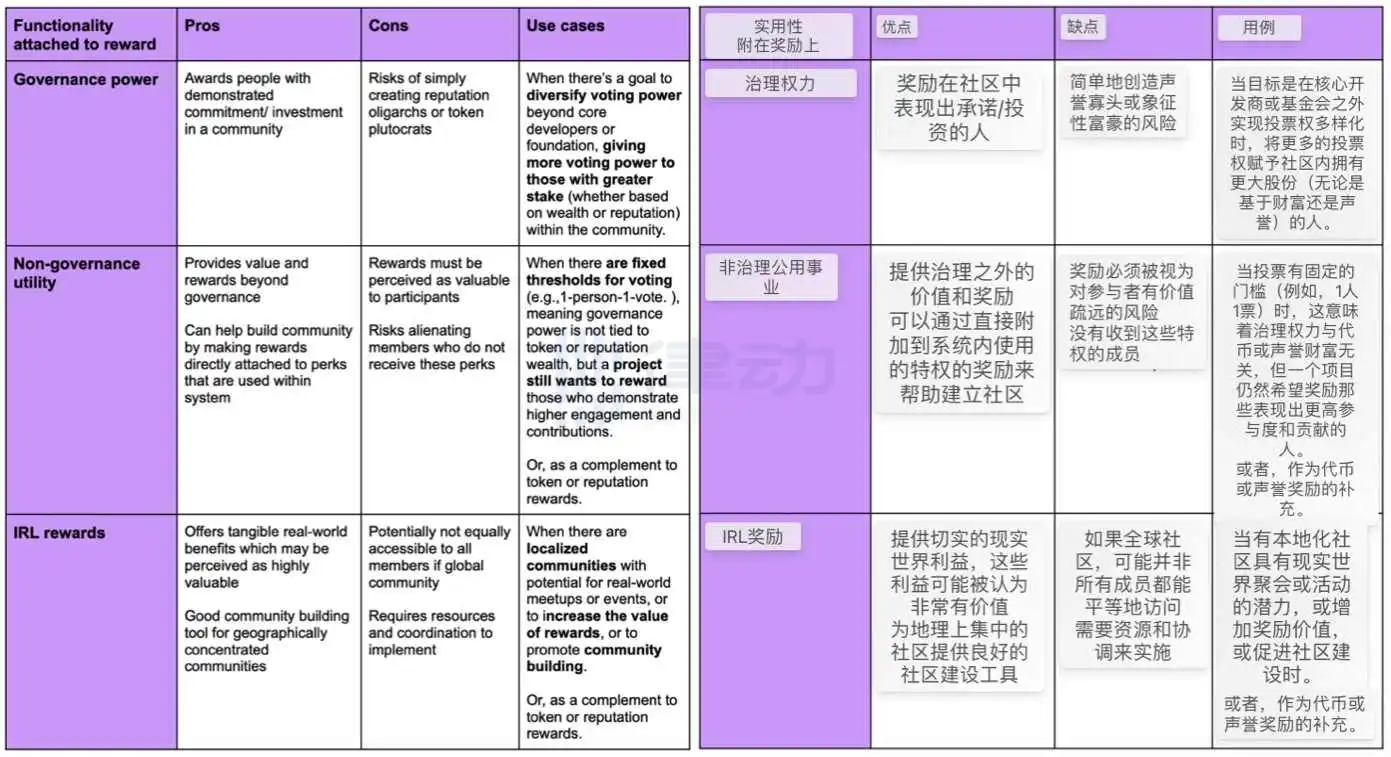
Issues to be aware of when designing online governance reward systems
To summarize, when designing online governance reward systems, we need to make trade-offs between multiple factors. When formulating these systems, the following specific questions may be raised, and the answers a project gives to these questions will affect whether its reward system relies on reputation or tokens.
How is information collected and aggregated as rewards?
How do rewards translate in different scenarios, and is the goal to achieve interoperability of rewards (such as reputation scores) between different ecosystems (such as cross-chain interactions)?
Do you plan to have rewards designed by a central authority or based primarily on decentralized interactions?
Do you want rewards to be tied to real-world identities or anonymous accounts?
Is Sybil resistance critical to the project and reward mechanism?
Do you plan to use reputation tokens in conjunction with transferable tokens?
Recent research suggests that whether a project is suitable for token-based governance depends on whether it is civic or economic in nature. As mentioned above, there are trade-offs on specific dimensions (e.g., scalability, entry, privacy, Sybil resistance, etc.). While there are arguments in favor of token voting (e.g., stake in the game), a common concern with token-based governance systems is the potential for plutocracy, where wealthy participants exert disproportionate influence, which is clearly contrary to the spirit of Web3. Another concern about transferable token governance is the potential risk of market exit (i.e., participants selling tokens when the price rises).
In contrast, reputation-based systems enable meritocracy by tying governance or other power within the community to earned reputation. However, non-transferable reputation systems can be difficult to implement due to the complexity of measuring and verifying reputation. Exploring reputation-based governance and other approaches beyond voting with transferable tokens is therefore an open and potentially fruitful area of decentralized governance. While some considerations for implementing reputation systems have been outlined, this is an evolving area and we look forward to further discussion and experimentation on how to design effective online democratic governance systems.
Welcome to join the official BlockBeats community:
Telegram Subscription Group: https://t.me/theblockbeats
Telegram Discussion Group: https://t.me/BlockBeats_App
Official Twitter Account: https://twitter.com/BlockBeatsAsia