BitVM is popular, but can it run "Doom"?

Original Title: "BitVM: But Can It Run DOOM?"
Author: Shinobi
Compiled by: Luccy, BlockBeats
BlockBeats Note: "DOOM" is a very popular first-person shooter game, first released in 1993. The game is known for its fast-paced gameplay, advanced 3D graphics, and online multiplayer capabilities. The game is often used to test the performance of various devices and platforms.
Recently, the project leader of ZeroSync released a white paper titled "BitVM: Compute Anything on Bitcoin", which has sparked discussions.
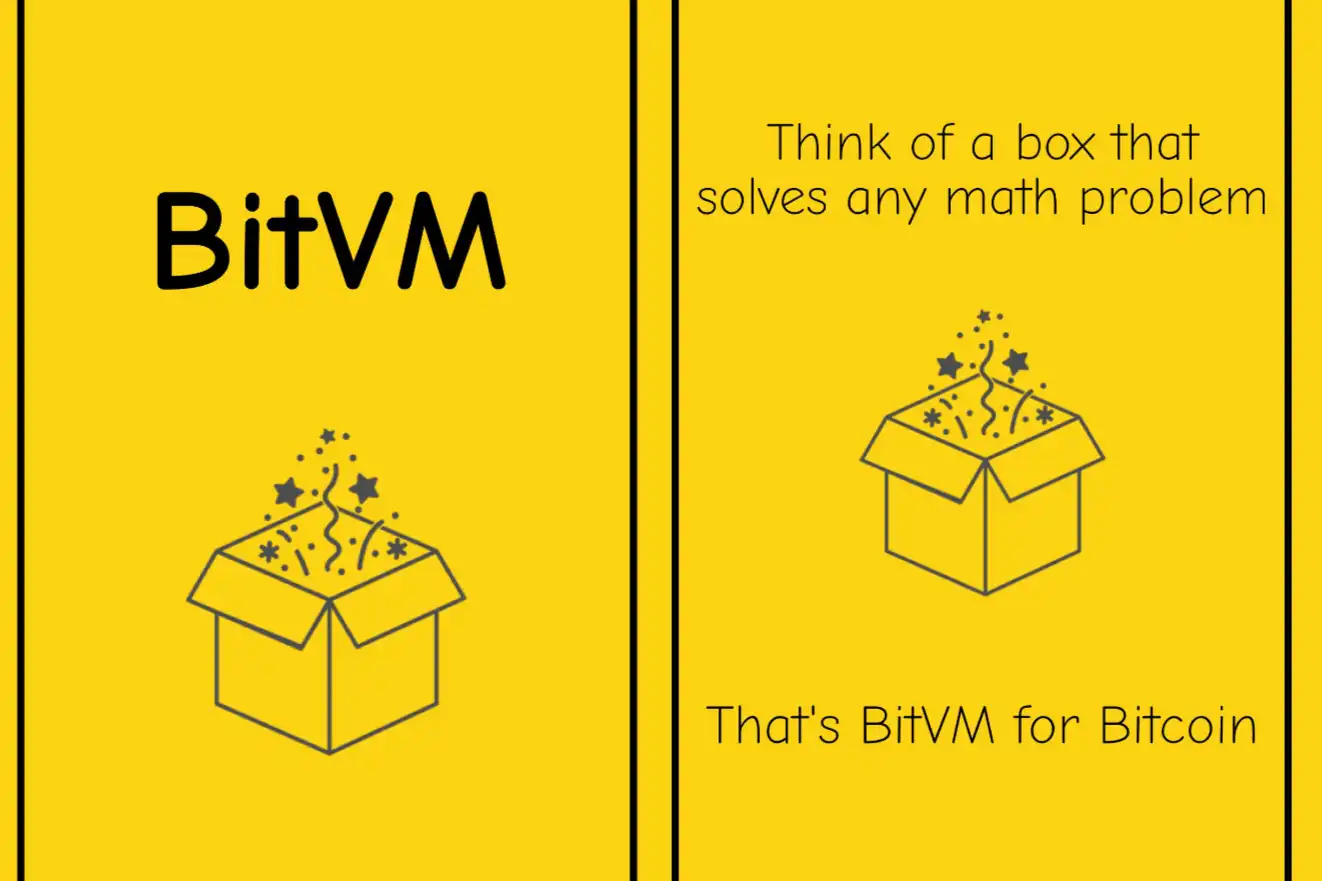
In this white paper reviewed by Super Testnet and Sam Parker, it can be seen that BitVM is a new computing paradigm designed by Robin Linus at Zero Sync, which combines Optimistic Roll Up, Fraud Proof, Taproot Leaf, and Bitcoin Script.
BitVM allows for the expression of Turing-complete Bitcoin contracts without changing the Bitcoin network's consensus rules. It can execute any computable function and perform offline calculations without leaving any trace on the chain. The whitepaper also introduces BitVM's architecture, input/output, limitations, and prospects.
Related reading: "What do senior developers think of BitVM for calculating anything on Bitcoin?"
BitCoin community technology editor Shinobi also expressed his views on the BitVM related technology ideas on the community platform and pointed out that the efficiency level of building things on BitVM is currently quite poor, but this is an important moment in Bitcoin history. BlockBeats now compiles the original text as follows:
Recently, a relatively new fully automated public figure has emerged in the encryption industry. He has proposed a crazy idea, and surprisingly, we don't even need to make any changes or hard forks to Bitcoin to immediately implement this concept.
Although I believe that the hype surrounding this idea has become very exaggerated and disconnected from reality, I still believe that this is an important moment in Bitcoin's history. The efficiency level achieved in building things on BitVM is quite poor, both in terms of the size of the required taproot tree and the number of pre-signed transactions. At least for me, this is a very obvious question: what are the actual use cases that can accept this inefficiency in exchange for the guarantees it provides? However, the functionality that this architecture can achieve is indeed very significant.
Currently, two specific ideas have been proposed. Although there are some issues with the significant off-chain costs of pre-signed transactions and scripts in the Taproot tree, in reality, paying these data costs may be meaningful in order to obtain the trust assurance types that BitVM can provide.
Firstly, introduce an innovative bidirectional anchoring mechanism, namely "Sentry Peg". This mechanism allows the establishment of a sidechain managed by the federation, where the federation deposits bonds into a BitVM contract that executes the sidechain logic. When processing each withdrawal, the federation must provide proof to BitVM to confirm that it is a legitimate withdrawal. If proof is not provided, a group of validators acting as watchtowers can confiscate the federation's bonds in BitVM.
This mechanism brings an interesting possibility: entities that store funds on a sidechain must prove the legitimacy of their actions to external parties, otherwise the funds will be confiscated. Compared to traditional punitive bond schemes, the new dynamic here is that the logic of when to implement punishment can be more complex, and actual execution is through a verification process rather than relying on clever cryptographic techniques or additional layers of trust.
Next, we introduce UTXOracle. Although this is a very excellent way to calculate the Bitcoin-to-US dollar price valuation through your own node without trust, there is actually no way to "input" this data into the Bitcoin script for use in smart contracts without trust. BitVM provides a method to achieve this goal.
By constructing a logic gate circuit, SPV verification can be performed on Bitcoin blocks (limited to proof of work), and the actual complete block can be input into BitVM. Then, with a long enough string, you can actually use the UTXOracle logic within BitVM to bind the contract's result with price data obtained from the blockchain without trust.
For high-value contracts or sidechains, it may be worth paying for off-chain data of hundreds of megabytes or even one or two gigabytes to provide such guarantees. In short, although BitVM will not make Bitcoin comparable to Ethereum in the short term, and its development may be quite slow and experimental, it does open up a whole new paradigm for how to use Bitcoin.
Welcome to join the official BlockBeats community:
Telegram Subscription Group: https://t.me/theblockbeats
Telegram Discussion Group: https://t.me/BlockBeats_App
Official Twitter Account: https://twitter.com/BlockBeatsAsia

 Related Articles