The demand remains significant, and Tornado Cash remains the largest cryptocurrency mixer on Ethereum even after being sanctioned.

Table of Contents:
· The largest cryptocurrency mixer on Ethereum
· Tornado Cash sanctioned twice by the United States
· The "regulation" and "privacy" of Tornado Cash
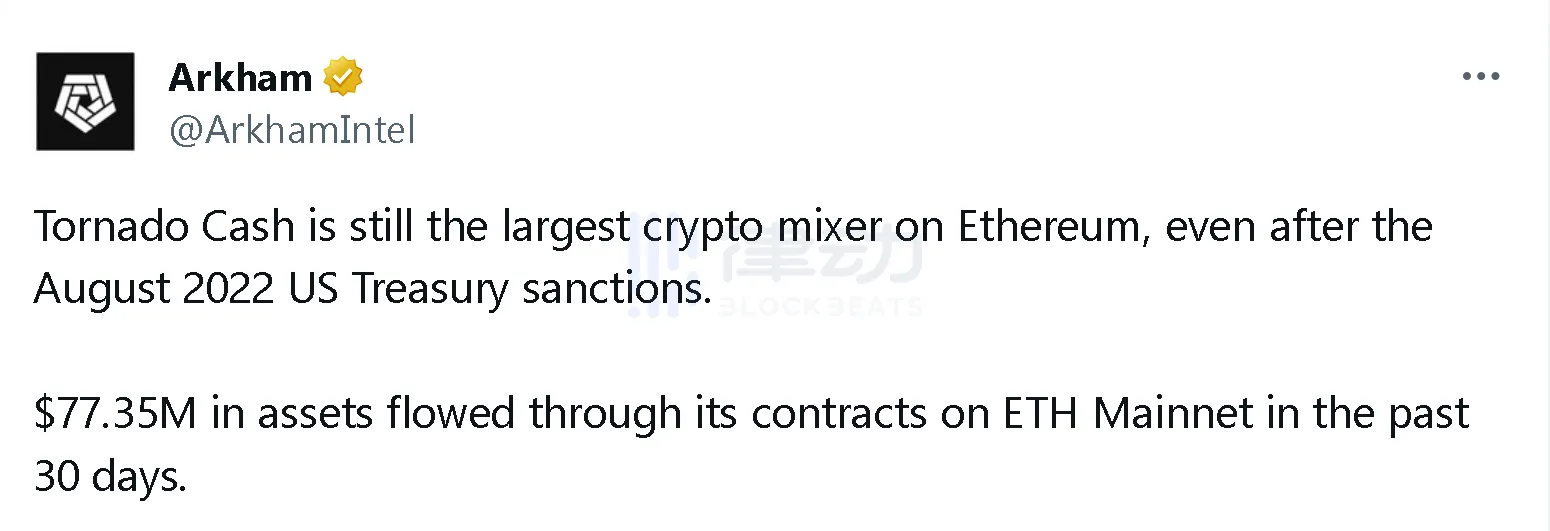
BlockBeats News, October 10th, Arkham, a cryptocurrency data tracking platform, announced that even after Tornado Cash was sanctioned by the US Treasury Department in August 2022, it remains the largest cryptocurrency mixer on the Ethereum network. In the past 30 days, $77.35 million in assets have been transferred through Tornado Cash on the Ethereum mainnet.
The largest cryptocurrency mixer on Ethereum
Tornado Cash operates on 7 different blockchains and can mix 10 different cryptocurrencies. The asset with the highest amount of mixing is the native ETH on the Ethereum mainnet. During the peak period in July 2021, the Tornado Cash pool contract held over $700 million worth of ETH.
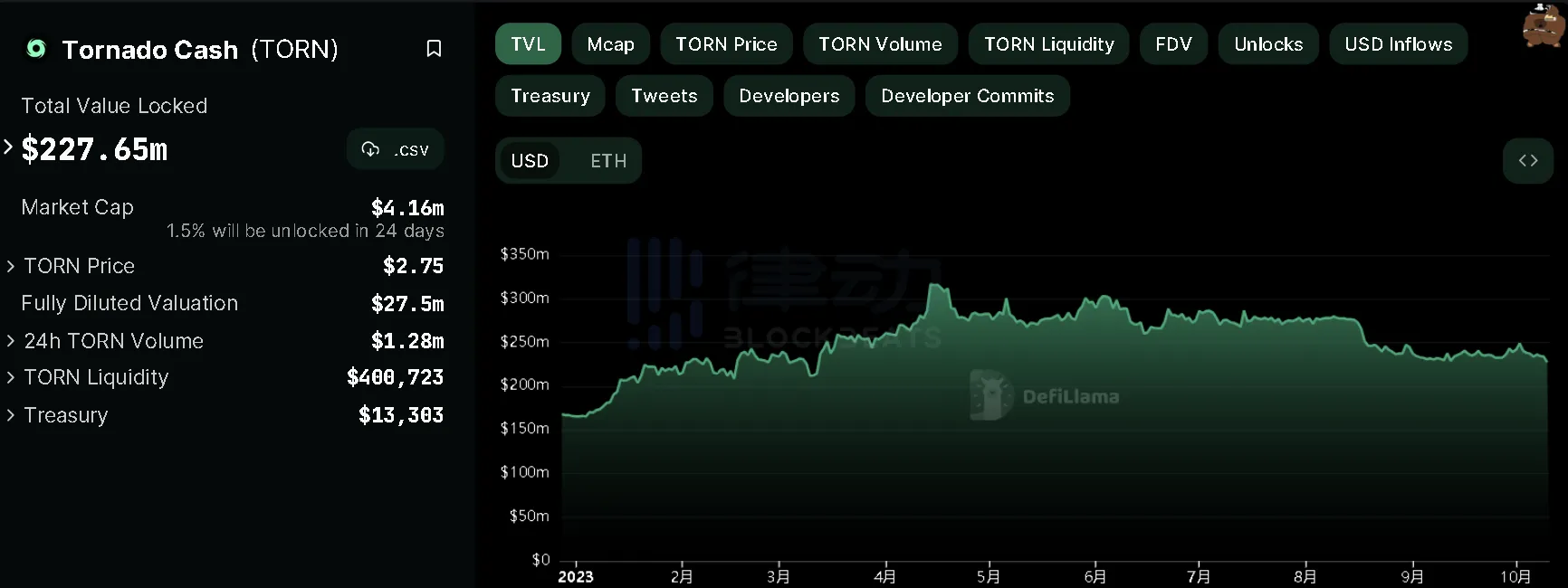
After being sanctioned by the US Treasury Department, the assets in Tornado Cash decreased by more than 60%, and the transfer volume also significantly decreased. However, Tornado's TVL is currently about $227.65 million.
On July 24th, Palmswap suffered a hacker attack and lost approximately $900,000. One month later, the attacker transferred 835.6 BNB (worth about $183,600) to Tornado Cash.
Arbitrum ecosystem leverage yield protocol Rodeo suffered a hacker attack on July 13, resulting in a loss of about $1.7 million. The hacker transferred 200.8 ETH (about $33.1 million) obtained through price manipulation on Rodeo Finance to Tornado Cash on August 27, according to The Block.
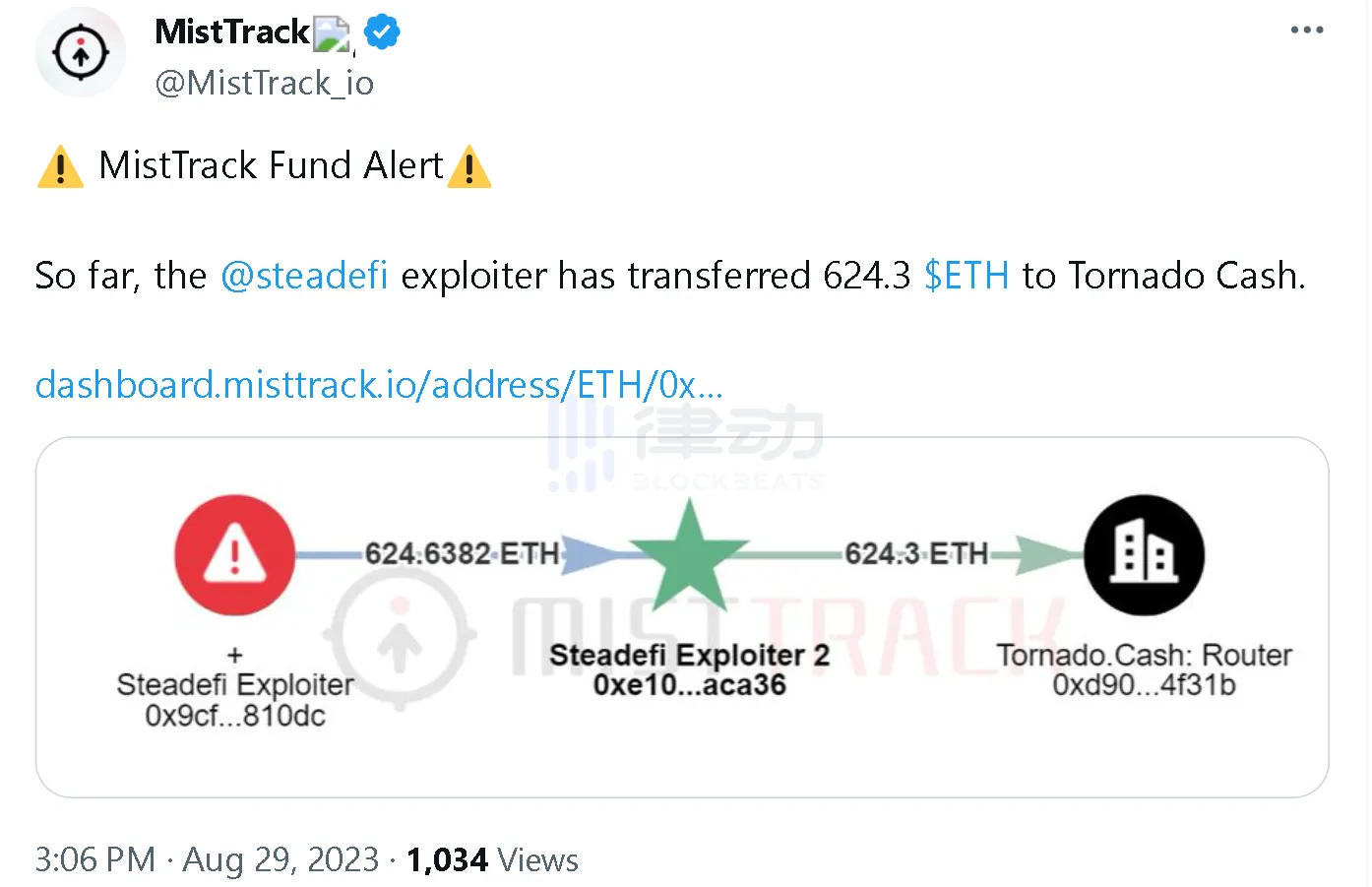
On August 8th, the DeFi protocol Steadefi was attacked and approximately $1.14 million was stolen. As of August 29th, the attackers had transferred 624.3 ETH (approximately $1.03 million) to Tornado Cash for mixing.
Jimbos Protocol suffered an attack on May 28th, with a total loss of approximately $7.5 million. On September 10th, the hacker transferred the stolen $7.5 million funds through Tornado.cash.
On September 11th, the phishing attacker who previously attacked a certain whale address and obtained 24.24 million US dollars worth of cryptocurrency exchanged 28,000 DAI for 17.3 ETH and transferred 1,100 ETH (about 1.78 million US dollars) to Tornado Cash.
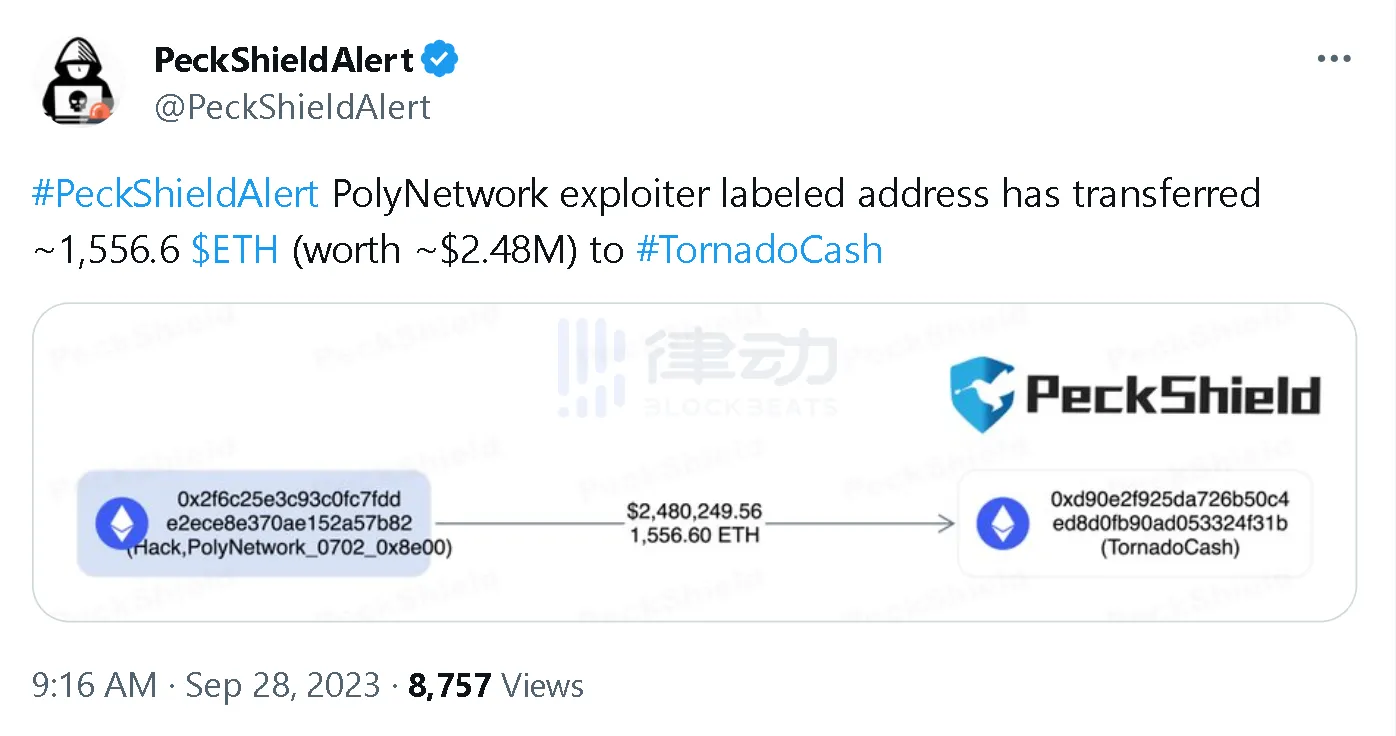
On September 28th, the attacker address of Poly Network transferred 1556.6 ETH (approximately $2.48 million) to Tornado.Cash. The information is from this source.
Tornado Cash has been sanctioned twice by the United States
The US Department of Treasury stated that since its establishment in 2019, Tornado Cash has been used to launder money for criminals, including covering up the theft of hundreds of millions of dollars in virtual currency by the Lazarus Group hackers.
Related reading: "Accused of aiding North Korea's largest hacker, founder of Tornado Cash sanctioned by US Treasury (full text)"
The Lazarus Group was sanctioned by the United States in 2019. In March 2022, they launched an attack on Axie Infinity's Ronin cross-chain bridge, stealing over $455 million, making it the largest known virtual currency theft to date. Since then, the Lazarus Group has used Tornado Cash for money laundering, including over $96 million from the network theft of Harmony's Horizon bridge on June 24, 2022, and at least $7.8 million from the Nomad theft on August 2, 2022. These revenues have provided resources for North Korea, which uses them to support its illegal ballistic missile and nuclear weapons programs.
In 2022, the Office of Foreign Assets Control (OFAC) of the US Department of the Treasury sanctioned Tornado Cash and Blender.io for providing mixing services to the Lazarus group.
The second round of sanctions and accusations is based on earlier actions and aims to reveal certain elements in the virtual currency ecosystem that are used by cybercriminals (including the Lazarus group) to conceal the source and destination of their illegal activity funds.
Tornado Cash co-founder Roman Semenov was listed on the U.S. Department of the Treasury's Office of Foreign Assets Control (OFAC) list of individuals and companies whose assets are frozen and are prohibited from doing business with Americans on August 23, according to reports. The move is said to mark the first major action taken by OFAC to sanction Semenov personally and also signifies an escalation of OFAC's investigation into Tornado Cash.
The next day, Roman Storm, co-founder of Tornado Cash, was arrested by the FBI and the National Tax Agency on charges of "conspiring to launder money, conspiring to operate an unlicensed money transmission business, and conspiring to violate sanctions regulations." Roman Semenov is still at large.
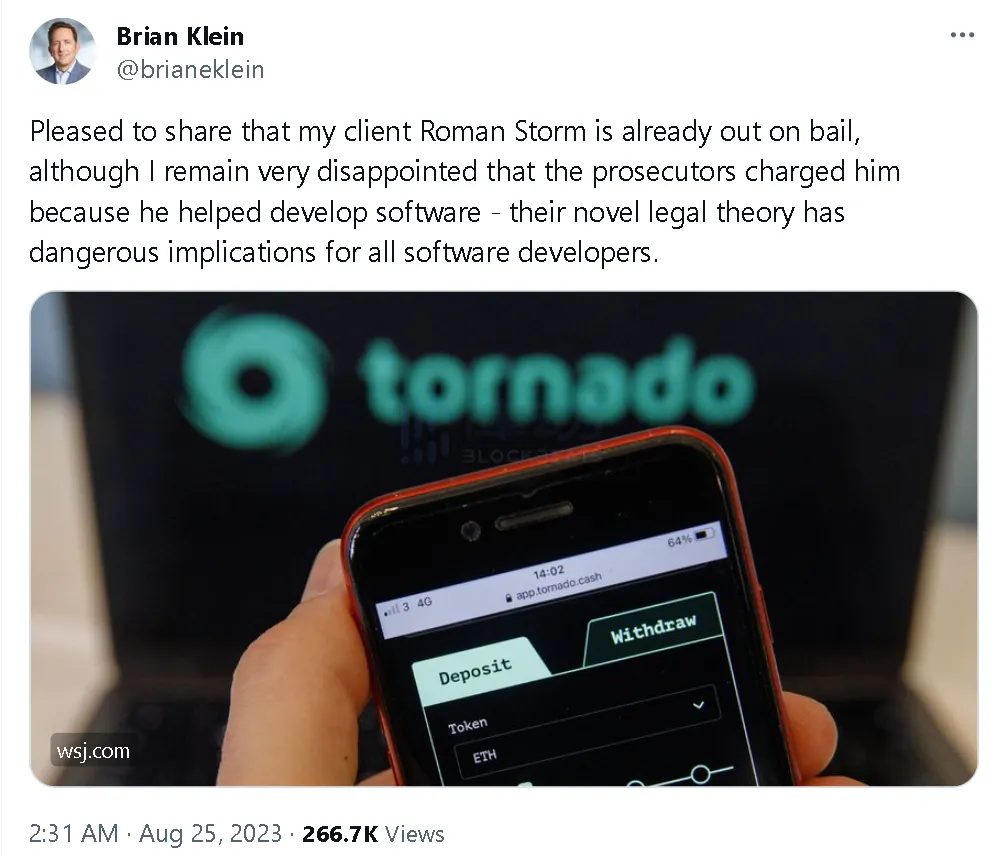
Later, Roman Storm's lawyer Brian Klein stated that Roman Storm has been granted bail. Klein expressed disappointment in the prosecutor's charges against Roman Storm for his involvement in software development, stating that their novel legal theory has a dangerous impact on all software developers.
In addition, Roman Storm also pleaded "not guilty" to the charge during the trial. Tornado Cash stated that the project did not have direct contact with the hacker organization that used it, but was only exploited by the organization.
Related reading: "Privacy Pools: Where Will They Go After Vitalik's New Paper and Tornado Cash Being Regulated?"
The main idea of Tornado Cash is to mix a large number of deposit and withdrawal behaviors together. After depositing tokens into Tornado, depositors prove that they have made a deposit with a ZK proof, and then withdraw using a new address to cut off the association between deposit and withdrawal addresses. Therefore, only deposits and withdrawals can be seen on the chain, but not their corresponding relationships, so it is anonymous.
Tornado Cash's "Regulation" and "Privacy"
The argument of this case boils down to "Tornado Cash intentionally assists money laundering by not implementing KYC or AML procedures", which means a direct attack on cryptocurrency and freedom of speech. The officials stated that "creating privacy protocols for criminals to use is a criminal act". This also means that the struggle between "privacy, freedom of speech, cryptocurrency, and our basic natural rights" and "regulation" has once again escalated.
Related reading: "Tornado Cash co-founder arrested, is "code is speech" a false proposition?"
The founders of Tornado Cash, Roman Storm and Roman Semenov, have become political prisoners of the US government for writing code. However, this sanction not only attacks cryptocurrency, but also attacks speech itself...
On April 15, 1996, Judge Marilyn Hall Patel in Northern California issued a crucial first ruling that code is speech and therefore protected by the First Amendment.
The non-profit organization Coin Center, which focuses on cryptocurrency policies, has released an analysis article on the recent accusations against Roman Storm and Roman Semenov, the founders of Tornado Cash. The article points out that the two founders have been accused of conducting illegal currency transfer business. Based on the current facts of the accusation, it is unclear whether they have actually violated relevant laws. The defendants seem to fit more into FinCEN's definition of anonymous software providers, which does not consider them as currency transmitters.
Related reading: "DeFi regulatory dilemma, Uniswap in heaven, Tornado Cash in hell"
The Financial Crimes Enforcement Network (FinCEN), a subsidiary of the US Treasury, has not filed a civil lawsuit against Tornado Cash and its founder for operating an unlicensed money transmission business. If Tornado Cash falls under the definition of a money transmitter, this definition would also apply to other similar DeFi projects. Once implemented, these projects would need to register with FinCEN and go through KYC/AML/CFT processes, which would have a huge impact on the DeFi world.
The article also pointed out that the government claimed that the defendant "promoted" the Tornado Cash tool and "profited" from governance tokens related to smart contracts, but these activities are not equivalent to "accepting and transmitting" currency.
The Anti-Money Laundering Certification Expert Association (ACAMS) Senior Manager of Anti-Money Laundering, Craig Timm, stated that the Department of Justice seems to have specifically pointed out the issue with Tornado Cash's user interface in the Tornado Cash case, rather than the smart contract itself. It seems unlikely that charges would be brought without a user interface. Former financial crime prosecutor Anand Sithian stated that Tornado Cash's native TORN token is another complicating factor. According to the indictment, the defendants profited from using the token to operate Tornado Cash's services.
Welcome to join the official BlockBeats community:
Telegram Subscription Group: https://t.me/theblockbeats
Telegram Discussion Group: https://t.me/BlockBeats_App
Official Twitter Account: https://twitter.com/BlockBeatsAsia

 Related Articles