Interview with Caduceus: How does GPU rendering enhance the metaverse?

As an underlying infrastructure that integrates blockchain and edge computing technologies, Caduceus has established its unique market position, focusing on providing computing power and rendering resources for metaverse vendors. Currently, it is building the world's first user-friendly 3D metaverse platform, including various functions such as P2P communication and IPFS storage. By putting the tools in the hands of creators, Caduceus is reshaping multiple fields such as XR, operating systems, and identity verification, aiming to innovate in multiple fields such as travel, education, social, film and television, games, and entertainment.
Providing highly compatible and extremely flexible construction foundations for 3D NFT, GameFi, AI, and metaverse ecosystems, Caduceus will assist global metaverse participants in joining at a lower threshold. It is worth mentioning that Caduceus announced the completion of a $4 million Series A financing led by SIG and BlockFills on March 30th last year.
Caduceus has a diverse team, with members from various backgrounds including blockchain, DeFi, software development, finance, retail, music, art, media, and entertainment.
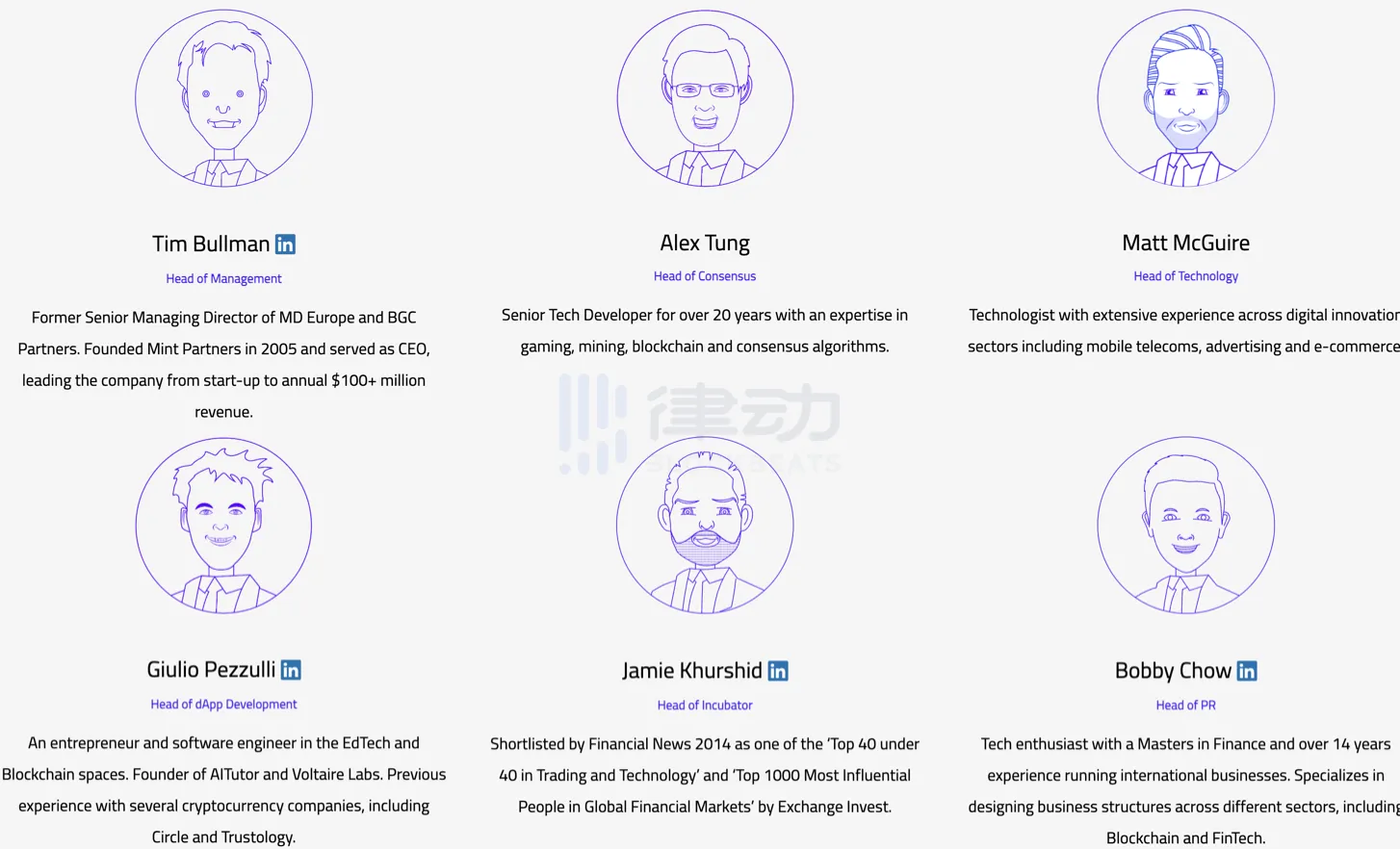
The head of foundation management, Tim Bullman, was formerly the senior managing director of MD Europe and BGC Partners, as well as the founder and CEO of Mint Partners. The consensus algorithm technology leader, Alex Tung, has over 20 years of experience in advanced technical development and has deep expertise in gaming, mining, blockchain, and consensus algorithms. The edge rendering technology leader, Matt McGuire, is a technology expert with rich experience in fields such as mobile telecommunications, advertising, and e-commerce. The application extension leader, Giulio Pezzulli, is a blockchain entrepreneur and software engineer with rich experience in cryptocurrency companies such as Circle and Trustology. The incubator leader, Jamie Khurshid, was named one of the "40 under 40" in the trading and technology field by the Financial News in 2014, as well as one of the "1000 most influential people in the global financial market".
At the recently concluded "EDGE Summit" Hong Kong conference, BlockBeats had an in-depth conversation with Caduceus' dApp development director, further exploring Caduceus' current development status and its insights into the industry.
BlockBeats: First, please introduce yourself, including your professional experience, and why you want to do the Caduceus project? What is your job at Caduceus now?
Giulio: I am Giulio Pezzulli, the DAPP development manager at Caduceus. In fact, I started in the technical field as a developer and later worked for several cryptocurrency companies, one of which was a cryptocurrency wallet company called Trustology. After that, I joined the stablecoin company Circle USDC and then entered Caduceus as the DAPP development manager. Currently, my core focus is on observing the ecosystem, ensuring that the documentation is complete and ensuring that developers understand how to build on our chain, while also trying to build tools for them.

Giulio Pezzulli spoke at the "EDGE Summit" Hong Kong conference
Where is the technological innovation of Caduceus?
BlockBeats: What technologies are integrated into Caduceus' technical solution? And how is it combined with AI, blockchain, and edge computing?
Giulio: Our system is a distributed blockchain with nodes spread across the globe. Its core objective is to provide GPU rendering capabilities to various companies, such as metaverse companies. As an example, this is the first use case of edge rendering. Furthermore, in the field of AI, we are currently considering implementing an API so that developers can more easily integrate and utilize large language models that have been carefully tuned. This is indeed a direction for the future. Because we have resources from our nodes, we can provide it as an API to users.
BlockBeats: Can you specify the technological innovation of Caduceus? Is it edge rendering?
Giulio: One of the huge advantages is that it allows you to render your virtual world geographically. This is achieved through nodes and other elements. We are all using frameworks like Unity or Unreal to build and are also leveraging these architectures. As for the future, Caduceus aims to become a blockchain with extremely high transaction per second. Currently, this is particularly evident in helping with use cases in the metaverse, where there are a lot of personnel transactions, and perhaps many AI transactions as well. So, speed is very important.
BlockBeats: How is the construction of Caduceus currently going? What are the important developments in Mainnet V2.0?
Giulio: Regarding TestNet, Caduceus is currently developing and testing, and has achieved a processing capacity of approximately 30,000 transactions per second. The goal is to increase this to 100,000 transactions per second. We know how to achieve this, although it is a very difficult road, especially in the current market environment, but this is our next plan. Caduceus plans to release a new test version at some point (perhaps called the New Testament or another specific module name).
BlockBeats: How will Caduceus achieve 100,000 tps?
Giulio: The first operation we perform is to decompose the process of achieving high transaction volume. Secondly, in the local environment, this is a layer one solution that does not rely on any layer two solutions. First, we have a consensus mechanism for transaction sorting. Once the transactions are sorted - which is a very fast process with limited data requirements - we then have a process for verifying the transactions to ensure they can actually be processed in parallel at some level. Then we have an execution node responsible for executing parts, and a storage node responsible for storing results. Therefore, we manage to divide the entire process into several independent parts and use some efficient algorithms to achieve their parallel operation. Yes, this means that Caduceus can handle a large number of operations. Then we iterate this process continuously and optimize the algorithms to push its performance to 100,000 tps.
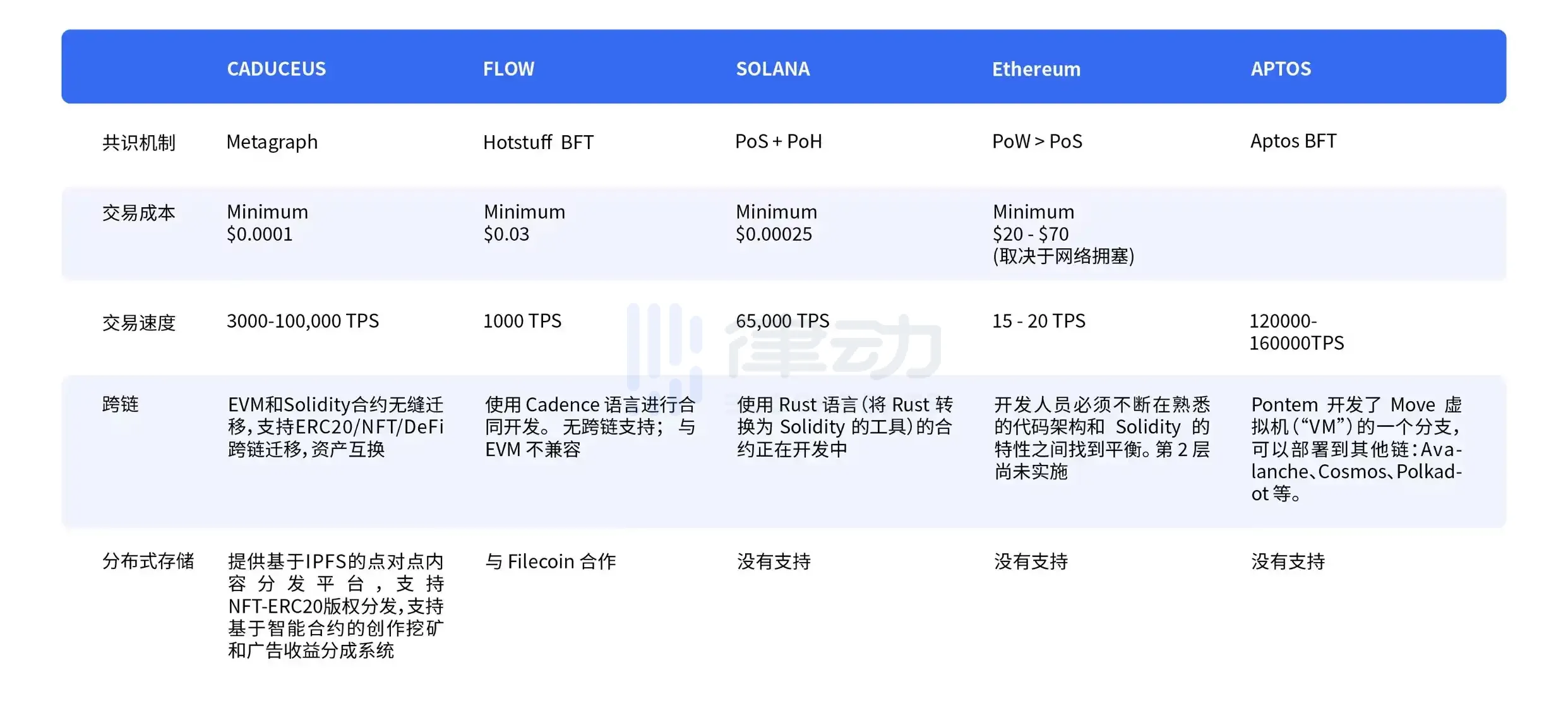
Caduceus 对行业有哪些理解
Caduceus's understanding of the industry is as follows:
Caduceus is different in that, although it belongs to Layer1 public chains, Caduceus targets a commercial scenario rather than a specific industry technical problem. It hopes to combine decentralized solutions with edge computing, rendering, 3D technology, and XR software and hardware to provide strong infrastructure support for the metaverse application layer scene. Gray believes that the metaverse is the clearest scenario for the future development of the Web3 concept, but there is currently no blockchain infrastructure suitable for this scene.
BlockBeats: How do you build your ecosystem? Is it mainly through cooperation with 3D or based on blockchain entertainment business?
Giulio: We have connections with numerous outstanding creators and a vast network of fashion brands. Therefore, producers naturally evolve into entities that want to be part of the metaverse, which aligns with our strategy from the beginning and leads us into this digital world. Thanks to our partner networks in China and Western Europe, we are able to access these communities and business opportunities.
Therefore, in terms of projects, there are many exciting NFT brands that have worked with us, which are partnered with Diesel Tech. Caduceus also collaborates with Partner Patient, who recently launched the Lancer project with Robbie Williams, who has countless fans around the world. He will be performing on Lightcycle, and we can also host concerts for other well-known artists on Lightcycle. These artists will join Lightcycle, and in addition, we have Vertex Network. Of course, we are also exploring some DeFi projects, and some stablecoins are considering integrating with our chain, but we are still in the early stages.
BlockBeats: How does Caduceus attract developers and users, and guide them to achieve such high TPS?
Giulio: First of all, it is crucial for developers to know that we have the ability to achieve high TPS, as they can only rely on a few chains to solve the problems they need to deal with, and we will become one of the options. Therefore, this should be an important reason for them to choose us. Secondly, we are developing a platform with an Ethereum WebAssembly (Wasm) virtual machine. Having the ability to support WebAssembly means that it will support developers to use multiple programming languages for development. So, they don't have to worry about learning Solidity language. This is exactly what we are focusing on and actively developing. From this foundation, we will explore more possibilities and development.
BlockBeats: How did you come up with innovative mechanisms? Were you inspired by anything? Are there any similar chains working on these?
Giulio: Our inspiration comes from Ethereum, and through the execution and Cosmos, combined with two protocols - Hashgraph and IOTA - and a DAG. From their technology, we have accumulated valuable experience. We have formed partnerships with various technologies and learned a lot from them. These learnings have ignited our belief that we can do better. Therefore, Caduceue has decided to develop on its own, integrating these elements together to achieve efficient and rapid EBM execution. We believe that all these parts can be organically integrated together to achieve our goals.
(BlockBeats Note: Hashgraph and IOTA are both distributed ledger technologies that use different methods to achieve high levels of scalability and security. Hashgraph uses a novel consensus algorithm called "gossip about gossip," while IOTA uses a directed acyclic graph (DAG) called Tangle.)
BlockBeats: How do you view the ability and influence of the Ethereum ecosystem? What advantages does Caduceus have compared to them?
Giulio: Obviously, Ethereum occupies an extremely important position in this field, leading the innovation of many contracts, such as the concept of Account Abstraction proposed by at least some developers, and a group discussion on this topic was held yesterday. This involves maintaining compatibility to achieve similar benefits.
We are also researching this abstraction. We do it either locally or internally - just like internally. We will directly use smart contracts to implement it, just as they do. In any case, the key is to ensure that those who provide tools for the Ethereum community can also provide tools for our "producer community". This is just a collaborative game because we are compatible with EVM (Ethereum Virtual Machine). Therefore, anyone who builds tools for Ethereum can easily deploy them to Ducis.
Therefore, our next project will focus on maintaining the differences between us and Ethereum, and minimizing these differences as much as possible. When the differences are minimized, developers will be able to see the advantages of our community, because they will say, "Oh, we have more tools." And our speed is faster and costs are lower. We are about to welcome a huge partner.
BlockBeats: What's your view on layer2 on Ethereum? Such as Optimism and zk?
Giulio: Personally, I don't like their TOS model because it actually just shifts the computation and logic to a small group of privately run nodes operated by others. So, while you get fast execution capabilities, you sacrifice the benefits of decentralization. Therefore, you are not fully realizing the potential of a chain like Ethereum, which ensures execution because suddenly the operation of your output layer is controlled by a small group of participants holding administrator keys. Your assets are indeed at some risk. So, in our blockchain, we don't need a second layer.
But I do believe that zero-knowledge proofs are very exciting. I think this is a great innovation. Although there are some performance issues - they are very computationally intensive - these issues are being addressed. But hopefully future research will solve this problem. And there are many exciting projects studying this issue. We are also exploring this issue in zero-knowledge proofs. Zero-knowledge proofs are applicable to various applications where you want to preserve privacy, which is key. It provides privacy-protected execution. Therefore, we will persevere and further study it. At the same time, some second-layer technologies are also using zero-knowledge proofs, which again presents an interesting concept and excellent innovation. We do not adopt second-layer technology because our speed is already fast enough. Therefore, as long as we can ensure that the zero-knowledge proof engine is integrated into the first layer, we will be satisfied.
BlockBeats: How do you view the impact on GPU miners after Ethereum's transition to PoS? Regarding the transformation of PoW miners, Caduceus provides a new idea, but miners need to bear certain costs to deploy equipment, how will Caduceus ensure that they can obtain sufficient profits?
Giulio: I am personally very happy about Ethereum's shift to PoS, because I believe that PoW is a suboptimal algorithm due to the energy it consumes. If you can accomplish the same work at a lower cost and in a simpler way, why not do it? That's my point of view. So I am satisfied with this. Obviously, this has attracted many miners who previously relied on PoW on Ethereum. We benefit from this because we provide another source of income for miners.
We don't need to rely on work proof to achieve our consensus, but in some cases we do need work proof. It's not a true Application-Specific Integrated Circuit (ASIC), but we need to use our rendering to "mine". So for non-miners with powerful GPUs, we can attract them to join the producer chain and provide two sources of income: one from consensus and block rewards, and the other from providing GPU computing power.
BlockBeats: How do you view the ecology that has emerged on the Bitcoin network this year? For example, BRC20, Ordinals, and the Lightning Network?
Giulio: My in-depth research is still ongoing. I am currently taking a reserved stance and believe that the innovation of BRC20 may not necessarily achieve great success. Building something similar to ERC20 on Bitcoin will go through a lot of hardships and development processes. And the resulting NFT or TOKEN does not have all the ideal features. Although this attempt is very fascinating, full of fun, and requires a lot of work, I am not sure if you will see it achieve the expected success or demand, at least in terms of auditing ordinary protocols.
When it comes to the work of the Lightning Network, I do think it is remarkable. However, I don't think it is as simple as people generally think. It's not just about speeding up Bitcoin - you have to start a Lightning node and have one when accepting payments. Therefore, it's not something that can be achieved through some improvements. Although it does provide a potential infinitely scalable solution for Bitcoin, it is not yet a fully viable solution. I don't think it has fundamentally transformed Bitcoin as a payment system.
Next cycle, BAYC may not necessarily be the leader?
BlockBeats: How long do you think it will take for the next cycle of NFT to begin?
Giulio: I think we are currently waiting for further technological improvements, which may take several years. I believe we have already done everything possible with NFTs in a relatively simple real world, and their applicability to large enterprise use cases is very limited. Of course, you can do some things with brands and fashion, which have become part of our current business model.
I believe that the previous cycle was the first wave, and in the upcoming cycles, we may see changes combined with better infrastructure, more sophisticated tools, and development trends. I believe that the next wave of innovation will focus on the protocol layer. Therefore, the first layer of blockchain will once again become the focus of attention.
BlockBeats: Do you think BAYC will still be the market leader in the NFT industry in the next cycle?
Giulio: I don't think so. The success of NFT projects largely depends on the strength of the community behind them, but I believe that BAYC's strength is just as strong as its community. If a project can gather a strong community like BAYC, it has the potential to become the next success story, attracting a large number of users who will directly transfer over. I believe the next BAYC is on its way.
In this field, the power of the community is a decisive factor. Will BAYC still be the market leader in the next cycle? I think it depends entirely on BAYC itself and the community. There are always so many physical projects being created, and creating them is actually very easy. New NFT projects are emerging one after another, and new BAYC is also on the way.
BlockBeats: Although the metaverse was very popular a few years ago, it is not very popular now. So why do you still want to do a metaverse project?
Giulio: This is because the market always goes through phases, and just because something isn't popular now doesn't mean it won't be in the future. We anticipate that the digital world will become very important or very popular at some point in the future. Therefore, we want to be at the forefront and start developing now. While others are still thinking about how to build, we can also be a part of it and be among the first to enter.
I believe that the concept of the Metaverse is still very young, and we are in a very early stage where it has not truly blossomed yet. We need more technology to help us have a smoother experience. The Metaverse is still in its primitive stage, and Caduceus is still searching for its practicality.
BlockBeats: How do you view the relationship between AI and blockchain?
Giulio: I believe that artificial intelligence and blockchain are destined to work together. First, consider the demand for computing power. Artificial intelligence has a huge demand for CPU and GPU, which is the main factor. You can get it from AWS or other cloud providers, but now you can also get it from Soul Computer. With this technology, you can reserve the usage time of these computers.
Caduceus simplifies this process, reducing it to a lower level. So you actually just directly obtain a resource and can perform any operation you want on it. But over time, you build more layers around it. So you can actually run a module directly through an API. Indeed, this is exciting. It began with using blockchain to provide computing resources in a decentralized manner. It's about hosting data and processing data. It also hosts data training and provides a database. Once you have a market, you can start training models. Next, you can provide finely tuned models on the blockchain and use them as an execution plan with distributed ledgers or distributed storage.
BlockBeats: Finally, do you have any prospects for Caduceus' development in the Asian market?
Giulio: In fact, we are currently focusing on a mobilization and call-to-action initiative aimed at activating a series of new wave applications to meet the needs and demands of developers. This has become a major focus of our market. We love this field and hope to have as many developers as possible on our chain to achieve dynamic communication and generate widespread interest. Asia has many sincere believers, so we will continue to deepen our presence in the Asian market.
You can observe our community activities, we have a Discord server and our members come from various backgrounds. Singapore is our base and we hope to reach out to more developers as Caduceus chain is designed for everyone. In the recent two-day summit, we also had conversations with multiple projects who showed strong interest in deploying on our chain.
Welcome to join the official BlockBeats community:
Telegram Subscription Group: https://t.me/theblockbeats
Telegram Discussion Group: https://t.me/BlockBeats_App
Official Twitter Account: https://twitter.com/BlockBeatsAsia
 Related Articles